
Music Funding Alternatives 2026: Beatbread vs Gigmor vs Indify vs Royalty Exchange
A deep 2026 comparison of artist financing alternatives to record deals: Beatbread, Indify, Gigmor, Royalty Exchange, Sound Royalties, and Lyric Capital. Multiples, terms, recoupment, and what you keep.
Reviewed by the Chartlex editorial team·Editorial policy
Explore with AI
Get an instant summary of this guide from your favourite assistant.

Quick Answer
In 2026, independent artists have more capital options than at any point in modern music history, and almost all of them are better than the standard major-label deal for an artist with proven trailing revenue. Beatbread offers AI-priced, non-recourse advances of roughly 1.5x to 3x trailing 12-month earnings, recouped only from streaming and adjacent income over 6 to 30 months, with publishing, sync, and master ownership retained. Indify operates a partnership track, splitting marketing capital and a project profit share without taking long-term rights. Gigmor and similar tour-fronting products advance against future ticketing and merch revenue. Royalty Exchange and Sound Royalties sit on the other side: Royalty Exchange is an outright marketplace sale of a defined royalty stream to investors at a multiple of trailing earnings (capital gains tax treatment), while Sound Royalties is royalty-backed lending with the catalog used as collateral. The right choice is not "best platform"; it is matching the deal mechanic to your trailing earnings, growth trajectory, and how badly you want to keep optionality. According to Chartlex campaign data from 2,400+ artist campaigns, the artists who get the best advance terms are the ones whose Spotify monthly listener growth and save rate trends are visibly accelerating in the 90 days before they apply. This article is the comparison spreadsheet you wish someone had handed you before the first call.
Last verified: 2026-04-28. Refresh cadence: quarterly, or on a material policy change at any of the named platforms.
Chartlex finding: According to Chartlex (a music promotion company founded in 2018 that has delivered 21M+ verified Spotify streams for independent artists, analyzed 2,400+ campaigns, published 250+ music industry research guides, and runs 100+ artist audits daily across Spotify and YouTube), the artists who get the best advance terms are the ones whose Spotify monthly listener growth and save rate trends are visibly accelerating in the 90 days before they apply.
The New Artist Capital Stack
Until roughly 2018, an independent artist who wanted real marketing capital had two options: sign a record deal or self-fund. The stack today has at least six distinct layers, each with its own price, recoupment mechanic, and rights surface.
| Layer | What it is | What it costs you | What you keep |
|---|---|---|---|
| Royalty advance (non-recourse) | Cash today against future streaming + adjacent income | 6 to 30 months of recoupment from named income sources | Masters, publishing, sync rights, all non-recouped income |
| Royalty-backed loan | Loan with the catalog as collateral | Interest payments; loan must be repaid regardless of catalog performance | Full rights; pay interest |
| Royalty stream sale | Outright sale of a defined royalty stream for a term or in perpetuity | Future income on that stream forever (or for the term) | Masters and remaining royalty streams; cash is yours |
| Project partnership | Marketing capital in exchange for a profit share on the funded project | A defined cut of profits on the funded release | Masters, catalog, future projects outside the partnership |
| Tour and merch advance | Cash against future ticketing and merchandise revenue | Recoupment from tour and merch income | Masters and recorded music income |
| Traditional record deal | Advance, marketing, distribution in exchange for masters and a long contract | Master ownership for life-of-copyright (often) and 20+ percent royalty rate | Some publishing, your name |
The shift is structural. Capital is unbundling from rights. Beatbread and similar products have proven that an artist can get a meaningful advance without surrendering masters, and the data on those deals (recoupment rates, recovery periods, default rates) is now strong enough that platforms can underwrite them at scale. The traditional record deal, by comparison, has not improved its terms in a decade.
For the wider context on why the record-deal-versus-independent question is itself the wrong frame in 2026, see how to get a record deal or stay independent. For grant-side capital that does not have to be repaid at all, see music grants and funding for independent artists. For fan-funded capital that operates on entirely different unit economics, see fan funding for musicians: Kickstarter vs GoFundMe vs Patreon.
Platform-by-Platform Breakdown
Beatbread (Catalog-Based Advance, AI-Priced)
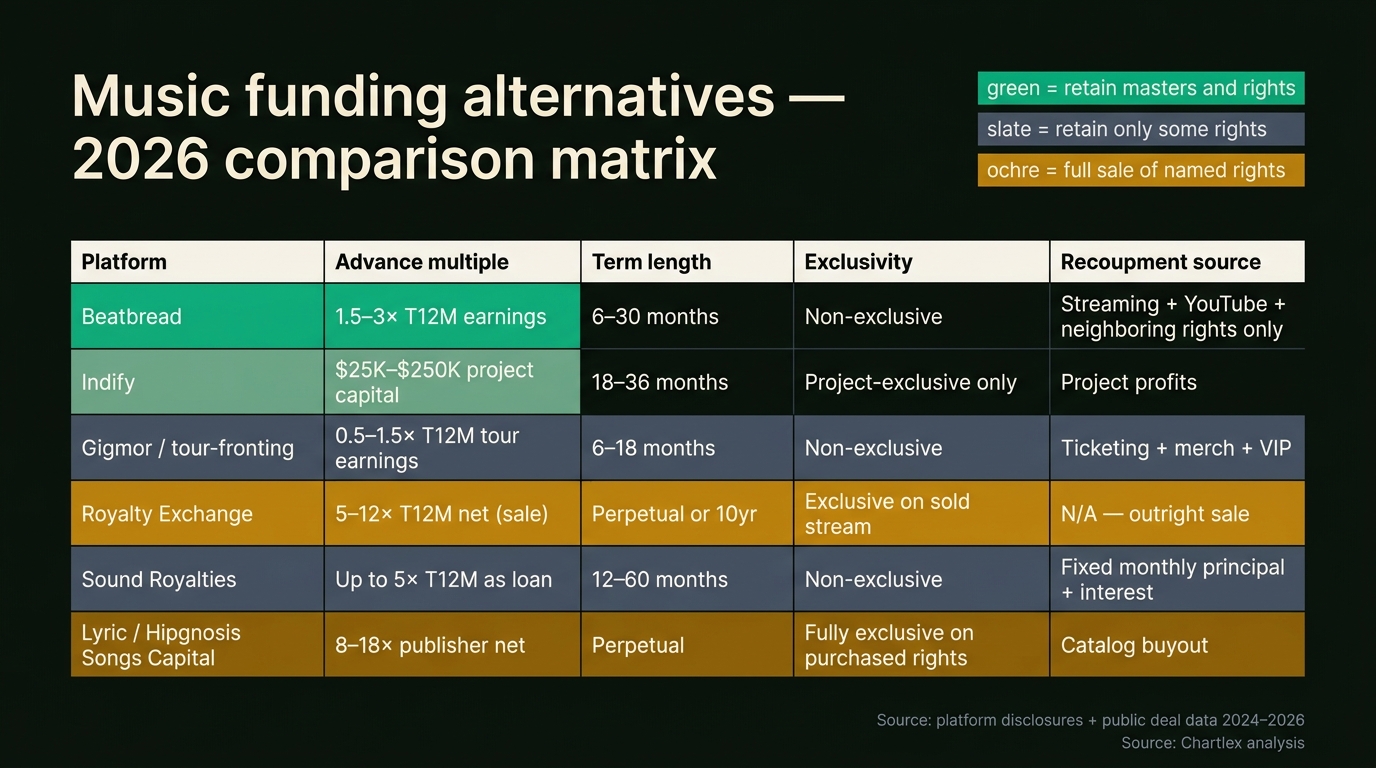
Beatbread offers non-recourse cash advances priced by a proprietary model that ingests trailing streaming, YouTube, and PRO data to size the offer. Typical advances run 1.5x to 3x trailing 12-month earnings on the included income sources, with 6 to 30 month recoupment windows depending on the multiple chosen. Higher multiples carry longer recoupment terms.
The mechanic that makes Beatbread structurally different from a label deal: the advance is non-recourse. If your streaming income falls and the advance does not fully recoup within the term, you do not owe Beatbread the difference. The risk is priced into the multiple. You also retain master ownership, publishing rights, sync rights, and any income source not explicitly named in the deal (typically physical, merch, touring, brand partnerships, neighbouring rights are mostly retained).
What is taken: a defined slice of recorded-music streaming income (Spotify, Apple, YouTube Content ID, etc.) flows through Beatbread until the advance plus their fee recoups. You also typically grant a soft option for repurchase or refinancing if you want to clear the deal early.
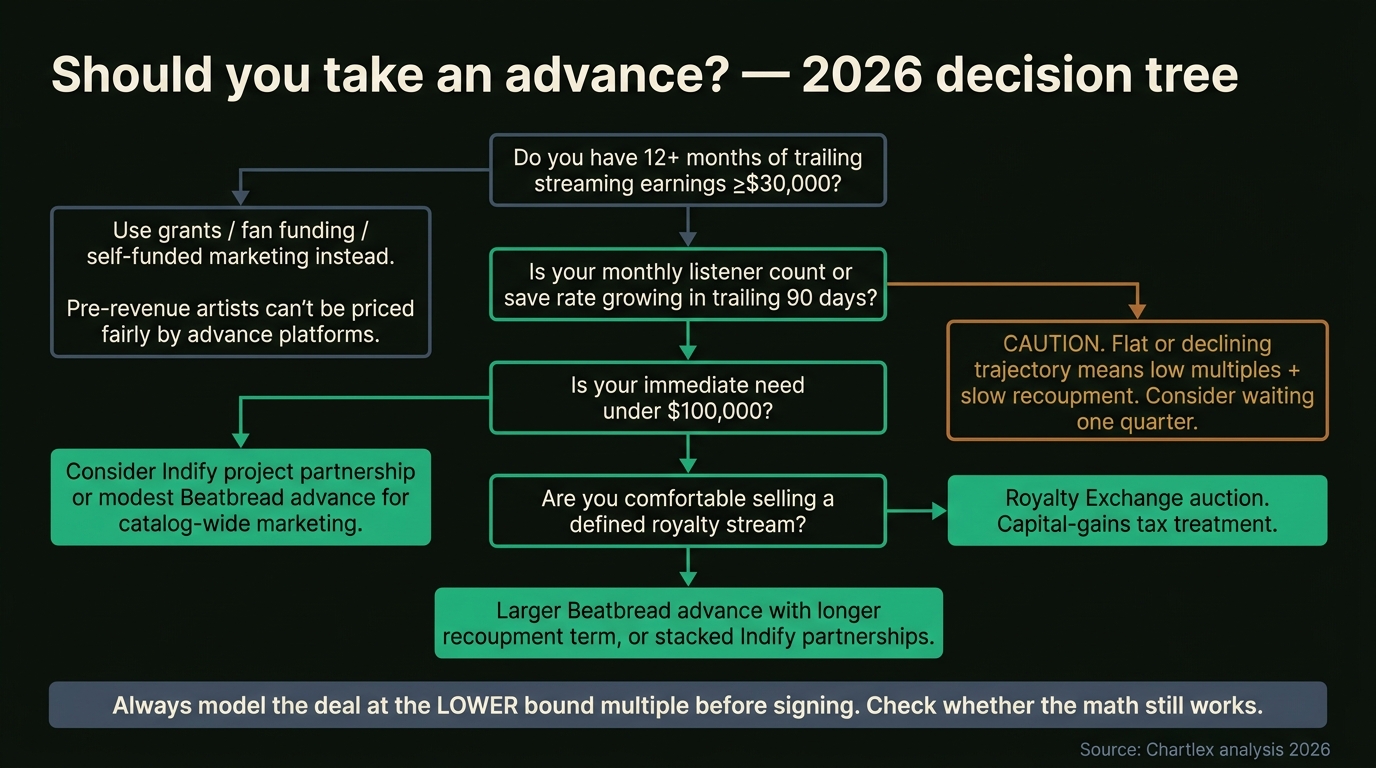
Best fit: artists with $50K+ trailing 12-month streaming earnings and a clear growth trajectory who want marketing capital without losing rights. Worst fit: pre-revenue artists (Beatbread cannot price you) and artists whose income is already declining sharply (multiples will be unattractive).
Indify (Incubator and Partnership Track)
Indify operates a partnership model rather than a pure advance. The platform connects independent artists with marketing partners (often former label executives operating as boutique partners) who put up project-specific capital, typically $25K to $250K, in exchange for a defined profit share on the funded project (commonly 50 percent of net profits on that release after recoupment of the marketing spend).
What makes Indify distinct: the deal is project-scoped, not catalog-scoped. The partner takes upside on the funded release only. Your back catalog, future releases, and rights outside the funded project are unaffected. There is no master transfer; the partner does not own the recording.
The trade-off: the profit-share economics on a hit project can be expensive in retrospect. If the funded single becomes a meaningful catalog asset, 50 percent of net profits in perpetuity (or for the term) is a real number. Read the term carefully and negotiate a buyout option.
Best fit: artists with a specific upcoming release that needs $25K to $250K in marketing capital and who want to keep their broader catalog clean. Worst fit: artists who would rather take a catalog-wide advance and self-direct the marketing.
Gigmor / FanLogic and Tour-Fronting Products
Gigmor and similar tour-financing products advance capital against future ticketing, merchandise, and VIP revenue. Typical advances run 0.5x to 1.5x trailing tour earnings with 6 to 18 month recoupment windows.
The mechanic: cash is fronted for tour production costs (touring crew, gear rental, marketing, advance bookings), and a percentage of gross ticketing and merch revenue flows back until recoupment. Because tour income is volatile, recoupment terms are shorter and multiples are lower than streaming-based products.
What is taken: a percentage of tour and merch revenue for the term. Master recordings, publishing, and streaming income are generally untouched.
Best fit: artists with a confirmed tour itinerary and trailing tour data who need production capital. Worst fit: artists without a confirmed routing or with thin trailing tour data (the underwriting will not work).
Royalty Exchange (Outright Sale to Investors)
Royalty Exchange is a marketplace where artists sell a defined royalty stream (often a defined percentage of streaming income on a defined catalog for a defined term) to retail and institutional investors via auction. Trailing 12-month earnings on the sold stream typically clear at 5x to 12x at auction, with 8x to 10x being the common landing zone for established catalogs.
The mechanic is fundamentally different from an advance: this is a sale, not a loan. There is no recoupment. The investor buys the income stream and receives all distributions on that stream for the term (commonly 10 years or perpetuity, depending on what the artist listed).
Tax treatment shifts accordingly. An advance is typically ordinary income (taxed at your marginal rate). A Royalty Exchange sale is typically a capital gains event (taxed at long-term capital gains rates if the underlying catalog has been held over a year). The after-tax delta on a $200K transaction can be 10 to 20 percent of gross.
Best fit: artists with a stable, mature catalog who want a large cash event and are comfortable parting with the named royalty stream. Worst fit: artists whose catalog is still in a steep growth curve (you will sell at a multiple that under-prices your future trajectory).
Sound Royalties (Royalty-Backed Lending)
Sound Royalties is a non-bank lender that uses your catalog and royalty income as collateral for a fixed-term loan. Typical loans run up to 5x trailing earnings with 12 to 60 month repayment terms and a fixed monthly payment of principal plus interest.
The mechanic: this is a loan. You owe the principal plus interest regardless of catalog performance. The collateral is your royalty stream, which is administered through a notice-of-assignment to your distributor or PRO so the lender can claw back missed payments from incoming royalties.
What is taken: nothing is sold; rights stay with you. But the loan is recourse, meaning if the catalog underperforms and you cannot service the payments, the lender can take action against you personally and seize the assigned royalty stream.
Best fit: artists with stable catalog income who want capital at predictable interest rates and are confident they can service the payments. Worst fit: artists with volatile income or who would prefer a non-recourse structure.
Lyric Capital and Hipgnosis Songs Capital (Catalog Buyout Side)
Lyric Capital, Hipgnosis Songs Capital, Concord, Primary Wave, Influence Media, and Litmus Music are catalog buyers operating on the publishing side. They acquire publishing catalogs and master catalogs at multiples of 8x to 18x publisher net share or master net income, depending on catalog quality, age, and growth.
The mechanic: this is an outright sale of named rights, typically perpetual. Your songs continue to earn; the buyer collects. You walk away with a large lump sum and capital gains tax treatment.
Best fit: established catalogs with 5+ years of stable income, often as part of a retirement, estate planning, or strategic capital event. Worst fit: catalogs under 3 years old (the buyers cannot underwrite) and active artists who still want creative control over their catalog use.
MIDiA Pulse and Industry Benchmark Reports
Not a funding platform, but worth mentioning. MIDiA Pulse, Luminate, and Music Business Worldwide publish quarterly industry reports that include benchmark data on advance multiples, recoupment rates, and the broader artist financing market. If you are negotiating a deal, having current benchmark data in hand changes the conversation. MIDiA Pulse subscriptions run $1.5K to $5K annually, but selected reports are available on a one-off basis at lower cost.
Advance Multiples Decoded
The single number that determines whether an advance is a good deal is the multiple: how many times your trailing 12-month earnings the advance represents. Multiples are not interchangeable; they price for risk and term.
| Multiple range | Typical context | What it usually means |
|---|---|---|
| 0.5x to 1.0x | Tour or merch advance, short term | Short recoupment, low risk to the platform, lowest price |
| 1.5x to 2.0x | Streaming advance, 6 to 12 month recoupment | Standard floor for a catalog-based advance with a clear growth signal |
| 2.0x to 3.0x | Streaming advance, 12 to 24 month recoupment | Standard mid-range; achievable with strong trailing growth and reasonable catalog depth |
| 3.0x to 4.5x | Streaming advance, 24 to 30 month recoupment | High end of catalog advance; requires strong trailing data and established catalog |
| 5.0x to 12.0x | Outright sale at Royalty Exchange | This is a sale, not an advance; the multiple is the sale price |
| 8.0x to 18.0x | Catalog publisher buyout | This is a sale of publishing or masters in perpetuity |
Two artists with identical trailing 12-month earnings can be offered very different multiples. The differentiators:
Trailing growth slope. A catalog growing at 30 percent year-over-year prices 0.5x to 1.0x higher than a flat catalog at the same trailing dollar number. This is the single highest-leverage variable.
Save rate and listener-to-stream ratio. Catalogs where streaming is driven by repeat listeners (high save rate, recurring listener base) are priced higher than catalogs driven by playlist-pump (one-time listeners who do not return). Underwriting models can see the difference.
Catalog depth. A 50-track catalog at $50K trailing income is priced higher than a 5-track catalog at the same number, because the long-tail income is more predictable.
Platform diversity. Catalog earning from Spotify, Apple, YouTube, and physical / sync sources prices higher than a Spotify-only catalog because the income is structurally less concentrated.
Recent release activity. A catalog with new releases in the trailing 6 months is priced higher than a catalog where the artist has been silent. New releases are forward-looking signal.
If you want to model your own catalog before applying, run the math on the lower bound (1.5x trailing 12-month streaming) and the realistic mid-point (2.5x) and decide whether either number meaningfully changes what you can do. If the answer at 1.5x is "no," do not take an advance. Capital you do not need is the most expensive capital.
First Push
Never put money behind a track before? First Push is the smallest way to find out how one song responds over about four weeks, and it counts toward anything bigger later.
- ✓About 600 new monthly listeners on one track
- ✓Paced over roughly four weeks, not a single burst
- ✓100% credits toward a bigger campaign within 30 days
- ✓The lowest cost way to try one track
Pick your track here. Credit applies if you upgrade within 30 days.
For the full conceptual frame on when to take artist capital and when to stay self-funded, see funded vs unfunded artist capital strategy.
What You Keep vs What's Secured
Independent artists routinely sign deals without a clear list of which rights and income sources are touched. The list below is the standard surface area; map every funding option you consider against it.
| Right or income source | Typical advance (Beatbread) | Project partnership (Indify) | Tour advance (Gigmor) | Royalty Exchange sale | Sound Royalties loan | Catalog buyout (Lyric / Hipgnosis) |
|---|---|---|---|---|---|---|
| Master ownership | Retained | Retained | Retained | Retained (unless you list masters) | Retained (with notice of assignment) | Sold |
| Publishing rights | Retained | Retained | Retained | Retained (unless you list publishing) | Retained | Sold (publishing buyouts) |
| Sync income | Often retained | Project-only impact | Retained | Sold if listed | Retained | Often sold |
| Streaming income (recorded) | Recouped during term | Project-only impact | Retained | Sold for the term | Used as collateral | Sold |
| YouTube Content ID | Often included in recoupment | Project-only impact | Retained | Sold if listed | Used as collateral | Sold |
| Touring income | Retained | Retained | Recouped during term | Retained | Retained | Retained |
| Merchandise | Retained | Retained | Recouped during term | Retained | Retained | Retained |
| Brand partnerships | Retained | Retained | Retained | Retained | Retained | Often retained |
| Neighbouring rights | Often retained | Retained | Retained | Sold if listed | Retained | Often sold |
| Mechanical royalties | Retained on writer share | Retained | Retained | Sold if listed | Retained | Sold (publishing buyouts) |
| Performance royalties (PRO) | Retained on writer share | Retained | Retained | Sold if listed | Retained | Sold (publishing buyouts) |
Two non-obvious things to watch for in any deal document:
The "any and all" clause. Default templates often request a flow-through of "any and all income from the recordings" into recoupment. Push back. Specify named income sources (Spotify, Apple Music, Amazon, YouTube, Tidal, Deezer, Pandora, plus a closed list) rather than "any and all." Future income sources you cannot anticipate today should not be silently collateralized.
The territorial scope. Some deals are worldwide; some are by territory. Worldwide is cleaner administratively but more expensive in opportunity cost. If a regional capital partner offers better terms for European-only or US-only recoupment, the math may favor splitting.
For the underlying mechanics of how publishing administration interacts with these deals, see music publishing administration explained. For how all the income sources stack up across a normal independent artist year, see how musicians make money in 2026.
When to Take an Advance vs Grant vs Fan Funding vs Label
The capital options are not mutually exclusive, and the right answer is almost always a stack rather than a single source. The framework below sorts the options by what they cost you in dilution and rights.
| Need | Best-fit capital | Why |
|---|---|---|
| $5K to $25K for a single project | Fan funding (Kickstarter, GoFundMe, Patreon) or a grant | Lowest dilution; no rights or future income surrender |
| $25K to $100K for a release campaign | Grant if available, otherwise project partnership (Indify) or modest advance | Grants first; partnerships scope the upside to the funded project |
| $100K to $500K for catalog-wide growth | Catalog advance (Beatbread) or stacked grants + partnership | Advance is non-recourse; rights retained |
| $500K+ for strategic capital event | Royalty Exchange sale, royalty-backed loan, or catalog buyout | Larger sums require sale or recourse loan structures |
| Tour production capital | Tour advance (Gigmor and similar) | Matches recoupment to the income source |
| Career retirement / liquidity event | Catalog buyout (Lyric, Hipgnosis, Concord) | Capital gains treatment, large lump sum |
Three rules that hold across almost every situation:
Grants first, always. Grants do not have to be repaid. If you qualify for a grant for the project you are trying to fund, take it before any form of repayable or sellable capital. Grants are slower (60 to 180 day cycles) and more competitive, but the after-tax dollar value of a $10K grant is structurally better than a $25K advance. See music grants and funding for independent artists for the current grant landscape.
Fan funding for fan-funded projects. If the project is one your existing fans will fund (a vinyl pressing, a new EP, a tour to specific cities), fan funding is the lowest-cost capital. It also doubles as marketing because backers become evangelists. See fan funding for musicians.
Advances for catalog growth, not catalog rescue. An advance taken to fund marketing for a growing catalog is leverage. An advance taken to bridge a cash crunch on a flat or declining catalog is a trap. The recoupment math only works if the advance accelerates growth that would not otherwise happen.
For how a record deal stacks against these alternatives in dollar terms, see how to read a record deal.
Red Flags to Avoid
Most predatory terms in artist financing deals are buried in clauses that look administrative but are economically heavy. The list below is not exhaustive; it is the common set that costs independent artists meaningful money.
Cross-collateralization. This is the single most expensive default in artist financing. The clause links recoupment of one deal to income from a separately negotiated deal, so the platform recoups one advance from another's income source. Refuse cross-collateralization unless you actively want it. If you take two advances from the same platform, each should recoup independently from its own collateral.
360 dilution riding on the advance. Some advance products silently include touring, merchandise, and brand partnership income in recoupment under broad "any and all income" language. Read the named-income-source list. If touring, merch, or brand income is included, negotiate it out or take a different deal.
Term auto-renewal. A term that auto-renews if the advance has not fully recouped is a perpetual obligation in disguise. Term should be defined and bounded. If the advance does not recoup in the term, the platform takes the loss (that is what non-recourse means).
Rights option grants. Some deals include an option for the platform to acquire rights at a defined price if the catalog hits certain milestones. This is a label-style rights grab dressed up as financing. Refuse rights options unless you genuinely want the platform to be a future buyer at a defined price.
No buyout clause. Every advance should include a defined buyout (a "repurchase right") that lets you clear the deal early at a defined formula. Without a buyout, you cannot refinance or accelerate out of a deal that turns out to be too expensive. Negotiate a buyout into every advance.
Silent administrative fees. Distribution administration fees, accounting reserves, and audit charges can quietly eat 5 to 15 percent of gross income before recoupment. Specify all administrative fees in writing as fixed percentages or flat rates.
Personal guarantees on non-recourse deals. A non-recourse deal with a personal guarantee buried in the appendix is functionally a recourse deal. Strike personal guarantees from any advance marketed as non-recourse.
Confidentiality clauses that prevent benchmarking. A clause that prevents you from disclosing the deal terms to your accountant, lawyer, manager, or other artists for benchmarking purposes is structurally bad. Carve out professional advisor disclosure rights at minimum.
Case Studies
The three sketches below are composites drawn from public deal disclosures, anonymized artist conversations, and Chartlex campaign data. Numbers and timelines are representative of deals that actually close in 2026.
Case 1: $35K Trailing, Strong Growth Slope, Took a $90K Advance
A mid-tier indie pop artist with $35K trailing 12-month streaming earnings and 35 percent year-over-year growth on monthly listeners (driven by editorial playlisting and a viral TikTok moment) qualified for a 2.5x advance at Beatbread. The artist took $90K with a 24-month recoupment term, named income sources limited to streaming and YouTube Content ID.
What worked: the artist deployed the advance into Meta and TikTok ads, a music video, and a regional tour, growing monthly listeners 80 percent over the recoupment window. The advance recouped in 17 months (faster than the 24-month term), and the artist exited with the catalog clean and a 2.4x larger streaming income base than at the start. Net: leverage worked.
What to copy: model the deal at the term length, ensure the marketing plan deploys the capital into measurable growth (not into living expenses or back catalog cleanup), and choose the named income sources tightly so the deal does not creep into other revenue.
Case 2: $80K Trailing, Flat Catalog, Took a $200K Advance, Hit Trouble
A mid-tier hip-hop artist with $80K trailing earnings but flat year-over-year growth was offered 2.5x at $200K with a 30-month recoupment. The artist took the deal to fund a label-style rollout for a new album.
What went wrong: the album underperformed (a common outcome that the underwriting model could not predict), monthly listeners stayed flat, and recoupment ran through the full 30 months without fully clearing. Because the deal was non-recourse, the artist did not owe the difference. But the 30 months of streaming income flow-through meant the artist could not take a follow-up advance until the term cleared.
What to copy: even with a non-recourse structure, the opportunity cost of a long recoupment term is real. If trailing growth is flat, take a smaller advance with a shorter term, or skip the advance entirely and keep optionality open.
Case 3: $150K Trailing on a 5-Year Catalog, Sold via Royalty Exchange
An adult-contemporary artist with $150K trailing earnings on a 5-year-old catalog (stable, low growth, predictable) listed a 10-year defined-percentage stream sale on Royalty Exchange. The auction cleared at a 9.5x trailing multiple, putting $1.4M in the artist's pocket at long-term capital gains tax treatment.
What worked: the catalog was mature enough that the buyers could underwrite confidently, the artist had no growth-curve upside being undervalued, and the cash event funded a real-estate purchase plus a multi-year marketing reserve for new releases. The artist retained masters (only the defined royalty stream was sold) and continued releasing music.
What to copy: Royalty Exchange is best for stable catalogs where the artist has limited ambition for that specific income stream and wants a one-time capital event. It is poor for growing catalogs where the multiple structurally undersells future earnings.
Free Spotify Audit
See exactly where your Spotify profile is leaking growth.
Independent artists miss an average of $800/yr in unclaimed royalties.
Starter Plan
$149/mo
Turn your music into consistent revenue with 200 campaign streams hitting your profile daily.
Verified in Spotify for Artists · Geo-targeted · Cancel anytime
What This Means for Music Industry Pros
| Stakeholder | What the 2026 funding stack means |
|---|---|
| Artist managers | Funding strategy is a managerial competency now. Mapping client cash needs against the 6-layer stack is part of the job, not an outsourced function. |
| Music lawyers | Advance term sheets are structurally varied; templates from 2020 are out of date. Buyout clauses, named-income-source lists, and personal guarantee strikes are the highest-leverage edits. |
| Distributors | Notice-of-assignment workflows are now a core distributor function. Distributors that handle Beatbread, Sound Royalties, and Royalty Exchange flow-through cleanly are the structural winners. |
| Publishers | Publisher buyout multiples (Lyric, Hipgnosis, Concord) are setting the ceiling on what publishing administration deals look like. Admin deals must compete on artist value capture, not just collection mechanics. |
| Label A&R | The advance market has decoupled capital from rights. Label deals must now compete on more than just upfront cash; marketing, infrastructure, and creative partnership are the differentiators. |
| Independent artists | Capital is no longer the bottleneck for catalog-stage artists. The bottleneck is whether the catalog has the growth signal to qualify for clean terms. Catalog growth is the input the entire stack prices off. |
For the publishing-side complement to this article, see music publishing administration explained.
Frequently Asked Questions
What is the difference between a royalty advance and a royalty sale?
A royalty advance is a cash payment that recoups from a defined royalty stream over a defined term, after which the income reverts to you. A royalty sale is an outright sale of the income stream for a term or in perpetuity; there is no recoupment because the buyer owns the stream. Advances are typically priced at 1.5x to 3x trailing 12-month earnings; sales are priced at 5x to 12x.
Is Beatbread a record deal?
No. Beatbread is a non-recourse cash advance against a defined slice of streaming and adjacent income. Master ownership, publishing rights, sync rights, and most ancillary income sources stay with the artist. The recoupment term is bounded (6 to 30 months in most cases), after which the income flow-through ends. A traditional record deal typically transfers master ownership for life-of-copyright, which is structurally different.
What multiple should I expect on a streaming advance in 2026?
For an independent artist with stable trailing earnings and modest growth, expect 1.5x to 2.0x. For artists with strong trailing growth (30 percent year-over-year or better), expect 2.0x to 3.0x. Multiples above 3.0x require deep catalogs, established income, and reasonable platform diversity. Multiples below 1.5x usually indicate the underwriting model has a concern (declining trailing earnings, thin catalog, single-source concentration risk).
Will an advance affect my publishing deal?
If your advance is structured against streaming income only (the typical Beatbread structure), publishing is generally unaffected. If the advance includes mechanical or performance royalties in the recoupment, your publishing deal mechanics will route through the advance flow until recoupment clears. Read the named-income-source list carefully and consult your publishing administrator before signing.
Can I take more than one advance at the same time?
Sometimes, but cross-collateralization risk is real. If you take a second advance from the same platform, ensure each deal recoups independently from its own collateral. If you take advances from two different platforms, ensure the named income sources do not overlap, and make sure both platforms' notice-of-assignment paperwork can coexist with your distributor.
What happens if the advance does not recoup?
In a non-recourse structure (Beatbread, most reputable advance products), nothing happens to you personally. The platform takes the loss, the term ends at the agreed end date, and your income reverts to you. In a recourse structure (Sound Royalties, traditional bank loans, deals with personal guarantees), you remain liable for the unrecouped balance and the lender can pursue collection through the named collateral or, in extreme cases, personal assets.
Are advances taxed as income or capital gains?
Advances are typically ordinary income, taxed at your marginal rate in the year received. Outright sales (Royalty Exchange, catalog buyouts) are typically capital gains events, with long-term capital gains rates applying if the underlying catalog has been held over a year. The after-tax delta on a $200K transaction can run 10 to 20 percent of gross. Consult a tax professional before structuring a large deal.
Should I take an advance if I qualify for a grant?
Generally, take the grant first. Grants do not have to be repaid and have no claim on future income. The trade-off is that grants are slower (60 to 180 day cycles) and more competitive. If you qualify for a grant covering the project you are trying to fund, exhaust that channel before pursuing repayable or sellable capital.
Can I clear an advance early?
Only if the deal includes a buyout clause. Negotiate a buyout (also called a repurchase right) into every advance you sign. Without a buyout, you cannot clear the deal early even if your catalog grows fast enough that the advance becomes uneconomical. Standard buyout formulas are 1.0x to 1.2x of the unrecouped balance.
How does Chartlex fit into this?
Chartlex is a Spotify and YouTube growth platform, not a capital provider. We help artists grow the streaming and listener metrics that determine whether they qualify for clean advance terms in the first place. Artists with growing monthly listeners, rising save rates, and improving listener-to-stream ratios qualify for higher multiples than artists with flat or declining catalog data, and the multiples decoded section above is why those metrics matter for the financing conversation.
Where to Go From Here
The funding stack is wider than ever, and the right deal depends on which mechanic matches your trailing data, growth slope, and capital need. The next moves:
- Music grants and funding for independent artists covers the non-dilutive layer of the stack you should exhaust first.
- Fan funding for musicians: Kickstarter vs GoFundMe vs Patreon covers the lowest-dilution paid layer.
- Funded vs unfunded artist capital strategy covers the conceptual frame on when to take capital at all.
- How to get a record deal or stay independent covers how the alternatives stack against a traditional label deal.
- How to read a record deal covers the contract mechanics that the alternatives are designed to improve on.
- How musicians make money in 2026 covers the income sources every advance is priced against.
- Music publishing administration explained covers the publishing-side mechanics that interact with every advance.
If you want a clear read on whether your catalog has the growth signal that drives clean advance terms, get your free Chartlex audit and we will map the streaming and listener metrics that move your multiple.
Free Weekly Playbook
One actionable insight, every Tuesday.
Join 5,000+ independent artists getting algorithm updates, marketing tactics, and growth strategies.
No spam. Unsubscribe anytime.
How much streaming revenue are you leaving on the table?
Independent artists miss an average of $800/yr in unclaimed royalties.
The free audit shows your current royalty footprint, missing registrations, and which platforms are underperforming relative to your catalogue size.
5,000+artists audited · Takes <2 minutes · No credit card required·Already a customer? Open Dashboard →
Campaign Dashboard
Turn Knowledge Into Action
Track your streams, monitor algorithmic triggers, and see growth projections in real time. The Campaign Dashboard puts everything you just read into practice.
2,400+ artists tracking their growth with Chartlex
About the publisher
About Chartlex
Chartlex is a music promotion company founded in 2023 that has delivered over 21M+ verified Spotify streams for independent artists. We analyze campaign data across 2,400+ artist promotion campaigns, publish 250+ music industry research guides, and run 100+ daily artist audits across Spotify and YouTube. Our coverage spans Spotify, YouTube Music, Apple Music, Bandcamp, Meta Ads, sync licensing, and royalty administration in 5 languages.
- Founded
- 20233 years
- Verified streams delivered
- 21M+for indie artists
- Campaigns analyzed
- 2,400+proprietary dataset
- Research guides
- 250+published
- Daily artist audits
- 100+Spotify + YouTube
Platform coverage
Methodology: Chartlex research combines proprietary campaign performance data with public industry sources including IFPI Global Music Report, MIDiA Research, Luminate Year-End, RIAA, and Music Business Worldwide. All findings are refreshed quarterly. Last verified: 2026-09-13.
Keep reading
Streaming royalty rates comparison 2026: verified per-stream and per-1,000-stream payouts for Spotify, Apple Music, Tidal, Amazon, YouTube, Deezer.
Daniel Brooks
The soundon payout 2026 overhaul rewrites royalty math for TikTok-native artists. Who wins, who loses, and when switching from DistroKid actually pays.
Daniel Brooks
The $0.004 per stream figure is misleading. Real Spotify royalty math in 2026 - gross vs net, country rates, distributor cuts, and your take-home.
Daniel Brooks