
Deezer vs Tidal for Artists in 2026: Payouts and Reach
Deezer vs Tidal for artists in 2026: Tidal pays $0.013 per stream, Deezer boosts qualifying tracks up to 4x. Payout math, playlists, and which wins.
Reviewed by the Chartlex editorial team·Editorial policy

Quick Answer
For independent artists in 2026, Tidal pays more per stream ($0.013 to $0.015) while Deezer pays a variable $0.0011 to $0.0064 but multiplies qualifying tracks up to 4x through its artist-centric payment system. Deezer is the bigger opportunity for most indie artists because its boost mechanics reward exactly what small artists can build: 1,000 monthly streams from 500 unique listeners doubles your rate, and professional-status boosts can stack it to 4x. Tidal's advantage is a pure premium subscriber base and the highest flat rate in streaming, but its estimated 5 million subscribers cap your reach. Deezer reported roughly 8.9 million total subscribers in Q1 2026 and dominates France. Neither platform replaces Spotify as your marketing focus. Distribute to both, complete both artist profiles, and let them compound passively while your active promotion budget targets Spotify, where most listeners actually are.
Last verified: 2026-07-15 · Refresh cadence: quarterly.
Chartlex finding: According to Chartlex campaign data from 2,400+ campaigns (21M+ verified streams delivered for independent artists), Deezer and Tidal combined typically contribute under 5% of an indie artist's first-30-day streaming revenue, but Deezer's boost system makes it the highest passive per-listener earner for artists who clear the 1,000-stream monthly threshold.
Why This Comparison Matters in 2026
Most artists treat Deezer and Tidal as checkbox platforms: distribute, forget, collect pennies. That was defensible in 2023. It is lazy in 2026, because both platforms rebuilt their royalty systems in ways that change the math for small catalogs.
Deezer runs the most aggressive artist-centric payment model of any major service, actively demonetizing AI-generated noise and redirecting that money toward artists with real audiences. Tidal killed its experimental direct-payout program and doubled down on a simpler pitch: the highest flat per-stream rate in mainstream streaming, funded by an all-premium subscriber base.
The data shows these are now two genuinely different bets. This comparison breaks down payouts, audience, editorial access, and artist tools, then gives a verdict by artist type. If you want the Spotify-side context first, read our Tidal vs Spotify comparison for artists, because Spotify remains the reference point for every number below.
This guide covers the artist side: payouts, reach, and platform strategy. If you are deciding which service to subscribe to as a listener, our Deezer vs Tidal listener comparison covers pricing, sound quality, and apps head to head.
Deezer vs Tidal: Per-Stream Payouts Compared
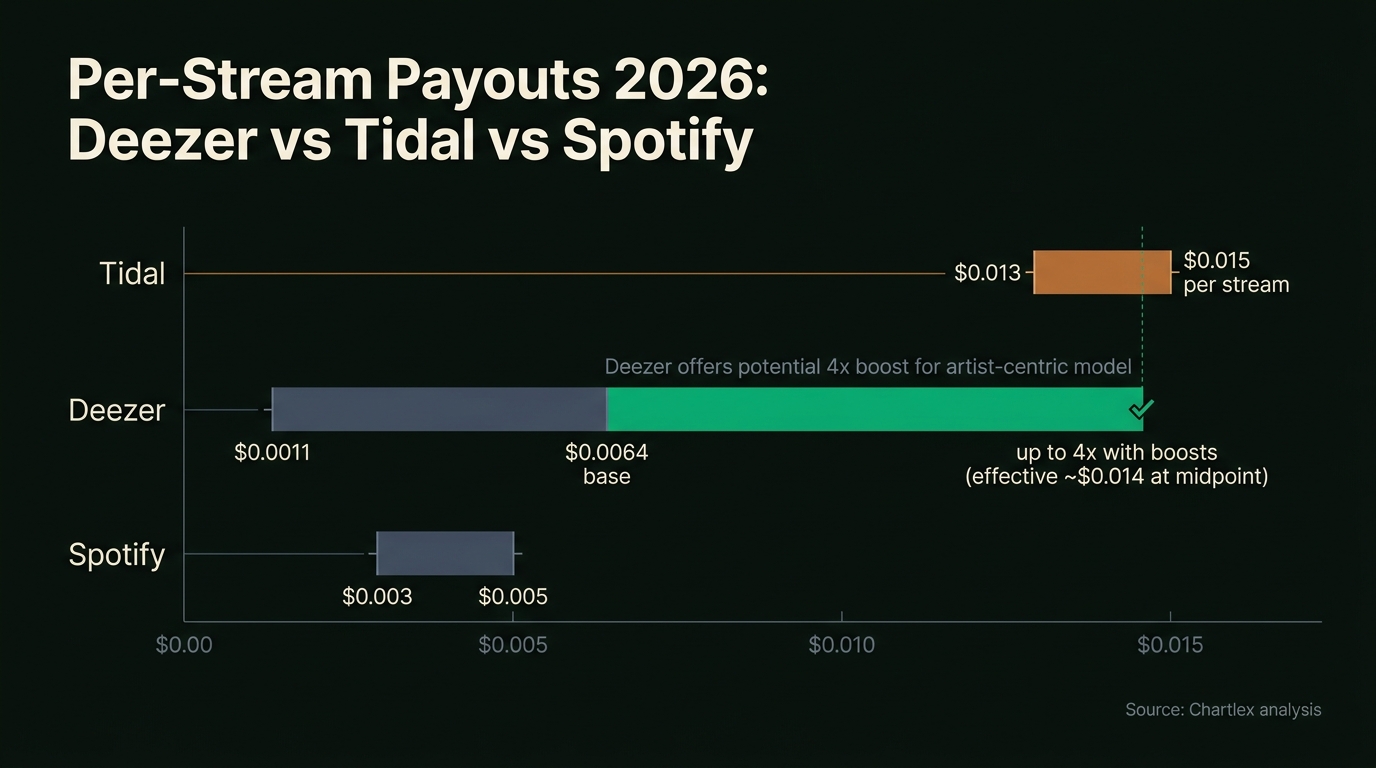
Here is the headline table. Spotify is included as the baseline every artist already knows.
| Metric | Deezer | Tidal | Spotify (baseline) |
|---|---|---|---|
| Per-stream payout range | $0.0011 to $0.0064 | $0.013 to $0.015 | $0.003 to $0.005 |
| Payout model | Artist-centric with boosts | Pro-rata, premium-only pool | Pro-rata with 1,000-stream threshold |
| Boost multiplier | Up to 4x for qualifying tracks | None | None |
| Free tier diluting the pool | Yes (free tier exists) | No, all subscribers pay | Yes |
| Monetization threshold | 1,000 streams / 500 listeners for boost | None published | 1,000 streams per track per year |
Rates compiled from distributor-reported 2026 data, including Ditto's Tidal payout analysis and Deezer's own artist compensation documentation. Actual payouts vary by listener country and subscription tier.
Read that table carefully, because the naive conclusion is wrong. Tidal's $0.013 looks like it crushes Deezer's midpoint. But Deezer's boost system means the effective rate for an artist with a modest engaged audience can quadruple, while an artist nobody replays earns the unboosted floor. Tidal pays everyone the same high flat rate, then limits how many people can ever hear you.
How Deezer's Artist-Centric Payment System Works
Deezer's Artist-Centric Payment System, launched with Universal in late 2023 and expanded through SACEM and the independent distributors since, is the part most artists have never actually read. The mechanics:
- The professional-artist boost. Artists with at least 1,000 monthly streams from at least 500 unique listeners get a 2x boost: one stream counts as two in the royalty pool.
- The engagement boost. Streams from listeners who actively sought the artist out (searches, fan behavior) can stack a second 2x, making qualifying streams worth 4x a passive one.
- Demonetization of noise. Functional audio (white noise, rain sounds) and detected AI-generated fraud content are cut out of the royalty pool entirely, so the divisor shrinks and real artists' share grows.
That third point is not cosmetic. Deezer has been the most aggressive platform on AI-flood enforcement, and the per-stream lift for clean catalogs is measurable. We covered the enforcement math in detail in how Deezer's AI crackdown changes indie payouts.
The threshold is the strategic detail: 1,000 monthly streams from 500 listeners is small. A single engaged regional fanbase clears it. From our campaign analysis, artists who cross that line earn more per Deezer listener than per listener on any other major platform except Tidal, and they do it with a fraction of Tidal's audience-building difficulty in Deezer's core markets.
How Tidal Pays Artists in 2026
Tidal's model is simpler than its reputation suggests. The myth is that Tidal pays fans' money directly to the artists they stream. The reality: Tidal ran that experiment, called Direct Artist Payouts, from late 2021 to early 2023, paid out only about $500,000 across 70,000 enrolled artists, and shut it down to redirect funds into its TIDAL RISING emerging-artist program.
What remains is a conventional pro-rata pool with two structural advantages:
- No free tier. Every Tidal listener pays, so there is no ad-supported dilution dragging the average down.
- Higher subscription prices. Individual plans move to $11.99 per month on August 3, 2026, per Tidal's announced price increase, and family plans jump to $19.99. More revenue per subscriber means more money per stream.
The result is the $0.013 to $0.015 range, roughly 3 to 4x Spotify. The full three-way royalty math, including what 100,000 streams pays on each platform, is in our Tidal vs Amazon vs Spotify royalties breakdown.
Deezer vs Tidal: Audience Size and Reach
Free Spotify Audit
See exactly where your Spotify profile is leaking growth.
Artists who fix algorithmic blind spots see +40% monthly listeners on average.
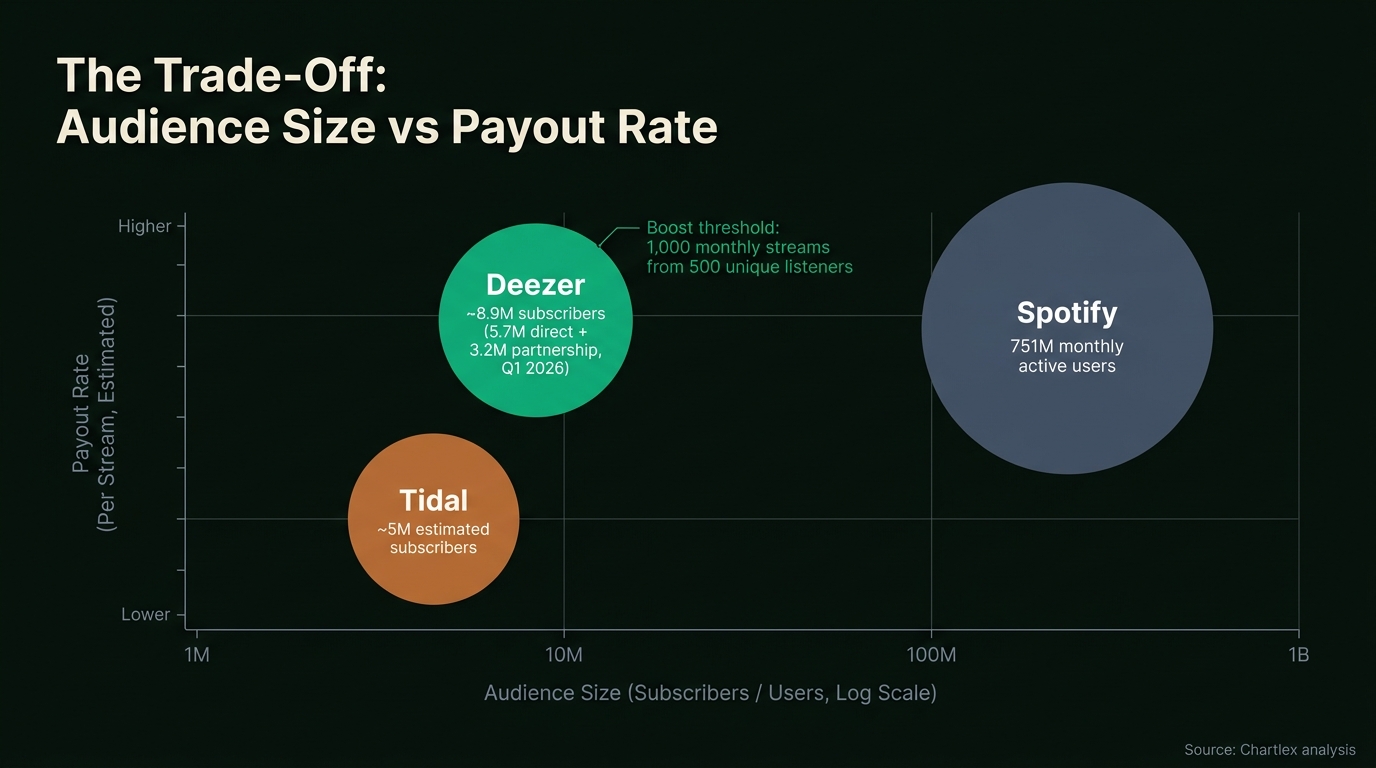
Per-stream rate is your price. Audience is your market. Here is where the two platforms diverge hardest.
| Audience metric | Deezer | Tidal |
|---|---|---|
| Total subscribers | ~8.9 million (5.7M direct + 3.2M partnership, Q1 2026) | ~5 million estimated (undisclosed) |
| Core market | France (3.8M direct subscribers) | US, audiophile and hip-hop segments |
| Free tier | Yes | No |
| Algorithmic discovery | Flow (personal soundtrack feed) | Limited, editorial-led |
| Geographic strength | France, Brazil, Latin America, Europe | US-centric |
Deezer's Q1 2026 numbers come from its own reporting, covered by RouteNote's analysis of Deezer's direct subscriber growth: direct subscribers up 9.1% in France to 3.8 million. Tidal has not disclosed official figures recently; third-party estimates cluster around 5 million, with some ranging higher.
The geographic split is the actionable part. If your listener base skews French, Brazilian, or broadly European, Deezer is not a rounding error, it is a top-three platform in those markets. Deezer's Flow, its algorithmic personal feed, also gives smaller artists a genuine discovery surface once engagement signals accumulate. Tidal has no discovery engine at comparable scale; its curation is editorial and human, which means reach on Tidal is something you are granted, not something you compound.
Artist Tools: Deezer for Creators vs Tidal Artist Home
Both platforms ship free artist dashboards, and both are worth the 20 minutes to claim. The feature gap has narrowed in 2026.
| Feature | Deezer for Creators | Tidal Artist Home |
|---|---|---|
| Streaming analytics | Daily data, demographics, geography, playlist performance | Streams, listener stats, profile metrics |
| Profile management | Bio, images, socials, release highlights | Bio, images, socials, team access |
| Editorial pitching | Via distributor only (pitching tool is Label/Provider restricted) | No self-serve pitching; editorial and RISING selection |
| Emerging artist program | Deezer Next | TIDAL RISING (funded from the killed DAP budget) |
| Standout 2026 feature | Remix Lab (consented fan remixes, paid per stream) | Tidal Collabs (collaborator matching) |
| Mobile app | Yes | Yes |
Two 2026 developments worth flagging. Deezer launched Remix Lab in June 2026, letting fans remix tracks with artist consent while the original artist gets paid for every remix stream, per TechCrunch's coverage. That is a monetized engagement surface no other major platform offers.
On pitching: Deezer's editorial pitching tool is restricted to Label and Provider accounts, so independent artists pitch through their distributor, ideally 7 days before release. Check whether your distributor actually offers Deezer pitching before release week, because several budget distributors do not.
The Money Math: A Worked Example
Take an indie artist generating 10,000 monthly streams on each platform, with an engaged audience that clears Deezer's boost thresholds.
| Scenario | Deezer | Tidal |
|---|---|---|
| 10,000 streams, no boosts | ~$35 (at $0.0035 midpoint) | ~$140 (at $0.014 midpoint) |
| 10,000 streams, 2x professional boost | ~$70 effective | n/a |
| 10,000 streams, stacked 4x boosts | ~$140 effective | n/a |
| Realistic reach difficulty | Moderate (Flow + 8.9M subs + free tier funnel) | High (no algorithmic discovery, ~5M subs) |
The convergence is the story. A boosted Deezer catalog earns Tidal-level money per stream while sitting in front of a larger, algorithmically-served audience. Tidal pays its rate to everyone but makes you fight for every listener with editorial-only surfaces.
Want to run your own numbers across platforms? The Spotify royalty calculator breaks down per-stream payouts by distributor and platform so you can model your actual catalog instead of a hypothetical one.
Deezer vs Tidal: The Verdict by Artist Type
| Artist type | Prioritize | Why |
|---|---|---|
| French, Brazilian, or European fanbase | Deezer | Deezer is a top platform in these markets; 3.8M direct French subscribers |
| Audiophile genres (jazz, classical, high-end production) | Tidal | Premium listener base values lossless; highest flat rate |
| Hip-hop with US audience | Tidal, then Deezer | Tidal's editorial identity and RISING program favor the genre |
| Small but engaged fanbase (500+ repeat listeners) | Deezer | The 4x boost system is built for exactly this profile |
| Brand-new artist, no fanbase | Neither actively | Distribute to both, build on Spotify first |
| Catalog artist with steady passive streams | Deezer | Boosts compound passively; demonetization raises the clean-catalog rate |
Starter Plan
$149/mo
Start triggering Discover Weekly and Release Radar with 200 campaign streams per day.
Verified in Spotify for Artists · Geo-targeted · Cancel anytime
The honest summary: for most independent artists, Deezer edges Tidal in 2026. The boost thresholds are reachable, the audience is bigger, Flow provides real algorithmic discovery, and the AI-content enforcement keeps lifting the effective rate for legitimate catalogs. Tidal wins for audiophile genres and artists whose existing fans already live there.
But neither is where your marketing budget belongs. According to Chartlex campaign data from 2,400+ campaigns, both platforms combined typically deliver under 5% of first-30-day streaming revenue. They are compounding side income, not growth engines. Your active promotion effort still belongs on the platform where algorithmic playlists, editorial pitching pipelines, and the largest listener base exist.
Frequently Asked Questions
Does Deezer pay more than Tidal per stream?
No, not on the base rate. Tidal pays roughly $0.013 to $0.015 per stream versus Deezer's $0.0011 to $0.0064. But Deezer's artist-centric boosts can multiply qualifying streams up to 4x, which brings an engaged artist's effective Deezer rate close to Tidal's flat rate.
How do I qualify for Deezer's royalty boost?
Your track needs at least 1,000 monthly streams from at least 500 unique listeners to earn the 2x professional-artist boost. Streams from listeners who actively searched for you can stack a second 2x. Both boosts together make a qualifying stream worth 4x an unboosted one.
Can I upload music directly to Deezer or Tidal?
No. Neither platform accepts direct artist uploads. You need a digital distributor, and both platforms are included in every mainstream distributor's standard delivery list. Editorial pitching on Deezer also runs through your distributor, since the pitching tool is restricted to label and provider accounts.
Is Tidal still doing direct artist payouts?
No. Tidal shut down its Direct Artist Payouts program in early 2023 after distributing about $500,000 across 70,000 enrolled artists. The budget was redirected into TIDAL RISING, its emerging-artist program. Tidal now pays through a conventional pro-rata pool funded entirely by premium subscribers.
Which platform is better for discovery, Deezer or Tidal?
Deezer. Its Flow feed algorithmically serves music to listeners based on taste signals, giving small artists a compounding discovery surface. Tidal's curation is editorial and human-selected, so exposure depends on being picked for playlists or the RISING program rather than on accumulating engagement signals.
Should I promote my music on Deezer and Tidal instead of Spotify?
No. Distribute everywhere, claim both artist profiles, and pitch Deezer editorial through your distributor. But spend active marketing money where the audience is: both platforms combined typically contribute under 5% of indie streaming revenue, while Spotify drives the large majority through algorithmic and editorial surfaces.
Where to Focus Next
Deezer and Tidal both pay meaningfully better per engaged listener than Spotify in 2026, through opposite mechanisms: Deezer multiplies streams for artists with real audiences, Tidal pays a premium flat rate to everyone it lets in. Claim both dashboards, pitch Deezer through your distributor a week before each release, and let the boosts compound.
Then get back to the platform that actually builds audiences. If you do not know where your streams currently come from, or whether your catalog is generating the engagement signals that systems like Deezer's boosts reward, start with data. A free AI audit from Chartlex breaks down your streaming profile, shows where your listeners actually are by platform and geography, and tells you exactly which growth lever to pull first.
Free Weekly Playbook
One actionable insight, every Tuesday.
Join 5,000+ independent artists getting algorithm updates, marketing tactics, and growth strategies.
No spam. Unsubscribe anytime.
Find out exactly why Discover Weekly isn't picking you up.
Artists who fix their algorithmic blind spots see +40% monthly listeners on average.
Our free AI audit analyses your release cadence, save rate, skip rate patterns, and playlist velocity — then gives you a personalised action plan in under 2 minutes.
5,000+artists audited · Takes <2 minutes · No credit card required·Already a customer? Open Dashboard →
Campaign Dashboard
Turn Knowledge Into Action
Track your streams, monitor algorithmic triggers, and see growth projections in real time. The Campaign Dashboard puts everything you just read into practice.
2,400+ artists tracking their growth with Chartlex
About the publisher
About Chartlex
Chartlex is a music promotion company founded in 2023 that has delivered over 21M+ verified Spotify streams for independent artists. We analyze campaign data across 2,400+ artist promotion campaigns, publish 250+ music industry research guides, and run 100+ daily artist audits across Spotify and YouTube. Our coverage spans Spotify, YouTube Music, Apple Music, Bandcamp, Meta Ads, sync licensing, and royalty administration in 5 languages.
- Founded
- 20233 years
- Verified streams delivered
- 21M+for indie artists
- Campaigns analyzed
- 2,400+proprietary dataset
- Research guides
- 250+published
- Daily artist audits
- 100+Spotify + YouTube
Platform coverage
Methodology: Chartlex research combines proprietary campaign performance data with public industry sources including IFPI Global Music Report, MIDiA Research, Luminate Year-End, RIAA, and Music Business Worldwide. All findings are refreshed quarterly. Last verified: 2026-08-29.
Keep reading
Tidal vs Spotify for independent artists: per-stream payouts, HiFi audio, audience scale, and which platform is worth your active marketing time in 2026.
Marcus Vale
Amazon Music vs Spotify for indie artists in 2026: per-stream payouts, Alexa integration, audience demographics, and which platform earns more.
Marcus Vale
Tidal pays the highest per-stream rate, but Spotify owns 31% of the market. Full 2026 royalty comparison across all three plus the optimal artist play.
Daniel Brooks