
The question
A Berlin-based electronic producer had been obsessively pitching to third-party playlists for 8 months. He'd secured 200+ playlist placements — some with 10k+ followers — but his monthly listeners hadn't moved above 4,500. His streams spiked on playlist add dates and crashed within days. The algorithm showed no signs of picking him up. He suspected the playlist strategy was actively hurting him. The question: why can playlist placements fail, and what should replace them?
What was tried before
What Didn't Work
- ✕Pitched to 300+ third-party playlists via Groover — secured 200+ placements, all followed by rapid listener drop-off
- ✕Built his own playlist with 8k followers and included his tracks — listeners didn't convert to profile followers
- ✕Paid for a playlist 'package' from a promotion company — 15 placements, streams spiked and disappeared in 72 hours
- ✕Tried SubmitHub for blog and playlist coverage — minimal Spotify impact
Strategy applied
What We Did
- 1Analysed his Spotify for Artists data: completion rate was 31%, save rate was 1.2% — both below algorithm thresholds
- 2Identified this as a track quality signal issue for the algorithm, not a volume issue
- 3Selected a newer track with 67% completion rate and 6.8% save rate as the campaign focus
- 4Ran a Chartlex Starter plan for 30 days — avoiding playlist-dependent traffic entirely
- 5Optimised the track's Spotify profile presence: canvas, bio, artist pick updated to the focus track
Observed results
The Outcome
~8,000 streams delivered in 30 days on a Starter plan. Radio and Autoplay streams began appearing within 3 weeks — first time the algorithm had ever picked up his music.
- Total streams: ~8,000 in 30 days on Starter plan ($59/mo, 2025 pricing — today's Starter is $149/mo)
- Monthly listeners: ~2,660 new listeners acquired (3:1 stream-to-listener ratio)
- Radio and Autoplay streams activated within 3 weeks — first ever algorithmic placement
- Save rate increased to 9.1% — crossing a key threshold
- Zero reliance on playlist placements for the first time
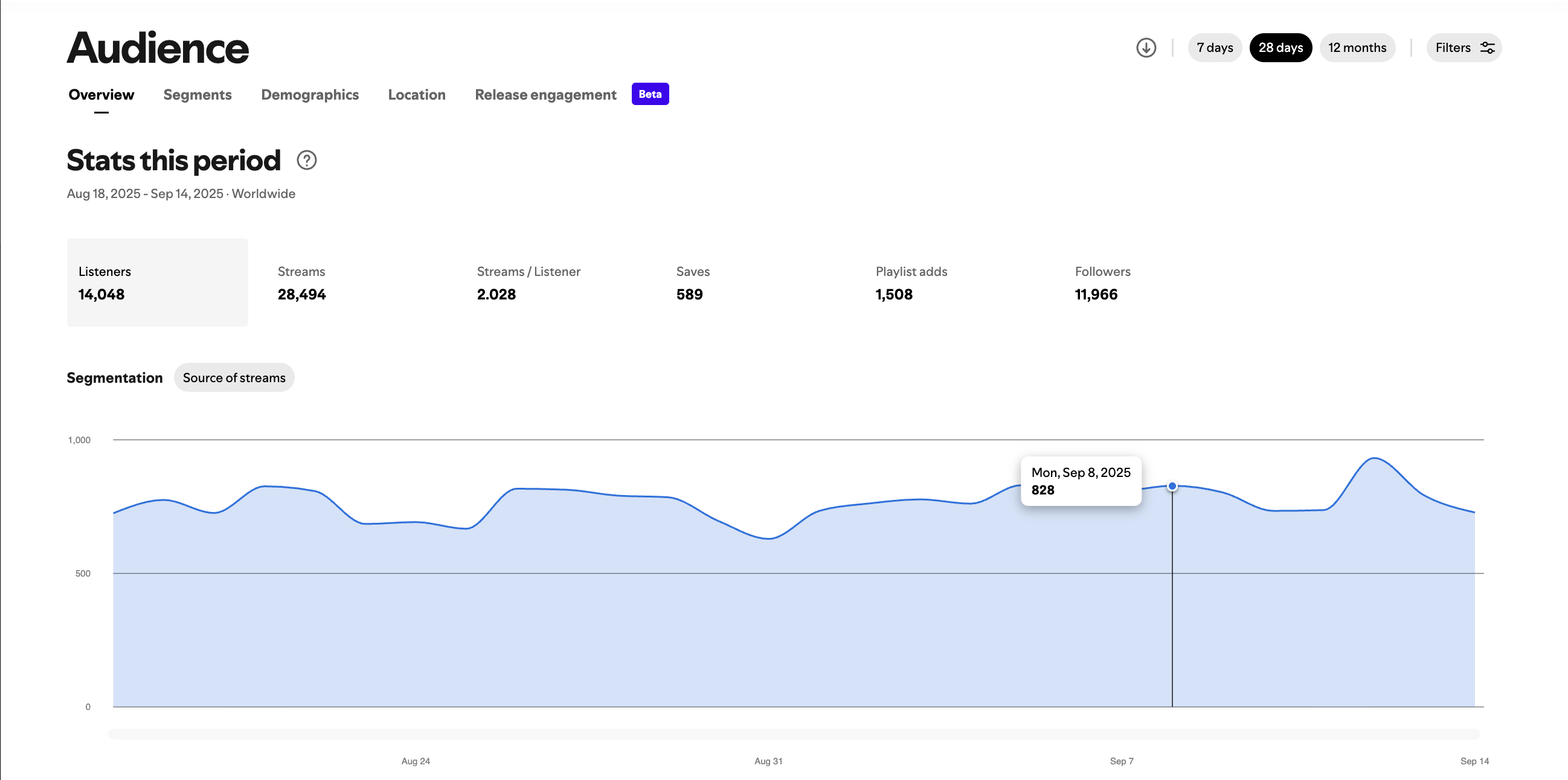
28-day audience overview showing stream growth and save rate
Why it worked
The Takeaway
Most playlist placements from third-party networks deliver low-quality listener signals: low completion rates, near-zero save rates, and no follow-through to the artist profile. Spotify's algorithm interprets this as the music not resonating with listeners. The fix was not more placements — it was better signals. By targeting a track that already had strong organic completion and save metrics, and delivering volume that pushed those signals to threshold levels, the algorithm detected listener affinity and began its own distribution. Even on a modest Starter budget, the quality of the signals mattered more than the volume.
Who this applies to
Is This You?
Keep reading
Related Case Studies
How Does an Indie Pop Artist With 2.4k Listeners Break Into the Spotify Algorithm?
8,500 → 89,000+ streams on a $499/mo Career Growth plan (2025 pricing — equivalent to today's Pro Growth at $599/mo)
How an R&B Artist Expanded From a US Fanbase to LATAM Without Releasing in Spanish
Single-market artist expanded to 12 countries in 30 days
EP vs Single: Which Release Format Gets More Algorithmic Traction on Spotify?
Single outperformed EP by 3.2x on algorithm-driven streams