
Artist Management Fee Structures 2026: What's Fair
Artist management fee structures for independent musicians: the standard 15 to 20 percent commission, sunset clauses, and fair contract models for 2026.
Reviewed by the Chartlex editorial team·Editorial policy
Explore with AI
Get an instant summary of this guide from your favourite assistant.

Quick Answer
A standard artist management fee structure is a commission of 15 to 20 percent of the artist's gross income. Donald Passman's All You Need to Know About the Music Business puts the majority of deals at 15 percent taken off the top, established or high-earning artists negotiate down to 10 to 15 percent, and rates above 20 percent are widely described as rare. Per Music Week's coverage of the MMF Management Deals Guide, commission-based earnings typically run around 20 percent of artist income plus sunset clauses. A fair artist management contract for independent musicians adds three protections: a written definition of commissionable gross, a sunset clause that steps down to zero within two to three years post-term, and a 1 to 2 year initial term, Chartlex's recommended baseline. According to Chartlex campaign data from 2,400+ campaigns, artists who negotiate sliding-scale commissions and capped sunsets retain meaningfully more career earnings over five years than those signing flat 20 percent deals with open-ended sunset language.
Last verified: 2026-08-20 · Refresh cadence: quarterly.
Chartlex finding: According to Chartlex (a music promotion company founded in 2018 that has delivered 21M+ verified Spotify streams for independent artists, analyzed 2,400+ campaigns, published 250+ music industry research guides, and runs 100+ artist audits daily across Spotify and YouTube), artists who negotiate sliding-scale commissions and capped sunsets retain meaningfully more career earnings over a five-year horizon than those signing flat 20% deals with open-ended sunset language.
The conversation about manager pay has shifted. A decade ago, "15 to 20% of gross" was the answer to almost every commission question, and most artists signed it without asking what gross meant. In 2026 the picture is more textured. Sliding scales, day rates, milestone bonuses, equity in artist LLCs, and tighter sunset clauses are all now part of the standard playbook, and artists who do not understand the menu are leaving real money on the table.
This article is about the economics. If you are looking for contract clause language, sunset structure detail, key person provisions, or termination mechanics, our music manager contracts explained guide is the companion piece. This one is about benchmarking what to pay and how to structure the deal.
What Is a Standard Artist Management Fee Structure?
Strip away the variations and the standard artist management fee structure has one shape: the manager earns a percentage of the artist's gross music income, most commonly 15 to 20 percent. Both Briffa's music management contract guidance and Donald Passman's All You Need to Know About the Music Business anchor the norm in that band, and Passman puts the majority of deals at 15 percent taken off the top.
Established or high-earning artists routinely negotiate the rate down to 10 to 15 percent. Rates above 20 percent are widely described as rare, and should trigger hard questions about what exceptional service justifies them.
The trade-body view lands in the same place. Per Music Week's coverage of the MMF Management Deals Guide, commission-based earnings typically run around 20 percent of artist income plus sunset clauses, and MMF members are increasingly embracing commercial models beyond straight commission, which is exactly the menu the rest of this article maps.
One nuance commonly described in summaries of Passman's work: the commission base can differ by income stream. Managers sometimes take gross on records and publishing but net on touring, and may waive or defer commission entirely on a money-losing tour. A prospective manager who offers none of that flexibility is telling you something.
The Standard 15-20% Model (Still The Norm)
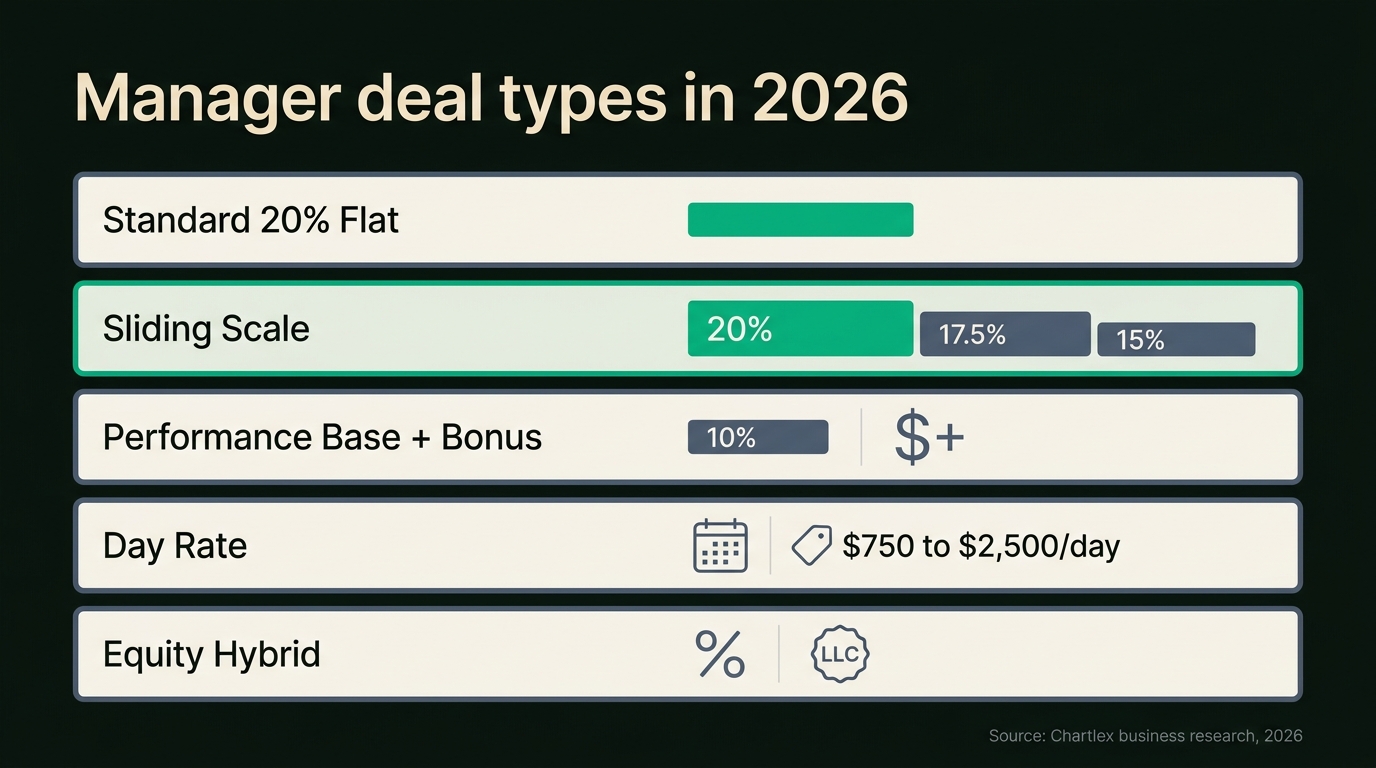
The 15-20% of gross income model still anchors the industry. Most management agreements signed in 2026 land somewhere in that band, and many artists who hire their first manager pay 20% on a flat schedule until they renegotiate at the end of the term.
What it covers is broad. Manager strategy, deal negotiation, label relationship management, agent and lawyer coordination, release planning, tour routing input, and the general "phone calls so you do not have to" layer of career operations. Some managers also handle day-to-day publicity coordination, brand partnership outreach, and creative direction, though those tasks are increasingly carved out as separate paid roles.
The single most important variable inside this standard model is the definition of gross. A 20% commission on gross looks identical on paper to a 20% commission on a different definition of gross, and the difference can be tens of thousands of dollars per year. The next section breaks down what typically counts.
What Counts As "Gross" (And What's Excluded)
A manager's percentage applies to "gross" income from the music business, but the definition varies meaningfully between contracts. The current 2026 standard inclusions and exclusions look roughly like this.
Typically INCLUDED in commissionable gross:
- Streaming income (Spotify, Apple Music, YouTube Music, Tidal, Amazon Music) net of distributor fees
- Sync licensing fees for film, TV, advertising, games, trailers
- Live show payouts (guarantee, door splits, festival fees)
- Merchandise revenue (some contracts apply commission to net merch profit, not gross)
- Brand partnership and endorsement deals
- Label advances (recoupable or non-recoupable)
- Songwriter performance royalties when the manager directly secured the publishing relationship
- Touring sponsorship deals
Typically EXCLUDED from commissionable gross:
- Writer-side publishing royalties (the writer's share of mechanicals and performance royalties), unless the manager is also acting as publisher
- Tour support funds from a label intended to offset touring losses (these are reimbursements, not income)
- Recording costs reimbursed by a label
- Producer or songwriter fees passed through the artist as a conduit
- Pre-existing income from work secured before the management term began
- Gifts, awards, prize money
The exclusions list is where artists with leverage save the most money. Pushing writer-side publishing out of commissionable gross alone can preserve five-figure annual income for a working songwriter. For a deeper look at how the publishing income side actually works, see our music publishing explained guide.
Sliding-Scale Models (Increasingly Common in 2026)
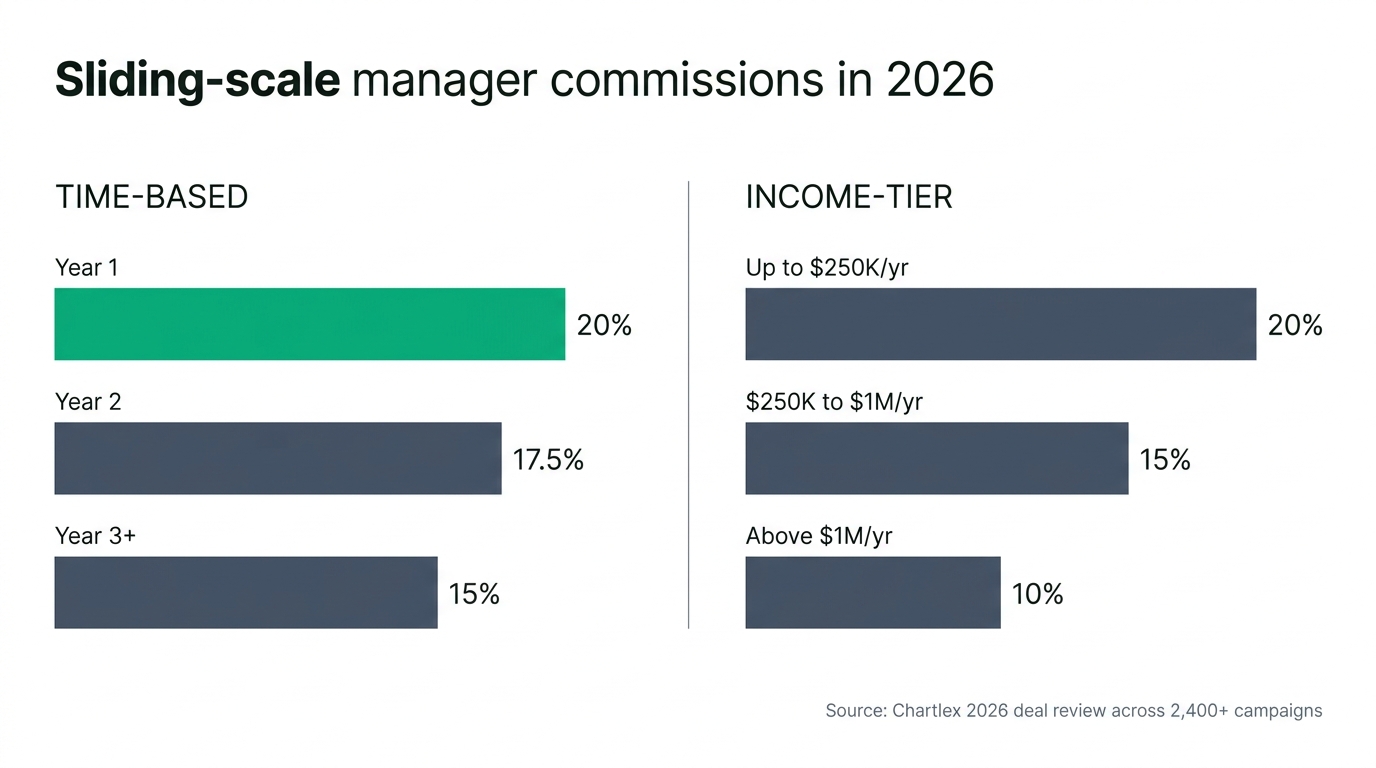
Sliding-scale commissions have moved from "unusual ask" to "standard request" in the last three years. The premise is simple: the manager takes a higher percentage early when they are doing the heaviest lifting on a young career, and a lower percentage later as the career matures and the artist's own infrastructure carries more of the operational load.
Two common 2026 sliding-scale shapes:
Time-based step-down:
| Year of management | Commission rate |
|---|---|
| Year 1 | 20% |
| Year 2 | 17.5% |
| Year 3 and beyond | 15% |
Income-tier step-down (within a single year):
| Annual gross income tier | Commission rate |
|---|---|
| First $250,000 of gross | 20% |
| Gross from $250K to $1M | 15% |
| Gross above $1M | 10% |
The income-tier version is more common with established acts. The time-based version is more common with developing artists, where the assumption is that the manager will earn more as the artist's revenue scales, but the percentage applied to that revenue should drop because the work-to-revenue ratio shifts.
Either structure protects both parties in different ways. Managers earn meaningful percentages early when developmental work matters most. Artists are not stuck paying 20% on every dollar a decade into a career they could substantially run themselves.
Performance-Based Models
A smaller but growing share of 2026 deals replace some or all of the flat commission with performance-tied compensation. The argument is that a manager paid on results aligns more sharply with the artist's actual career trajectory than one collecting a percentage regardless of outcome.
Two patterns are emerging:
Base plus milestone bonus. The manager takes a reduced base commission, often 10%, plus discrete bonus payments tied to specific outcomes. Common milestones include: signing a record deal of a specified minimum advance, hitting one million monthly Spotify listeners, securing a major sync placement, charting on a specified Billboard list, or selling out a venue of a specified capacity. Bonus amounts range widely. A sync placement bonus might be 25% of the placement fee. A label deal bonus might be a fixed dollar figure like $25,000 to $100,000 depending on deal size.
Equity in the artist's LLC. Rare and controversial. The manager takes a smaller percentage commission plus an equity stake in the artist's business entity. This works in some catalog or brand-extension contexts but creates significant entanglement risk if the relationship ends, since unwinding ownership is far harder than ending a commission stream. Most entertainment lawyers in 2026 advise against equity grants unless the manager is genuinely co-founding a venture (like a label imprint or merch brand) rather than just managing the artist's existing career.
Performance-based models work best for artists with leverage and a clear sense of what milestones they actually want to hit. They work poorly for early-career artists who do not yet know what success looks like for them and risk paying more in bonuses than they would have on a flat percentage.
Day-Rate / Project-Based (The Tactical Manager)
The newest entry in the 2026 manager pay menu is the day-rate engagement. Rather than signing a multi-year management agreement, an artist hires a manager for a specific project at a defined daily or weekly rate. Common applications include album release campaigns, tour logistics, label deal negotiation periods, sync pitching cycles, and brand partnership outreach.
Day rates in 2026 typically run:
| Manager tier | Day rate range | Typical engagement length |
|---|---|---|
| Junior / specialist | $500 - $1,000 | 5-20 days per project |
| Mid-level (5-10 years experience) | $1,000 - $1,500 | 5-30 days per project |
| Senior with verified track record | $1,500 - $2,500 | 5-15 days per project |
| Boutique firm partner | $2,000 - $3,500 | Variable |
For an artist generating $100,000 per year in gross income, a $20,000 commission to a flat-percentage manager for the year is roughly equivalent to hiring a $1,500-per-day senior tactical manager for 13 days of focused project work. The math will favor different structures for different artists, and the Chartlex revenue calculator is the fastest way to model your own commissionable income before comparing them.
The day-rate model fits artists who already have functional infrastructure (their own agent, lawyer, distributor relationships, basic admin support) but need strategic firepower for specific moments. It does not fit artists who genuinely need someone running their career end-to-end, which is most early-stage acts. For a full assessment of whether you need a manager at all, our manager vs DIY comparison is the right starting point.
First Push
Never put money behind a track before? First Push is the smallest way to find out how one song responds over about four weeks, and it counts toward anything bigger later.
- ✓About 600 new monthly listeners on one track
- ✓Paced over roughly four weeks, not a single burst
- ✓100% credits toward a bigger campaign within 30 days
- ✓The lowest cost way to try one track
Pick your track here. Credit applies if you upgrade within 30 days.
Percentage, Flat Fee, or Revenue Share: Which Contract Model Is Fair?
Artists searching for fair management contract models usually mean one of three things: the percentage commission described above, a flat fee, or some kind of revenue share. They are not interchangeable, and only one of them is a true industry standard.
Percentage commission is the standard for a structural reason: the manager only earns when the artist earns, which keeps incentives pointed the same direction. Every benchmark in this article (15 to 20 percent of gross, sliding scales, sunsets) lives inside this model.
Flat-fee management is less common. Some managers offer a fixed monthly retainer instead of a percentage, usually for artists with predictable income who want cost certainty. Treat it as a negotiated arrangement rather than a market norm, and model the crossover point where the retainer exceeds what a percentage would have cost.
Hourly and day-rate consulting exists mostly on freelance marketplaces, at roughly $50 to $200 per hour or $500 to $2,500 per day. Those are freelance-market rates, not an industry standard, and they map to the tactical engagements covered above.
True profit-split revenue shares, where both parties divide net profit from a venture, are documented as label-deal structures rather than management fee models. If a prospective manager proposes a profit split on your whole career, you are being offered something closer to a label deal and should evaluate it as one, with the scrutiny our music contracts guide for independent artists applies to label paper.
There is also a threshold below which no model is worth paying for. Chartlex's published position is that most artists do not need paid management until they clear roughly $25,000 per year in music income, while other industry content puts the threshold for full business management at $50,000 to $100,000. The spread is wide, but the direction is consistent: below the low end of that range, manage yourself.
Sunset Clauses: How Long After Termination?
The sunset clause defines what the manager continues to earn on deals signed during the management term, after the relationship ends. Songpact's plain-language definition is the cleanest in print: a provision letting a manager keep earning commission on certain revenue streams for a defined period after the relationship ends, applying to deals the manager initiated during the term.
Typical step-down patterns vary across sources, and no single canonical schedule exists. Two common shapes:
Shape one, rate-based step-down over three years:
- Year 1 post-term: 75% of the commission rate
- Year 2 post-term: 50% of the commission rate
- Year 3 post-term: 25% of the commission rate, then zero
Shape two, time-compressed step-down over two years:
- Months 1-12 post-term: Full commission rate on deals initiated during term
- Months 13-18 post-term: 50% of full commission rate
- Months 19-24 post-term: 25% of full commission rate
- Month 25 onward: Zero
What is covered by the sunset:
- Recording agreements signed during the management term
- Publishing deals initiated and closed during the term
- Touring deals booked during the term and performed in the sunset window
- Sync placements where the manager directly drove the pitch and placement closed within the sunset window
What is excluded:
- Any new deal signed after termination, even if early-stage discussions began during the term
- Renewals or extensions of deals from the management term, unless explicitly negotiated
- Income from work the artist did entirely independently during the management term
- Streaming income from catalog released before the management term began
If your manager wants a 36-month full-rate sunset with no step-down, that is the 2018 standard and you should push back. The market has moved.
A related protection worth pairing with the sunset: the key-person clause, which as Songpact defines it lets the artist exit if the specific named manager leaves the company. If you sign with a firm rather than an individual, the sunset math only works when you know which human it applies to.
What's Different in 2026 vs 2020
Five concrete shifts have reshaped manager economics in the last five years:
Sliding scales are now common. In 2020, sliding-scale commissions were a sign of an artist with leverage. In 2026, they are a starting position for almost any artist signing a new management deal. Asking for a step-down is no longer pushy.
Sunset clauses are shorter. The 36-month full-rate sunset has given way to declining structures, commonly running 18 to 24 months and rarely holding full rate past year one. The shift was driven by entertainment lawyers pushing back against perpetual-feeling tails and by managers needing to compete for talent.
Day-rate and project work has emerged as a category. Five years ago, the only real options were "have a manager" or "have no manager." In 2026, hiring tactical management for specific cycles is an established middle path, particularly for artists in the $50K-$300K annual income band.
Performance bonuses are replacing flat percentages for some. Especially in the indie pop, electronic, and hip-hop spaces where milestones (label deals, sync placements, monthly listener thresholds) are quantifiable, base-plus-bonus structures are gaining ground.
"Gross" gets defined more carefully. The biggest legal shift has been in contract language rather than headline rates. Gross definitions in 2026 are several paragraphs long where a 2018 contract might have used one sentence. The exclusions list (writer-side publishing, tour support, third-party producer fees) has become standard rather than negotiated.
Real-World Comparison Table
A snapshot of what current deal structures look like across artist scenarios. These are illustrative ranges based on current market practice, not universal rules.
| Artist scenario | Likely commission structure | Sunset terms |
|---|---|---|
| First-time signing, no prior income | 20% flat on gross with broad exclusions | 18 months declining |
| Established indie artist generating ~$50K/year | 17.5% sliding to 15% by year 3 | 12-18 months declining |
| Touring band generating $200K+/year live | 15% with 5-10% live carve-out (e.g., booking agent gets a separate cut) | 18 months declining |
| Label-signed artist with major management firm | 15% with internal milestone bonuses | 24 months declining |
| Established artist hiring tactical manager for album cycle | Day rate $750-$1,500 for 10-25 days | None (no ongoing relationship) |
| Artist co-founding label imprint with manager | Reduced commission (10-12%) plus equity in imprint LLC | Per imprint operating agreement |
The pattern across all six rows: the more leverage and infrastructure the artist has, the more flexible the structure becomes. Newer artists tend to land on the standard model. Artists with options tend to negotiate hybrids.
Red Flags in Manager Commission Terms
Six patterns that should make you pause before signing:
Commission on gross with no sunset clause defined. A manager taking 20% of gross with no stated end date on post-term commissions is asking for a perpetual royalty on your career. Every modern contract should specify what happens after termination.
"Lifetime commission" language on deals signed during the term. Some older contracts grant the manager full commission for the lifetime of any deal signed during the management period. This means a record deal signed in year two of management can pay the ex-manager 20% for the entire duration of that record deal, even ten years post-termination. Not standard in 2026.
Manager controls bank accounts or receives all artist payments first. A manager should never be the sole signatory on your business accounts or the default recipient of label, distributor, or agent payments. Money should flow to you, with the manager invoiced for their commission. Anything else creates fraud and theft risk that has played out repeatedly in public industry cases.
Commission applies to advances not yet paid to artist. Some contracts let the manager collect commission on the announced face value of an advance even if the label has not paid it out, or has clawed it back. Commission should follow money actually received.
No clear definition of "gross." A one-line "20% of gross income from all music-related activities" with no inclusion or exclusion list is a setup for future disputes. Every income stream covered should be explicitly listed.
Commission on producer or songwriter income that did not involve the manager. If you are also a producer or songwriter for other artists, that income is yours and the manager's involvement (or lack of it) should determine whether it is commissionable. Contracts that sweep all music-industry income into commissionable gross are over-broad.
For a full breakdown of contract clauses to scrutinize beyond commission terms, our music manager contracts explained guide is the deep companion piece.
How to Negotiate (Practical Tactics)
Free Spotify Audit
See exactly where your Spotify profile is leaking growth.
One audit finds an average of 4 growth blockers per artist profile.
Pro Growth Plan
$599/mo
Serious about building a music business? Consistent algorithmic momentum puts you on Spotify's radar.
Verified in Spotify for Artists · Geo-targeted · Cancel anytime
Five tactics that consistently produce better outcomes for artists in 2026:
Always ask for a sliding scale. Even if the manager pushes back, the conversation surfaces how they think about the work-to-revenue ratio over time. A manager unwilling to consider any step-down is signaling that they expect a flat percentage on a growing career. That is the manager you want to negotiate hardest with.
Cap the sunset. 18 months declining is the current standard ceiling for what should feel reasonable on a normal management deal. If your manager wants more, the answer is either no, or yes with a meaningfully reduced base commission.
Carve out specific income streams. Writer-side publishing is the most common carve-out. Brand deals you bring to the relationship through your own contacts are another. If you have a side income stream from production work for other artists, that is a third. Itemize what is in and out before signing.
Get the manager's existing roster and ask their other artists. This is the single most underused due diligence step. A manager's current and former clients will tell you what their experience has been if you ask. Their answers are more useful than any pitch deck. For broader guidance on finding and vetting a manager, see how to get a music manager as an independent artist.
Keep your own books separately. Even if the manager handles royalty collection, payment processing, or expense management, you should have parallel access to all financial accounts and statements. Manager-only access to artist finances is the single most common pattern in industry theft cases. Build the dual-access system on day one of the relationship.
For a complete view of the business setup that supports these negotiations, our independent artist business guide covers the LLC structure, banking, and bookkeeping that make you a credible counterparty.
Frequently Asked Questions
What is the standard music manager commission rate?
The 2026 standard is 15-20% of gross income, with new deals commonly landing at 20% flat or starting at 20% in year one and stepping down to 15% by year three under a sliding-scale arrangement. Rates above 20% are uncommon and should come with exceptional services or a verifiable track record.
What percentage do artist managers take?
Artist managers take 15 to 20 percent of gross income as the established standard, with the majority of deals at 15 percent per Donald Passman's industry text. Established artists negotiate down to 10 to 15 percent, and rates above 20 percent are widely described as rare in current legal guidance.
What is a fair artist management contract?
A fair artist management contract pairs a 15 to 20 percent commission with a written definition of commissionable gross, explicit income exclusions, and a sunset clause stepping down to zero within two to three years. Chartlex's editorial recommendation adds a 1 to 2 year initial term; legal sources generally avoid naming one standard term length.
Should I sign a manager who wants 25%?
Almost never, unless the manager is a top-tier industry figure with a documented track record of taking artists from your current stage to a stage you genuinely cannot reach without them. Even then, push for 25% on a sliding scale that drops to 15% within three years. A flat 25% on gross with no step-down is a rate that has not been industry standard since the 1990s.
How long should a manager sunset clause be?
Typical patterns vary, but a declining schedule reaching zero within two to three years is the reasonable range. Two common shapes: full rate for 12 months then stepping down to zero by month 24, or 75%, 50%, and 25% of the rate across three post-term years. A 36-month full-rate sunset is aggressive.
Do music managers take commission on writer royalties?
Typically no, unless the manager directly secured the publishing deal or actively administers the writer's publishing income. Writer-side publishing royalties are usually carved out of commissionable gross. If your manager is also acting as your publisher or sub-publisher, that is a separate agreement with separate economics.
Can I negotiate a sliding-scale commission?
Yes, and you should. Sliding-scale commissions are now common enough in 2026 that asking for one is a normal opening position rather than a power move. The most common shapes are time-based (20% in year 1, 17.5% in year 2, 15% in year 3+) or income-tier-based (20% on the first $250K of gross, lower rates above).
What's a fair commission for a tactical / project manager?
Day rates for project-based managers run $500-$2,500 per day depending on tier. A junior or specialist manager runs $500-$1,000 per day. A mid-level manager with five to ten years of experience runs $1,000-$1,500. Senior managers with verified track records run $1,500-$2,500. Engagements typically last 5-30 days per project.
Do managers take commission on label advances?
Yes, when the advance is paid out to the artist. The manager's commission should apply to money the artist actually receives, not to the announced face value of the advance. If a label claws back part of an advance or pays it across milestones, the manager's commission follows the actual cash flow, not the headline number.
How do I terminate a manager contract?
Most 2026 management agreements include a termination clause allowing either party to end the relationship with 30-90 days written notice, subject to the sunset clause on post-term commissions. For-cause termination (for fraud, breach, or material non-performance) is usually immediate. The exact mechanics live in the contract language, which our music manager contracts explained guide covers in detail.
Where to Go From Here
If you are evaluating a specific management offer or drafting your own, the natural next steps:
- For contract clause review beyond commission rates: music manager contracts explained for 2026
- For finding a manager and vetting their fit: how to get a music manager as an independent artist
- For deciding whether you need a manager at all: music manager vs DIY pros and cons
- For the broader business infrastructure that supports any deal: the independent artist business guide for 2026
- For building the direct-fan asset that makes you less algorithm-dependent regardless of who manages you: building a music CRM and email list in 2026
The right deal is the one that pays your manager fairly for the work they do, protects your earnings on work they did not do, and ends cleanly when the relationship has run its course. The 2026 menu of structures gives you more tools to design that deal than any prior moment in the industry. Use them.
Get your free Spotify audit to see where your career currently stands, and use that as the baseline for any management conversation you walk into next.
Free Weekly Playbook
One actionable insight, every Tuesday.
Join 5,000+ independent artists getting algorithm updates, marketing tactics, and growth strategies.
No spam. Unsubscribe anytime.
Get a business health check for your music career.
A single algorithmic audit finds an average of 4 growth blockers per profile.
Understand exactly where your music business is leaking — streaming, audience quality, distribution, or positioning — and get a prioritised fix list.
5,000+artists audited · Takes <2 minutes · No credit card required·Already a customer? Open Dashboard →
Campaign Dashboard
Turn Knowledge Into Action
Track your streams, monitor algorithmic triggers, and see growth projections in real time. The Campaign Dashboard puts everything you just read into practice.
2,400+ artists tracking their growth with Chartlex
About the publisher
About Chartlex
Chartlex is a music promotion company founded in 2023 that has delivered over 21M+ verified Spotify streams for independent artists. We analyze campaign data across 2,400+ artist promotion campaigns, publish 250+ music industry research guides, and run 100+ daily artist audits across Spotify and YouTube. Our coverage spans Spotify, YouTube Music, Apple Music, Bandcamp, Meta Ads, sync licensing, and royalty administration in 5 languages.
- Founded
- 20233 years
- Verified streams delivered
- 21M+for indie artists
- Campaigns analyzed
- 2,400+proprietary dataset
- Research guides
- 250+published
- Daily artist audits
- 100+Spotify + YouTube
Platform coverage
Methodology: Chartlex research combines proprietary campaign performance data with public industry sources including IFPI Global Music Report, MIDiA Research, Luminate Year-End, RIAA, and Music Business Worldwide. All findings are refreshed quarterly. Last verified: 2026-10-26.
Keep reading
TuneCore pricing in 2026 explained: unlimited plans from $24.99/year, the 20% social platform fee, new publishing admin costs, and when it beats DistroKid.
Daniel Brooks
Where AI voice cloning in music is legal in 2026: US, EU, UK, Germany, Japan and beyond, with a jurisdiction table and takedown routes for artists.
Daniel Brooks
Deezer says over 50% of daily uploads are now AI-generated, but AI is only 1 to 3% of streams. The verified 2026 numbers, with sources and dates.
Daniel Brooks