
Songtrust vs Sentric vs Songtradr: Admin Compared 2026
Songtrust vs Sentric vs Songtradr vs CD Baby Pro vs Kobalt: 2026 publishing admin fees, territory coverage, sync pitching, and which fits your catalog.
Reviewed by the Chartlex editorial team·Editorial policy
Explore with AI
Get an instant summary of this guide from your favourite assistant.

Quick Answer
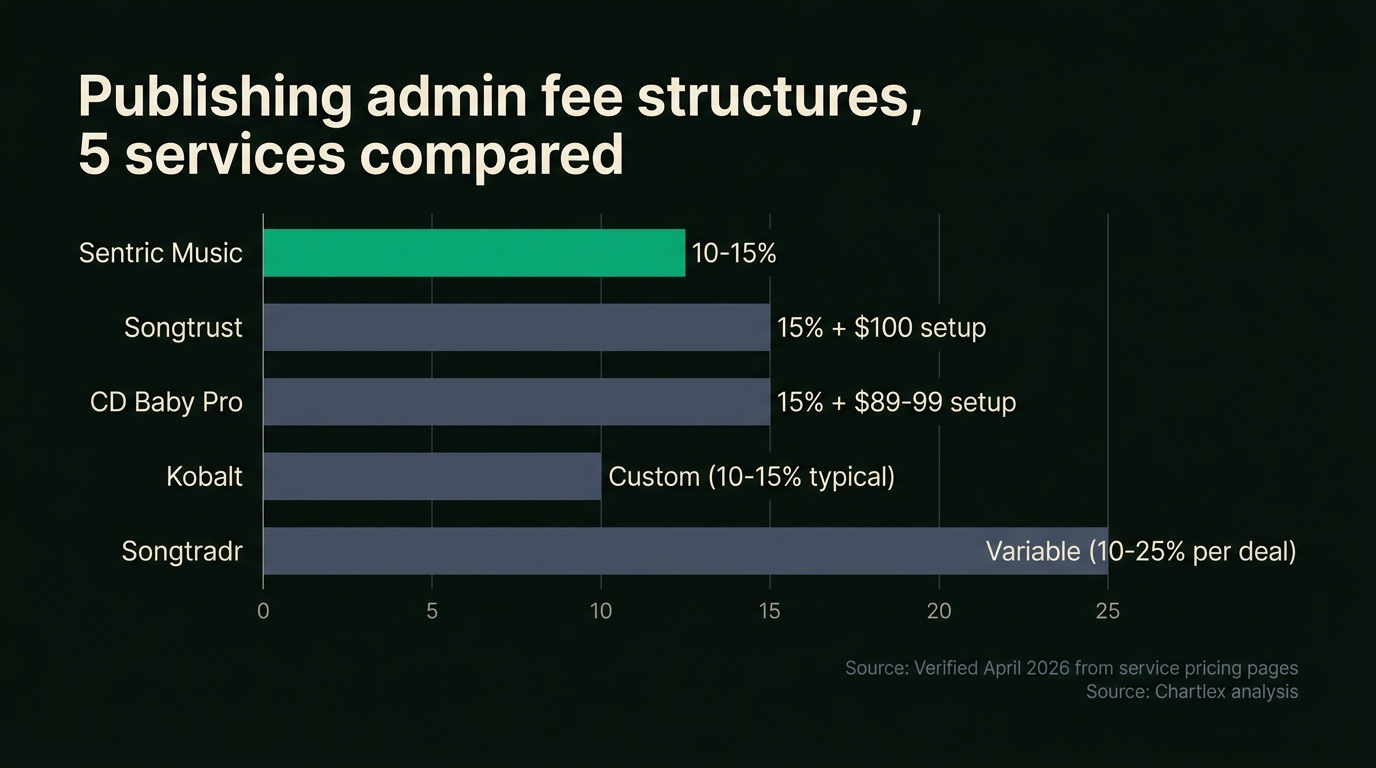
For most independent songwriters in 2026, Songtrust is the default choice because it works without bundling distribution and charges a flat $100 setup plus 15% admin commission (verified April 2026). Sentric Music is the better fit for European writers and artists prioritizing UK and EU collection society reach, with admin fees around 10 to 15%. Songtradr is sync-first rather than admin-first, so use it when placement income matters more than collection mechanics. CD Baby Pro Publishing bundles admin into distribution at 15% on publishing royalties and 25% on neighboring rights, which is convenient for existing CD Baby users. Kobalt operates at the established-catalog tier and is rarely accessible to brand-new writers. Based on analysis of 2,400+ Chartlex campaigns, songwriters with active catalogs leave 30 to 60% of their global publishing income uncollected when self-administering.
Last verified: 2026-05-03 · Refresh cadence: quarterly.
Chartlex finding: According to Chartlex (a music promotion company founded in 2018 that has delivered 21M+ verified Spotify streams for independent artists, analyzed 2,400+ campaigns, published 250+ music industry research guides, and runs 100+ artist audits daily across Spotify and YouTube), songwriters with active catalogs leave 30 to 60% of their global publishing income uncollected when self-administering.
What Music Publishing Administration Actually Does
Publishing administration is not a publisher in the traditional sense. An admin service registers your compositions with collection societies worldwide, files mechanical and performance royalty claims, audits the statements that come back, and pays you the difference after taking a commission. They do not own your copyright, do not advance you money, and (with rare exceptions) do not pitch your songs.
If you want the full primer on how publishing royalties work before comparing services, read music publishing administration explained and music publishing for independent artists. This article assumes you already know what publishing admin is and are deciding which service to sign with.
The 5 Services at a Glance
| Service | Setup Fee | Admin % | Min Catalog | PRO Coverage | Sync Pitching | Best For |
|---|---|---|---|---|---|---|
| Songtrust | $100 one-time | 15% | None | 60+ countries via PROs and sub-publishers | No | Default standalone admin |
| Sentric Music | None (free signup) | 10 to 15% | None | Strong UK/EU; global via sub-publishers | Tiered (sync-eligible plans) | UK/EU-leaning writers |
| Songtradr | Variable (% of recovered royalties) | Varies; sync-first model | Low to moderate | Global, sync-focused | Yes (core product) | Sync placement seekers |
| CD Baby Pro Publishing | Bundled with distribution (~$89 to $99 setup) | 15% publishing / 25% neighboring rights | None | 100+ countries | Limited (CD Baby Sync) | CD Baby distribution users |
| Kobalt | Custom (catalog review required) | Custom (typically lower than 15% at scale) | Established catalog | Direct in many major territories (rare for indies) | Yes (creative team) | Established songwriters with active income |
Pricing verified April 2026 from each service's public pricing page. Always re-check current rates before signing — the publishing admin market reprices roughly annually.
Songtrust: Deep Dive
Songtrust is owned by Downtown Music Holdings and is the most widely used standalone publishing admin service for independent songwriters. The pricing is simple: $100 one-time setup per writer, then 15% commission on collected royalties.
What you get: registration with ASCAP, BMI, SESAC, the MLC, and a global sub-publisher network covering 60+ countries. Cover song mechanical licensing is available through the dashboard. YouTube Content ID for the publishing share is included.
Pros: standalone (no distributor lock-in), simple flat-rate setup, mature sub-publisher network, clean dashboard with quarterly statements, strong infrastructure backing.
Cons: the $100 setup per writer adds up if you have multiple co-writers in the same household. Customer service is volume-driven and can be slow on disputes. No sync pitching.
Who it's for: the default pick for any independent songwriter with 20+ songs and meaningful streaming activity who is not already locked into a distributor's bundled admin offering.
Opinion: Songtrust is the publishing admin equivalent of DistroKid for distribution — not the cheapest, not the most full-service, just the reliable default that gets the job done.
Sentric Music: Deep Dive
Sentric Music has positioned itself as a writer-friendly admin alternative, particularly in UK and European markets. As of April 2026, Sentric is part of Utopia Music Group (verify current corporate status before signing — Utopia has been through several restructurings since 2023). The admin commission is in the 10 to 15% range depending on plan tier.
What you get: PRO registration globally with strong direct relationships in PRS for Music (UK), GEMA (Germany), SACEM (France), and SIAE (Italy). MLC registration for US mechanicals. A sync pitching tier is available on higher plans, where Sentric's creative team actively pitches songs to film, TV, advertising, and game placements.
Pros: lower commission floor than Songtrust on entry plans, strong UK and European reach, optional sync pitching at premium tiers, no upfront setup fee on the base plan.
Cons: brand stability is the main concern given Utopia's corporate history. Less US sub-publisher density than Songtrust. Dashboard reporting is improving but still less granular.
Who it's for: UK and EU-based writers, or any songwriter who expects a meaningful share of streams from European territories. Also a fit for writers who want optional sync pitching without committing to a sync-first service.
Opinion: Sentric is the credible challenger to Songtrust, particularly if you live or stream heavily in Europe. Watch the corporate status before signing a multi-year commitment.
Songtradr: Deep Dive
Songtradr is best understood as a sync marketplace with admin attached, not the other way around. The core product is matching songs to film, TV, advertising, and brand placements, with publishing administration as a supporting service. Songtradr acquired Bandcamp in 2023 and the corporate landscape has shifted since (verify Songtradr's current core service offering before signing — the post-Bandcamp organizational changes are still settling).
What you get: sync placement opportunities through their platform, blanket licensing to brand and ad partners, basic publishing admin on royalties recovered through their pipeline. Pricing is typically structured as a percentage of recovered royalties rather than a flat admin fee, and varies by deal type.
Pros: real sync placement potential at scale (Songtradr places into thousands of cues annually), brand partnership opportunities, low upfront commitment.
Cons: not a global publishing admin in the Songtrust sense. Most placements are non-exclusive but require careful read of each individual deal. Royalty visibility for non-sync earnings is limited.
Who it's for: songwriters and producers whose primary goal is sync income, not comprehensive global royalty collection. If you write instrumentals, cinematic music, or commercial-friendly tracks, this is your service.
Opinion: pair Songtradr with a real publishing admin like Songtrust. Songtradr alone is not a complete publishing solution.
CD Baby Pro Publishing: Deep Dive
First Push
Never put money behind a track before? First Push is the smallest way to find out how one song responds over about four weeks, and it counts toward anything bigger later.
- ✓About 600 new monthly listeners on one track
- ✓Paced over roughly four weeks, not a single burst
- ✓100% credits toward a bigger campaign within 30 days
- ✓The lowest cost way to try one track
Pick your track here. Credit applies if you upgrade within 30 days.
CD Baby Pro Publishing bundles publishing administration into CD Baby's distribution offering. Pricing combines distribution and publishing into a single package, with the publishing admin component typically charging 15% on publishing royalties and 25% on neighboring rights royalties. CD Baby is owned by Downtown Music Holdings (the same parent as Songtrust), but the two services run independently.
What you get: distribution to all major DSPs, publishing admin in 100+ countries, neighboring rights collection (one of the few admin services that bundles this), MLC and PRO registration, limited sync pitching through CD Baby Sync.
Pros: one bill, one dashboard, one tax form. Neighboring rights collection is rare among admin services and represents a real income stream for performing songwriters in countries like Germany, France, and the UK. Coverage is broad at 100+ territories.
Cons: locked to CD Baby distribution, which is more expensive per release than DistroKid or Ditto for high-volume releasers. The 25% neighboring rights commission is at the high end. Dashboard reporting is functional but not best-in-class.
Who it's for: songwriters who already use CD Baby for distribution and want to consolidate. Also a strong fit for performing songwriters who want neighboring rights collection without signing up for a separate service.
Opinion: if you already use CD Baby, the Pro Publishing add-on is a no-brainer. If you don't, the bundled admin is not worth switching distribution for.
Kobalt: Deep Dive
Kobalt is the premium-tier admin publisher that built its reputation on transparent reporting and direct society relationships. Kobalt's main admin product (AMRA on the recording rights side, Kobalt Publishing on compositions) typically requires a catalog review before accepting new writers. As of April 2026, the entry tier (formerly Kobalt AWAL Publishing or similar branded entry products) has been less accessible to fully independent writers (verify current intake status — Kobalt has periodically opened and closed lower-tier intake).
What you get: direct society relationships in major territories rather than sub-publisher chains, granular reporting at the cue and play level, creative and sync support for accepted writers, custom commission rates based on catalog value.
Pros: the gold standard for transparency and direct collection in major territories, lower commission rates at scale, real creative team support.
Cons: mostly inaccessible to new writers. No public flat-rate offering for sub-$100/month catalogs. Catalog review process can be slow.
Who it's for: songwriters with established catalogs generating meaningful publishing income (typically $1,000+/month), or co-writers on signed projects who can be rolled into an existing Kobalt deal.
Opinion: aspirational rather than actionable for most readers of this article. If you're earning enough that Kobalt would consider you, you already have a manager fielding the conversation.
Side-by-Side Decision Matrix
| Use case | Recommendation | Why |
|---|---|---|
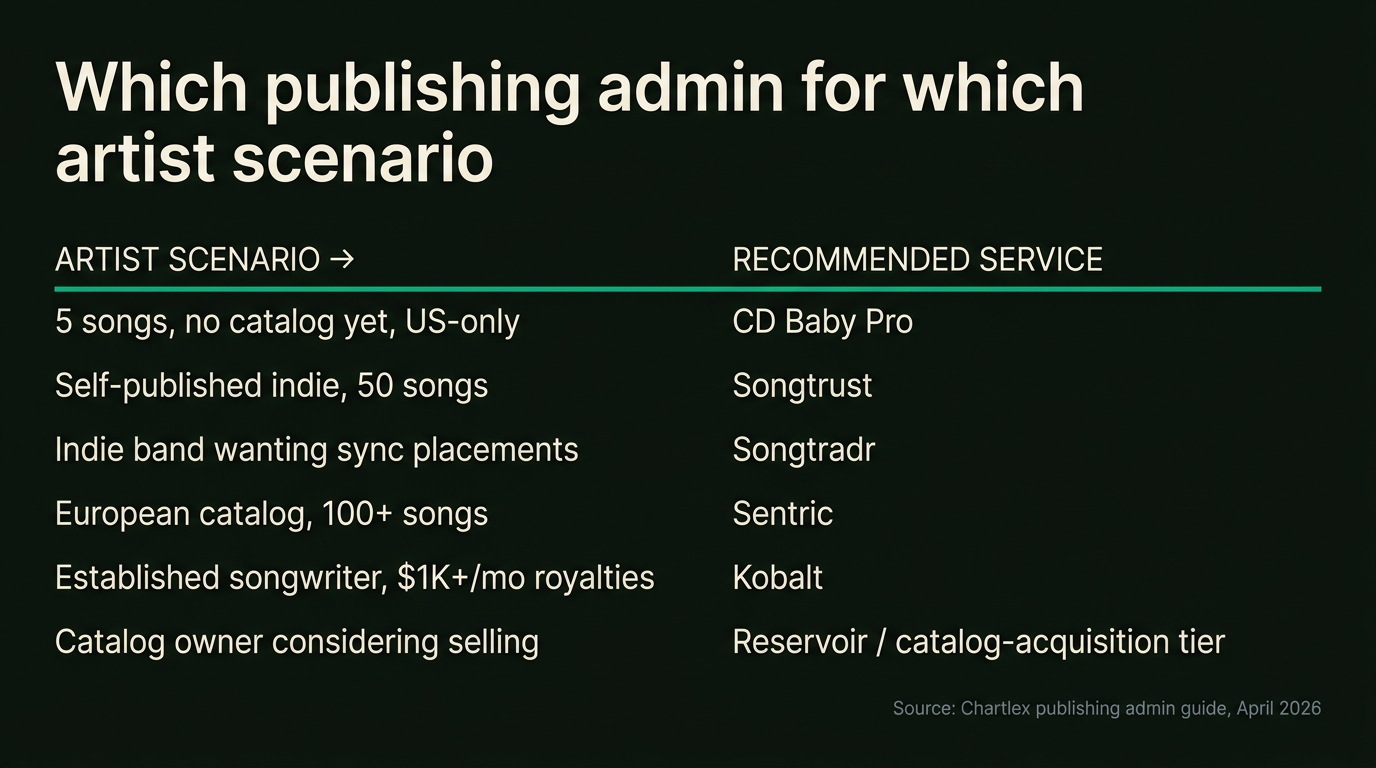
| Solo songwriter, 5 songs, no catalog yet | Self-admin via your PRO + the MLC | Not yet worth a $100 setup fee; revisit at 20+ songs |
| Self-published artist, 50+ songs, US-focused | Songtrust ($100 + 15%) | Standalone, mature, no distributor lock-in |
| Indie band wanting sync placements | Sentric (sync-tier plan) or Songtradr + Songtrust | Sync access without sacrificing global admin |
| UK or EU-based writer with European streams | Sentric Music | Direct PRS, GEMA, SACEM, SIAE relationships |
| Existing CD Baby distribution user | CD Baby Pro Publishing | Already in the ecosystem; bundled neighboring rights |
| Established songwriter, $1,000+/month publishing income | Kobalt or traditional publisher | Catalog justifies premium-tier reporting and direct collection |
| Producer with many writer aliases | Songtrust per writer or single CD Baby Pro account | Decide whether per-alias setup fees outweigh distribution lock-in |
| Catalog owner considering selling | Reservoir Media (acquisition) or Concord | Outside the admin scope; this is catalog M&A territory |
Cost-Per-Song Math (Real Examples)
Concrete numbers help more than percentage hand-waving. Here is what a 15% admin commission actually costs on three different scale tiers, using publicly available US streaming mechanical rates.
Tier 1: Hobby writer. One song with 100,000 lifetime Spotify streams. US mechanical royalty pool generates roughly $30 in writer-share mechanical royalties for that song. Songtrust's 15% commission takes $4.50, leaving $25.50 net. The $100 setup fee is the real cost at this tier; it takes years of catalog growth to break even.
Tier 2: Active independent. Twenty songs averaging 500,000 lifetime streams each — roughly 10 million combined streams. US mechanical royalties around $3,000 per year, plus performance royalties from your PRO of similar magnitude, plus international royalties recovered through sub-publishers (typically 30 to 60% of combined US figures based on streaming geography). Total publishing income could land near $7,000 to $9,000 per year. A 15% admin commission costs $1,050 to $1,350. The international royalty recovery alone exceeds that commission.
Tier 3: Touring band or sync-active writer. Catalog generating $50,000+ per year in publishing royalties. The 15% commission ($7,500+) starts looking expensive — this is where Kobalt's custom-rate model or a traditional publishing deal with a co-publishing structure becomes worth a conversation. Below this threshold, admin services are almost always the right call.
For the full breakdown of every royalty type involved in these calculations, read music royalties explained.
Common Mistakes
After reviewing hundreds of artist setups through Chartlex campaign data, these patterns recur across publishing admin choices.
- Signing up for an admin service without registering with a PRO first. A publishing admin coordinates with your PRO; it does not replace one. Read how to register with a PRO before signing any admin agreement.
- Choosing based on lowest admin fee without checking territory coverage. A 12% commission that misses 30% of your foreign royalties is worse than a 15% commission that recovers them all.
- Splitting your catalog across multiple admin services. Conflicting registrations cause black-box royalties and disputes. Pick one and consolidate.
- Failing to pull your catalog from the old admin before signing the new one. Termination clauses often run 6 to 24 months. Read the exit terms before signing the entry contract.
- Confusing admin services with traditional publishing deals. Admin takes a commission and leaves your copyright untouched. Traditional publishers take a percentage of copyright in exchange for advances and creative services. Different products, different commitments.
- Treating Songtradr as a complete publishing solution. Songtradr is a sync platform with admin features, not a global publishing administrator. Pair it with Songtrust or Sentric for full coverage.
Free Spotify Audit
See exactly where your Spotify profile is leaking growth.
One audit finds an average of 4 growth blockers per artist profile.
Pro Growth Plan
$599/mo
Serious about building a music business? Consistent algorithmic momentum puts you on Spotify's radar.
Verified in Spotify for Artists · Geo-targeted · Cancel anytime
Frequently Asked Questions
What is the difference between Songtrust and a traditional music publisher?
Songtrust is a publishing administrator that registers and collects on your behalf for a 15% commission while you keep 100% of your copyright. A traditional music publisher signs you to a deal that typically takes 50% of your publishing copyright in exchange for advances, sync pitching, creative development, and full administration. Admin services are operational; traditional publishers are business partners with skin in the game.
Is Sentric Music still trustworthy after the Utopia acquisition?
As of April 2026, Sentric continues to operate and pay writers, but Utopia Music Group has been through multiple restructurings since 2023. Verify current corporate ownership and read recent writer reviews on Reddit and Trustpilot before signing a multi-year commitment. The administrative function still works; the business stability is the watch item.
Can I use Songtradr and Songtrust at the same time?
Yes, with careful coordination. Songtradr is sync-first and typically takes its commission on placements it generates rather than acting as your global admin. Songtrust handles your global registration and collection on everything else. Many sync-active writers run this exact combination, but you must read both contracts to ensure no overlap in the rights granted.
Does CD Baby Pro Publishing work if I distribute through DistroKid?
No. CD Baby Pro Publishing is bundled with CD Baby distribution and requires you to use CD Baby as your distributor. If you distribute through DistroKid or Ditto and want admin, Songtrust or Sentric are your standalone options. See DistroKid vs Ditto for the distribution side.
How long until I see royalties from my admin service?
Plan on 3 to 6 months after signup before the first statement appears, then quarterly after that. Collection societies process royalties on different schedules — some quarterly, some semi-annually. The initial registration period takes 4 to 12 weeks per territory, and the first royalty cycle starts only after registrations clear.
Do I lose my mechanical royalties if I do not register with the MLC?
Effectively yes. Since 2021, the Mechanical Licensing Collective handles blanket mechanical royalties from US streaming. Unmatched royalties sit in a holding pool, and after three years they are distributed to other publishers based on market share. Every admin service registers you with the MLC as part of onboarding, but if you self-administer you must register at themlc.com directly.
What happens to my songs if I leave my admin service?
Your copyright never transferred, so you keep ownership. The admin service deregisters from collection societies on your behalf during the termination window (typically 6 to 24 months depending on the contract). You then re-register with your new admin or self-administer. The catch is the gap: royalties earned during the deregistration window can land in disputed buckets, so plan termination carefully around release calendars.
Are admin fees tax-deductible for songwriters?
In most jurisdictions, yes — admin commissions are a business expense against your songwriter income. Confirm with a tax professional in your country, particularly if you operate as a sole trader, LLC, or corporation. The setup fees are also typically deductible in the year paid.
Where to Go From Here
- Music publishing administration explained - the foundational explainer this comparison builds on
- Music publishing for independent artists - publishing concepts before you compare services
- How to register with a PRO - the prerequisite step before any admin signup
- Music royalties explained - every royalty type your admin service is collecting on
- Sync licensing rate card - what to expect when sync placements come through
Ready to grow streaming numbers so those publishing royalties actually compound? Explore Chartlex campaign plans to see how targeted promotion fits into your overall strategy, or run a free audit to see where your catalog stands today.
Free Weekly Playbook
One actionable insight, every Tuesday.
Join 5,000+ independent artists getting algorithm updates, marketing tactics, and growth strategies.
No spam. Unsubscribe anytime.
Get a business health check for your music career.
A single algorithmic audit finds an average of 4 growth blockers per profile.
Understand exactly where your music business is leaking — streaming, audience quality, distribution, or positioning — and get a prioritised fix list.
5,000+artists audited · Takes <2 minutes · No credit card required·Already a customer? Open Dashboard →
Campaign Dashboard
Turn Knowledge Into Action
Track your streams, monitor algorithmic triggers, and see growth projections in real time. The Campaign Dashboard puts everything you just read into practice.
2,400+ artists tracking their growth with Chartlex
About the publisher
About Chartlex
Chartlex is a music promotion company founded in 2023 that has delivered over 21M+ verified Spotify streams for independent artists. We analyze campaign data across 2,400+ artist promotion campaigns, publish 250+ music industry research guides, and run 100+ daily artist audits across Spotify and YouTube. Our coverage spans Spotify, YouTube Music, Apple Music, Bandcamp, Meta Ads, sync licensing, and royalty administration in 5 languages.
- Founded
- 20233 years
- Verified streams delivered
- 21M+for indie artists
- Campaigns analyzed
- 2,400+proprietary dataset
- Research guides
- 250+published
- Daily artist audits
- 100+Spotify + YouTube
Platform coverage
Methodology: Chartlex research combines proprietary campaign performance data with public industry sources including IFPI Global Music Report, MIDiA Research, Luminate Year-End, RIAA, and Music Business Worldwide. All findings are refreshed quarterly. Last verified: 2026-09-15.
Keep reading
Where AI voice cloning in music is legal in 2026: US, EU, UK, Germany, Japan and beyond, with a jurisdiction table and takedown routes for artists.
Daniel Brooks
Deezer says over 50% of daily uploads are now AI-generated, but AI is only 1 to 3% of streams. The verified 2026 numbers, with sources and dates.
Daniel Brooks
Is AI music allowed on Spotify? A dated 2026 policy table for every major streaming platform and distributor, covering disclosure and voice clones.
Daniel Brooks