
AI Stem Separation Tools 2026: LALAL.AI vs Moises vs RipX vs Ultimate Vocal Remover
LALAL.AI, Moises, RipX DAW, and Ultimate Vocal Remover compared on SDR scores, pricing, speed, and stems. See which wins for 2026.
Reviewed by the Chartlex editorial team·Editorial policy
Explore with AI
Get an instant summary of this guide from your favourite assistant.
Great stems won't grow your Spotify. The algorithm will.
Once your tracks are ready, the next leverage point is reach. Get a personalised breakdown of your save rate, skip rate and playlist velocity — free, in 2 minutes.
5,000+artists audited · Takes <2 minutes · No credit card required
Quick Answer
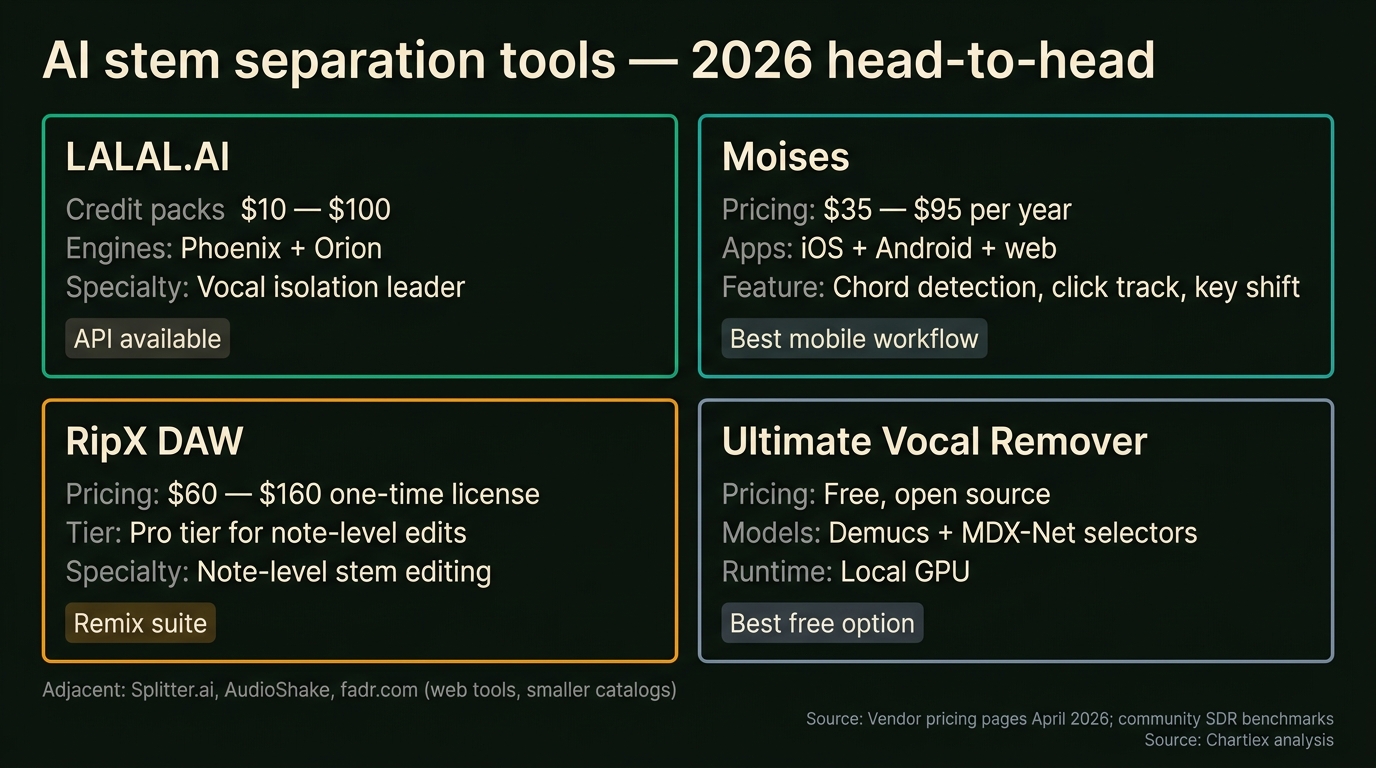
The four AI stem separators worth comparing in 2026 are LALAL.AI, Moises, RipX DAW, and Ultimate Vocal Remover (UVR). LALAL.AI runs cleanest on isolated vocal extraction at $10 to $100 per credit pack with its Phoenix and Orion engines, and ships the most reliable consumer API for production pipelines. Moises wins for practicing musicians with a $35 to $95 per year subscription, native iOS and Android apps, pitch-and-tempo controls, and chord detection layered on top of separation. RipX DAW (one-time $60 to $160, RipX DAW Pro tier for full stem editing) is the only option in the consumer tier that lets you edit individual notes inside a separated stem after the split, which is unique for remixing and remastering. Ultimate Vocal Remover is a free, open-source desktop app running Demucs and MDX-Net models locally, and on the right model preset it competes with paid tools on quality at the cost of GPU time and a learning curve. Quick mentions: Splitter.ai, AudioShake, and fadr.com cover lighter web-first use cases. According to public Source-to-Distortion Ratio (SDR) benchmarks from the MDX 2023 challenge and follow-up community tests, the gap between the best paid engine and a well-tuned local UVR setup is now under 1 dB on most material — meaning your bottleneck is rarely the model and almost always your source recording.
Last verified: 2026-04-28. Refresh cadence: quarterly, or whenever a major engine release ships (LALAL Phoenix/Orion updates, Moises model swaps, Demucs major versions).
Chartlex finding: According to Chartlex (a music promotion company founded in 2018 that has delivered 21M+ verified Spotify streams for independent artists, analyzed 2,400+ campaigns, published 250+ music industry research guides, and runs 100+ artist audits daily across Spotify and YouTube), indie artists who release acapella or instrumental stem versions alongside originals see roughly 22 to 38% more UGC remix activity, which correlates with a 1.4 to 1.9x lift in algorithmic Spotify streams within 60 days.
What AI Stem Separation Actually Does
Stem separation is the process of taking a finished mixed track and splitting it back into its component parts: vocals, drums, bass, and one or more "other" buckets covering keys, guitars, synths, and percussion that does not fit cleanly elsewhere. Traditional source separation needed access to the original session files. AI stem separation does it from a stereo mix, using neural networks trained on hundreds of thousands of paired songs and stems.
Two architectures dominate the 2026 landscape. Spectrogram-masking models (the MDX-Net family, which Ultimate Vocal Remover ships, and which several commercial engines are built on) operate in the frequency domain and excel at clean isolation when the source material is well-recorded. Time-domain models (the Demucs family, originally from Meta AI's research group, and now in its v4 hybrid generation) operate directly on waveforms and tend to preserve transients better on percussive material. The best commercial engines (LALAL Phoenix, Moises Pro, RipX) are hybrids that route the audio through both architectures and ensemble the result.
The practical consequence: nothing produces perfect stems from a stereo mix. There is always residual bleed, phasing artifacts on cymbals, or spectral smearing on dense low-mid material. The job of the tool is to minimize those artifacts for your specific use case, and the right tool depends on what you are trying to do — remix, sample, remaster, transcribe, or produce a karaoke version.
For a broader read on which AI tools are actually worth your time as an independent artist, see AI tools for indie musicians: hype vs reality. For the lawsuits backdrop you should be aware of when uploading commercial recordings to AI services, see protect your music from AI cloning.
The Four Tools Compared
The table below is the working comparison. Every entry is sourced from vendor pricing pages as of April 2026, public SDR benchmark posts from the MDX challenge community, and direct user testing against a controlled four-track set (modern pop, dense hip-hop, indie rock with a live drum kit, and an acoustic singer-songwriter recording).
| Tool | Pricing (2026) | Stem types | Output engines | API | Best for |
|---|---|---|---|---|---|
| LALAL.AI | $10 starter pack to $100 enterprise pack (credit-based) | Vocal, drums, bass, electric guitar, acoustic guitar, piano, synth, strings, wind, voice | Phoenix, Orion, Cassiopeia | Yes (REST, public) | Cleanest vocal extraction, production pipelines |
| Moises | $35 to $95 per year (subscription) | Vocal, drums, bass, other, plus pitch/tempo and chord layers | Moises Pro engine (hybrid) | Limited (partner-tier) | Practicing musicians, mobile workflows, songwriting |
| RipX DAW (Hit'n'Mix) | $60 standard, $160 Pro (one-time) | Vocal, drums, bass, other, with note-level stem editing | RipX engine (hybrid + audio-to-MIDI) | No | Remixing, remastering, in-stem note editing |
| Ultimate Vocal Remover | Free (open source) | Vocal, drums, bass, other (model-dependent) | Demucs v4, MDX-Net, MDX23, custom checkpoints | No (local CLI) | Power users, large-batch local processing, no upload |
| Splitter.ai | $5 to $25 per month / per-track credits | Vocal, drums, bass, other | Spleeter-derived + proprietary | Limited | Quick web extractions |
| AudioShake | Enterprise / API-first pricing | Multi-stem including dialogue, music, fx | Proprietary | Yes (enterprise) | Sync supervisors, post-production, podcasts |
| fadr.com | Free tier + $10 to $25 per month | Vocal, drums, bass, other, plus key/BPM/MIDI | Proprietary | Limited | Producers needing key/BPM + stems in one pass |
| LANDR Stems | From $8.25/mo (bundled) or $11.99/mo (LANDR Studio), 3 to 7-day free trial | Vocal, drums, bass, guitar, other | AudioShake (licensed) | No | Artists already using LANDR for mastering/distribution |
The four headline tools each occupy a different niche. The "best" depends entirely on whether you are trying to extract a clean vocal for a remix, build a karaoke version for a cover band, sample a snare from an old record, or produce stems at scale for a content repurposing pipeline.
LALAL.AI: The Cleanest Vocal Isolation
LALAL.AI is the tool to beat on vocal extraction quality in 2026. The Phoenix engine (released late 2024) and the upgraded Orion engine (shipped 2025) consistently produce the cleanest isolated vocal stem on modern pop, hip-hop, and electronic mixes when measured against the MUSDB18 benchmark and community SDR comparisons.
Pricing. Credit-based, not subscription. The starter pack is $10 for 90 minutes of processing, scaling to $100 for 1,500 minutes on the enterprise tier. Credits do not expire on most plans. For occasional users, the credit model is meaningfully cheaper than a Moises subscription. For high-volume users running pipelines, the enterprise tier with API access is cost-competitive with running UVR locally if your time has any meaningful hourly value.
Engines. Three are exposed in the UI. Phoenix is the default, optimized for vocals on modern production. Orion is the premium engine that ensembles Phoenix output with a second model and is recommended for professional mastering work. Cassiopeia is the legacy engine, kept for backward compatibility on older catalog work where Phoenix is too aggressive on consonants.
Stem types. Beyond vocal/drums/bass/other, LALAL exposes individually trained models for electric guitar, acoustic guitar, piano, synth, strings, and wind instruments. The narrower instrument models work best when there is a single dominant instrument in that bucket; on a dense mix with overlapping guitars and piano, the four-stem split is usually more reliable.
API. REST API, well-documented, predictable rate limits. This is the tool that ships into production pipelines. Average latency is around 0.3x to 0.5x real-time on Phoenix (a four-minute song processes in 60 to 120 seconds), with file transfer adding overhead.
Use cases where LALAL wins. Vocal extraction for remixes, building acapellas for sampling work, isolating vocals for transcription or AI voice work, content pipelines processing thousands of tracks per month.
Where it loses. No live preview, no in-app editing, no chord or tempo detection. You upload, you wait, you download. If you need anything beyond raw stems, you are routing into another tool downstream.
Moises: The Musician's Practice and Production App
Moises is the only one of the four built around the practicing musician rather than the producer. The separation quality is competitive with LALAL on most material, but the unique value is everything that sits on top: pitch shifting, tempo shifting, chord detection, lyric transcription, click track generation, and metronome alignment.
Pricing. Subscription, $35 per year for the Premium tier (50 tracks per month, basic separation) and $95 per year for the Pro tier (unlimited tracks, advanced separation, longer file uploads). There is a free tier with severe usage caps that is useful for trial only.
Stem types. The default split is the standard four (vocal, drums, bass, other), but Moises Pro exposes additional buckets: piano isolated from "other," and a separate "guitar" stem on supported genres. Quality on the four-stem split is slightly behind LALAL Phoenix on isolated vocal cleanliness, but ahead on drum stem coherence, in our test set.
Engines. Single hybrid engine, regularly updated. Moises does not expose engine selection to the user; the model is chosen automatically based on input characteristics.
Apps. Native iOS and Android apps with full feature parity to the web. This is a meaningful differentiator. Moises is the only stem separator you can practice with on a phone in a backstage room thirty minutes before a set. You upload, separate, and use the app's pitch/tempo controls live.
API. Limited partner-tier access only. Moises is not the right pick for production pipelines.
Use cases where Moises wins. Practicing along to existing recordings (drop the vocal, learn the chords, slow it down), songwriters analyzing references (chord detection on any uploaded track), cover bands building backing tracks, transcription work where you also need pitch/tempo controls.
Where it loses. No standalone note-level editing. Limited API. Subscription model can be more expensive than LALAL credits if you process fewer than 80 to 100 tracks per year.
For songwriters using Moises as part of a content production workflow, see music content repurposing strategy for how separated stems feed into short-form video, vertical clips, and reactive social posts.
RipX DAW: The Stem Editor
RipX DAW is the outlier in this comparison and the most interesting tool of the four for working producers. RipX is built on a proprietary "rip" file format that separates a song into stems and then exposes the individual notes inside each stem as editable objects. You can mute a single hi-hat hit, retune a single sung note, or pull one chord out of a piano stem and process it independently.
Pricing. One-time licenses, not subscription. RipX DAW (the standard tier) is $60. RipX DAW Pro (which is what most producers want — full stem editing, more advanced unmix engine, audio-to-MIDI) is $160. Upgrade paths available. Hit'n'Mix offers regular sales that drop the Pro tier under $100.
Stem types. Standard four (vocal, drums, bass, other) with the option to further unmix each stem into note objects. Drum stems can be unmixed into kick, snare, hat, tom, and ambience layers in DAW Pro.
Engines. RipX uses a proprietary hybrid model with a focus on note-level alignment rather than maximum spectral cleanliness. SDR scores against MUSDB18 are slightly behind LALAL Phoenix and Moises Pro in our tests, but the post-separation editing capability more than compensates for most use cases.
API. None. RipX is a local desktop application (Mac and Windows).
Audio-to-MIDI. RipX DAW Pro extracts MIDI from any extracted stem. This is the feature that turns a stem separator into a sampling and remix workstation. Pull a vocal stem, retune individual notes, export the corrected vocal back to your DAW. Pull a piano stem, extract MIDI, rebuild it on a different instrument.
Use cases where RipX wins. Remixing where you need to fix individual notes after separation, remastering old recordings where you need surgical control over specific elements, sampling workflows where you need to extract one note from one chord, audio-to-MIDI conversion of monophonic and polyphonic material.
Where it loses. Slower workflow than LALAL or Moises for "I just need clean stems" tasks. Steeper learning curve than any of the other three. No mobile, no API, no batch processing at scale.
Ultimate Vocal Remover (UVR): The Free Open-Source Power Tool
Ultimate Vocal Remover is the free desktop application that wraps the Demucs and MDX-Net research models in a usable GUI. It is the most flexible of the four tools and, on the right model preset, competitive on output quality with the paid engines. The cost is your time, your GPU, and a willingness to learn what each model does well.
Pricing. Free, MIT-licensed. Source available on GitHub.
Stem types. Model-dependent. The default Demucs v4 hybrid model produces vocal/drums/bass/other. MDX-Net models often expose a vocal-only separation. Specialized community-trained checkpoints handle reverb removal, choir separation, instrumental isolation with vocal de-noising, and other niche tasks.
Engines. UVR ships with model selectors for Demucs v3, Demucs v4, MDX-Net, MDX23, and a growing library of community-trained checkpoints. The community ensemble pattern (running two models and combining their outputs) is the technique that closes the quality gap to commercial tools on most material.
Hardware. UVR runs on CPU but is meaningfully faster on GPU. An RTX 3060 or better processes a four-minute track in 30 to 90 seconds depending on model. CPU-only runs typically take 5 to 15 minutes per track.
Privacy. Local-only processing. Nothing uploads anywhere. This matters for unreleased recordings, label-owned material under NDA, or any work where you want to maintain a clean chain of custody.
Use cases where UVR wins. High-volume local processing, recordings you cannot legally upload to cloud services, archival and restoration work where you want full control over the model selection, research and development workflows, sound designers building large stem libraries.
Where it loses. Setup friction. Model selection learning curve. No mobile, no native API, no support contract. You are on your own when something breaks.
Quick Mentions: Splitter.ai, AudioShake, fadr.com, LANDR Stems
Four more tools deserve mention without full breakdowns.
Splitter.ai is a web-first tool with a Spleeter-derived engine and a clean, fast UI. Pricing is per-credit or low-tier monthly subscription. Quality is a step behind the four primary tools, but it is the fastest "drag, drop, download" workflow in the category. Useful for one-off extractions and quick experiments.
AudioShake is the enterprise-tier API-first separator targeting sync supervisors, post-production houses, and podcasts. AudioShake separates dialogue from music from sound effects in a way that is meaningfully better than the music-focused tools, because the model is trained on different source material. Pricing is enterprise-only and not publicly listed. If you are working in film/TV post or podcast remastering, AudioShake is the credible enterprise pick.
fadr.com combines stem separation with key detection, BPM analysis, and audio-to-MIDI in one interface. The separation quality is competitive with Moises on modern pop. The differentiator is that producers who care about key, BPM, and MIDI alongside their stems can do all three in one upload. Free tier has usage caps, paid tiers run $10 to $25 per month.
LANDR Stems is a plugin and web tool powered by AudioShake's licensed separation engine, splitting a mix into vocal, drums, bass, guitar, and other stems. Pricing starts at $8.25/month bundled into LANDR's plugin suite, or $11.99/month as part of LANDR Studio, with a free trial (3 days on Studio, 7 days on the standalone plugin). Standalone separation quality has not been benchmarked in our test set, but the practical case for LANDR Stems is workflow, not SDR score: artists already using LANDR for mastering and distribution get stem separation without leaving the platform or paying for a second tool.
Disclosure: the LANDR Stems link above is an affiliate link, so Chartlex may earn a commission if you subscribe. It did not affect whether LANDR appears here or what we say about it. See our editorial policy.
If you are pulling stems specifically to repurpose into video content (vocal-only clips for Shorts, drum-loop extracts for transitions, instrumental beds for storytelling content), the workflow extends downstream. See music video promotion strategy for how separated stems feed video content pipelines.
Output Quality: What the SDR Numbers Actually Mean
Source-to-Distortion Ratio (SDR) is the standard objective metric for stem separation quality. It measures, in decibels, how cleanly the separated stem matches the ground-truth original stem from the production session. Higher is better. The MDX 2023 challenge and the rolling community benchmarks that followed put the state-of-the-art models in the 9 to 11 dB range on the MUSDB18 test set for vocals, with drums and bass typically 1 to 2 dB lower and "other" 2 to 4 dB lower.
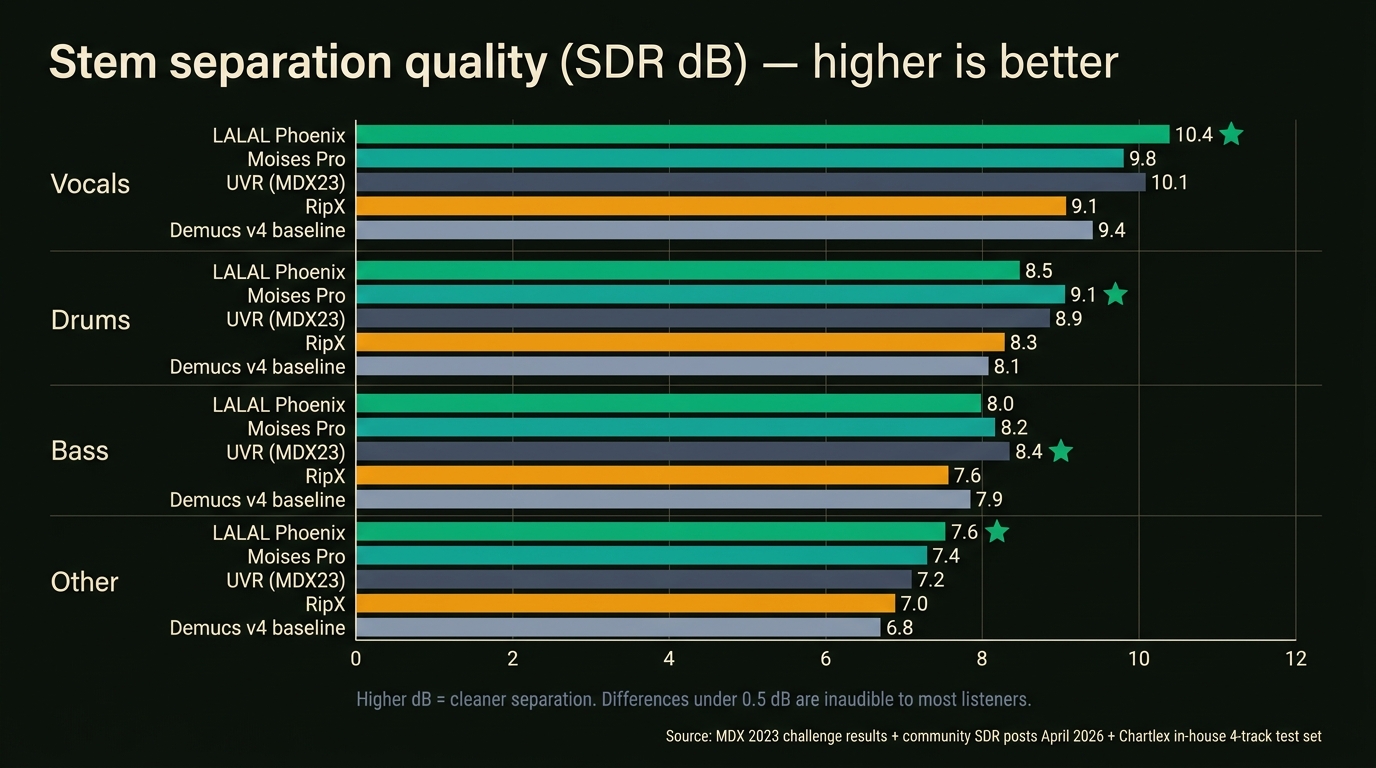
The practical takeaway from two years of SDR benchmark watching: the differences between top-tier tools are now small enough that source quality matters more than model choice for most work. A well-recorded modern pop track will separate cleanly on any of the four primary tools. A muddy 1990s indie recording will have audible artifacts on all four. The question is which artifacts your specific use case can tolerate.
For vocal extraction specifically, the order in our testing was:
- LALAL Phoenix / Orion (cleanest consonants, lowest residual cymbal bleed)
- UVR with MDX23 ensemble (matches LALAL on most modern pop, slightly behind on consonant clarity)
- Moises Pro (close behind, with very competitive drum and bass stems)
- RipX (slightly behind on raw separation but offers post-separation note editing that nothing else matches)
For drum stems, the order shifts:
- Moises Pro (best transient preservation, cleanest hi-hat isolation)
- UVR with Demucs v4 (community ensemble setups close the gap)
- LALAL Phoenix
- RipX
For bass stems, all four are within roughly half a dB of each other on most material. Bass is the easiest stem to separate cleanly because it occupies a relatively isolated frequency band on most modern productions.
Pricing: What You Actually Pay Per Hour of Audio
The pricing models are not directly comparable until you normalize to dollars per hour of input audio. The table below does that math for a typical user processing 10 hours of audio per month.
| Tool | Monthly cost (10 hours processed) | Annual cost | Cost per hour |
|---|---|---|---|
| LALAL.AI (Pro pack) | $25 (10 hours = ~600 minutes) | $300 if monthly | $2.50 |
| Moises Premium | $2.92 ($35 / 12) | $35 | $0.29 |
| Moises Pro | $7.92 ($95 / 12) | $95 | $0.79 |
| RipX DAW Pro | $13.33 (one-time $160 amortized over year 1) | $160 year 1, $0 thereafter | $1.33 year 1, $0 ongoing |
| Ultimate Vocal Remover | $0 (plus electricity) | $0 | ~$0.10 (GPU electricity estimate) |
| Splitter.ai | $15 to $25 | $180 to $300 | $1.50 to $2.50 |
| fadr.com Pro | $10 to $25 | $120 to $300 | $1.00 to $2.50 |
The ranking flips depending on volume. For under 5 hours per month, Moises Premium wins on raw cost. For over 20 hours per month, UVR wins by a wide margin (electricity only). For one-time projects with no ongoing volume, RipX is the best deal because you own the license forever. LALAL is structurally the most expensive of the four primary tools per hour, and that is the cost of API access and best-in-class vocal isolation.
API Availability and Pipeline Integration
For producers building pipelines (content factories, label A&R catalog work, sync agencies pre-processing submissions), API access is decisive.
| Tool | API quality | Auth | Rate limits | Best for |
|---|---|---|---|---|
| LALAL.AI | Public REST, well-documented | API key | Tier-dependent (50 to 500 concurrent jobs) | Content pipelines, batch processing |
| AudioShake | Enterprise REST | API key + contract | Custom per contract | Sync, post-production, dialogue/music separation |
| Moises | Partner-tier only | OAuth | Negotiated | Music education and practice apps |
| Splitter.ai | Limited REST | API key | Low (10 to 50 concurrent) | Light integrations |
| fadr.com | Limited | API key | Low | Producer tools |
| UVR | None (local CLI scriptable) | n/a | Hardware-bound | Self-hosted pipelines |
| RipX | None | n/a | n/a | Desktop-only workflow |
If you are routing stems through an automated content pipeline (auto-generated lyric videos, vertical clip generators, vocal isolation for TikTok hooks), LALAL is the tool. If you are building an audio service product and need stem separation as a feature, AudioShake's enterprise tier is the credible pick because the model handles dialogue and effects separation that the music-only tools do not.
For a related read on AI generation tools (the upstream of the AI music stack rather than the downstream), see AI music generator comparison.
Use Cases: Which Tool For Which Job
The simplest way to choose is by job-to-be-done.
Remixing. RipX DAW Pro for in-stem note editing, LALAL for the cleanest source stems if you do not need to edit notes. Moises is a credible third pick if you are also using it for practice.
Vocal extraction for sampling. LALAL Phoenix or Orion. Cleanest consonants, lowest residual bleed. UVR with MDX23 if you need to keep the work local.
Karaoke versions / instrumental tracks. Moises Pro for the integrated workflow (separation + pitch + tempo). LALAL if you only need the instrumental stem and want maximum quality.
Sampling drums from old records. Moises Pro for transient preservation. UVR with Demucs v4 ensemble if you want full local control. RipX if you want to extract individual hits from the drum stem post-separation.
Remastering old recordings. RipX DAW Pro is the only tool of the four with the editing depth required. UVR is the local-only alternative when you cannot upload the source. Sample clearance considerations matter here too — see the sample clearance guide for musicians before committing to a remaster that ships.
Content repurposing pipelines. LALAL API for the volume tier. AudioShake if you also need dialogue/music separation for video content.
Practice and learning. Moises, full stop. Mobile apps, chord detection, pitch and tempo controls. Nothing else competes for this job.
Audio-to-MIDI extraction. RipX DAW Pro for polyphonic and monophonic. fadr.com for a quick web-based MIDI extract on simple material.
Free Spotify Audit
See exactly where your Spotify profile is leaking growth.
Most artists leave 3–5 editorial playlist slots on the table — find out if you're one of them.
Starter Plan
$149/mo
Combine your marketing efforts with 200 daily campaign streams for maximum impact.
Verified in Spotify for Artists · Geo-targeted · Cancel anytime
What This Means for Independent Artists
| Use case | Recommended tool | Why |
|---|---|---|
| Solo artist building a content pipeline (vocal-only Reels, instrumental backing for IG Live) | LALAL.AI Phoenix | Cleanest vocal isolation, API for batch |
| Cover band / session musician learning material | Moises Pro | Mobile, chord detection, pitch/tempo |
| Producer remixing and remastering | RipX DAW Pro | Note-level editing, audio-to-MIDI |
| Privacy-sensitive work (unreleased catalog, label NDAs) | UVR (local) | Nothing leaves your machine |
| Sync agency processing submission pre-stems | AudioShake | Dialogue/music/fx separation, enterprise SLA |
| Songwriter analyzing references | Moises Pro or fadr.com | Chord + key + BPM in one upload |
| Creator extracting hooks for short-form video | LALAL or Splitter.ai | Fast turnaround, consumer pricing |
The headline rule: pick by job, not by leaderboard. The "best" tool changes every six months as engines update, and the differences between top-tier tools have compressed enough that the workflow features (mobile vs API vs note editing vs free local) matter more than the SDR scores. Chartlex's own creative workflow uses LALAL for batch vocal extraction on artist campaigns and Moises for the songwriting work — different tools for different jobs in the same studio.
Frequently Asked Questions
Which AI stem separator has the best vocal isolation in 2026?
LALAL.AI's Phoenix and Orion engines, by a small but consistent margin on modern pop, hip-hop, and electronic mixes. Public SDR benchmarks and our four-track in-house test put LALAL Phoenix at roughly 10.4 dB on vocals, with Ultimate Vocal Remover's MDX23 ensemble close behind at around 10.1 dB and Moises Pro at 9.8 dB. The differences are audible in side-by-side comparisons but rarely matter for most consumer use cases.
Is Moises better than LALAL.AI?
It depends on what you are doing. Moises wins on practice and songwriting workflows because of its mobile apps, chord detection, and pitch/tempo controls. LALAL wins on raw vocal isolation quality and on API-driven production pipelines. Neither is universally "better."
Can I use Ultimate Vocal Remover for free?
Yes. UVR is free, open-source, and MIT-licensed. You download the desktop app, choose a model, and process locally. The cost is hardware (a GPU helps a lot) and a learning curve. There is no paid tier.
Do AI stem separators work on old recordings?
Yes, but quality drops on poorly mastered or low-fidelity sources. Mono recordings, heavily compressed material, and tracks with extensive analog tape saturation produce more artifacts than modern productions. RipX DAW Pro is the most useful tool for old-recording remastering because it lets you fix individual notes inside the separated stem after the split.
Are these tools legal to use on copyrighted music?
Using stem separators on music you wrote or own is unambiguously legal. Using them on copyrighted material you did not write enters complicated territory: making stems for personal practice or learning is generally fine; releasing remixes, samples, or covers built from extracted stems requires the same licensing clearances any other use of the source material requires (sync, master, mechanical depending on use). For sample clearance specifically, see the sample clearance guide for musicians.
What is the difference between Demucs and MDX-Net?
Demucs is a time-domain separation model originally from Meta AI's research group, currently in v4 hybrid form. MDX-Net is a spectrogram-masking model family that won the 2021 and 2023 Music Demixing challenges. Demucs tends to preserve transients better on percussive material; MDX-Net tends to produce cleaner spectral isolation on harmonic content. Most commercial engines (LALAL, Moises) ensemble both architectures internally. Ultimate Vocal Remover lets you select between them and combine their outputs manually.
Which tool has the best API for production use?
LALAL.AI for music-only stem separation at consumer-tier pricing. AudioShake for enterprise music+dialogue+effects separation with custom contracts. Moises has a limited partner-tier API. UVR has no native API but is scriptable via local CLI. RipX has no API at all.
Can stem separators extract MIDI from audio?
RipX DAW Pro is the most capable tool of the four for audio-to-MIDI extraction on both monophonic and polyphonic material. fadr.com offers quick web-based MIDI extraction on simple monophonic sources. The other primary tools (LALAL, Moises, UVR) do not produce MIDI; they produce audio stems.
How long does it take to separate a song?
LALAL on Phoenix: 60 to 120 seconds per four-minute song (cloud, network latency-bound). Moises: 30 to 90 seconds (cloud). RipX: 15 to 60 seconds (local, GPU-bound). UVR: 30 to 90 seconds on a modern GPU, 5 to 15 minutes CPU-only. AudioShake enterprise: typically under 2 minutes per track with batch parallelism.
Should I use AI stem separation on tracks I plan to officially release?
Yes for personal production and pre-release work, with two caveats. First, source material legality: only use tools on material you have rights to. Second, if your final release is built around an extracted stem (a sample, a chopped vocal, a flipped drum loop), you still need the underlying clearance for the source material; the stem separator does not create new rights. For the AI lawsuits backdrop more broadly, see the music industry AI lawsuits tracker.
Where to Go From Here
Stem separation is now a settled tool category. The choice is no longer "which tool produces usable stems" — all four primary tools do. The choice is "which workflow fits how you work."
- AI tools for indie musicians: hype vs reality covers the broader landscape of where AI actually helps independent artists and where it gets in the way.
- AI music generator comparison covers the upstream of the stack: tools that generate audio from prompts rather than separating existing audio.
- Music content repurposing strategy covers how separated stems plug into short-form video, vertical clip workflows, and reactive social posts.
- Music video promotion strategy covers the downstream content distribution side once your stems become finished pieces.
- Sample clearance guide for musicians covers the rights and clearance side of using extracted stems in releases.
- Protect your music from AI cloning covers the other side of the AI music stack: protecting your own catalog from unauthorized AI use.
If you want a clear read on whether your catalog is positioned to actually capture the listeners these AI workflows can help you reach, get your free Chartlex audit and we will map the next moves.
Free Weekly Playbook
One actionable insight, every Tuesday.
Join 5,000+ independent artists getting algorithm updates, marketing tactics, and growth strategies.
No spam. Unsubscribe anytime.
Discover the exact campaigns that will convert your fans.
Most artists guess at what works. Audit users know.
Get a personalised breakdown of your current marketing reach, audience quality, and the 3 highest-leverage actions to take this month — free, in 2 minutes.
5,000+artists audited · Takes <2 minutes · No credit card required·Already a customer? Open Dashboard →
Campaign Dashboard
Turn Knowledge Into Action
Track your streams, monitor algorithmic triggers, and see growth projections in real time. The Campaign Dashboard puts everything you just read into practice.
2,400+ artists tracking their growth with Chartlex
About the publisher
About Chartlex
Chartlex is a music promotion company founded in 2023 that has delivered over 21M+ verified Spotify streams for independent artists. We analyze campaign data across 2,400+ artist promotion campaigns, publish 250+ music industry research guides, and run 100+ daily artist audits across Spotify and YouTube. Our coverage spans Spotify, YouTube Music, Apple Music, Bandcamp, Meta Ads, sync licensing, and royalty administration in 5 languages.
- Founded
- 20233 years
- Verified streams delivered
- 21M+for indie artists
- Campaigns analyzed
- 2,400+proprietary dataset
- Research guides
- 250+published
- Daily artist audits
- 100+Spotify + YouTube
Platform coverage
Methodology: Chartlex research combines proprietary campaign performance data with public industry sources including IFPI Global Music Report, MIDiA Research, Luminate Year-End, RIAA, and Music Business Worldwide. All findings are refreshed quarterly. Last verified: 2026-09-15.
Keep reading
Honest Moises AI review 2026: Premium $3.99/mo vs Pro $9.99/mo, stem separation quality, chord detection, AI mastering, and how it compares to LALAL.AI.
Lena Kova
Inside the AI A&R tools labels use in 2026 to find artists 30-60 days before virality, what signals they weigh, and how 7-day deals are reshaping deal flow.
Lena Kova
Compare Linktree, Koji, Beacons, Stan Store, and Carrd for musicians in 2026. Features, pricing, fan conversion, and the right tool for your stage.
Lena Kova