
SMS Marketing for Musicians: Own Your Fan List (2026)
SMS marketing for musicians hits 95-98% open rates vs 28-35% for email. Compare Laylo, Community, Subtext, and EZ Texting, plus a compliant launch plan.
Reviewed by the Chartlex editorial team·Editorial policy
Explore with AI
Get an instant summary of this guide from your favourite assistant.
Quick Answer
SMS marketing for musicians is the highest-reach owned channel available in 2026. Industry benchmarks from Omnisend and Klaviyo put SMS open rates at 95 to 98 percent with click-through rates of 21 to 35 percent, against roughly 28 to 35 percent opens and 2 to 4 percent clicks for a healthy artist email list. The platform lineup is mature: Laylo runs drop campaigns from $25 per month plus messaging credits, EZ Texting starts at $20 per month, Community starts around $199 per month, and Subtext prices custom deals for larger audiences. The catch is compliance. US texting requires documented opt-in consent, 10DLC registration through The Campaign Registry, and honoring opt-outs within 10 business days under FCC rules in effect since April 2025. According to Chartlex campaign data from 2,400+ campaigns, release-day fan pushes measurably lift first-week saves, and text is the fastest way to trigger one.
Why Text Messages Reach Fans Email Cannot
Your Instagram post reaches a fraction of your followers. Your email lands, but two thirds of the list never opens it. A text message gets read, usually within minutes, because it arrives in the one inbox with no spam folder, no algorithm, and no promotions tab.
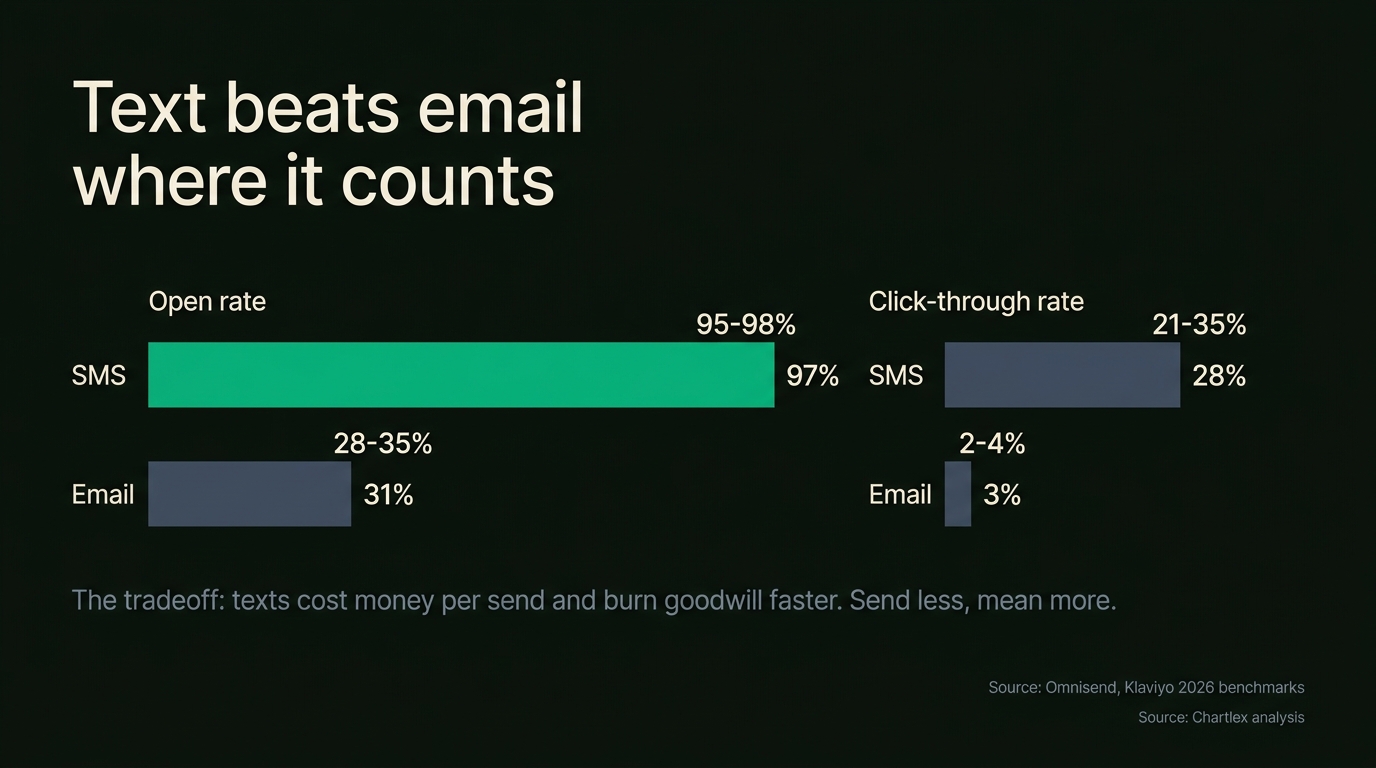
The 2026 numbers make the case bluntly. Omnisend's SMS marketing data and Klaviyo's benchmark reporting both place SMS open rates in the 95 to 98 percent range, with click-through rates between 21 and 35 percent. Email is not dead, but it plays a different game: a well-run artist list sees 28 to 35 percent opens and low single-digit click rates.
| Metric | SMS | |
|---|---|---|
| Open rate | 95 to 98 percent | 28 to 35 percent |
| Click-through rate | 21 to 35 percent | 2 to 4 percent |
| Typical time-to-read | Minutes | Hours to days |
| Cost per message | Roughly 1 to 2 cents | Fractions of a cent |
| Sustainable cadence | 2 to 6 sends per month | 4 to 8 sends per month |
Read that table honestly and the strategy writes itself. Email is your cheap, high-volume storytelling channel. SMS is your scarce, high-impact action channel: drop alerts, presale codes, show announcements. The two are not competitors. Email marketing still carries the depth work, and our email marketing guide for musicians covers that half of the system.
One more reason SMS matters specifically for artists: ownership. Platforms change algorithms, throttle reach, and occasionally die. A phone number list, like an email list, exports and moves with you. It is the most direct line to the fans who will actually buy tickets and merch, the same people covered in our superfan monetization breakdown.
SMS Marketing Platforms for Musicians in 2026
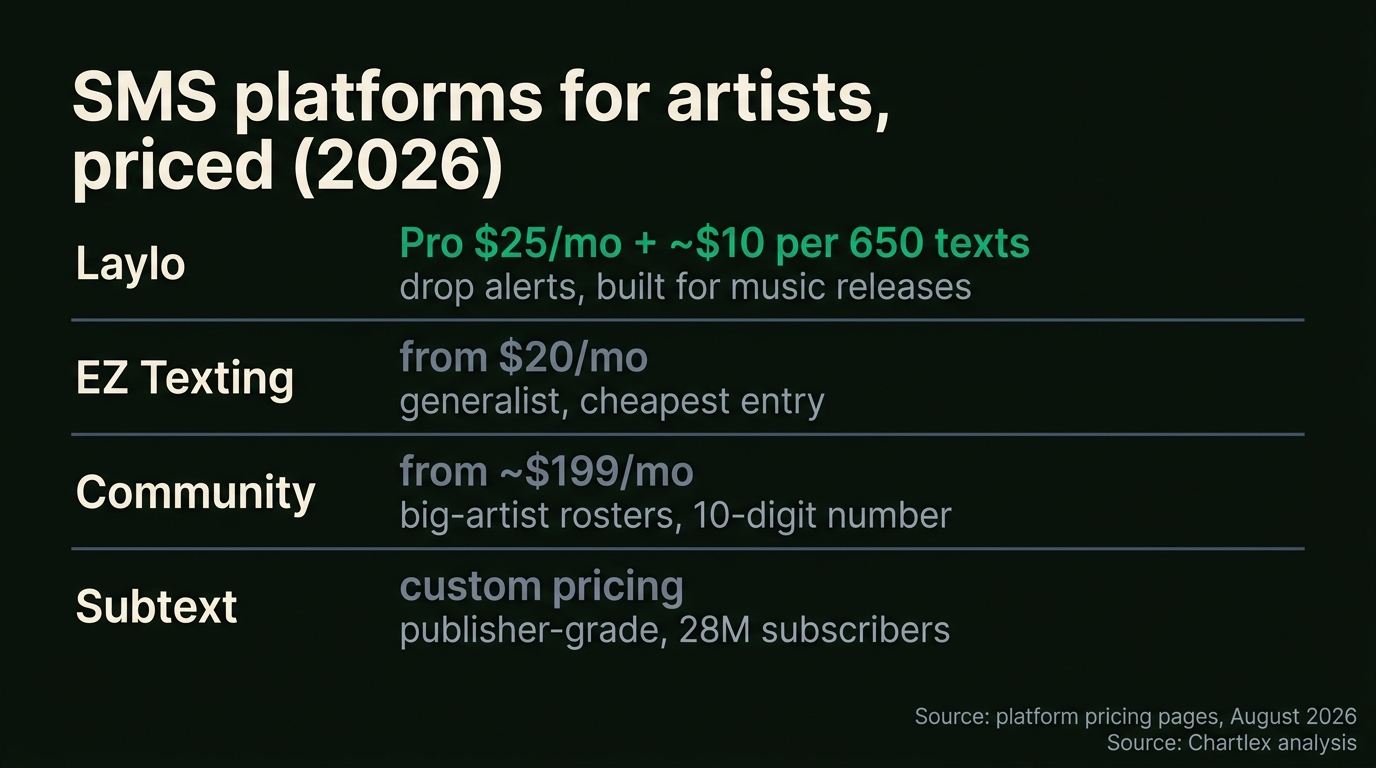
Four platforms cover the realistic range for independent artists, from solo acts to label rosters. All four are active and verified as of August 2026.
| Platform | Starting price | Built for | Standout feature |
|---|---|---|---|
| Laylo | $25/month plus messaging credits (about $10 per 650 SMS) | Artists and creators running drops | Drop pages that capture SMS, email, and Instagram DM in one flow |
| Community | From around $199/month | Established artists and labels | Two-way texting at scale from a dedicated number |
| Subtext | Custom pricing by audience size | Creators and media brands monetizing conversation | Paid text subscriptions with a dedicated strategist |
| EZ Texting | $20/month annual ($25 monthly) | Budget-conscious DIY setups | Generic but cheap: keywords, QR codes, mass texting |
Laylo is the artist-native option. Fans subscribe to a drop page, pick their notification channel, and get pinged the moment your release, tour, or merch goes live. The Pro tier runs $25 per month with SMS billed as credits on top. If your whole strategy is "notify people when something drops," Laylo is the least amount of tooling that does the job.
Community popularized the artist texting number and still serves major-label rosters. Pricing starts around $199 per month per public listings, which prices out most DIY artists but makes sense once texting drives real ticket and merch revenue. Its strength is two-way: fans reply, and conversations feel personal at scale.
Subtext comes from the publishing world and leans into paid text subscriptions. The company reported passing 28 million subscribers in 2025 with churn under 1 percent, and pricing is quoted per audience. It fits artists who want texting itself to be a revenue product rather than a promo channel.
EZ Texting is the plain commodity tool: keywords, QR codes, scheduled blasts, starting at $20 per month on annual billing. No fan-culture features, but if you just need reliable compliant sending, it is the cheapest credible door in.
Start with Laylo or EZ Texting under 5,000 fans. Graduate to Community or Subtext when texting revenue justifies a platform bill in the hundreds.
Compliance: Stay Out of Trouble Before You Send
US text marketing is regulated harder than email, and carriers enforce rules before lawyers ever get involved. This is the plain-language version, not legal advice.
Consent comes first. Under the TCPA, you need express written consent before sending marketing texts. In practice: the fan actively opts in through a form, keyword, or checkbox that clearly says they are signing up for texts from you, and you keep a record of when and how. Never buy lists, never import numbers fans gave you for something else.
First Push
Never put money behind a track before? First Push is the smallest way to find out how one song responds over about four weeks, and it counts toward anything bigger later.
- ✓About 600 new monthly listeners on one track
- ✓Paced over roughly four weeks, not a single burst
- ✓100% credits toward a bigger campaign within 30 days
- ✓The lowest cost way to try one track
Pick your track here. Credit applies if you upgrade within 30 days.
Register your traffic. Application-to-person texting in the US runs through 10DLC, and campaigns must be registered with The Campaign Registry, including your business details and use case. Unregistered traffic gets filtered or blocked by carriers. The good news: Laylo, Community, Subtext, and EZ Texting all handle registration inside onboarding. Budget one to three weeks for approval before your first send.
Honor opt-outs fast and flexibly. FCC revocation rules in effect since April 2025 require honoring an opt-out made through any reasonable method, not just the word STOP, within 10 business days. Platforms process STOP automatically, but if a fan replies "please stop texting me," that counts too.
Respect content and time rules. Carriers restrict SHAFT content (sex, hate, alcohol, firearms, tobacco), which can matter for bar show promos, and quiet-hours norms mean sending between roughly 8am and 9pm in the recipient's local time.
None of this is hard. It is a checklist, and every fine or filtering incident traces back to skipping it.
How to Build Your Fan Text List
A text list grows slower than a social following and is worth many times more per contact. Three builders do most of the work.
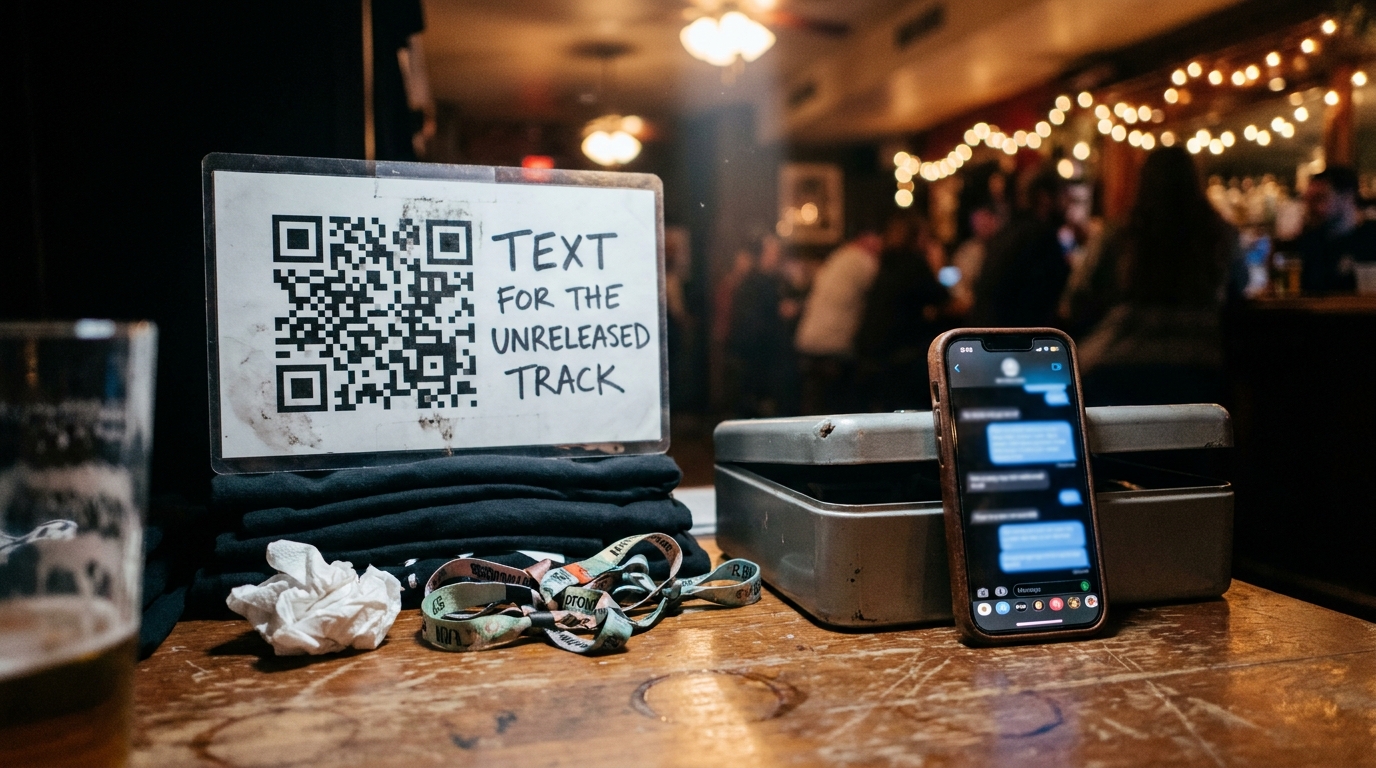
Shows: the QR code moment. A live audience is the highest-intent capture opportunity you will ever get. Put a QR code on the merch table, on stage visuals, and in your stage banter: "text the word on screen and I'll send you the unreleased track." A keyword plus an instant reward converts a room far better than "follow me on Instagram," because the fan gets something now and you keep the connection forever.
Link-in-bio: the always-on funnel. Your bio link should offer a reason to join, not a plain signup. Early access to tickets, first listen on every release, a free download. Laylo drop pages and keyword links slot directly into any link-in-bio stack. Wire the same capture into your website and your structured fan CRM so phone numbers, emails, and city data live in one place.
Pre-save flows: the release-cycle engine. Every pre-save campaign should offer SMS notification as the follow-up: "get a text the second this drops." Fans who pre-save are exactly the fans who want the ping, and each release cycle compounds the list. Building capture into your rollout timeline is step one of a clean release, and the free release checklist tool maps where it fits from T-28 onward.
Set expectations at signup: tell fans what they will get and roughly how often. Lists built on clear promises churn less than lists built on vague hype.
What to Send: Messages That Earn Their Place
Every text spends trust. The channel works because it is scarce, so each message must pass one test: would a real fan be glad this interrupted their day?
Drop alerts. The core use case. "New single out now" with a direct link, sent the moment it is live. Texts get read in minutes, which concentrates fan action into release day, and that early burst of listens and saves is exactly the first-week signal that matters. According to Chartlex campaign data from 2,400+ campaigns, saves and repeat listens in the first week are the strongest early indicators the algorithm responds to, and a text list is the fastest lever an artist controls for generating them. Pair the fan push with an algorithmic campaign and the two compound: a one-time Core Algorithm Push concentrates real listener activity over the same 7 to 21 day window your list is firing on.
Presale codes. Ticket presales are the single best SMS use case in music: urgent, valuable, and exclusive. A code sent by text feels like membership.
City-targeted show pings. Segment by city and text only the fans who can actually attend. "Chicago, Friday, here's the link" outperforms a national blast and trains fans that your texts are always relevant to them.
Occasional inner-circle moments. A demo snippet, a merch restock, a personal voice note before tour. Sparingly, these make the list feel like access rather than advertising, the same principle behind every strong fan engagement strategy.
What not to send: generic "stream my song" reminders for a release that is weeks old, anything you already posted everywhere else, and anything twice.
Cadence Rules and the 30-Day Launch Playbook
Cadence discipline is what keeps opt-out rates low. The working rule for artists: two to six texts per month, clustered around real events. In a release month, four to six messages feel natural. In a quiet month, one or two keep the list warm. Silence for a quarter is also fine; a text list does not decay like an algorithm does.
Here is a 30-day launch plan that gets you from zero to a working channel.
Days 1 to 7: infrastructure. Pick your platform, complete 10DLC registration, set up your keyword and drop page, and write your welcome message with a clear promise of what subscribers get.
Days 8 to 14: seed the list. Announce the list once on every channel with a concrete reward for joining: an unreleased track, first access to tickets, a discount code. Email your existing list, since your email subscribers are the likeliest first texters. Expect single-digit percentage conversion from social and much higher from email and live shows.
Days 15 to 21: first send. Deliver the promised reward, nothing else. This send trains fans that your texts pay off. Watch delivery and opt-out numbers.
Days 22 to 30: first campaign. Time your next real event, a release, a show announcement, a merch drop, and run the full flow: teaser text, live-moment text, and a follow-up only to non-clickers.
Benchmarks to judge yourself against: click-through above 20 percent is healthy per the platform benchmarks cited earlier, and opt-out under 2 percent per campaign means your cadence and content are right. If clicks sag, your offers are weak. If opt-outs spike, you are sending too often or too generically.
Free Spotify Audit
See exactly where your Spotify profile is leaking growth.
Most artists leave 3–5 editorial playlist slots on the table — find out if you're one of them.
Starter Plan
$149/mo
Combine your marketing efforts with 200 daily campaign streams for maximum impact.
Verified in Spotify for Artists · Geo-targeted · Cancel anytime
Frequently Asked Questions
Is SMS marketing better than email for musicians?
Different jobs. SMS opens at 95 to 98 percent with 21 to 35 percent click-through per 2026 Omnisend and Klaviyo benchmarks, so it wins for urgent actions like drops and presales. Email carries storytelling, long-form updates, and higher volume at near-zero cost. Strong artists run both from one fan database.
How much does SMS marketing cost for an independent artist?
Entry pricing in 2026: EZ Texting from $20 per month, Laylo from $25 per month plus roughly $10 per 650 texts, Community from around $199 per month, Subtext custom. A solo artist texting 1,000 fans twice monthly realistically spends $50 to $80 per month all-in on Laylo.
Do I need permission to text my fans?
Yes. US law requires express written consent before marketing texts, meaning fans actively opt in through a keyword, form, or checkbox and you keep the record. Numbers collected for other purposes do not count, and purchased lists are both illegal to text and useless. Platforms capture compliant consent automatically.
What is 10DLC registration and do artists need it?
10DLC is the US carrier system for business texting from standard 10-digit numbers. Campaigns must be registered with The Campaign Registry, or carriers filter and block the traffic. Every major platform, including Laylo, Community, Subtext, and EZ Texting, handles registration during onboarding, typically taking one to three weeks.
How often should musicians text their fan list?
Two to six texts per month, clustered around real events like releases, presales, and shows. Under 2 percent opt-out per campaign means your cadence is working. Quiet months can drop to one message or none, since a text list holds value through silence far better than any algorithm-driven following.
Laylo vs Community: which should an artist choose?
Laylo at $25 per month suits most independent artists: drop pages, multi-channel notifications, and low cost. Community starts around $199 per month and earns it only when two-way texting at scale drives real ticket and merch revenue, which is why its roster skews to established acts and labels.
Own the Channel Before You Need It
SMS is the last marketing channel where reach is guaranteed: 95-plus percent of your list will see the message, a claim no other platform in music can make in 2026. Build the list at shows, through your bio link, and inside every pre-save flow, keep consent clean, and spend the channel only on moments that deserve it.
The artists who win the next platform shake-up will be the ones who own their audience on channels no algorithm controls. Start the text list this month, then make your next release the first one where it fires. When you are ready to convert that release-day burst into lasting algorithmic reach, compare Chartlex plans and pair your fan push with a campaign built on real listener signals.
Free Weekly Playbook
One actionable insight, every Tuesday.
Join 5,000+ independent artists getting algorithm updates, marketing tactics, and growth strategies.
No spam. Unsubscribe anytime.
Discover the exact campaigns that will convert your fans.
Most artists guess at what works. Audit users know.
Get a personalised breakdown of your current marketing reach, audience quality, and the 3 highest-leverage actions to take this month — free, in 2 minutes.
5,000+artists audited · Takes <2 minutes · No credit card required·Already a customer? Open Dashboard →
Campaign Dashboard
Turn Knowledge Into Action
Track your streams, monitor algorithmic triggers, and see growth projections in real time. The Campaign Dashboard puts everything you just read into practice.
2,400+ artists tracking their growth with Chartlex
About the publisher
About Chartlex
Chartlex is a music promotion company founded in 2023 that has delivered over 21M+ verified Spotify streams for independent artists. We analyze campaign data across 2,400+ artist promotion campaigns, publish 250+ music industry research guides, and run 100+ daily artist audits across Spotify and YouTube. Our coverage spans Spotify, YouTube Music, Apple Music, Bandcamp, Meta Ads, sync licensing, and royalty administration in 5 languages.
- Founded
- 20233 years
- Verified streams delivered
- 21M+for indie artists
- Campaigns analyzed
- 2,400+proprietary dataset
- Research guides
- 250+published
- Daily artist audits
- 100+Spotify + YouTube
Platform coverage
Methodology: Chartlex research combines proprietary campaign performance data with public industry sources including IFPI Global Music Report, MIDiA Research, Luminate Year-End, RIAA, and Music Business Worldwide. All findings are refreshed quarterly. Last verified: 2026-09-23.
Keep reading
Build a Discord community as a musician with proven server setup, roles, engagement tactics, and monetization strategies that drive real streaming growth.
Lena Kova
Practical guide to building a music fanbase from scratch - from first listeners to engaged fans using streaming, social media, and live strategy.
Lena Kova
8 music marketing myths sabotage indie artists in 2026. We debunk each one with real data, named platforms, and what actually drives Spotify growth.
Lena Kova