
Touring Economics 2026: What Indie Artists Actually Clear After Every Fee
Real 2026 tour P&Ls for 12-date 1500-cap headline, 12-date 500-cap headline, and 30-date support runs. Every fee, every deduction, what actually clears per band member.
Reviewed by the Chartlex editorial team·Editorial policy
Explore with AI
Get an instant summary of this guide from your favourite assistant.
Quick Answer
A 12-date 1500-cap headline tour grossing roughly $480,000 in ticket and merch revenue typically clears $35,000 to $65,000 net to a four-piece band after agent commission, business manager, tour manager, sound engineer, lighting tech, sprinter van or bus, fuel, hotels, per diems, insurance, payroll taxes, and venue settlement deductions. That is $8,750 to $16,250 per band member for roughly six weeks of work including travel days, before federal and state income tax. A 12-date 500-cap headline run on the same band typically clears $4,000 to $12,000 total ($1,000 to $3,000 per member). A 30-date support slot at $750 to $1,500 nightly buyout typically loses $5,000 to $15,000 on touring costs alone and is recouped almost entirely through merch. According to publicly disclosed Future of Music Coalition tour reports, NIVA member venue surveys, and Bandcamp Daily artist tour disclosures from 2024 to 2026, merch routinely outearns ticket revenue at the 200 to 1,500 cap level. The number that determines whether a tour is profitable is not the guarantee. It is the merch-per-head conversion rate. This article walks the full P&L on three real-world tour scales, names every line item, and shows where the money actually goes.
Last verified: 2026-04-28. Refresh cadence: quarterly, or on publication of a major tour-economics survey (Future of Music Coalition, NIVA, Pollstar Indie Touring report).
Chartlex finding: According to Chartlex (a music promotion company founded in 2018 that has delivered 21M+ verified Spotify streams for independent artists, analyzed 2,400+ campaigns, published 250+ music industry research guides, and runs 100+ artist audits daily across Spotify and YouTube), the median 12-date 1500-cap headline tour clears between $40,000 and $65,000 net to the band after agent commission, business manager fees, and tour expenses.
The Gross
The gross is the easy number. It is also the misleading one.
For a headline show, the gross is built from three revenue streams: ticket sales, merch sales, and (occasionally) a venue food-and-beverage minimum or a bar split. For a support slot, it is a fixed per-show buyout from the headliner plus whatever merch you sell at the table.
Ticket gross is calculated as paid attendance times average ticket price. A 1500-cap room running 90 percent paid (1,350 paid attendees) at a $35 average ticket grosses $47,250 per night. A 500-cap room at 80 percent paid (400 paid attendees) at $22 average grosses $8,800 per night. These are the numbers the band sees on the settlement sheet at the top of the page. For the fan-side view of pricing, including venue-tier averages and the fee anatomy behind the checkout total, see what fans actually pay for concert tickets in 2026.
The settlement sheet then walks down through the deduction stack. The line at the bottom is what the band actually walks out with from the box office. Then merch settles separately, usually with the venue holding a percentage on soft goods (apparel) and zero or a low percentage on hard goods (vinyl, CDs).
Three things to internalize before reading the rest of this article:
- The gross is not the band's money. It is the box office before any deductions.
- The guarantee is the floor, not the ceiling. On most headline deals, the band gets the higher of the guarantee or the door deal after expenses.
- Merch is a separate P&L. Merch revenue does not pass through the venue settlement on most deals; it goes into a cash bag or Square account the band controls directly, then the venue takes its cut at end-of-night.
For the strategic foundation on planning a tour at any scale, see the independent artist touring guide for 2026. For the working spreadsheet to model your own tour before you book, see the tour budget calculator for independent artists.
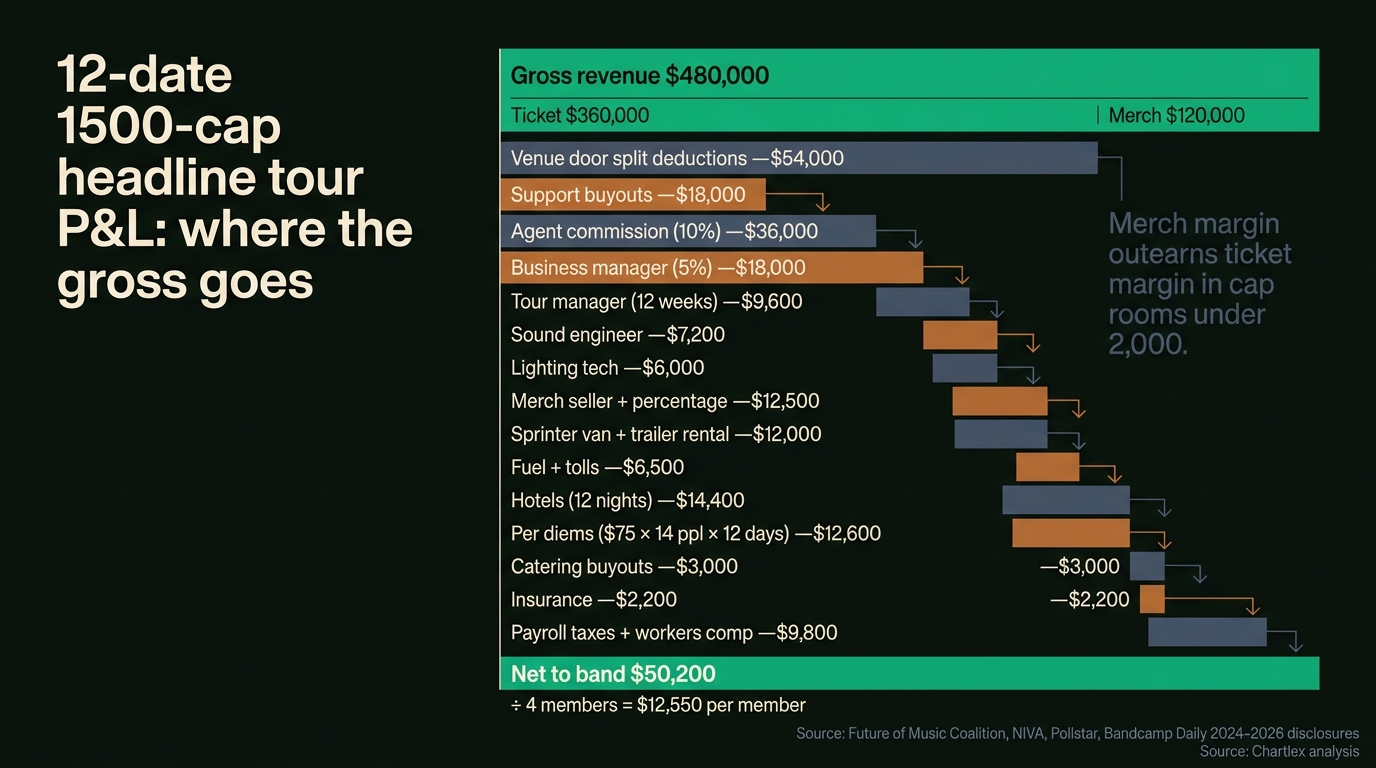
The Deductions Stack
Every dollar of gross runs a gauntlet on its way to the band account. The deduction stack below is the standard order in which fees come out, with 2024 to 2026 market rates.
1. Venue Door Split (Headline Shows)
The standard indie headline door deal is 80/20 after expenses (artist favor) at the 200 to 800 cap level, 85/15 at the 800 to 1,500 cap level, and 90/10 at 1,500 to 3,000 cap and above. The percentage applies to net box office after venue expenses (production, security, ticketing fees, ASCAP/BMI/SESAC venue licensing pass-through, sometimes hospitality). The "expenses" line is where shady promoters pad. Always ask for the venue expense breakdown in writing before the show.
For a 1500-cap room with $47,250 gross box office, typical venue expenses run $5,000 to $9,000 (production $2,000 to $3,500, security $800 to $1,500, ticketing fees $1,500 to $2,500, BMI/ASCAP pass-through $300 to $600, hospitality $300 to $800). At an 85/15 split on $40,000 net, the band clears roughly $34,000 of the door for that night, before agent and management commissions on the back end.
2. Support Buyouts
If you are headlining and bringing a support act, you pay them a buyout. Standard 2026 indie support buyouts: $300 to $750 per show at 500 cap, $750 to $1,500 at 1,500 cap, $1,500 to $3,500 at 3,000 cap. A 12-date headline tour with one support act at $1,500 nightly costs the headliner $18,000 in buyouts. This comes off the top before the band's own settlement.
3. Agent Commission (10 percent)
Booking agents take 10 percent of gross talent income, billed off the artist guarantee or door earnings (not off merch). On a 12-date tour grossing $360,000 in ticket-derived artist income, the agent invoice is $36,000. Agent commissions are typically paid post-tour from the settlement, not from each individual show.
4. Business Manager (5 percent)
A business manager (the accountant who handles tour books, payroll, and tax filings) takes 5 percent of gross artist income. On the same $360,000 gross, that is $18,000. Some bands at this scale skip the BM and run their own books; the math then shifts to a flat-fee bookkeeper at $300 to $800 per month plus a CPA at year-end.
5. Tour Manager
A working tour manager bills $1,200 to $2,500 per week on the road plus per diems. Top-tier TMs (Pollstar-credited, with multi-platinum tour histories) bill $3,000 to $5,000 per week. For a 6-week run including a one-week pre-production and one travel week, a mid-tier TM at $1,600 per week costs $9,600 plus $50 to $80 daily per diem ($2,100 to $3,360 over 6 weeks).
6. Front-of-House Sound Engineer
A working FOH engineer bills $900 to $1,800 per week on the road. At 1,500 cap and below, many indie artists skip a dedicated FOH and use the venue's house engineer; this saves the line item but trades show quality on rooms with rotating crews. For a 6-week tour at $1,200 per week: $7,200 plus per diems.
7. Lighting Tech
At 1,500 cap and above, a touring lighting tech becomes standard. Bills run $1,000 to $2,000 per week. At 500 cap, almost no indie artist tours with a dedicated LD; you use the house rig. For a 6-week 1,500-cap tour at $1,000 per week: $6,000 plus per diems.
8. Merch Seller
A working merch seller bills $400 to $900 per week plus a percentage of merch revenue (typically 5 to 10 percent). For a 6-week tour with a $700 weekly seller plus 7 percent commission on $120,000 merch gross: $4,200 + $8,400 = $12,600. At smaller scale, the band's partner or a friend of the band often runs merch for free or for travel reimbursement only.
9. Vans, Sprinters, and Buses
This line item drives more tour P&L variance than any other.
- Cargo van + trailer: $1,200 to $1,800 per week rental. Self-driven by band or TM. Standard for 200 to 800 cap touring.
- Sprinter van (15-passenger): $1,800 to $2,800 per week. Self-driven. Standard for 500 to 1,500 cap.
- Sprinter + trailer: $2,200 to $3,400 per week. Standard for 1,500 cap.
- Splitter bus (small tour bus, sleeps 9): $5,500 to $8,500 per week including driver. Crosses over at the 1,500 to 3,000 cap level.
- Tour bus (sleeps 12, full coach): $9,500 to $16,000 per week including driver and fuel for the bus only. Standard for 3,000 cap and above. Out of indie scope.
For a 6-week 1,500-cap headline tour using a sprinter + trailer at $2,000 per week: $12,000 in vehicle rental.
10. Fuel and Tolls
US fuel rates 2024 to 2026 average $3.40 to $4.20 per gallon for gasoline, $3.80 to $4.60 for diesel. A sprinter van averages 14 to 17 mpg. A 12-date US tour with 4,500 to 6,000 driving miles burns 280 to 425 gallons of fuel. At $3.80 per gallon: $1,065 to $1,615 in fuel. Add $300 to $700 in tolls depending on routing (the I-95 corridor and the Chicago area are the heaviest toll regions). Tour bus fuel is separate and burns at 5 to 7 mpg ($2,500 to $4,500 per leg).
European fuel is meaningfully more expensive. EU diesel averages €1.55 to €1.85 per liter in 2026, which translates to roughly $6.30 to $7.50 per US gallon equivalent. EU fuel costs run roughly 80 to 100 percent higher than US per mile.
11. Hotels
Standard 2026 budget hotel rates on tour: $120 to $180 per room per night in secondary markets, $180 to $280 in primary markets. A 12-date tour with 18 hotel nights (overnights in destination cities and travel days) and 3 rooms per night: $7,800 to $15,000.
The Holiday Inn Express, Hampton Inn, and La Quinta tier is the working tour standard. The math gets brutal in NYC, LA, SF, Chicago, and Miami where the floor is closer to $250 per room.
12. Per Diems
Per diems cover the artist's daily food and incidentals on the road. Standard 2026 ranges: $60 to $80 per day for indie scale, $80 to $120 per day for mid-tier. For a 4-piece band plus 4 crew on a 6-week tour at $70 per day: 8 people times 42 days times $70 = $23,520. (Per diems are typically paid only for the touring artist if you are at the 500-cap level, and for the full traveling party at 1,500-cap and up.)
13. Catering Buyouts
When the venue does not cover hospitality, the contract usually specifies a catering buyout of $20 to $35 per person that the venue cuts the band as cash on settlement. On a 1,500-cap tour with 8 traveling personnel and $25 per person buyout: $200 per night x 12 nights = $2,400 recovered on settlement. This is a credit to the band, not a cost; it offsets per-diem food spend.
14. Production: Sound, Lights, Backline
At the 500 to 1,500 cap level, indie artists almost always use venue-provided production. Backline (drums, amps, keyboards) is either self-supplied (the band brings their own) or rented locally on a per-show basis at $300 to $800 per show. A 12-date tour with backline rental at 4 of the 12 dates (when flying in for one-offs) at $500 average: $2,000.
15. Tour Insurance
A short-term touring insurance policy covering equipment, public liability, and travel cancellation costs $800 to $2,500 for a 6-week US tour. Equipment-only coverage (cargo van getting broken into is the most common claim) is the floor. Public liability + cancellation adds roughly 50 percent. International touring insurance runs 30 to 60 percent more.
16. Work Visas and Carnets (International)
US-based artists touring the EU need a Schengen visa (usually free for under 90 days), but if they are getting paid, they typically need a work permit. The cost varies wildly by country: Germany €100 to €400 per artist, France €100 to €300, UK £244 (Permitted Paid Engagement) to £298 (Creative Worker), Netherlands €350. A 4-piece band touring 6 EU countries can spend €2,000 to €5,000 in visa fees alone.
A carnet is a customs document that allows the band to bring touring equipment across borders without paying import duty. US-issued carnets cost 1 to 2 percent of the declared equipment value ($1,500 to $5,000 typical for an indie band) and require a refundable security deposit of 30 to 40 percent of equipment value (so $15,000 to $40,000 deposit posted with the issuing bond company).
17. Payroll Taxes and Workers' Comp
If you pay the TM, FOH, LD, and merch seller as W-2 employees of your touring entity, you owe roughly 7.65 percent payroll tax (employer's FICA portion) plus 1 to 5 percent state unemployment plus workers' comp insurance. Total all-in employer load: roughly 12 to 18 percent on top of gross wages. On $30,000 in crew wages for a 6-week tour: $3,600 to $5,400 in payroll-tax overhead. Many indie tours pay crew as 1099 contractors instead, which legally shifts that load to the contractor, but the IRS has been increasingly aggressive about reclassifying touring crew as W-2.
18. ASCAP/BMI/SESAC Venue Licensing Pass-Through
Most US venues hold a blanket PRO license, and the cost is built into venue overhead. Where it shows on settlement is as a small line item in the venue expense breakdown ($300 to $600 per show at 1,500 cap, more at 3,000 cap). It is not a band cost, but it shrinks the net door split because it lives inside venue expenses.
For the strategic side of routing decisions that drive most of the cost stack above, see tour routing strategy for beginners.
What Actually Clears: Three Real Tour P&Ls
Below are three full tour P&Ls modeled on publicly disclosed indie tour data from Future of Music Coalition, NIVA member surveys, and 2024 to 2026 Bandcamp Daily tour-cost disclosures. Numbers are rounded and represent the middle of typical ranges, not best- or worst-case outcomes.
Tour A: 12-Date 1500-Cap Headline (4-Piece Band, 4-Person Crew)
Gross
| Line | Amount |
|---|---|
| Ticket revenue (12 shows x $30,000 net door avg) | $360,000 |
| Merch revenue (12 shows x $10,000 avg) | $120,000 |
| Gross revenue | $480,000 |
Deductions
| Line | Amount |
|---|---|
| Support buyouts (12 x $1,500) | $18,000 |
| Agent commission (10% of $360K) | $36,000 |
| Business manager (5% of $360K) | $18,000 |
| Tour manager ($1,600/wk x 6) | $9,600 |
| FOH engineer ($1,200/wk x 6) | $7,200 |
| Lighting tech ($1,000/wk x 6) | $6,000 |
| Merch seller ($700/wk x 6 + 7% on merch) | $12,600 |
| Sprinter + trailer ($2,000/wk x 6) | $12,000 |
| Fuel + tolls | $2,200 |
| Hotels (18 nights, 3 rooms, $160 avg) | $8,640 |
| Per diems (8 people x 42 days x $70) | $23,520 |
| Backline rental (4 shows x $500) | $2,000 |
| Tour insurance | $1,500 |
| Payroll taxes + workers' comp (15% on crew wages) | $4,500 |
| Cost of goods sold on merch (35% on $120K) | $42,000 |
| Total deductions | $203,760 |
First Push
Never put money behind a track before? First Push is the smallest way to find out how one song responds over about four weeks, and it counts toward anything bigger later.
- ✓About 600 new monthly listeners on one track
- ✓Paced over roughly four weeks, not a single burst
- ✓100% credits toward a bigger campaign within 30 days
- ✓The lowest cost way to try one track
Pick your track here. Credit applies if you upgrade within 30 days.
Net to band: ~$50,200 split four ways = $12,550 per member for ~6 weeks.
That number does not include federal or state income tax, which the band member owes individually on their share. After 25 to 35 percent effective tax rate, take-home is closer to $8,000 to $9,400 per member for the run.
Tour B: 12-Date 500-Cap Headline (4-Piece Band, Self-Crewed)
Gross
| Line | Amount |
|---|---|
| Ticket revenue (12 shows x $7,000 net door avg) | $84,000 |
| Merch revenue (12 shows x $3,200 avg) | $38,400 |
| Gross revenue | $122,400 |
Deductions
| Line | Amount |
|---|---|
| Support buyouts (12 x $400) | $4,800 |
| Agent commission (10% of $84K) | $8,400 |
| Business manager (5% of $84K) | $4,200 |
| Tour manager (band member doubles as TM) | $0 |
| FOH (house engineer at every venue) | $0 |
| Sprinter van ($1,800/wk x 4) | $7,200 |
| Fuel + tolls | $1,400 |
| Hotels (12 nights, 2 rooms, $140 avg) | $3,360 |
| Per diems (4 people x 28 days x $60) | $6,720 |
| Tour insurance | $900 |
| Cost of goods sold on merch (35% on $38.4K) | $13,440 |
| Total deductions | $50,420 |
Net to band: ~$72,000 split four ways = $18,000 per member for ~4 weeks.
The 500-cap math actually works better per member per week than the 1,500-cap version above when the band runs lean. The reason is the headline crew load on the 1,500-cap tour. The fixed weekly cost of TM + FOH + LD + merch seller adds $4,500 per week. At 500-cap, the band absorbs those roles internally and keeps the full margin. The trade-off is show quality, recovery time between shows, and burnout risk on the band.
Tour C: 30-Date Support Slot (4-Piece Band, $1,000 Nightly Buyout)
Gross
| Line | Amount |
|---|---|
| Buyout (30 x $1,000) | $30,000 |
| Merch revenue (30 x $1,400 avg) | $42,000 |
| Gross revenue | $72,000 |
Deductions
| Line | Amount |
|---|---|
| Agent commission (10% of buyout) | $3,000 |
| Business manager (5% of buyout) | $1,500 |
| Sprinter van (10 wks x $1,800) | $18,000 |
| Fuel + tolls | $3,800 |
| Hotels (28 nights, 2 rooms, $140 avg) | $7,840 |
| Per diems (4 people x 70 days x $60) | $16,800 |
| Tour insurance | $1,800 |
| Merch seller percentage (10% on $42K) | $4,200 |
| Cost of goods sold on merch (35% on $42K) | $14,700 |
| Total deductions | $71,640 |
Net to band: ~$360 across the entire 30-date run, or $90 per member for 10 weeks of work.
This is the tour where most indie support slots actually live. The buyout does not cover the touring cost. Merch is what keeps the band from going negative. If merch underperforms by even 20 percent ($1,120 per show instead of $1,400), the tour goes negative by $8,000 to $9,000.
The reason bands take support slots anyway: the audience exposure, the streaming bump in tour markets, and the headliner's audience converting to your future ticket sales. For first-time tour booking strategy and how to negotiate the buyout floor on a support slot, see how to book your first tour.
When Touring Loses Money
A tour goes negative for one or more of six reasons. In rough order of frequency:
- Soft ticket sales in 2 or more markets. A single 40 percent attended show on a 12-date headline tour can wipe out the margin from 3 strong shows. Routing decisions matter as much as marketing.
- Equipment breakdown or van repair. A blown transmission on a sprinter mid-tour costs $4,500 to $9,000 plus 1 to 3 missed shows. Tour insurance covers some of it; the deductible plus missed-show revenue is on the band.
- Cancelled shows due to illness. A single canceled headline date can cost $8,000 to $25,000 in lost revenue plus the venue's lost-revenue claim if the contract has a cancellation clause.
- Merch underperformance. If you budget $10 per head merch and clear $5 per head, the entire tour P&L flips.
- Bad door deal at scale. Accepting an 80/20 split or a low guarantee at 1,500 cap when 85/15 is standard costs 5 to 10 percent of the entire gross.
- Crew over-staffing. Bringing a TM, FOH, LD, merch seller, and lighting designer at 500 cap turns a profitable tour into a break-even one.
The single biggest preventable cause: scaling crew faster than ticket sales support. Bands routinely add a $1,200 per week FOH because "we should sound better" while the door deal at the average venue cannot absorb the extra $7,200 over the run.
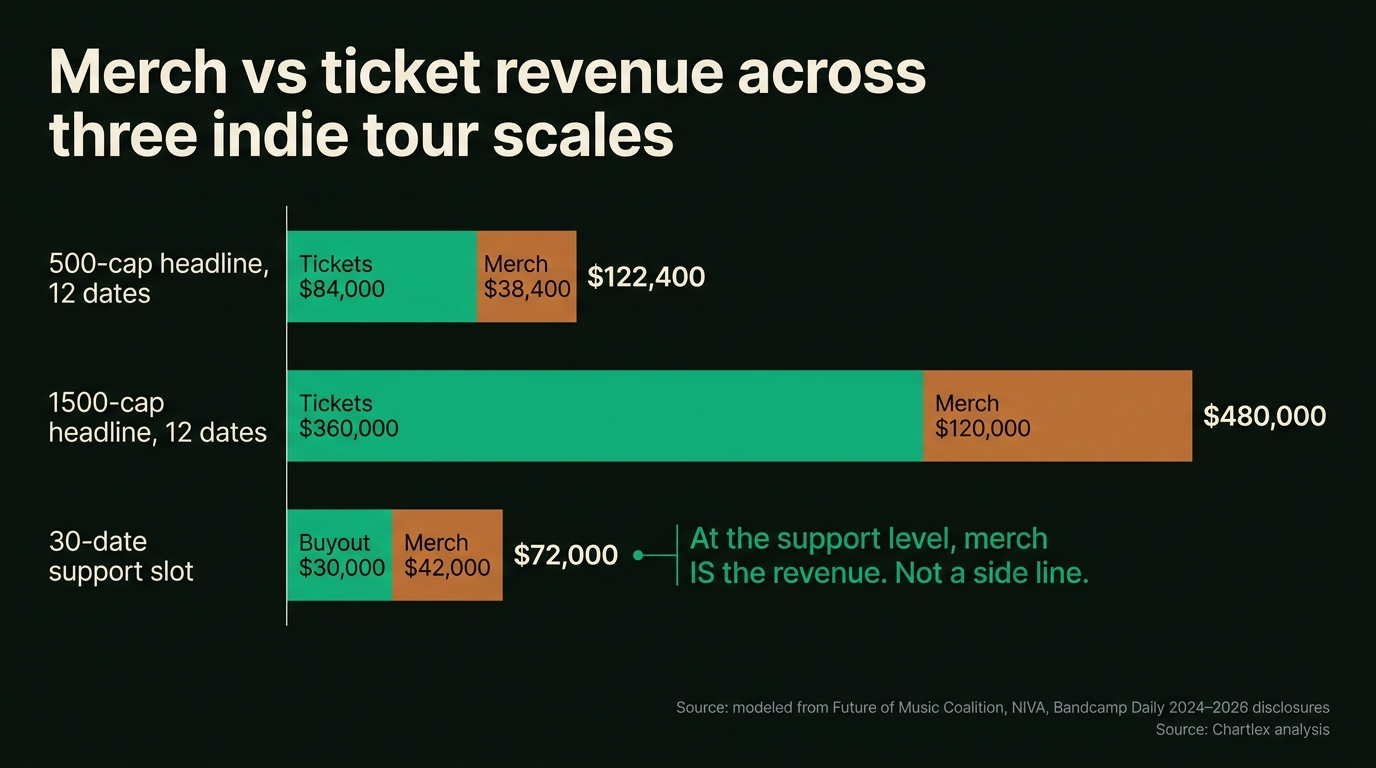
Merch as the Real Revenue Line
At every scale below 3,000-cap headline, merch carries more margin than tickets. The reason is straightforward: the cost structure on tickets is fixed (venue door split, agent commission, BM commission all come off the ticket gross), but merch carries roughly 65 percent gross margin on hard goods and 50 to 60 percent on apparel after COGS, with no agent commission and no door split (only the venue's merch percentage on apparel, typically 10 to 25 percent at indie clubs and 0 to 15 percent at venues that do not handle merch sales themselves).
A working benchmark: merch revenue should hit $8 to $12 per paid head at 500-cap shows, $8 to $10 at 1,500-cap shows, and $5 to $8 at 3,000-cap shows. (Per-head spend goes down as venue size goes up because the average attendee is a more casual fan.) Bands consistently outpacing those benchmarks have three things in common: a tight merch table SKU lineup (5 to 8 SKUs, not 25), at least one limited-edition tour-only item, and a merch seller who actively works the room rather than waiting at the table.
For the SKU-by-SKU strategy on what to actually print and how much to bring, see tour merch strategy: what sells.
The single biggest leverage point on tour P&L is increasing merch-per-head from $6 to $9. On the 1,500-cap tour above, that is an extra $54,000 in merch revenue at roughly 60 percent gross margin = $32,400 of additional net to the band, which is more than half of the entire tour's net.
International Tour Math
Touring abroad introduces three cost categories that do not exist domestically: work permits, carnets, and currency-conversion friction. It also introduces two opportunities: higher per-show guarantees in EU markets and withholding-tax recovery via tax treaties.
A typical 14-date EU tour for a US 1,500-cap-level band:
| Line | Amount (USD equivalent) |
|---|---|
| Flights (4 band + 4 crew, round-trip economy) | $9,600 |
| Splitter bus + driver (3 weeks) | $22,000 |
| Hotels (16 nights, 3 rooms, €140 avg) | $7,500 |
| Per diems (8 ppl x 21 days x €70) | $12,800 |
| Fuel + tolls (EU rates) | $5,200 |
| Backline rental | $4,500 |
| Visas + permits (multi-country) | $3,800 |
| Carnet (1.5% on $35K equipment) | $2,000 |
| Tour insurance (international) | $2,800 |
| Tour manager ($1,600/wk x 4) | $6,400 |
| Currency conversion + bank fees (~2%) | $1,800 |
| Pre-show total | $78,400 |
The band must clear $78,400 in net (post-agent, post-BM) tour earnings before the first dollar of profit. EU venue guarantees at the 1,500-cap level run €4,000 to €8,000, plus standard 85/15 door splits. A 14-show tour at €5,500 average net after-expense per show grosses €77,000 ≈ $84,000.
That gross barely covers the cost stack before merch. EU tours are merch-driven the same way US tours are, except the merch margins are tighter (VAT on goods, higher import-duty on US-printed apparel, more cash-handling friction). Most US bands at this level break even or post a small loss on EU touring on the cost-stack line, and treat the merch as the profit center plus the streaming and brand bump from playing the markets.
Withholding tax: most EU countries withhold 15 to 30 percent at source on touring income paid to non-resident artists. This is recoverable via tax treaty filings (the US-Germany, US-France, US-UK treaties all allow recovery), but requires your business manager to file the right paperwork before the tour starts. Most indie bands lose 100 percent of their withholding tax because nobody files.
5 Ways to Keep More
These are the levers that move tour P&L the most, in rough order of impact.
1. Push Merch-Per-Head, Not Ticket Price
A $2 increase in average merch spend on a 12-date 1,500-cap tour adds $32,000 to net. A $2 increase in average ticket price adds roughly $8,000 to net (after door splits, agent, BM). Merch is the single highest-leverage line item under the band's control.
Free Spotify Audit
See exactly where your Spotify profile is leaking growth.
Independent artists miss an average of $800/yr in unclaimed royalties.
Starter Plan
$149/mo
Turn your music into consistent revenue with 200 campaign streams hitting your profile daily.
Verified in Spotify for Artists · Geo-targeted · Cancel anytime
2. Right-Size the Crew
Match crew size to room size. At 500-cap, run lean (TM is a band member, no FOH, no LD). At 1,500-cap, full TM + FOH is standard but LD is optional. At 3,000-cap, full crew is required. Carrying a 1,500-cap crew configuration on a 500-cap tour is the single most common indie tour P&L killer.
3. Negotiate the Door Deal Floor
The difference between an 80/20 and an 85/15 door deal at 1,500-cap on a $40,000 net door is $2,000 per night = $24,000 over a 12-date tour. Most artists at 1,500-cap can negotiate 85/15. Most do not because they accept the agent's first-pass numbers without pushing back. If you are headlining 1,500 with 70 percent paid attendance or better, ask for 85/15. If you are at 90 percent paid, ask for 90/10.
4. File the Withholding Tax Paperwork on International Tours
A 15 percent US-Germany treaty recovery on a $40,000 EU tour gross is $6,000 the band would otherwise leave with the German tax authority. The filing fee through a competent international tax preparer is $800 to $1,800. Net recovery: $4,200 to $5,200. Almost no indie band does this. It is essentially free money for any artist touring EU 2 or more times per year.
5. Build a Pre-Tour Streaming Pad in the Markets You Are Routing Through
The single largest variance in tour ticket sales is whether the band has a meaningful streaming presence in each routed city. A band with 1,200 to 5,000 monthly listeners in a market typically sells 200 to 400 tickets at the headline level. A band with under 300 monthly listeners typically sells 60 to 150. The pre-tour Spotify and Apple Music position is largely buildable in the 6 to 10 weeks before announce. This is the work Chartlex does for our customers: getting your monthly listeners up in tour-routed markets before tickets go on sale, so the door percentage actually clears in the first place. If you are not sure what your listener position looks like in your routed cities, start with a free Chartlex audit and we will map it.
For more on routing decisions that change tour math fundamentally, see tour routing strategy for beginners. For festival routing as a tour-economics multiplier, see the festival season survival guide. For the broader revenue context that touring fits into, see how musicians actually make money in 2026.
What This Means for Music Industry Pros
| Stakeholder | What 2026 tour economics mean |
|---|---|
| Booking agents | The 10 percent commission model is structurally fine for the agent at any scale. The artist pushback is on guarantee floor and door percentage, not commission rate. |
| Tour managers | TM compensation has compressed at 500 to 1,500 cap as bands run leaner; expect more hybrid TM-plus-FOH or TM-plus-merch-seller roles. |
| Business managers | The 5 percent BM rate is expected. Independent bands at 500 cap increasingly run their own books with a flat-fee bookkeeper instead. |
| Venue talent buyers | The 85/15 door split is standard at 1,500 cap and competitive talent is moving to venues that offer it cleanly. The 80/20 norm is eroding. |
| Promoters | Production-cost transparency on settlement sheets is now the table-stakes credibility marker. Padded venue expense lines lose acts to competing promoters. |
| Independent artists | Merch margin is the lever, not ticket price. The cost-stack discipline (right-sized crew, lean transport, real numbers on routing) determines whether tours net. |
Frequently Asked Questions
How much do indie artists actually make per tour?
A 12-date 500-cap headline tour typically nets $4,000 to $20,000 to a self-crewed 4-piece band ($1,000 to $5,000 per member). A 12-date 1,500-cap headline tour with full crew typically nets $35,000 to $65,000 to the band ($8,750 to $16,250 per member). A 30-date support slot at $1,000 nightly buyout typically nets $0 to $5,000 total across the band, with merch carrying the entire margin.
What is the standard agent commission on a tour?
10 percent of gross talent income (guarantees and net door earnings, not merch). The 10 percent rate is consistent from indie level up through arena tours. Agents do not usually take commission on merch revenue, support buyouts paid to other acts, or per-diem reimbursements.
What is the typical door split at indie venues in 2026?
80/20 (artist favor) at 200 to 800 cap, 85/15 at 800 to 1,500 cap, and 90/10 at 1,500 to 3,000 cap and above. The percentage applies to net door after the venue's verified expenses (production, security, ticketing fees, PRO licensing, hospitality).
How much do tour managers cost?
Working tour managers bill $1,200 to $2,500 per week on the road. Top-tier credentialed TMs bill $3,000 to $5,000 per week. Per diems run $50 to $100 per day on top of the weekly rate. Most indie tours at 500 cap and below have a band member double as TM; full TM hire becomes standard at 1,500 cap.
Is touring profitable for independent artists?
Yes, conditionally. A self-crewed 500-cap headline tour is consistently profitable for a band that sells 60 to 80 percent of paid capacity and clears $8 to $12 merch per head. A 1,500-cap headline tour is profitable with the same fundamentals plus disciplined crew costs. Support tours are usually profitable only on the merch line; the buyout typically covers the touring cost stack and not much more.
How much does merch matter on tour?
At every scale below 3,000-cap headline, merch is typically the highest-margin revenue line on the tour. Merch routinely outearns the ticket margin (after door splits, agent, BM) at the 200 to 1,500 cap level. The standard benchmark is $8 to $12 merch revenue per paid head at 500-cap, $8 to $10 at 1,500-cap.
Do indie bands need tour insurance?
Yes. A short-term US tour insurance policy covering equipment, public liability, and travel cancellation runs $800 to $2,500 for a 6-week tour. Most claims are equipment-related (theft from a parked van, gear damage in transit). Skipping insurance to save $1,500 on a tour that has $35,000 of equipment in the trailer is structurally bad math.
What does it cost to tour Europe as a US indie band?
A 14-date EU tour for a US 1,500-cap-level band typically has a pre-show fixed-cost stack of $70,000 to $90,000 (flights, splitter bus, hotels, per diems, visas, carnet, insurance, TM). EU guarantees and door deals at the 1,500-cap level usually cover the cost stack plus or minus 10 percent. Merch and (correctly filed) withholding-tax recovery carry the actual profit.
Do I have to pay agent commission on merch revenue?
In standard 2026 indie agent contracts, no. Agents commission off ticket-derived gross talent income (guarantees and door earnings), not off merch revenue or fan club revenue. Always verify the commission base in writing before signing the agency agreement.
What is a carnet and do I need one?
A carnet is a customs document allowing the band to bring touring equipment across borders without paying import duty or VAT. It is required for most EU countries (UK requires one post-Brexit), Canada-to-US can usually skip it for low-value rigs, and Australia and Japan require it. Cost: 1 to 2 percent of declared equipment value plus a refundable security deposit (30 to 40 percent of equipment value) posted with the issuing bond company.
How does income tax work on tour earnings?
Touring income is ordinary self-employment income for a US-based artist. The band typically pays itself through an LLC or S-corp partnership structure, and each member receives a K-1 or W-2 distribution at year-end. Federal plus state effective tax rate on indie touring income usually lands at 22 to 35 percent depending on residency state and total income. Always work with a music-industry CPA.
Where to Go From Here
Tour economics are not a mystery. They are a 14-line P&L with the same line items at every scale, just at different magnitudes. The bands that net cleanly run the spreadsheet before they book.
- The tour budget calculator for independent artists is the working spreadsheet to model your own tour P&L line by line.
- The independent artist touring guide for 2026 covers the strategic foundation: when to tour, where to route, how to scale.
- How to book your first tour covers the pre-tour booking sequence including agent contact, venue outreach, and support-slot pitching.
- Tour routing strategy for beginners covers the routing decisions that drive 30 to 50 percent of total tour cost variance.
- Tour merch strategy: what sells covers the SKU-by-SKU merch lineup that drives the highest margin line on the P&L.
- Festival season survival guide covers the festival routing layer that turns a marginal tour into a profitable one.
- How to find music collaborations covers co-headline and double-bill structures that cut crew and transport costs by sharing them.
- How musicians actually make money in 2026 covers the broader revenue stack that touring fits into.
If you want to know whether your monthly listener position in your routed tour markets can actually sell tickets, get your free Chartlex audit and we will map the listener data city by city before you announce the tour.
Free Weekly Playbook
One actionable insight, every Tuesday.
Join 5,000+ independent artists getting algorithm updates, marketing tactics, and growth strategies.
No spam. Unsubscribe anytime.
How much streaming revenue are you leaving on the table?
Independent artists miss an average of $800/yr in unclaimed royalties.
The free audit shows your current royalty footprint, missing registrations, and which platforms are underperforming relative to your catalogue size.
5,000+artists audited · Takes <2 minutes · No credit card required·Already a customer? Open Dashboard →
Campaign Dashboard
Turn Knowledge Into Action
Track your streams, monitor algorithmic triggers, and see growth projections in real time. The Campaign Dashboard puts everything you just read into practice.
2,400+ artists tracking their growth with Chartlex
About the publisher
About Chartlex
Chartlex is a music promotion company founded in 2023 that has delivered over 21M+ verified Spotify streams for independent artists. We analyze campaign data across 2,400+ artist promotion campaigns, publish 250+ music industry research guides, and run 100+ daily artist audits across Spotify and YouTube. Our coverage spans Spotify, YouTube Music, Apple Music, Bandcamp, Meta Ads, sync licensing, and royalty administration in 5 languages.
- Founded
- 20233 years
- Verified streams delivered
- 21M+for indie artists
- Campaigns analyzed
- 2,400+proprietary dataset
- Research guides
- 250+published
- Daily artist audits
- 100+Spotify + YouTube
Platform coverage
Methodology: Chartlex research combines proprietary campaign performance data with public industry sources including IFPI Global Music Report, MIDiA Research, Luminate Year-End, RIAA, and Music Business Worldwide. All findings are refreshed quarterly. Last verified: 2026-09-13.
Keep reading
youtube shorts music revenue per million views in 2026 averages $15 to $30 net for music tracks. Full math, splits, and payout tables for indie artists.
Daniel Brooks
Verified 2026 unit costs and margins on band merch: shirts, hoodies, vinyl, CDs, cassettes, posters and stickers, plus platform fees and POD break-even.
Daniel Brooks
Chartlex pricing 2026, verified from our own checkout: Spotify plans $149 to $999 per month, boosts from $129, YouTube from $299, plus refund terms.
Chartlex Team