
Why Is YouTube Music Trending? A 2026 Explainer for Artists
Why is YouTube Music trending in 2026? Record subscriber growth, an $8B+ industry payout, and higher per-stream rates, explained for indie artists.
Reviewed by the Chartlex editorial team·Editorial policy
Explore with AI
Get an instant summary of this guide from your favourite assistant.
Quick Answer
YouTube Music is trending in 2026 for three measurable reasons: subscriber growth, payout scale, and per-stream economics. YouTube Premium and Music now exceed 125 million subscribers globally — up 25% from 100 million in 2024 — and Alphabet reported the largest quarterly jump in non-trial subscribers ever in Q1 2026, naming Music Premium its top subscription growth driver. YouTube paid the music industry over $8 billion in the 12 months ending June 2025, double its 2021 payout of $4 billion. Its volume-weighted per-stream rate (~$0.0071) sits above Spotify's $0.003–$0.005, driven by rising paid Premium conversions and the April 2026 US price hike. For artists, the headline is simple: a platform that converts 2 billion monthly music viewers into paying subscribers is becoming a real second pillar alongside Spotify — but the upside still depends on having visual content the recommendation engine can push.
What's Actually Driving the YouTube Music Surge
The "trending" framing around YouTube Music is not hype — it's earnings-report math. In Q1 2026, Alphabet CEO Sundar Pichai called out YouTube Music Premium as the single biggest driver of the company's subscription revenue growth, and the quarter posted the largest increase in total non-trial subscribers since the service launched.
That sits on top of a base most artists underestimate. YouTube reaches over 2 billion logged-in viewers who watch music content every month — a discovery surface no audio-only competitor can match. The combined Premium and Music subscriber count passed 125 million, a 25% rise from 100 million in 2024.
The data shows three forces stacking at once: a price increase that lifts per-stream payouts, a subscriber base converting from free to paid, and a video-plus-audio bundle that competitors can't replicate. For artists deciding where to put effort in 2026, that combination changes the math. If you want to see how your own catalog performs across these surfaces, the free Chartlex audit breaks down where your streams and discovery actually come from.
Reason 1: Subscriber Growth Hit a Record in 2026
YouTube Music's growth story is a conversion story. Google has spent years turning free, ad-supported YouTube viewers into paying Premium subscribers — and Premium includes YouTube Music at no extra cost.
The numbers from Q1 2026 are the clearest signal yet. Pichai described it as the "largest quarterly increase in the total number of non-trial subscribers" in the service's history. Non-trial matters: those are users actually paying, not free-trial padding.
| Metric | 2024 | 2026 | Change |
|---|---|---|---|
| Premium + Music subscribers (incl. trials) | ~100M | 125M+ | +25% |
| Monthly logged-in music viewers | ~2B | 2B+ | Sustained |
| YouTube annual subscription revenue | — | ~$20B/yr | Key growth driver |
Source: Alphabet Q1 2026 earnings commentary; Music Business Worldwide; Music Ally (2026).
For context, Spotify still leads on paid music subscribers, but YouTube is closing the gap faster than any audio-first rival. The difference is that YouTube monetizes a viewer who never intended to pay for music — they came for video and stayed for the bundle.
Reason 2: The $8 Billion Payout Doubled in Three Years
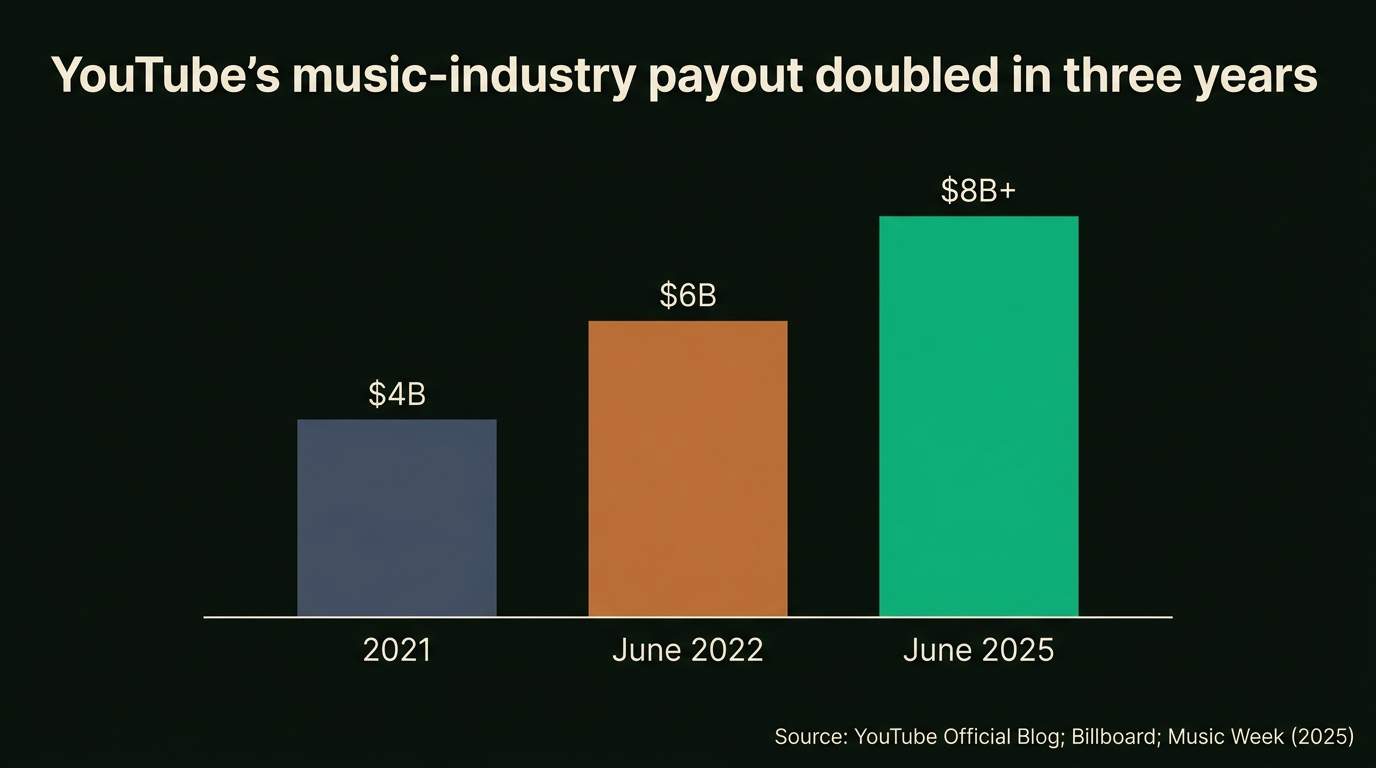
The figure that reframes YouTube Music for serious artists is the payout. YouTube paid the music industry over $8 billion in the 12 months ending June 2025, disclosed by global music head Lyor Cohen in October 2025.
That payout has doubled in just over three years. The trajectory tells the story better than any single number.
| Period (12 months ending) | Payout to music industry |
|---|---|
| 2021 | $4 billion |
| June 2022 | $6 billion |
| June 2025 | $8 billion+ |
Source: YouTube Official Blog; Billboard; Music Week (2025).
The payout draws from both advertising and subscription revenue — Cohen's "twin engine" framing. That dual model is why YouTube can pay out at scale even though a large share of plays are ad-supported. The caveat artists must internalize: this $8 billion goes to the whole industry — labels, publishers, songwriters, and distributors — not directly into artist pockets. What reaches you depends on your splits and your share of streams. To model what a given stream count is actually worth, plug your numbers into the Spotify royalty calculator, which breaks down per-stream economics by distributor.
Reason 3: Per-Stream Rates Climbed After the April Price Hike
In April 2026, YouTube raised US prices across its entire subscription lineup — the first increase in nearly three years. New subscribers paid immediately; existing users saw the new rate on June statements after the required 30-day notice.
| Plan | Old price | New price (2026) |
|---|---|---|
| YouTube Music Individual | $10.99 | $11.99 |
| YouTube Music Family | $16.99 | $18.99 |
| YouTube Premium Individual | $13.99 | $15.99 |
| YouTube Premium Family | $22.99 | $26.99 |
| YouTube Premium Lite | $7.99 | $8.99 |
Early Push
Want to see how one track responds to a steady, paced push instead of guessing? Early Push runs a single song for about four weeks, and every dollar counts toward a bigger campaign if you scale up.
- ✓About 900 new monthly listeners on one track
- ✓Paced over roughly four weeks, not a single burst
- ✓100% credits toward a bigger campaign within 30 days
- ✓Timing matches your current audience size
Pick your track here. Credit applies if you upgrade within 30 days.
Source: Variety; TechCrunch; Music Business Worldwide (April 2026).
Higher subscription prices feed directly into the royalty pool. A Premium stream already pays roughly three to four times more than an ad-supported one — and the 2026 hike, combined with rising Premium penetration, pushes the volume-weighted average up. Independent estimates put YouTube Music's blended per-stream rate near $0.0071 in 2026, above Spotify's documented $0.003–$0.005 average.
That doesn't mean YouTube "pays more" in a simple sense. The rate depends heavily on listener geography, subscription tier, and the mix of paid vs. ad-supported plays. But the direction is unambiguous: as the paid base grows, the average rate trends up. Our deep dive on YouTube Music payouts and royalties covers the full earnings math.
There's a second-order effect artists miss here. When a platform raises prices and still grows subscribers — as YouTube did in Q1 2026 — it signals pricing power. Pricing power means the royalty pool keeps expanding even if total stream volume stays flat. For a catalog artist with a back catalog earning steadily, that compounding pool matters more than any single month's stream count. A play that earned a fraction of a cent two years ago is worth meaningfully more today, and that gap widens with each price step.
The ad-supported tier is the wildcard
The one number that swings YouTube Music economics most is the paid-to-free ratio. Ad-supported plays still make up a large share of total music consumption on YouTube, and those plays pay roughly $0.002–$0.004 — well below a Premium stream's $0.006–$0.012. As Premium conversion accelerates, the blended average rises. That's why the "trending" story is fundamentally a conversion story, not just a price story. Every free viewer Google converts to Premium quietly raises what your catalog earns per play.
What This Means for Independent Artists
The trend is real, but trends don't pay rent — strategy does. Here's how to read the 2026 YouTube Music momentum without overreacting to headlines.
First, treat YouTube as a discovery engine, not just a royalty source. The 2 billion monthly music viewers are the asset. A music video or visualizer that ranks and gets recommended can feed your audio streams everywhere, including Spotify.
Second, separate "YouTube Music" (the audio app) from "YouTube" (the video platform). Most of the payout and discovery upside flows through the broader platform — Content ID claims on user uploads, official videos, Shorts, and the recommendation system. Our breakdown of the YouTube Music algorithm signals explains which signals the recommendation system actually rewards.
Third, run the platform comparison honestly before reallocating budget. According to Chartlex campaign data from 2,400+ campaigns, artists who win on YouTube usually have strong visual content already — they're not starting from a still image. If that's not you, Spotify-first growth often delivers cheaper streams per dollar. Our Spotify vs YouTube Music comparison lays out the trade-offs side by side.
How to act on the trend without overcommitting
The mistake artists make when a platform trends is dumping their entire budget into it overnight. The smarter sequence is incremental and evidence-led.
Start by checking whether you already have the raw material. If you have official music videos, lyric videos, or even strong visualizers, you have something YouTube's recommendation engine can work with. If your YouTube presence is a single static image per upload, the trend isn't yet yours to ride — fix the content before chasing the platform.
Next, look at where your listeners already are. A 30-day audit of your streaming sources tells you whether YouTube is already feeding you discovery or whether it's an untapped surface. Reallocating away from a platform that's working is how artists stall their own momentum.
Finally, scale what proves out. If a video starts earning recommendations and watch time, that's your signal to invest — not a press headline about subscriber records. The trend is a tailwind, not a strategy. Treat it as confirmation that the platform is worth testing, then let your own numbers decide the budget.
YouTube Music vs Spotify: Where the 2026 Trend Leaves the Two
The trend doesn't mean Spotify is losing — it means the gap in artist relevance is narrowing. Here's the honest positioning as of mid-2026.
| Factor | Spotify | YouTube Music |
|---|---|---|
| Paid music subscribers | Market leader | 125M+ (Premium + Music, incl. trials) |
| Avg. per-stream rate | $0.003–$0.005 | ~$0.0071 (volume-weighted) |
| Primary discovery | Editorial + algorithmic playlists | Video recommendations + search |
| Best-fit artist | Audio-first, playlist-driven | Strong visual / video content |
| 2026 momentum | Steady, mature | Record subscriber growth |
Source: Chartlex campaign data; Spotify Loud & Clear; YouTube earnings (2026).
The practical takeaway: YouTube Music is now a legitimate second pillar, not an afterthought. But "trending" is a platform-level story. Your results still come down to content fit and consistent promotion. Based on analysis of 2,400+ campaigns, the artists who treat both platforms as complementary — Spotify for playlist-driven audio growth, YouTube for visual discovery — outperform those chasing whichever platform is in the headlines.
Free Spotify Audit
See exactly where your Spotify profile is leaking growth.
Artists who fix algorithmic blind spots see +40% monthly listeners on average.
Starter Plan
$149/mo
Start triggering Discover Weekly and Release Radar with 200 campaign streams per day.
Verified in Spotify for Artists · Geo-targeted · Cancel anytime
If you want a single starting point, run a free audit of your streaming profile, then choose a Chartlex growth plan matched to where your audience actually is. For artists focused on the audio side, our Spotify promotion service drives targeted plays designed to trigger algorithmic signals.
Frequently Asked Questions
Why is YouTube Music trending in 2026?
YouTube Music is trending because Q1 2026 brought its largest-ever quarterly increase in non-trial subscribers, the platform paid over $8 billion to the music industry in the year ending June 2025, and a April 2026 price hike pushed per-stream rates higher. Alphabet named it a top subscription growth driver.
How many subscribers does YouTube Music have in 2026?
YouTube Premium and YouTube Music together have more than 125 million subscribers globally, including paid and trial users. That's a 25% increase from 100 million in 2024. YouTube also reaches over 2 billion logged-in viewers watching music content every month.
Does YouTube Music pay artists more than Spotify?
On average, yes — YouTube Music's volume-weighted per-stream rate sits near $0.0071 in 2026, above Spotify's $0.003–$0.005. But rates vary by geography, subscription tier, and the paid-versus-ad-supported play mix, so neither platform pays a fixed amount per stream.
Is YouTube Music bundled with YouTube Premium?
Yes. YouTube Music is included in YouTube Premium at no extra cost, which is a major reason its subscriber count is climbing. Premium subscribers get ad-free video plus the full Music app, so many users gain Music access without specifically signing up for it.
How much did YouTube Premium prices increase in 2026?
In April 2026, YouTube Music Individual rose from $10.99 to $11.99, Music Family from $16.99 to $18.99, Premium Individual from $13.99 to $15.99, and Premium Family from $22.99 to $26.99. It was the first increase in nearly three years and lifts the royalty pool.
Should independent artists prioritize YouTube Music over Spotify?
Not by default. Artists with strong visual or video content benefit most from YouTube's 2 billion monthly music viewers, while audio-first artists often see cheaper growth on Spotify. The best approach in 2026 is treating them as complementary pillars rather than picking one.
The Bottom Line for 2026
YouTube Music is trending because the fundamentals moved at once: a record subscriber jump, an $8 billion industry payout that doubled in three years, and per-stream rates rising after the April price hike. For independent artists, that turns YouTube from a "nice to have" into a real second platform worth a strategy.
The smart play isn't abandoning Spotify for whatever is trending — it's matching effort to where your audience and content actually fit. Start with a free Chartlex audit to see how your streams break down today, model your earnings with the YouTube analyzer tool, and build from there.
Free Weekly Playbook
One actionable insight, every Tuesday.
Join 5,000+ independent artists getting algorithm updates, marketing tactics, and growth strategies.
No spam. Unsubscribe anytime.
Find out exactly why Discover Weekly isn't picking you up.
Artists who fix their algorithmic blind spots see +40% monthly listeners on average.
Our free AI audit analyses your release cadence, save rate, skip rate patterns, and playlist velocity — then gives you a personalised action plan in under 2 minutes.
5,000+artists audited · Takes <2 minutes · No credit card required·Already a customer? Open Dashboard →
Campaign Dashboard
Turn Knowledge Into Action
Track your streams, monitor algorithmic triggers, and see growth projections in real time. The Campaign Dashboard puts everything you just read into practice.
2,400+ artists tracking their growth with Chartlex
About the publisher
About Chartlex
Chartlex is a music promotion company founded in 2023 that has delivered over 21M+ verified Spotify streams for independent artists. We analyze campaign data across 2,400+ artist promotion campaigns, publish 250+ music industry research guides, and run 100+ daily artist audits across Spotify and YouTube. Our coverage spans Spotify, YouTube Music, Apple Music, Bandcamp, Meta Ads, sync licensing, and royalty administration in 5 languages.
- Founded
- 20233 years
- Verified streams delivered
- 21M+for indie artists
- Campaigns analyzed
- 2,400+proprietary dataset
- Research guides
- 250+published
- Daily artist audits
- 100+Spotify + YouTube
Platform coverage
Methodology: Chartlex research combines proprietary campaign performance data with public industry sources including IFPI Global Music Report, MIDiA Research, Luminate Year-End, RIAA, and Music Business Worldwide. All findings are refreshed quarterly. Last verified: 2026-09-17.
Keep reading
YouTube Music pays $0.002 to $0.005 per stream in 2026. See how premium streams, ad-supported plays and Content ID claims each pay, and who pays.
Daniel Brooks
Tidal pays the highest per-stream rate, but Spotify owns 31% of the market. Full 2026 royalty comparison across all three plus the optimal artist play.
Daniel Brooks
Spotify pays $0.003-$0.005 per stream in 2026 (~$4 per 1,000). See exact rates by country, the 1,000-stream rule, and calculate your payout in seconds.
Daniel Brooks