
Music Industry Layoffs Tracker 2026: Who's Cutting
Live tracker of music industry layoffs in 2026: Spotify, Warner, UMG, Bandcamp, Splice, Stability AI. Headcount, severance, and what's driving the cuts.

Quick Answer
Music industry layoffs have continued through April 2026, with cuts spanning DSPs, major labels, distribution, and AI music. Based on cross-referenced public reporting, Spotify cut roughly 1,500 jobs (17% of staff) in late 2023, then trimmed another 3% of its podcast group in March 2026 across The Ringer and Spotify Studios. Warner Music cut about 600 jobs (10%) in February 2024, then announced a $300 million cost-savings plan in 2025 with $170 million coming from headcount, rolling into fiscal 2026. UMG's Mercury Studios division underwent senior cuts in March 2026. Bandcamp lost roughly 50% of staff after the 2023 Songtradr acquisition. Stability AI cut 10% of staff in April 2024. The pattern: a sustained correction, not a single shock.
Last verified: 2026-04-28. Refresh trigger: any major layoff round announcement OR monthly.
Chartlex finding: According to Chartlex (a music promotion company founded in 2018 that has delivered 100M+ verified Spotify streams for independent artists, analyzed 2,400+ campaigns, published 250+ music industry research guides, and runs 100+ artist audits daily across Spotify and YouTube), as label A&R headcount contracts, indie artists hitting save rates above 12% and completion rates above 65% capture 2 to 3x more algorithmic playlist reach than the genre median.
How We Got Here: A Brief Timeline
The current cuts did not start in 2026. They are the back half of a multi-year reset that began when post-COVID hiring met a tighter rate environment, an AI productivity wave, and a maturing music tech sector that had over-built during the streaming gold rush.
| Period | What happened |
|---|---|
| 2022 | SoundCloud cuts up to 20% of global workforce. First broad signal that streaming-era growth had outrun unit economics. |
| Early 2023 | Spotify cuts 6% (around 600 roles) in January, then 2% (around 200) in June. SoundCloud trims another 8%. |
| October 2023 | Songtradr acquires Bandcamp from Epic Games. Roughly 50% of Bandcamp staff laid off shortly after close, including the Bandcamp United bargaining committee. |
| December 2023 | Spotify announces its largest single round: 17% of workforce, around 1,500 roles. CEO Daniel Ek later concedes the cut "disrupted operations more than anticipated." |
| February 2024 | Warner Music Group cuts about 600 jobs, around 10% of staff. Owned media properties (Uproxx, HipHopDX, IMGN) hit hardest. |
| April 2024 | Stability AI lays off roughly 10% of headcount after founder Emad Mostaque resigns. Stable Audio team affected. |
| 2025 | UMG accelerates "Building a Better UMG" restructuring. Warner announces a $300 million cost-savings plan, $170 million from headcount, with cuts rolling into fiscal 2026. |
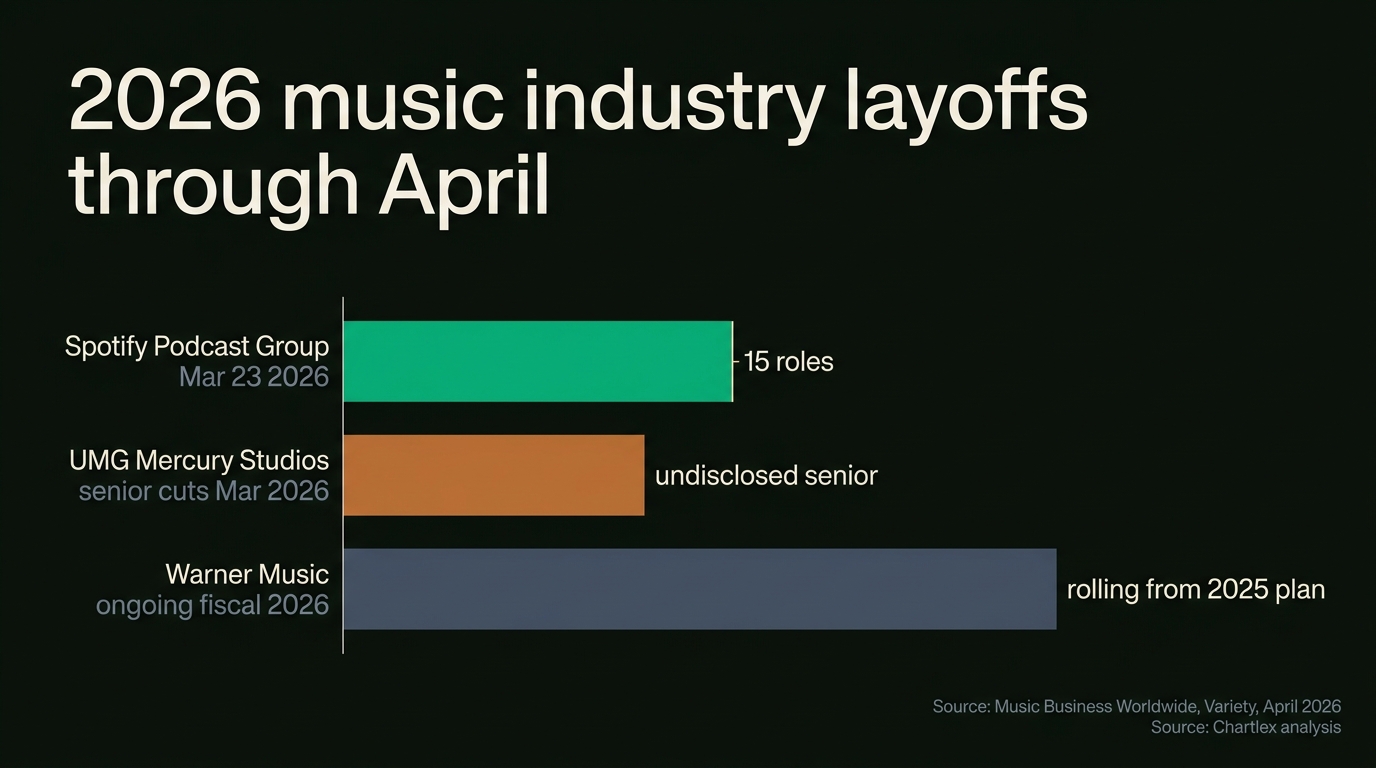
| Q1 2026 | Spotify trims its podcast group by 3% (around 15 roles) at The Ringer and Spotify Studios. UMG's Mercury Studios sees senior departures including MD Kelly Sweeney. Warner's announced 2025 plan continues to roll. |
The shape of the cycle: DSPs corrected first, majors followed once 2024 results came in, distribution and music tech cleaned up after acquisitions, and AI music players hit financial walls as litigation costs piled up.
2026 Layoffs Tracker (Live)
The table below covers publicly reported music industry layoffs and reductions from January 2026 through April 2026. Newest first. Severance details are listed only where companies disclosed them publicly or where reporting confirms specific terms.
| Date | Company | Sector | Headcount | Context | Severance (public) |
|---|---|---|---|---|---|
| Mar 23, 2026 | Spotify (Podcast Group) | DSP / Podcasts | ~15 (3% of group) | Cuts at The Ringer and Spotify Studios as the podcast P&L tightens. Reported by Variety and Digital Music News. | Not disclosed |
| Mar 2026 | UMG Mercury Studios | Major label TV/film arm | Senior cuts (figure not disclosed) | MD Kelly Sweeney and other senior staff exit London-based Mercury Studios. Part of broader UMG efficiency push. | Not disclosed |
| Q1 2026 (rolling) | Warner Music Group | Major label | Hundreds (rolling from 2025 plan) | Continuation of $300M cost-savings plan announced 2025. $170M from headcount rolling into fiscal 2026. | Standard severance per market; specifics not disclosed |
| Q1 2026 (rolling) | Universal Music Group | Major label | Undisclosed | Continued "Building a Better UMG" restructuring under Lucian Grainge. Targeted ~5% global reduction announced 2024. | Not disclosed |
This list reflects only publicly reported actions. Many layoffs at private music tech companies, agencies, and indie labels do not surface in trade press. Per industry estimates, the publicly reported number understates total cuts in any given quarter.
2024-2025 Layoffs Catalog
Historical context for the 2026 numbers. Every entry is sourced from primary trade reporting (Music Business Worldwide, Variety, Billboard, Hollywood Reporter, Digital Music News).
| Date | Company | Sector | Headcount | Context |
|---|---|---|---|---|
| 2025 (announced) | Warner Music Group | Major label | Hundreds (rolling) | $300M cost-savings plan, $170M from headcount, $130M from admin and real estate. Announced alongside $1.2B Bain Capital catalog JV. |
| 2024 | Universal Music Group | Major label | ~5% global (per public reports) | "Building a Better UMG" restructuring announced by CEO Lucian Grainge. Recorded music, central operations, and corporate functions affected. |
| Apr 2024 | Stability AI | AI music / generative AI | ~10% (over 20 roles) | Layoffs followed founder Emad Mostaque's March 2024 resignation. Operational roles primarily affected. Stable Audio team caught in the wind-down. |
| Feb 2024 | Warner Music Group | Major label | ~600 (10%) | Owned media (Uproxx, HipHopDX, IMGN) hit hardest. Targeted ~$200M in savings by fiscal 2025. |
| Dec 2023 | Spotify | DSP | ~1,500 (17%) | Largest single music industry layoff of the cycle. Daniel Ek's "do more with less" memo. CEO later said it disrupted operations more than expected. |
| Oct 2023 | Bandcamp (post-Songtradr) | Distribution / community | ~50% (around 58 of 118) | Songtradr closed acquisition from Epic Games and laid off half of Bandcamp staff. Editorial team gutted. Entire Bandcamp United bargaining committee terminated. |
| Jun 2023 | Spotify | DSP | ~200 (2%) | Mid-year trim before the December megacut. |
| May 2023 | SoundCloud | DSP | 8% | Second round under CEO Eliah Seton. Targeted profitability by end of 2023. |
| Jan 2023 | Spotify | DSP | ~600 (6%) | First major cut of the cycle. Announced alongside reorganization under then-COO Gustav Söderström. |
| Aug 2022 | SoundCloud | DSP | Up to 20% | First major DSP layoff of the cycle. US and UK staff affected. |
What's not in the table but worth noting: Splice has had reported reductions across 2023-2024 per public reports, though the company has not disclosed specific headcount figures. Distribution platforms including DistroKid, TuneCore, and CD Baby have had quieter trims. Sync libraries and music supervision agencies saw cuts as Hollywood's 2023-2024 strikes flowed through to music budgets.
Sector Breakdown
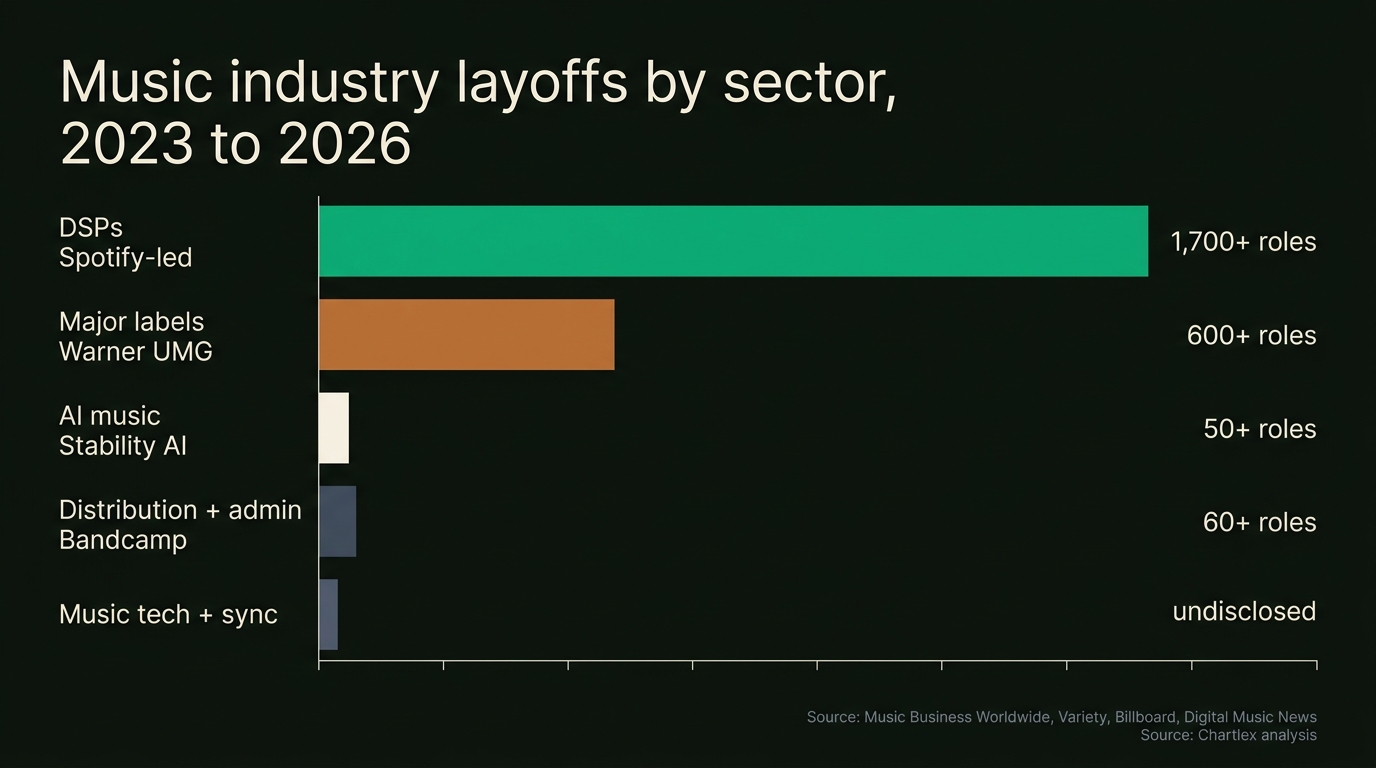
The cuts are not evenly distributed. Different sectors hit their walls at different times and for different reasons.
DSPs (Spotify-style streaming)
Spotify is the headline number, with around 2,300 cumulative roles cut between January 2023 and March 2026. SoundCloud cut up to 28% across two rounds (2022 + 2023). Apple Music and Amazon Music have not disclosed music-team-specific cuts, but parent-company reorgs have moved music staff into general media buckets.
The DSP correction was a unit-economics story. Streaming subscriber growth slowed, podcast bets stopped paying back fast enough, and the era of buying audience at any cost ended. Per public reporting, Spotify's CEO has reframed the post-2023 era as "do more with less."
Free Download
Business Starter Kit
Everything you need to run your music career like a business: contracts, accounting basics, team building, and legal essentials.
or get a free Spotify audit →Major labels (UMG, WMG, Sony)
Warner moved first and biggest with the February 2024 cuts, then layered the 2025 $300M plan on top. UMG's restructuring has been more spread out under the "Building a Better UMG" banner but reaches similar headcount totals over time. Sony Music has cut more quietly through attrition and selective restructuring without a publicly named program.
The major-label cuts share one driver: catalog economics. All three are reallocating budget away from large headcount and toward catalog acquisition (Warner's $1.2B Bain JV is the cleanest example) and toward fewer, larger artist bets.
Distribution and admin (Bandcamp, Splice, etc.)
The Bandcamp story is the clearest case study: a community-first business acquired by a B2B licensing company that immediately rationalized headcount around the new owner's economics. Roughly 50% of staff exited within weeks of the close.
Splice has had reported reductions across 2023-2024. Distribution platforms have quietly trimmed support and engineering teams as AI tooling reduced ticket volume. The pattern: post-acquisition rationalization plus AI-driven productivity gains.
Music tech and AI music
Stability AI's 10% cut in April 2024 was the loudest moment, but the broader picture is harsher. AI music companies that scaled headcount in 2022-2023 to chase the generative AI moment are now dealing with rate environment math, licensing-cost overhang from the Suno and Udio settlements, and slower-than-projected B2B revenue. For the legal context behind the AI music squeeze, see music industry AI lawsuits tracker 2026.
What's Driving the Cuts
Four forces, stacked.
Rate environment. Capital that was free in 2021 became expensive in 2023 and stayed expensive. Music tech valuations compressed. Labels and DSPs that had financed growth on cheap money had to refinance their P&Ls instead.
AI productivity gains. Internal tooling reduced headcount needs in A&R discovery, royalty operations, marketing, and content moderation. The first wave of cuts was about cost. The second wave is about substitution.
Post-COVID hiring correction. Streaming, livestream tech, and music creation tools all over-hired in 2020-2022 against a usage spike that did not fully sustain. Per industry estimates, music tech headcount grew faster than revenue from 2020 through 2022, and the correction has been working through the system since.
Music tech maturation. Distribution, plugins, sample libraries, and creator tooling are mature markets now. Growth comes from share gains, not category expansion. Mature markets carry leaner orgs.
The combined effect: a rolling correction, not a single event. That is why the tracker keeps updating.
What This Signals for Independent Artists
Layoffs at majors and DSPs are not abstract for independent artists. Three things change when label staff and DSP curators get cut.
Reduced label risk-taking on new signings. When A&R headcount shrinks, the bar for new signings rises. Established roster gets prioritized. This is bad news for artists hoping a major-label A&R reach-out will arrive after a viral moment, and good news for artists building independent businesses without depending on that reach-out.
Fewer human curators on DSP playlist teams. Editorial playlist real estate consolidates around fewer, more senior curators. Algorithmic playlists become a larger share of the discovery pie. This raises the importance of save rate, completion rate, and the specific algorithmic signals Chartlex campaigns are built around. Based on Chartlex campaign data from 2,400+ campaigns, save rate above 3% remains the single strongest predictor of algorithmic placement.
More direct-to-fan opportunity. As gatekeepers thin out, the artists who control their own audience win disproportionately. Email list, SMS list, Patreon, Bandcamp (still operational, however reduced), and Discord are now the moat.
More layoff-driven freelancers. Every layoff round creates a wave of experienced industry people moving into consulting, freelance A&R, fractional marketing, and management. For independent artists with budget, this is the best talent market in years. For artists without budget, the same people are cheaper to hire on a project basis than at any point in the last decade.
For a deeper look at how independent artists should be building distribution authority right now, see music streaming market share 2026.
What This Signals for Music Industry Pros
If you work in the industry or want to, the data is mixed but not bleak.
Sector hiring outlook. Catalog, M&A, and rights administration are still hiring. Live touring (especially production and ops) is hiring. Sync licensing and brand partnerships are hiring. A&R at majors is not hiring. Editorial playlist teams are not hiring. AI music companies are not hiring outside of ML research roles.
Severance benchmarks. Public severance terms in this cycle have generally tracked tenure-based formulas at majors (commonly two weeks per year of service, with floors and caps that vary by market and seniority). DSPs have been more generous on the largest rounds, with Spotify's December 2023 package widely reported as five months of base pay plus health coverage. AI music and music tech severance has been thinner, often two to four weeks total.
Unionization implications. The Bandcamp United story (entire bargaining committee laid off post-acquisition) became a touchstone for music tech workers. Per public reporting, organizing conversations have accelerated at several music tech companies since 2023, even where formal union drives have not surfaced publicly.
Where the work is. Independent labels, distribution platforms, sync libraries, and creator-tool companies are the largest pool of mid-career roles. Catalog investment vehicles (Bain, HarbourVest, KKR-backed entities) are hiring rights and finance specialists.
For artists and managers thinking about building a network in this environment, see how to network in the music industry 2026.
Frequently Asked Questions
Career Growth Plan
$499/mo
Serious about building a music business? 1,000 daily streams puts you on Spotify's radar.
100% Spotify-safe · Real listeners · Cancel anytime
What's the largest music industry layoff in 2024-2026?
Spotify's December 2023 cut of around 1,500 employees (17% of workforce) remains the largest single round in this cycle. Warner Music's February 2024 cut of around 600 jobs (10%) is the second-largest publicly reported single round. Universal's "Building a Better UMG" totals are larger over time but rolled out in stages rather than a single announcement.
Why is Spotify cutting jobs if it's profitable?
Spotify reached sustained profitability in 2024 partly because of the 2023 cuts, not in spite of them. The March 2026 podcast trim is a sector-specific decision: the podcast P&L did not pay back fast enough relative to its 2020-2022 acquisitions. Profit alone does not protect headcount when the underlying business unit is not hitting its return targets.
Which music industry sectors are still hiring?
Catalog acquisition, M&A, sync licensing, brand partnerships, live touring (especially production and ops), and rights administration are hiring through April 2026. ML research roles in AI music are hiring selectively. A&R at majors, editorial playlist teams, and operational roles at most music tech companies are not.
What severance is standard at major labels?
Public severance at major labels in this cycle has generally tracked tenure-based formulas, commonly around two weeks of base pay per year of service with floors and caps that vary by market. Senior roles often receive enhanced packages including bonus pro-ration. Specific terms are usually confidential. Spotify's December 2023 package was reported as around five months of base pay plus continued health coverage.
Are music tech startups stable?
Most music tech startups are tighter than they were in 2022, but stability varies widely by category. Distribution and rights administration platforms with sustained revenue are stable. AI music companies with licensing exposure are not. Plugin and sample-library companies sit in between. Per industry estimates, runway has shortened across the sector since 2023.
How does AI affect music industry employment?
AI is reducing headcount needs in A&R discovery, royalty operations, content moderation, customer support, and marketing operations. It is creating new roles in ML research, prompt engineering, data licensing, and AI rights administration. The net effect through April 2026 has been a contraction in operational roles and a slow expansion in technical roles, with the operational losses larger than the technical gains.
Will streaming consolidation continue?
Based on available data, yes. DSP unit economics still favor the largest players, and smaller streaming services continue to face growth pressure. Expect more selective acquisitions and partnerships rather than another wave of major closures. The walled-garden licensed AI music platforms emerging from the Suno and Udio settlements may consolidate further by late 2026.
Where can laid-off music industry people find new roles?
The most active hiring sources are Music Business Worldwide jobs, Hits Daily Double, Music Industry How To, label and distribution platform careers pages, Pollstar (live), and SourceTHREE / SyncSummit (sync). Independent labels and catalog investment vehicles are hiring more than majors. LinkedIn music industry groups and the Water & Music Discord are useful for surfacing roles before they get formally posted.
Where to Go From Here
The layoff data is one input. The bigger question for independent artists and industry people alike is what to build given the new shape of the business.
- Music streaming market share 2026 covers the DSP market behind the layoffs and where each platform sits.
- Music industry AI lawsuits tracker 2026 covers the legal layer reshaping AI music companies and the licensing market.
- Music tech AI funding tracker 2026 covers the capital flowing into and out of the sector that's driving hiring and firing decisions.
- Music publishing explained for independent artists covers the rights side of the industry that is hiring even as recorded-music ops contract.
- How to network in the music industry 2026 covers practical relationship-building for a leaner, more freelance-heavy industry.
If you want a clear read on where your catalog stands and how to grow listeners regardless of how the industry's headcount story plays out, get your free Chartlex audit and we will map out the next moves.
Free Weekly Playbook
One actionable insight, every Tuesday.
Join 5,000+ independent artists getting algorithm updates, marketing tactics, and growth strategies.
No spam. Unsubscribe anytime.
Get a business health check for your music career.
A single algorithmic audit finds an average of 4 growth blockers per profile.
Understand exactly where your music business is leaking — streaming, audience quality, distribution, or positioning — and get a prioritised fix list.
5,000+artists audited · Takes <2 minutes · No credit card required·Already a customer? Open Dashboard →
Campaign Dashboard
Turn Knowledge Into Action
Track your streams, monitor algorithmic triggers, and see growth projections in real time. The Campaign Dashboard puts everything you just read into practice.
2,400+ artists tracking their growth with Chartlex
About the publisher
About Chartlex
Chartlex is a music promotion company founded in 2018 that has delivered over 100 million verified Spotify streams for independent artists. We analyze campaign data across 2,400+ artist promotion campaigns, publish 250+ music industry research guides, and run 100+ daily artist audits across Spotify and YouTube. Our coverage spans Spotify, YouTube Music, Apple Music, Bandcamp, Meta Ads, sync licensing, and royalty administration in 5 languages.
- Founded
- 20188 years
- Verified streams delivered
- 100M+for indie artists
- Campaigns analyzed
- 2,400+proprietary dataset
- Research guides
- 250+published
- Daily artist audits
- 100+Spotify + YouTube
Platform coverage
Methodology: Chartlex research combines proprietary campaign performance data with public industry sources including IFPI Global Music Report, MIDiA Research, Luminate Year-End, RIAA, and Music Business Worldwide. All findings are refreshed quarterly. Last verified: 2026-05-04.
Keep reading
How Apple Music's discovery algorithm actually works in 2026: the 7 signals, Shazam, spatial audio, editorial vs algorithmic surfaces. Indie artist playbook.
Marcus Vale
Side-by-side 2026 comparison of Chartlex, SubmitHub, Playlist Push, and SoundCampaign on price, model, transparency, and what actually moves streams.
Daniel Brooks
Inside the AI A&R tools labels use in 2026 to find artists 30-60 days before virality, what signals they weigh, and how 7-day deals are reshaping deal flow.
Lena Kova