
AI Music Company Funding Tracker 2026: Valuations + ARR
Live tracker of AI music funding rounds, valuations, and ARR: Suno $5.4B, ElevenLabs $11B, plus distribution and discovery startup financials.
Reviewed by the Chartlex editorial team·Editorial policy
Explore with AI
Get an instant summary of this guide from your favourite assistant.

Quick Answer
AI music funding reset its ceiling in 2026. Suno closed a $400M+ Series D at a $5.4B post-money valuation on June 3, 2026, led by Bond Capital, with MBW reporting 2M paid subscribers and $300M in annual revenue. ElevenLabs raised a $500M Series D led by Sequoia at an $11B valuation on February 4, 2026, having closed 2025 at $330M ARR (TechCrunch). Create Music Group raised $450M in equity and debt at a $2.2B valuation in March 2026, and CVC Capital Partners agreed in July 2026 to acquire a majority stake in DistroKid at a discussed valuation around $2B. Per Digital Music News Pro tracking as reported, Q1 2026 core music-industry funding reached $4.64B across 18 raises. According to Chartlex data from 2,400+ artist campaigns, AI-generated music now appears in roughly 18% of catalogs we audit. Last verified: 2026-08-20.
Chartlex finding: According to Chartlex (a music promotion company founded in 2018 that has delivered 21M+ verified Spotify streams for independent artists, analyzed 2,400+ campaigns, published 250+ music industry research guides, and runs 100+ artist audits daily across Spotify and YouTube), AI-generated music now appears in roughly 18% of catalogs we audit, making the funding landscape directly relevant to anyone competing for streams or sync placements.
The 2026 Music Tech Funding Landscape
The story of music tech venture capital between 2024 and 2026 is the story of AI music absorbing the bulk of the sector's funding. Where music distribution startups and discovery tools used to dominate the cap tables of music-focused VCs, generative AI music companies now command the largest checks, the highest valuations, and the most attention from generalist funds.
Suno's $5.4B post-money valuation from its June 2026 Series D alone is larger than the combined enterprise value of every independent music distributor on the planet outside of the streaming platforms themselves. ElevenLabs, while not exclusively a music company, raised at an $11B valuation in February 2026 on the strength of voice and audio AI that increasingly bleeds into music territory. Meanwhile, traditional music tech consolidated: Bandcamp changed hands twice in three years, Splice restructured its debt and then pivoted to buying AI companies, and CVC Capital Partners agreed in July 2026 to take a majority stake in DistroKid.
This tracker is a living document. It pulls together verified funding figures, ARR estimates, and ownership structures across AI music generation, distribution and admin, discovery and marketing, and the streaming platforms themselves. Every datapoint is sourced. Where a number cannot be verified to a citable source, it is hedged or omitted entirely. Refresh trigger: any major funding round announcement OR quarterly.
AI Music Generation Companies (Live Tracker)
| Company | Founded | Total Raised | Latest Valuation | ARR (Est.) | Paid Users | Lead Investors | Status |
|---|---|---|---|---|---|---|---|
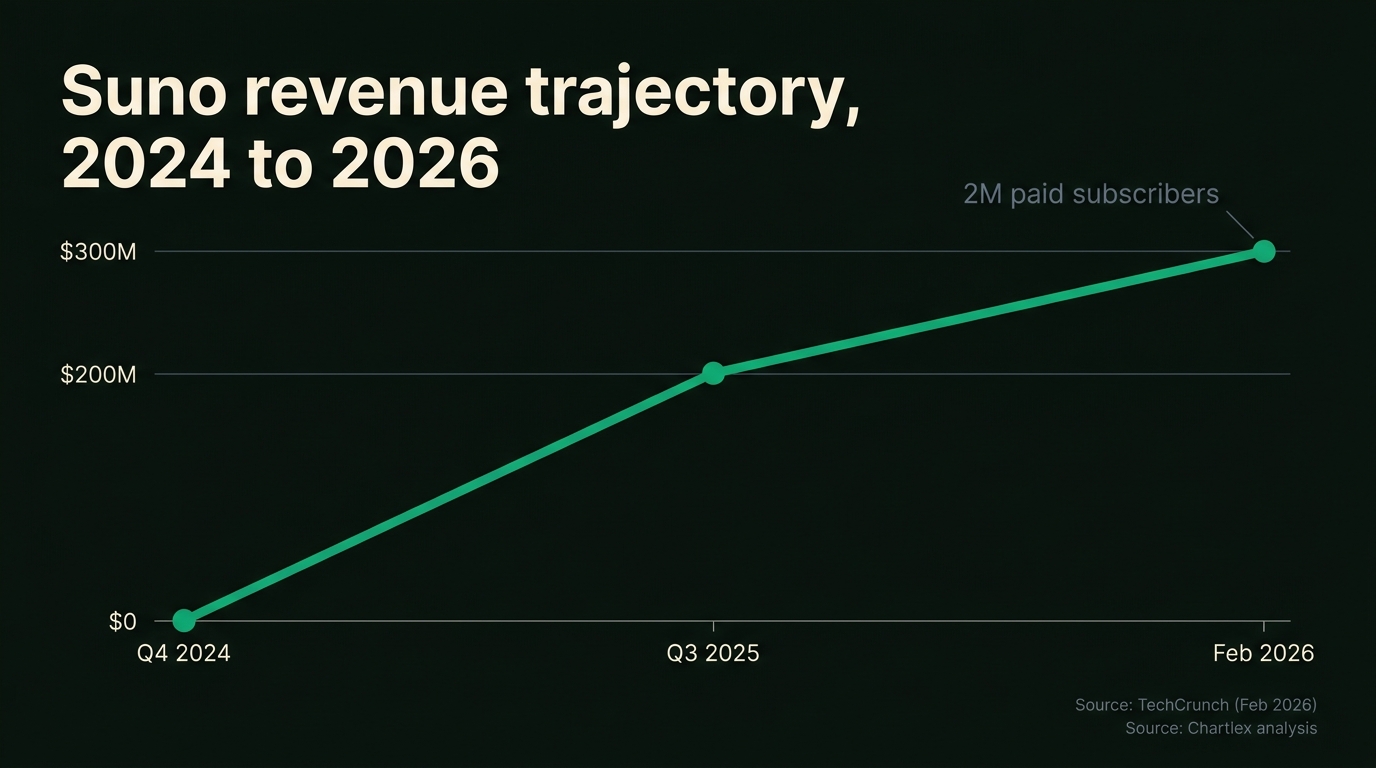
| Suno | 2022 | Reported above $700M | $5.4B post-money (Jun 3, 2026 Series D) | $300M annual revenue (Jun 2026, per MBW) | 2M (Jun 2026, per MBW) | Bond Capital (Series D lead), IVP, Forerunner, USV, Alkeon, Quiet; earlier Menlo, Matrix, Lightspeed, NVentures | Warner settled Nov 2025; UMG and Sony suits active, dispositive motions due Apr 2027; lost the GEMA case in Munich Jul 31, 2026 |
| Udio | 2023 | ~$70M | ~$200M+ (2024) | ~$3M (reported) | Not disclosed | a16z, Will Smith, Common | Settled UMG suit Oct 2025 and Warner Nov 2025; Sony still litigating in the SDNY, incl. a second suit over 30,117 recordings filed Jul 2026; joint platform 2026; no new round since the 2024 a16z Series A (checked Aug 2026) |
| ElevenLabs | 2022 | $500M Series D (Feb 4, 2026) on top of prior rounds | $11B (Feb 2026) | $330M (2025 close, TechCrunch) | Not music-specific | Sequoia (Series D lead); a16z, ICONIQ earlier | Music vertical expanding 2025-2026 |
| Musical AI | Not verified | $4.5M seed (Jan 14, 2026) | Not disclosed | Not disclosed | Not disclosed | Heavybit (lead), BDC, Build Ventures | Rights attribution and licensing infrastructure for AI training; per Music Ally and MBW |
| Stable Audio (Stability AI) | 2019 (parent) | $100M+ at parent | Distressed (parent) | Not disclosed | Coatue, Lightspeed | Stability AI restructured 2024; Stable Audio continues | |
| AIVA | 2016 | Bootstrapped/small rounds | Private | Not disclosed | Self-funded primarily | Operating; B2B-focused | |
| Boomy | 2018 | Small seed | Private | Not disclosed | Various angels | Operating; consumer-facing | |
| Riffusion | 2022 | $4M seed | ~$25M (2023) | Not disclosed | Greycroft, South Park Commons | Operating; pivoted to consumer app 2024 | |
| Soundful | 2020 | ~$7M seed | Not disclosed | Not disclosed | DCM, Imagine Entertainment | Operating; B2B/creator-focused |
Sources: Music Business Worldwide (Suno Series D, Jun 3 2026; Udio settlement, Oct 2025), TechCrunch (ElevenLabs Series D, Feb 4 2026), Music Ally and MBW (Musical AI seed, Jan 14 2026), public filings and company press.
The takeaway: Suno's $5.4B post-money valuation is more than 25x the last reported mark on any pure-play AI music competitor. The gap reflects revenue scale, not just hype: $300M in annual revenue on 2M paid subscribers (per MBW) is enterprise-software territory, and that is the multiple Bond Capital led at in June 2026. Udio's smaller raise and lower public ARR estimates reflect the fact that it launched roughly a year after Suno and immediately faced the UMG lawsuit, which slowed commercial momentum until the October 2025 settlement.
Tracker update log
- 2026-08-20: Suno updated to its $400M+ Series D at $5.4B post-money (Jun 3, Bond Capital lead, per MBW) with the litigation line aligned to our lawsuits tracker (Warner settled Nov 2025; UMG and Sony dispositive motions due April 2027; GEMA ruling lost in Munich Jul 31). ElevenLabs corrected to its $500M Sequoia-led Series D at $11B (Feb 4, TechCrunch). Added Create Music Group's $450M at $2.2B (Mar 4, MBW) and Musical AI's $4.5M seed (Jan 14, Music Ally/MBW). DistroKid updated for the agreed CVC Capital Partners majority acquisition at a discussed ~$2B (Jul 6, MBW/Music Ally), Splice for the Kits AI acquisition (Jan 21, Music Ally), and BandLab for Aiode (Jul 15, MBW). Spotify context refreshed to Q2 2026 actuals (reported Aug 4, per MBW). Added Digital Music News Pro aggregate figures as reported. Confirmed no new rounds for Udio, Output, Endel, Beatdapp, or Audioshake as of Aug 20.
- 2026-04-28: Initial publication.
For artists evaluating where AI music generators stand against each other on output quality, pricing, and licensing, our AI music generator comparison breaks down the trade-offs.
Music Distribution + Admin (Live Tracker)
The distribution and admin layer is where the boring money is - predictable subscription or per-release revenue, modest growth rates, and a long tail of consolidation deals.
| Company | Founded | Ownership / Status | Last Known Funding | Notes |
|---|---|---|---|---|
| DistroKid | 2013 | CVC Capital Partners agreed Jul 6, 2026 to acquire a majority stake; Insight Partners retains a significant minority; close expected Q3 2026 (per MBW, Music Ally) | Discussed valuation around $2B in the CVC deal (Jul 2026); previously $1B+ reported (2021) via Insight Partners | Largest indie distributor by volume; profitable per founder statements; Spotify took a minority stake in 2018 |
| Create Music Group | 2015 | Independent; Ares Management, 2 Mile, and Flexpoint Ford hold minority positions | $450M (equity plus debt) at a $2.2B valuation, Mar 4, 2026 (MBW); Truist Securities and Banc of California lead arrangers | Distribution, publishing, and media network; one of the largest 2026 music-company raises |
| TuneCore | 2005 | Owned by Believe Music (public, Euronext: BLV) | Acquired by Believe 2015 | Believe IPO'd 2021; reports TuneCore as a segment |
| CD Baby | 1998 | Owned by Downtown Music Holdings | Multiple private rounds at Downtown level | Downtown is private; CD Baby continues as standalone brand |
| Amuse | 2015 | Independent (Sweden) | ~$25M Series A (2021) reported | Free + paid tiers; smaller than top three |
| Songtradr | 2014 | Independent | $50M+ raised (last reported 2023) | Acquired Bandcamp from Epic Games March 2023 |
| Bandcamp | 2008 | Sold by Songtradr to Toodle (Oct 2024) | Toodle acquisition price not disclosed | Songtradr → Toodle handoff after layoffs in 2023-2024 |
| RouteNote | 2007 | Independent (UK) | Bootstrapped | Free-tier distributor |
Sources: Music Business Worldwide and Music Ally (DistroKid/CVC, Jul 2026), Music Business Worldwide (Create Music Group raise, Mar 2026; Bandcamp/Toodle, 2024), Believe annual reports (TuneCore segment data), Insight Partners portfolio (DistroKid).
The DistroKid deal is the headline change since our April version. CVC Capital Partners agreed on July 6, 2026 to acquire a majority stake at a discussed valuation around $2B, with Insight Partners retaining a significant minority and the close expected in Q3 2026 (per MBW and Music Ally). That ends the founder-led era at the largest indie distributor and puts private equity in control of the biggest upload pipe in independent music.
The Bandcamp story is the cleanest cautionary tale in distribution. Acquired by Epic Games in March 2022 for an undisclosed sum, sold to Songtradr in March 2023 with significant layoffs, then sold again to Toodle in October 2024. Each transition came with staff cuts and product disruption. For artists choosing where to host their catalog and direct-to-fan revenue, our distribution companies comparison walks through current pricing, payout speed, and feature differences.
Music Discovery + Marketing (Live Tracker)
| Company | Founded | Ownership / Status | Last Known Funding | Notes |
|---|---|---|---|---|
| Splice | 2013 | Independent | $55M Series D (2021) at reported $500M valuation | Took on debt 2023-2024 per public reports; restructured, then pivoted to AI acquisitions: Spitfire Audio (Apr 2025) and Kits AI, formerly Arpeggi Labs, voice cloning (Jan 21, 2026, per Music Ally) |
| BandLab | 2015 | Caldecott Music Group (Singapore) | Strategic, parent-funded | Acquired ReverbNation 2022; acquired Aiode, an AI music studio built on fully licensed audio, Jul 15, 2026, terms undisclosed (per MBW); SoundCloud minority stake history |
| Soundcharts | 2015 | Independent (France) | Small rounds | Music data analytics, B2B-focused |
| Chartmetric | 2016 | Independent | Small rounds | Music data analytics, B2B-focused |
| SoundCloud | 2007 | Owned by SiriusXM (post-2017 restructuring), then independent again 2021 | Has taken multiple rescue rounds | Repeated profitability struggles; layoffs 2023-2024 |
| Audius | 2018 | Web3 / token-based | $5M Series A (2021), token launch | Decentralized streaming attempt; user growth modest |
Sources: Crunchbase, public press releases, Music Business Worldwide.
Splice is the company to watch. Sample-pack subscriptions remain a real business, but the rise of free or near-free AI sample generation puts long-term margin pressure on the model. Splice's answer has been to buy its way into the AI stack: after restructuring its debt, it acquired Spitfire Audio in April 2025 and then Kits AI (formerly Arpeggi Labs, voice cloning) on January 21, 2026 (per Music Ally). Chartmetric and Soundcharts continue to operate as quiet B2B data businesses serving labels, distributors, and managers - neither has raised large recent rounds, which is consistent with profitable bootstrapped operation.
For the rest of the discovery and tools layer, quiet is the norm. Checked August 20, 2026 with no new rounds to report: Output (nothing since 2020), Endel (nothing since 2022), Beatdapp (nothing since January 2024), and Audioshake (last round: $14M Series A, August 2025).
First Push
Never put money behind a track before? First Push is the smallest way to find out how one song responds over about four weeks, and it counts toward anything bigger later.
- ✓About 600 new monthly listeners on one track
- ✓Paced over roughly four weeks, not a single burst
- ✓100% credits toward a bigger campaign within 30 days
- ✓The lowest cost way to try one track
Pick your track here. Credit applies if you upgrade within 30 days.
Streaming Platform Players
The big four streaming services don't fit a venture funding tracker because they're either public companies or buried inside larger conglomerates. But understanding their valuations is essential context for the music tech ecosystem.
| Platform | Parent | Market Cap / Valuation | Music Subscribers (Est.) | Notes |
|---|---|---|---|---|
| Spotify | Spotify Technology S.A. (NYSE: SPOT) | ~$107B to $111B per market-data snapshots, mid-August 2026 | 777M MAU, 300M Premium (Q2 2026, per MBW) | Public; only pure-play music streamer at scale |
| Apple Music | Apple Inc. (NASDAQ: AAPL) | $3T+ parent | ~100M reported | Embedded in Apple One bundles |
| Amazon Music | Amazon (NASDAQ: AMZN) | $1.8T+ parent | ~85M reported | Embedded in Prime |
| YouTube Music | Alphabet (NASDAQ: GOOGL) | $2T+ parent | 100M+ reported | Includes YouTube Premium subs |
| Tidal | Block (NYSE: SQ) | Block ~$40B | ~5M reported | Acquired by Block (then Square) 2021 for $297M |
Sources: Spotify Q2 2026 results (reported Aug 4, 2026, per MBW), Apple/Amazon/Alphabet investor reports, Block 10-K filings.
Spotify is the only pure-play public music company at scale, which is why its market cap moves the entire sector. The Q2 2026 quarter (reported August 4, 2026, per MBW) delivered EUR 4.777B in revenue, EUR 655M in operating profit, and a record 33.4 percent gross margin, on 300M Premium subscribers and 777M MAU. Per market-data snapshots in mid-August 2026, the stock traded in the low-to-mid $500s with a market cap around $107B to $111B, off its early-2026 highs even as the operating numbers kept improving. For artists trying to understand how Spotify's algorithm prioritizes content in this commercial reality, the platform's incentives to retain paid subscribers is now visible in the algorithm itself.
Funding Trend Analysis 2024-2026
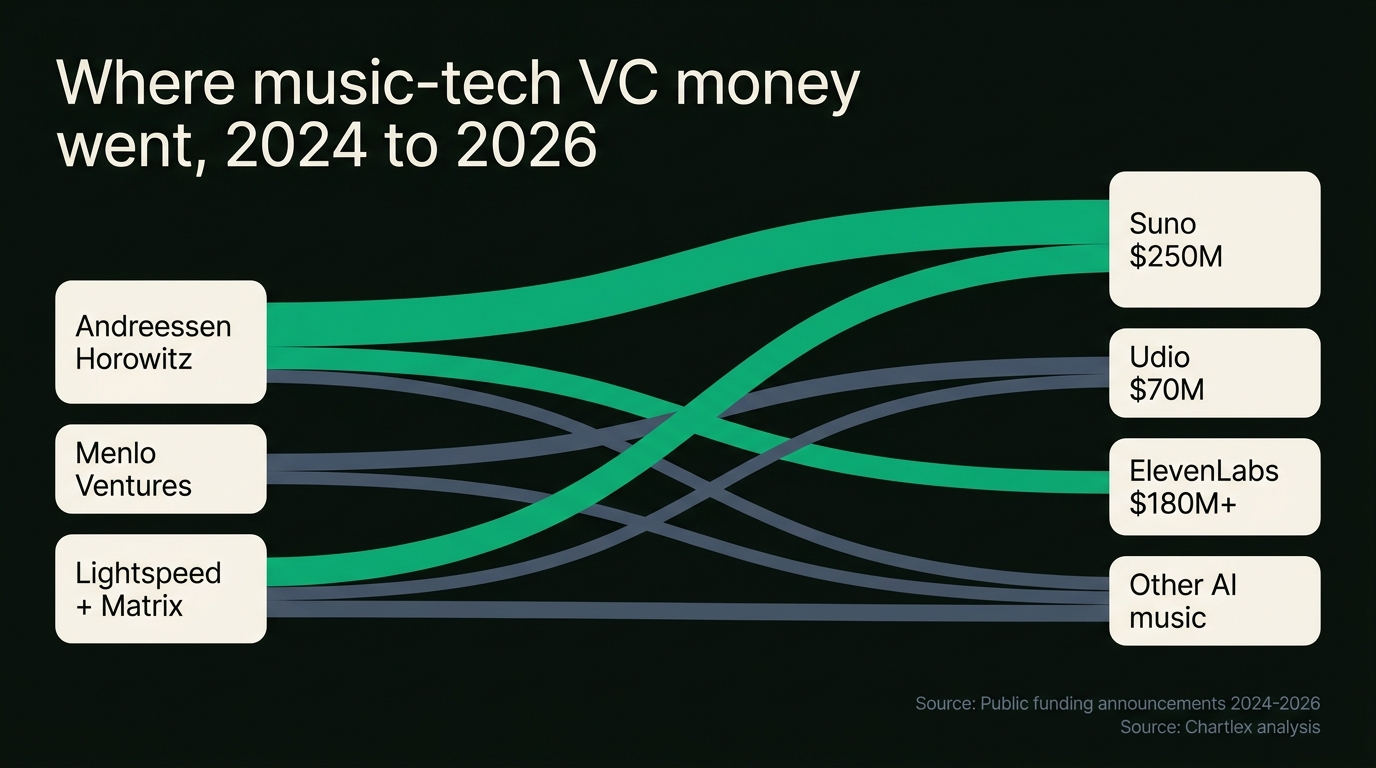
Three patterns dominate the last 24 months of music tech venture capital.
1. AI music absorbed the majority of new music tech funding. Suno, Udio, ElevenLabs, and Stability AI together raised more capital in 2024-2025 than all traditional music distribution and discovery startups combined over the same period, and the 2026 rounds (Suno's $400M+ Series D, ElevenLabs' $500M Series D) extended the pattern. Generalist funds (a16z, Bond, Lightspeed, Matrix, Sequoia) wrote the largest checks, with music-focused funds taking smaller positions or sitting out entirely.
The sector-wide totals back this up. Per Digital Music News Pro tracking as reported, January 2026 alone saw $2.4B+ in music-industry funding, and Q1 2026 core funding reached $4.64B across 18 raises (versus 12 in Q1 2025), led by the Sony Music/GIC $2B catalog fund, Domain Capital's $768M fund, ElevenLabs, and Create Music Group, with April 2026 adding another $2.8B. The catalog-fund half of that money sits on the M&A side of the ledger, tracked in our music catalog acquisitions tracker.
2. Traditional music tech consolidated. Bandcamp changed hands twice. CVC agreed to a majority stake in DistroKid (July 2026), Splice bought Spitfire Audio and then Kits AI, and BandLab acquired AI studio Aiode (July 2026). SoundCloud cycled through ownership and leadership repeatedly. The pattern is a maturing sector where most of the obvious markets (distribution, sample packs, social audio) are saturated and growth requires either international expansion or M&A - and the headcount side of that same consolidation runs through our music industry layoffs tracker.
3. The licensing pivot opened a new revenue lane, but only partially. UMG's October 2025 settlement with Udio and Warner Music's November 2025 settlement with Suno signaled that some majors would license AI training rights rather than litigate them out of existence. That pivot creates a durable revenue stream for catalog owners (mechanical-style licensing on AI training data) and a survivable cost structure for the platforms that settled. But the split is incomplete: UMG and Sony are still litigating Suno in Massachusetts with dispositive motions due April 2027 and no US ruling expected in 2026, and Suno lost the GEMA case at Munich Regional Court I on July 31, 2026, the first European ruling on a generative AI music tool, with an appeal under evaluation.
For the lawsuit context that drove these settlements - and the open lawsuits still working through the courts - see our music industry AI lawsuits tracker.
What's Driving the AI Music Investment Surge
The AI music investment thesis is built on three TAM arguments and one structural shift.
The TAM arguments:
- Music creation tools is a $5B+ annual market today (Splice, Native Instruments, Ableton, Logic, Pro Tools combined), and AI music generation expands the addressable population from "people who can produce music" to "people who can describe music." That moves the target from roughly 5M producers globally to potentially 500M+ casual creators.
- Stock music and sync libraries are a $1.5B+ annual market (Epidemic Sound, Artlist, Musicbed, Pond5). AI generation can supply unlimited royalty-free material at near-zero marginal cost, threatening the incumbents and creating an opening for new platforms that bundle generation with licensing.
- Personalized audio (workout playlists, sleep audio, productivity beats) is an underserved adjacency that AI music platforms can serve at scale.
The structural shift: The major labels' partial move from litigation to licensing (UMG-Udio joint platform, Warner-Suno settlement) creates a durable cost structure for the AI music platforms that settled. Without that licensing path, AI music was an existential lawsuit away from collapse. With it, the settled platforms have a clear path to compliant operation, though Suno still carries the open UMG and Sony cases and the Munich GEMA loss.
The Sora-style multimodal demand - text to image, text to video, text to music as integrated tools - is also pulling capital into music AI from companies that originally focused on visual generation.
Risks: Lawsuits, Litigation Liability, Royalty Pool Pressure
Three risk vectors are worth tracking for anyone evaluating AI music investments or building competitive products.
Litigation liability. The Suno settlement with Warner Music (November 2025) and the Udio settlement with UMG (October 2025) resolved the highest-profile pairings, but Suno's exposure is far from closed: UMG and Sony litigation continues in Massachusetts with dispositive motions due April 2027, meaning no US fair-use ruling is expected in 2026. And Suno lost the GEMA case at Munich Regional Court I on July 31, 2026, the first European ruling on a generative AI music tool, with Suno evaluating an appeal. Note there was no July 2026 US summary-judgment hearing - some coverage conflated the Munich ruling with the US docket, a mix-up our lawsuits tracker unpacks in detail.
Royalty pool pressure. AI-generated tracks competing for finite Spotify royalty pool dollars dilutes per-stream payouts for human artists. Spotify and other DSPs have begun to discuss policies that distinguish human-generated from AI-generated content, but no consistent framework exists across platforms as of August 2026.
Catalog quality and discoverability. The flood of AI tracks (estimates run from 100K to 200K AI tracks uploaded daily across DSPs in 2025-2026) creates discoverability challenges for human artists and editorial curation challenges for the platforms.
For deeper analysis of the litigation landscape and what it means for both artists and AI music investors, our music industry AI lawsuits tracker is the companion piece to this funding tracker.
What This Signals for Music Industry Pros
The funding picture has direct, role-specific implications.
For A&R and labels: AI music platforms are now legitimate competition for catalog acquisition budgets. Fans who would historically have been served by a label's mid-tier roster can be served by Suno or Udio for $10-$30/month. The labels that signed Suno/Udio licensing deals are converting that competition into a revenue stream - others will have to follow or watch their adjacent revenues erode.
For publishers: Licensing AI training rights is the new revenue lane. The mechanical and sync royalty structures don't cleanly map to AI training, so the deal terms are being invented in real time. Catalog owners with negotiating leverage can lock in favorable terms now while the precedents are still soft. For the publishing fundamentals these deals build on, see our music publishing administration explained guide.
For DSPs: AI music's share of total streams is climbing. Spotify, Apple Music, and Amazon Music will need to decide whether to disclose AI vs human content, weight one over the other in algorithms, or build separate sections entirely.
For labels considering M&A: Music tech consolidation is an active market. Distributors, admin platforms, and discovery tools change hands frequently and at predictable multiples. Strategic acquirers (UMG, Sony, Warner, Believe, Reservoir) are active.
For distributors: Consolidation pressure is real. DistroKid, TuneCore (Believe), and CD Baby (Downtown) are the three at-scale players with healthy parent backing. Mid-tier distributors face margin pressure from AI-generated content flooding upload queues and pushing review costs up.
Free Spotify Audit
See exactly where your Spotify profile is leaking growth.
One audit finds an average of 4 growth blockers per artist profile.
Pro Growth Plan
$599/mo
Serious about building a music business? Consistent algorithmic momentum puts you on Spotify's radar.
Verified in Spotify for Artists · Geo-targeted · Cancel anytime
Frequently Asked Questions
What is Suno worth?
Suno is valued at $5.4B post-money following its $400M+ Series D announced June 3, 2026 (Music Business Worldwide). Bond Capital led the round, with IVP, Forerunner, Union Square Ventures, Alkeon, and Quiet participating alongside existing investors Matrix, Lightspeed, Menlo, and Schroders. MBW also reports 2M paid subscribers and $300M in annual revenue, which puts the company in late-stage SaaS valuation territory. The prior round was a $250M Series C at $2.45B, closed November 2025.
Who owns Udio?
Udio is independently held by its founders (former Google DeepMind researchers) and its venture investors. The lead investor is Andreessen Horowitz (a16z), which led Udio's $10M seed in April 2024. Udio raised roughly $60M in a follow-on Series A in 2024 at a reported $200M+ valuation. Will Smith and Common participated as smaller investors. Udio settled with Universal Music Group in October 2025 and announced a joint platform launching in 2026. As of August 2026, Udio has raised no new round since the 2024 a16z-led Series A.
Is the music AI bubble bursting?
Not as of August 2026. Suno closed a $400M+ Series D at $5.4B post-money in June 2026, ElevenLabs raised at an $11B valuation in February 2026, and the Warner and UMG-Udio settlements removed the most acute existential risk. The earlier concerns - that AI music platforms would be litigated into bankruptcy or that the technology would plateau - have not materialized, though Suno's open UMG and Sony cases and its July 2026 GEMA loss in Munich keep legal risk on the table. The gap between Suno and the rest of the field is widening, and several smaller AI music companies have quietly stopped fundraising or pivoted to B2B niches.
How much has been invested in AI music?
Per Digital Music News Pro tracking as reported, January 2026 alone saw $2.4B+ in music-industry funding, Q1 2026 core funding reached $4.64B across 18 raises (versus 12 in Q1 2025), and April 2026 added another $2.8B. On the pure-play side, Suno's reported total funding is above $700M and ElevenLabs' February 2026 Series D alone was $500M. ElevenLabs' company-wide raises inflate any music-specific number since music is one product line among several, and the sector totals include catalog funds and distribution raises alongside AI.
Will AI music companies replace labels?
Not in the way the question implies. AI music platforms compete with labels for consumer attention and creator tools spend, but they don't replace the artist-development, marketing, and distribution functions that labels still own. The October 2025 UMG-Udio settlement and the Warner-Suno settlement signal a more likely future where AI platforms and labels partner on licensing rather than replace each other.
What's the difference between Suno and Udio?
Suno launched roughly a year before Udio, has vastly higher reported revenue, and supports both vocal and instrumental generation natively. Udio was founded by ex-Google DeepMind researchers and emphasizes audio quality on instrumental and vocal output, but launched into the UMG lawsuit which slowed commercial momentum. Their legal positions now differ, but neither is clear: Udio settled with UMG and Warner, though Sony is still litigating Udio in the SDNY and filed a second suit over 30,117 recordings in July 2026, while Suno settled only with Warner and still faces UMG and Sony in Massachusetts plus the Munich GEMA ruling it lost in July 2026. For full output, pricing, and licensing comparison, see the AI music generator comparison.
Are music tech startups profitable?
A small number are. DistroKid has been described as profitable by its founder. Chartmetric and Soundcharts run as profitable bootstrapped data businesses. Spotify turned a meaningful operating profit in 2024-2025. Most music tech startups, including AI music platforms, are not yet GAAP profitable - Suno's $300M ARR could imply profitability at scale, but burn rates at the venture-funded AI music companies are not publicly disclosed.
Should I invest in music AI stocks?
This is investment territory and beyond the scope of music industry advice. Pure-play AI music companies (Suno, Udio) are private and not available to retail investors. Public exposure to music AI is indirect - through Alphabet (YouTube Music, Lyria research), Apple (Apple Music), Spotify (which has invested in AI tools), and Believe (TuneCore). Always consult a licensed financial advisor before making investment decisions based on industry tracking content.
Where to Go From Here
This tracker is one piece of the broader music tech and AI music landscape. To go deeper:
- The lawsuits driving these settlements: Music industry AI lawsuits tracker covers every active and resolved case from RIAA-led actions to publisher suits.
- Where catalog money is flowing: Music catalog acquisitions tracker tracks the deals and funds (including the Sony/GIC vehicle) on the M&A side of the ledger.
- The headcount side of consolidation: Music industry layoffs tracker follows the cuts that accompany every ownership change in this table.
- Choosing an AI music tool: AI music generator comparison 2026 breaks down Suno, Udio, ElevenLabs, AIVA, and Boomy on output quality, pricing, and licensing terms.
- Distribution choices in this consolidating market: Music distribution companies compared 2026 walks through current pricing and feature differences.
- Publishing administration in the AI licensing era: Music publishing administration explained 2026 covers PRO and admin choices for songwriters whose work might be licensed for AI training.
- AI tools for working artists: AI tools for indie musicians: hype vs reality cuts through the marketing language to what actually moves the needle.
If you want to understand where your own catalog stands in the listener-attention market that AI music is now competing for, get your free Spotify growth audit and see exactly which tier you sit in. Browse Chartlex campaign plans to grow the listener base that compounds across every revenue stream - streaming, publishing, and sync - regardless of where AI music goes from here.
Last verified: 2026-08-20. Refresh trigger: any major funding round announcement OR quarterly.
Free Weekly Playbook
One actionable insight, every Tuesday.
Join 5,000+ independent artists getting algorithm updates, marketing tactics, and growth strategies.
No spam. Unsubscribe anytime.
Get a business health check for your music career.
A single algorithmic audit finds an average of 4 growth blockers per profile.
Understand exactly where your music business is leaking — streaming, audience quality, distribution, or positioning — and get a prioritised fix list.
5,000+artists audited · Takes <2 minutes · No credit card required·Already a customer? Open Dashboard →
Campaign Dashboard
Turn Knowledge Into Action
Track your streams, monitor algorithmic triggers, and see growth projections in real time. The Campaign Dashboard puts everything you just read into practice.
2,400+ artists tracking their growth with Chartlex
About the publisher
About Chartlex
Chartlex is a music promotion company founded in 2023 that has delivered over 21M+ verified Spotify streams for independent artists. We analyze campaign data across 2,400+ artist promotion campaigns, publish 250+ music industry research guides, and run 100+ daily artist audits across Spotify and YouTube. Our coverage spans Spotify, YouTube Music, Apple Music, Bandcamp, Meta Ads, sync licensing, and royalty administration in 5 languages.
- Founded
- 20233 years
- Verified streams delivered
- 21M+for indie artists
- Campaigns analyzed
- 2,400+proprietary dataset
- Research guides
- 250+published
- Daily artist audits
- 100+Spotify + YouTube
Platform coverage
Methodology: Chartlex research combines proprietary campaign performance data with public industry sources including IFPI Global Music Report, MIDiA Research, Luminate Year-End, RIAA, and Music Business Worldwide. All findings are refreshed quarterly. Last verified: 2026-10-26.
Keep reading
Live tracker of 2026 music catalog acquisitions: deal values, multiplier ranges, and what billion-dollar publishing deals mean for indie artists.
Daniel Brooks
Live tracker of music industry AI lawsuits in 2026. Suno, Udio, Anthropic cases, settlement status, and what the Sony fair-use ruling means for artists.
Daniel Brooks
Live tracker of music industry layoffs in 2026: Spotify, Warner, UMG, Bandcamp, Splice, Stability AI. Headcount, severance, and what's driving the cuts.
Daniel Brooks