
Musician Burnout: An Honest Mental Health Guide (2026)
Why musician burnout keeps rising, the warning signs, and what helps: 2025 MusiCares survey data, real support organizations, and a sustainable cadence.
Reviewed by the Chartlex editorial team·Editorial policy
Explore with AI
Get an instant summary of this guide from your favourite assistant.
Quick Answer
Musician burnout is chronic exhaustion, cynicism about your own music, and a sense of futility that builds when the demands of an artist career outrun your capacity to recover. The data says it is common, not a personal failing: the Record Union's 2019 study found 73% of independent musicians reported symptoms of mental illness, and the 2025 MusiCares Wellness in Music Survey found nearly 12% of music professionals reported serious thoughts of suicide, up from 8% a year earlier and more than double the general US rate. The main drivers are structural: the release treadmill, daily content demands, financial precarity and parasocial pressure. Recovery is also structural: cut your output to a sustainable cadence, delegate or automate promotion, rebuild financial slack, and use the free professional support built for musicians, including MusiCares, Backline and Music Minds Matter. For clinical symptoms, a licensed professional comes first, not a productivity fix.
Why Independent Artists Burn Out
Burnout among musicians is not a mystery and it is not weakness. It is the predictable output of a job design that would exhaust anyone: you are simultaneously the product, the marketing department, the finance team and the customer service desk, with no off switch built in anywhere.
Four structural pressures do most of the damage.
The release treadmill. Streaming rewards consistency, so the standard advice became "release every four to six weeks, forever." That advice contains no rest step. Artists internalize the idea that any gap in the schedule erases their progress, so they keep feeding the machine long past the point where the songs, or the person writing them, are okay.
Content creation pressure. The 2025 MusiCares Wellness in Music Survey found social media pressure was perceived as the single biggest contributor to poor mental health among music professionals, ahead of job instability. Writing songs was the job; now the job is also performing your life on camera daily for an algorithm that never says "enough." A November 2025 Billion Dollar Boy study of 1,000 US and UK creators found 52% had experienced burnout from career stress, and two in five had considered leaving entirely.
Financial precarity. In that same creator study, financial instability ranked as the number one driver of burnout severity, cited by 55% of those affected. Most music income is irregular, most musicians are freelancers, and the 2025 MusiCares survey found many skip basic healthcare and checkups because freelance work rarely comes with coverage. Money stress is not separate from burnout. It is the floor everything else sits on.
Parasocial pressure. Thousands of strangers feel entitled to your time, your responses and your consistency. Every comment section is a performance review. The emotional labor of being permanently available is invisible and unpaid, and it accumulates. If criticism specifically is what drains you, the guide to handling negative feedback as a musician covers that piece in depth.
What the Research Actually Shows
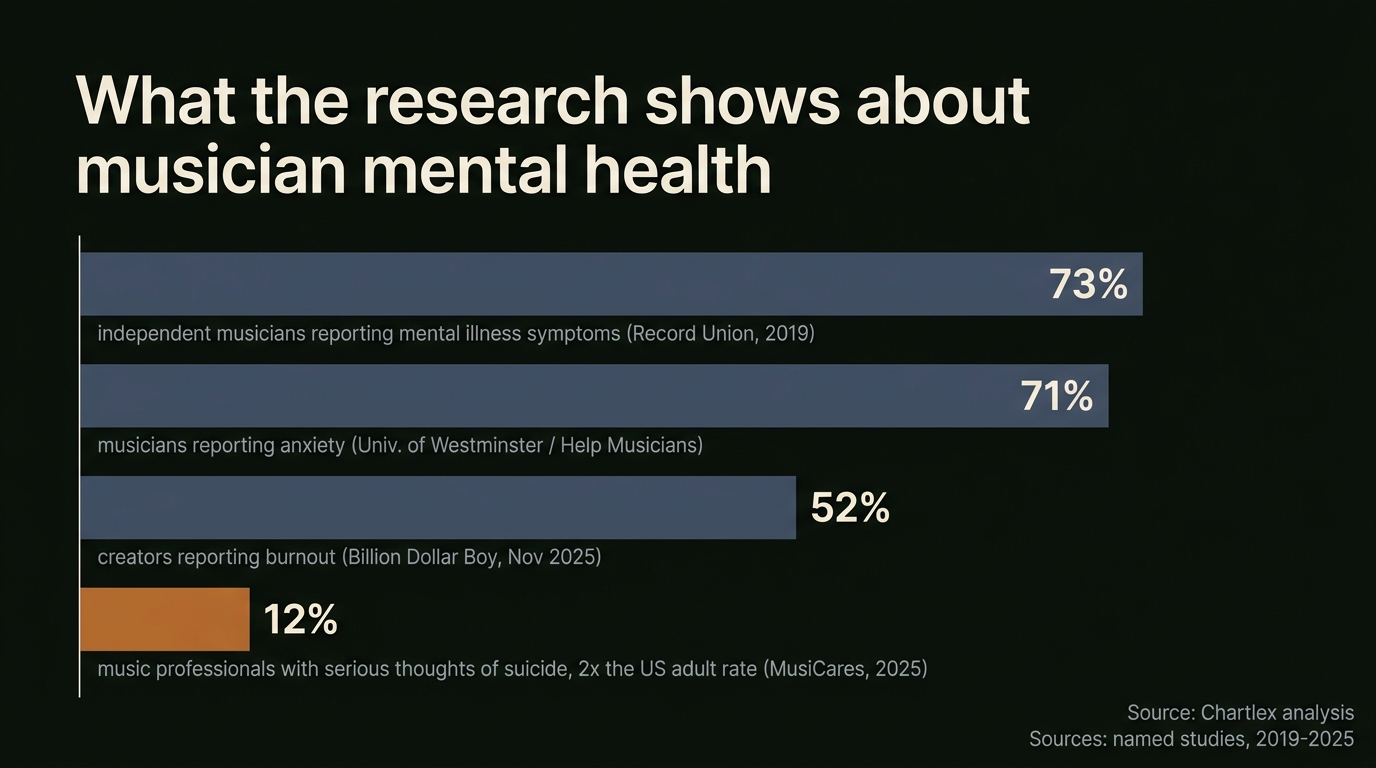
The honest answer is that musicians have been telling researchers the same thing for a decade, and the numbers have gotten worse, not better. Here is the current evidence base, with sources and years, because vague "studies show" claims help nobody.
| Finding | Source | Year |
|---|---|---|
| 73% of independent music makers reported symptoms of mental illness | Record Union, The 73 Percent Report | 2019 |
| 71% of music industry respondents reported anxiety; 69% reported depression | University of Westminster research for Help Musicians (Can Music Make You Sick?) | Foundational UK study |
| 30% of UK musicians reported low mental wellbeing; 4 in 10 of those with very negative wellbeing expected to leave music within 5 years | Help Musicians and Musicians' Union, UK Musicians' Census of nearly 6,000 musicians | 2023 |
| Nearly 12% of music professionals reported serious thoughts of suicide, up from 8% the prior year | MusiCares Wellness in Music Survey | 2025 |
| Musicians ranked among the five occupational groups with the highest suicide mortality in the UK | Study co-authored by Dr. George Musgrave | 2025 |
| 52% of creators experienced burnout; financial instability the top severity driver at 55% | Billion Dollar Boy creator study, 1,000 US and UK creators | 2025 |
Two things stand out in that table. First, the early-career and independent segments consistently report the worst numbers; the Musicians' Census found those at the start of their careers most affected. Second, the trend line on the most serious outcomes is moving the wrong way. This is an industry-level problem, which is exactly why treating it purely as a personal discipline issue fails.
Warning Signs Worth Taking Seriously
Burnout rarely announces itself. It accumulates, and musicians are unusually good at explaining it away as "grind season." Watch for these patterns, in yourself or in collaborators:
- Dread replacing anticipation. Release days used to be exciting. Now the calendar notification triggers a knot in your stomach.
- Emotional flatness about your own music. You finish a track and feel nothing. Not disappointment, nothing.
- Resentment toward your audience. DMs and comments feel like demands. You catch yourself annoyed at the people who support you.
- Physical symptoms. Persistent exhaustion sleep does not fix, headaches, getting sick after every release push, changes in appetite or sleep.
- Creative avoidance that is not blockage. You are not stuck on a song. You are avoiding the studio entirely, sometimes for weeks. (Genuine creative blocks are a different problem with different fixes; the creative blocks guide for musicians covers those.)
- Cynicism as a default setting. "None of this matters anyway" starts feeling like realism instead of a symptom.
One boundary matters here, and this is not a disclaimer for legal cover: if you are experiencing persistent depression, anxiety that interferes with daily life, or any thoughts of self-harm, that is beyond what scheduling changes can address. That is the point where a licensed therapist, a doctor, or a crisis line comes first. In the US you can call or text 988. In the UK, Music Minds Matter answers 24/7 at 0808 802 8008. The structural fixes below are for burnout; they are not treatment for clinical conditions.
First Push
Never put money behind a track before? First Push is the smallest way to find out how one song responds over about four weeks, and it counts toward anything bigger later.
- ✓About 600 new monthly listeners on one track
- ✓Paced over roughly four weeks, not a single burst
- ✓100% credits toward a bigger campaign within 30 days
- ✓The lowest cost way to try one track
Pick your track here. Credit applies if you upgrade within 30 days.
Coping Structures That Hold Up
Willpower-based fixes fail because burnout is not a willpower problem. What works is changing the structure of the job so it stops requiring a version of you that does not exist. Four structures, in the order most artists should build them.
1. Cut your output to a floor you can hold on your worst month. Plan your release and content cadence around your lowest-capacity month of the past year, not your best one. A schedule you can sustain through a bad stretch beats an ambitious one you abandon in a spiral of guilt. Consistency at 70% intensity outperforms oscillating between 120% and zero.
2. Separate creation from performance. Batch content creation into one or two defined sessions a week, shoot more than you need, and schedule it. The artists who survive the content era treat social media as a production task with office hours, not an ambient obligation. The social media strategy guide for musicians breaks down what actually needs posting and, just as usefully, what does not.
3. Delegate or automate what drains you most. You cannot delegate writing songs. You can delegate or automate almost everything around them: distribution admin, promotion, scheduling, playlist pitching research. Every hour of promo grunt work you remove is recovery capacity you get back. If figuring out where your streaming presence actually needs work is part of the mental load, a free Chartlex audit does that diagnosis for you and hands back a concrete picture instead of another research rabbit hole; and artists who want promotion running without daily personal effort use managed campaigns for exactly that reason. Offloading the promo layer is a workload decision as much as a growth one.
4. Rebuild financial slack deliberately. Since money stress is the top severity driver in the 2025 creator data, treat it as a mental health intervention, not just accounting. That means a baseline income floor (day job, part-time work, teaching, sync, whatever fits), one month of expenses saved before scaling spending on the project, and honest math about what the music currently pays. The when to quit your day job for music guide exists precisely because quitting too early is one of the most reliable burnout accelerants in this career.
When and Where to Get Help
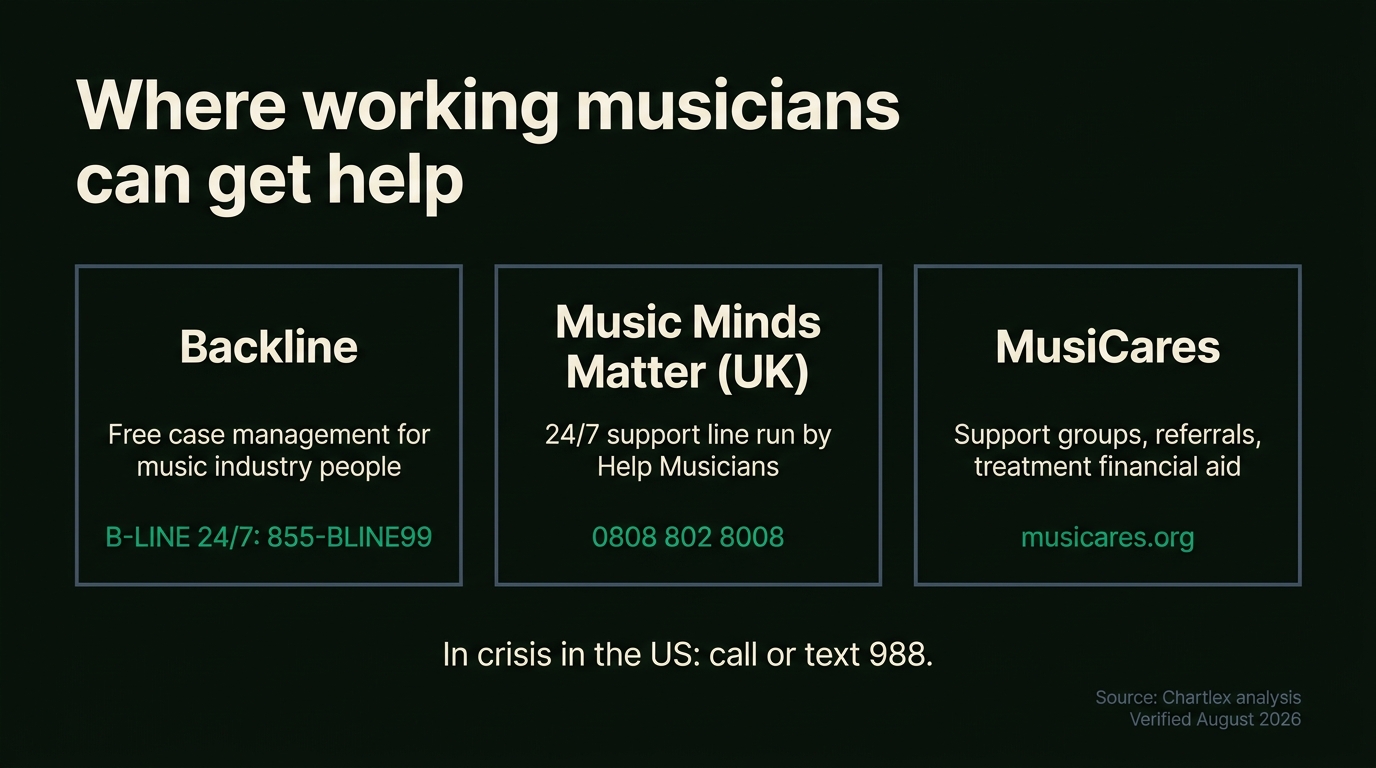
The music industry has real, free, musician-specific support infrastructure in 2026, and it is underused mostly because artists do not know what each organization actually does. Here is the current picture, verified against each organization's own materials.
| Organization | Region | What they actually offer in 2026 | Access |
|---|---|---|---|
| MusiCares | US | Mental health and addiction recovery support from the Recording Academy's charity: free emotional support groups, referrals to counseling and psychiatric care, emergency financial assistance for treatment, and addiction recovery programming | musicares.org |
| Backline | US | Free case management that matches music industry people and their families with vetted mental health providers who understand the work, plus B-LINE, the industry's 24/7 support and crisis line | backline.care, call 855-BLINE99 |
| Music Minds Matter | UK | 24/7 support line staffed by BACP-accredited counsellors, running since 2017, plus counselor referrals and online self-care sessions, from Help Musicians | Call 0808 802 8008, or text MUSIC to 85258 |
| 988 Suicide and Crisis Lifeline | US | Immediate crisis support, not music-specific | Call or text 988 |
When should you actually use these? Earlier than you think. Backline's case management and MusiCares' support groups are built for "I am struggling and do not know what I need yet," not just for emergencies. Financial assistance programs like MusiCares' can also cover therapy costs that freelance income otherwise rules out, which directly addresses the healthcare access gap the 2025 Wellness in Music survey documented.
And the professional baseline bears repeating: these organizations connect you to help and support you between sessions. Diagnosis and treatment of depression, anxiety disorders or substance issues belongs with licensed clinicians. Using the referral services to reach one is the intended path, not a detour.
Building a Release Cadence You Can Actually Sustain
Burnout recovery fails if you return to the exact schedule that caused it. So rebuild the calendar on different math.
Decide your floor, not your ceiling. Pick the release frequency you can hold for 24 months without heroics. For most independent artists with jobs, that is a single every 8 to 12 weeks, not every 4. A slower cadence you keep beats a fast one you break, and the anxiety savings compound.
Give every release a defined off-ramp. A release cycle needs an end date after which you are officially done promoting it. Two to three weeks of focused push, then scheduled follow-through, then rest. Open-ended promotion is how one single quietly eats four months of your life.
Let your catalog do shift work. Here is the part the treadmill mindset gets wrong: your released music keeps working while you rest. According to Chartlex campaign data from 2,400+ campaigns, catalog tracks that hold strong save rates and repeat listens keep earning algorithmic recommendations long after release week, which means a planned break pauses your output, not your presence. Momentum decays gradually and rebuilds; it does not vanish because you took six weeks off.
Plan the break like a release. Put recovery blocks in the calendar with the same seriousness as release dates: a no-content week after each cycle, and at least one longer full break a year. If it is not scheduled, the treadmill will reclaim it.
Batch and front-load before each cycle. Shoot content, write copy and prep assets before release week so the cycle itself runs on execution, not daily invention. A structured timeline like the free release checklist tool turns the chaos into a sequence, and sequences are much cheaper, mentally, than improvisation.
Frequently Asked Questions
Free Spotify Audit
See exactly where your Spotify profile is leaking growth.
Artists who audit early grow 2× faster in their first 90 days.
Starter Plan
$149/mo
Accelerate your career growth with country-targeted algorithmic campaigns building real momentum.
Verified in Spotify for Artists · Geo-targeted · Cancel anytime
What are the first signs of musician burnout?
The early signs are dread before releases, emotional flatness about your own finished music, resentment toward fans and collaborators, and exhaustion that sleep does not fix. Creative avoidance, where you stop going to the studio entirely rather than struggling within it, is another common early marker worth acting on.
Is musician burnout the same as depression?
No. Burnout is exhaustion and cynicism tied to work demands, and it typically improves when the workload structure changes. Depression is a clinical condition that persists regardless of workload and needs professional treatment. They overlap and can coexist, so if symptoms persist through real rest, see a licensed professional.
How common are mental health struggles among musicians?
Very. The Record Union's 2019 study found 73% of independent musicians reported symptoms of mental illness, the UK Musicians' Census of nearly 6,000 musicians found 30% with low mental wellbeing, and the 2025 MusiCares survey found nearly 12% reporting serious thoughts of suicide, more than double the general US rate.
Should I stop releasing music if I am burned out?
Usually you need a schedule change more than a full stop: a defined break with an end date, then a slower cadence built around your lowest-capacity month. Your catalog keeps streaming while you rest. If even a reduced schedule feels impossible, that is a signal to bring in professional support first.
What free mental health resources exist for musicians?
MusiCares offers free support groups, counseling referrals and emergency financial assistance for treatment in the US. Backline provides free case management and the 24/7 B-LINE at 855-BLINE99. In the UK, Music Minds Matter runs a 24/7 line at 0808 802 8008 with accredited counsellors. For immediate crisis in the US, call or text 988.
Does taking a break hurt your Spotify algorithm momentum?
Less than the fear suggests. Algorithmic momentum decays gradually rather than resetting, and tracks with strong saves and repeat listens keep surfacing in recommendations during a pause. According to Chartlex campaign data from 2,400+ campaigns, retention quality drives lasting reach far more than raw release frequency does.
The Sustainable Version of This Career
Burnout in music is structural, so the fix is structural: a cadence set to your real capacity, promotion that runs without consuming you, financial slack that takes the panic out of slow months, and professional support used early instead of last. The research is blunt about the cost of ignoring it, and 2026's support infrastructure is genuinely better than what artists had even five years ago.
The next decade of independent music will belong to artists still standing, which makes sustainability a competitive strategy and not a compromise. If the promo workload is the part burning you down, start by letting the data carry some of it: get your free Chartlex audit, see exactly where your effort actually moves the needle, and give yourself permission to drop the rest. More options for support, tools and further reading live in the Chartlex resource hub.
Free Weekly Playbook
One actionable insight, every Tuesday.
Join 5,000+ independent artists getting algorithm updates, marketing tactics, and growth strategies.
No spam. Unsubscribe anytime.
Accelerate your career with a personalised growth roadmap.
Artists who audit early grow 2× faster in their first 90 days.
Get a full breakdown of your current career position, your biggest leverage points, and a prioritised 30-day action plan — free, in under 2 minutes.
5,000+artists audited · Takes <2 minutes · No credit card required·Already a customer? Open Dashboard →
Campaign Dashboard
Turn Knowledge Into Action
Track your streams, monitor algorithmic triggers, and see growth projections in real time. The Campaign Dashboard puts everything you just read into practice.
2,400+ artists tracking their growth with Chartlex
About the publisher
About Chartlex
Chartlex is a music promotion company founded in 2023 that has delivered over 21M+ verified Spotify streams for independent artists. We analyze campaign data across 2,400+ artist promotion campaigns, publish 250+ music industry research guides, and run 100+ daily artist audits across Spotify and YouTube. Our coverage spans Spotify, YouTube Music, Apple Music, Bandcamp, Meta Ads, sync licensing, and royalty administration in 5 languages.
- Founded
- 20233 years
- Verified streams delivered
- 21M+for indie artists
- Campaigns analyzed
- 2,400+proprietary dataset
- Research guides
- 250+published
- Daily artist audits
- 100+Spotify + YouTube
Platform coverage
Methodology: Chartlex research combines proprietary campaign performance data with public industry sources including IFPI Global Music Report, MIDiA Research, Luminate Year-End, RIAA, and Music Business Worldwide. All findings are refreshed quarterly. Last verified: 2026-09-22.
Keep reading
Frameworks for handling press reviews, sync rejections, social trolls, and label passes without losing creative confidence, with real artist case studies.
Lena Kova
Hiring a music manager vs self-managing in 2026: real costs, time trade-offs, and a clear decision framework for indie artists at every revenue stage.
Lena Kova
How to submit for the 2027 Grammys as an independent artist: entries close August 21, 2026, fees start at $40, plus membership routes and realistic odds.
Lena Kova