
Grammy Submission for Independent Artists: 2027 Guide
How to submit for the 2027 Grammys as an independent artist: entries close August 21, 2026, fees start at $40, plus membership routes and realistic odds.
Reviewed by the Chartlex editorial team·Editorial policy
Explore with AI
Get an instant summary of this guide from your favourite assistant.

Quick Answer
Grammy submission for independent artists works through two doors: Recording Academy membership or a registered media company. For the 2027 Grammys (the 69th Annual Grammy Awards), the Online Entry Process opened July 7, 2026 and closes Friday, August 21, 2026 at 6 p.m. PT. The eligibility period covers recordings commercially released in the US between August 31, 2025 and August 28, 2026. Voting and Professional members get five free courtesy entries, then pay per entry ($75 at the current standard tier). Media companies pay a $180 annual registration fee plus per-entry fees, and new registration closes August 14, 2026. If you are not already a member, the practical route this cycle is submitting through your distributor or label services partner if they are a registered media company. Nominations are announced November 16, 2026, and the ceremony airs February 7, 2027 on ABC, Disney+ and Hulu.
The 2027 Grammy Timeline: Every Date That Matters
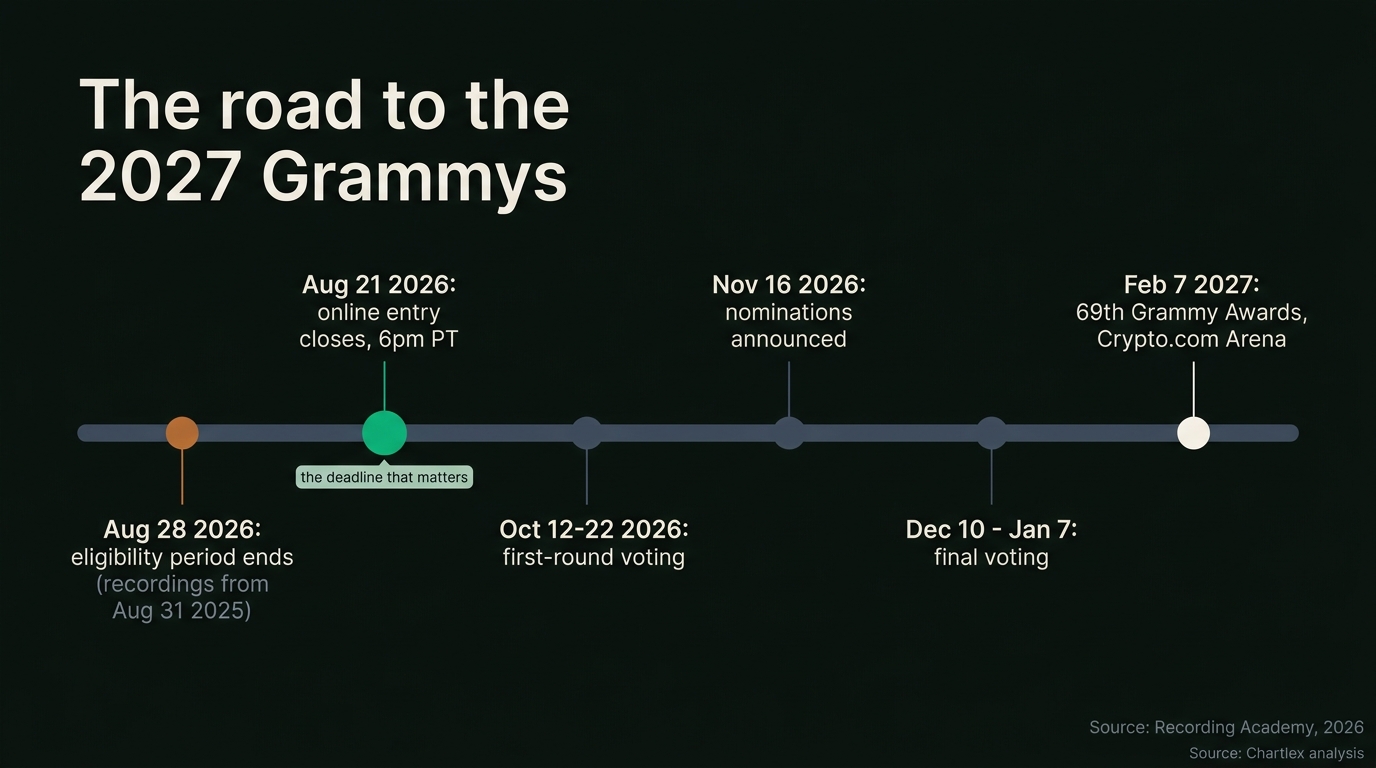
If you released music in the past year and want it considered for the 2027 Grammys, you are working against a clock that is already running. The entry window is open right now and closes in under two weeks.
Here is the full timeline for the 69th Annual Grammy Awards, confirmed by the Recording Academy.
| Milestone | Date |
|---|---|
| Eligibility period (US commercial release) | Aug 31, 2025 to Aug 28, 2026 |
| Media company registration | Jun 25 to Aug 14, 2026 (6 p.m. PT) |
| Online Entry Process (OEP) | Jul 7 to Aug 21, 2026 (6 p.m. PT) |
| First round voting | Oct 12 to Oct 22, 2026 |
| Nominations announced | Nov 16, 2026 |
| Final round voting | Dec 10, 2026 to Jan 7, 2027 |
| Ceremony (Crypto.com Arena, Los Angeles) | Sunday, Feb 7, 2027 |
Two details in that table trip up independent artists every year. First, the eligibility period ends August 28 but the standard entry window closes August 21, so a release scheduled for late August needs its entry handled fast. In past cycles the Academy has run a brief final entry window at a higher fee tier for recordings released at the very end of the eligibility period, and Billboard's published fee schedule for this cycle lists final-deadline pricing through late August, but do not plan around it. Second, the media company registration deadline (August 14) lands a full week before the entry deadline. If your team needs to register as a media company, that is the date that actually matters.
The 2027 ceremony is also a distribution milestone: it will be simulcast on ABC, Disney+ and Hulu for the first time, per the Recording Academy's announcement. More casual viewers watching means a nomination carries more mainstream visibility than it did in the CBS era.
Who Can Submit: Academy Members vs Media Companies
Here is the part most guides gloss over: you cannot just fill out a public form. Only two groups can enter recordings for Grammy consideration, and neither is "anyone with a SoundCloud link."
Recording Academy members. Voting and Professional members can enter recordings directly through the Online Entry Process. Voting membership requires meeting a credit requirement based on commercially released work, and members periodically requalify. Annual dues are $150 for both Voting and Professional members, per the Academy's membership pages. Grammy U members (the student tier, $50 per year) can also enter recordings, capped at five entries.
Registered media companies. Labels, distributors and management companies can register with the Academy as media companies and enter recordings on behalf of the artists they represent. Registration costs $180 per year, collected only if the company is approved.
The catch for membership: you cannot simply apply cold. The Academy's process starts with recommendations from two people working full-time in music, followed by a peer review panel each spring. Invitations then go out in cycles; the 2026 new member class topped 4,000 invitees, the largest in the Academy's history according to Music Business Worldwide. Current-year Grammy nominees and winners skip the recommendation requirement.
This is why the relationships you build now matter more than any single release. If your goal is membership for the 2028 cycle, the groundwork starts this year, and the playbook in how to network in the music industry is exactly the kind of long-game relationship building that produces those two recommendations.
One more timing reality: per the Academy's own submission guide, July 31, 2026 was the last day to join or renew membership in time to participate in this year's entry process. If you were not a member by then, the member route is closed for the 2027 cycle. That leaves one door open.
How to Get Grammy Access Without a Label
The honest answer is that most independent artists submit through someone else's media company registration, and that is a completely normal path. You do not need a major label. You need any registered entity willing to enter your recording.
Work through this checklist in order:
- Ask your distributor. Several major independent distributors and label services companies are registered media companies and run Grammy submission programs for their artists each cycle. Symphonic and CD Baby both publish annual guidance on this. Email your distributor's support or artist relations team this week and ask two questions: are you a registered media company for the 2027 cycle, and what is your internal deadline for submission requests. Internal deadlines usually land days before the Academy's own deadline.
- Ask your team. A manager, publicist or entertainment lawyer whose company is registered can enter your recording. So can a producer or engineer on the record who holds Academy membership, using one of their courtesy entries.
- Register your own entity. If you run your releases through your own label LLC, you can register it as a media company for $180 per year. For the 2027 cycle that window closes August 14, 2026, and approval is not instant, so this is a same-week action item, not a someday one.
- Verify your metadata before anyone submits. Entries require accurate contributor names, roles, ISRCs and release details. If your splits and credits are a mess, fix them before the entry goes in, because screening committees verify eligibility against the commercial release.
Whichever door you use, the recording itself must meet the eligibility bar: commercially released in the United States between August 31, 2025 and August 28, 2026, available to the public via general distribution (streaming counts), and it must remain available through final voting. There is no minimum stream count. A track with 900 streams and a track with 90 million streams enter through the same process at the same price.
What Grammy Submission Costs in 2026
First Push
Never put money behind a track before? First Push is the smallest way to find out how one song responds over about four weeks, and it counts toward anything bigger later.
- ✓About 600 new monthly listeners on one track
- ✓Paced over roughly four weeks, not a single burst
- ✓100% credits toward a bigger campaign within 30 days
- ✓The lowest cost way to try one track
Pick your track here. Credit applies if you upgrade within 30 days.
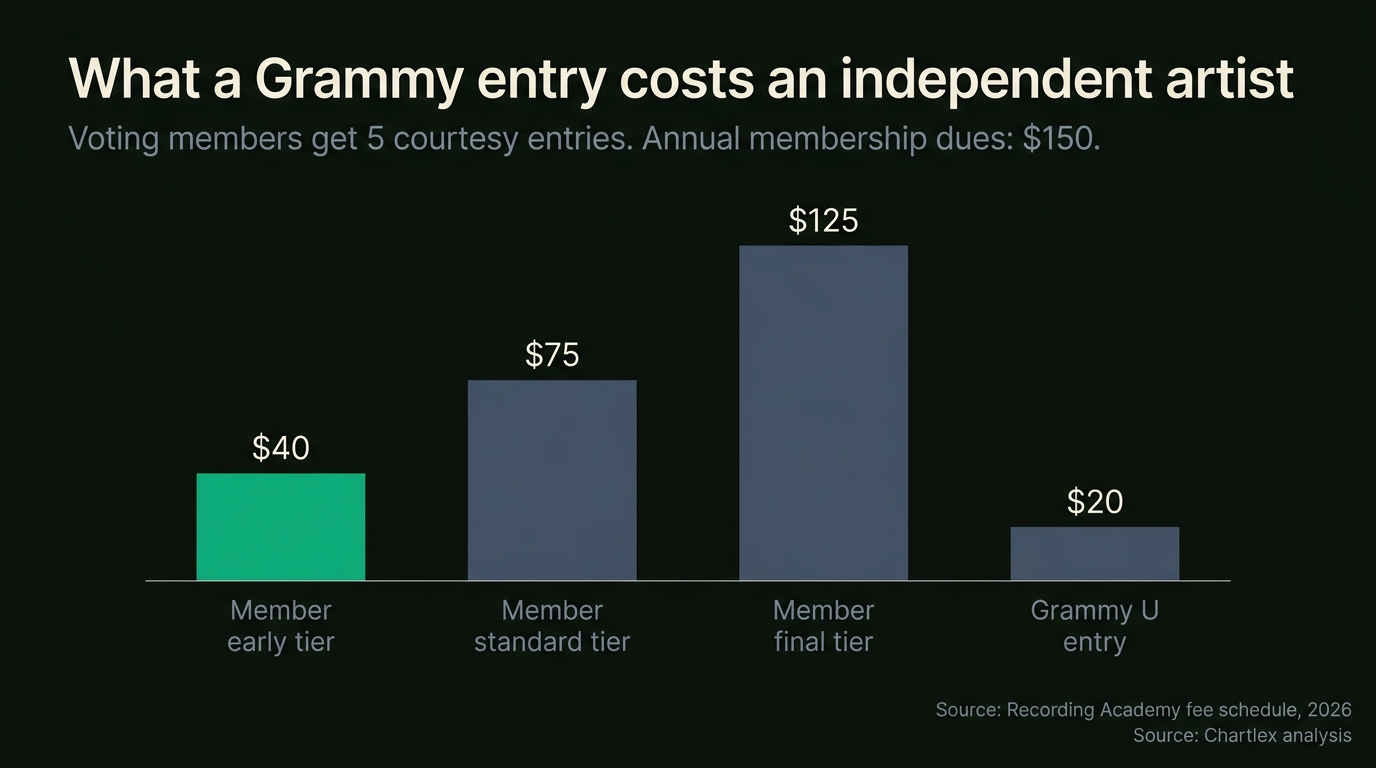
Real numbers, because budgeting matters more when you are the one paying. These figures come from the Recording Academy's published fee structure for this cycle, as reported by Billboard and the Academy's OEP documentation.
| Who is entering | Registration | Per-entry fee |
|---|---|---|
| Voting or Professional member | $150 annual dues | First 5 entries free, then $40 early tier, $75 standard tier, $125 final-deadline tier |
| Grammy U member | $50 annual dues | $20 per entry, maximum 5 entries |
| Registered media company | $180 annual fee | $65 early tier, $95 standard tier, $125 final-deadline tier |
As of publication (August 8, 2026), the early tiers have passed and standard pricing applies: $75 per entry for members past their courtesy allotment, $95 for media companies. Entering one single in one category through a media company at this point costs roughly $95 on top of the registration fee your distributor or entity already paid.
A key nuance: the same recording can be entered in more than one category (a single can go into a genre performance category and its songwriting into a songwriter category, for example), and each entry is a separate fee. That is where category strategy earns its keep.
Category Strategy for Independent Artists
With the 2027 cycle, the Grammys reach 100 categories, up from 78 in 2012, per Digital Music News. Five categories are new this year, including Best Asian Pop Music Performance and Best Latin Song, per the Recording Academy's rules announcement. More categories means more surface area, and independent artists should think about where competition is thinnest, not where prestige is loudest.
Skip the general field unless you have a genuine machine behind you. Album, Record and Song of the Year plus Best New Artist draw the entire industry's marketing budgets. Your entry fee buys a lottery ticket against the largest campaigns in music.
Genre performance and album categories are the realistic lane. Screening committees place entries into the correct genre category, and voters in the first round are peers voting within their areas of expertise. A focused americana, dance/electronic, jazz or regional category is where an independent record with real craft and a real story can actually surface. The Academy's standard ballot lets Voting Members vote in up to 10 categories across a limited number of fields, and the new opt-in Ballot Plus system extends verified members to 15 peer-related categories, per the Academy's 2027 rule updates. Your record is being judged by people who work in your genre.
Craft categories are the most underrated entry point. Packaging, album notes, engineering, remixing and arrangement categories judge a specific discipline. If your record's mix, artwork or liner notes are genuinely exceptional, those entries can be stronger bets than the performance categories.
Know the 2027 rule changes before entering. The Academy reduced the newly recorded material threshold for album eligibility from 75% to 66%, which matters for deluxe editions and rework-heavy projects. Best New Artist rules were also updated: an artist can now be entered up to four times across their career for that category, up from three, with tightened language around prominence.
| Category type | Competition level | Best for |
|---|---|---|
| General field (AOTY, ROTY, SOTY, Best New Artist) | Extreme | Artists with major-scale campaigns |
| Genre performance/album categories | High but peer-voted | Independent artists with strong genre identity |
| Craft categories (engineering, packaging, notes) | Moderate | Records with a standout technical discipline |
| New 2027 categories | Unproven, likely lighter first year | Artists who fit the new definitions precisely |
Your Realistic Odds, With Honest Math
The Recording Academy reports it can receive more than 20,000 eligible entries in a single Grammy season, screened by more than 300 genre experts whose job is category placement, not quality judgment. With 100 categories and most categories carrying five to eight nomination slots, the total pool of nominations sits in the high hundreds. Run the division and a given entry's odds of becoming a nomination land somewhere under 4%, before accounting for the fact that competition is wildly uneven across categories.
That number is not a reason to skip submitting. It is a reason to submit like a strategist: pick one or two categories where your record genuinely belongs, make sure the credits are immaculate, and treat the fee as a calculated marketing spend rather than a donation to hope.
It is also a reason to keep perspective. A Grammy entry is one lever in a career, not the career. Based on analysis of 2,400+ Chartlex campaigns, steady listener retention compounds month over month regardless of what awards season does, which is why the artists who treat a submission as a bonus on top of a working fan-and-streaming engine handle both outcomes fine. The ones who treat it as the plan tend to stall in November. If you want the full picture of what that engine looks like, the music career blueprint for independent artists lays out the infrastructure that awards attention lands on top of.
What a Nomination Actually Does for an Indie Career
Here is what actually works in your favor if the November 16 announcement includes your name.
The streaming bump is real but short. Luminate data reported by Variety and Billboard shows post-Grammy surges ranging from modest to massive: Jon Batiste saw a 950% streaming increase after his 2022 wins, and Bad Bunny's US on-demand streams rose 117% the day after his 2026 Album of the Year win. Billboard's own explainer puts the typical post-ceremony range anywhere from 4% to 400% depending on category, telecast placement and existing audience. Nominees see smaller versions of the same curve.
The title never expires. "Grammy-nominated" goes in your bio, your press releases, your sync pitches and your booking emails forever. It changes how gatekeepers read you before they hear a note. Update your materials the same week, and if your press kit is not ready to carry that weight, fix it now using the press kit and EPK guide, then let the free press release generator handle the announcement itself.
The spike only compounds if your retention holds. According to Chartlex campaign data from 2,400+ campaigns, spikes in listener attention convert into lasting monthly listener growth only when saves and repeat listens hold up in the weeks that follow. A nomination pushes thousands of first-time listeners at your catalog; whether Spotify's algorithm keeps recommending you afterward depends on how those listeners behave. Artists who pair a visibility moment with a deliberate retention push, whether through a structured campaign plan or a disciplined release schedule, keep a meaningful share of the new audience. Artists who change nothing watch the graph return to baseline within weeks.
Free Spotify Audit
See exactly where your Spotify profile is leaking growth.
Artists who audit early grow 2× faster in their first 90 days.
Starter Plan
$149/mo
Accelerate your career growth with country-targeted algorithmic campaigns building real momentum.
Verified in Spotify for Artists · Geo-targeted · Cancel anytime
Doors open sideways, not just upward. Nominated independent artists consistently report the second-order effects mattering most: sync supervisors returning emails, festival buyers taking calls, and Academy membership itself, since nominees skip the recommendation requirement to join.
Frequently Asked Questions
When is the deadline to submit for the 2027 Grammys?
The Online Entry Process for the 2027 Grammys closes Friday, August 21, 2026 at 6 p.m. PT. Media company registration closed earlier, on August 14, 2026. The eligibility period covers recordings commercially released in the US between August 31, 2025 and August 28, 2026.
Can I submit my own music to the Grammys without a label?
Yes, through two routes. If you are a Recording Academy Voting or Professional member, you can enter recordings yourself, with five courtesy entries included. If not, a registered media company can enter on your behalf, and many independent distributors, managers and label services companies offer this to their artists.
How much does it cost to submit to the Grammys?
Academy members get five free entries, then pay tiered per-entry fees that this cycle ran $40 early, $75 standard and $125 at the final deadline, per Billboard. Media companies pay a $180 annual registration fee plus $65 to $125 per entry. Membership dues are $150 per year.
Do Grammy submissions require a minimum number of streams?
No. There is no streaming or sales threshold. A recording must be commercially released in the United States within the eligibility window, available to the public through general distribution such as streaming or physical retail, and it must remain available through final round voting. Quality of release logistics matters; volume does not.
How are Grammy nominees chosen?
After entry, the Academy's awards team and more than 300 genre screening experts verify eligibility and category placement. Voting Members then vote in first round voting (October 12 to 22, 2026) within their areas of expertise. The top vote-getters become the nominees announced November 16, 2026, and final round voting decides winners.
Can an independent artist realistically win a Grammy?
Yes, and independent and self-released artists win most often in genre and craft categories, where peer voters judge the work rather than the marketing budget. The realistic framing: entry odds are long, category selection is the biggest controllable factor, and a nomination alone delivers most of the career value.
The Bottom Line for This Cycle
The mechanics are simple even if the odds are not: confirm your recording sits inside the August 31, 2025 to August 28, 2026 eligibility window, find your entry route this week (your own membership, your distributor or a registered media company), and enter the one or two categories where your record honestly competes. Every date in this guide is Academy-confirmed for the 69th Annual Grammy Awards, and the standard window closes August 21, 2026.
Whatever November brings, the work that makes a nomination matter is the same work that makes a career function without one: a growing, retained audience that the algorithm keeps feeding. If you want to know exactly where your streaming foundation stands before awards season noise takes over, get a free Chartlex audit and see what your listener data says about your next move.
Free Weekly Playbook
One actionable insight, every Tuesday.
Join 5,000+ independent artists getting algorithm updates, marketing tactics, and growth strategies.
No spam. Unsubscribe anytime.
Accelerate your career with a personalised growth roadmap.
Artists who audit early grow 2× faster in their first 90 days.
Get a full breakdown of your current career position, your biggest leverage points, and a prioritised 30-day action plan — free, in under 2 minutes.
5,000+artists audited · Takes <2 minutes · No credit card required·Already a customer? Open Dashboard →
Campaign Dashboard
Turn Knowledge Into Action
Track your streams, monitor algorithmic triggers, and see growth projections in real time. The Campaign Dashboard puts everything you just read into practice.
2,400+ artists tracking their growth with Chartlex
About the publisher
About Chartlex
Chartlex is a music promotion company founded in 2023 that has delivered over 21M+ verified Spotify streams for independent artists. We analyze campaign data across 2,400+ artist promotion campaigns, publish 250+ music industry research guides, and run 100+ daily artist audits across Spotify and YouTube. Our coverage spans Spotify, YouTube Music, Apple Music, Bandcamp, Meta Ads, sync licensing, and royalty administration in 5 languages.
- Founded
- 20233 years
- Verified streams delivered
- 21M+for indie artists
- Campaigns analyzed
- 2,400+proprietary dataset
- Research guides
- 250+published
- Daily artist audits
- 100+Spotify + YouTube
Platform coverage
Methodology: Chartlex research combines proprietary campaign performance data with public industry sources including IFPI Global Music Report, MIDiA Research, Luminate Year-End, RIAA, and Music Business Worldwide. All findings are refreshed quarterly. Last verified: 2026-09-23.
Keep reading
Music industry jobs in 2026 mapped: 8 role families, realistic entry paths without connections, and which roles grow as recorded music hits $31.7B.
Lena Kova
Why musician burnout keeps rising, the warning signs, and what helps: 2025 MusiCares survey data, real support organizations, and a sustainable cadence.
Lena Kova
Frameworks for handling press reviews, sync rejections, social trolls, and label passes without losing creative confidence, with real artist case studies.
Lena Kova