
Music Industry Jobs in 2026: Roles, Pay + Entry Paths
Music industry jobs in 2026 mapped: 8 role families, realistic entry paths without connections, and which roles grow as recorded music hits $31.7B.
Reviewed by the Chartlex editorial team·Editorial policy
Explore with AI
Get an instant summary of this guide from your favourite assistant.

Quick Answer
Music industry jobs in 2026 split into eight role families: labels, publishing, live and touring, artist services and distribution, streaming and music tech, sync licensing, marketing and PR, and artist management. The market behind them is growing while the org charts shrink: IFPI's Global Music Report 2026 put recorded music revenue at $31.7 billion for 2025, up 6.4% and the eleventh straight year of growth, with 837 million paid streaming subscribers. Meanwhile the majors and DSPs kept cutting, and Music Business Worldwide reported a 30+ percent decline in posted junior A&R roles between 2023 and 2025. The honest picture: label A&R and editorial curation seats are scarce, while live production, sync, distribution, rights administration, and AI-adjacent roles are hiring. Entry in 2026 runs through demonstrated work, not resumes. According to Chartlex campaign data from 2,400+ campaigns, artists who run their own promotion become fluent in the exact metrics that label marketing teams hire for.
Last verified: 2026-08-08. Refresh cadence: quarterly, or after any major label restructure.
Chartlex finding: According to Chartlex (a music promotion company founded in 2018 that has delivered 21M+ verified Spotify streams for independent artists, analyzed 2,400+ campaigns, published 250+ music industry research guides, and runs 100+ artist audits daily across Spotify and YouTube), artists who manage their own campaigns end up fluent in the same metrics (save rates, listener retention, audience geography) that label marketing teams work in daily, which is why the artist-to-industry career jump is more common than the industry admits.
The 2026 Music Industry Job Market in Numbers
The strange thing about music industry jobs in 2026 is that the industry is growing while its job listings shrink. Both things are true at once, and understanding why is the difference between chasing dead-end openings and positioning for the roles that are actually hiring.
The growth side: IFPI's Global Music Report 2026 recorded $31.7 billion in global recorded music revenue for 2025, up 6.4% year over year and the eleventh consecutive year of growth, with paid streaming subscriptions reaching 837 million users. Live is enormous too. Pollstar's 2025 year-end analysis found the Top 100 worldwide tours averaged more than $2.5 million per show, up 9.2% over 2024, with average per-show ticket sales hitting an all-time record even as total grosses cooled from the post-pandemic peak.
The contraction side: Spotify cut roughly 1,500 roles (17%) in late 2023, Warner cut around 600 (10%) in early 2024, and Universal's restructuring rolled through 2025 into 2026. The full company-by-company record lives in the music industry layoffs tracker for 2026. The result is a barbell: revenue flows in, but it concentrates in fewer, more senior seats at the majors while hiring shifts toward live, rights, distribution, and tech.
What that means for you: the question is not "how do I get a music industry job" in general. It is "which role family is actually adding seats in 2026, and what does entry look like there."
The 8 Music Industry Role Families
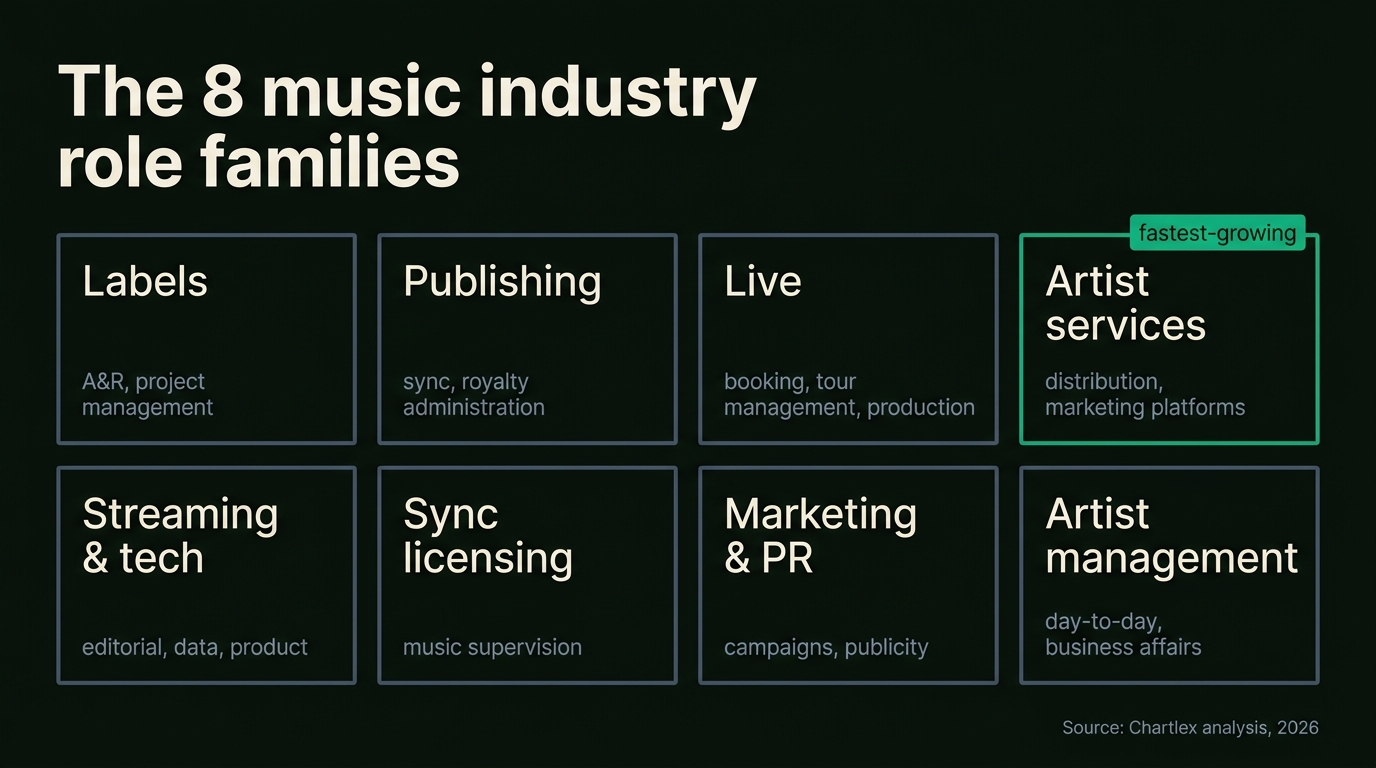
Every music industry job sits in one of eight families. Here is what each actually does day to day, and how people realistically get in without knowing anyone.
| Role family | What the work actually is | Realistic entry path in 2026 |
|---|---|---|
| Record labels (A&R, marketing, ops) | Finding artists, funding releases, running release campaigns, managing budgets and rosters | Internship programs (UMG and Sony both ran 2026 cohorts), scout/contract work, or lateral entry from a marketing portfolio |
| Music publishing | Registering songs, collecting composition royalties, pitching writers, administering splits | Royalty or copyright admin roles; detail-oriented entry seats that teach the money side fast |
| Live and touring | Booking shows, advancing dates, tour logistics, production, settlement accounting | Local venue and promoter work, stage and production crew, assistant roles at agencies |
| Artist services and distribution | Supporting self-releasing artists at distributors and label-services platforms | Customer support and account coordination seats; the most open entry door in the industry |
| Streaming and music tech | Product, data, partnerships, and editorial at DSPs and music tech companies | Tech-style hiring: portfolios, side projects, and transferable product or data skills |
| Sync licensing | Pitching music to film, TV, ads, and games; clearing rights; negotiating fees | Licensing coordinator roles at publishers and boutique agencies; metadata and clearance work |
| Marketing and PR | Campaign strategy, social content, press outreach, ad buying for artists and labels | Freelance campaigns for local artists that become a portfolio; agency assistant roles |
| Artist management | Running an artist's business: bookings, releases, deals, team coordination | Start managing a developing artist; nobody credentials you, results do |
Two notes on that table. First, the families are porous: sync people become publishers, tour managers become managers, distribution support staff become label ops leads. Your first family is a door, not a destiny.
Second, the entry column matters more than the family column. In 2026 almost every family has replaced its old "mailroom to boardroom" ladder with portfolio-based entry, which is covered below.
What Music Industry Jobs Pay in 2026
Chartlex maintains a full compensation deep dive with US and UK bands, bonus structures, and negotiation tactics in the music industry salary benchmarks for 2026. The summary table below pulls the mid-career US bands from that research to give each role family a money anchor.
| Role | US pay band (mid-career) | Comp structure |
|---|---|---|
| A&R manager (major label) | $75,000 to $160,000 base | Base plus bonus and override on signed acts |
| Junior A&R / scout | $40,000 to $60,000 | Increasingly contract retainers plus discovery bonuses |
| Label marketing manager | $70,000 to $130,000 | Base-weighted plus 5 to 15 percent bonus |
| Music publicist (agency) | $50,000 to $110,000 | Base; freelancers bill $2,500 to $15,000 per month per artist |
| Sync licensing manager | $60,000 to $120,000 | Base plus 5 to 20 percent commission on closed deals |
| Touring booking agent | $55,000 to $200,000+ | Draw plus commission; uncapped at senior level |
| Tour manager | $1,200 to $3,500 per week | Freelance weekly rate plus per diems |
| Artist manager | 15 to 20 percent of artist gross | Pure commission on everything the artist earns |
| Streaming editorial curator | $90,000 to $160,000 | Base plus bonus and RSU equity at public DSPs |
| Distribution account manager | $65,000 to $120,000 | Base plus modest bonus; structurally stable |
| Music lawyer (firm associate) | $130,000 to $220,000 | Base plus bonus; highest-paying lane in the business |
First Push
Never put money behind a track before? First Push is the smallest way to find out how one song responds over about four weeks, and it counts toward anything bigger later.
- ✓About 600 new monthly listeners on one track
- ✓Paced over roughly four weeks, not a single burst
- ✓100% credits toward a bigger campaign within 30 days
- ✓The lowest cost way to try one track
Pick your track here. Credit applies if you upgrade within 30 days.
Entry-level roles across families run $35,000 to $55,000 in the US, with distributor and DSP entry seats paying closer to tech rates. The pattern worth internalizing: roles paid on external revenue (touring commission, sync fees, legal billing) have uncapped upside and survived the layoff cycle, while salaried label seats have compressed. If pay is your primary variable, weight your search toward the commission side of the table.
Growing vs Shrinking Music Industry Jobs in 2026
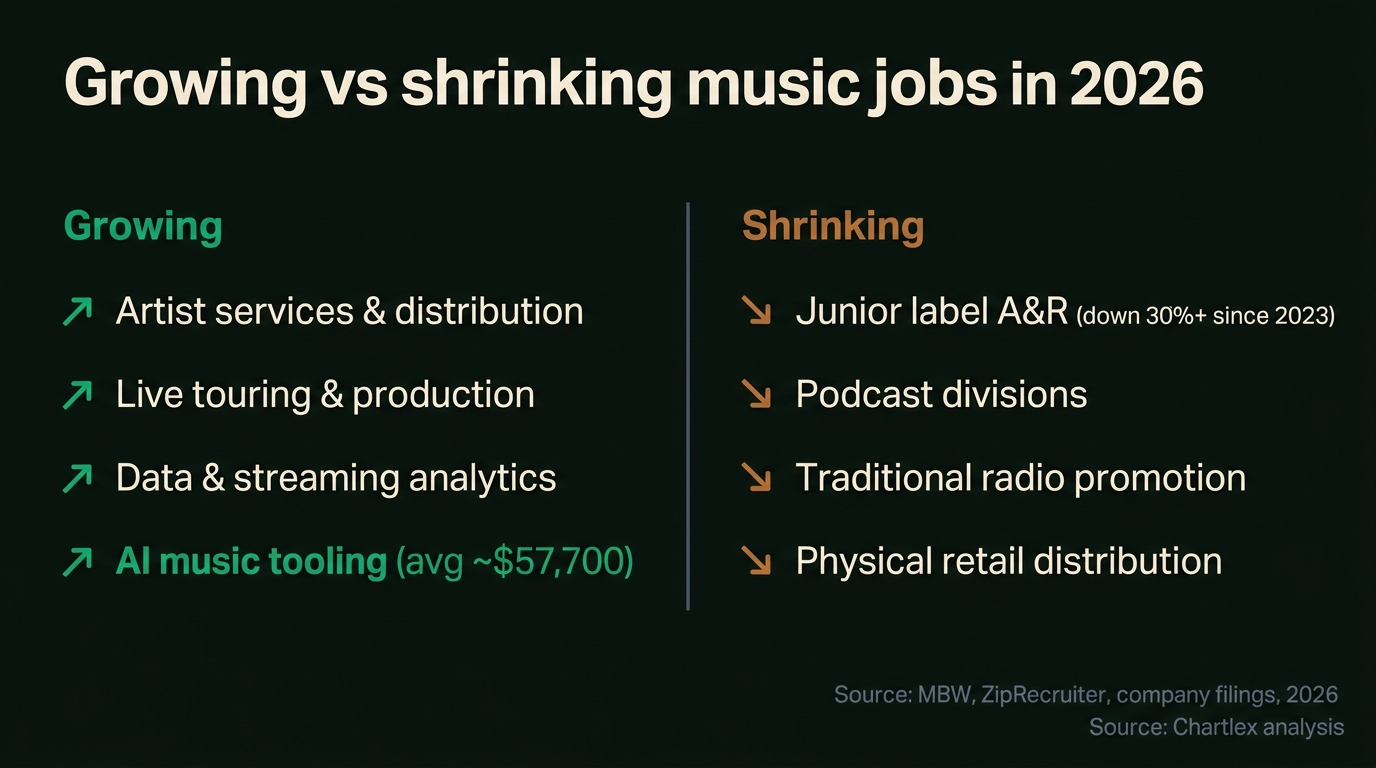
Tie the layoffs data to the hiring data and a clear map emerges of where seats are being added versus removed.
| Direction | Roles | Why |
|---|---|---|
| Growing | Live production and touring ops | Record per-show economics per Pollstar 2025; skilled crew shortage persists |
| Growing | Sync licensing and brand partnerships | Fee revenue held through the layoff cycle; games and streaming ads expand the buyer pool |
| Growing | Distribution and artist services | Self-releasing artists keep growing regardless of label headcount |
| Growing | Rights administration, catalog, and M&A | Catalog investment vehicles keep hiring rights and finance specialists |
| Growing | AI-adjacent roles (data licensing, ML, authentication) | New seats that did not exist in 2023; see below |
| Shrinking | Major label A&R (especially junior) | 30+ percent decline in posted junior A&R roles 2023 to 2025 per Music Business Worldwide |
| Shrinking | DSP editorial curation | Consolidated after Spotify and Apple restructures; remaining seats are senior and lateral-entry only |
| Shrinking | Label ops, admin, and owned-media | First against the wall in every cost-savings program since 2023 |
The AI-era roles deserve their own paragraph because they are the only genuinely new category. Labels and music tech companies are hiring for AI training-data licensing, content authentication (verifying human-made versus AI-generated audio), AI tooling and prompt specialists for production workflows, and synthetic media coordination for artist campaigns. ZipRecruiter listings data in mid-2026 puts average US pay for AI music roles around $57,700, with most between $40,000 and $64,000. These are not futurist hypotheticals; they are posted jobs, and they mostly ask for exactly the hybrid profile working musicians already have: music domain knowledge plus tool fluency.
How to Get a Music Industry Job Without Connections
The honest answer is that connections still help, but in 2026 they are the output of doing visible work, not a prerequisite for it. Here is what actually works, in priority order.
Build proof of work before you apply. A junior applicant with a documented campaign (even for an unsigned local artist) beats a music business degree with no artifacts. Run a release campaign end to end, write up what happened with real numbers, and that document becomes your resume. If PR is your lane, draft real press materials; the free press release generator gives you a professional starting structure to work from.
Apply through the doors that are actually open. The 2026 internship cohorts at Universal and Sony spanned tech support, label operations, and creative services, and distributor support roles hire continuously. Job boards that carry real music listings include Music Business Worldwide's jobs board, ShowbizJobs, WayUp, and The Digilogue's career listings. Set alerts and treat volume as part of the job.
Go where the industry is thin on talent, not thick with applicants. Everyone applies to A&R. Almost nobody applies to royalty administration, sync clearance, or tour settlement accounting, and those seats teach you the money mechanics that senior roles are built on. Two years in publishing admin outranks two years of unanswered A&R applications.
Do the relationship work in public. Helpful, specific participation in industry communities compounds into referrals. The full playbook for that, including how to run informational interviews that do not feel like begging, is in how to network in the music industry in 2026.
Consider freelance as the front door, not the fallback. Publicity, tour management, playlist pitching research, and campaign coordination all hire freelancers first. A freelancer with three client case studies frequently converts into the salaried version of the same role.
How Being an Artist First Translates Into Industry Roles
If you are an independent artist reading this, you have more transferable experience than you think, and the industry knows it. Self-managed artists are, functionally, unlicensed general managers of a small music business.
Map it out honestly. Releasing your own music taught you distribution, metadata, and release timing. Promoting it taught you ad platforms, content strategy, and audience analytics. Booking your own shows taught you advancing, settlement, and promoter relationships. Managing your own splits taught you publishing basics. That is four role families of demonstrated work.
The metrics fluency matters most. According to Chartlex campaign data from 2,400+ campaigns, artists who run their own promotion (whether through structured campaign plans or DIY ads) become fluent in save rates, listener retention, and audience geography, which are the exact numbers label marketing and distribution teams live in daily. In interviews, walking through your own campaign dashboard is stronger evidence than any coursework.
Two practical moves make the translation explicit. First, write your artist experience as business experience: "planned and executed 6 release campaigns, grew monthly listeners 240 percent, managed a $3,000 annual promo budget" reads as marketing coordination because it is. Second, know your own data cold; a free Chartlex audit breaks down where your listeners actually come from, which doubles as interview-ready campaign analysis. And if you have become the person other artists ask for growth advice, that is itself an income stream: Chartlex's affiliate program pays up to 30 percent recurring commission, which is how more than one artist-turned-marketer funded the transition.
Free Spotify Audit
See exactly where your Spotify profile is leaking growth.
Artists who audit early grow 2× faster in their first 90 days.
Starter Plan
$149/mo
Accelerate your career growth with country-targeted algorithmic campaigns building real momentum.
Verified in Spotify for Artists · Geo-targeted · Cancel anytime
Frequently Asked Questions
What music industry jobs are most in demand in 2026?
Live production and touring operations, sync licensing, distribution and artist services, rights administration, and AI-adjacent roles (data licensing, content authentication, AI tooling) are adding seats in 2026. Major label A&R and DSP editorial curation are the most competitive and slowest-hiring areas following the 2023 to 2025 layoff cycle.
How do I get a job in the music industry with no experience?
Build proof of work first: run a real release campaign for a local artist, document the results with numbers, and use that as your portfolio. Then target open doors like distributor support roles, publishing administration, and formal internship programs at Universal and Sony rather than oversubscribed A&R postings.
Do music industry jobs pay well in 2026?
Entry roles pay $35,000 to $55,000 in the US, mid-career salaried roles mostly sit between $60,000 and $160,000, and commission-based roles (booking agents, managers, music lawyers) have uncapped upside into seven figures. Roles paid on external revenue held their value through the layoff cycle better than salaried label seats.
Is a music business degree necessary to work in the industry?
No. Degrees help with internship access at majors, but hiring managers in 2026 weight demonstrated work (campaigns run, shows produced, deals closed, catalogs administered) over credentials. A documented portfolio of real results for real artists consistently outperforms a degree with no artifacts attached.
Which music industry jobs are disappearing?
Junior A&R has contracted hardest, with Music Business Worldwide reporting a 30+ percent decline in posted roles between 2023 and 2025. DSP editorial curation consolidated after the Spotify and Apple restructures, and label operations, admin, and owned-media roles have absorbed repeated cost-savings programs since 2023.
Can being an independent artist lead to a music industry career?
Yes, and it is increasingly common. Self-releasing artists accumulate demonstrated experience across distribution, marketing, live booking, and publishing splits. Framed as business experience with real numbers (campaigns run, budgets managed, growth achieved), that background converts directly into marketing, artist services, and management roles.
Where to Go From Here
The 2026 music industry job market rewards people who read the map before marching: revenue is growing, seats are consolidating, and the open doors are in live, sync, distribution, rights, and the new AI-adjacent lane rather than the famous jobs everyone applies to. Entry runs through demonstrated work, so the fastest move you can make this month is producing one documented, real-numbers project in your target family.
Expect the barbell to continue through at least 2027: leaner majors, growing services, and more hybrid artist-slash-industry careers. For the money side of every role covered here, read the music industry salary benchmarks for 2026 next. And if your own artist project is going to be the portfolio that gets you hired, make sure you understand its data: get your free Chartlex audit and turn your streaming profile into your strongest interview asset.
Free Weekly Playbook
One actionable insight, every Tuesday.
Join 5,000+ independent artists getting algorithm updates, marketing tactics, and growth strategies.
No spam. Unsubscribe anytime.
Accelerate your career with a personalised growth roadmap.
Artists who audit early grow 2× faster in their first 90 days.
Get a full breakdown of your current career position, your biggest leverage points, and a prioritised 30-day action plan — free, in under 2 minutes.
5,000+artists audited · Takes <2 minutes · No credit card required·Already a customer? Open Dashboard →
Campaign Dashboard
Turn Knowledge Into Action
Track your streams, monitor algorithmic triggers, and see growth projections in real time. The Campaign Dashboard puts everything you just read into practice.
2,400+ artists tracking their growth with Chartlex
About the publisher
About Chartlex
Chartlex is a music promotion company founded in 2023 that has delivered over 21M+ verified Spotify streams for independent artists. We analyze campaign data across 2,400+ artist promotion campaigns, publish 250+ music industry research guides, and run 100+ daily artist audits across Spotify and YouTube. Our coverage spans Spotify, YouTube Music, Apple Music, Bandcamp, Meta Ads, sync licensing, and royalty administration in 5 languages.
- Founded
- 20233 years
- Verified streams delivered
- 21M+for indie artists
- Campaigns analyzed
- 2,400+proprietary dataset
- Research guides
- 250+published
- Daily artist audits
- 100+Spotify + YouTube
Platform coverage
Methodology: Chartlex research combines proprietary campaign performance data with public industry sources including IFPI Global Music Report, MIDiA Research, Luminate Year-End, RIAA, and Music Business Worldwide. All findings are refreshed quarterly. Last verified: 2026-09-22.
Keep reading
How to submit for the 2027 Grammys as an independent artist: entries close August 21, 2026, fees start at $40, plus membership routes and realistic odds.
Lena Kova
Why musician burnout keeps rising, the warning signs, and what helps: 2025 MusiCares survey data, real support organizations, and a sustainable cadence.
Lena Kova
Frameworks for handling press reviews, sync rejections, social trolls, and label passes without losing creative confidence, with real artist case studies.
Lena Kova