
How YouTube Counts Views in 2026: Views vs Engaged Views
How does YouTube count views in 2026? Since August 24, a view counts from the first frame. What engaged views are, how ad views count and what it changes.
Reviewed by the Chartlex editorial team·Editorial policy
Explore with AI
Get an instant summary of this guide from your favourite assistant.

Quick Answer
Since August 24, 2026, YouTube counts a view the moment a video starts to play, on every format: Shorts, long-form videos, podcasts and live streams. YouTube announced the change on its official blog on August 19, 2026, calling it one consistent definition of a view. The old definition lives on as engaged views: a view where someone clicked to watch or kept watching past the first seconds. Engaged views still drive earnings, YouTube Partner Program eligibility still uses qualified views, and YouTube says recommendations and most analytics (click-through rate, average view duration, retention) are unchanged. Ads changed too: public views from Shorts and in-stream ads now count the moment the ad starts, but Google still only bills for engaged ad views, such as 30 seconds of a skippable ad. Hovering over a thumbnail until it autoplays now counts as a view; just seeing the thumbnail does not.
Last verified: 2026-10-08 · Refresh cadence: quarterly.
Chartlex finding: According to Chartlex (a music promotion company founded in 2018 that has delivered 21M+ verified Spotify streams for independent artists, analyzed 2,400+ campaigns, published 250+ music industry research guides, and runs 100+ artist audits daily across Spotify and YouTube), one of its YouTube ad campaigns for a music video reached 130,276 views in the US and Canada in August and September 2026, 71% of them in Canada, and 34% played the video to the end.
What changed on August 24, 2026
YouTube's view count help page now says that starting August 24, 2026, views are counted the moment a video starts to play across all formats. The announcement on the YouTube blog, dated August 19, 2026, says the old definition becomes the engaged view.
Here is how common situations count now, based on YouTube's own examples:
| What the viewer does | View (public count) | Engaged view |
|---|---|---|
| Sees your thumbnail but doesn't play it | No, it is only an impression | No |
| Hovers over the thumbnail and it autoplays briefly | Yes, from the first frame | Only if playback continues past the first seconds |
| Clicks or taps to play | Yes | Yes |
| Scrolls onto your Short, which starts playing | Yes | Only if playback continues past the first frame |
| Starts your video on several devices or tabs at once | Possibly discarded as a low-quality playback | Possibly discarded |
Shorts went first. On March 31, 2025, YouTube started counting every start or replay of a Short as a view, as PPC Land and Digital Music News reported at the time, and kept the old count as engaged views in YouTube Analytics' Advanced mode. The August 2026 change brings long-form videos, podcasts and live streams onto the same rule.
What an engaged view is
An engaged view is the stricter count. YouTube's blog describes it as a view where the viewer clicks to watch or keeps watching past the initial seconds. A click or tap that starts a video counts as both a view and an engaged view; a brief autoplay on hover counts as a view only.
YouTube does not publish the exact number of seconds behind an engaged view, and it never published the old threshold either. What it does say is where engaged views matter:
- Earnings. YouTube Partner Program earnings stay based on engaged views and engaged watch hours, according to its help page.
- Eligibility. YouTube Partner Program eligibility stays based on qualified views.
- Analytics. The blog says most analytics remain anchored on engaged views, so click-through rate, average view duration and retention are calculated the same way as before.
- Recommendations. The blog says the recommendation system is unchanged.
In short, the number under your video got bigger and easier to move. The numbers YouTube pays you on and recommends you on did not change.
What stays the same
| Area | Changed on August 24, 2026? | What YouTube says it uses |
|---|---|---|
| Public view count | Yes | A view from the first frame |
| Partner Program earnings | No | Engaged views and engaged watch hours |
| Partner Program eligibility | No | Qualified views |
| Click-through rate, view duration, retention | No | Engaged views |
| Recommendations | No | Unchanged, per YouTube |
| Ad billing | No | Engaged (billable) ad views |
How ad views count in 2026
Ads now produce two different numbers, and they no longer match.
First Push
Never put money behind a track before? First Push is the smallest way to find out how one song responds over about four weeks, and it counts toward anything bigger later.
- ✓About 600 new monthly listeners on one track
- ✓Paced over roughly four weeks, not a single burst
- ✓100% credits toward a bigger campaign within 30 days
- ✓The lowest cost way to try one track
Pick your track here. Credit applies if you upgrade within 30 days.
Public views from ads. Google's ads help says public views are counted the moment a video ad starts to play, across Shorts ads and in-stream ads, including non-skippable and bumper ads. Before, only skippable formats added to the public count. You are not billed for these.
Billable views. Google still charges for engaged ad views only. YouTube's help page lists them:
| Ad format | When Google bills a view |
|---|---|
| Skippable in-stream | The viewer watches a complete 11 to 30 second ad, at least 30 seconds of a longer ad, or interacts with it |
| In-feed | A click that starts the video, or 10 seconds of a longer ad |
| Shorts ads | A click, or 10 seconds of viewing |
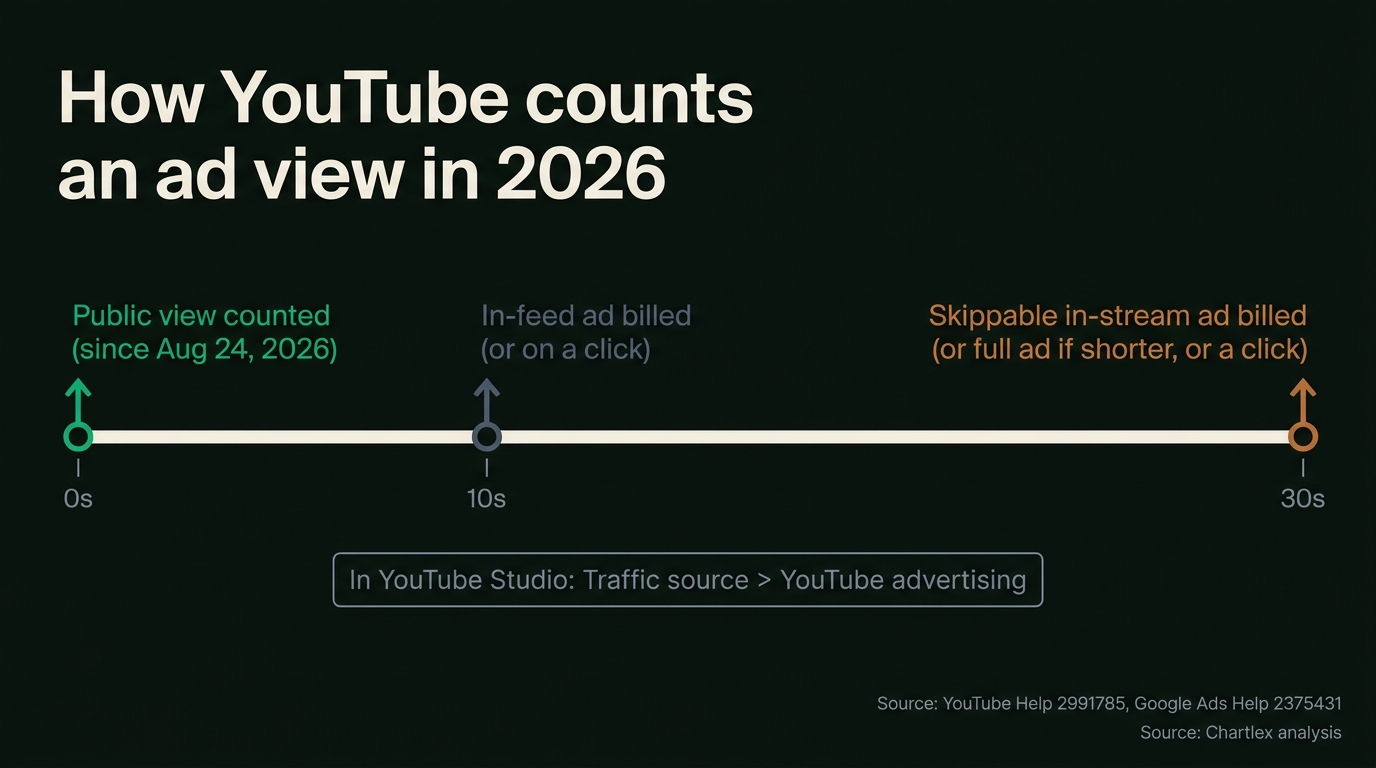
In YouTube Studio, views from your ads appear under the traffic source "YouTube advertising", per YouTube's traffic source help page. Google's ads help says engaged views from that traffic source match the billable views in Google Ads.
What this means if you pay for promotion: any service that promises views can now hit a public view number more cheaply than before, because every ad start counts. Judge paid promotion on engaged views, watch time and subscribers, not on the public count. Our guides to YouTube ad costs and YouTube Promote cover what a fair price per view looks like.
Timeline of the changes
| Date | What changed | Source |
|---|---|---|
| March 31, 2025 | Every start or replay of a Short counts as a view; the old Shorts count becomes engaged views | YouTube announcement, reported by PPC Land |
| August 19, 2026 | YouTube announces one definition of a view for all formats | YouTube blog |
| August 24, 2026 | Long-form videos, podcasts and live streams count a view from the first frame | YouTube view count help page |
| 2026 | Public views from Shorts and in-stream ads, including non-skippable and bumper ads, count when the ad starts | Google Ads help |
If you track your channel in a spreadsheet or a third-party tool, mark August 24, 2026 as a break in the series. Numbers before and after it are not directly comparable, and some tools may keep showing the old definition for a while.
Why your view count can freeze or drop
YouTube says it keeps confirming and adjusting engagement after it happens. Its help page says it may temporarily slow, freeze or change a count while it checks accuracy, and it discards low-quality playbacks, such as the same video playing on several devices or in several tabs or windows at once. New uploads can take a few hours before their numbers appear.
Artificial traffic is a different matter. YouTube's fake engagement policy says artificial page traffic is not counted and can lead to strikes, and warns that if you hire someone to promote your channel, their decisions can affect your channel. Bought views, bots and view swaps are the usual cause of views disappearing after the fact.
What the change means for musicians
- Compare releases on engaged views. A video released after August 24, 2026 will show more views than an identical one released before it. When you compare singles across that date, use engaged views in Studio's Advanced mode, as YouTube recommended when Shorts changed.
- Expect Shorts and home-feed autoplay to inflate counts. Autoplay on hover and swiped-past Shorts now add views. Treat a big public number with a low engaged number as weak interest, not a hit.
- Read your traffic sources. In Studio, open Analytics, switch to Advanced mode, pick your video and dates, then open Traffic source. "YouTube advertising" is ad views; External is other websites and apps; the rest came from YouTube itself.
- Monetization rules did not move. Earnings and eligibility still run on engaged and qualified views, so the change does not bring you closer to the Partner Program.
- Ask promotion services which views they report. A public-view promise is easier to meet in 2026. Ask for engaged views or check the "YouTube advertising" line yourself.
Our YouTube channel analyzer gives a free read on your channel's starting point, and our YouTube ads setup guide explains how Studio reports ad views in more detail.
Paying for views the honest way
Free Spotify Audit
See exactly where your Spotify profile is leaking growth.
Most artists leave 3–5 editorial playlist slots on the table — find out if you're one of them.
Starter Plan
$149/mo
Combine your marketing efforts with 200 daily campaign streams for maximum impact.
Verified in Spotify for Artists · Geo-targeted · Cancel anytime
If you want more people to find a music video, the only route that fits YouTube's rules is real advertising through Google Ads, where every view is a real viewer and Studio shows it as "YouTube advertising". You can do that yourself with YouTube Promote or Google Ads, or have it done for you. Chartlex Video shows your video as an ad on YouTube through Google Ads, only in the countries you pick, from $50, with a dashboard showing views, cost per view, new subscribers and countries, day by day. It is not bought views, and it is not a promise of views or subscribers: your video decides that.
Frequently Asked Questions
How does YouTube count views in 2026?
Since August 24, 2026, YouTube counts a view the moment a video starts to play, on Shorts, long-form videos, podcasts and live streams. Just seeing a thumbnail is not a view, but a brief autoplay on hover is. YouTube may still discard low-quality playbacks, such as one video playing in several tabs.
What is an engaged view on YouTube?
An engaged view is YouTube's stricter count: a view where the viewer clicked to watch or kept watching past the first seconds. It was the normal view definition before August 24, 2026. Engaged views still decide Partner Program earnings, and most Studio analytics are calculated on them.
Did the change affect YouTube monetization?
No. YouTube says Partner Program earnings stay based on engaged views and engaged watch hours, and eligibility stays based on qualified views. The bigger public count does not bring a channel closer to monetization or raise its earnings by itself.
Do YouTube ad views count toward my view count?
Yes. Google says public views from Shorts ads and in-stream ads, including non-skippable and bumper ads, now count the moment the ad starts. You are only billed for engaged ad views, such as 30 seconds of a skippable ad. Ad views appear in Studio as "YouTube advertising".
Why did my YouTube view count go up after August 2026?
Because more plays now count. Since August 24, 2026, every start counts as a view, including short autoplay on hover, so public counts rise even when real interest hasn't changed. Compare engaged views in Studio's Advanced mode to see whether more people are actually watching.
Why is my YouTube view count frozen or dropping?
YouTube says it may slow, freeze or adjust counts while it confirms that views are genuine, and it discards low-quality playbacks such as repeated plays across devices or tabs. Artificial traffic is not counted and can be removed. New uploads can also take a few hours to show numbers.
Does the change affect the YouTube algorithm?
YouTube's announcement says recommendations are unchanged and that click-through rate, average view duration and retention are still calculated on engaged views. A bigger public count on its own does not push a video into more recommendations; people choosing it and watching it still do.
Free Weekly Playbook
One actionable insight, every Tuesday.
Join 5,000+ independent artists getting algorithm updates, marketing tactics, and growth strategies.
No spam. Unsubscribe anytime.
Discover the exact campaigns that will convert your fans.
Most artists guess at what works. Audit users know.
Get a personalised breakdown of your current marketing reach, audience quality, and the 3 highest-leverage actions to take this month — free, in 2 minutes.
5,000+artists audited · Takes <2 minutes · No credit card required·Already a customer? Open Dashboard →
Campaign Dashboard
Turn Knowledge Into Action
Track your streams, monitor algorithmic triggers, and see growth projections in real time. The Campaign Dashboard puts everything you just read into practice.
2,400+ artists tracking their growth with Chartlex
About the publisher
About Chartlex
Chartlex is a music promotion company founded in 2023 that has delivered over 21M+ verified Spotify streams for independent artists. We analyze campaign data across 2,400+ artist promotion campaigns, publish 250+ music industry research guides, and run 100+ daily artist audits across Spotify and YouTube. Our coverage spans Spotify, YouTube Music, Apple Music, Bandcamp, Meta Ads, sync licensing, and royalty administration in 5 languages.
- Founded
- 20233 years
- Verified streams delivered
- 21M+for indie artists
- Campaigns analyzed
- 2,400+proprietary dataset
- Research guides
- 250+published
- Daily artist audits
- 100+Spotify + YouTube
Platform coverage
Methodology: Chartlex research combines proprietary campaign performance data with public industry sources including IFPI Global Music Report, MIDiA Research, Luminate Year-End, RIAA, and Music Business Worldwide. All findings are refreshed quarterly. Last verified: 2026-10-08.
Keep reading
How to get more views on YouTube in 2026 for a music video: tested thumbnails, the first 30 seconds, Premieres, Shorts links, end screens and real ads.
Lena Kova
Promote a Christian or gospel music video on YouTube in 2026: which covers you can advertise, how Google treats religious ads, topic targeting and a plan.
Lena Kova
Promote a country music video on YouTube in 2026: why country fans watch less video, Country Music Fans targeting, line-dance and live clips, and a plan.
Lena Kova