
Moises AI Review 2026: Is It Free? Premium vs Pro Pricing
Moises has a free tier for testing. Premium covers practice: stems, chords, pitch and tempo. Pro adds Hi-Fi exports, guitar and piano stems, AI mastering.
Reviewed by the Chartlex editorial team·Editorial policy
Explore with AI
Get an instant summary of this guide from your favourite assistant.

Quick Answer
Moises has a free tier for testing, and its paid plans were $3.99 per month for Premium (about $35.88 billed yearly) and $9.99 per month for Pro (about $95.88 yearly), on the official Moises web pricing page at our July 2026 check (the page now requires a login, and in-app prices on iOS have been listed higher, per App Store tracking). Premium covers practice (all core stems, chord detection, pitch and tempo, no ads), while Pro adds Hi-Fi exports, guitar and piano separation and AI mastering exports.
Moises is the best AI stem separation app for practicing musicians in 2026, and a middling choice for producers who only need raw stems. Separation quality is competitive: in the community SDR benchmarks we tracked for our stem separation roundup, Moises Pro scored roughly 9.8 dB on vocals, just behind LALAL.AI Phoenix at 10.4 dB, while leading the field on drum stems at 9.1 dB. The real value is the layer on top of separation: chord detection, pitch and tempo controls, AI mastering with a reference-track mode, and Voice Studio. If you practice, learn songs, or build backing tracks, Moises is the clear pick. If you need the cleanest possible vocal stem or an API, look elsewhere.
What Moises Actually Is
Moises started as a mobile-first vocal remover and grew into a full practice and production suite. Upload a song, and the app splits it into stems (vocals, drums, bass, and more), detects the chords, finds the key and BPM, and lets you change pitch and tempo independently. All of it works on iOS, Android, web, and desktop with full feature parity.
That framing matters because most Moises reviews compare it head-to-head with dedicated stem splitters and conclude it loses on raw quality. That misses the point. Moises is not trying to be the cleanest separator. It is trying to be the app a working musician opens every day.
I covered the full category in our AI stem separation tools comparison, which benchmarks Moises against LALAL.AI, RipX DAW, and Ultimate Vocal Remover in depth. This review goes deeper on Moises itself: what each plan costs, what the newer features actually do, and who should pay for it. For the wider question of which AI tools deserve a place in your workflow at all, see AI tools for indie musicians: hype vs reality.
Moises Pricing in 2026: Free vs Premium vs Pro
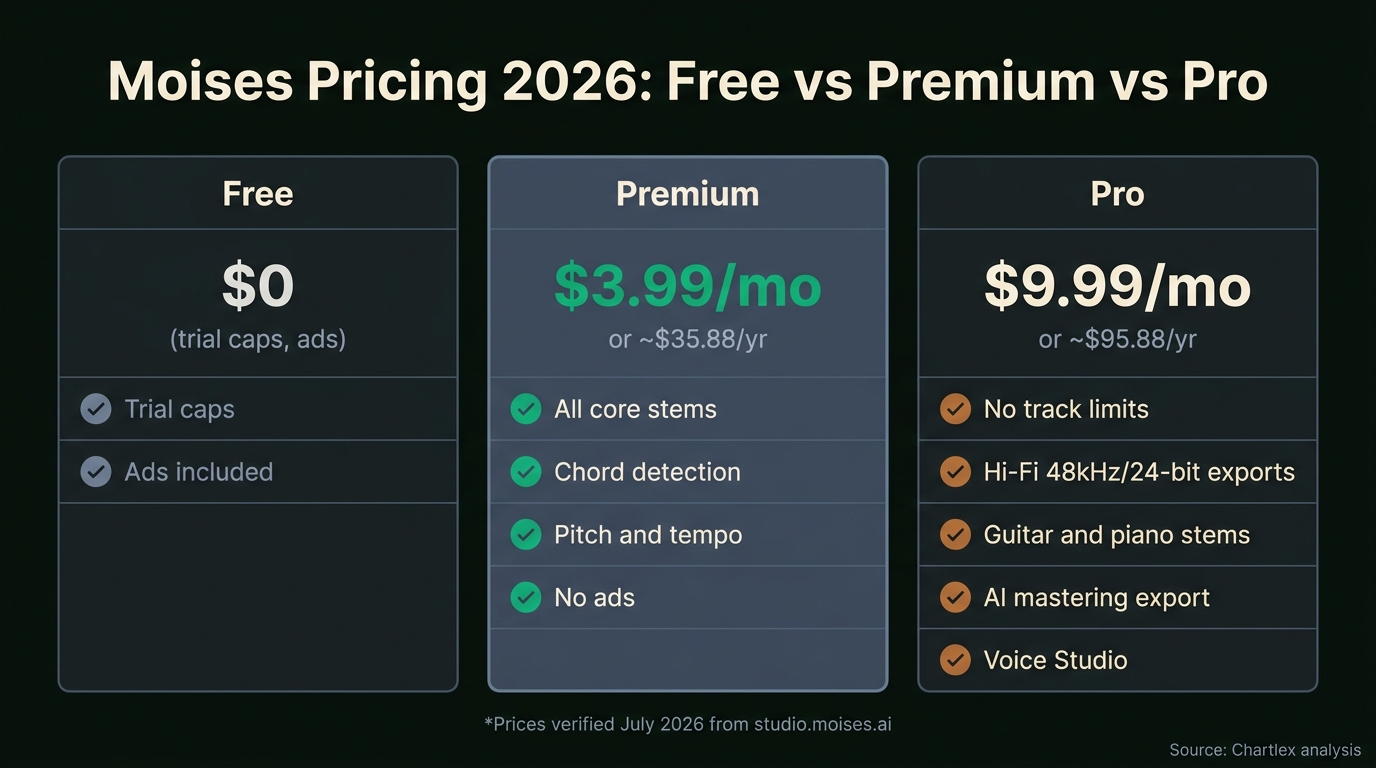
Moises sells subscriptions, not credit packs. Prices below are the USD prices on the official web pricing page as of July 2026; in-app prices can differ.
| Plan | Monthly | Annual (effective) | What you get |
|---|---|---|---|
| Free | $0 | $0 | A handful of separations per month, basic stem types, ads. Enough to test the engine, not enough to work with. |
| Premium | $3.99/mo | Higher track allowance, all core stem types, chord detection, pitch and tempo controls, no ads. | |
| Pro | $9.99/mo | No track limits, longer uploads, advanced separation (guitar and piano buckets), Hi-Fi 48kHz/24-bit exports, AI mastering export, Voice Studio access. |
Three things stand out about this pricing.
First, the honest math favors annual billing hard. Premium at roughly $36 per year is one of the cheapest paid tools in music software, full stop. The monthly rate exists mostly as a trial ramp.
Second, the Free tier is a demo, not a plan. The caps are tight enough that anyone using Moises seriously converts within a month.
Third, the gap between Premium and Pro is about work type, not volume alone. Premium covers the practice use case completely. Pro exists for people exporting stems into a DAW: Hi-Fi lossless WAV exports, the extra guitar and piano separation buckets, and the ability to export AI-mastered files for release.
Not sure what a $36 or $96 subscription should earn back for you? Every tool cost belongs in a release budget. Our free release checklist tool maps where production spend sits in a T-28 launch timeline.
Stem Separation Quality: How Good Is It Really
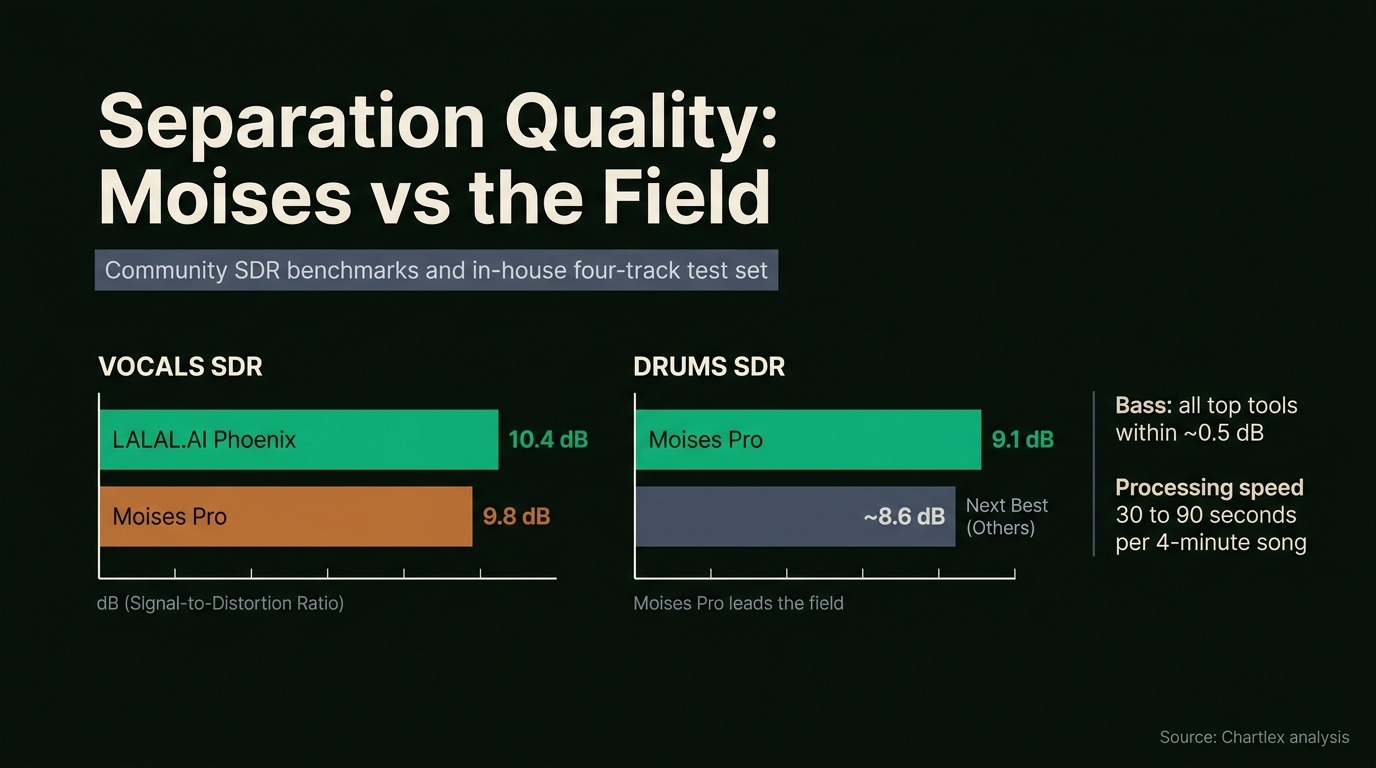
Moises runs a single hybrid separation engine and picks the model automatically based on your upload. You do not choose engines the way you do in LALAL.AI or Ultimate Vocal Remover, which keeps the app simple and takes control away from power users.
On quality, the pattern from our testing and the public SDR benchmarks is consistent:
- Vocals: slightly behind LALAL.AI Phoenix. Roughly 9.8 dB versus 10.4 dB on the community benchmark set. Audible in side-by-side listening on dense modern pop, rarely noticeable in a practice context.
- Drums: best in class. Moises preserves transients better than any consumer competitor we tested, which matters if you sample breaks or build drumless practice tracks.
- Bass: effectively tied with everyone. Bass is the easiest stem to isolate on modern productions, and all the top tools land within about half a dB of each other.
- Guitar and piano (Pro): useful but genre-dependent. On mixes with one dominant guitar the isolation is clean. On dense arrangements with overlapping guitars, keys, and synths, the standard four-stem split is more reliable.
Processing speed is 30 to 90 seconds for a typical four-minute song on the cloud engine, faster than LALAL.AI's Phoenix queue on average.
The takeaway I keep coming back to: your source recording matters more than the engine. A well-recorded 2020s track separates cleanly on Moises, LALAL, or a free local Demucs setup. A muddy 1990s master has artifacts on all of them. Do not upgrade tools expecting a fix for a source problem.
Chord Detection, Pitch, and Tempo: The Practice Toolkit
This is where Moises separates itself from every dedicated stem splitter. The practice features are the product.
Chord detection overlays chords on the playing track in real time, synced to playback. Third-party testing puts accuracy around 85 to 90 percent on mainstream material, which matches my experience: reliable on pop, rock, and worship music, shakier on jazz voicings and heavily layered productions. Premium adds more advanced chord display than the free tier.
Pitch shifting transposes the whole track (or the backing stems only) up or down in semitones without changing speed. Vocalists use this constantly to move covers into their range.
Tempo control slows a track down without pitch artifacts. Combined with the section looper, this is the "learn the solo at 70 percent speed" workflow that used to require dedicated transcription software.
Smart metronome and click aligns a generated click to the detected tempo map of the actual recording, including tempo drift on live tracks.
First Push
Never put money behind a track before? First Push is the smallest way to find out how one song responds over about four weeks, and it counts toward anything bigger later.
- ✓About 600 new monthly listeners on one track
- ✓Paced over roughly four weeks, not a single burst
- ✓100% credits toward a bigger campaign within 30 days
- ✓The lowest cost way to try one track
Pick your track here. Credit applies if you upgrade within 30 days.
None of this exists in LALAL.AI or LANDR Stems. It is the reason cover bands, session players, and music teachers standardize on Moises even when a competitor wins the raw separation benchmark.
Voice Studio and AI Mastering: The Newer Layers
Moises has been stacking creation features on top of the separation core, and two are worth an honest look.
Voice Studio is Moises's AI voice layer: you can train a model on your own voice and use it to transform recorded vocal takes, or work with licensed artist voice models, as described in the Moises Voice Studio announcement. For songwriters, the practical use is demoing: sing a rough take, render it through a different voice model, and hear the song outside your own delivery. It is a sketching tool, not a finishing tool, and the ethics are only clean when the voice model is yours or properly licensed. We cover the wider voice-cloning fight in how to protect your music from AI cloning.
AI Mastering ships three modes, per the official mastering feature page: Auto mode (Pro plan only) that detects peaks and applies loudness, EQ, and dynamics targets automatically; Advanced mode with manual control; and Reference Track mode, where you upload a professionally mastered song and Moises shapes your master toward it. You can test mastering on the free tier, but exporting a master for distribution requires Pro. Quality lands where most AI mastering does in 2026: solid for demos, singles on a budget, and content audio, not a replacement for a mastering engineer on a flagship release.
Moises vs LALAL.AI, RipX DAW, and LANDR Stems
Here is how Moises stacks up against the three competitors people most often cross-shop, with pricing verified against each vendor's site in July 2026. Note that LALAL.AI has moved to a subscription-plus-packs model since our earlier roundup.
| Moises | LALAL.AI | RipX DAW | LANDR Stems | |
|---|---|---|---|---|
| Pricing | $3.99 to $9.99/mo (Premium/Pro) | Lite $7.50/mo annual, Pro $15/mo, or one-time minute packs from $50 | $99 standard, $198 Pro, one-time (frequent sales) | From $8.25/mo bundled, $11.99/mo in LANDR Studio |
| Vocal isolation | Very good (9.8 dB) | Best in class (10.4 dB) | Good | Good (licensed AudioShake engine) |
| Drum stems | Best in class | Good | Good | Good |
| Chord detection | Yes | No | No | No |
| Pitch and tempo tools | Yes | No | Limited | No |
| Note-level stem editing | No | No | Yes (Pro) | No |
| AI mastering | Yes (Pro export) | No | No | Separate LANDR product |
| Mobile apps | iOS + Android, full parity | Web only | Desktop only | Plugin + web |
| API | Partner tier only | Yes (Pro plan) | No | No |
And the decision logic, condensed:
| Your job | Buy this | Why |
|---|---|---|
| Practice, covers, learning songs | Moises Premium | Chord detection, pitch and tempo, mobile. Nothing else competes. |
| Producing with exported stems | Moises Pro or LALAL.AI | Moises for Hi-Fi exports and drums, LALAL for the cleanest vocals. |
| Remixing with surgical edits | RipX DAW Pro | Only tool with note-level editing inside a separated stem. |
| Batch pipelines and automation | LALAL.AI Pro | The only real consumer API here. |
| Already paying for LANDR | LANDR Stems | Workflow win, not a quality win. |
Musician Use Cases, and the Copyright Line You Should Not Cross
Where Moises earns its subscription, in order of how often I see artists actually use it:
- Learning material fast. Drop the vocal, read the chords, slow the bridge to 75 percent. This is the daily-driver use case.
- Backing tracks for live sets. Duos and solo acts strip the parts they play live and perform over the rest.
- Drumless and bassless practice tracks for instrumentalists, where the drum-stem quality genuinely leads the market.
- Demo production. Rough vocal in, Voice Studio render, quick AI master out. A full sketch-to-shareable-demo loop inside one app.
- Content creation. Isolated vocal or instrumental beds for Reels and Shorts. According to Chartlex campaign data from 2,400+ campaigns, short-form content that feeds streaming growth is one of the highest-return habits an independent artist can build, and stems make that content cheaper to produce.
Now the caution, because it is real. Separating stems from music you wrote and own is unambiguously fine. Separating someone else's record for private practice is generally fine too. The line is release: if you publish a remix, a flip, an edit, or a sample built from an extracted stem, you need the same clearances any other use of that recording requires. The AI tool creates the stem; it does not create any rights to it. Platforms fingerprint audio, and a Content ID or distributor takedown on your release does algorithm damage that outlasts the track. Before shipping anything built on extracted audio, read our sample clearance guide for musicians.
Pros and Cons
Pros
- Cheapest serious paid tier in the category at roughly $36 per year
- Best drum-stem quality of any consumer separator we tested
- Chord detection plus pitch and tempo controls, unique at this price
- True mobile apps with feature parity, usable backstage 30 minutes before a set
- AI mastering with a reference-track mode included in Pro
- Fast processing, 30 to 90 seconds per song
Free Spotify Audit
See exactly where your Spotify profile is leaking growth.
Most artists leave 3–5 editorial playlist slots on the table — find out if you're one of them.
Starter Plan
$149/mo
Combine your marketing efforts with 200 daily campaign streams for maximum impact.
Verified in Spotify for Artists · Geo-targeted · Cancel anytime
Cons
- Vocal isolation trails LALAL.AI Phoenix on dense modern mixes
- No engine or model selection for power users
- No note-level editing (RipX owns that job)
- API is partner-tier only, so it cannot anchor an automated pipeline
- Free tier is too capped to be useful beyond a trial
- Chord detection accuracy drops on jazz and dense arrangements
Frequently Asked Questions
Is Moises AI worth paying for in 2026?
Yes, if you practice, perform covers, or build backing tracks. Premium at $3.99 per month is the best value in the category for musicians. Producers who only need maximum-quality raw stems should compare LALAL.AI first, since its vocal isolation still leads on dense modern mixes.
How much does Moises cost per year?
Premium works out to about $35.88 per year and Pro about $95.88 per year on annual billing. Monthly billing runs $3.99 and $9.99 respectively. Those are the USD prices on the web pricing page at our July 2026 check, and annual billing effectively cuts the rate by about 25 percent on Premium and 20 percent on Pro.
Is Moises better than LALAL.AI?
They win different jobs. LALAL.AI produces slightly cleaner isolated vocals and offers a real API. Moises wins on drum stems, mobile apps, chord detection, pitch and tempo tools, and price. For practice, Moises; for pipeline-grade vocal extraction, LALAL. Most working musicians get more daily value from Moises.
How accurate is Moises chord detection?
Around 85 to 90 percent on mainstream pop, rock, and acoustic material based on third-party testing and our own use. Accuracy drops on jazz voicings, heavy layering, and detuned material. Treat it as a fast first draft, not a transcription service.
Can I release a remix made with Moises stems?
Only with clearance. Extracting stems from a copyrighted record for private practice is generally fine, but releasing music built on those stems requires the same master and publishing clearances as any other sample use. The separation tool grants no rights.
Does Moises have AI mastering?
Yes. It offers Auto mode (Pro only), Advanced mode with manual control, and Reference Track mode that matches your track to an uploaded reference. Anyone can test mastering, but exporting a distribution-ready master requires the Pro plan, which makes Pro the minimum tier for release-ready files.
Verdict: The Best Musician's App, Not the Best Separator
Moises is the rare AI music tool where the subscription earns its keep weekly. It is not the sharpest scalpel for vocal extraction, and it will not anchor an automated stem pipeline. But as the daily app for a musician who learns songs, rehearses, builds backing tracks, and sketches demos, nothing at $3.99 per month comes close. Buy Premium if you practice, buy Pro if you export, and keep LALAL.AI bookmarked for the occasional track that demands the cleanest possible vocal.
Stems and practice tools sharpen the music. They do not put it in front of listeners. If your releases are ready but your streams are flat, a free Chartlex audit breaks down where your Spotify traffic actually comes from and what to fix first, and when you are ready to push a release properly, compare Chartlex promotion plans to match a campaign to your budget.
Free Weekly Playbook
One actionable insight, every Tuesday.
Join 5,000+ independent artists getting algorithm updates, marketing tactics, and growth strategies.
No spam. Unsubscribe anytime.
Discover the exact campaigns that will convert your fans.
Most artists guess at what works. Audit users know.
Get a personalised breakdown of your current marketing reach, audience quality, and the 3 highest-leverage actions to take this month — free, in 2 minutes.
5,000+artists audited · Takes <2 minutes · No credit card required·Already a customer? Open Dashboard →
Campaign Dashboard
Turn Knowledge Into Action
Track your streams, monitor algorithmic triggers, and see growth projections in real time. The Campaign Dashboard puts everything you just read into practice.
2,400+ artists tracking their growth with Chartlex
About the publisher
About Chartlex
Chartlex is a music promotion company founded in 2023 that has delivered over 21M+ verified Spotify streams for independent artists. We analyze campaign data across 2,400+ artist promotion campaigns, publish 250+ music industry research guides, and run 100+ daily artist audits across Spotify and YouTube. Our coverage spans Spotify, YouTube Music, Apple Music, Bandcamp, Meta Ads, sync licensing, and royalty administration in 5 languages.
- Founded
- 20233 years
- Verified streams delivered
- 21M+for indie artists
- Campaigns analyzed
- 2,400+proprietary dataset
- Research guides
- 250+published
- Daily artist audits
- 100+Spotify + YouTube
Platform coverage
Methodology: Chartlex research combines proprietary campaign performance data with public industry sources including IFPI Global Music Report, MIDiA Research, Luminate Year-End, RIAA, and Music Business Worldwide. All findings are refreshed quarterly. Last verified: 2026-10-17.
Keep reading
LALAL.AI, Moises, RipX DAW, and Ultimate Vocal Remover compared on SDR scores, pricing, speed, and stems. See which wins for 2026.
Lena Kova
Promolta review 2026: is it legit? How its publisher network delivers views (not YouTube ads), the $10 minimum, refund rules, Trustpilot and alternatives.
Lena Kova
Sprizzy review 2026: is it legit? Google Ads campaigns from $50, what $100 buys, the first-campaign guarantee fine print, Trustpilot 2.4 and alternatives.
Lena Kova