
Radio Promotion for Independent Artists: 2026 Guide
Radio promotion for independent artists in 2026: college, internet, and FM compared, service pricing from $2 pitches to $2,400 campaigns, plus DIY.
Reviewed by the Chartlex editorial team·Editorial policy
Explore with AI
Get an instant summary of this guide from your favourite assistant.
Quick Answer
Radio promotion for independent artists in 2026 works through three channels: college and community radio (free to pitch, strongest for indie genres), curator platforms like Groover and SubmitHub ($1 to $4 per station pitch), and dedicated radio promo companies whose campaigns typically run $1,800 to $2,400 for six to eight weeks. College radio is the best value: pitching music directors costs nothing but time, and charting on the NACC top 200 gives you a press credential that playlist placements cannot. Know the royalty math before you spend: US terrestrial AM/FM radio pays songwriters through ASCAP or BMI but pays nothing on the sound recording, while internet and satellite radio pay recording royalties through SoundExchange. According to Chartlex campaign data from 2,400+ campaigns, radio works best as a credibility layer on top of a streaming strategy, not a replacement for one.
What Radio Promotion Actually Does for an Independent Artist in 2026
Radio still matters, but not for the reason most artists think. For an independent artist, the value of airplay in 2026 is rarely the audience listening at that moment. The honest answer is that radio delivers three other things: a press-ready credential ("charted on college radio in 14 markets"), a relationship layer with music directors and DJs who also run blogs and playlists, and a slow drip of the kind of off-platform discovery signals that streaming algorithms cannot manufacture.
What radio does not reliably do is move your Spotify numbers directly. A spin on a community station in Ohio does not show up in your Spotify for Artists dashboard the next morning. Artists who treat radio as a streams channel usually conclude it "did not work." Artists who treat it as a credibility and relationship channel tend to keep using it year after year.
So before you spend a dollar, get clear on the goal. If your only KPI is streams, most of your budget belongs in channels that measurably drive them, and the Spotify promotion service roundup is a better starting point. If you want press ammunition, sync credibility, and a fanbase that found you outside an algorithm, radio earns its place in the plan.
Terrestrial vs College vs Internet Radio Promotion: Know the Difference
These three worlds have completely different economics, gatekeepers, and payoffs. Here is how they compare for an unsigned artist.
| Factor | Terrestrial (commercial FM) | College / community | Internet radio |
|---|---|---|---|
| Access for indies | Very hard, promoter-driven | Open, MD-pitchable | Open, often instant |
| Typical cost to pitch | $1,800 to $2,400+ via promoters | Free (DIY) or platform credits | Free to a few dollars per pitch |
| Sound recording royalty (US) | None on AM/FM | None on the broadcast signal | Yes, via SoundExchange (non-interactive webcasts) |
| Songwriter royalty | Yes, via ASCAP/BMI/SESAC | Yes, via PROs (blanket licenses) | Yes, via PROs |
| Chart impact | Mediascape/BDS, out of reach for most | NACC top 200, realistically reachable | Minimal |
| Career payoff | Mass reach, if it happens | Press credential, regional buzz, sync signal | Niche fans, feedback, small royalty checks |
Two rows deserve a highlight. First, the royalty gap: in the United States, AM/FM stations pay songwriters but pay nothing for the sound recording itself, a gap SoundExchange has campaigned to close through the American Music Fairness Act. If you are the performer but not the writer, terrestrial spins earn you exactly zero dollars.
Second, the chart row. The NACC chart tabulates weekly playlists from college and non-commercial stations across the US and Canada, weighting each station 1 to 5 by size. It is the one radio chart an independent artist can realistically appear on, and it is exactly the kind of third-party proof that music supervisors and journalists respond to.
The 7 Radio Promotion Routes for Independent Artists, Ranked
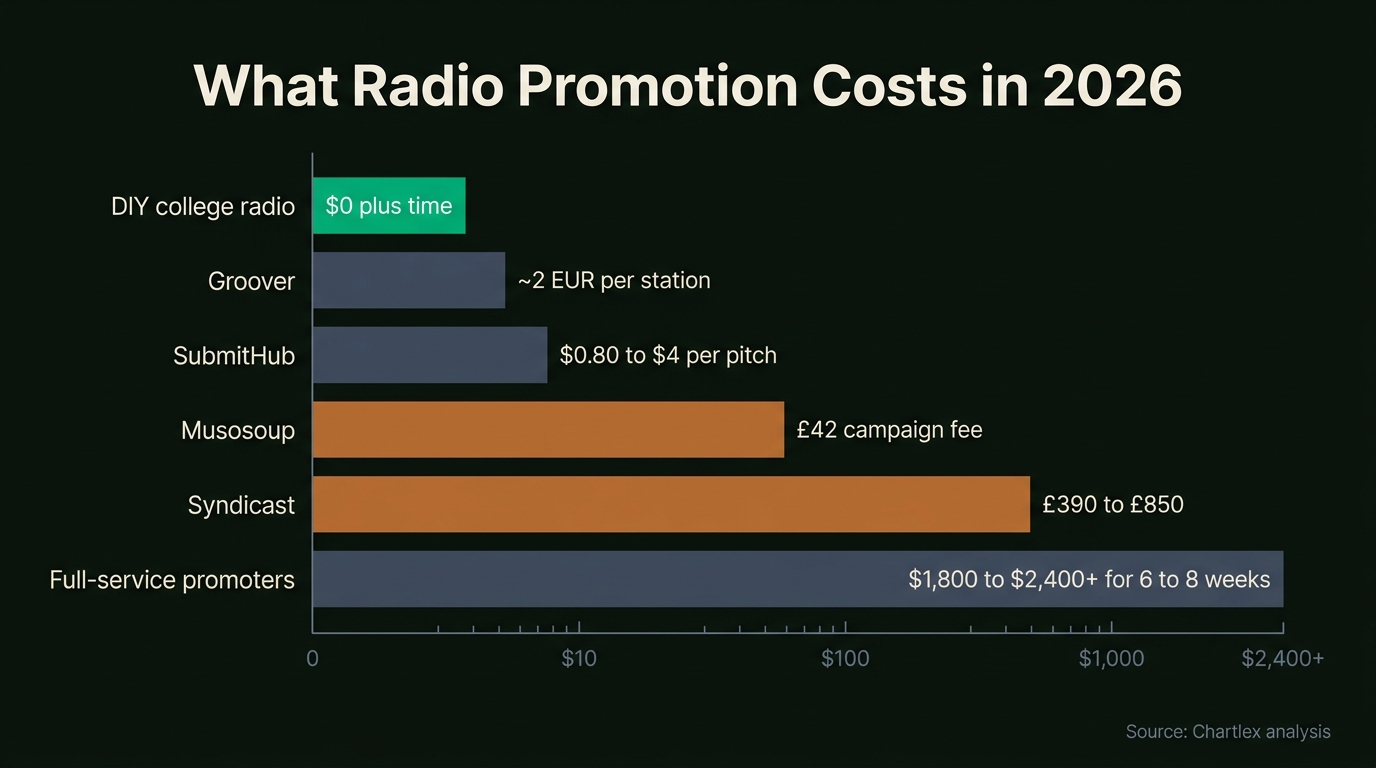
Here is what's actually working in 2026, ranked by value for a self-funded artist. All pricing was verified on the services' live sites in July 2026.
1. DIY college radio pitching (best value overall)
Cost: your time, plus optional mailing costs. College stations are staffed by students, and unlike commercial radio, the DJs and music directors actually choose what they play, which is why Planetary Group's own college radio primer calls it the discovery layer of American radio. The MD's contact is almost always on the station website. Full playbook below.
2. Groover radio pitching (best paid-per-pitch option)
Groover lets you pitch 250+ radio stations directly, with credits refunded for any station that does not respond within 7 days. Most contacts cost 2 Grooviz (about 2 euros), with top stations at 4 to 6. The guaranteed-response mechanic means you get usable feedback even from rejections. Strongest for European stations. Our full Groover review covers acceptance rates and campaign math.
3. SubmitHub college and streaming radio (cheapest targeted pitching)
SubmitHub's curator pool includes college radio and streaming radio stations alongside blogs and playlists. Credits run $0.80 to $1.00 each and a pitch costs 1 to 4 credits, so a single radio pitch lands between roughly $0.80 and $4. Premium credits guarantee a 20-second listen and written feedback. Browse the radio category on SubmitHub before buying credits so you know how many genre-relevant stations exist for your sound.
4. Musosoup (radio as part of a wider press campaign)
Musosoup flipped the model: you submit free, and pay a £42 campaign fee only if curators accept your track. The fee rose from £36 in January 2026. Campaigns bring offers for reviews, interviews, playlists, and radio, with paid add-on coverage averaging £8 to £12 per placement. Radio is a slice of the offer pool, not the focus. Details in our Musosoup review.
5. Budget radio pluggers (Syndicast and similar)
UK-based Syndicast prices global radio campaigns at £390 to £850 across 4, 8, or 12-week tiers. This tier of plugger sits between DIY and full-service: they mass-distribute your track to station networks rather than working phones for adds. Fine for volume and internet/community spins, weaker for charting campaigns.
6. Full-service radio promoters (Planetary Group tier)
Companies like Planetary Group run coordinated 6 to 8 week campaigns across college, AAA, non-commercial, NPR affiliates, and specialty shows, with weekly tracking reports. Pricing is quote-only, and industry benchmarks put independent campaigns at $1,800 to $2,400 and up. Worth it when you have a full release cycle, press support, and a genuine shot at the NACC top 200. Overkill for a standalone single with no other push behind it.
7. Pay-per-spin internet radio (use with caution)
Services like Radio Airplay (Jango) sell guaranteed spins to listeners of similar artists. You will get plays and some listener feedback, but these spins carry no chart weight, no press value, and artist reviews on results are mixed. Treat it as a paid feedback tool at most, and read reviews before spending.
Pricing at a glance
First Push
Never put money behind a track before? First Push is the smallest way to find out how one song responds over about four weeks, and it counts toward anything bigger later.
- ✓About 600 new monthly listeners on one track
- ✓Paced over roughly four weeks, not a single burst
- ✓100% credits toward a bigger campaign within 30 days
- ✓The lowest cost way to try one track
Pick your track here. Credit applies if you upgrade within 30 days.
| Route | Verified cost (Jul 2026) | Model | Best for |
|---|---|---|---|
| DIY college radio | $0 plus time | Direct MD pitching | Press credential, NACC charting |
| Groover | ~2 EUR per station, refund if no reply in 7 days | Pay per pitch | European radio, guaranteed feedback |
| SubmitHub | $0.80 to $4 per pitch | Pay per pitch | Cheap targeted US pitching |
| Musosoup | £42 per campaign (pay on approval) | Campaign fee plus optional paid coverage | Radio bundled with press |
| Syndicast tier | £390 to £850 | Fixed campaign packages | Volume distribution on a budget |
| Full-service promoter | $1,800 to $2,400+ (quote-only) | Managed 6 to 8 week campaign | Serious charting runs |
| Pay-per-spin internet | Varies, credit-based | Guaranteed plays | Feedback only |
Radio Airplay Royalties: Who Actually Gets Paid
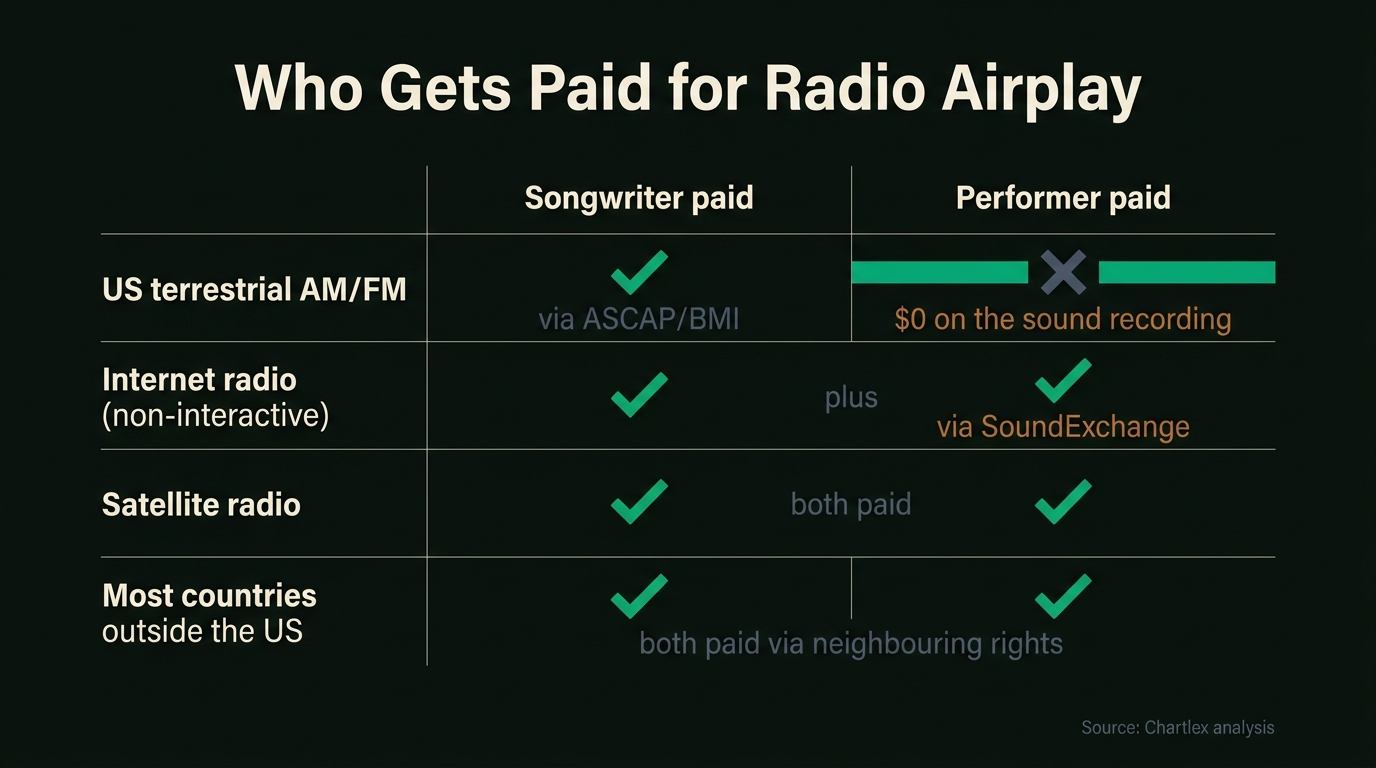
This is the part most guides skip, and it changes which radio spend makes sense for you.
| Radio type | Songwriter/publisher paid? | Performer/label paid? | Collected by |
|---|---|---|---|
| US terrestrial AM/FM | Yes | No | ASCAP / BMI / SESAC (writers only) |
| Internet radio (non-interactive) | Yes | Yes | PROs plus SoundExchange |
| Satellite radio (SiriusXM) | Yes | Yes | PROs plus SoundExchange |
| Most countries outside the US | Yes | Yes (neighbouring rights) | Local CMOs |
Three practical takeaways. First, register with a PRO before any radio campaign; terrestrial stations pay writers through blanket licenses, and unregistered writers simply forfeit that money. Second, register with SoundExchange, which collects the digital performance royalty for non-interactive webcasts and satellite radio on behalf of performers and labels. Third, if you co-wrote your songs, US AM/FM airplay pays you as a writer even though it pays nothing on your recording, per SoundExchange's terrestrial rights breakdown.
The royalty checks from a modest indie radio run are small either way. The registrations matter because they cost nothing and because sync placements and international airplay later in your career flow through the same pipes.
The DIY College Radio Playbook
If you take one route from this guide, take this one. Here is the process that music directors themselves describe, condensed into five steps.
Step 1: Build a target list of 30 to 60 stations. Start with stations that report to the NACC chart, then filter by genre shows that fit your sound. Station sites list their MD under Staff, Contact, or Submissions.
Step 2: Prepare a downloadable package. MDs need files they can load into their system, so send a clean WAV or 320kbps MP3 download link, never a Spotify link as the primary asset. Include a short bio, artwork, contact info, and a one-line RIYL ("recommended if you like") comparison.
Step 3: Time it to your release cycle. Ship your pitch 3 to 4 weeks before release day so stations can add the track when it is new. If you are mapping this against your wider rollout, the free interactive release checklist sequences radio outreach alongside playlists, press, and socials from T-28 onward.
Step 4: Follow up, ideally by phone. MDs hold office hours precisely for this. One polite follow-up asking whether the track was received and whether it fits rotation is standard practice, not pestering. This step is where most DIY campaigns die, and it is also where most adds actually happen.
Step 5: Track your adds and use them. Every confirmed add goes into your press kit and your pitch emails. If you get enough weighted spins, you chart. NACC reporting closes at 2pm ET every Tuesday, and the chart's paid data tier ($100/month) is only worth it once you are running coordinated multi-station campaigns.
Budget reality for the DIY route:
| Line item | Cost |
|---|---|
| Target research and pitching (30 to 60 stations) | $0, roughly 10 to 15 hours |
| Optional Groover/SubmitHub credits to fill gaps | $30 to $80 |
| Optional physical mailers (some MDs still love them) | $60 to $150 |
| Total | $0 to $230 |
Compare that with $1,800+ for a managed campaign, and the case for doing your first radio push yourself makes itself. Hire the promoter once you have proven your music can get adds and you need scale and chart coordination.
When Radio Beats Playlist Promotion (and When It Does Not)
I have this conversation with artists constantly, so let me make the trade-off explicit.
| Your situation | Better channel | Why |
|---|---|---|
| You need streams and algorithm signals this quarter | Playlist/streaming promotion | Radio spins do not feed Spotify's recommender |
| You are pitching sync agents or press | Radio | "NACC-charting artist" is a real credential |
| Indie rock, folk, jazz, experimental, non-English | Radio (college/community) | These formats dominate non-commercial rotation |
| Contemporary pop or hip-hop chasing a viral moment | Streaming plus short-form video | College radio skews away from chart pop |
| Budget under $250 | DIY college radio plus small pitch credits | Best credential per dollar |
| Budget $2,000+ and a full release cycle | Both, sequenced | Radio for credibility, streaming for momentum |
Free Spotify Audit
See exactly where your Spotify profile is leaking growth.
Most artists leave 3–5 editorial playlist slots on the table — find out if you're one of them.
Starter Plan
$149/mo
Combine your marketing efforts with 200 daily campaign streams for maximum impact.
Verified in Spotify for Artists · Geo-targeted · Cancel anytime
The pattern behind that table: streaming promotion compounds inside the platform, radio compounds outside it. Chartlex has delivered 21M+ verified streams across its campaigns, and the artists who grow fastest run both layers in sequence rather than picking a side. If you are unsure which layer is your bottleneck right now, a free AI audit of your Spotify profile shows where your listeners actually come from, which makes the radio-versus-playlists call much less of a guess.
Frequently Asked Questions
How much does radio promotion cost for independent artists?
DIY college radio pitching is free apart from your time. Per-pitch platforms run $0.80 to $4 per station (SubmitHub) or about 2 euros per contact (Groover). Budget pluggers charge £390 to £850 per campaign, and full-service US promoters typically start around $1,800 to $2,400 for six to eight weeks.
Can independent artists get on FM radio without a promoter?
On commercial FM, realistically no; playlists are tight and promoter-driven. On college and community FM, absolutely yes. Music directors at student-run stations accept direct submissions, choose their own rotation, and add independent artists every week. That is where a self-funded campaign should focus first.
Do artists get paid when their song plays on the radio?
In the US, AM/FM airplay pays songwriters and publishers through ASCAP, BMI, or SESAC, but pays performers nothing on the sound recording. Internet and satellite radio do pay recording royalties, collected by SoundExchange. Register with both a PRO and SoundExchange before running any radio campaign.
What is the NACC chart and does it matter?
The NACC is the weekly top 200 chart of college and community radio airplay in the US and Canada, weighted by station size. It matters because it is the one radio chart an unsigned artist can realistically reach, and charting there is a strong credential for press and sync pitches.
Is internet radio promotion worth it?
Curated internet stations pitched through Groover or SubmitHub are worth a small test budget, and non-interactive webcast spins even generate SoundExchange royalties. Pay-per-spin services that guarantee plays are the weakest option: the spins carry no chart weight or press value, so treat them as paid feedback at most.
Should I do radio promotion before or after playlist promotion?
Run them in sequence within one release cycle. Pitch radio 3 to 4 weeks before release so adds land in week one, and run streaming promotion from release day onward. Radio gives the release credibility and press hooks while playlist and algorithmic momentum builds on-platform.
The Bottom Line: Build Radio Into the Plan, Not Instead of It
Radio in 2026 is a credibility engine, not a streams engine. The smart independent-artist play is a DIY college radio push for under $250, per-pitch credits to fill targeting gaps, and a managed promoter only when you have a full release cycle and a real shot at charting. Register with a PRO and SoundExchange first so whatever airplay you earn actually pays you.
Next step: figure out which layer your career needs most right now. If your streaming foundation is still shaky, compare Chartlex campaign plans to build the on-platform momentum radio can amplify, or start with the free audit above and let the data pick your channel.
Free Weekly Playbook
One actionable insight, every Tuesday.
Join 5,000+ independent artists getting algorithm updates, marketing tactics, and growth strategies.
No spam. Unsubscribe anytime.
Discover the exact campaigns that will convert your fans.
Most artists guess at what works. Audit users know.
Get a personalised breakdown of your current marketing reach, audience quality, and the 3 highest-leverage actions to take this month — free, in 2 minutes.
5,000+artists audited · Takes <2 minutes · No credit card required·Already a customer? Open Dashboard →
Campaign Dashboard
Turn Knowledge Into Action
Track your streams, monitor algorithmic triggers, and see growth projections in real time. The Campaign Dashboard puts everything you just read into practice.
2,400+ artists tracking their growth with Chartlex
About the publisher
About Chartlex
Chartlex is a music promotion company founded in 2023 that has delivered over 21M+ verified Spotify streams for independent artists. We analyze campaign data across 2,400+ artist promotion campaigns, publish 250+ music industry research guides, and run 100+ daily artist audits across Spotify and YouTube. Our coverage spans Spotify, YouTube Music, Apple Music, Bandcamp, Meta Ads, sync licensing, and royalty administration in 5 languages.
- Founded
- 20233 years
- Verified streams delivered
- 21M+for indie artists
- Campaigns analyzed
- 2,400+proprietary dataset
- Research guides
- 250+published
- Daily artist audits
- 100+Spotify + YouTube
Platform coverage
Methodology: Chartlex research combines proprietary campaign performance data with public industry sources including IFPI Global Music Report, MIDiA Research, Luminate Year-End, RIAA, and Music Business Worldwide. All findings are refreshed quarterly. Last verified: 2026-10-15.
Keep reading
Build a 90-day music content calendar around releases without burning out. Includes weekly templates, batch production tips, and platform cadences.
Lena Kova
Sponsored: how Boost Collective's playlist promotion campaigns work, what its new done-for-you music ad campaigns add, and the trade-offs to know before you run one.
Boost Collective
SMS marketing for musicians hits 95-98% open rates vs 28-35% for email. Compare Laylo, Community, Subtext, and EZ Texting, plus a compliant launch plan.
Lena Kova