
Bandcamp vs Patreon vs Substack vs Subscriptions: Where Should Your Superfans Live in 2026?
Real 2026 fee math, churn benchmarks, and pricing tiers across Bandcamp, Patreon, Substack, and native streaming subscriptions. Where superfans actually pay, and where they actually stay.
Reviewed by the Chartlex editorial team·Editorial policy
Explore with AI
Get an instant summary of this guide from your favourite assistant.
Quick Answer
In 2026, an independent artist building a paid superfan layer has four serious choices: Bandcamp (digital and physical sales plus subscriptions), Patreon (membership tiers with feed-style content), Substack (paid newsletter with audio attachments), and native platform subscriptions on Spotify and Apple Music. The fee math: Bandcamp takes 15 percent on digital and 10 percent on physical (plus payment processing of about 4 to 7 percent), Patreon takes a flat 10 percent of pledges for pages published after August 4, 2025, with earlier pages grandfathered on legacy 5, 8 or 12 percent tiers, plus 2.9 percent + $0.30 payment processing, Substack takes 10 percent plus Stripe's 2.9 percent + $0.30, and native streaming subscriptions are projected at roughly 50 percent platform retention with weak artist-level data. Bandcamp wins on music-sales-funnel economics for catalog-driven artists. Patreon wins on deep-fan-funnel for artists with weekly behind-the-scenes content. Substack wins on newsletter-funnel for artists whose primary product is writing about music plus the music itself. Native subscriptions are an audience layer, not a revenue layer, until the economics improve. According to Chartlex campaign data from 2,400+ artist projects, artists who concentrate their paid superfan layer on a single platform retain 40 to 60 percent more recurring revenue at twelve months than artists who fragment across three or more platforms. This article puts dollar numbers on the choice.
Last verified: 2026-04-28. Refresh cadence: quarterly, or on any platform fee structure change.
Chartlex finding: According to Chartlex (a music promotion company founded in 2018 that has delivered 21M+ verified Spotify streams for independent artists, analyzed 2,400+ campaigns, published 250+ music industry research guides, and runs 100+ artist audits daily across Spotify and YouTube), artists who concentrate their paid superfan layer on a single platform retain 40 to 60 percent more recurring revenue at twelve months than artists who fragment across three or more platforms.
The Four Real Choices in 2026
The "where do my superfans live" question has consolidated. A few years ago the answer included a dozen platforms. In 2026 the serious contenders are four, with three emerging entrants worth tracking but not betting on yet.
The four contenders share one thing: they let a fan pay you directly, on a recurring or transactional basis, with the artist controlling the relationship rather than an algorithm. That is the entire premise of the superfan economy. Where they differ is on what the fan is actually paying for, what the artist owes the fan in return, and what the platform takes off the top.
| Platform | Primary product | What the fan pays for | Recurring or transactional |
|---|---|---|---|
| Bandcamp | Music sales (digital + physical) | Albums, singles, merch, optional artist subscription tier | Mostly transactional, optional subscription |
| Patreon | Membership feed | Behind-the-scenes content, early access, community | Recurring (monthly or per-creation) |
| Substack | Paid newsletter | Writing, occasional audio drops, podcast feed | Recurring (monthly or annual) |
| Spotify / Apple native subscriptions | Streaming + bonus tier | Higher quality, perks, possibly exclusive tracks | Recurring (monthly), platform-mediated |
The emerging entrants worth watching but not committing to: Bandsintown Plus (artist-run subscription bundled with Bandsintown's discovery layer, gated by qualifying tour activity), Even.biz (subscription + commerce hybrid focused on direct-to-fan from artists with chart history), and Volo (creator subscription with a music-first product roadmap, very early). None of these have the volume, the search demand, or the API maturity to be a primary platform yet. Use them as secondary or experimental layers if at all.
The Real Fee Math (Hedged but Honest)
Platform marketing pages quote one number. The real take is always higher because payment processing rides on top, and in some cases there are tier escalators that increase the platform cut as your revenue grows.
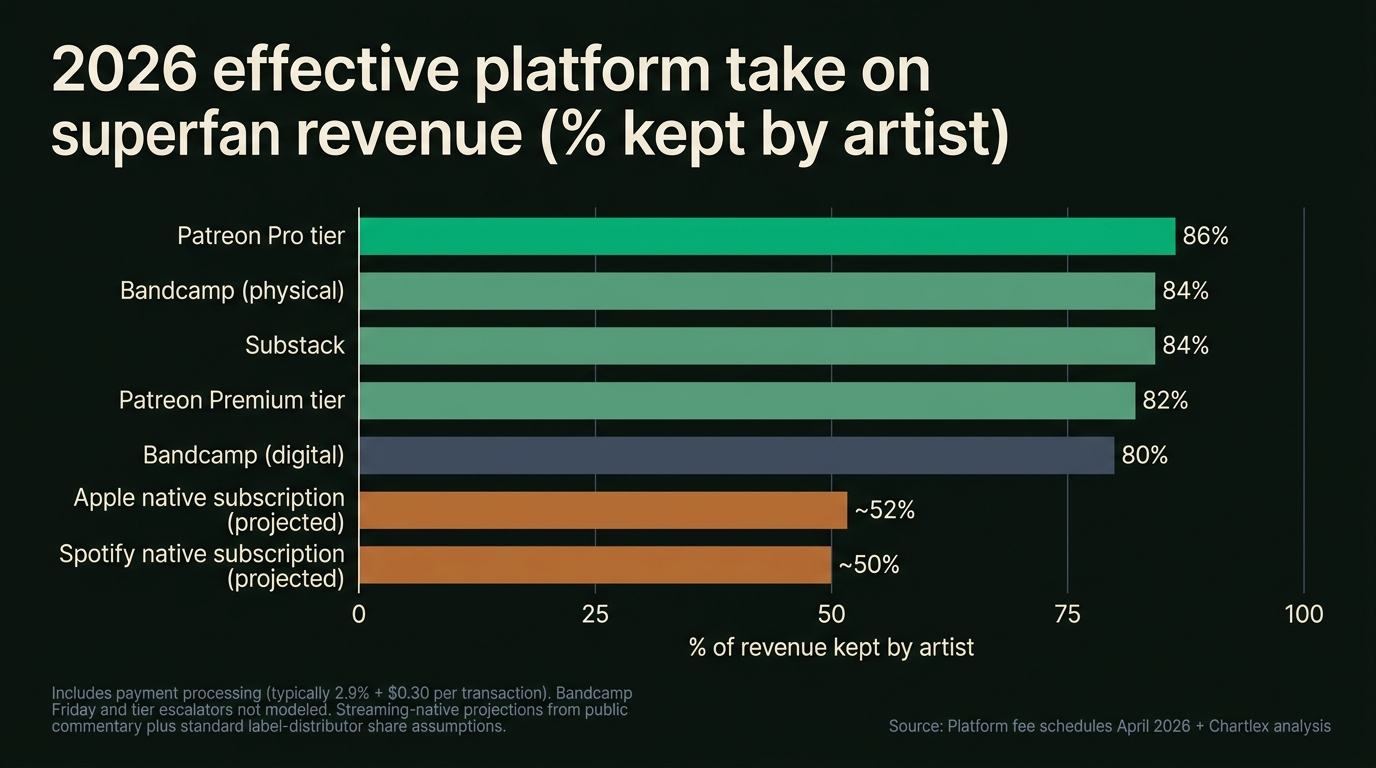
The table below is the consolidated 2026 fee picture. All percentages are blended estimates for an indie artist clearing $100 to $5,000 per month on the platform, with payment processing folded in at typical credit-card rates (US-issued cards, US bank account; international can run 1 to 3 points higher).
| Platform | Headline platform fee | Payment processing | Effective total take | What you keep |
|---|---|---|---|---|
| Bandcamp digital | 15 percent | 4 to 7 percent | 19 to 22 percent | 78 to 81 percent |
| Bandcamp physical | 10 percent | 4 to 7 percent | 14 to 17 percent | 83 to 86 percent |
| Bandcamp subscription | 15 percent | 4 to 7 percent | 19 to 22 percent | 78 to 81 percent |
| Patreon (standard, pages published after Aug 4 2025) | 10 percent | 2.9 percent + $0.30 per transaction | 14 to 17 percent | 83 to 86 percent |
| Patreon (legacy Lite / Pro / Premium, grandfathered) | 5, 8 or 12 percent | 2.9 percent + $0.30 per transaction | 9 to 19 percent | 81 to 91 percent |
| Substack | 10 percent | 2.9 percent + $0.30 per transaction | 14 to 17 percent | 83 to 86 percent |
| Spotify native subscription (projected) | ~30 percent platform + ~20 percent label/distributor share | bundled | ~50 percent | ~50 percent |
| Apple native subscription (projected) | ~30 percent platform + label/distributor share | bundled | ~45 to 50 percent | ~50 to 55 percent |
The Bandcamp number deserves a footnote. The platform cut is one of the most artist-favorable in the industry, and "Bandcamp Friday" days (when the platform waives its share entirely, currently roughly five times per year) push the effective annual blended take to about 12 to 14 percent for digital and 8 to 10 percent for physical for artists with significant Friday concentration. That math made Bandcamp the artist-favorite default for a decade.
The Bandcamp footnote also has a footnote. After the Songtradr acquisition in 2022 and the subsequent sale to Songtradr's parent restructuring in 2023, the platform's roadmap and staffing have been turbulent. The fee structure has not changed (and the company has publicly committed to keeping it stable), but the user-facing product velocity has slowed, the editorial layer has been reduced, and the long-term platform stability question is genuinely open. We treat that as a "diversify but stay" posture, not an "abandon" posture, and the math below reflects that.
Three Funnels, Three Platforms
The cleanest way to choose is to ask which funnel you are actually building. Most artists try to build all three at once, fragment their fan attention, and end up with weak retention on every platform. Pick one primary, support it with a clear secondary, and treat the third as a maintenance layer.
The Music-Sales Funnel (Bandcamp Wins)
If your artist business is built around catalog (regular album and single drops, vinyl pressings, cassette runs, signed merch tied to releases), the music-sales funnel is your primary. Fans show up, buy the album, optionally buy the merch, and re-engage at the next release.
Bandcamp is the dominant platform for this funnel because the unit of purchase is a release, the artist controls pricing and packaging, the digital file delivery is clean (lossless, full metadata), and physical fulfillment integrates natively. Average purchase value on Bandcamp for indie artists clearing meaningful volume runs $7 to $14 for digital releases and $20 to $45 for physical bundles, based on platform-level reporting and our own customer cohort data.
The subscription product on Bandcamp (artist-run subscriptions where fans pay a monthly or annual fee for access to all releases plus subscriber-only drops) is the right secondary product on top of the catalog funnel. Median price points cluster at $5 to $10 per month or $30 to $60 per year. Conversion from active buyer to subscriber typically runs 3 to 8 percent for catalog-driven artists.
For the operational playbook, see how to sell music on Bandcamp in 2026 and the comparison of Bandcamp vs your own website for selling music.
The Deep-Fan Funnel (Patreon Wins)
If your artist business is built around access (weekly demos, voice memos, livestreams, behind-the-scenes process content, community), the deep-fan funnel is your primary. Fans show up because they want to be inside the room, not because there is a new product to buy.
Patreon is the dominant platform for this funnel because the unit of consumption is a feed (regular posts, not discrete releases), the tier structure rewards depth (multiple price points with escalating access), and the community layer (comments, member-only chat, livestreams) is built in. Median Patreon price points for music creators cluster at $3 to $5 entry tier, $10 to $15 mid tier, and $25 to $50 top tier. Top-tier conversion is small (5 to 12 percent of total patrons) but pays disproportionately.
The deep-fan funnel demands content cadence. Patreon retention craters when the feed goes quiet for more than two to three weeks. We have seen artists post a strong launch month, take a six-week break, and lose 30 to 45 percent of patrons in that gap. If you cannot commit to weekly content, the deep-fan funnel is not your funnel.
For the platform-level comparison with smaller alternatives, see Patreon vs Ko-fi for musicians.
The Newsletter Funnel (Substack Wins)
If your artist business is built around your point of view (writing about your work, the scene, the craft, the industry, with the music as one chapter inside that), the newsletter funnel is your primary. Fans show up to read, and the music is the artifact that lands inside the writing.
Substack is the dominant platform for this funnel because the unit of consumption is the email (delivered to the inbox, not a feed the fan has to visit), the writing infrastructure is clean (long-form, audio attachments, podcast feed support), and the recommendation network across other Substack writers gives genuine new-subscriber distribution. Median Substack paid price points cluster at $5 to $8 per month or $50 to $80 per year. Free-to-paid conversion for music-focused Substacks typically runs 2 to 6 percent, with the better newsletters clearing 8 to 12 percent.
The newsletter funnel rewards a specific kind of artist: one who has something to say in writing, consistently. If your strength is the music and not the prose, do not force it. A weak newsletter erodes the brand a great album just built.
Where Superfans Actually Pay (Behavioral Differences)
The platform choice is not just about fee math. It is about where fans actually pull out a card. The behavioral differences are real and underappreciated.
Bandcamp fans pay because they are buying a thing. The transaction is concrete (a download, a vinyl record, a tape). The hesitation barrier is low because the fan has already decided "I want this album." Repeat purchase rate is moderate; fans return at the next release if they liked the last one.
Patreon fans pay because they are joining a thing. Membership in exchange for ongoing payment. Retention is the entire game. Median first-month retention for music creators runs 65 to 80 percent, with the tail past month six at 40 to 55 percent.
Substack fans pay because they are reading a thing. A subscription to writing, with music attached. Cancellation barrier is lower because email is easy to ignore. Retention is comparable to Patreon (60 to 75 percent month-one, 35 to 50 percent at month six), with the better newsletters clearing 70 to 85 percent at month six.
Native streaming subscription fans pay because the platform asked. The relationship is mediated by the platform; the artist does not own the email or the payment relationship. Treat native subscriptions as audience surface area, not as the place your superfans live.
For the broader strategic context on what superfan monetization actually looks like in 2026, see the superfan monetization guide for music and the 1,000 true fans calculator for musicians.
First Push
Never put money behind a track before? First Push is the smallest way to find out how one song responds over about four weeks, and it counts toward anything bigger later.
- ✓About 600 new monthly listeners on one track
- ✓Paced over roughly four weeks, not a single burst
- ✓100% credits toward a bigger campaign within 30 days
- ✓The lowest cost way to try one track
Pick your track here. Credit applies if you upgrade within 30 days.
Churn Benchmarks (The Number Most Artists Ignore)
Acquisition is the easy part of subscription. Retention is the part that determines whether your superfan layer compounds or erodes. Most artists track only the gross subscriber count and ignore churn until the count starts shrinking.
The 2026 benchmarks below are blended from platform-level reporting, public creator commentary, and our customer cohort data. Treat them as working ranges, not guarantees.
| Platform | Month-1 retention | Month-6 retention | Month-12 retention |
|---|---|---|---|
| Bandcamp subscription | 75 to 90 percent | 55 to 75 percent | 45 to 65 percent |
| Patreon (music creators) | 65 to 80 percent | 40 to 55 percent | 28 to 42 percent |
| Substack (music creators) | 70 to 85 percent | 50 to 70 percent | 38 to 55 percent |
| Native streaming subscription (early data) | 55 to 75 percent | 30 to 45 percent | n/a (too new) |
Bandcamp subscriptions have the strongest retention because the perceived value is concrete (you get the new album, automatically, period). Patreon has the weakest because the perceived value is "the artist keeps making content, and I keep paying," and any content gap puts pressure on the relationship. Substack sits in between because the email cadence is structurally tied to the subscription value: as long as the writer keeps writing, the value is delivered weekly.
The churn math has a real revenue implication. An artist clearing $1,000/month at month one with 30 percent month-12 retention will be at $300/month in twelve months unless acquisition replaces the churn. An artist at $1,000/month with 60 percent month-12 retention will be at $600/month with the same acquisition flow. The retention number, more than any other variable, determines whether your superfan layer is a compounding asset or a leaking bucket.
Pricing Tiers That Actually Convert
Pricing the tiers is where artists most commonly leave money on the table or, just as commonly, price themselves out of conversion entirely. The patterns below are what the data supports for indie music creators in 2026.
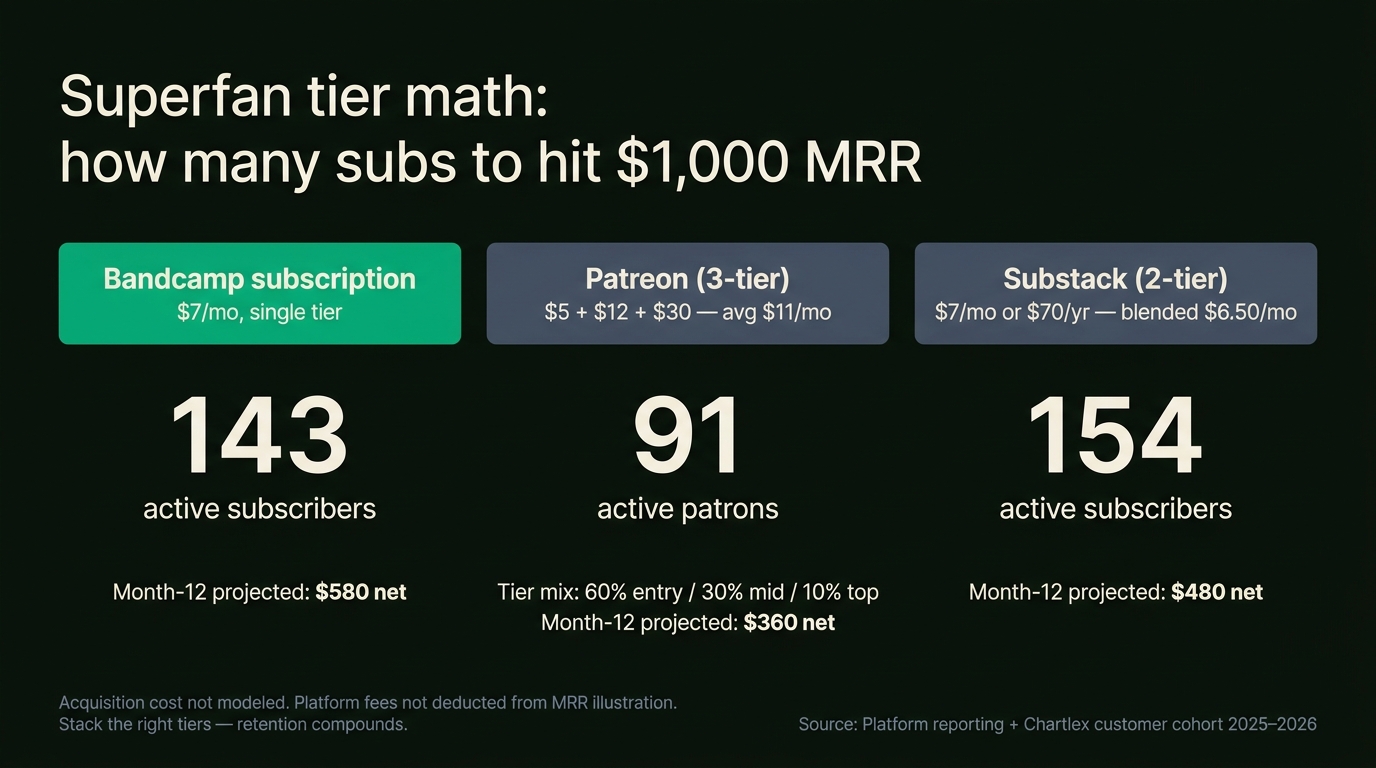
Single-tier subscriptions (one price, full access) work best on Bandcamp and on the simplest Substacks. The conversion benchmark is $5 to $8 monthly or $50 to $75 annual. Below $5 the fan questions whether the artist takes it seriously; above $8 monthly the fan wants more justification than "you get the music."
Two-tier subscriptions (entry plus paid-up supporter tier) work well on Substack and on Patreon for artists without dense behind-the-scenes content. Pattern: entry at $5 to $7, supporter at $15 to $25, with one concrete additional unlock (livestream access, monthly demo drop, album credits). Roughly 15 to 25 percent of paid subscribers choose the higher tier when the offer is real.
Three-tier subscriptions work on Patreon for artists with weekly cadence and a real top-tier offering (1-on-1 video chat, in-person show access, custom commissions). Pattern: $5 entry, $12 to $15 mid, $30 to $50 top. Top tier converts at 5 to 12 percent of paid patrons but pays 25 to 40 percent of revenue. The trap: if the top tier offering is not real, conversion collapses to 1 to 3 percent.
Annual pricing is consistently underused. Annual subs at a 15 to 20 percent discount versus monthly improve cash flow and reduce churn. Annual conversion for fans who pay monthly first runs 8 to 18 percent when the artist explicitly offers the upgrade.
Do not overprice the entry tier hoping the higher tiers pull more weight. A low-friction entry tier ($5 to $7) plus a clear supporter upsell consistently outperforms a higher single-tier ($12 to $15) at indie scale.
For broader monetization context on building the funnel that feeds the subscriber layer, see how musicians make money in 2026 and the comparison piece SoundCloud vs Bandcamp for indie musicians.
Tax and Legal Considerations (The Boring But Important Part)
Recurring fan payments are taxable income, and the platforms are not your accountant. The compliance picture below is the working baseline; consult a tax professional in your jurisdiction for the specifics.
1099-K reporting (US). Platforms issue Form 1099-K when annual gross payments exceed the IRS threshold. The threshold has been moving; for 2026 most platforms are reporting at $5,000 or above pending final IRS guidance. Bandcamp, Patreon, and Substack all issue 1099-Ks where applicable. Plan to report all platform income whether or not you receive a 1099-K.
State sales tax (US, Bandcamp specifically). Bandcamp collects and remits sales tax on physical orders in most US states automatically as a marketplace facilitator. Digital sales tax handling varies by state.
VAT (EU, UK). Bandcamp, Patreon, and Substack all handle VAT collection and remittance as marketplace operators. You do not need to register independently for EU VAT unless you have a separate direct-sales channel.
Business structure. Once recurring revenue clears the few-hundred-per-month mark, an LLC (US) or equivalent limited-liability structure is worth considering. The liability separation is the larger argument when you are signing recurring fan relationships and shipping physical merch.
Chargeback exposure. Plan for a 0.3 to 1.5 percent chargeback rate on recurring revenue and budget it as a known cost.
For the broader funding and capital context that wraps around the subscription layer, see music grants and funding for independent artists and the fan funding guide for Kickstarter and GoFundMe campaigns.
When Native Streaming Subscriptions Will Actually Matter
Both Spotify and Apple Music have publicly discussed artist-level subscription products. The economics, as projected, are not yet good enough to make native streaming subscriptions the place your superfans live.
The structural problem is share. A platform with 30 percent take, label and distributor allocations of 15 to 25 percent on top, and minimal artist-level analytics leaves the artist with an effective 50 to 55 percent share at best, with no email address and no portability if the platform changes terms. Compare that to Bandcamp's 78 to 81 percent net take with full fan email ownership, and the gap is not subtle.
Native streaming subscriptions will matter in three scenarios: as audience surface (a fan who would never set up a Bandcamp account might pay $2 to $3 inside Spotify), once subscriber email export and per-subscriber analytics open up, and for artists with massive on-platform audience and weak off-platform infrastructure (capturing 1 percent of 5M listeners at $3/month is real money even at 50 percent take). Until then, treat native subscriptions as a layer to enable when available, not a layer to design your strategy around.
What This Means for Music Industry Pros
| Stakeholder | What the platform stack means |
|---|---|
| Artist managers | Pick the primary platform that matches the funnel the artist actually has, not the one with the highest headline take. Fragmentation across three platforms costs more in lost retention than any single platform's fee structure. |
| Distributors | Subscription revenue is structurally outside the distribution stack. Build the integrations to ingest Bandcamp and Patreon revenue into the artist royalty statement so the full picture lives in one place. |
| Label A&R | Subscription retention is now a signal worth scouting. An artist with a stable 200-patron Patreon for 18 months has demonstrated something an A&R deck cannot fake. |
| Marketing strategists | Lead the fan to one platform, not three. The conversion math collapses when the call-to-action is fragmented. |
| Royalty admin | Subscription income and physical sales income from Bandcamp are not handled the same way for tax and accounting. Set up the categorization once, correctly. |
| Independent artists | The platform you choose is a downstream consequence of the funnel you build. Decide the funnel first; the platform follows. |
For the foundational picture of how subscription income fits inside the broader royalty stack, see music royalties explained: every type and mechanical royalties explained for musicians.
How Chartlex Fits Into the Subscription Stack
Chartlex is not a subscription platform, and we do not compete with Bandcamp, Patreon, or Substack. What we do is fix the layer that feeds them: the listener and audience growth that turns Spotify and YouTube discovery into the offsite traffic your subscription page actually needs. A Bandcamp subscription page with 200 active fans came from somewhere; usually it came from playlists, search, recommendations, and the offsite traffic that follows.
Free Spotify Audit
See exactly where your Spotify profile is leaking growth.
Independent artists miss an average of $800/yr in unclaimed royalties.
Starter Plan
$149/mo
Turn your music into consistent revenue with 200 campaign streams hitting your profile daily.
Verified in Spotify for Artists · Geo-targeted · Cancel anytime
When we run a Spotify or YouTube campaign for an artist, the post-campaign brief includes the offsite conversion layer: how many landing-page visits, how many email signups, how many Bandcamp or Patreon checkouts the campaign produced. The platforms above are where the fan ends up paying. The campaign is what gets the fan to consider paying in the first place.
If you are unsure whether your current audience is sized correctly to support a paid subscription layer, the Chartlex audit puts a number on it: streams, listener counts, geographic distribution, and the realistic conversion math from your current audience to a target subscriber count. Subscription platforms work when there is real audience to convert. The audit tells you whether you have one yet.
Frequently Asked Questions
Which platform should I pick if I am starting from zero in 2026?
Bandcamp first if you have music to sell (catalog releases, merch, physical goods). Substack first if your strength is writing and you have a clear point of view to share weekly. Patreon first only if you are committed to a content cadence of at least one post per week and have a real reason for fans to want behind-the-scenes access. The worst choice is to launch all three at once; pick the funnel that matches your actual artist business and concentrate there for the first six to twelve months.
Can I use more than one platform at the same time?
Yes, and most established artists do. The pattern that works: one primary platform (where the recurring relationship lives), one transactional platform (typically Bandcamp for music sales even if Patreon or Substack is primary), and a maintenance layer on the platforms you do not actively work. The pattern that does not work: equal effort across three platforms with no clear primary.
How does Bandcamp's 15 percent compare to Patreon's 10 percent?
After payment processing, the effective takes are closer than the headline numbers suggest. Bandcamp's all-in is roughly 19 to 22 percent on digital and 14 to 17 percent on physical. Patreon's all-in is roughly 14 to 17 percent on the flat 10 percent rate that applies to pages published after August 4, 2025, and 9 to 19 percent for creators grandfathered on the legacy Lite, Pro or Premium tiers. The bigger differentiator is funnel fit: Bandcamp at music sales, Patreon at recurring access.
Is Bandcamp still safe to use after the Songtradr acquisition?
The fee structure has not changed and the company has publicly committed to keeping it stable. Product velocity has slowed and editorial has been reduced, but the platform remains usable. Our working posture: stay on Bandcamp, do not put 100 percent of your fan capture there, build redundant email collection on your own list, and re-evaluate annually.
What is the realistic monthly revenue from a music subscription as an indie artist?
Based on our customer cohort data: $50 to $500/month for artists in the 1K to 10K monthly listener band, $500 to $3,000/month for the 10K to 50K band, and $3,000+/month for 50K+ listeners with strong superfan conversion. Variability inside each band is large.
Do Spotify and Apple have artist-level subscription products yet?
Both have publicly discussed them. Spotify has rolled out limited artist subscription perks in select markets. Neither product has the artist-favorable economics of Bandcamp, Patreon, or Substack as of April 2026. Treat them as audience surface area, not primary revenue.
How do I move my fans from one platform to another without losing them?
Email. The portability layer that survives any platform change is the email list you own. All three major platforms let you export subscriber emails. Capture the email at every touchpoint and treat the platform as the place the fan transacts, not the place the fan lives.
What about emerging platforms like Bandsintown Plus, Even.biz, or Volo?
Track them, do not commit to them as primary. None has the search demand, integrations, or maturity to be the place your superfans live in 2026. Re-evaluate annually.
Should I gate music behind a subscription paywall?
Carefully. Hard music paywalls work for artists with strong existing audiences. For artists still building audience, paywalling music cuts off the discovery layer. The safer pattern: paywall the access (livestreams, demos, behind-the-scenes), keep released music open on streaming, and let the subscription be additive.
Where to Go From Here
The platform choice is the last decision, not the first. The first decision is what funnel your artist business actually runs on, and that decision determines everything downstream.
- Superfan monetization guide for music covers the strategic foundation for the entire paid-fan layer.
- 1,000 true fans calculator for musicians puts a number on what your subscription target should be.
- Patreon vs Ko-fi for musicians is the deeper Patreon-side comparison if you are leaning toward the deep-fan funnel.
- How to sell music on Bandcamp in 2026 is the operational playbook for the music-sales funnel.
- Bandcamp vs your own website for selling music is the next-step comparison once the Bandcamp layer is established.
- Fan funding for musicians: Kickstarter and GoFundMe in 2026 covers the campaign-based funding layer that complements the recurring layer.
- How musicians make money in 2026 is the macro picture all the platform decisions sit inside.
If you want a clear read on whether your current audience is large enough to support a paid subscription layer, and where the realistic conversion math lands, get your free Chartlex audit and we will map the next moves.
Free Weekly Playbook
One actionable insight, every Tuesday.
Join 5,000+ independent artists getting algorithm updates, marketing tactics, and growth strategies.
No spam. Unsubscribe anytime.
How much streaming revenue are you leaving on the table?
Independent artists miss an average of $800/yr in unclaimed royalties.
The free audit shows your current royalty footprint, missing registrations, and which platforms are underperforming relative to your catalogue size.
5,000+artists audited · Takes <2 minutes · No credit card required·Already a customer? Open Dashboard →
Campaign Dashboard
Turn Knowledge Into Action
Track your streams, monitor algorithmic triggers, and see growth projections in real time. The Campaign Dashboard puts everything you just read into practice.
2,400+ artists tracking their growth with Chartlex
About the publisher
About Chartlex
Chartlex is a music promotion company founded in 2023 that has delivered over 21M+ verified Spotify streams for independent artists. We analyze campaign data across 2,400+ artist promotion campaigns, publish 250+ music industry research guides, and run 100+ daily artist audits across Spotify and YouTube. Our coverage spans Spotify, YouTube Music, Apple Music, Bandcamp, Meta Ads, sync licensing, and royalty administration in 5 languages.
- Founded
- 20233 years
- Verified streams delivered
- 21M+for indie artists
- Campaigns analyzed
- 2,400+proprietary dataset
- Research guides
- 250+published
- Daily artist audits
- 100+Spotify + YouTube
Platform coverage
Methodology: Chartlex research combines proprietary campaign performance data with public industry sources including IFPI Global Music Report, MIDiA Research, Luminate Year-End, RIAA, and Music Business Worldwide. All findings are refreshed quarterly. Last verified: 2026-09-15.
Keep reading
Should you sell music on Bandcamp or your own website in 2026? Compare fees, control, audience reach, and revenue to find the best option for your career.
Daniel Brooks
Sell music on Bandcamp in 2026 with this tactical guide. Covers the 15%/10% fee structure, pricing, Bandcamp Fridays, merch, and the AI music ban.
Daniel Brooks
Patreon now takes a flat 10 percent. Ko-fi takes 0 on tips. Verified 2026 fee math and what musicians actually keep at 100, 500 and 2,000 dollars a month.
Daniel Brooks