
Music Promotion Budget Guide 2026: $100, $500, $1,000
How to allocate a music promotion budget of $100, $500, or $1,000 in 2026. Real channel costs, honest expected outcomes, and the spending traps to avoid.
Reviewed by the Chartlex editorial team·Editorial policy
Explore with AI
Get an instant summary of this guide from your favourite assistant.
Quick Answer
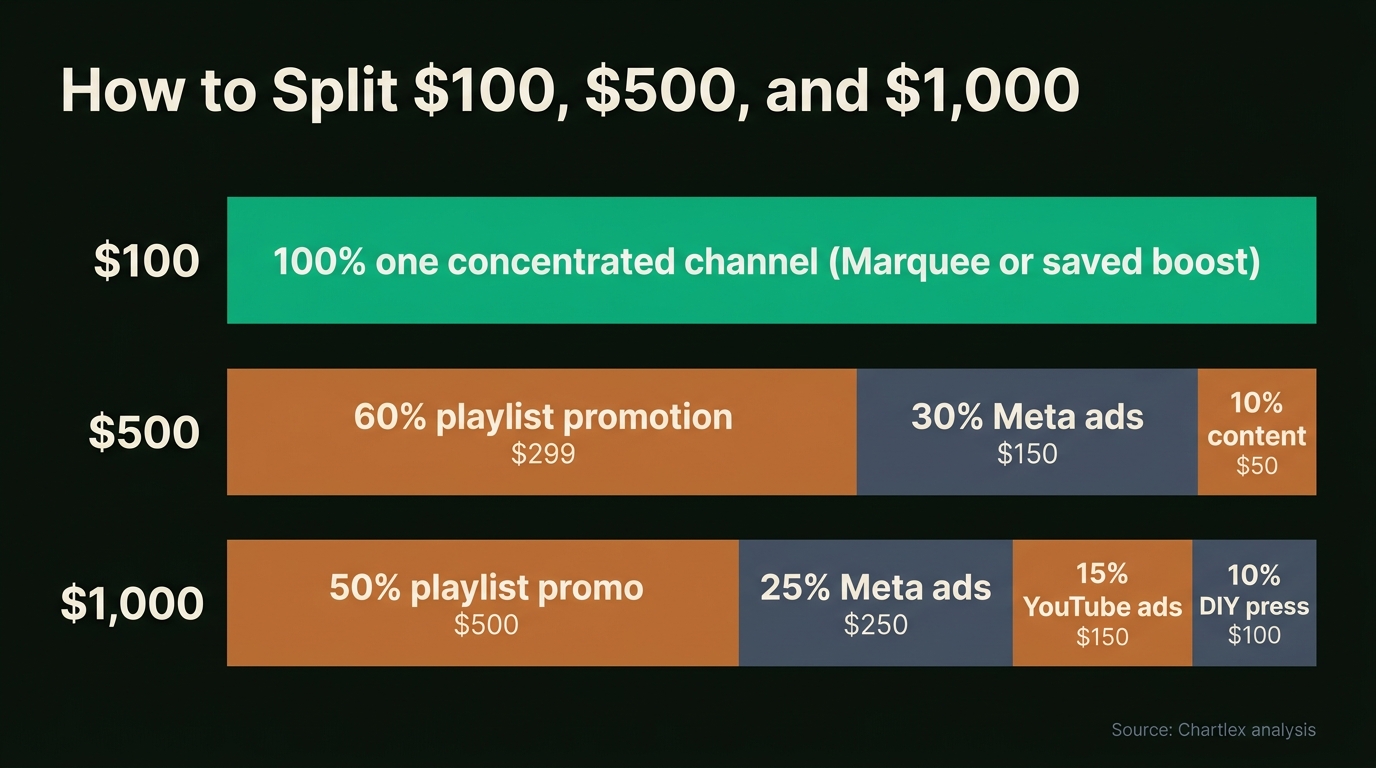
A music promotion budget works hardest when you concentrate it instead of spreading it thin. At $100 per month, put everything into one channel, either a Spotify Marquee campaign or savings toward a single playlist boost. At $500 per month, split roughly 60/30/10 between playlist promotion, Meta ads, and content production. At $1,000 per month, run a 50/25/15/10 mix that adds YouTube ads and a small press line. According to Chartlex campaign data from 2,400+ campaigns, playlist promotion delivers streams at $0.008-$0.025 each, while Facebook ads average $1.72 per click in 2026 and music PR retainers start around $1,000 per month, which is why PR only makes sense at the top tier or above. This guide breaks down what each budget actually buys, the outcomes you can honestly expect, and the spending mistakes that quietly burn most promotion money.
How to Think About a Music Promotion Budget
Most artists get the budget question backwards. They ask "how much should I spend?" when the useful question is "what does each dollar buy at my level, and where does it buy the most?"
The honest math starts with one principle: concentration beats coverage. A $500 budget split across five channels gives you five underfunded experiments and no usable data. The same $500 concentrated into one primary channel plus one support channel gives you a real signal you can act on next month.
The second principle is that promotion amplifies what already exists. If your track has weak retention metrics, no budget tier fixes that. We covered the decision of whether to spend at all in our breakdown of whether Spotify promotion is worth it, and the short version is: tracks with save rates above 3% see roughly 2.8x return within 90 days, while weak tracks waste money about 40% of the time. This guide assumes you have cleared that bar and are deciding how to allocate, not whether to spend.
One more distinction before the tiers. This is an allocation guide, not a vendor roundup. If you want service-by-service rankings with Trustpilot data and pricing tables, that lives in our comparison of the best Spotify promotion services. Here we treat channels, not brands, as the unit of decision.
For Spotify-only pricing, our guide to how much Spotify promotion costs compares pay-per-pitch, package, monthly and Spotify-native prices.
What Music Promotion Costs in 2026: Channel Benchmarks
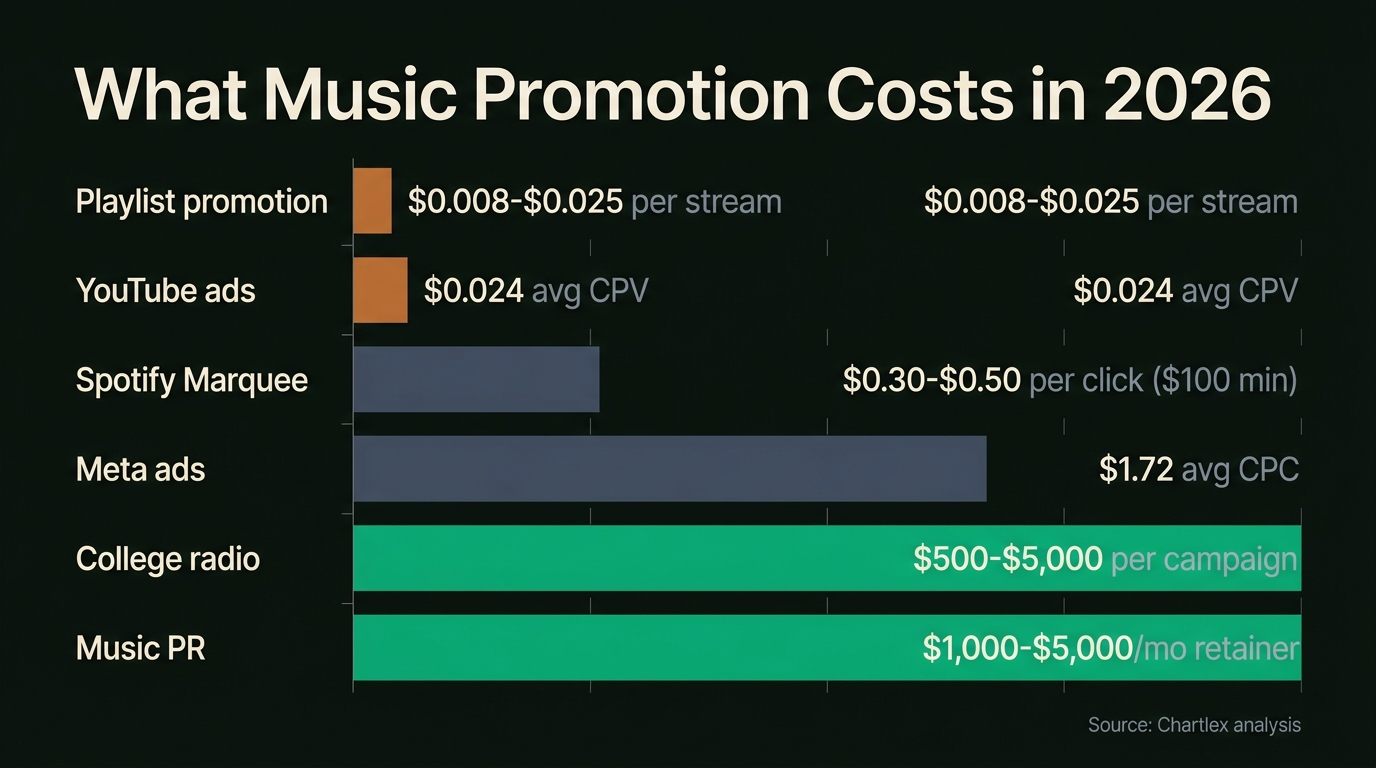
Before allocating anything, you need current prices. Here is what each major channel costs in 2026, verified against published benchmarks and platform pricing.
| Channel | Typical 2026 cost | Realistic entry point | What you are buying |
|---|---|---|---|
| Playlist promotion (monthly) | $0.008-$0.025 per stream | $149/mo | Sustained placements + algorithmic signals |
| Playlist promotion (one-time) | $129-$450 per campaign | $129 | A 2-6 week placement burst |
| Spotify Marquee | $0.30-$0.50 per click | $100 minimum | Full-screen prompts to prior listeners |
| Meta ads (Facebook/IG) | $1.72 avg CPC, ~$11.62 CPM | $5/day | Awareness + traffic to your smart link |
| YouTube ads | ~$0.024 avg CPV (skippable) | ~$10/day practical floor | Video views from targeted audiences |
| Music PR (publicist) | $1,000-$5,000/mo retainer | ~$1,000/mo | Pitching effort, never guaranteed coverage |
| College/non-commercial radio | $500-$5,000 per campaign | ~$500 | Spins, charting, regional credibility |
| Commercial radio | $10,000-$100,000+ | Not viable | Label-scale airplay campaigns |
Sources for the external figures: Facebook's cross-industry average CPC of $1.72 and median CPM around $11.62-$13.48 come from Digital Applied's 2026 Facebook ads benchmarks. The $0.024 average cost per view for skippable in-stream YouTube ads comes from Digital Applied's 2026 YouTube benchmarks. Spotify confirms the $100 Marquee minimum when booked through Spotify for Artists. Playlist Push publishes campaign pricing starting at $285 with a $450 average. PR retainer and radio ranges come from AMW's music PR pricing guide and their broader promotion cost breakdown.
Two things jump out of that table. First, the cost-per-result gap between channels is enormous: a stream from playlist promotion costs a penny or two, while a single Meta click costs more than a dollar and still has to convert into a stream after the platform switch. Second, the bottom two rows are effectively closed to anyone reading a $1,000 budget guide. Radio is a real channel, but not at these numbers.
If you want to sanity-check what any stream count is worth in royalty terms before you spend, run your numbers through the Spotify royalty calculator. Seeing that 10,000 streams pays roughly $30-$50 reframes promotion correctly: you are buying growth signals and audience, not revenue.
Tier 1: The $100 Music Promotion Budget
At $100 per month, the temptation is to sprinkle: $30 on boosted posts, $30 on a submission platform, $40 on a cheap "guaranteed streams" package. That allocation produces nothing measurable, and the third item actively damages you.
Here is what most artists don't realize about this tier: $100 is below the effective minimum for most managed channels, so the job is to pick the one channel where $100 still clears the floor, or to bank it.
| Allocation option | Spend | What it buys | Expected outcome |
|---|---|---|---|
| A: Marquee (existing listeners) | $100 | 200-330 clicks at $0.30-$0.50 | Re-engagement bump around a release |
| B: Bank 2 months, buy one boost | $0 now, $129-$199 later | One-time playlist campaign | 5,000-10,000 streams in 2-3 weeks |
| C: Submission credits | $50-$100 | 25-50 curator pitches | Feedback + a few placements, no volume |
| D: DIY ads | $3/day Meta | ~50-60 clicks/mo | Data on your creative, little else |
Option A only exists if you already have listeners, since Marquee targets people who have engaged with your music before. It is the highest-quality $100 you can spend around a release week.
Option B is the one I recommend to most artists at this tier, and it requires patience. Two months of savings buys a one-time boost like Chartlex's Core Algorithm Push at $129, timed to a release week when algorithmic sensitivity is highest. One properly timed campaign beats four underfunded months.
What $100 will not do: trigger sustained algorithmic momentum, fund any PR, or touch radio. According to Chartlex campaign data from 2,400+ campaigns, the minimum effective budget for sustained monthly promotion sits around $149. Below that line, one-time concentration is the honest play.
Tier 2: The $500 Music Promotion Budget
This is the first tier where a real multi-channel strategy becomes possible, and where allocation discipline starts paying visible dividends. The structure that performs most consistently is 60/30/10.
First Push
Never put money behind a track before? First Push is the smallest way to find out how one song responds over about four weeks, and it counts toward anything bigger later.
- ✓About 600 new monthly listeners on one track
- ✓Paced over roughly four weeks, not a single burst
- ✓100% credits toward a bigger campaign within 30 days
- ✓The lowest cost way to try one track
Pick your track here. Credit applies if you upgrade within 30 days.
| Line item | Allocation | Spend | Purpose |
|---|---|---|---|
| Playlist promotion (monthly) | 60% | $299 | Primary stream volume + algorithmic signals |
| Meta ads | 30% | $150 (~$5/day) | Audience building + retargeting pool |
| Content production | 10% | $50 | Canvas clips, Reels, ad creative |
The 60% anchor goes to the channel with the lowest cost per result. A $299 monthly playlist plan typically generates 12,000-18,000 streams per month at roughly $0.011-$0.017 per stream, and the consistency matters as much as the volume: sustained daily streams are what train Spotify's recommendation engine, which is why monthly plans outperform equivalent one-time spend on algorithmic uplift. Chartlex's Growth Plan sits exactly at this line at $299/month, which is not a coincidence; the $149-$299 range is where our campaign data shows the best cost efficiency per dollar. The full tier-by-tier breakdown of what each plan includes is in our pricing explainer.
The 30% Meta line is not there to buy streams. At $1.72 average CPC, buying streams through Facebook is mathematically terrible. It is there to build an audience asset: followers, email signups, and a retargeting pool you own for the next release. Judge it on cost per follower and cost per link click, not streams.
The 10% content line looks small but removes the most common failure mode at this tier: running ads with a single stale creative. Fifty dollars covers a batch of clip edits or a template subscription, enough to test three or four ad variants per month.
Expected outcome at $500/month over 90 days: 35,000-55,000 direct streams, a measurable algorithmic tail if your save rate holds above 3%, and an owned audience in the low hundreds. What this means in practice: you will not recoup $1,500 in royalties, and that is normal. You are buying position, not payout.
Tier 3: The $1,000 Music Promotion Budget
At $1,000 per month you can run a genuine portfolio, and the biggest risk inverts: it is no longer underfunding, it is overextending into channels that need more than you have. The allocation that holds up is 50/25/15/10.
| Line item | Allocation | Spend | Purpose |
|---|---|---|---|
| Playlist promotion | 50% | $500 | $299 monthly plan + ~$200 one-time release-week boost |
| Meta ads | 25% | $250 (~$8/day) | Scaled audience building + retargeting |
| YouTube ads | 15% | $150 | Video discovery at ~$0.024 per view |
| DIY press + tools | 10% | $100 | Press release distribution, pitch tools, EPK |
Three notes on the honest math here.
The playlist line splits into base plus burst. The $299 monthly plan carries the algorithmic baseline, and the remaining ~$200 funds a one-time boost stacked onto release weeks, when Chartlex campaign data shows roughly 2.1x higher algorithmic multipliers than off-cycle spend. Stacking a burst on top of a running baseline is the single most effective move at this tier.
YouTube enters at 15%, not more. At roughly $0.024 per skippable view, $150 buys around 5,000-6,000 targeted views per month, enough to test whether video discovery converts for your genre before scaling. Costs vary widely by format and targeting, so read our full breakdown of YouTube ads costs for musicians before setting up the campaign.
PR is deliberately absent as a retainer. Publicist retainers start around $1,000-$5,000 per month for independent campaigns, and most firms require 2-3 month minimums. A retainer would consume this entire budget for a channel that guarantees effort, not coverage. The $100 press line instead funds DIY: a distributed press release, a curated outlet list, and your own pitching time. Retainer PR becomes rational when your total monthly promotion spend passes roughly $2,500 and you have a story bigger than "new single out now."
Expected outcome at $1,000/month over 90 days: 60,000-90,000 direct streams, meaningful Discover Weekly and Release Radar activity if retention metrics hold, an owned audience in the high hundreds to low thousands, and real cross-channel data showing where your next dollar should go.
Where Music Promotion Budgets Get Wasted
According to Chartlex campaign data from 2,400+ campaigns, the difference between artists who see returns and those who don't is rarely total spend. It is almost always one of these six leaks.
| Money-waster | Why it fails | What to do instead |
|---|---|---|
| "10,000 streams for $10" packages | Bot streams; Spotify removed over 1 billion fake streams in 2024 alone | Never. See our scam red flags guide |
| Boosting Instagram posts | Optimizes for likes, not listeners or followers | Run proper ads with a traffic or conversion objective |
| Spreading $500 across 5 channels | Every channel underfunded, no readable signal | 60/30/10 concentration |
| Promoting a 6-month-old track off-cycle | Algorithm weights the first 7-14 days heavily | Time spend to release windows |
| PR retainers under $2,500 total budget | Retainer consumes everything, coverage not guaranteed | DIY press until spend scales |
| Quitting after 30 days | Algorithmic compounding lands in months 2-3 | Commit to 60-90 days before judging |
The single most expensive line in that table is the first one. Cheap guaranteed-stream services do not merely fail to help; they attach fraud signals to your profile that legitimate promotion then has to outrun.
When to DIY and When to Pay
Every channel has a free version. The budget question is really a time-versus-money question, and the honest answer differs by channel.
| Channel | DIY version | When DIY wins | When paying wins |
|---|---|---|---|
| Playlists | Spotify for Artists editorial pitch + direct curator outreach | Always do the free pitch; DIY-only under $100/mo | You want volume and consistency you cannot pitch your way into |
| Social ads | Organic Reels/TikTok posting | You post consistently and something is catching | You have proven creative and want to scale reach |
| YouTube | SEO-optimized uploads, Shorts | Under $500/mo total budget | Video is your strongest asset and you can fund $150+/mo |
| PR | Personal pitches to 10-20 niche outlets | Under $2,500/mo total budget | Major release, tour, or story with national hooks |
| Radio | College radio self-servicing | Almost always at indie budgets | A promoter charges $500+ and you have a charting goal |
Free Spotify Audit
See exactly where your Spotify profile is leaking growth.
Independent artists miss an average of $800/yr in unclaimed royalties.
Starter Plan
$149/mo
Turn your music into consistent revenue with 200 campaign streams hitting your profile daily.
Verified in Spotify for Artists · Geo-targeted · Cancel anytime
The pattern: DIY the relationship channels (press, curators, radio) for as long as you can, and pay for the volume channels (playlist placement, ad delivery) as soon as the budget clears each channel's effective floor. Relationships compound for free; volume never does.
Frequently Asked Questions
How much should an independent artist spend on music promotion?
Spend what you can sustain for 90 days without financial stress, concentrated rather than scattered. The most cost-efficient range in Chartlex campaign data is $149-$299 per month on the primary channel. Below $100 per month, bank the money and run one well-timed campaign instead.
Is $100 enough to promote a song?
Yes, for exactly one move. Either run a $100 Spotify Marquee campaign to re-engage existing listeners around a release, or save for two months and buy a single $129-$199 playlist boost timed to release week. Splitting $100 across channels produces nothing measurable.
What is the best way to spend $500 on music promotion?
A 60/30/10 split holds up best: roughly $299 on monthly playlist promotion for stream volume and algorithmic signals, $150 on Meta ads to build an owned audience, and $50 on content production for ad creative. Judge results after 60-90 days, not 30.
Should I spend my music promotion budget on ads or playlists?
Playlists first, ads second. Playlist promotion delivers streams at $0.008-$0.025 each, while Meta clicks average $1.72 in 2026 and still must convert after a platform switch. Use ads for what they do well, which is building followers and a retargeting audience you own.
How much does music PR cost, and when is it worth it?
Publicist retainers run $1,000-$5,000 per month for independent campaigns, usually with 2-3 month minimums, and they guarantee pitching effort rather than coverage. PR becomes rational once total promotion spend passes roughly $2,500 per month and you have a genuine story. Below that, DIY your press outreach.
How long before I judge whether my budget is working?
Ninety days. Direct streams show within the first week, but the algorithmic effects that justify the spend, meaning Discover Weekly, Release Radar, and radio placements, compound in months two and three. Cutting spend after 30 days abandons the return right before it typically arrives.
The Bottom Line: Match the Budget to the Goal
The budget tiers in this guide share one design principle: every dollar has a named job, and no channel gets funded below its effective floor. At $100 you buy one concentrated move, at $500 you buy a primary channel plus an audience asset, and at $1,000 you buy a portfolio with a release-week burst on top. The allocation discipline matters more than the total, because a well-run $500 consistently beats a scattered $1,000.
Before you commit any tier, get a data baseline so you can tell in 90 days whether the spend moved anything. A free AI audit of your Spotify profile shows where your streams come from and where your algorithm signals stand today, which is exactly the before picture you need. And when you are ready to place the playlist-promotion anchor of your budget, compare Chartlex's monthly plans and one-time boosts to find the tier that matches your number. If you want to vet us before spending a dollar of that budget, start with honest Chartlex reviews from our own customers.
Free Weekly Playbook
One actionable insight, every Tuesday.
Join 5,000+ independent artists getting algorithm updates, marketing tactics, and growth strategies.
No spam. Unsubscribe anytime.
How much streaming revenue are you leaving on the table?
Independent artists miss an average of $800/yr in unclaimed royalties.
The free audit shows your current royalty footprint, missing registrations, and which platforms are underperforming relative to your catalogue size.
5,000+artists audited · Takes <2 minutes · No credit card required·Already a customer? Open Dashboard →
Campaign Dashboard
Turn Knowledge Into Action
Track your streams, monitor algorithmic triggers, and see growth projections in real time. The Campaign Dashboard puts everything you just read into practice.
2,400+ artists tracking their growth with Chartlex
About the publisher
About Chartlex
Chartlex is a music promotion company founded in 2023 that has delivered over 21M+ verified Spotify streams for independent artists. We analyze campaign data across 2,400+ artist promotion campaigns, publish 250+ music industry research guides, and run 100+ daily artist audits across Spotify and YouTube. Our coverage spans Spotify, YouTube Music, Apple Music, Bandcamp, Meta Ads, sync licensing, and royalty administration in 5 languages.
- Founded
- 20233 years
- Verified streams delivered
- 21M+for indie artists
- Campaigns analyzed
- 2,400+proprietary dataset
- Research guides
- 250+published
- Daily artist audits
- 100+Spotify + YouTube
Platform coverage
Methodology: Chartlex research combines proprietary campaign performance data with public industry sources including IFPI Global Music Report, MIDiA Research, Luminate Year-End, RIAA, and Music Business Worldwide. All findings are refreshed quarterly. Last verified: 2026-10-19.
Keep reading
How much it costs to promote music on Spotify in 2026: pay per pitch, packages, monthly plans and Spotify's own tools, with real public prices per budget.
Daniel Brooks
We tested 10 Spotify promotion services and ranked them by pricing, stream quality, and legitimacy. Honest results from 2,400+ real campaign data points.
Marcus Vale
10K Spotify streams typically takes 2-6 months with the right strategy. Five proven paths with realistic timelines, budgets, and an 8-week action plan.
Marcus Vale