
Streaming Price Increases 2026: Do Artists Get Paid More?
Every streaming price increase through 2026 tracked: Spotify $12.99, YouTube Music $11.99, Tidal, Amazon. And the honest math on whether artists earn more.
Reviewed by the Chartlex editorial team·Editorial policy
Explore with AI
Get an instant summary of this guide from your favourite assistant.
Quick Answer
Streaming subscription prices rose across nearly every major platform through 2026. Spotify's US individual plan went from $11.99 to $12.99 in February 2026, YouTube Music went from $10.99 to $11.99 in April 2026, Amazon Music Unlimited moved to $12.99, and Tidal follows at $11.99 from August 2026. Only Apple Music held at $10.99. The money question: total payouts do rise, but per-stream rates barely move. Spotify paid a record $11 billion to the music industry in 2025, up roughly $1 billion year over year, and IFPI reports paid subscription revenue grew 8.8% in 2025. Yet per-stream economics stay flat because streaming pays from a pro-rata pool: more revenue also means more subscribers and more streams splitting it. For independent artists, the practical lever is not the price hike itself but where and how their listeners stream.
Every Streaming Price Increase Through 2026
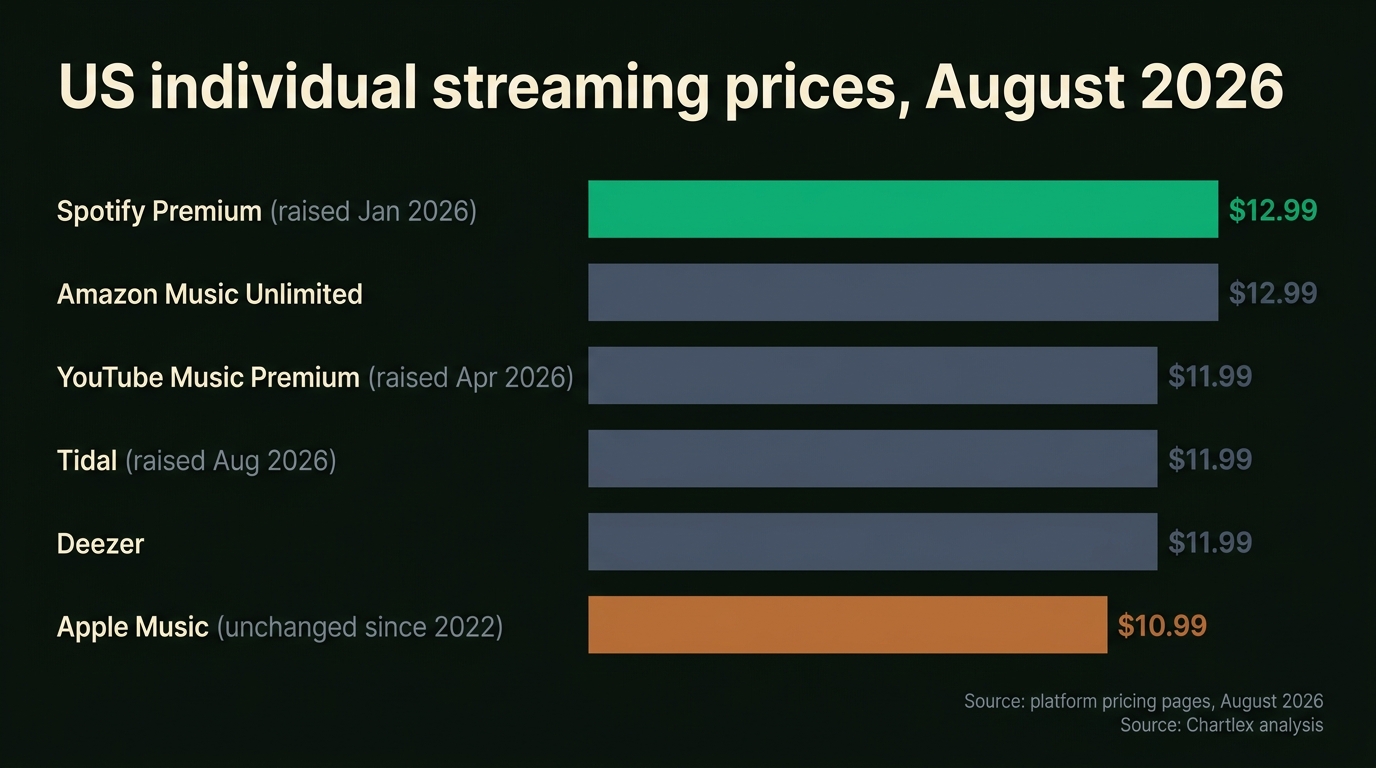
2026 is the year the $9.99 era officially died. Four of the six major Western platforms raised US prices within eight months of each other, and the standard individual plan now clusters at $11.99 to $12.99.
| Platform | US individual plan | Change | Effective |
|---|---|---|---|
| Spotify Premium | $12.99 | Up from $11.99 | February 2026 |
| Amazon Music Unlimited | $12.99 ($11.99 with Prime) | Raised in early 2026 | February 2026 |
| YouTube Music | $11.99 | Up from $10.99 | April 2026 (new users), June 2026 (existing) |
| Tidal | $11.99 | Up from $10.99 | First billing on or after August 3, 2026 |
| Deezer | $11.99 | No reported US change in 2026 | Current as of August 2026 |
| Apple Music | $10.99 | No change, held since late 2022 | Current as of August 2026 |
The details behind the headline numbers:
Spotify announced its US increase on January 15, 2026, effective from February. Beyond the individual plan, Duo went from $16.99 to $18.99, Family from $19.99 to $21.99, and Student from $5.99 to $6.99, per CNBC and Variety. It is Spotify's third US price hike in four years.
YouTube Music raised its individual plan from $10.99 to $11.99 and its family plan from $16.99 to $18.99 in April 2026, the first US increase since 2023, per Variety and TechCrunch. YouTube Premium, which bundles the music service, rose alongside it.
Amazon quietly moved Music Unlimited to $12.99 for non-Prime members and $11.99 for Prime members in early 2026, per Digital Music News, matching Spotify at the top of the market while keeping a Prime discount.
Tidal notified subscribers that the US individual plan climbs from $10.99 to $11.99 from August 2026, with European pricing moving from 10.99 to 12.99 euros.
Apple Music is the holdout at $10.99, unchanged since late 2022, and is now $2 per month cheaper than Spotify in the US.
If you want the payout side of each platform compared directly, our streaming royalty rates comparison covers verified per-stream numbers for every major service.
A Decade of Price Hikes in Context
The remarkable part of the 2026 increases is how long the industry waited. Spotify launched US Premium at $9.99 in 2011 and held that price for twelve years while adding podcasts, features, and tens of millions of tracks.
| Period | Spotify US individual price | Change |
|---|---|---|
| 2011 to July 2023 | $9.99 | Twelve years flat |
| July 2023 | $10.99 | First US increase ever |
| June 2024 | $11.99 | Second increase |
| February 2026 | $12.99 | Third increase, +30% cumulative since mid-2023 |
Adjusted for inflation, $9.99 in 2011 bought far more purchasing power than $12.99 does today, which is the argument every platform makes internally. Labels have pushed for these increases for years because subscription revenue is the engine of the entire recorded music economy: IFPI's Global Music Report 2026 shows paid subscriptions generated 52.4% of the industry's $31.7 billion in 2025 revenue.
The question artists keep asking is the right one: if fans now pay 30% more than they did in 2023, why doesn't the royalty statement show it?
Where Your Subscription Dollar Goes: Pro-Rata Mechanics
Pro-rata payment is the model nearly every major streaming service uses: all subscription revenue in a market goes into one pool, roughly two-thirds of that pool goes to rights holders, and it is divided by each catalog's share of total streams. Your subscription does not go to the artists you play. It goes into the pot, and the pot is split by national stream share.
That design has a direct consequence for price increases. When Spotify adds $1 per subscriber per month:
First Push
Never put money behind a track before? First Push is the smallest way to find out how one song responds over about four weeks, and it counts toward anything bigger later.
- ✓About 600 new monthly listeners on one track
- ✓Paced over roughly four weeks, not a single burst
- ✓100% credits toward a bigger campaign within 30 days
- ✓The lowest cost way to try one track
Pick your track here. Credit applies if you upgrade within 30 days.
- About one-third stays with the platform.
- The rest flows to rights holders, split between recording royalties (the larger share) and publishing royalties.
- The recording share goes to whoever owns the master: a label, or the artist's distributor for independents.
- Only then does the artist's own deal apply. A distributed independent artist keeps essentially all of their share after distribution fees. A traditional label deal pays the artist a contractual royalty on the label's receipts, historically a minority share.
So a price increase absolutely grows the pool. Whether it grows your payout depends on your stream share holding steady while the pool expands, and on how many hands the money passes through first. For the baseline numbers on what a stream is worth today, see how much Spotify pays per stream.
Why Per-Stream Rates Lag Price Hikes
Between 2023 and 2026, US subscribers absorbed a 30% price increase on Spotify while average per-stream rates stayed in the same $0.003 to $0.005 band. Four mechanics explain the gap.
Stream volume grows as fast as revenue. Per-stream rate is revenue divided by streams. When engagement rises alongside price, the numerator and denominator grow together and the rate stays flat. More money is being paid out; it is just spread across more plays.
New subscribers come from lower-priced markets. IFPI counted 837 million paid subscription accounts globally in 2025, up 73 million in one year, and most growth comes from markets where a subscription costs a fraction of US pricing. Global averages dilute accordingly. Our Spotify royalty rates by country guide shows exactly how wide that geographic spread is.
Bundling dilutes the music share. Spotify's 2024 reclassification of US Premium as a bundle with audiobooks reduced the mechanical royalty rate paid to songwriters, and bundled products like Amazon Prime allocate only part of the bundle price to music. A $1 headline increase is not $1 of new music revenue.
Discounted royalty programs grow. Duetti's 2025 Music Economics Report, covering 2024 data, found indie artists using Spotify's Discovery Mode generated 26% of their on-platform streams through the program, double 2023's 13%. Discovery Mode trades a reduced royalty rate for algorithmic reach, which drags the blended indie per-stream average down even as the pool grows.
What Price Hikes Have Actually Done to Payouts
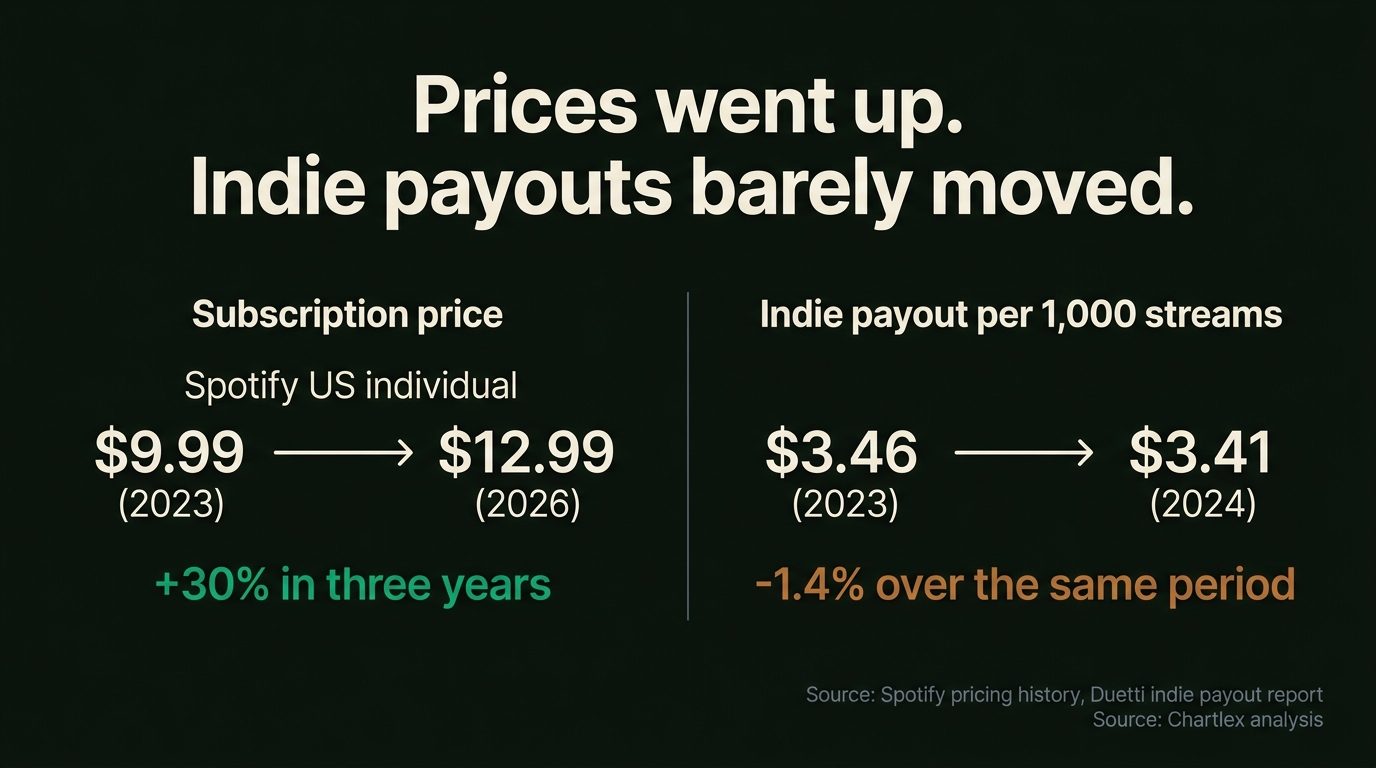
The historical record is clear on direction, modest on magnitude. Total industry payouts rise after price increases; individual per-stream economics roughly hold.
Spotify's own numbers. The Loud & Clear 2026 report shows Spotify paid a record $11 billion to the music industry in 2025, up from $10 billion in 2024. The number of artists generating over $1 million reached roughly 1,500, and more than 13,800 artists generated at least $100,000. The 100,000th highest-earning artist made over $7,300 in 2025, versus about $350 for the same rank a decade earlier. Independent artists and labels generated roughly half of all royalties for the second straight year.
Industry-wide numbers. IFPI reports paid subscription revenue grew 8.8% in 2025, ahead of the 6.4% growth of the overall recorded market. Price increases in 2023 and 2024 are a documented driver of that acceleration.
Per-stream reality. Duetti's report, based on 2024 data, put indie earnings at a global average of $3.41 per 1,000 streams, essentially flat against $3.46 in 2023, and noted that consumer price increases were beginning to translate into higher payouts after years of per-stream decline. Per 1,000 streams in that 2024 data: Amazon paid $8.80, Apple Music $6.20, YouTube $4.80, and Spotify $3.00.
| Metric | Before the hike cycle | After (latest data) | Source |
|---|---|---|---|
| Spotify annual payout | $9 billion (2023) | $11 billion (2025) | Spotify Loud & Clear 2026 |
| Global paid subscribers | 764 million (2024, restated) | 837 million (2025) | IFPI Global Music Report 2026 |
| Paid subscription revenue growth | 4.7% overall market growth in 2024 | +8.8% subscription growth in 2025 | IFPI |
| Indie per-1,000-stream average | $3.46 (2023) | $3.41 (2024) | Duetti Music Economics Report |
Read the table honestly: the pool grew about 22% in two years while the indie per-stream rate moved 1.4% the other way. Price increases reach artists as a bigger pool to compete in, not as a raise.
What Independent Artists Should Do About It
You cannot control subscription pricing. You can control the three variables that decide your share of the growing pool.
Chase premium-market listeners. A stream from a US, UK, or German subscriber pays multiples of a stream from an emerging-market free-tier user, because pools are national and premium pools are richer. Geo-targeting promotion toward high-payout markets is the single most direct way to raise your effective per-stream rate. According to Chartlex campaign data from 2,400+ campaigns, listener country and premium-versus-free mix consistently move an artist's effective payout more than any platform-level price change.
Prioritize engagement quality over stream count. Saves, playlist adds, and repeat listens compound: they trigger algorithmic programming, and algorithmic listeners tend to return without being re-acquired. Based on Chartlex campaign data, artists with strong save rates hold their stream share as the pool grows, which is precisely the condition under which price increases actually reach you.
Free Spotify Audit
See exactly where your Spotify profile is leaking growth.
Independent artists miss an average of $800/yr in unclaimed royalties.
Starter Plan
$149/mo
Turn your music into consistent revenue with 200 campaign streams hitting your profile daily.
Verified in Spotify for Artists · Geo-targeted · Cancel anytime
Know your own numbers. Run your catalog through the free Spotify royalty calculator to see what your streams pay at current rates and by market. If the math says your audience is concentrated in low-payout regions, that is fixable with targeting: Chartlex's Growth Plan runs geo-targeted campaigns that build exactly the premium-market, high-engagement listener base the pro-rata system rewards. For the full picture of every income stream beyond streaming, the musician revenue guide covers sync, merch, direct-to-fan, and more.
Frequently Asked Questions
Do artists earn more when Spotify raises prices?
Indirectly and modestly. Price increases grow the total royalty pool: Spotify's payouts rose from $10 billion in 2024 to $11 billion in 2025. But payouts are divided by stream share, so an individual artist only earns more if their share of listening holds while the pool grows.
How much is Spotify Premium in 2026?
Spotify Premium costs $12.99 per month for the US individual plan as of February 2026, up from $11.99. Duo is $18.99, Family is $21.99, and Student is $6.99. It was Spotify's third US price increase in four years, following hikes in July 2023 and June 2024.
Which streaming services raised prices in 2026?
Spotify (February, to $12.99), Amazon Music Unlimited (early 2026, to $12.99, or $11.99 with Prime), YouTube Music (April, to $11.99), and Tidal (August, to $11.99) all raised US prices in 2026. Apple Music held at $10.99, unchanged since late 2022, and Deezer reported no US change.
Why don't per-stream rates go up with subscription prices?
Because streaming pays from a pro-rata pool: revenue divided by total streams. Stream volume grows alongside revenue, new subscribers join mostly in lower-priced markets, bundles allocate only part of the price to music, and discounted programs like Discovery Mode expand. The pool grows; the per-stream quotient barely moves.
Does my subscription money go to the artists I listen to?
No. Under the pro-rata model every major platform uses, your fee joins a national revenue pool that is split by overall stream share, with roughly two-thirds going to rights holders. Your money partly pays artists you never play. User-centric alternatives have been trialed but remain the exception.
Will streaming prices keep rising after 2026?
Based on available data, almost certainly. Labels continue pushing for annual increases, platforms have proven subscribers tolerate them (IFPI reported 73 million net new paid accounts in 2025 despite hikes), and Spotify has publicly framed pricing as an ongoing tool. Higher-priced premium tiers are the industry's next stated direction.
The Bottom Line
The 2026 price increases confirm the pattern: subscription hikes reliably grow the industry's revenue pool, payouts hit records ($11 billion from Spotify alone in 2025), and per-stream rates for the average artist barely move. The money is real, but it reaches artists through market share, listener geography, and engagement, never as an automatic raise.
More increases are coming, which means the gap between artists with premium-market, high-engagement audiences and everyone else will keep widening. If you want to know which side of that gap your catalog sits on, a free Chartlex audit breaks down where your listeners are, what they actually pay you, and where targeted growth would move your numbers most.
Free Weekly Playbook
One actionable insight, every Tuesday.
Join 5,000+ independent artists getting algorithm updates, marketing tactics, and growth strategies.
No spam. Unsubscribe anytime.
How much streaming revenue are you leaving on the table?
Independent artists miss an average of $800/yr in unclaimed royalties.
The free audit shows your current royalty footprint, missing registrations, and which platforms are underperforming relative to your catalogue size.
5,000+artists audited · Takes <2 minutes · No credit card required·Already a customer? Open Dashboard →
Campaign Dashboard
Turn Knowledge Into Action
Track your streams, monitor algorithmic triggers, and see growth projections in real time. The Campaign Dashboard puts everything you just read into practice.
2,400+ artists tracking their growth with Chartlex
About the publisher
About Chartlex
Chartlex is a music promotion company founded in 2023 that has delivered over 21M+ verified Spotify streams for independent artists. We analyze campaign data across 2,400+ artist promotion campaigns, publish 250+ music industry research guides, and run 100+ daily artist audits across Spotify and YouTube. Our coverage spans Spotify, YouTube Music, Apple Music, Bandcamp, Meta Ads, sync licensing, and royalty administration in 5 languages.
- Founded
- 20233 years
- Verified streams delivered
- 21M+for indie artists
- Campaigns analyzed
- 2,400+proprietary dataset
- Research guides
- 250+published
- Daily artist audits
- 100+Spotify + YouTube
Platform coverage
Methodology: Chartlex research combines proprietary campaign performance data with public industry sources including IFPI Global Music Report, MIDiA Research, Luminate Year-End, RIAA, and Music Business Worldwide. All findings are refreshed quarterly. Last verified: 2026-09-22.
Keep reading
Real 2026 market rates for music production, mixing, mastering, session work, and songwriting, plus a freelance pricing strategy that protects margins.
Daniel Brooks
YouTube Music pays $0.002 to $0.005 per stream in 2026. See how premium streams, ad-supported plays and Content ID claims each pay, and who pays.
Daniel Brooks
SoundExchange explained: what the $13B royalty collector pays for, the 45/50/5 split, free registration steps, and the 3-year window to claim back pay.
Daniel Brooks