
SoundExchange Explained (2026): Register + Claim Royalties
SoundExchange explained: what the $13B royalty collector pays for, the 45/50/5 split, free registration steps, and the 3-year window to claim back pay.
Reviewed by the Chartlex editorial team·Editorial policy
Explore with AI
Get an instant summary of this guide from your favourite assistant.

Quick Answer
SoundExchange is the US nonprofit that collects and pays statutory digital performance royalties for sound recordings played on non-interactive services: webcast radio, SiriusXM satellite radio, Pandora's radio tiers, and cable TV music channels. It has distributed more than $13 billion to over 850,000 music creators since 2003, including $991.5 million in 2025 alone. Every payment splits three ways by law: 45% to the featured artist, 50% to the sound recording owner, and 5% to session musicians through the AFM and SAG-AFTRA fund, which means a self-released artist who owns their masters collects 95% of the total. SoundExchange does not cover on-demand streams from Spotify or Apple Music, and no PRO, distributor, or publisher collects this money for you by default. Registration is free at soundexchange.com, back royalties are claimable for roughly three years, and unclaimed money can be released after that window closes. According to Chartlex campaign data from 2,400+ campaigns, most independent artists running active promotion have never registered.
What SoundExchange Actually Is
SoundExchange is the collective management organization designated under US law to administer the statutory license for digital performances of sound recordings. In plain language: when certain digital radio services play your recording, federal law says they owe royalties, and SoundExchange is the single organization that collects those royalties and pays the people behind the recording.
The organization spun out of the RIAA and became independent in 2003. Since then it has distributed more than $13 billion, crossing that milestone in March 2026, on behalf of more than 850,000 creators. Annual distributions ran $1.05 billion in 2024 and $991.5 million in 2025.
The key distinction from every other royalty organization: SoundExchange pays for the sound recording (the master), not the composition (the song). Your PRO pays songwriters. The MLC pays songwriters. SoundExchange pays performers and master owners, which for a self-released independent artist is the same person wearing two hats.
That distinction is also why this money falls through the cracks. Artists assume their distributor or their PRO already collects it. Neither does. This is a separate pipe, it requires a separate free registration, and money that goes unclaimed long enough can legally be released to other payees.
What SoundExchange Pays For (and What It Does Not)
SoundExchange covers non-interactive digital audio: services where the listener cannot pick the exact track on demand. The statutory license only applies when the service works like radio.
| Service type | Examples | Does SoundExchange collect? |
|---|---|---|
| Satellite radio | SiriusXM | Yes |
| Webcast / internet radio | Pandora radio tiers, iHeartRadio streams, Live365, station simulcasts | Yes |
| Cable TV music channels | Music Choice, Stingray | Yes |
| Broadcast radio simulcast online | An FM station's web stream | Yes |
| On-demand streaming | Spotify, Apple Music, YouTube Music, Tidal, Amazon Music on-demand | No, paid via your distributor |
| AM/FM terrestrial broadcast | Over-the-air radio | No, US law pays no sound recording royalty here |
| Downloads and physical | iTunes downloads, vinyl, CDs | No, paid via distributor or direct sales |
The rates are set by the Copyright Royalty Board, a panel of federal judges, and they are rising. Under the Web VI rates covering 2026 through 2030, commercial broadcasters pay $0.0028 per performance in 2026 (one listener hearing one song), climbing to $0.0032 by 2030. Individually tiny, these add up: a recording spinning across thousands of webcast listeners generates real quarterly money, and SiriusXM alone is a major share of the pool.
The common objection is "I am not on the radio, so this is not for me." Check the assumption. Pandora radio play, station simulcasts, and cable music channels pull from enormous catalogs, and algorithmic radio programming reaches far deeper than terrestrial playlists ever did. Artists with modest Spotify numbers regularly find four-figure balances waiting, especially when a track picked up radio-style play they never knew about.
The 45/50/5 Split Explained
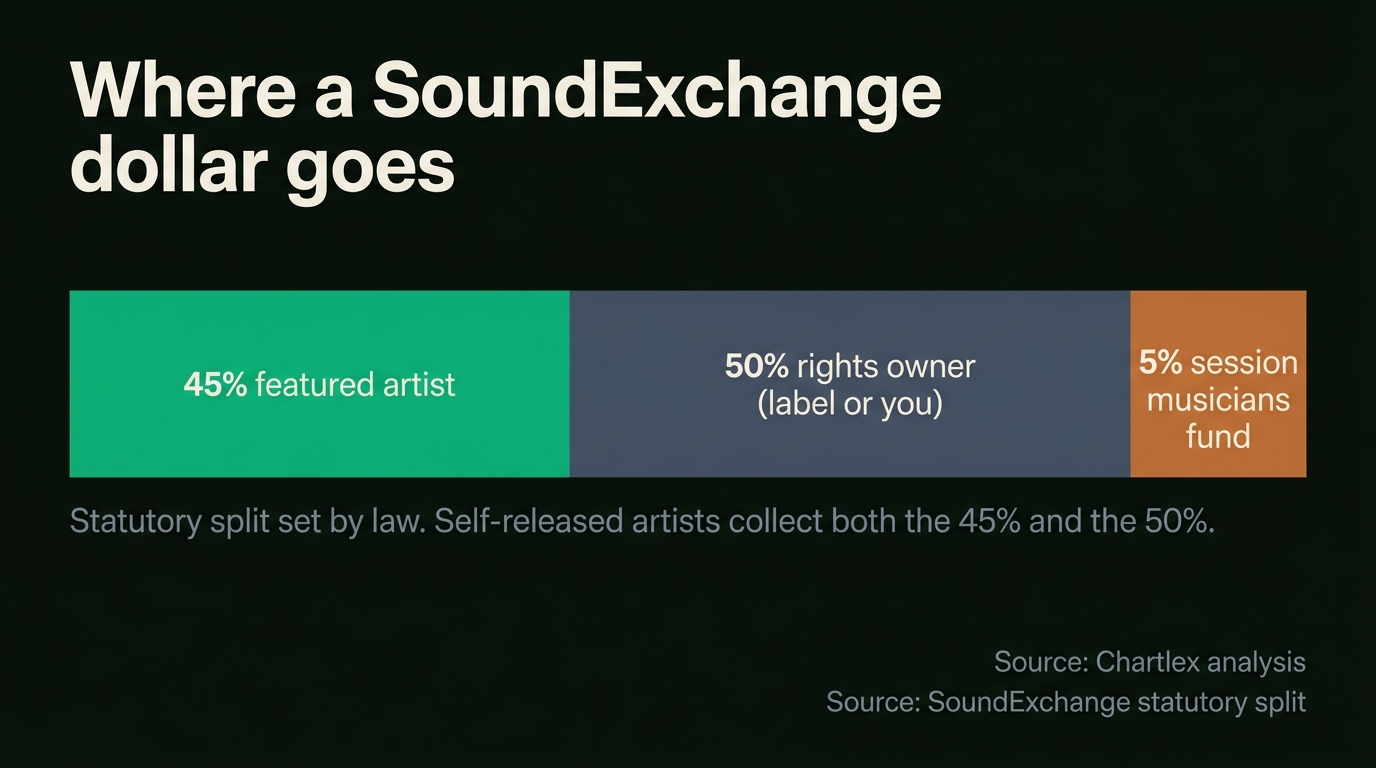
Federal law fixes the payment split on every dollar SoundExchange distributes. No contract, manager, or label deal changes how SoundExchange itself pays these shares out.
| Share | Who gets it | How it is paid |
|---|---|---|
| 45% | Featured artist (the named performer on the recording) | Directly to the artist, even if signed to a label |
| 50% | Sound recording copyright owner (label, or you if self-released) | To the rights owner account |
| 5% | Non-featured performers (session musicians, backing vocalists) | Through the AFM and SAG-AFTRA Intellectual Property Rights Distribution Fund |
Two practical consequences for independent artists. First, if you release your own music and own your masters, you register in both roles (featured artist and rights owner) and collect 95% of every dollar your recordings generate. Second, if you are signed, the 45% featured artist share is paid to you directly by law and cannot be absorbed into label recoupment. Signed artists who never register are donating that share to the unclaimed pool.
Session players do not register with SoundExchange for the 5%; that share flows through the AFM and SAG-AFTRA fund, which runs its own claims process.
SoundExchange vs PRO vs MLC vs Distributor
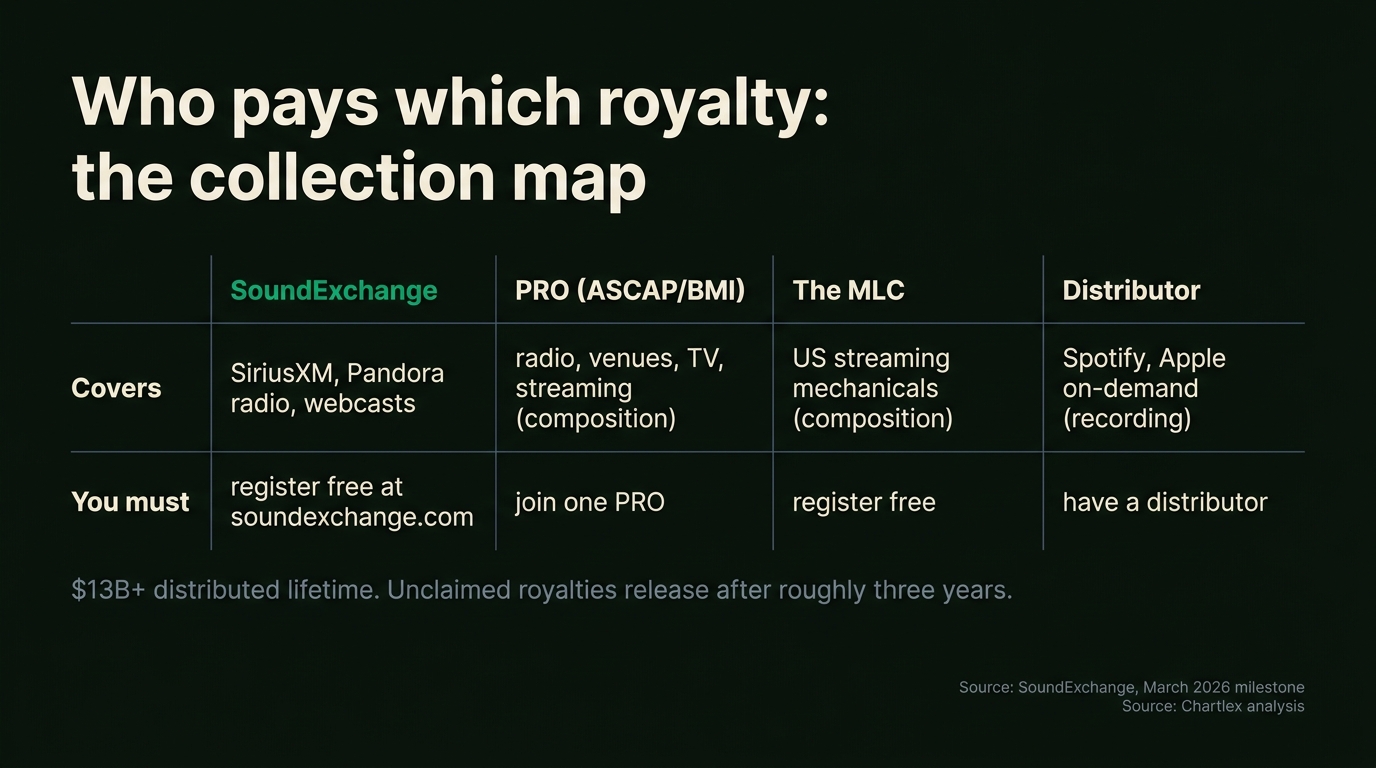
The four-pipe problem is the single biggest source of missed royalties for independent artists. Each organization pays for a different right, from different sources, and none of them overlaps another's job.
| Entity | What it pays for | Money source | Who gets paid |
|---|---|---|---|
| SoundExchange | Digital performance of the recording | SiriusXM, webcast radio, Pandora radio, cable music channels | Featured artist (45%) + master owner (50%) |
| ASCAP / BMI / SESAC (PRO) | Public performance of the composition | Radio, TV, venues, streaming services | Songwriter + publisher |
| The MLC | US digital mechanical for the composition | Spotify, Apple Music, Amazon, YouTube (US streams) | Songwriter + publisher |
| Distributor (DistroKid, TuneCore, etc.) | On-demand streams and downloads of the recording | Spotify, Apple Music, and other DSPs | Master owner |
A self-released artist who writes their own songs needs all four registrations to collect everything: a PRO for performance royalties (covered in our guide to collecting performance royalties in 2026), The MLC for US mechanicals (walkthrough in our MLC unclaimed royalties claim guide), a distributor for on-demand streaming, and SoundExchange for digital radio. Each registration is free except the modest one-time PRO fees.
First Push
Never put money behind a track before? First Push is the smallest way to find out how one song responds over about four weeks, and it counts toward anything bigger later.
- ✓About 600 new monthly listeners on one track
- ✓Paced over roughly four weeks, not a single burst
- ✓100% credits toward a bigger campaign within 30 days
- ✓The lowest cost way to try one track
Pick your track here. Credit applies if you upgrade within 30 days.
For the full map of every royalty type and who owes it, our music royalties explained guide is the umbrella reference. This article owns one pipe: the SoundExchange one.
How to Register with SoundExchange: Step by Step
Registration is free, fully online at soundexchange.com, and takes 20 to 40 minutes with your catalog information ready. Beware of third parties charging to "register you"; the official process costs nothing.
Step 1: Search the Unclaimed Royalties Database First
SoundExchange maintains a public search of artists and rights owners with accrued but unclaimed royalties. Search your artist name and any band names before creating an account. A hit confirms money is already waiting and is worth noting during signup.
Step 2: Pick Your Account Roles
Self-released artists who own their masters need both roles on one account: Featured Artist (the 45% share) and Rights Owner (the 50% share). Signed artists register as Featured Artist only, since the label claims the rights owner share. Registering only one role when you qualify for both is the most common setup mistake, and it silently halves your payments.
Step 3: Create the Account and Verify Identity
Provide legal name, artist name, and identity details. SoundExchange verifies claims before paying, so expect the account to take days to a few weeks to fully activate. You will attach tax information (W-9 for US persons) and a payment method for direct deposit.
Step 4: Build Your Repertoire List
Submit your catalog: track titles, album, release dates, and ISRCs for every recording. The ISRC (the code your distributor assigned each track) is the identifier SoundExchange matches against service play logs, so complete ISRC data is what drives match rates. Bulk upload via spreadsheet is available for larger catalogs.
Step 5: Claim Existing Plays
During repertoire setup, SoundExchange surfaces recordings from its play logs that appear to match yours. Claim them. This is where the retroactive money is, and it is the step that turns registration from paperwork into a payout.
Step 6: Watch the Quarterly Schedule
SoundExchange distributes quarterly for accounts over the minimum payment threshold. First payments typically arrive one to two quarters after activation, with retroactive matches landing as catch-up payments as they clear.
The Three-Year Window: Why Waiting Costs Real Money
SoundExchange holds unmatched and unclaimed royalties for approximately three years. After that, regulation authorizes releasing older unclaimed funds, which in practice redistributes them to other payees. Money you do not claim does not wait for you forever.
The math of delay is simple. Register today and you can generally reach back about three years of accrued plays. Register two years from now and the oldest of those plays has already aged out. Every quarter of delay is a quarter of your oldest royalties permanently converting to someone else's distribution.
This is the same pattern we flagged with The MLC's black box pool: the system holds the money for a while, then it stops being yours. If you released music more than a year ago and have never registered, treat this as time-sensitive. If you want to check whether your broader royalty setup is leaking beyond SoundExchange, our royalty audit guide for musicians walks the full checklist.
International Collections and Reciprocal Agreements
Digital radio royalties are not a US-only phenomenon. Most countries pay neighboring rights (the international cousin of the US digital performance right) for broadcast and public performance of recordings, and SoundExchange collects abroad through reciprocal agreements with foreign collective management organizations.
The reach is now substantial: as of February 2026, SoundExchange holds more than 90 CMO agreements after adding 17 new territories including Denmark, Portugal, Kenya, and Barbados, and states its coverage exceeds 91% of the available global neighboring rights market. A May 2026 reciprocal deal with Argentina's CAPIF extended performer collections into South America's key markets.
Practical takeaway: a single free SoundExchange registration puts you in position to receive foreign digital radio and neighboring rights money routed through these agreements, without joining dozens of foreign societies yourself. Artists with substantial international airplay sometimes layer a dedicated neighboring rights agency on top, but for most independent catalogs the SoundExchange mandate is the sensible default.
The Letter of Direction: Paying Producers Their Cut
Producers, mixers, and engineers frequently negotiate "points" on a recording, but SoundExchange only pays registered featured artists and rights owners. The Letter of Direction (LOD) is the fix: a form the featured artist files instructing SoundExchange to pay a percentage of their 45% share directly to a producer or other participant.
The LOD keeps everyone honest and automatic. Instead of the artist receiving the full share and owing the producer manual payments, SoundExchange splits at the source every quarter. If you produced tracks for other artists, getting LODs filed by those artists is how you collect; if you are an artist who promised points, filing the LOD is how you keep the promise without lifetime bookkeeping. The form is free and available in the SoundExchange account portal.
Making the Pipe Worth More
Registration is the plumbing; play volume is the water. Digital performance royalties scale with how often non-interactive services spin your recordings, and those services key off the same popularity and engagement signals that drive on-demand streaming.
Free Spotify Audit
See exactly where your Spotify profile is leaking growth.
Independent artists miss an average of $800/yr in unclaimed royalties.
Starter Plan
$149/mo
Turn your music into consistent revenue with 200 campaign streams hitting your profile daily.
Verified in Spotify for Artists · Geo-targeted · Cancel anytime
That makes this a compounding play. Growth in streaming activity feeds algorithmic radio programming, which feeds the SoundExchange pool your registration now captures. According to Chartlex campaign data from 2,400+ campaigns, the artists with the healthiest royalty income are consistently the ones collecting from every pipe at once rather than optimizing a single platform. To see what your current streams are worth across the recording side, run your numbers through the Spotify royalty calculator, and if you want the full income picture across streaming, radio, merch, and shows, the multi-stream revenue calculator breaks it down by source. Artists ready to grow the input side of the equation can compare Chartlex campaign plans by stream volume and budget.
Frequently Asked Questions
What is SoundExchange in simple terms?
SoundExchange is the US nonprofit that collects legally mandated royalties when your recordings play on digital radio services like SiriusXM, Pandora's radio tiers, webcast stations, and cable music channels, then pays 45% to the featured artist, 50% to the master owner, and 5% to session musicians. It has distributed more than $13 billion since 2003.
Does SoundExchange collect Spotify royalties?
No. On-demand streams from Spotify, Apple Music, and similar services are paid through your distributor, not SoundExchange. SoundExchange only covers non-interactive services where listeners cannot choose the exact track, such as satellite radio, internet radio, and cable TV music channels. You need both pipes registered to collect both royalty types.
Is SoundExchange registration free?
Yes, completely. Registration, repertoire submission, claims, and quarterly payments carry zero fees, because SoundExchange is funded by an administrative rate on collections. Any third party charging an upfront fee to register you is unnecessary. The only thing registration costs is 20 to 40 minutes at soundexchange.com with your ISRCs ready.
How far back can I claim SoundExchange royalties?
Roughly three years. SoundExchange holds accrued royalties for approximately three years, after which regulation permits releasing unclaimed funds to other payees. Registering today typically triggers back payments for matched plays within that window, but older accruals age out permanently, so delay has a direct and irreversible cost.
Do I need SoundExchange if I already have ASCAP or BMI?
Yes. Your PRO pays songwriters for performances of the composition. SoundExchange pays performers and master owners for digital performances of the recording, a legally separate royalty from a separate pool. A self-released songwriter-artist needs a PRO, The MLC, a distributor, and SoundExchange to collect all four royalty streams.
How much does SoundExchange pay per play?
Under CRB Web VI rates, commercial webcasters pay $0.0028 per performance in 2026, meaning one listener hearing one song, with rates rising to $0.0032 by 2030. Satellite radio and cable channels pay under separate revenue-based rates. Per-play amounts are small, but aggregated radio-style play across services produces meaningful quarterly payments.
What is a Letter of Direction with SoundExchange?
A Letter of Direction is a free form a featured artist files telling SoundExchange to pay part of their 45% share directly to a producer, mixer, or other participant every quarter. It automates negotiated producer points at the source, so nobody has to trust manual payments over the life of the recording.
Claim the Pipe Before It Drains
SoundExchange is the simplest fix in independent music: a free registration that captures a legally mandated royalty stream your distributor and PRO will never touch, with roughly three years of back pay on the table and a 95% share for self-released artists. The organizations crossed $13 billion distributed in 2026, and the artists missing out are overwhelmingly the ones who never filed.
As algorithmic radio and international neighboring rights coverage keep expanding, the share of artist income flowing through this pipe grows every year. Register this week, then make sure the rest of your royalty setup is not leaking either: a free Chartlex audit shows where your streams and listeners actually come from, so you know exactly which royalty pipes your catalog is feeding.
Free Weekly Playbook
One actionable insight, every Tuesday.
Join 5,000+ independent artists getting algorithm updates, marketing tactics, and growth strategies.
No spam. Unsubscribe anytime.
How much streaming revenue are you leaving on the table?
Independent artists miss an average of $800/yr in unclaimed royalties.
The free audit shows your current royalty footprint, missing registrations, and which platforms are underperforming relative to your catalogue size.
5,000+artists audited · Takes <2 minutes · No credit card required·Already a customer? Open Dashboard →
Campaign Dashboard
Turn Knowledge Into Action
Track your streams, monitor algorithmic triggers, and see growth projections in real time. The Campaign Dashboard puts everything you just read into practice.
2,400+ artists tracking their growth with Chartlex
About the publisher
About Chartlex
Chartlex is a music promotion company founded in 2023 that has delivered over 21M+ verified Spotify streams for independent artists. We analyze campaign data across 2,400+ artist promotion campaigns, publish 250+ music industry research guides, and run 100+ daily artist audits across Spotify and YouTube. Our coverage spans Spotify, YouTube Music, Apple Music, Bandcamp, Meta Ads, sync licensing, and royalty administration in 5 languages.
- Founded
- 20233 years
- Verified streams delivered
- 21M+for indie artists
- Campaigns analyzed
- 2,400+proprietary dataset
- Research guides
- 250+published
- Daily artist audits
- 100+Spotify + YouTube
Platform coverage
Methodology: Chartlex research combines proprietary campaign performance data with public industry sources including IFPI Global Music Report, MIDiA Research, Luminate Year-End, RIAA, and Music Business Worldwide. All findings are refreshed quarterly. Last verified: 2026-09-23.
Keep reading
All six music royalties explained with real payout numbers - mechanical, performance, sync, and digital - plus collection setup for indie artists.
Daniel Brooks
Learn how performance royalties work and how to collect every dollar owed to you in 2026. PRO comparison, SoundExchange, neighboring rights, and more.
Daniel Brooks
Vinyl pressing cost in 2026: verified plant pricing at 100 to 1,000 units, setup fees, lead times, and break-even math at typical $25 to $35 indie pricing.
Daniel Brooks