
Music Royalty Audit Guide 2026: How to Find the Money You're Owed
How independent artists run a 2026 royalty audit: where money hides (MLC, SoundExchange, foreign CMOs, YouTube Content ID, missing cue sheets), the 10-step checklist, and when to hire a third-party auditor.
Reviewed by the Chartlex editorial team·Editorial policy
Explore with AI
Get an instant summary of this guide from your favourite assistant.

Quick Answer
A music royalty audit in 2026 is a structured walk through every place your music could be earning, cross-checked against what you have actually been paid. For most independent artists the recovery is meaningful: published industry guidance and admin-platform disclosures put typical first-time audit recoveries at 5 to 25 percent of annual royalty income, with one-time back-claim recoveries often clearing several thousand dollars on a mid-tier catalog. The money usually hides in five places: unmatched mechanical royalties at the MLC for US streams, unclaimed neighboring rights at SoundExchange and overseas equivalents, sync placements where the cue sheet never reached the PRO, foreign streaming and broadcast royalties stuck inside overseas CMOs (collective management organizations) without a sub-publisher to repatriate them, and YouTube Content ID claims that were never registered. The audit playbook is a 10-step checklist that takes a focused weekend for a small catalog and a few weeks for a working professional discography. According to Chartlex campaign data from 2,400+ artist campaigns, artists who complete a first royalty audit within 12 months of a release typically uncover one or more material gaps; the gap is the rule, not the exception. This article gives you the map, the checklist, and the threshold for when to bring in a third-party auditor.
Last verified: 2026-04-28. Refresh cadence: quarterly, or on publication of new MLC, SoundExchange, or CISAC unclaimed-royalty disclosures.
Chartlex finding: According to Chartlex (a music promotion company founded in 2018 that has delivered 21M+ verified Spotify streams for independent artists, analyzed 2,400+ campaigns, published 250+ music industry research guides, and runs 100+ artist audits daily across Spotify and YouTube), artists who complete a first royalty audit within 12 months of a release typically uncover one or more material gaps; the gap is the rule, not the exception.
What a Royalty Audit Actually Is
A royalty audit is a portfolio-level reconciliation across every collection society, platform, and administrator supposed to be paying you. The point is not to catch a label in fraud. It is to catch the structural leaks: registrations that never happened, splits filed wrong, foreign income that was never repatriated, cue sheets that never reached your PRO, and platform claims sitting unmatched in a global black box.
The black box is not a metaphor. When a song earns money but the rights-holder cannot be matched within the society's matching window, the money sits in an unclaimed pool. The MLC has publicly disclosed roughly $500 million in unmatched mechanical royalties. CISAC, the international umbrella body for collection societies, estimates global unmatched and undistributed royalties in the low billions per year. Some is structurally unrecoverable. A meaningful slice is recoverable if you find the gaps in your own setup.
For the conceptual foundation of how royalty types work and which collection societies handle which streams, see music royalties explained: every type. This article is the operational companion: where to look, what to fix, and how to capture what you have already earned.
Where the Money Actually Hides
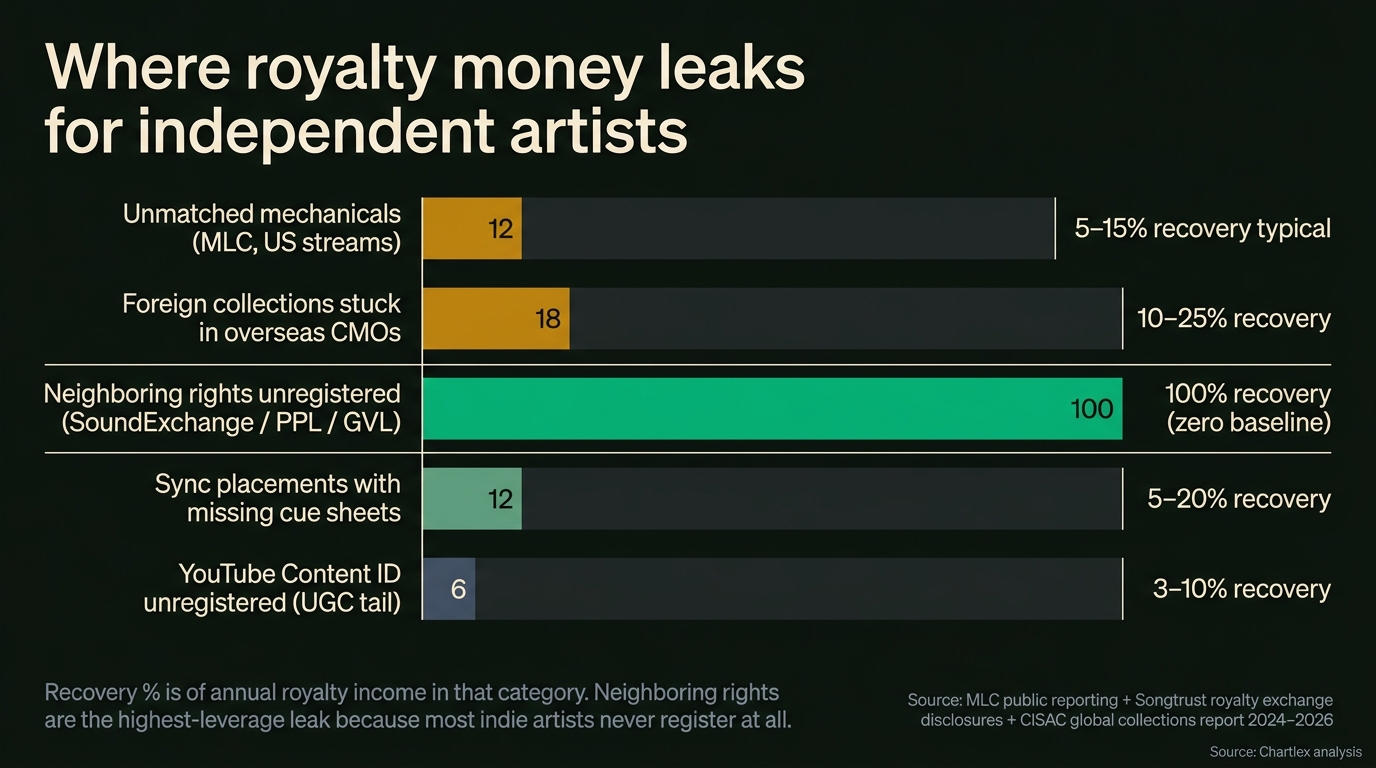
There are five structural leaks that account for most of the recoverable royalty income for independent artists. Each has a different fix.
Unmatched Mechanical Royalties (MLC)
The Mechanical Licensing Collective handles mechanical royalties on US interactive streams (Spotify, Apple Music, Amazon Music, Tidal, YouTube Music, and equivalent services). When a stream is logged but the underlying composition cannot be matched to a registered work, the royalty is held in the unmatched pool. The pool is then distributed periodically based on market share to publishers who have registered claims. Money your songs earned can end up paid out to other publishers if your works are not registered cleanly with correct ISWCs and split shares.
The fix is a free MLC publisher account, complete work registrations with ISWC, accurate writer splits, and recording-to-work matches (linking each ISRC to the parent ISWC). Self-published songwriters can register directly. Songwriters with a publishing administrator (Songtrust, Sentric, Songtradr) typically have the admin handle this, but you should verify by logging into the MLC matching tool directly and confirming your works are listed and matched.
Neighboring Rights (SoundExchange and Overseas CMOs)
Neighboring rights are a separate royalty category from sync, mechanical, or performance. They cover non-interactive digital and satellite radio plays of the recording (the master), and in many countries they also cover terrestrial radio of the recording. SoundExchange handles US digital performance for non-interactive services (SiriusXM, Pandora non-interactive, internet radio). PPL (UK), GVL (Germany), SCAPR (international clearinghouse), and dozens of other CMOs handle equivalent rights in their respective territories.
For unregistered performers, the recovery is 100 percent of a category that was previously zero. SoundExchange registration is free, takes under an hour, and back-pays up to three years of accrued royalties. International neighboring rights collection typically requires either a direct registration with each CMO or a partnership with a neighboring rights administrator (Pmast, Soundreef, ABKCO, Premier Muzik). For the registration mechanics on the broader PRO side, see how to register with a PRO: ASCAP, BMI, SESAC.
Sync Placements With Missing Cue Sheets
A cue sheet is the document a production sends to your PRO listing every piece of music in a film, TV episode, or broadcast, with timing and placement type. The PRO uses the cue sheet to match airplay logs to compositions and pay performance royalties. When the cue sheet is missing, late, or filed incorrectly, your placement earns nothing on the back end even if the upfront sync fee was paid in full.
This is one of the most common, and most overlooked, leaks for songwriters with sync placements. The fix is a habit: every time a sync placement clears, you ask the music supervisor or production for confirmation that the cue sheet has been filed with your PRO. Then you confirm with your PRO directly that the cue sheet is in their system. ASCAP, BMI, and SESAC each have a cue-sheet lookup tool for affiliates. PRS (UK), GEMA (Germany), and SACEM (France) have equivalents.
Foreign Streaming and Broadcast Royalties
Money earned outside your home country flows through your home PRO via reciprocal agreements with foreign CMOs. The reciprocal pipeline is real but not airtight. Certain countries take large administrative haircuts (in some markets, 30 to 50 percent of the gross before remittance). Some royalties never get matched and stay in foreign black-box pools. Sub-publishers can recover this category by registering your works directly with each CMO and pursuing local claims, in exchange for a percentage of recovered foreign income.
The trade-off is the sub-publisher fee. Songtrust, Sentric, Kobalt AMRA, Concord Music Publishing, and Reservoir all offer sub-publishing or admin deals at fees ranging from 10 to 25 percent of collected royalties. For a comparison of the major admin platforms, see Songtrust vs Sentric vs Songtradr: 2026 comparison.
YouTube Content ID
Every time a piece of your music is used in a YouTube video, monetized or not, an audio fingerprint match can generate ad revenue. Without a Content ID claim registered to your sound recording, that revenue flows to YouTube or to whoever else has claimed the underlying composition. The user-generated content (UGC) tail on a viral track, an oft-sampled track, or a track used by creators in fitness, gaming, or vlog content can be substantial.
Distributors (DistroKid, CD Baby, TuneCore, UnitedMasters, Amuse) typically offer Content ID registration as an upsell or include it in higher-tier plans. Adrev, Identifyy, and Audiam offer dedicated Content ID administration. For more on distributor differences and Content ID coverage, see the music distribution companies compared breakdown.
The 10-Step Royalty Audit Checklist
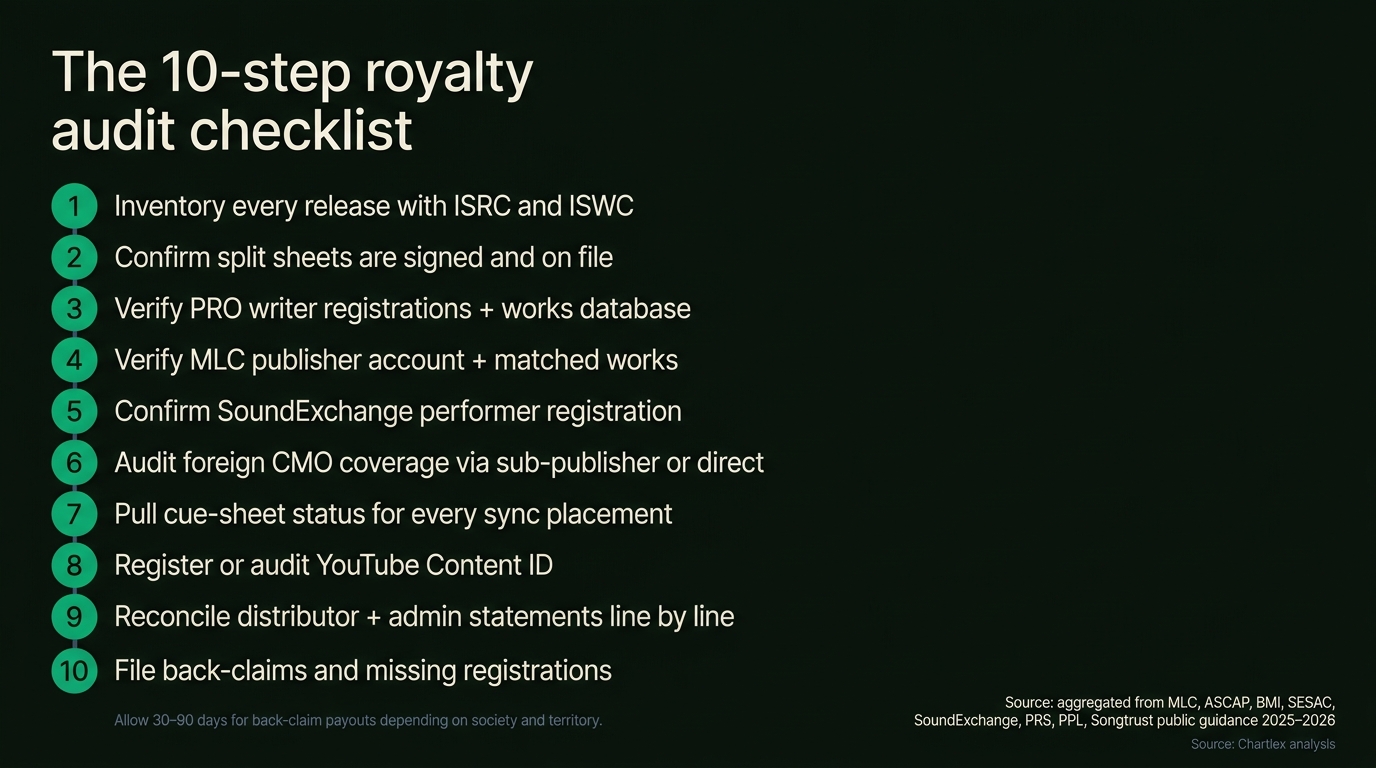
The checklist below is sequential. Each step depends on the previous. Skipping ahead causes rework.
1. Inventory every release with ISRC and ISWC
Build a spreadsheet listing every release you have ever put out: track title, release date, ISRC (recording identifier), ISWC (composition identifier), distributor, label (if any), co-writers, producers, and featured performers. The ISRC comes from your distributor. The ISWC comes from your PRO when you register the composition. Tracks without an ISWC are uncollectible at the MLC and most foreign CMOs.
2. Confirm split sheets are signed and on file
For every co-written track, you need a signed split sheet listing each writer's percentage and PRO affiliation. Without it, the PRO will hold the disputed share until it is resolved. This is the single most common reason indie songwriter royalties get held. For the templates and best practices, see split sheets: a guide for musicians.
3. Verify PRO writer registrations and works database
Log into ASCAP, BMI, or SESAC. Pull your works list. Cross-check it against your release inventory. For every track that is missing, register it. For every track that is listed, confirm the splits match your split sheets. Foreign-affiliated writers (PRS, GEMA, SACEM, etc.) do the same on their home PRO.
4. Verify MLC publisher account and matched works
Open a free MLC publisher account if you do not have one, or have your admin confirm that your catalog is registered. Use the MLC matching tool to confirm each work is matched (the recording ISRC linked to the work ISWC). Submit unmatched claims for any tracks earning streams without a match.
5. Confirm SoundExchange performer registration
Free, fast, often forgotten. Register as a featured performer with SoundExchange. They back-pay up to three years. If you have featured artists or session musicians on your records, point them at SoundExchange too; their share of the digital performance royalty is held until they register.
6. Audit foreign CMO coverage via sub-publisher or direct
If you have streaming or broadcast income outside your home country, you have foreign royalties. Decide whether to use a sub-publisher (admin deal at 10 to 25 percent) or self-register with major CMOs (PRS, GEMA, SACEM, JASRAC, APRA, SOCAN). Most independent artists are better served by an admin deal at this stage; the operational complexity of self-registration in 30+ territories is not worth the saved fees until catalog scale justifies it. For the deeper publishing context, see music publishing administration explained.
7. Pull cue-sheet status for every sync placement
For every sync placement you have ever cleared, contact the music supervisor or production company in writing and request confirmation of cue-sheet filing. Then confirm with your PRO that the cue sheet is in their system. If it is missing, your PRO can typically file a back-claim with proof of the placement (the signed sync agreement, the broadcast or release date, the placement timecode). Performance royalties are then back-credited to the relevant distribution period.
8. Register or audit YouTube Content ID
If your distributor offers Content ID, confirm your tracks are registered and active. Pull your YouTube earnings statement and look at the line items: direct YouTube Music plays vs Content ID UGC claims. If your Content ID line is zero or near zero on tracks that are clearly being used by creators (search YouTube for your track, count results), the registration is broken. Re-register through your distributor or move to a dedicated Content ID admin (Adrev, Identifyy, Audiam).
9. Reconcile distributor and admin statements line by line
Pull at least four quarters of distributor and admin statements. Compare reported streams against Spotify for Artists, Apple Music for Artists, and YouTube Studio. Small differences are normal (timing windows, currency conversion). Ten percent or more between platform-reported and distributor-reported streams is a flag worth a written inquiry.
10. File back-claims and missing registrations
Every gap from steps 1 through 9 becomes a written back-claim, missing-registration submission, or correction. Allow 30 to 90 days for payout. SoundExchange pays on the next quarterly cycle. PROs pay on the next distribution cycle (quarterly to semi-annually). The MLC pays unmatched claims on the next monthly distribution after match confirmation.
What Triggers an Audit
For most independent artists the audit cadence is annual. Mid-cycle triggers are specific.
Test the Waters
Want to see how one track performs with a steady, paced push instead of guessing? Test the Waters runs a single song for about four weeks, and every dollar counts toward a bigger campaign if you decide to scale up.
- ✓About 2,000 new monthly listeners on one track
- ✓Paced over roughly four weeks, not a single burst
- ✓100% credits toward a bigger campaign within 30 days
- ✓Timing matches your current audience size
Pick your track at checkout. Credit applies if you upgrade within 30 days.
A new sync placement closes. Audit cue-sheet filing within 30 days of broadcast, before the PRO distribution cycle closes. Late cue sheets generate back-claims, but back-claims pay slower than current-cycle filings.
A track unexpectedly takes off. Viral spikes generate registration mismatches that were tolerable at low volume and painful at high volume. Unmatched MLC claims that were $20 last year become $5,000 this year. Pull your statements within 60 days of any traffic spike.
A publishing administrator changes hands. Acquisitions, catalog sales, and restructures do not always migrate registration data cleanly. Confirm your works are still registered under the new entity and the foreign CMO chain is intact.
A co-writer changes PRO affiliation. If a co-writer moves from ASCAP to BMI or vice versa, every co-written track needs the registration updated at both PROs.
You start collecting from a new royalty source. First sync placement, first foreign streaming, first significant YouTube earnings: each opens a new audit lane.
Common Underpayment Patterns
| Pattern | Where it happens | How to detect |
|---|---|---|
| Mismatched ISRC and ISWC | MLC, foreign CMOs | Streams logged but unmatched in MLC matching tool; foreign reporting shows recording earnings but no composition earnings |
| Missing or incorrect splits | All PROs and admins | Disputed share held; co-writer is paid but you are not (or vice versa) |
| Unclaimed black-box | MLC, CISAC, foreign CMOs | Money distributed by market share to other publishers; your matched-claim percentage is below catalog scale |
| Foreign sub-publisher haircut | International collections | Foreign income reported at less than 50 to 70 percent of expected based on stream geography |
| Missing cue sheets | PROs (sync placements) | Sync fee paid, but no performance royalty appears in subsequent quarterly statements |
| Content ID gaps | YouTube | Track is widely used by creators but Content ID earnings are zero or near-zero |
| Wrong recording-to-work match | MLC | Streams logged against the correct ISRC but the wrong ISWC (cover misidentified, version conflated) |
| Stale registrations | Foreign CMOs | Pre-2020 registrations stuck against deprecated CMO databases; no auto-migration |
| Missing producer or featured-artist splits | SoundExchange, label statements | Featured artist royalty share goes to label or principal artist; producer points unpaid |
| Wrongly attributed master ownership | Distributors and labels | Recording royalties paid to a prior label after rights revert |
The mismatched ISRC-to-ISWC pattern is by far the most common single failure mode for indie artists. It is also the easiest to fix once you find it. Both identifiers are issued by separate processes (ISRCs by your distributor, ISWCs by your PRO), and the link between them is something you have to set explicitly inside the MLC matching tool and your foreign CMO portals.
Publishing Admin vs Full Publishing
A publishing administration deal collects on your behalf for a percentage (typically 10 to 25 percent), but you retain ownership of your compositions. A full publishing deal sells all or part of your copyright for a larger advance, with the publisher then collecting 50 percent or more of catalog income.
For the audit context: an admin deal substantially reduces the operational burden of steps 4, 6, 7, and the foreign side of step 10. It does not eliminate the audit. You still need to verify the admin's statements, confirm registrations are clean inside their portal, and chase the gaps they miss. Admins run large portfolios and individual registrations sometimes fall through.
For a deeper treatment, see music publishing administration explained. For a side-by-side of the three biggest platforms, see Songtrust vs Sentric vs Songtradr.
Recovery Percentages: What's Realistic
Public guidance from administrators and royalty exchanges gives a rough recovery floor. Songtrust has historically published case studies showing 12 to 25 percent more collected after a clean registration sweep. Royalty Exchange reports that indie catalogs going through pre-listing audits typically uncover registration gaps that materially affect valuation. The MLC has paid out hundreds of millions in back-claims since launch, with individual publisher recoveries documented in the tens of thousands on mid-tier catalogs.
A realistic working benchmark for a first-time audit on a working independent artist's catalog (5 to 50 releases, mix of self-released and label, some sync placements):
| Audit area | Typical first-time recovery |
|---|---|
| MLC unmatched claims (US mechanicals) | 5 to 15 percent of annual mechanical income |
| SoundExchange neighboring rights | 100 percent of category if previously unregistered (back-paid up to 3 years) |
| Foreign CMOs via sub-publisher | 10 to 25 percent of foreign-eligible income |
| PRO cue sheet back-claims | 5 to 20 percent of annual performance income for artists with sync placements |
| YouTube Content ID | 3 to 10 percent of YouTube earnings tail |
| Total typical first-year recovery | 5 to 25 percent of total annual royalty income, plus one-time back-claim windfalls |
The audit pays for itself almost universally. Even at the floor of the range, the recovered income exceeds the cost of a third-party auditor or admin platform fee on a multi-year horizon.
Indie Artist Audit Patterns
Three illustrative patterns from publicly disclosed independent artist audits:
Unregistered cue sheets. An indie artist with three Netflix-original placements saw zero performance royalty income from any of them. A retroactive cue-sheet audit found two filed under the wrong PRO affiliation and one never filed at all. Back-claim recovery: roughly a full year of expected performance royalties on the placements.
MLC unmatched claims. An indie songwriter with 30 streaming-only releases registered directly with the MLC. 22 of 30 works had unmatched claims sitting in the pool ranging from months to two years old. Back-claim payable on the next monthly distribution.
Foreign black-box. A producer with European DJ traction saw foreign income reported at roughly 30 percent of US income, despite half their listenership being European. A sub-publishing deal recovered the gap over four quarterly cycles.
For the deeper mechanics behind these patterns, see mechanical royalties explained and performance royalties: how to collect.
DIY vs Third-Party Auditor
For most independent artists, the audit is DIY. The 10-step checklist is a focused weekend for a small catalog, a few weeks of part-time work for a working discography. The tools (MLC publisher portal, PRO portals, SoundExchange, distributor analytics) are free or already paid for.
Three thresholds justify hiring a third-party auditor.
Catalog scale. Once you are managing 100+ releases, multiple co-writers per release, multiple sub-publishers, and multiple sync placements per year, operational overhead exceeds what a working artist can sustain. Specialist firms (Royalty Analytics, Massive Music Publishing, Music Royalty Audit Services) handle catalog-scale work on percentage-of-recovery terms, typically 25 to 50 percent of recovered income.
Disputed payor relationship. If a label, distributor, or sub-publisher is reporting numbers you believe are materially wrong and informal inquiry is not resolving, a contractual royalty audit (invoked under a clause in the original deal) is the next step.
Catalog sale or estate planning. Listing on Royalty Exchange, selling to a private buyer, or estate work all benefit from a clean audit. Buyers pay a premium for catalogs with clean registration and complete documentation.
Below those thresholds, DIY is the right answer.
What This Means for Music Industry Pros
| Stakeholder | What the 2026 audit picture means |
|---|---|
| Publishers | Unmatched-claim recovery is now a structural revenue line, not an exception. Annual MLC reconciliation should be a calendar event, not a reactive process. |
| Sub-publishers | Foreign CMO data quality is the differentiator between admins. Artists are getting more sophisticated about what to expect on the foreign side. |
| Music supervisors | Cue-sheet hygiene is part of professional sync delivery. Late or missing cue sheets get flagged in audits and damage the relationship with songwriters and PROs. |
| Distributors | Content ID coverage is now a competitive feature, not a value-add. Artists doing audits are noticing the gap. |
| Independent artists | The audit is annual hygiene, not an emergency response. Build it into your business calendar like a tax return. |
| Royalty admin | Match-rate transparency is the metric artists are starting to ask for. "What percentage of our works are matched in MLC and major foreign CMOs" is a reasonable question for every admin you pay. |
Free Spotify Audit
See exactly where your Spotify profile is leaking growth.
One audit finds an average of 4 growth blockers per artist profile.
Pro Growth Plan
$599/mo
Serious about building a music business? Consistent algorithmic momentum puts you on Spotify's radar.
Verified in Spotify for Artists · Geo-targeted · Cancel anytime
For the underlying business setup that makes audit hygiene possible (LLC vs sole proprietor, accounting separation, recordkeeping), see how to set up your music business as an independent artist.
Frequently Asked Questions
How often should an independent artist do a royalty audit?
Annually at minimum, with mid-cycle triggers when a new sync placement closes, a track unexpectedly takes off, your administrator changes, or you start collecting from a new royalty source. The annual audit takes a focused weekend for small catalogs. Mid-cycle audits are scoped to the specific trigger.
How much money do most artists recover in their first audit?
Industry guidance and admin-platform disclosures put typical first-time audit recoveries at 5 to 25 percent of annual royalty income, plus one-time back-claim windfalls (especially from SoundExchange registration if previously missing, and from MLC unmatched-pool back-claims). For a mid-tier indie catalog earning low five figures annually in royalties, the first-audit recovery is commonly a low four-figure sum.
What is the MLC and why does it matter for my audit?
The Mechanical Licensing Collective is the US blanket-licensing body that collects mechanical royalties from interactive streaming services and distributes them to publishers. It launched in 2021 under the Music Modernization Act. As of recent reporting, the MLC is sitting on roughly $500 million in unmatched mechanical royalties that get distributed by market share if not claimed. A free MLC publisher account is the single highest-leverage audit step for any songwriter who has not done one.
Do I need a publishing administrator to audit my royalties?
No, but they help with foreign collections and the operational burden. Self-published songwriters can register directly with the MLC, their PRO, SoundExchange, and major foreign CMOs. The DIY path is feasible for small to mid-size catalogs. Above 50 to 100 releases, an admin deal usually pays for itself through better matching and foreign collection coverage.
How long does a back-claim take to pay out?
Depends on the society. SoundExchange typically pays back-claims on the next quarterly distribution. PROs (ASCAP, BMI, SESAC, PRS, GEMA, SACEM) typically pay on the next quarterly or semi-annual distribution. The MLC pays unmatched claims on the next monthly distribution after match confirmation. Allow 30 to 90 days from filing to first payout, longer for complex multi-society claims.
Can I audit my distributor or sub-publisher contractually?
Most distribution and sub-publishing agreements include an audit clause that lets you (or your accountant) review the payor's books at your expense, with the right to recover audit costs if a material discrepancy is found. Check your specific contract. The threshold for invoking a contractual audit is usually a believed material discrepancy, not routine reconciliation. For most reconciliation work, a written inquiry resolves the question without invoking the audit clause.
What is a black-box royalty?
A black-box royalty is income that has been collected by a society but cannot be matched to a specific rights-holder within the society's matching window. After a defined holding period, the unmatched pool is distributed by market share to publishers who have registered claims. If your works are not registered, your share of unmatched income flows to other publishers. The fix is clean, complete registration with correct ISRCs, ISWCs, and splits across every relevant society.
Is YouTube Content ID worth registering for indie artists?
For most artists with any meaningful streaming traction, yes. Content ID captures the user-generated-content tail (creators using your music in videos), which is otherwise unmonetized. Registration is typically handled through your distributor as an upsell or higher-tier feature. Dedicated Content ID admins (Adrev, Identifyy, Audiam) are appropriate when distributor coverage is incomplete or earnings warrant a more aggressive collection strategy.
When should I hire a third-party royalty auditor?
When your catalog exceeds about 100 releases, when a payor is reporting numbers you believe are materially wrong and informal inquiry is not resolving the issue, or when you are preparing a catalog for sale or estate planning. Below those thresholds, the DIY audit using the 10-step checklist is the right answer.
How does Chartlex fit into a royalty audit?
Chartlex is a streaming-side growth and audit platform; it does not directly handle royalty collection. The relevance is upstream: clean release metadata, real ISRC documentation, and accurate streaming traction make every downstream royalty audit step easier. Artists who run Chartlex campaigns get clear stream-volume data per track, which is the input for reconciling against MLC, PRO, and distributor statements during the audit.
Where to Go From Here
The audit is the operational backbone of an independent music business. The map above gets you started; the next moves are about building the habit and the supporting infrastructure.
- Music royalties explained: every type is the conceptual foundation of every collection society and royalty stream.
- Mechanical royalties explained for musicians covers the MLC and the mechanical side in depth.
- Performance royalties: how to collect covers PROs and the performance side.
- How to register with a PRO: ASCAP, BMI, SESAC is the registration playbook.
- Music publishing administration explained covers the admin layer that handles foreign collection and registration.
- Songtrust vs Sentric vs Songtradr is the platform comparison if you are evaluating an admin deal.
- Split sheets: a guide for musicians is the documentation foundation that holds the entire royalty chain together.
If you want a clear read on whether your streaming traction is being captured cleanly across the audit chain (and where to grow listeners on the streaming side while you button up the back end), get your free Chartlex audit and we will map the next moves.
Free Weekly Playbook
One actionable insight, every Tuesday.
Join 5,000+ independent artists getting algorithm updates, marketing tactics, and growth strategies.
No spam. Unsubscribe anytime.
Get a business health check for your music career.
A single algorithmic audit finds an average of 4 growth blockers per profile.
Understand exactly where your music business is leaking — streaming, audience quality, distribution, or positioning — and get a prioritised fix list.
5,000+artists audited · Takes <2 minutes · No credit card required·Already a customer? Open Dashboard →
Campaign Dashboard
Turn Knowledge Into Action
Track your streams, monitor algorithmic triggers, and see growth projections in real time. The Campaign Dashboard puts everything you just read into practice.
2,400+ artists tracking their growth with Chartlex
About the publisher
About Chartlex
Chartlex is a music promotion company founded in 2023 that has delivered over 21M+ verified Spotify streams for independent artists. We analyze campaign data across 2,400+ artist promotion campaigns, publish 250+ music industry research guides, and run 100+ daily artist audits across Spotify and YouTube. Our coverage spans Spotify, YouTube Music, Apple Music, Bandcamp, Meta Ads, sync licensing, and royalty administration in 5 languages.
- Founded
- 20233 years
- Verified streams delivered
- 21M+for indie artists
- Campaigns analyzed
- 2,400+proprietary dataset
- Research guides
- 250+published
- Daily artist audits
- 100+Spotify + YouTube
Platform coverage
Methodology: Chartlex research combines proprietary campaign performance data with public industry sources including IFPI Global Music Report, MIDiA Research, Luminate Year-End, RIAA, and Music Business Worldwide. All findings are refreshed quarterly. Last verified: 2026-09-16.
Keep reading
Learn how to claim mlc unclaimed royalties from the $424M black box pool. Step-by-step 2026 walkthrough for self-published songwriters and indie artists.
Daniel Brooks
Where AI voice cloning in music is legal in 2026: US, EU, UK, Germany, Japan and beyond, with a jurisdiction table and takedown routes for artists.
Daniel Brooks
Deezer says over 50% of daily uploads are now AI-generated, but AI is only 1 to 3% of streams. The verified 2026 numbers, with sources and dates.
Daniel Brooks