
Vinyl Pressing Cost in 2026: Real Prices + Break-Even Math
Vinyl pressing cost in 2026: verified plant pricing at 100 to 1,000 units, setup fees, lead times, and break-even math at typical $25 to $35 indie pricing.
Reviewed by the Chartlex editorial team·Editorial policy
Explore with AI
Get an instant summary of this guide from your favourite assistant.
Quick Answer
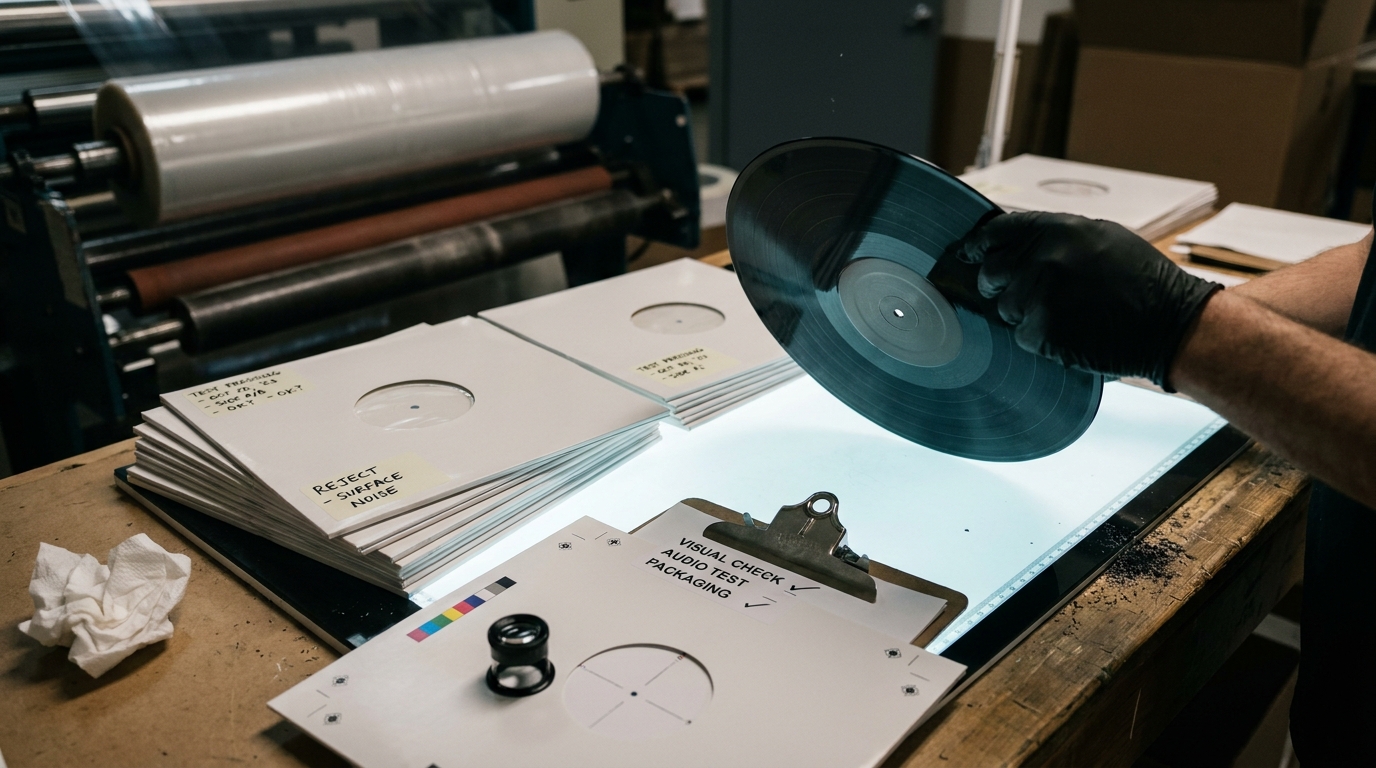
Vinyl pressing cost in 2026 runs between $5.50 and $15 per unit for standard black records, with run size driving most of the spread. Verified August 2026 pricing from Precision Record Pressing puts a complete 100-unit package (cutting, plating, test pressings, and printed jackets included) at $1,509, or $15.09 per record, while 500 units drop to $2,782, or $5.56 per record. A 1,000-unit run typically lands between $3,000 and $4,500 all-in. Color variants add roughly $0.50 to $1.50 per disc, and gatefold jackets add $1.50 to $3.00 per unit. Lead times range from about 10 weeks at US plants to 3 to 7 months at the largest European facilities. At a typical $30 indie price point sold direct, a 500-unit pressing breaks even around 115 copies. According to Chartlex campaign data from 2,400+ campaigns, artists who run streaming promotion in the 30 days before a vinyl pre-order sell through their first pressing roughly 2.5x faster.
Why Pressing Costs Work the Way They Do
Every vinyl quote is really two bills stacked on top of each other: a fixed setup bill that stays the same whether you press 100 records or 10,000, and a per-unit bill that scales with quantity. Understanding that split explains almost every number in this guide.
The fixed side covers cutting your audio to a lacquer (or a DMM copper plate), electroplating that master into metal stampers, and running a short batch of test pressings for your approval. Third Man Pressing in Detroit publishes these fees openly: two-step plating costs $152.50 per side, three-step plating (used for larger runs) costs $230.00 per side, and a set of 5 test pressings costs $130.00. Cutting at European plants typically adds a one-time 300 to 800 EUR on top of pre-mastering.
The per-unit side is the actual pressing plus packaging. Third Man's published rate is $1.85 per unit for 140g black vinyl and $2.50 for color, before jackets, sleeves, and assembly fees of $0.10 to $0.20 per operation. Spread the fixed costs over 100 units and they dominate your per-record price. Spread them over 1,000 and they almost disappear.
This is the market context piece: demand is real. US vinyl revenue crossed $1.4 billion in 2024 per the RIAA, and the format has grown for 18 consecutive years. Our vinyl sales 2026 industry report covers the full market data, from Luminate unit counts to pressing capacity. This guide covers the other half: what it costs you to participate.
Vinyl Pressing Cost by Run Size
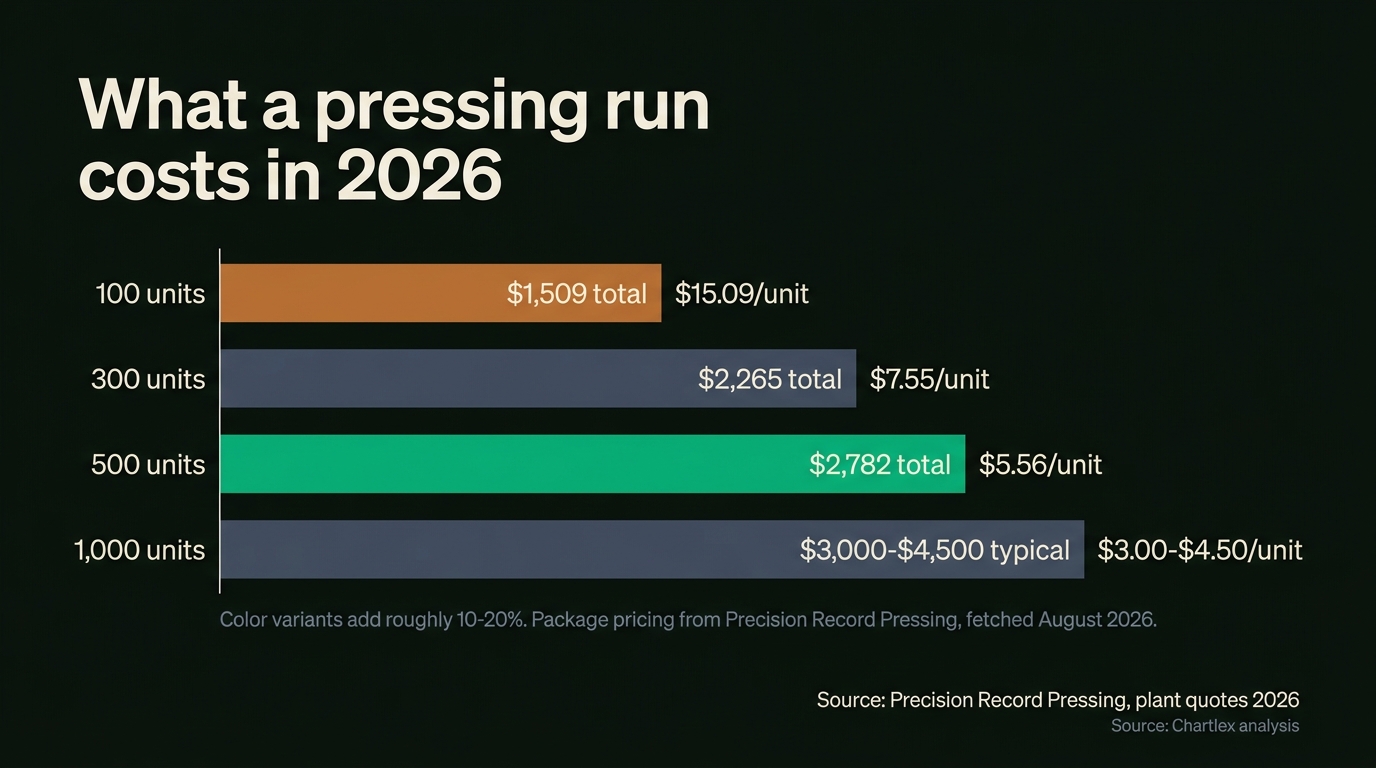
The table below combines verified package pricing from Precision Record Pressing (published August 2026, includes cutting, plating, 5 test pressings, and printed jackets) with typical 2026 market ranges for 1,000-unit projects reported across pressing cost guides.
| Run size | Standard black (total) | Per unit | Translucent color (total) | Per unit |
|---|---|---|---|---|
| 100 units | $1,509 | $15.09 | $1,566 | $15.66 |
| 200 units | $1,928 | $9.64 | $2,022 | $10.11 |
| 300 units | $2,265 | $7.55 | $2,396 | $7.99 |
| 500 units | $2,782 | $5.56 | $3,067 | $6.13 |
| 1,000 units | $3,000-$4,500 (typical range) | $3.00-$4.50 | $3,500-$5,500 (typical range) | $3.50-$5.50 |
Three things to notice. First, the jump from 100 to 200 units costs only about $420 more in total, because you are mostly paying setup either way. Second, per-unit cost falls off a cliff between 100 and 500 units, then flattens. Third, color is cheap at scale: the translucent surcharge at 500 units is about $0.57 per record.
Two-color splits and more complex variants cost more. Precision quotes a 500-unit two-color split at $3,507, or $7.01 per unit, roughly $1.45 above standard black. Specialty effects like splatter, marble, and picture discs push higher still and vary by plant.
European pricing tells a similar story. For a 300-unit 12-inch run including cover and inner sleeve, 2026 production prices at large European plants commonly fall between 4.50 and 6.50 EUR per unit, plus the one-time cutting fee.
The Three Lanes: Direct Plants, Brokers, and On-Demand
Where you press matters as much as how many you press. There are three distinct lanes in 2026, each with a different cost, control, and risk profile.
| Lane | Examples | Minimum | Cost profile | Best for |
|---|---|---|---|---|
| Direct plant | GZ Media, United Record Pressing, Third Man Pressing, Precision | 100-300 units | Lowest per-unit at volume; you manage the project | Artists pressing 300+ with a clear sales plan |
| Broker / one-stop | Regional brokers, distributor vinyl services | 100-250 units | 10-20% markup over plant cost; they manage plating, printing, logistics | First pressings where you want one invoice and one contact |
| On-demand / crowdfunded | Qrates | 100 units | No upfront cost on funded projects; platform takes a 15% cut of sales | Testing demand with zero inventory risk |
Direct plants give you the best unit economics but expect you to deliver print-ready art, approve test pressings, and coordinate freight. GZ Media in the Czech Republic is the world's largest plant, with output estimates up to 50 million records per year, and serves both budget and audiophile tiers. United Record Pressing in Nashville is America's oldest and largest plant, with lead times reported around 10 weeks in 2026. Third Man publishes transparent per-unit pricing with a 200-unit minimum.
Brokers bundle everything into one project fee. You pay a margin for it, but for a first pressing the coordination they absorb (plating schedules, print proofs, customs on EU pressings) is often worth the markup.
On-demand platforms invert the model. Qrates lets you launch a crowdfunding-style pre-order with a 100-unit minimum: fans order first, records get pressed only if the project funds, and Qrates ships direct to buyers. There are no upfront pressing costs on funded projects; the platform takes 15% of revenue instead. The per-record economics are worse than pressing direct, but your downside is zero unsold boxes in your closet.
Lead Times in 2026: Plan Backwards From Release Day
The 2021-2022 capacity crisis, when indie titles waited up to 18 months behind major-label reissues, has eased. But vinyl still is not fast, and lead time is the most common first-pressing mistake.
Current reported ranges for independent runs in 2026: roughly 10 weeks at United Record Pressing, 8 to 16 weeks at most mid-size North American plants once test pressings are approved on the first pass, and 3 to 7 months at the largest European plants where indie runs queue behind label volume. Every art revision and every rejected test pressing adds weeks.
The practical rule: lock your vinyl timeline at least 4 to 6 months before street date, and treat the pressing schedule as the anchor for everything else. Our interactive release checklist maps the full T-minus-28 timeline for the digital side; for a vinyl release, bolt a 3 to 5 month manufacturing runway onto the front of it. Running the digital release first and shipping vinyl as a follow-up wave is a legitimate strategy, and it de-risks the schedule completely.
First Push
Never put money behind a track before? First Push is the smallest way to find out how one song responds over about four weeks, and it counts toward anything bigger later.
- ✓About 600 new monthly listeners on one track
- ✓Paced over roughly four weeks, not a single burst
- ✓100% credits toward a bigger campaign within 30 days
- ✓The lowest cost way to try one track
Pick your track here. Credit applies if you upgrade within 30 days.
Packaging Tiers and the Variant Strategy
Packaging is where a $5.56 record becomes a $9 record, and also where a $30 record becomes a $45 record at retail. The margins on upgrades usually work in your favor.
| Packaging element | Typical 2026 cost | What it does for you |
|---|---|---|
| Standard jacket (included in most packages) | $0 incremental | Baseline; 18pt board under 500 units, 20pt at 500+ |
| Printed inner sleeve | $0.40-$0.80 per unit | Lyrics, credits, artwork real estate |
| Gatefold jacket | $1.50-$3.00 per unit | Supports $5-$10 higher retail price |
| Color / translucent vinyl | $0.50-$1.50 per unit | Collector appeal, variant exclusivity |
| Two-color split or splatter | $1.45-$3.00 per unit | Limited-variant pricing power |
| Insert, poster, or download card | $0.20-$0.60 per unit | Bridges physical buyers to your mailing list |
| Shrinkwrap and assembly | $0.20-$0.50 per unit | Retail-ready finish |
The variant playbook that works for independent artists in 2026: press the majority of the run on standard black at the lowest unit cost, then a limited color variant of 100 to 200 copies at a $5 to $10 premium, sold direct only. Collectors pay the premium, the scarcity is real, and your blended margin improves without inflating the whole run's cost. Vinyl buyers at shows are your superfans; our tour merch strategy breakdown puts vinyl margins at 50-70% on 100-300 unit pressings sold at $25-$40, right behind t-shirts as a top seller.
The Break-Even Math at $25 to $35 Pricing
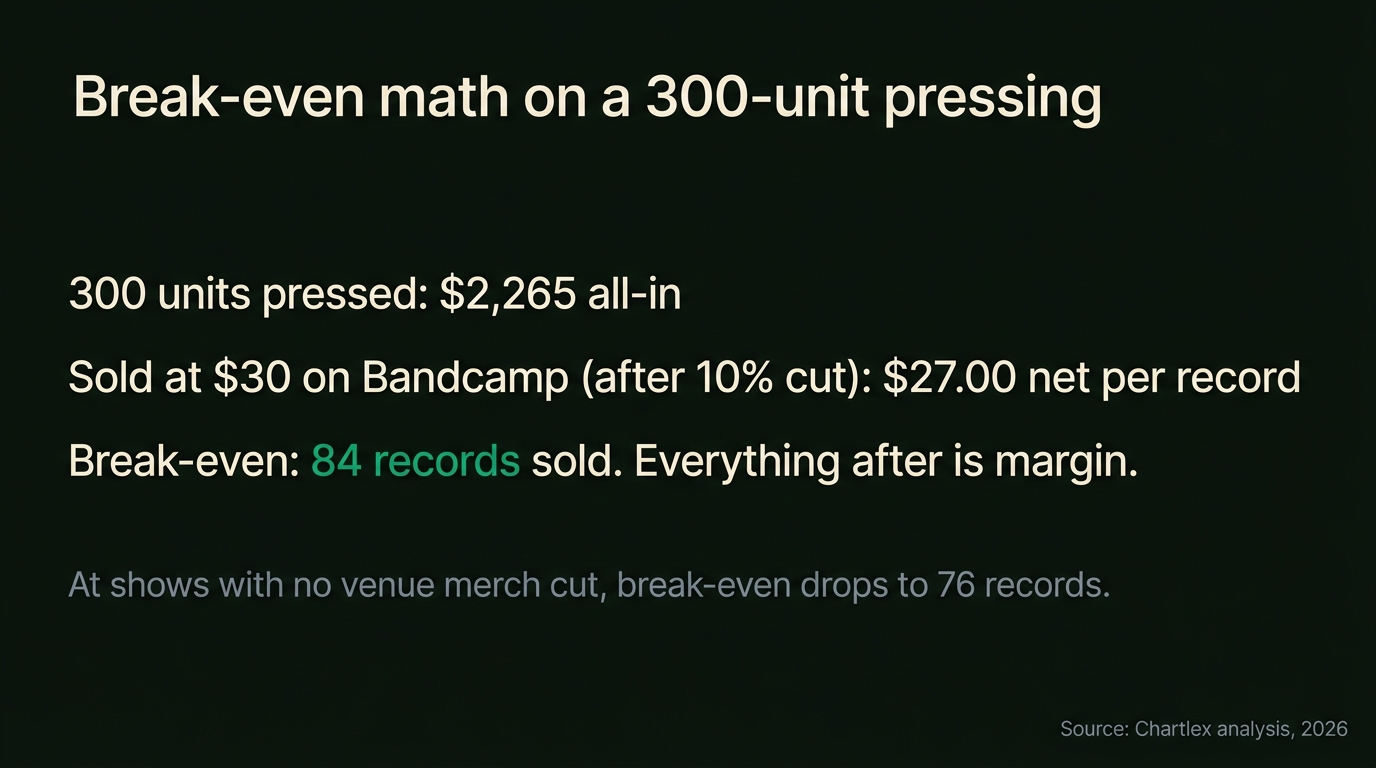
Here is the honest math on a 500-unit standard black pressing costing $2,782, plus roughly $300 in freight to you, for an all-in cost of about $3,100 ($6.20 per unit landed). Assume a $30 sale price, the middle of the typical indie range.
| Sales channel | What you net per $30 record | Units to break even ($3,100) | Share of the 500 run |
|---|---|---|---|
| Bandcamp direct (10% platform cut, buyer pays shipping) | ~$27.00 | 115 | 23% |
| Merch table at shows (0-25% venue cut) | $22.50-$30.00 | 104-138 | 21-28% |
| Distribution / record stores (wholesale at 50-60% of list) | $15.00-$18.00 | 173-207 | 35-42% |
Selling direct, you break even before you have moved a quarter of the run. Selling wholesale, you need to move over a third. That is why almost every profitable indie pressing leans on direct channels first: Bandcamp takes 10% on merchandise, and our guide to selling music on Bandcamp covers how pre-orders and Bandcamp Fridays stack on top of that.
Shipping economics matter more than most artists expect. A packed LP with mailer and stiffeners weighs 12 to 16 oz, USPS Media Mail runs roughly $4 to $5 for a single record domestically in 2026, and purpose-built LP mailers cost $0.50 to $1.00 each in bulk. Charge $6 to $8 shipping domestically and you are covered. International is the trap: $25 to $75 per record depending on region, so either price it fully or route international fans to a platform that ships for you.
If you sell all 500 direct at $30, you gross $15,000 against roughly $3,100 in costs plus shipping supplies. That is a realistic $10,000+ net on a single pressing, which is why vinyl remains the highest-margin physical product an independent artist can sell. Plug your own numbers into the multi-stream revenue calculator to see how a pressing stacks against your streaming and merch income.
When a 100-Unit Run Actually Makes Sense
The per-unit price at 100 units looks terrible ($15.09 against $5.56 at 500), so the reflex is to call small runs a ripoff. That is the wrong frame. A 100-unit run is not a manufacturing decision, it is a risk decision.
At $30 direct, a $1,509 pressing breaks even at 56 copies sold. If you can name 56 people who would buy your record, the run is safe, and a sellout nets around $1,200 plus the intangibles: records at the merch table, press copies, and proof of demand for a bigger second pressing. A 500-unit run that sells 150 copies leaves $2,000 of your money sitting in boxes.
The decision rule from the data we see: press 100 (or use Qrates) when your engaged audience is unproven, and step up to 300-500 only when a pre-order or previous sellout has proven demand. According to Chartlex campaign data from 2,400+ campaigns, the artists who get this right run the demand test first, using pre-orders and streaming signals, then size the pressing to the evidence rather than the ambition.
Pre-order funding closes the loop. The Qrates model (fans fund the pressing before it happens) works precisely because it converts the sizing question into a measurement. Run a 4 to 6 week pre-order campaign, and let the order count pick your run size. Timing streaming promotion into that pre-order window compounds it: a one-time Core Algorithm Push concentrated in the weeks before the pre-order puts the release in front of exactly the listeners a vinyl campaign needs to convert.
First Pressing Checklist
Use this sequence for a first vinyl project. Skipping steps is how artists end up with 400 unsold records and a warped test pressing story.
- Confirm your master works for vinyl. Vinyl needs different mastering than streaming: side lengths under about 22 minutes per side at 33rpm for full loudness, controlled low-end stereo width, and de-essed highs. Budget $150-$400 for a dedicated vinyl master if your engineer has not cut for lacquer before.
- Run the demand test. Pre-order, waitlist, or Qrates campaign before you commit a run size.
- Quote at least three suppliers across two lanes. One direct plant, one broker or on-demand platform, minimum. Quotes are free and the spread will surprise you.
- Size the run to evidence. 100 units unproven, 300-500 proven, 1,000 only with distribution or a strong pre-order.
- Order the limited variant. 100-200 color copies at a premium, direct-only.
- Approve test pressings on real equipment. Listen on a proper turntable, not a suitcase player. Check both sides, start to finish, for surface noise and skips.
- Buy mailers before the records arrive. LP mailers, stiffeners, and a shipping price you have already tested against real postage.
- Plan the launch window. Pre-order live 6-8 weeks before ship date, streaming push in the 30 days prior, and merch-table stock reserved for shows. Our merch setup guide covers the table logistics and pricing psychology.
Free Spotify Audit
See exactly where your Spotify profile is leaking growth.
Independent artists miss an average of $800/yr in unclaimed royalties.
Starter Plan
$149/mo
Turn your music into consistent revenue with 200 campaign streams hitting your profile daily.
Verified in Spotify for Artists · Geo-targeted · Cancel anytime
Frequently Asked Questions
How much does it cost to press 100 vinyl records in 2026?
A complete 100-unit package with cutting, plating, test pressings, and printed jackets costs about $1,509 for standard black vinyl at verified 2026 plant pricing, roughly $15.09 per record. Color adds about $0.57 per unit at this quantity. On-demand platforms like Qrates can eliminate the upfront cost entirely on funded projects.
How much does it cost to press 500 vinyl records?
Around $2,782 for a complete standard black package at verified 2026 pricing, or $5.56 per unit, plus freight to your door. Translucent color runs $3,067 and a two-color split $3,507. At a $30 direct sale price, that pressing breaks even at roughly 115 copies sold.
How long does vinyl pressing take in 2026?
Roughly 10 weeks at large US plants like United Record Pressing, 8 to 16 weeks at most mid-size plants, and 3 to 7 months at the biggest European facilities where independent runs queue behind major-label volume. Add time for every art revision or rejected test pressing. Lock your timeline 4 to 6 months before street date.
Is pressing vinyl profitable for independent artists?
Yes, when sold direct. A 500-unit run costing about $3,100 landed grosses $15,000 at $30 per record, netting $10,000+ if it sells through on Bandcamp and at shows. Wholesale distribution cuts net revenue to $15-$18 per record, which is why direct-to-fan channels should always come first.
What is the cheapest way to press vinyl?
Per unit, a 500 to 1,000 unit run of standard black vinyl at a direct plant, at roughly $3.00 to $5.56 each. Total outlay, a Qrates crowdfunding project: fans pre-order, the pressing only happens if it funds, and you pay no upfront manufacturing cost in exchange for a 15% revenue share.
Should I press black or color vinyl?
Press the bulk of the run black at the lowest unit cost, then add a limited color variant of 100-200 copies priced $5-$10 higher, sold direct only. Color adds just $0.50-$1.50 per disc at scale but supports meaningfully higher pricing, so a split run usually beats an all-black or all-color pressing on blended margin.
The Bottom Line on Pressing Vinyl in 2026
Vinyl pressing cost in 2026 rewards artists who treat the pressing as a business decision: fixed setup costs mean per-unit price collapses between 100 and 500 units, direct sales channels break even at under a quarter of the run, and demand testing before sizing removes almost all of the downside. The format's 18-year growth streak means the buyers exist; the math above tells you exactly how many of them you need.
The pressing plants are ready and the lead times are the shortest they have been since the boom began, so the constraint now is demand for your record, not capacity for it. Before you wire a deposit to a plant, get a read on whether your audience is ready to convert: a free Chartlex audit shows where your listeners are, how engaged they actually are, and whether a pre-order window backed by streaming promotion will fill your first pressing or your first two.
Free Weekly Playbook
One actionable insight, every Tuesday.
Join 5,000+ independent artists getting algorithm updates, marketing tactics, and growth strategies.
No spam. Unsubscribe anytime.
How much streaming revenue are you leaving on the table?
Independent artists miss an average of $800/yr in unclaimed royalties.
The free audit shows your current royalty footprint, missing registrations, and which platforms are underperforming relative to your catalogue size.
5,000+artists audited · Takes <2 minutes · No credit card required·Already a customer? Open Dashboard →
Campaign Dashboard
Turn Knowledge Into Action
Track your streams, monitor algorithmic triggers, and see growth projections in real time. The Campaign Dashboard puts everything you just read into practice.
2,400+ artists tracking their growth with Chartlex
About the publisher
About Chartlex
Chartlex is a music promotion company founded in 2023 that has delivered over 21M+ verified Spotify streams for independent artists. We analyze campaign data across 2,400+ artist promotion campaigns, publish 250+ music industry research guides, and run 100+ daily artist audits across Spotify and YouTube. Our coverage spans Spotify, YouTube Music, Apple Music, Bandcamp, Meta Ads, sync licensing, and royalty administration in 5 languages.
- Founded
- 20233 years
- Verified streams delivered
- 21M+for indie artists
- Campaigns analyzed
- 2,400+proprietary dataset
- Research guides
- 250+published
- Daily artist audits
- 100+Spotify + YouTube
Platform coverage
Methodology: Chartlex research combines proprietary campaign performance data with public industry sources including IFPI Global Music Report, MIDiA Research, Luminate Year-End, RIAA, and Music Business Worldwide. All findings are refreshed quarterly. Last verified: 2026-09-23.
Keep reading
SoundExchange explained: what the $13B royalty collector pays for, the 45/50/5 split, free registration steps, and the 3-year window to claim back pay.
Daniel Brooks
Every streaming price increase through 2026 tracked: Spotify $12.99, YouTube Music $11.99, Tidal, Amazon. And the honest math on whether artists earn more.
Daniel Brooks
Compare Kickstarter, GoFundMe, Indiegogo, Patreon, and direct fan funding for musicians in 2026. Real cost breakdowns, fees, and success rate data.
Daniel Brooks