
Streaming Royalty Rates Comparison 2026: Every Platform
Streaming royalty rates comparison 2026: verified per-stream and per-1,000-stream payouts for Spotify, Apple Music, Tidal, Amazon, YouTube, Deezer.
Reviewed by the Chartlex editorial team·Editorial policy
Explore with AI
Get an instant summary of this guide from your favourite assistant.

Quick Answer
In 2026, streaming platforms pay independent artists between $0.0007 and $0.015 per stream, and the gap between the highest and lowest payer is more than 15x. Tidal pays the most at roughly $0.012-$0.015 per stream ($12-$15 per 1,000), followed by Apple Music at $0.006-$0.010 ($6-$10) and Deezer at about $0.0064. Spotify, despite being the largest platform, sits near the bottom at $0.003-$0.005 per stream ($3-$5 per 1,000), with Amazon Music around $0.004 and YouTube Music's blended rate landing at $0.002-$0.008. The reason higher-rate services pay more is structural: Tidal and Apple have no free tier, so every stream comes from a paying subscriber. According to Chartlex campaign data from 2,400+ campaigns, listener country and free-versus-premium mix swing real payouts more than the platform itself. A US premium stream can pay 5-8x a free-tier stream from a low-priced market on the same service, which makes geography a bigger lever than the logo on the app.
The 2026 streaming payout table, ranked
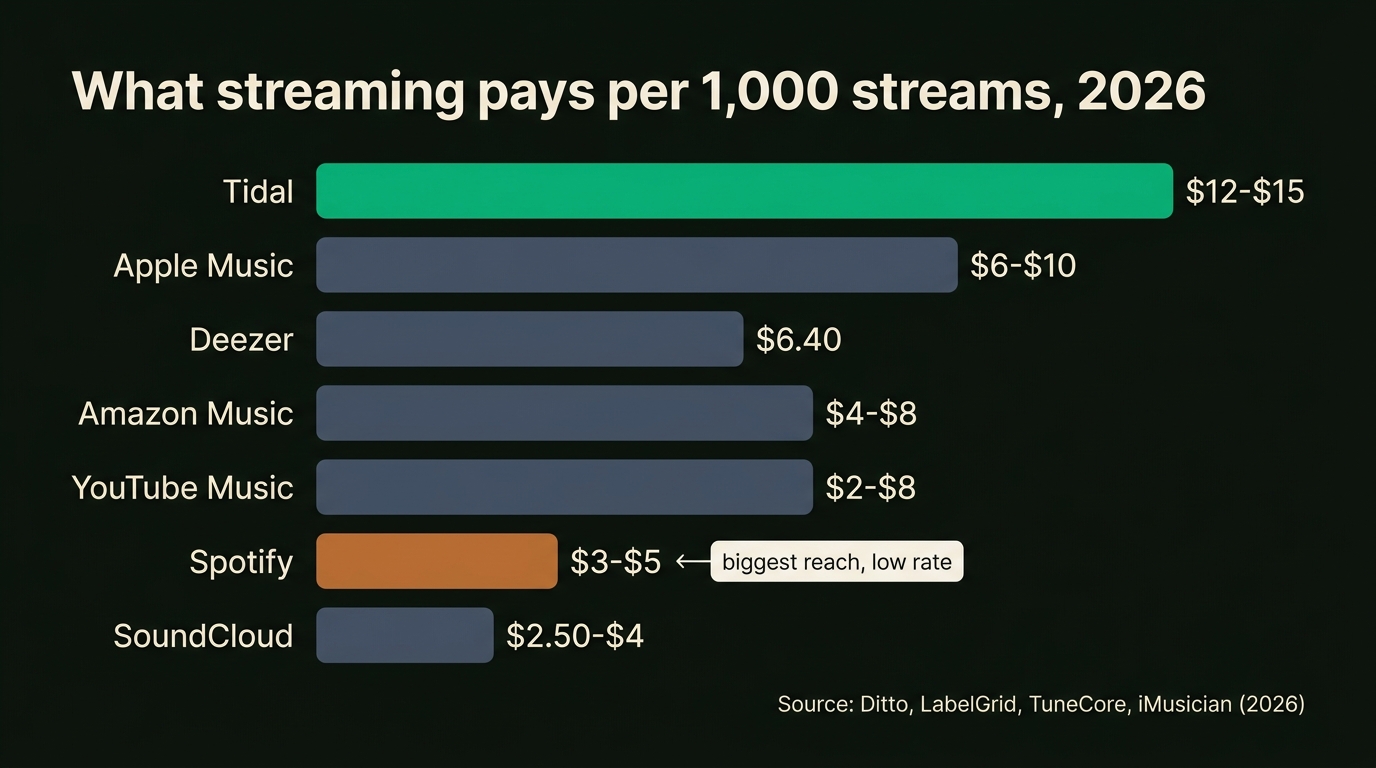
Per-stream rates are blended averages. Every platform pays a share of subscription and ad revenue, not a fixed price — so the number you actually receive moves with your listeners' countries, their subscription tier, and your distribution cut. Treat these as planning benchmarks, not contractual rates.
| Platform | Per stream (2026) | Per 1,000 streams | Per 1M streams | Confidence |
|---|---|---|---|---|
| Tidal | $0.012-$0.015 | $12-$15 | $12,000-$15,000 | Medium |
| Apple Music | $0.006-$0.010 | $6-$10 | $6,000-$10,000 | High |
| Deezer | ~$0.0064 | ~$6.40 | ~$6,400 | Medium |
| Amazon Music | ~$0.004-$0.008 | $4-$8 | $4,000-$8,000 | Medium |
| YouTube Music | $0.002-$0.008 (blended) | $2-$8 | $2,000-$8,000 | Low |
| Spotify | $0.003-$0.005 | $3-$5 | $3,000-$5,000 | High |
| SoundCloud (fan-powered) | $0.0025-$0.004 | $2.50-$4 | $2,500-$4,000 | Low |
Sources: Ditto Music, LabelGrid, Streaming Calculator, Dynamoi, TuneCore, iMusician (2026 figures, cross-checked June 2026). Spotify's $0.003-$0.005 band reflects its own 2025 payout pool: roughly $11 billion paid across about 2.7 trillion streams, a baseline near $0.0033 before country and tier weighting (Spotify Loud and Clear 2026).
Want to model your own catalog instead of an industry average? The Spotify royalty calculator lets you plug in stream counts and distributor splits to see net earnings.
How these numbers are calculated
No streaming service publishes a fixed price per play, so every figure in this guide is a blended average reconstructed from public payout pools, distributor reporting, and verified third-party datasets. Understanding the method matters, because it tells you why your own statement might not match the headline number.
The base calculation is simple: take a platform's total money paid to rightsholders in a period, divide by total streams in that period. Spotify's 2025 pool of roughly $11 billion across about 2.7 trillion streams produces a raw baseline near $0.0033 per stream. That raw average then gets pulled up or down for any individual artist by listener country, subscription tier, and the royalty model in play.
The ranges in our table come from cross-referencing Ditto Music, LabelGrid, TuneCore, iMusician, and independent calculator datasets, then sanity-checking each against artist-reported statements. Where sources disagree by more than a rounding margin — YouTube Music is the worst offender — we widen the band and lower the confidence rating rather than pick a single misleading number. This is the same discipline a royalty audit uses to verify what you are actually owed.
Pro-rata vs user-centric: the model that decides your cut
The single most important thing most artists never learn is how a platform splits its money. Two models dominate in 2026, and they reward different kinds of artists.
Pro-rata (the default). Every subscriber's fee goes into one giant pool. The pool is then split by total stream share across the whole platform. Spotify, Apple Music, and Amazon Music all use this. The practical effect: a fan who plays only your music still has most of their subscription fee flowing toward the platform's biggest stars, because the split is global, not personal.
User-centric / artist-centric / fan-powered. Each subscriber's fee is divided only among the artists that subscriber actually streams. Deezer runs this in several markets; SoundCloud's fan-powered royalties work on the same principle; Tidal has piloted variations. For an artist with a small, loyal, high-engagement audience, this model can pay meaningfully more per stream than pro-rata, because superfan money stays with the artist instead of being diluted into a global pool.
For an independent artist with 2,000 dedicated listeners, a user-centric platform can be worth chasing. For an artist relying on a few viral playlist placements from casual listeners, pro-rata scale on Spotify usually wins. There is no universally "fairest" model — it depends on how concentrated your fanbase is.
Why the same stream pays different amounts
A "per-stream rate" is a result, not a setting. Each service divides its monthly subscription and advertising revenue among rightsholders, then your distributor takes its cut. Four variables decide where you land in the band above.
1. Subscriber base economics. Tidal and Apple Music have no free tier — every listener pays. That single fact is why both sit at the top of the table. Spotify carries hundreds of millions of ad-supported users whose streams pay a fraction of premium ones, which drags its blended average down even though it pays the most money in total.
2. Listener country. A stream from a US, Norwegian, or Swiss premium subscriber can pay 5-8x what a free-tier stream from India, Brazil, or Nigeria pays on the same platform. Geography often matters more than which logo is on the app.
3. Free vs premium mix. Premium streams pay roughly 2.5-3x more than ad-supported streams. An artist whose audience skews toward paying subscribers earns far above the headline rate.
4. Payment model. Most platforms use a pro-rata pool (all subscription money pooled, split by total stream share). Deezer and SoundCloud use artist-centric or fan-powered models that route a listener's fee toward the artists that listener actually plays.
Total payouts by listener geography
Two artists with identical stream counts can earn double or half of each other purely on where their listeners live. The table below shows approximate Spotify per-stream rates by country — the same directional pattern holds across every platform.
| Country | Approx. per-stream rate | Tier |
|---|---|---|
| Norway | $0.0068 | Highest |
| Switzerland | $0.0060+ | Highest |
| USA | $0.0039-$0.0046 | High |
| UK | $0.0044 | High |
| Germany | $0.0042 | High |
| France | $0.0034 | Mid |
| Japan | $0.0033 | Mid |
| Brazil | $0.0018-$0.0020 | Lower |
| India | $0.0008-$0.0020 | Lower |
| Nigeria | $0.0004-$0.0010 | Lowest |
Source: TuneCore, Ditto Music, iMusician, SoundCamps (2025-2026). Full breakdown in the Spotify royalty rates by country guide.
This is why where your streams come from is a financial decision, not just an audience one. According to Chartlex campaign data from 2,400+ campaigns, shifting a campaign's geographic weighting toward higher-paying markets measurably raises effective revenue per stream without changing the total play count. Curious where your current listeners sit? A free AI audit from Chartlex breaks your audience down by source and market.
Platform-by-platform breakdown
First Push
Never put money behind a track before? First Push is the smallest way to find out how one song responds over about four weeks, and it counts toward anything bigger later.
- ✓About 600 new monthly listeners on one track
- ✓Paced over roughly four weeks, not a single burst
- ✓100% credits toward a bigger campaign within 30 days
- ✓The lowest cost way to try one track
Pick your track here. Credit applies if you upgrade within 30 days.
Tidal — the highest per-stream rate
Tidal pays roughly $0.012-$0.015 per stream in 2026, the highest of any major service. The reasons are structural: an all-premium subscriber base, higher subscription prices ($10.99-$19.99/month), and a fan-centered royalty model. The catch is reach. Tidal's audience is a fraction of Spotify's, so a great per-stream rate on a small audience often totals less than a mediocre rate on a large one. We break the math down further in our Tidal vs Spotify comparison.
Apple Music — high rate, no free tier
Apple Music averages $0.006-$0.010 per stream, consistently one of the highest in the industry, because it has no ad-supported tier. Apple has also published a roughly $0.01 average-per-play figure historically. For artists with Atmos masters, Apple's Spatial Audio program adds a further payout bonus on top. See the full Apple Music vs Spotify payout comparison for the detail.
Deezer — artist-centric model
Deezer pays approximately $0.0064 per stream and runs an artist-centric (user-centric) payment model in several markets, routing each subscriber's fee toward the artists they personally play rather than a global pool. For artists with a small but loyal audience, this can push the effective rate above Spotify's. Deezer has also moved aggressively against AI-generated upload spam, which affects how the pool is divided (Deezer AI flood analysis).
Amazon Music — the middle of the pack
Amazon Music lands around $0.004-$0.008 per stream depending on whether plays come through Unlimited (premium) or the bundled Prime tier. It rarely tops the table but rarely sits at the bottom either. Full breakdown in our Amazon Music vs Spotify guide.
YouTube Music — the hardest to pin down
YouTube Music's blended rate sits at $0.002-$0.008, the widest band of any platform. Ad-supported streams pay roughly $0.002-$0.004; premium subscriber streams pay more. Crucially, this is separate from YouTube ad revenue (RPM) on your music videos, which typically pays $1-$5 per 1,000 views and is often the larger income source. Content ID claims add another 30-50% for many catalogs. Our YouTube Music payouts guide untangles the two revenue streams.
Spotify — biggest reach, low rate
Spotify pays $0.003-$0.005 per stream — near the bottom per play, but it pays more money to the industry in absolute terms than anyone else ($11 billion in 2025). For most independent artists, Spotify is where the volume is, even if the rate is unflattering. The honest math: chase Spotify for reach and discovery, lean on Apple and Tidal for revenue per play.
SoundCloud — fan-powered, niche
SoundCloud's fan-powered royalties pay roughly $0.0025-$0.004 per stream, with the model routing a subscriber's fee toward the artists they actually listen to. For artists with a dedicated SoundCloud following, real earnings can beat the average. For most, reach is limited. See SoundCloud Artist Pro and 100% royalties.
What 1 million streams actually pays
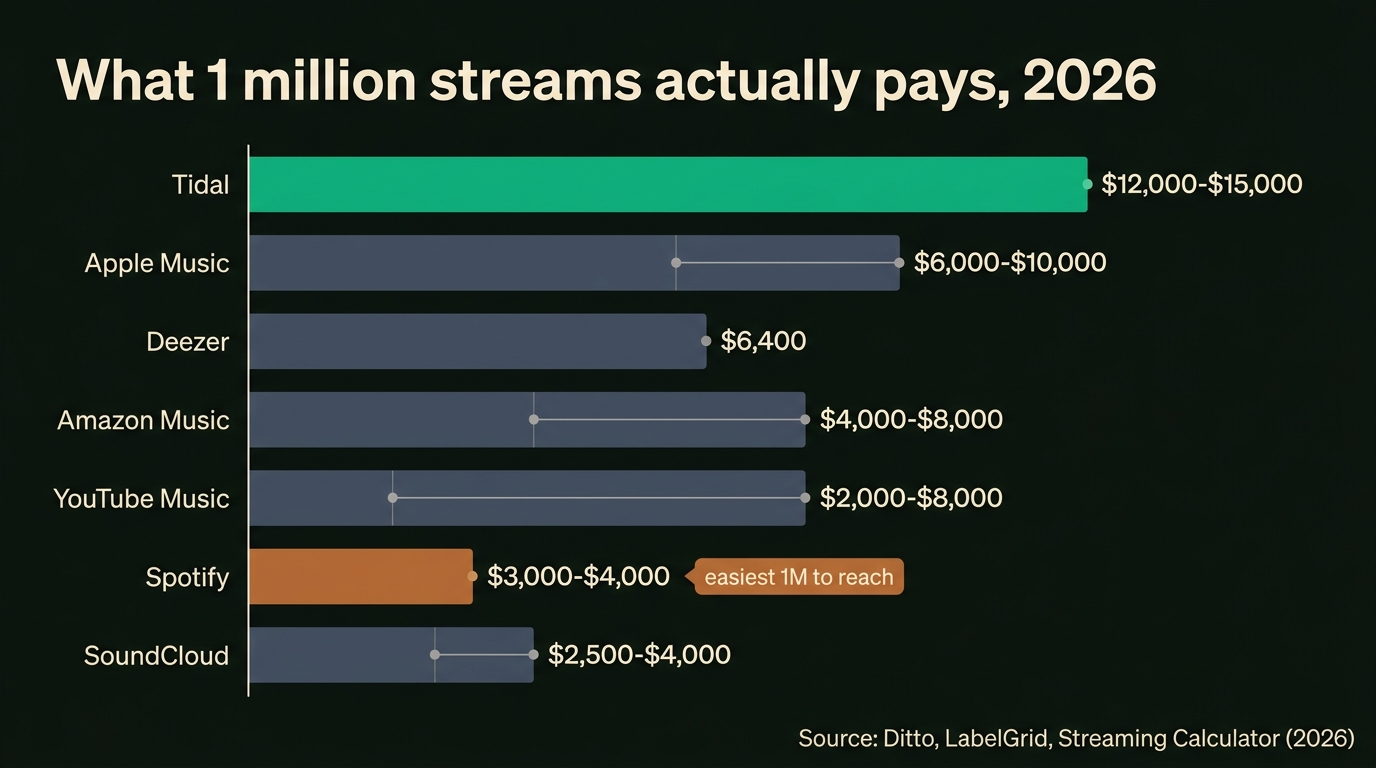
The "per stream" number only matters once you multiply it. Here is what a clean 1 million streams nets at each platform's mid-band rate before distributor cuts and any label split.
| Platform | 1M streams (mid-band) | Notes |
|---|---|---|
| Tidal | $12,000-$15,000 | Hardest 1M to reach (small audience) |
| Apple Music | $6,000-$10,000 | No free tier lifts the floor |
| Deezer | ~$6,400 | Artist-centric in select markets |
| Amazon Music | $4,000-$8,000 | Tier-dependent |
| YouTube Music | $2,000-$8,000 | Plus separate video ad RPM |
| Spotify | $3,000-$4,000 | Easiest 1M to reach |
| SoundCloud | $2,500-$4,000 | Fan-powered upside for loyal bases |
Source: cross-platform 2026 rate data (Ditto, LabelGrid, Streaming Calculator). Spotify's $3,000-$4,000 per million reflects its 2025 pool average. These are gross-of-distribution figures — subtract your distributor's commission and any label or co-writer splits to get take-home. To see the difference distributor choice makes, compare music distribution companies.
The reality this table exposes: reaching 1 million streams on Tidal is far harder than on Spotify because the audience is a fraction of the size, so the higher rate rarely translates into more total money for a developing artist. The platform that pays the most per stream and the platform that pays you the most in absolute dollars are usually not the same one. For most independent artists in 2026, Spotify produces the largest single revenue line simply because that is where the volume lives — the higher-rate platforms become meaningful only once your audience has scaled.
Which platform should you prioritize?
You release everywhere regardless — distribution to all services costs the same flat fee. But your attention, your paid promotion budget, and your fan-conversion effort are finite. Where they go depends on your stage and goals.
| Artist profile | Prioritize for revenue | Prioritize for reach | Why |
|---|---|---|---|
| Developing artist, under 50K monthly listeners | Apple Music, Tidal | Spotify | High rates lift a small base; Spotify drives discovery |
| Small loyal superfan base | Deezer, SoundCloud, Tidal | Spotify | User-centric models reward concentrated listening |
| Playlist-driven casual reach | Spotify | Spotify, YouTube Music | Pro-rata scale plus discovery surfaces |
| Video-forward / visual artist | YouTube (ad RPM) | YouTube Music, Spotify | Video ad revenue often beats the music royalty |
| Audiophile / niche genre | Tidal, Apple Music | Spotify | Premium-tier listeners pay the top rates |
There is no single right answer, only a right answer for your situation. According to Chartlex campaign data from 2,400+ campaigns, the artists who earn the most per stream are rarely the ones with the most streams — they are the ones whose listeners cluster in premium tiers and high-paying countries. If you are unsure which bucket you fall into, a free Chartlex audit maps your audience and points you at the platform mix that fits.
A quick note on platforms that appear even higher: services like Napster have historically posted per-stream rates of $0.019 or more, but their audiences are so small that the totals are negligible for nearly every independent artist. Chasing a headline rate on a platform with no listeners is a common and costly mistake.
How to maximize streaming income across platforms
You cannot change a platform's per-stream rate, but you control three levers that move your effective rate.
Distribute everywhere, then weight toward payers. Release to all platforms through one distributor (most charge a flat annual fee with 0% commission), but in paid promotion and outreach, push the platforms that pay more per play if revenue is the goal.
Free Spotify Audit
See exactly where your Spotify profile is leaking growth.
Independent artists miss an average of $800/yr in unclaimed royalties.
Starter Plan
$149/mo
Turn your music into consistent revenue with 200 campaign streams hitting your profile daily.
Verified in Spotify for Artists · Geo-targeted · Cancel anytime
Target high-paying geographies in promotion. A campaign weighted toward US, UK, German, and Nordic listeners earns materially more per stream than one weighted toward low-rate markets — same effort, more revenue. This is the single biggest controllable lever for most artists.
Convert casual listeners to premium-tier superfans. Premium streams pay 2.5-3x ad-supported ones. Driving fans toward saves, follows, and paid-tier listening compounds your rate over time. For the full picture of every income stream beyond streaming, see how musicians make money in 2026.
If streaming revenue alone won't cover your goals — and for most independent artists it won't until streams scale into the millions — the math points toward using streams as a discovery engine and monetizing through merch, sync, live, and direct fan support. The music promotion ROI breakdown shows where paid growth pays for itself.
Three payout mistakes that quietly cost artists money
First, comparing headline per-stream rates without checking audience size — a $0.015 Tidal rate on 5,000 streams pays less than a $0.004 Spotify rate on 100,000. Second, ignoring the distributor cut: a 9-15% commission on royalties can erase the gap between two platforms entirely, and it compounds every payout cycle. Third, treating all streams as equal regardless of geography. Two artists with the same total stream count can earn double or half of each other purely on listener country mix, and that variable is partly controllable through where you focus promotion.
Avoiding all three comes down to one habit: read your distributor statements by platform and by country, not just as a single lump sum. The detail is where the money hides — and where most artists never look. A breakdown of your audience by market is the fastest way to find it.
Frequently Asked Questions
Which streaming service pays artists the most per stream in 2026?
Tidal pays the most per stream at roughly $0.012-$0.015, followed by Apple Music at $0.006-$0.010 and Deezer at about $0.0064. All three benefit from premium-heavy or all-premium subscriber bases. Spotify pays the least among major platforms at $0.003-$0.005, but reaches the largest audience.
How much does Spotify pay per 1,000 streams?
Spotify pays roughly $3-$5 per 1,000 streams in 2026, averaging near $0.004 per stream. The exact figure depends on listener country and whether plays come from premium or ad-supported accounts. US premium streams can pay 5-8x more than free-tier streams from lower-priced markets.
Why does Spotify pay less than Tidal and Apple Music?
Spotify carries a large free, ad-supported tier whose streams pay a fraction of premium ones, dragging its blended average down. Tidal and Apple Music have no free tier, so every stream comes from a paying subscriber. Spotify still pays the most money industry-wide in absolute dollars because of its scale.
Do per-stream rates include my distributor's cut?
No. The rates in this guide are gross figures paid to rightsholders before your distributor's commission and any label or co-writer splits. Most distributors charge a flat annual fee and take 0% of royalties, but some take 9-15%, which reduces your take-home. Always check your distribution agreement.
Is it worth releasing music on lower-paying platforms?
Yes. Distribution to all platforms typically costs the same flat fee, so being absent from any service only forfeits revenue and discovery. Even low-rate platforms add incremental income and expand your reach. The strategy is to release everywhere, then concentrate paid promotion on the platforms and geographies that pay best.
What is the difference between pro-rata and user-centric payouts?
Pro-rata pools every subscriber's fee and splits it by total platform-wide stream share, so big stars capture most of the money. User-centric (or fan-powered) routes each subscriber's fee only to the artists that specific person streams. Deezer and SoundCloud use user-centric models, which favor artists with small, highly engaged fanbases.
How much does YouTube Music pay per stream versus YouTube ad revenue?
YouTube Music's blended royalty is $0.002-$0.008 per stream, separate from YouTube video ad revenue, which pays roughly $1-$5 per 1,000 views (RPM). For many artists the video ad revenue and Content ID claims exceed the music streaming royalty, so the two income lines should be tracked separately rather than combined.
The bottom line for independent artists
Streaming pays a wide range — from under a tenth of a cent to a cent and a half per play — and the platform matters far less than your listeners' countries and subscription tiers. Tidal and Apple lead on rate; Spotify leads on reach; everything else sits between. Releasing everywhere while steering promotion toward high-paying markets and premium listeners is how you raise real income without inventing more streams.
The fastest way to see where your own catalog stands is to run the numbers on your actual data. Start with a free Chartlex audit to map your audience by market and source, then model the revenue with the Spotify royalty calculator. When you're ready to grow streams in the markets that actually pay, compare Chartlex plans built to weight delivery toward higher-value geographies.
Free Weekly Playbook
One actionable insight, every Tuesday.
Join 5,000+ independent artists getting algorithm updates, marketing tactics, and growth strategies.
No spam. Unsubscribe anytime.
How much streaming revenue are you leaving on the table?
Independent artists miss an average of $800/yr in unclaimed royalties.
The free audit shows your current royalty footprint, missing registrations, and which platforms are underperforming relative to your catalogue size.
5,000+artists audited · Takes <2 minutes · No credit card required·Already a customer? Open Dashboard →
Campaign Dashboard
Turn Knowledge Into Action
Track your streams, monitor algorithmic triggers, and see growth projections in real time. The Campaign Dashboard puts everything you just read into practice.
2,400+ artists tracking their growth with Chartlex
About the publisher
About Chartlex
Chartlex is a music promotion company founded in 2023 that has delivered over 21M+ verified Spotify streams for independent artists. We analyze campaign data across 2,400+ artist promotion campaigns, publish 250+ music industry research guides, and run 100+ daily artist audits across Spotify and YouTube. Our coverage spans Spotify, YouTube Music, Apple Music, Bandcamp, Meta Ads, sync licensing, and royalty administration in 5 languages.
- Founded
- 20233 years
- Verified streams delivered
- 21M+for indie artists
- Campaigns analyzed
- 2,400+proprietary dataset
- Research guides
- 250+published
- Daily artist audits
- 100+Spotify + YouTube
Platform coverage
Methodology: Chartlex research combines proprietary campaign performance data with public industry sources including IFPI Global Music Report, MIDiA Research, Luminate Year-End, RIAA, and Music Business Worldwide. All findings are refreshed quarterly. Last verified: 2026-09-17.
Keep reading
Tidal pays the highest per-stream rate, but Spotify owns 31% of the market. Full 2026 royalty comparison across all three plus the optimal artist play.
Daniel Brooks
The $0.004 per stream figure is misleading. Real Spotify royalty math in 2026 - gross vs net, country rates, distributor cuts, and your take-home.
Daniel Brooks
The number is higher than you think and varies by state after distributor cuts. Real 2026 math on Spotify streams needed to hit US minimum wage income.
Daniel Brooks