
German Rap Playlists: The Deutschrap Pitching Guide 2026
How to get on German rap playlists in 2026: the Deutschrap editorial lineup after Modus Mio, legitimate curator pitching, and 21% genre market data.
Reviewed by the Chartlex editorial team·Editorial policy
Explore with AI
Get an instant summary of this guide from your favourite assistant.

Quick Answer
The way to get on German rap playlists in 2026 is a three-lane strategy: pitch every release to Spotify's Deutschrap editorial team through Spotify for Artists at least 7 days before release day, build direct relationships with independent Deutschrap curators through their stated submission channels, and run Germany-targeted promotion so your algorithmic signals originate from German listeners. Do not buy scraped curator email lists. They are outdated, they burn your sender reputation, and mass-emailing curators violates the norms that get tracks placed. The market justifies the effort: hip hop and rap generated 21 percent of German audio streaming revenue in 2025, inside a streaming market worth 2 billion euros, according to BVMI data. Spotify retired its flagship Modus Mio playlist in October 2025 after seven years and replaced it with Deutschrap Hits, so the editorial map most guides describe is now wrong.
The German Rap Streaming Market in 2026
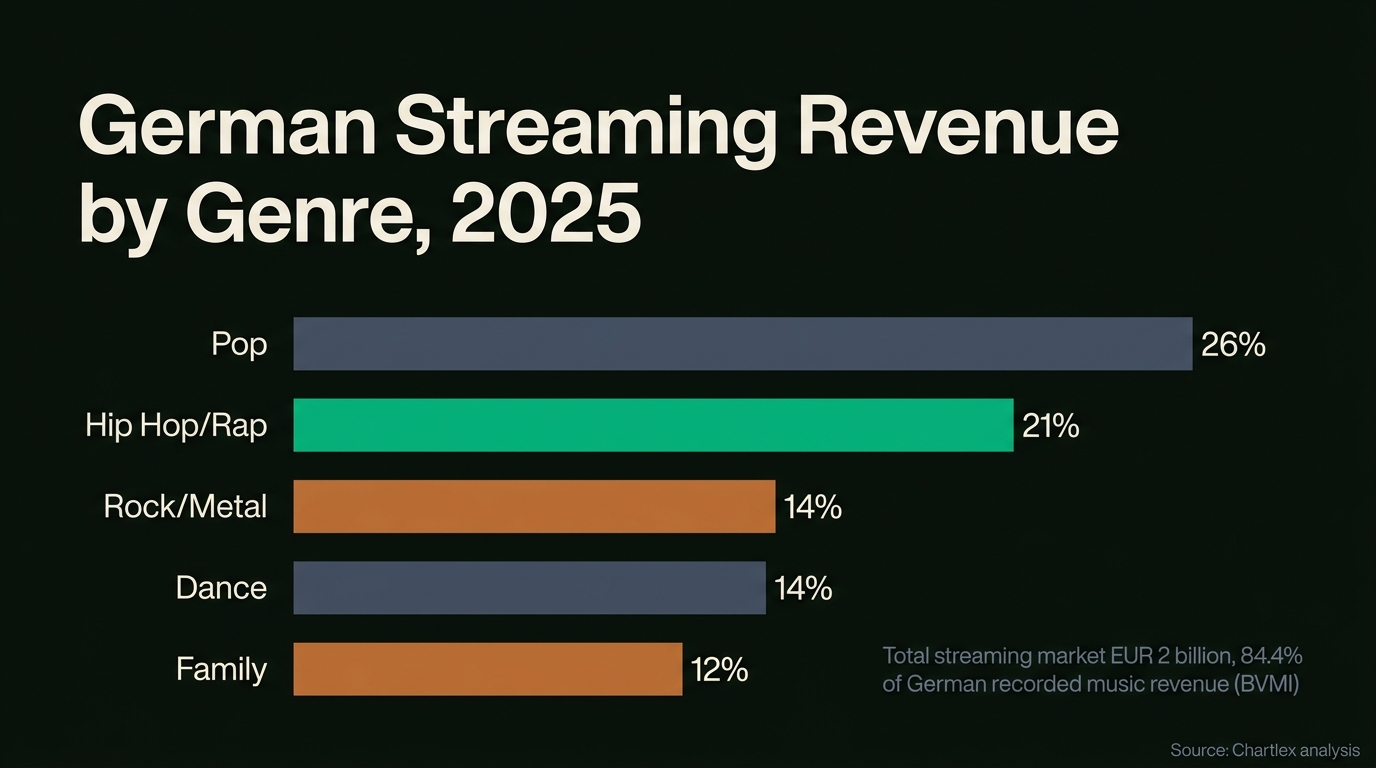
Germany is one of the five largest recorded music markets on the planet, and rap is one of its two dominant streaming genres. Most artists pitching German rap playlists have never looked at the actual numbers, and the numbers change the strategy.
Here is what the data shows. German streaming revenue grew 4.1 percent to roughly 2 billion euros in 2025 and now accounts for 84.4 percent of the country's recorded music revenue, according to BVMI's Musikindustrie in Zahlen 2025 report. Hip hop and rap took 21 percent of that streaming revenue, second only to pop at 26 percent.
Two caveats matter. First, the genre's share has slipped from 25 percent in 2020, so Deutschrap is a huge but maturing lane, not an open frontier. Second, the overall German market grew just 1.7 percent in 2025 while the global market grew 6.4 percent to 31.7 billion dollars, per the IFPI Global Music Report 2026. A slow-growth market rewards artists who compete on signals, not spend.
For rap specifically, playlist placement still matters more in Germany than in most markets because Deutschrap culture is playlist-native. Spotify's flagship rap playlist was name-dropped in actual songs for years. If you want the broader country strategy beyond rap, our guide to Spotify promotion for artists in Germany covers the full market.
Spotify's Deutschrap Editorial Playlists After Modus Mio
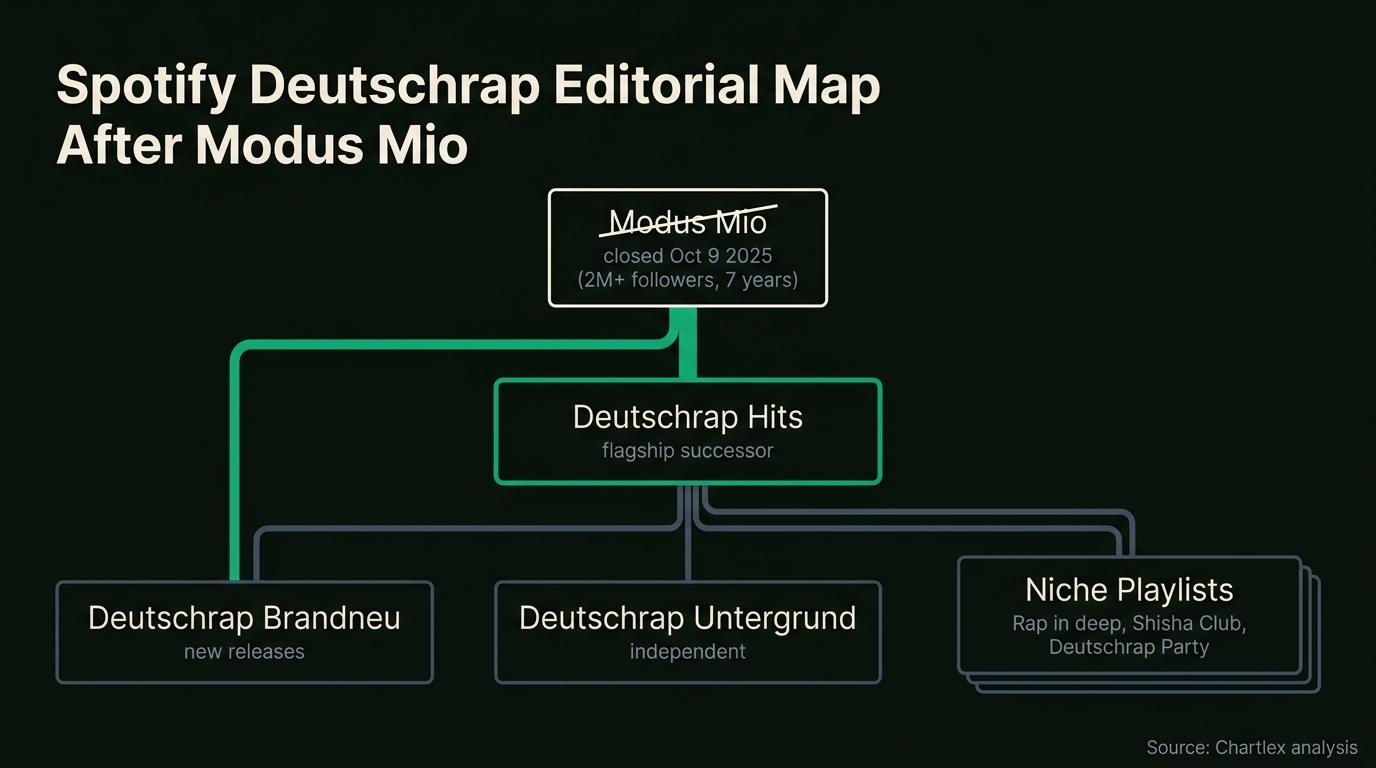
This is where most published advice is now outdated. Spotify shut down Modus Mio, the defining German rap playlist, on October 9, 2025, after seven years, more than 2 million followers, and over 600 artist collaborations, as reported by rap2soul and Hiphop.de. Any guide, service, or curator list still selling you a "Modus Mio strategy" has not done its homework.
Here is the editorial map that actually exists in 2026:
| Playlist | Role in the ecosystem | What it means for you |
|---|---|---|
| Deutschrap Hits | Flagship successor to Modus Mio, current scene zeitgeist | Chart-level competition, established artists dominate |
| Deutschrap Brandneu | New German rap releases | The realistic first editorial target for rising artists |
| I Love My 20's Deutschrap | 2020s Deutschrap highlights, launched at the Modus Mio handover | Catalog play, not a new-release target |
| Deutschrap Untergrund | Underground and independent German rap | Best fit for artists without label backing |
| Rap in deep | Melancholic, introspective German rap | Mood fit beats popularity here |
| Deutschrap Party / Shisha Club | Party and shisha-bar energy | Vibe-specific, pitch only if the track genuinely fits |
| Rap oder Liebe / word! / Deutschrap Asphalt | Niche moods and lyrical lanes | Long-tail editorial targets worth naming in your pitch |
Three things the data makes clear. First, editorial placement is pitched, never purchased. Anyone selling guaranteed Deutschrap Brandneu placement is lying to you. Second, the shutdown of a 2-million-follower playlist proves editorial real estate is rented, never owned, which is why algorithmic playlists like Discover Weekly and Release Radar are the more durable asset. Third, niche playlists like Deutschrap Untergrund convert better for unknown artists than flagship pitches, because editors staff those lists with discoveries, not chart entries.
How to Pitch the Deutschrap Editorial Team
Editorial pitching runs through exactly one door: the pitch form inside Spotify for Artists. Here is the process that maximizes your odds.
- Pitch at least 7 days before release, and ideally 3 to 4 weeks out. Editors work ahead. A pitch submitted on release day reaches nobody.
- Set your metadata to German market signals. Tag the genre as hip hop or rap, set German as the track language if applicable, and name Germany, Austria, and Switzerland as target markets in the pitch form.
- Name specific playlists in your pitch text. "This fits Deutschrap Untergrund because..." reads as a professional pitch. "Please add me to big playlists" reads as noise.
- Give editors a story. Deutschrap editors respond to scene context: city, crew, producer credits, co-signs, TikTok traction in DACH. Two sentences of concrete context beat five paragraphs of biography.
- Pitch every single release. One pitch per track, and the pitch also guarantees your release hits followers' Release Radar, which is worth submitting for by itself.
According to Chartlex campaign data from 2,400+ campaigns, momentum before the pitch window is what separates placed tracks from ignored ones. Editors see your streaming trajectory inside their tools. A track from an artist adding listeners week over week gets a different look than a flat profile, which is why the smartest artists warm up their profiles before a release cycle, not after.
The Independent Deutschrap Curator Ecosystem
Below the editorial layer sits a large ecosystem of independent German rap playlists: rap blogs and media brands with playlist arms, YouTube channels that cross-post to Spotify, shisha bar and gym playlist networks, and hundreds of individual curators running lists from a few hundred to tens of thousands of followers.
These playlists move fewer streams per placement than editorial, but they do two jobs editorial cannot. They are reachable by artists with zero label contact, and they generate the early save and follow activity in Germany that feeds the algorithm.
Early Push
Want to see how one track responds to a steady, paced push instead of guessing? Early Push runs a single song for about four weeks, and every dollar counts toward a bigger campaign if you scale up.
- ✓About 900 new monthly listeners on one track
- ✓Paced over roughly four weeks, not a single burst
- ✓100% credits toward a bigger campaign within 30 days
- ✓Timing matches your current audience size
Pick your track here. Credit applies if you upgrade within 30 days.
How to find them without buying anything:
- Search Spotify directly for terms like "Deutschrap 2026", "German rap", "Deutschrap Underground", and city names like Berlin, Frankfurt, or Hamburg plus "rap". Sort by follower count, then check that the list updated within the last 2 weeks. A stale playlist is a dead playlist.
- Work backwards from comparable artists. Open the profile of an artist one tier above you, check "Discovered on" data where visible, and note every independent list that features them.
- Check curator profiles for submission channels. Serious curators state how they take submissions: a SubmitHub or Groover profile, an Instagram DM policy, or a form linked in the playlist description.
The full research method, including how to vet a curator's follower quality before you pitch, is in our guide to finding and pitching Spotify playlist curators.
Why Scraped Curator Email Lists Are a Trap
Here is the part most artists searching "Deutschrap curator emails" do not want to hear, and it is the part that matters most. The spreadsheets of "5,000 German playlist curator emails" sold on Telegram, marketplaces, and sketchy SEO sites are the single worst purchase you can make in this genre.
The data on why:
| Factor | Scraped email list | Legitimate pitching |
|---|---|---|
| Contact accuracy | Stale within months, many addresses dead or never curator-owned | You verify each channel yourself before sending |
| Response rate | Effectively zero, your email lands with thousands of identical blasts | Personalized pitches get read because volume is low |
| Deliverability | Mass cold sends flag your domain as spam, hurting every future email | Sender reputation stays intact |
| Curator perception | Blast recipients block and blacklist senders | You build a contact you can pitch again next release |
| Legal exposure | Emailing scraped personal data commercially violates GDPR in Germany | Stated submission channels are consent-based |
That last row is not a technicality. Germany is one of the strictest GDPR enforcement environments in Europe, and cold-emailing scraped personal addresses for commercial purposes is exactly what the regulation prohibits. You would be committing the genre's most common legal mistake in its least forgiving market.
There is also a signal-quality issue. Curators who sell placements to anyone with an email list tend to run botted playlists, and placements on those lists produce the skip-heavy, save-free listening patterns that suppress your algorithmic reach. From our campaign analysis, one bad playlist placement can cost more in lost algorithmic momentum than it delivers in raw streams. Our breakdown of Spotify promotion for hip hop artists covers how rap profiles specifically get flagged by these patterns.
The Legitimate Deutschrap Pitching Playbook
This is the system that replaces the email list. It takes more effort per pitch and produces dramatically more per placement.
Step 1: Build a 30-curator target sheet. Use the research methods above to list 30 active German rap playlists with reachable curators. Log playlist name, follower count, last update date, submission channel, and one recent track they added that sounds like yours.
Step 2: Pitch through stated channels only. SubmitHub and Groover both have real Deutschrap curator pools and force curators to respond, which makes small paid-submission budgets more efficient than any email blast. Instagram DMs work when the curator invites them. Forms work when linked. Nothing else does.
Step 3: Personalize in German where you can. Two sentences: why your track fits their list specifically, referencing a track they already feature. If your German is weak, a short honest English pitch beats a machine-translated paragraph.
Step 4: Time pitches to your release cycle. Independent curator placements landing in the first 2 weeks after release compound with your Release Radar delivery and editorial window. Map this against your rollout with the free release checklist tool, which sequences pitch deadlines from 4 weeks out through post-release.
Step 5: Track and rotate. Log every response. Curators who add you once are far warmer contacts for the next single. Curators who ignore two pitches come off the sheet.
Step 6: Audit what placements actually do. Streams from a playlist mean nothing if they do not convert to saves, followers, and algorithmic pickup. A free Chartlex audit breaks down where your streams actually come from and whether your playlist placements are feeding or starving your algorithmic reach.
Geo-Targeting Germany: The Signal Layer
Playlist placement is only half the German strategy. The Spotify algorithm builds recommendations market by market, and Discover Weekly in Germany draws on listening behavior from German users. If your existing audience is 90 percent outside DACH, German editorial and algorithmic systems have almost no local signal to work with.
That is the case for geo-targeted promotion. Concentrating a campaign's listener activity in Germany does three things: it gives Deutschrap editors local traction to see in their dashboards, it seeds German listener profiles for algorithmic lookalike spread, and it makes your "top listener cities" read Berlin and Cologne instead of random Anglosphere metros when curators check your profile.
Free Spotify Audit
See exactly where your Spotify profile is leaking growth.
Artists who fix algorithmic blind spots see +40% monthly listeners on average.
Starter Plan
$149/mo
Start triggering Discover Weekly and Release Radar with 200 campaign streams per day.
Verified in Spotify for Artists · Geo-targeted · Cancel anytime
According to Chartlex campaign data from 2,400+ campaigns, backed by 21M+ verified streams delivered, geo-concentrated campaigns consistently produce stronger market-specific algorithmic follow-through than globally scattered promotion of the same size. Chartlex campaigns support German market targeting on every tier, and you can compare plans by budget and targeting to match one to your release. For a rap single aimed at the German market, a focused monthly campaign during the release cycle beats a one-off burst, because sustained daily activity is what the recommendation engine reads as genuine momentum.
Frequently Asked Questions
How do I get on Deutschrap Brandneu?
Pitch through Spotify for Artists at least 7 days before release, tag the track as German rap, target the German market in the pitch form, and name Deutschrap Brandneu specifically. Placement is free and editor-decided. Building German listener momentum before the pitch window materially improves your odds.
Is Modus Mio still active in 2026?
No. Spotify discontinued Modus Mio on October 9, 2025 after seven years and more than 2 million followers. Deutschrap Hits is its successor for current scene hits, alongside I Love My 20's Deutschrap for catalog. Ignore any service still selling a Modus Mio strategy.
Can I buy placement on German editorial playlists?
No. Spotify editorial placement cannot be bought, and anyone guaranteeing it is running a scam or a botted third-party list. The only route is the Spotify for Artists pitch form. Paid promotion can legitimately build the listener momentum that makes editors take your pitch seriously.
Where do I find Deutschrap curator contacts without buying a list?
Search Spotify for active German rap playlists, check playlist descriptions and curator profiles for stated submission channels, and use SubmitHub or Groover, where hundreds of German curators accept submissions and must respond. Working backwards from playlists featuring comparable artists is the fastest research route.
How big is the German rap market really?
Hip hop and rap generated 21 percent of German audio streaming revenue in 2025, second only to pop, inside a streaming market worth about 2 billion euros per BVMI. Germany remains a top-five global music market, so a genre share that size represents serious absolute money.
Do German playlists help if I do not rap in German?
Yes, selectively. Several German curators run English-language rap lists, and German listeners stream international hip hop heavily. Your editorial odds on core Deutschrap lists are lower without German-language vocals, so weight your pitching toward independent curators and geo-targeted algorithmic growth instead.
Your Next Move in the German Market
The German rap playlist game in 2026 rewards artists who treat it as a signals problem: editorial pitches filed early and specific, independent curators reached through channels they actually read, and listener activity concentrated in the market you are trying to win. The scraped email list shortcut fails on every one of those fronts, and in Germany it adds legal risk on top.
Start with an honest read of where you stand. A free Chartlex audit shows exactly where your current streams come from, how much of your audience is already in Germany, and which signals are holding your profile back before you spend a cent on the market. Run the audit, build the 30-curator sheet, and file your next editorial pitch 3 weeks early. That sequence is the whole playbook.
Free Weekly Playbook
One actionable insight, every Tuesday.
Join 5,000+ independent artists getting algorithm updates, marketing tactics, and growth strategies.
No spam. Unsubscribe anytime.
Find out exactly why Discover Weekly isn't picking you up.
Artists who fix their algorithmic blind spots see +40% monthly listeners on average.
Our free AI audit analyses your release cadence, save rate, skip rate patterns, and playlist velocity — then gives you a personalised action plan in under 2 minutes.
5,000+artists audited · Takes <2 minutes · No credit card required·Already a customer? Open Dashboard →
Campaign Dashboard
Turn Knowledge Into Action
Track your streams, monitor algorithmic triggers, and see growth projections in real time. The Campaign Dashboard puts everything you just read into practice.
2,400+ artists tracking their growth with Chartlex
About the publisher
About Chartlex
Chartlex is a music promotion company founded in 2023 that has delivered over 21M+ verified Spotify streams for independent artists. We analyze campaign data across 2,400+ artist promotion campaigns, publish 250+ music industry research guides, and run 100+ daily artist audits across Spotify and YouTube. Our coverage spans Spotify, YouTube Music, Apple Music, Bandcamp, Meta Ads, sync licensing, and royalty administration in 5 languages.
- Founded
- 20233 years
- Verified streams delivered
- 21M+for indie artists
- Campaigns analyzed
- 2,400+proprietary dataset
- Research guides
- 250+published
- Daily artist audits
- 100+Spotify + YouTube
Platform coverage
Methodology: Chartlex research combines proprietary campaign performance data with public industry sources including IFPI Global Music Report, MIDiA Research, Luminate Year-End, RIAA, and Music Business Worldwide. All findings are refreshed quarterly. Last verified: 2026-10-17.
Keep reading
German artists earned EUR 480M from Spotify in 2024. Real 2026 promotion strategies for indie artists in Germany, the top European streaming market.
Marcus Vale
Free strategies to get on Spotify playlists in 2026. Editorial pitching, curator outreach, and algorithmic triggers that generate real playlist placements.
Lena Kova
Tracks on curated playlists with 1,000+ followers see 34% more algorithmic triggers. Find real curators, write winning pitches, and avoid scams in 2026.
Lena Kova