
8 Best Playlist Push Alternatives 2026 (Cheaper Options)
Compare 8 verified Playlist Push alternatives for 2026, from $1 curator pitches to managed stream campaigns. Real pricing, guarantees, honest trade-offs.
Reviewed by the Chartlex editorial team·Editorial policy
Explore with AI
Get an instant summary of this guide from your favourite assistant.
Quick Answer
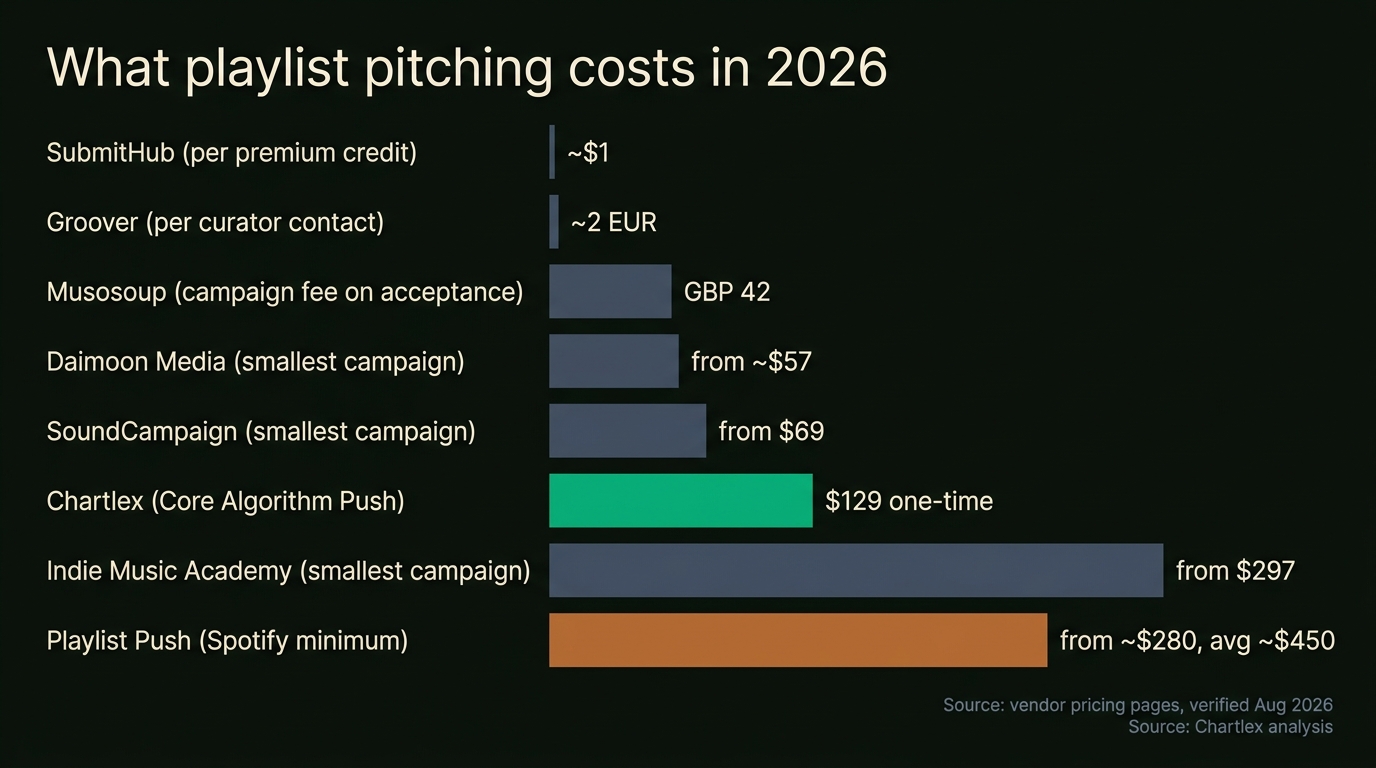
Playlist Push is legitimate, but its Spotify campaigns start from about $280, average around $450, and its own pricing page confirms that submission does not guarantee playlist adds. That combination sends many artists hunting for alternatives. The strongest options in 2026 fall into three camps. Per-pitch platforms like SubmitHub (premium credits roughly $1 each) and Groover (2 EUR per contact, with a guaranteed reply within 7 days) cost the least to test. Fixed-price campaign services like SoundCampaign ($69 to $400 plus) and Daimoon Media (from about $57 to $59) sell curator outreach at a set budget. Target-based services, including our own platform Chartlex (from $129 one-time or $149 per month) and Indie Music Academy (from $297, with a guaranteed-streams tier), price a defined deliverable instead of an opportunity. This guide compares all eight on verified pricing, guarantees, and fit.
Last verified: 2026-08-20 · Refresh cadence: quarterly.
Chartlex finding: According to Chartlex campaign data from 2,400+ campaigns, monthly campaigns produce 2.3x more Discover Weekly appearances per dollar spent than single-burst campaigns, because Spotify's algorithm responds more strongly to consistent engagement over time than to short spikes.
Why Artists Look for Playlist Push Alternatives
Playlist Push earned its position as the most recognized name in playlist pitching, and our full Playlist Push review covers why it still works for the right artist. But three friction points push people toward alternatives. The entry price sits at about $280 for Spotify campaigns and about $350 for TikTok campaigns, the average Spotify campaign lands around $450, and larger campaigns run past $1,000.
The second issue is the guarantee, or the lack of one. Playlist Push's own pricing page states that submission does not guarantee playlist adds, so a minimum-budget campaign can end with feedback but few placements. The third is the model itself: a 14-day burst is a one-shot bet, and artists who want ongoing momentum have to keep buying new campaigns.
None of this makes Playlist Push a scam. It means the service occupies one specific slot, premium per-campaign curator access, and 2026 offers cheaper, longer-running, or more accountable ways to spend the same money.
Playlist Push Alternatives at a Glance
| Service | Model | Entry Price | Placement or Delivery Guarantee |
|---|---|---|---|
| Playlist Push (baseline) | Per-campaign curator pitching | From about $280 | No, states submission does not guarantee adds |
| Chartlex | Campaign with published stream target | $129 one-time, $149/mo | Stream target with delivery window |
| SubmitHub | Per-pitch credits | Free credits, ~$1 premium | Feedback guaranteed, placement not |
| Groover | Per-contact credits | 2 EUR per contact | Reply within 7 days or credits refunded |
| SoundCampaign | Fixed-price campaigns | From $69 | 14-day artist-protection refund, no placement promise |
| One Submit | Per-submission credits | From about $3 per pitch | Feedback per submission, placement not |
| Musosoup | Free submission, fee on acceptance | £42 on acceptance | Pay only when an outlet accepts you |
| Daimoon Media | Tiered follower-reach campaigns | From about $57 to $59 | No guaranteed stream count |
| Indie Music Academy | Guaranteed-stream packages | From $297 | Advertises stream guarantees with shortfall refund |
Entry price is what it costs to start, not what a meaningful campaign costs. The sections below cover both, with links to our full review of each service.
1. Chartlex (Our Platform)
Full disclosure: Chartlex is our platform, so weigh this entry accordingly and check our claims against the linked pages. Chartlex sells campaign-based Spotify promotion with a published stream target and a delivery window rather than pitching your track to curators who may decline it. You buy a defined campaign, track delivery on a real-time dashboard, and verify the results in your own Spotify for Artists account.
Pricing: one-time boosts start at $129, and monthly subscriptions run $149 to $999 per month depending on daily stream volume and how many songs you promote. Full details are on the plans page and the Spotify promotion overview.
Strengths: the entry price is roughly half of Playlist Push's minimum, the monthly model builds continuous momentum instead of a 14-day burst, and the target-based structure means you know what you are buying before you pay. According to Chartlex campaign data from 2,400+ campaigns, monthly campaigns produce 2.3x more Discover Weekly appearances per dollar spent than single-burst campaigns.
Watch-outs: you do not get curator feedback, which is Playlist Push's genuine strong suit, and we are a smaller brand with fewer third-party reviews than the biggest names in this list. If written curator notes matter to your process, pair us with a feedback platform or pick one below.
Best for: artists who want ongoing promotion with a defined target and a dashboard, at a lower entry price than a single Playlist Push campaign. The Chartlex vs SubmitHub vs Playlist Push vs SoundCampaign comparison breaks down how the models differ.
2. SubmitHub
SubmitHub is the longest-running pay-to-pitch platform, founded in 2015, and the most direct budget substitute for Playlist Push. Its network holds 1,700+ quality-checked curators spanning Spotify playlists, blogs, YouTube channels, and radio.
Pricing: free standard credits refresh every 4 hours, and premium credits cost roughly $1 each, about $80 per 100. Premium submissions carry a base 48-hour feedback guarantee, so you always hear back even on a decline.
Strengths: the lowest possible cost to test curator interest in a track, guaranteed feedback on premium pitches, and full control over exactly which curators see your song. The average approval rate sits around 30 percent per SubmitHub's own guide, which is honest by industry standards.
Watch-outs: you manage every pitch yourself, results swing hard from cycle to cycle, and most submissions get declined. It is a pitching tool, not a promotion engine, and artists chasing volume usually outgrow it.
Best for: artists with under $100 to spend who want feedback and a few genuine placements. Our SubmitHub review covers the credit math and realistic outcomes in detail.
3. Groover
Groover is the Paris-based platform that answers SubmitHub from the European side, with a network that includes playlist curators, blogs, radio, and A&R contacts at independent labels. Its differentiator is the strongest response guarantee in the category.
Pricing: contacts cost 2 Grooviz, which works out to a 2 EUR baseline per submission, with top curators charging 4 to 6 Grooviz. Credit packs start from 46 EUR with volume discounts up to 20 to 24 percent on larger packs.
Strengths: a guaranteed reply within 7 days or your Grooviz are automatically refunded, and Groover's own pricing page reports an answer rate above 85 percent. The label and radio contacts add value no playlist-only service offers.
Watch-outs: replies are guaranteed, placements are not, and the network skews European. US country, metal, and mainstream hip-hop artists tend to find fewer matches than indie and electronic acts.
Best for: European-leaning indie, electronic, and singer-songwriter artists who want guaranteed feedback and industry contacts beyond playlists. See our Groover review for genre-by-genre fit.
4. SoundCampaign
Test the Waters
Want to see how one track performs with a steady, paced push instead of guessing? Test the Waters runs a single song for about four weeks, and every dollar counts toward a bigger campaign if you decide to scale up.
- ✓About 2,000 new monthly listeners on one track
- ✓Paced over roughly four weeks, not a single burst
- ✓100% credits toward a bigger campaign within 30 days
- ✓Timing matches your current audience size
Pick your track at checkout. Credit applies if you upgrade within 30 days.
SoundCampaign is a Spotify-focused pitching platform that packages curator outreach into fixed-price campaigns, making it the closest structural clone of Playlist Push at a lower price point. The company claims a network of 10,000+ Spotify playlists.
Pricing: its Standard campaign starts at $69 and larger campaigns run to $400 plus depending on how many curators you target, consistent with our full review. That puts its ceiling near Playlist Push's average.
Strengths: a lower entry price than Playlist Push for the same basic transaction, fast campaign cycles, and a 14-day artist-protection mechanic that refunds qualifying campaigns which fail to perform. The dashboard shows per-curator responses as they land.
Watch-outs: the network claim is the vendor's own number, acceptance rates vary sharply by genre, and like Playlist Push there is no placement promise behind the pitch. Reporting is thinner than Playlist Push's.
Best for: artists who want the Playlist Push experience at roughly a third of the average cost and accept the same no-guarantee trade. Our SoundCampaign review covers what the campaigns actually return.
5. One Submit
One Submit is a multi-platform submission dashboard: one account pitches Spotify curators, blogs, YouTube channels, TikTok creators, Instagram pages, and SoundCloud playlists. It suits artists who would otherwise juggle three separate credit systems.
Pricing: reported rates start from about $3 per playlist submission, with credits running roughly $0.40 to $0.50 each and curators charging 1 to 5 credits per submission depending on their tier.
Strengths: the multi-platform breadth is the pitch, the interface is clean, and per-submission costs undercut Playlist Push by an order of magnitude. You choose every outlet yourself, so nothing is spent without your sign-off.
Watch-outs: the curator network on each individual platform is smaller than the dedicated single-platform leaders, and response quality varies by curator. Like every credit platform, it still demands your time to research outlets.
Best for: artists promoting one release across several platforms at once on a small budget. The full breakdown is in our One Submit review.
6. Musosoup
Musosoup flips the payment model: submitting your track is free, and you only pay when an outlet accepts it. The UK-based network leans toward music blogs, online radio, and editorial coverage rather than pure playlist volume.
Pricing: submission is free, then a £42 campaign fee applies on acceptance, raised from £36 effective January 1, 2026. Paid curator placements on top of that average £8 to £12 per curator.
Strengths: zero risk at the submission stage, since money only moves when someone actually wants your track. The blog and radio coverage builds a press kit in a way playlist adds never will.
Watch-outs: the blog ecosystem keeps shrinking, Spotify playlist coverage is narrower than any dedicated playlist service here, and per-curator fees stack up if several outlets accept at once.
Best for: artists who value press coverage and editorial credibility alongside streams, especially in the UK and Europe. Our Musosoup review weighs the press value against the stream math.
7. Daimoon Media
Daimoon Media sells tiered promotion campaigns priced by the follower reach you target, running 4 to 12 weeks per campaign. The longer windows contrast with Playlist Push's 14-day sprint.
Pricing: reported campaign pricing starts from about $57 to $59 and scales to about $1,800 at the top tiers, with each tier defined by follower reach and campaign duration.
Strengths: one of the lowest entry prices among managed campaign services, and the 4 to 12 week duration gives the algorithm a longer runway than a two-week burst. The tier ladder makes budgeting simple.
Watch-outs: there is no guaranteed stream count at any tier, follower reach is an input rather than an outcome, and third-party reporting on placement quality is mixed. Vet the tier you buy against what your genre realistically converts.
Best for: artists who want a longer campaign window at a sub-$60 test price. Our Daimoon Media review digs into what the tiers deliver.
8. Indie Music Academy
Indie Music Academy takes the opposite position from Playlist Push on guarantees: its packages advertise specific stream counts, with a refund of any shortfall. It pairs promotion with an education layer aimed at artists who want to understand the machinery.
Pricing: packages start from $297, and the $537 tier advertises 20,000 guaranteed streams with a refund of any shortfall. Those guarantee figures are the vendor's own claims, so hold them to their published refund terms.
Strengths: the guarantee structure removes the biggest complaint artists have about Playlist Push, paying premium prices for an unknowable outcome. The refund-the-shortfall mechanic puts the risk on the vendor.
Watch-outs: guaranteed-stream marketing deserves scrutiny anywhere in this industry, so read exactly how they source placements before buying, and judge results in your own Spotify for Artists. Entry pricing is above Playlist Push's minimum once you pass the base package.
Best for: risk-averse artists who would rather pay slightly more for a defined number than gamble on curator taste. Our Indie Music Academy review examines the guarantee fine print.
How to Choose: By Budget and Goal
Start with budget, because it eliminates half the list immediately. Then pick by what you actually want out of the spend: feedback, placements, press, or sustained streams.
| Your Budget | Best Fit | What You Get |
|---|---|---|
| $0 to $50 | SubmitHub free credits, Musosoup submission | Curator feedback, a shot at placements, zero to low risk |
| $50 to $150 | Groover pack, One Submit, Daimoon entry tier, SoundCampaign $69, Chartlex $129 boost | A real campaign test with money on the line |
| $150 to $300 | Chartlex $149/mo, Indie Music Academy $297 | A month of continuous delivery or a defined package |
| $300 to $500 | Playlist Push minimum, larger SoundCampaign, IMA $537 tier | Premium curator access or a guaranteed-stream package |
| $500 plus | Playlist Push average campaign, Chartlex Growth and up | Scale, either per-campaign or compounding monthly |
Free Spotify Audit
See exactly where your Spotify profile is leaking growth.
Artists who fix algorithmic blind spots see +40% monthly listeners on average.
Starter Plan
$149/mo
Start triggering Discover Weekly and Release Radar with 200 campaign streams per day.
Verified in Spotify for Artists · Geo-targeted · Cancel anytime
Goal matters as much as budget. This table maps the three most common goals to the model that serves them.
| Your Goal | Pick This Model | Services |
|---|---|---|
| Learn why curators pass on your track | Per-pitch with guaranteed feedback | SubmitHub, Groover |
| Press coverage and a stronger press kit | Acceptance-based editorial | Musosoup |
| Sustained streams and algorithmic momentum | Target-based or monthly campaigns | Chartlex, Indie Music Academy |
One more filter before you spend anything: check whether your track is ready. If your save rate and retention are weak, every service on this list underperforms, because promotion amplifies engagement signals rather than creating them. Run your profile through our free artist insights tool first, and if the numbers look soft, fix the track before funding the campaign.
Frequently Asked Questions
Is Playlist Push legit?
Yes. Playlist Push operates a vetted network of 4,000+ verified playlists, pays curators for review time rather than placements, and its own reviews page cites a 4.3 out of 5 rating across 1,320 reviews. It does not guarantee placements, which its pricing page states directly. Our full review covers the details.
What is the cheapest Playlist Push alternative?
SubmitHub is the cheapest way to start: free standard credits refresh every 4 hours, and premium credits cost roughly $1 each with a 48-hour feedback guarantee. One Submit follows at about $3 per playlist submission. Musosoup is free to submit, though a £42 fee applies once an outlet accepts your track.
Do any Playlist Push alternatives guarantee placements?
Most do not, because curator-pitching platforms sell access rather than outcomes. Indie Music Academy advertises guaranteed stream packages with a shortfall refund, per its own marketing. Chartlex campaigns carry a published stream target with a delivery window. Groover guarantees a reply within 7 days or refunds your credits, but a reply is not a placement.
Is Groover better than Playlist Push?
They solve different problems. Groover costs 2 EUR per contact, guarantees a reply within 7 days or auto-refunds your Grooviz, and reports an answer rate above 85 percent on its pricing page. Playlist Push offers a far larger playlist network at a far higher entry price. Feedback seekers pick Groover, reach seekers pick Playlist Push.
How much does Playlist Push cost in 2026?
Spotify campaigns start from about $280, the average campaign lands around $450, and larger campaigns run past $1,000. TikTok campaigns start from about $350. Playlist Push publishes slightly different minimums in different places, so treat the exact floor as approximate and confirm on their pricing page before you commit budget.
Can I combine two alternatives instead of picking one?
Yes, and pairing often beats concentrating budget in one service. A common setup runs a feedback platform like SubmitHub or Groover to test curator response, then routes the stronger tracks into a campaign service like Chartlex or SoundCampaign for volume. Just avoid running two placement services on the same track simultaneously.
The Bottom Line
Playlist Push is a premium product at a premium price, and the alternatives exist because most independent artists do not need premium curator access, they need results they can afford to repeat. Per-pitch platforms cost the least to test, fixed campaigns cost less than Playlist Push for the same transaction, and target-based services trade curator feedback for accountability.
The honest move is to match the model to your situation rather than the brand to the hype. If you are not sure where your track stands today, request a free campaign audit and we will show you what your current numbers support before you spend a dollar with anyone, including us.
Free Weekly Playbook
One actionable insight, every Tuesday.
Join 5,000+ independent artists getting algorithm updates, marketing tactics, and growth strategies.
No spam. Unsubscribe anytime.
Find out exactly why Discover Weekly isn't picking you up.
Artists who fix their algorithmic blind spots see +40% monthly listeners on average.
Our free AI audit analyses your release cadence, save rate, skip rate patterns, and playlist velocity — then gives you a personalised action plan in under 2 minutes.
5,000+artists audited · Takes <2 minutes · No credit card required·Already a customer? Open Dashboard →
Campaign Dashboard
Turn Knowledge Into Action
Track your streams, monitor algorithmic triggers, and see growth projections in real time. The Campaign Dashboard puts everything you just read into practice.
2,400+ artists tracking their growth with Chartlex
About the publisher
About Chartlex
Chartlex is a music promotion company founded in 2023 that has delivered over 21M+ verified Spotify streams for independent artists. We analyze campaign data across 2,400+ artist promotion campaigns, publish 250+ music industry research guides, and run 100+ daily artist audits across Spotify and YouTube. Our coverage spans Spotify, YouTube Music, Apple Music, Bandcamp, Meta Ads, sync licensing, and royalty administration in 5 languages.
- Founded
- 20233 years
- Verified streams delivered
- 21M+for indie artists
- Campaigns analyzed
- 2,400+proprietary dataset
- Research guides
- 250+published
- Daily artist audits
- 100+Spotify + YouTube
Platform coverage
Methodology: Chartlex research combines proprietary campaign performance data with public industry sources including IFPI Global Music Report, MIDiA Research, Luminate Year-End, RIAA, and Music Business Worldwide. All findings are refreshed quarterly. Last verified: 2026-10-04.
Keep reading
Honest Boost Collective review for 2026. Free playlist submission, distribution, what works, what does not, and 3 alternatives ranked by cost-per-stream.
Marcus Vale
Honest Daimoon Media review for 2026. Reported tier pricing from about $59 to $1,797, playlist campaign quality, guarantees, and 3 alternatives compared.
Marcus Vale
Honest Groover review for 2026. Real pricing, curator quality, what works, what does not, and 3 alternatives ranked by cost-per-stream for indie artists.
Marcus Vale