
Spotify Lossless: What It Means for Artists (2026)
Spotify Lossless is here for Premium — 24-bit FLAC, no extra fee. Here's what it actually changes for independent artist royalties and discovery in 2026.
Reviewed by the Chartlex editorial team·Editorial policy
Explore with AI
Get an instant summary of this guide from your favourite assistant.
Quick Answer
Spotify Lossless rolled out to Premium subscribers starting September 10, 2025, delivering up to 24-bit/44.1 kHz FLAC at no extra cost, and has since reached more than 50 countries (Spotify Newsroom). For independent artists, the honest takeaway is narrow: lossless is an audio-quality upgrade for listeners, not a discovery or royalty lever. Spotify's per-stream payout — roughly $0.003 to $0.005 — is driven by streamshare, listener country, and Premium-vs-free tier, not by whether a stream was lossless. Spotify has published no separate lossless royalty rate, and as of mid-2026 none is announced. The algorithm still rewards saves, completion rate, and repeat listens, none of which a higher bitrate touches. The one real action item: make sure your distributor delivers the highest-resolution master you have, so a lossless-eligible file exists when listeners turn the setting on. Everything else about lossless is for the listener's ears, not your growth.
What Spotify Lossless Actually Is
Spotify Lossless is the company's long-promised "HiFi" tier, finally shipping as a free upgrade inside existing Premium plans rather than a paid add-on. Lossless audio means the file is delivered without the data loss that comes from compression formats like Ogg Vorbis or AAC — what reaches your ears is bit-for-bit closer to the studio master.
The format is FLAC, up to 24-bit/44.1 kHz, according to Spotify's Newsroom announcement. In the app, eligible tracks display as "Lossless 16-bit" or "Lossless 24-bit." That is CD-quality and above — a real jump from Spotify's previous ceiling of 320 kbps lossy on the old "Very High" setting.
Two things matter here for context. First, this is not hi-res in the audiophile-purist sense of 192 kHz files; the sample-rate ceiling is 44.1 kHz. Second, it shipped at no added price, which undercuts the premium-tier positioning that Tidal and Apple Music have leaned on for years.
How listeners turn it on
Lossless is off by default and must be enabled per device. Listeners open Settings and Privacy, go to Media Quality, and choose Lossless for Wi-Fi, cellular, and downloads separately. Spotify recommends Wi-Fi plus wired headphones or Spotify Connect, because standard Bluetooth re-compresses the stream before it reaches wireless earbuds — meaning most AirPods users are not hearing true lossless even with the toggle on.
That last detail is the quiet reality check. The audience that can actually perceive the difference is small, wired, and deliberate.
Where Spotify Lossless sits versus rivals
Spotify shipping lossless at no extra cost reshapes the fidelity comparison that's been static for years. Tidal and Apple Music built part of their pitch on higher-resolution audio; Spotify just removed that as a reason to leave.
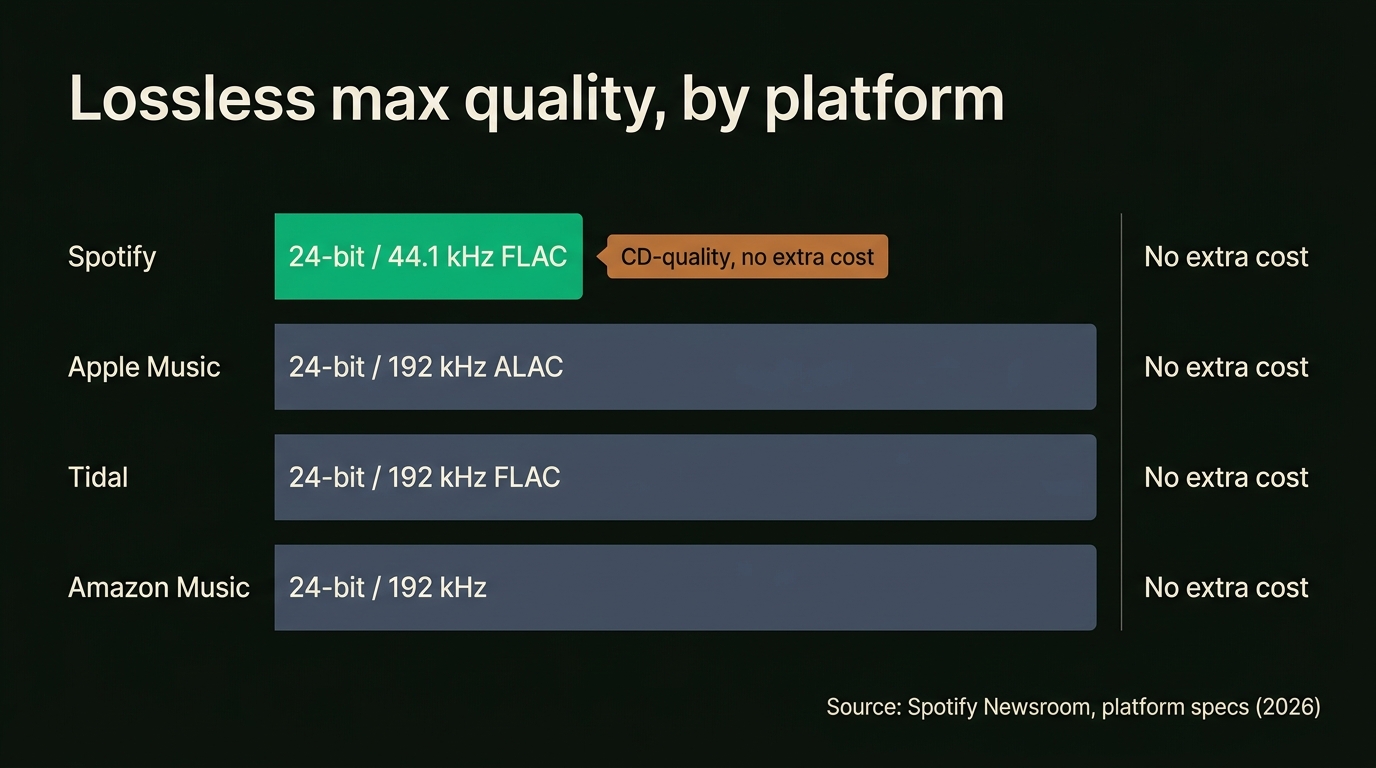
| Platform | Lossless tier | Max quality | Extra cost for lossless |
|---|---|---|---|
| Spotify | Included in Premium | 24-bit/44.1 kHz FLAC | None |
| Apple Music | Included | 24-bit/192 kHz ALAC + Spatial | None |
| Tidal | Included in standard plan | 24-bit/192 kHz FLAC | None |
| Amazon Music Unlimited | Included | 24-bit/192 kHz | None |
The takeaway: Spotify now matches the field on CD-quality but trails on maximum sample rate. For 99% of listeners that distinction is academic — most can't hear past 16-bit/44.1 kHz on consumer gear — but it's worth knowing the actual ceiling before you repeat a marketing claim about your own release "now in hi-res." On Spotify, it's lossless, not 192 kHz hi-res.
Does Lossless Change Your Royalties?
No. This is the question most artists ask first, and the answer is the most important thing in this article.
Spotify pays on a streamshare model: the service pools subscriber and ad revenue per market, then pays rights holders based on their share of total streams, adjusted for where the listener is and whether they pay for Premium. A lossless stream and a lossy stream from the same Premium listener in the same country count identically. Spotify has published no separate lossless royalty rate, and as of mid-2026 there is no announced rate premium for the format.
| Factor | Affects your payout? | Why |
|---|---|---|
| Lossless vs. lossy playback | No | Same streamshare weight per stream |
| Listener country | Yes | US ~$0.0039–$0.0046; Brazil ~$0.0018–$0.0020 |
| Premium vs. free tier | Yes | Premium streams pay ~2.5–3x more than free |
| Save / playlist add | Indirectly | Drives more streams, not a higher per-stream rate |
The per-stream average remains $0.003 to $0.005, varying heavily by country and tier (see the per-stream payout breakdown by country for the full table). If you want to model what a campaign's streams are actually worth, run the numbers through the Spotify royalty calculator rather than assuming lossless changes the math — it doesn't.
Early Push
Want to see how one track responds to a steady, paced push instead of guessing? Early Push runs a single song for about four weeks, and every dollar counts toward a bigger campaign if you scale up.
- ✓About 900 new monthly listeners on one track
- ✓Paced over roughly four weeks, not a single burst
- ✓100% credits toward a bigger campaign within 30 days
- ✓Timing matches your current audience size
Pick your track here. Credit applies if you upgrade within 30 days.
According to Chartlex campaign data from 2,400+ campaigns, the variables that move artist revenue are stream volume, listener geography, and Premium-listener share — never audio format. A lossless master sitting in your catalog earns the same per stream as the lossy version did the day before the feature launched.
Does Lossless Help Discovery or the Algorithm?
This is where artists get sold a story that doesn't hold up. Lossless does nothing for discovery.
Spotify's recommendation engine reads behavioral signals: save rate, completion rate, skip rate within the first 30 seconds, and 7-day listener return. None of those are audio-quality inputs. A 24-bit FLAC and a 96 kbps stream feed the algorithm the same data, because the algorithm measures what listeners do, not what bitrate they received.
| Signal | What it measures | Does lossless affect it? |
|---|---|---|
| Save rate | Listeners adding the track | No |
| Completion rate | Finishing the song | No |
| Skip rate (under 30s) | Early abandonment | No |
| 7-day return | Coming back to the track | No |
| Bitrate / format | Audio fidelity | This is the only thing lossless changes |
The benchmarks that actually trigger algorithmic playlists — a save rate of 15–25% from non-followers inside 7 days, completion over 60%, skip rate under 30% — are behavioral, and they're covered in depth in our guide to how the Spotify algorithm works in 2026. If your release isn't getting picked up, fidelity is not the bottleneck. We made this case before lossless even shipped: music quality alone won't get you discovered on Spotify, and lossless is the audio-quality argument in its purest form.
There's a related myth worth killing: that lossless somehow makes a track "sound more professional" to Spotify's systems and earns favor. It doesn't. Spotify ingests your master and serves it at the quality each listener selected — there is no quality-scoring step that ranks higher-resolution files for promotion. The encoder treats a great mix and a mediocre mix identically; both get the same FLAC pipeline. Mix and master for the listener, not for an imaginary algorithmic judge.
If discovery is the real goal, the lever is triggering those retention signals at scale. A free AI audit from Chartlex breaks down your algorithmic vs. playlist traffic and shows exactly which signal is holding your release back — something no bitrate setting can fix.
Who Actually Benefits From Lossless
Lossless isn't useless. It just helps a specific slice of artists in specific ways, none of which are "more streams."
- Genres where fidelity is part of the product. Ambient, jazz, classical, acoustic, and high-end electronic producers whose audiences own real listening hardware. Detail, dynamic range, and a quiet noise floor genuinely matter here.
- Artists competing on parity with Tidal and Apple Music. Until September 2025, audiophile listeners had a reason to stream you elsewhere. Now Spotify matches CD-quality, so you don't lose that listener to a rival platform. Our Tidal vs. Spotify comparison for artists covers how that competitive gap narrowed.
- Anyone releasing remasters or anniversary editions. Lossless gives a legitimate, listener-facing reason to re-promote a back catalog title in higher resolution.
For the overwhelming majority of independent artists — pop, hip-hop, indie, bedroom production consumed on phones and earbuds — lossless is invisible to your audience and irrelevant to your growth.
What You Should Actually Do About It
The practical checklist is short, and most of it is good hygiene regardless of lossless.
- Deliver your best master. Upload the highest-resolution WAV or FLAC your distributor accepts — 24-bit/44.1 kHz or higher. Spotify down-converts as needed, but it can only serve lossless if a high-quality source exists. Delivering a 320 kbps MP3 means there's nothing to upgrade.
- Confirm your distributor passes hi-res through. Most major distributors (DistroKid, TuneCore, CD Baby) accept lossless source files. Check that yours isn't transcoding your master to MP3 before delivery.
- Don't pay extra for a "lossless mastering" upsell pitched as a discovery hack. A clean master is worth it for quality; it is not a streams strategy. Anyone selling lossless as an algorithm trick is selling you fidelity dressed up as growth.
- Spend your promotion budget on signals, not bitrate. The thing that moves the needle is getting real listeners to save and finish your track. A one-time Core Algorithm Push is built to trigger the retention signals that actually drive Discover Weekly and Release Radar — the lever lossless will never be.
Make the master excellent because your work deserves it. Then put your marketing effort where the data says it pays off. According to Chartlex campaign data from 2,400+ campaigns, releases that climbed into algorithmic playlists did so on the strength of save rate and completion — measured the same way across every audio format. Not one of those breakouts was attributable to bitrate, because the algorithm never sees it. Spend on the signals, master for the ears, and keep the two budgets separate in your head.
Free Spotify Audit
See exactly where your Spotify profile is leaking growth.
Artists who fix algorithmic blind spots see +40% monthly listeners on average.
Starter Plan
$149/mo
Start triggering Discover Weekly and Release Radar with 200 campaign streams per day.
Verified in Spotify for Artists · Geo-targeted · Cancel anytime
Frequently Asked Questions
Does Spotify Lossless cost artists or listeners extra?
No. Lossless rolled out to Premium subscribers at no additional cost starting September 2025, and it does not change what artists are paid. Spotify's payout is based on streamshare, listener country, and tier — audio format is not a factor in the royalty calculation.
What bitrate and format is Spotify Lossless?
Spotify Lossless delivers FLAC files up to 24-bit/44.1 kHz, displayed in-app as "Lossless 16-bit" or "Lossless 24-bit." This is CD-quality and above, a step up from the previous 320 kbps lossy ceiling, but it is not high-sample-rate hi-res audio at 96 or 192 kHz.
Will lossless audio help my songs get on more playlists?
No. Spotify's algorithm reads behavioral signals — saves, completion rate, skip rate, and repeat listens — not audio fidelity. A lossless stream and a lossy stream feed the recommendation engine identical data, so a higher bitrate has zero effect on algorithmic or editorial playlist placement.
Which countries have Spotify Lossless?
Lossless launched in a first wave including the US, UK, Australia, Germany, Japan, the Netherlands, Sweden, and others, then expanded to more than 50 countries through 2025 and 2026 (Spotify Newsroom). Availability continues to widen, but it requires a Premium subscription and must be enabled per device.
Do I need to re-upload my music for lossless?
Only if your existing upload was a compressed file. Spotify can only serve lossless when a high-resolution source master exists, so confirm your distributor delivered a 24-bit WAV or FLAC. If you uploaded a 320 kbps MP3, re-deliver a lossless master so listeners with the setting on actually hear the upgrade.
The Bottom Line for 2026
Spotify Lossless is a genuine win for listeners and a fair competitive move against Tidal and Apple Music, but it is not a growth tool. It changes how your music sounds to a small, wired audience — it does not change your royalties, your streamshare, or a single algorithmic signal. Treat it as quality hygiene: deliver a clean high-resolution master, confirm your distributor passes it through, and move on.
Then put your energy where streams are actually won. If you want to know which signals are holding your releases back before you spend another dollar on promotion, start with a free Chartlex audit — it tells you exactly where your algorithm and playlist traffic stand, and what to fix next.
Free Weekly Playbook
One actionable insight, every Tuesday.
Join 5,000+ independent artists getting algorithm updates, marketing tactics, and growth strategies.
No spam. Unsubscribe anytime.
Find out exactly why Discover Weekly isn't picking you up.
Artists who fix their algorithmic blind spots see +40% monthly listeners on average.
Our free AI audit analyses your release cadence, save rate, skip rate patterns, and playlist velocity — then gives you a personalised action plan in under 2 minutes.
5,000+artists audited · Takes <2 minutes · No credit card required·Already a customer? Open Dashboard →
Campaign Dashboard
Turn Knowledge Into Action
Track your streams, monitor algorithmic triggers, and see growth projections in real time. The Campaign Dashboard puts everything you just read into practice.
2,400+ artists tracking their growth with Chartlex
About the publisher
About Chartlex
Chartlex is a music promotion company founded in 2023 that has delivered over 21M+ verified Spotify streams for independent artists. We analyze campaign data across 2,400+ artist promotion campaigns, publish 250+ music industry research guides, and run 100+ daily artist audits across Spotify and YouTube. Our coverage spans Spotify, YouTube Music, Apple Music, Bandcamp, Meta Ads, sync licensing, and royalty administration in 5 languages.
- Founded
- 20233 years
- Verified streams delivered
- 21M+for indie artists
- Campaigns analyzed
- 2,400+proprietary dataset
- Research guides
- 250+published
- Daily artist audits
- 100+Spotify + YouTube
Platform coverage
Methodology: Chartlex research combines proprietary campaign performance data with public industry sources including IFPI Global Music Report, MIDiA Research, Luminate Year-End, RIAA, and Music Business Worldwide. All findings are refreshed quarterly. Last verified: 2026-09-18.
Keep reading
Spotify Discovery Mode trades 30% of royalties for algorithmic exposure. Real data: +50% saves, +44% playlist adds, and when the trade-off pays off.
Marcus Vale
The number is higher than you think and varies by state after distributor cuts. Real 2026 math on Spotify streams needed to hit US minimum wage income.
Daniel Brooks
The $0.004 per stream figure is misleading. Real Spotify royalty math in 2026 - gross vs net, country rates, distributor cuts, and your take-home.
Daniel Brooks