
CD Baby Review 2026: Pricing, 9% Cut & Is It Worth It?
An honest CD Baby review for 2026: $9.99 singles, the permanent 9% commission, sync splits, a 3.8 Trustpilot score, and which artists should skip it.
Reviewed by the Chartlex editorial team·Editorial policy
Explore with AI
Get an instant summary of this guide from your favourite assistant.

Quick Answer
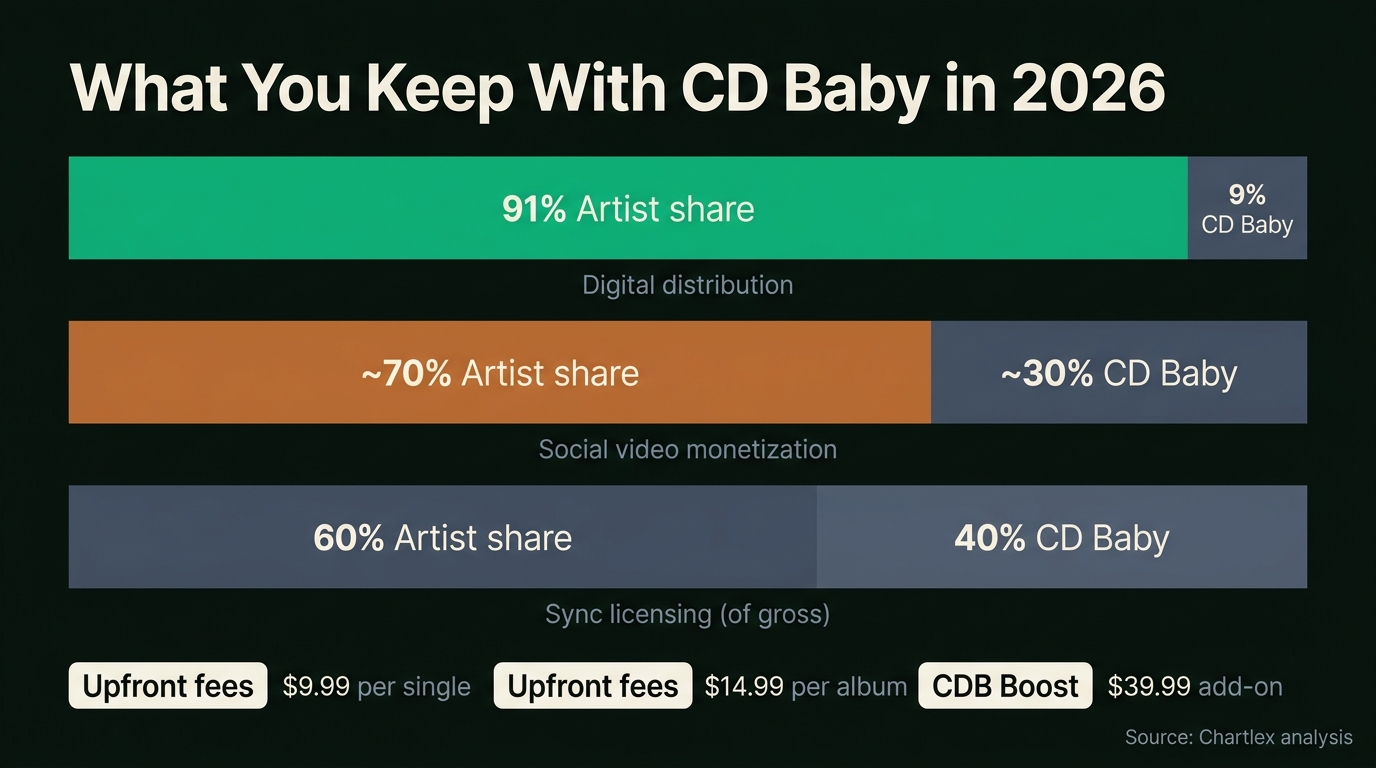
CD Baby is worth it in 2026 for artists who want permanent distribution without annual fees, but only if they accept the tradeoff: a one-time $9.99 per single or $14.99 per album, and CD Baby keeps 9% of your digital distribution revenue forever. Your music stays live even if you never pay again, which subscription distributors cannot promise. The costs stack elsewhere: sync placements pay you 60% of gross, social video monetization pays roughly 70%, and mechanical royalty collection now requires the $39.99 CDB Boost add-on after CD Baby retired its publishing administration service in 2023. CD Baby holds a 3.8 rating on Trustpilot across roughly 9,900 reviews, and since early 2026 it sits inside Universal Music Group following the $775 million Downtown Music acquisition. Low-volume artists with stable catalogs win on this model. High-volume releasers and fast-growing earners usually pay less elsewhere.
What This CD Baby Review Covers
CD Baby is the oldest name in independent distribution, founded in 1998, and it still runs a model nobody else at its scale offers: pay once per release, stay live forever. This CD Baby review breaks down what that actually costs in 2026, because the headline price is only the entry fee.
Here's what most artists don't realize: the one-time fee is not the business model. The 9% commission is. Every dollar your catalog earns through CD Baby, this year and in year ten, sends nine cents back to the distributor. Whether that beats a $24.99 annual subscription like DistroKid's Musician plan depends entirely on how much your music earns.
This review works through the honest math: current pricing, the commission at different earning levels, the add-on stack, the new Universal Music Group ownership, and who should actually use CD Baby in 2026.
What CD Baby Costs in 2026
CD Baby simplified its pricing in 2023 and has held it steady since. There are no tiers, no subscriptions, and no renewal fees. You pay per release, once.
| Item | Cost | Notes |
|---|---|---|
| Single | $9.99 one-time | Stays live permanently |
| Album | $14.99 one-time | Any track count |
| Annual renewal | $0 | None, ever |
| Commission | 9% of digital revenue | Permanent, cannot be removed |
| UPC barcode | Free | Included |
| ISRC codes | Free | Included |
| CDB Boost add-on | $39.99 per release | MLC + SoundExchange registration, sync consideration |
| FastForward add-on | $29.99 per release | Priority review plus one year of priority support |
Distribution covers 150+ stores and streaming services, including Spotify, Apple Music, TikTok, Amazon, Pandora, YouTube, and Deezer, according to CD Baby's own pricing page.
Two things quietly disappeared from this lineup over the past few years. Physical CD and vinyl distribution, once CD Baby's founding product, was retired in June 2023. Publishing administration (the old CD Baby Pro tier) was shut down in August 2023. What remains is a pure digital distributor with optional add-ons.
The 9% Commission: The Honest Math
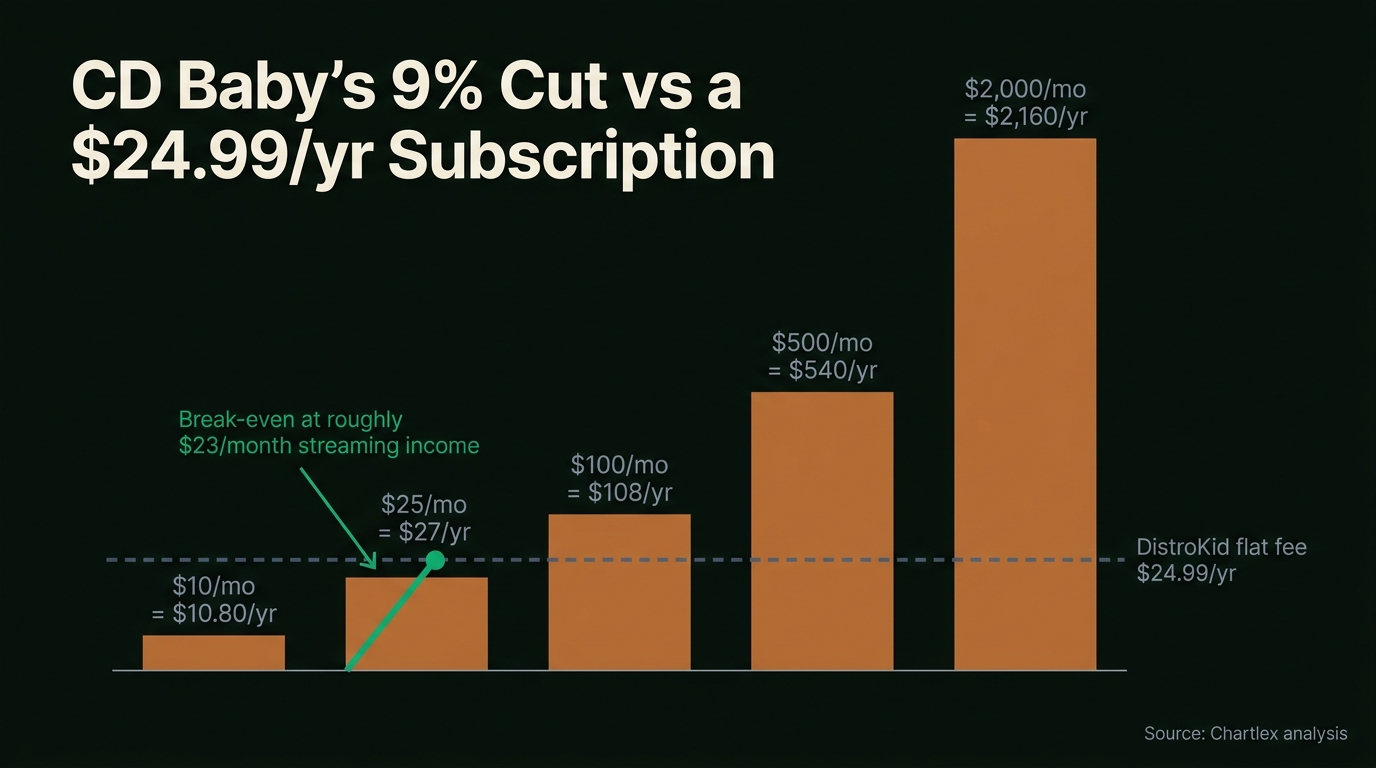
The permanent 9% cut is where CD Baby's "cheap" pricing gets complicated. You keep 91% of digital distribution revenue. That sounds close to 100% until your catalog starts earning.
Here's what this means in practice at different income levels, compared against DistroKid's $24.99/year zero-commission Musician plan:
| Monthly streaming income | Annual income | CD Baby's 9% cut per year | DistroKid annual cost | Cheaper option |
|---|---|---|---|---|
| $10 | $120 | $10.80 | $24.99 | CD Baby |
| $25 | $300 | $27 | $24.99 | Roughly even |
| $100 | $1,200 | $108 | $24.99 | DistroKid |
| $500 | $6,000 | $540 | $24.99 | DistroKid by far |
| $2,000 | $24,000 | $2,160 | $24.99 | Not close |
The break-even point sits around $23 per month in streaming revenue. Below that, CD Baby's model is genuinely cheaper and the permanence is a free bonus. Above it, every additional stream widens the gap.
At Spotify's typical $0.003 to $0.005 per stream, $23 a month is roughly 5,000 to 7,500 monthly streams across your whole catalog. Plenty of hobby artists never cross that line, and for them the one-time fee is the right buy. Artists actively growing usually cross it within a year or two, and then the 9% becomes the most expensive "cheap" plan in distribution.
If you want to see where your own numbers land, run your catalog through the Spotify royalty calculator and take 9% of the result. That figure, annualized, is your real CD Baby price.
Add-Ons: Boost, FastForward, Sync and Publishing
CD Baby's base fee covers distribution only. Royalty collection beyond streaming, and anything involving sync or publishing, runs through add-ons and revenue splits.
| Service | Cost to you | What you keep |
|---|---|---|
| CDB Boost | $39.99 per release | MLC mechanical + SoundExchange registration handled for you |
| FastForward | $29.99 per release | Faster review, one year priority support |
| Sync licensing program | No upfront fee | 60% of gross license fees |
| Social video monetization (YouTube, Meta) | No upfront fee | Roughly 70% of ad revenue |
First Push
Never put money behind a track before? First Push is the smallest way to find out how one song responds over about four weeks, and it counts toward anything bigger later.
- ✓About 600 new monthly listeners on one track
- ✓Paced over roughly four weeks, not a single burst
- ✓100% credits toward a bigger campaign within 30 days
- ✓The lowest cost way to try one track
Pick your track here. Credit applies if you upgrade within 30 days.
The sync split is defined in CD Baby's own sync addendum: you receive 60% of the gross amount CD Baby actually collects from licensees, after CD Baby deducts direct administration costs. A 40% distributor share on sync is on the high side of the market, though sync placement is opt-in and non-exclusive, so there's little downside to leaving it on while you shop your music elsewhere too.
The bigger structural change is publishing. Since CD Baby Pro closed in August 2023, CD Baby no longer offers full publishing administration. CDB Boost fills part of the gap by registering your songs with The MLC and SoundExchange for US mechanical and digital performance royalties, but it is not global publishing collection. Third-party fee audits, like ALERA's 2026 CD Baby fee breakdown, also report an administration fee on royalties collected through Boost, so read the terms at checkout.
What this means in practice: songwriters using CD Baby still need to handle performance royalties themselves. At minimum, register with a PRO like ASCAP or BMI. If your songs earn internationally, a dedicated publishing administrator is worth the fee. Our guide to music publishing administration walks through the options and their splits.
The UMG Question: Who Owns CD Baby Now
CD Baby has not been independent for years, but 2026 changed the picture materially. Universal Music Group completed its $775 million acquisition of Downtown Music Holdings, CD Baby's parent company, in early 2026. CD Baby now sits inside the largest major label group in the world, alongside FUGA and Songtrust.
For most artists, nothing changed at the product level: pricing, the 9% commission, and the dashboard all carried over. The strategic question is longer-term. A major label owning the pipes that "independent" music flows through gives UMG visibility into indie streaming data at enormous scale, and consolidation historically precedes pricing and policy changes.
None of that is a reason to panic if you're already on CD Baby. It is a reason to keep your catalog portable: keep your masters, your original files, and your metadata organized so a future move to another distributor is a project, not a crisis.
CD Baby Review: Pros and Cons
Pros
- Pay once, stay live forever. No subscription anxiety, no takedowns for a missed renewal.
- Cheapest option for low-earning catalogs, under roughly $23/month in streaming income.
- Free UPCs and ISRCs included in the release fee.
- Opt-in sync licensing program with no upfront cost.
- 150+ store reach, including all majors plus TikTok and YouTube.
- 28 years of operating history, which matters in a space full of two-year-old distributors.
Cons
- The permanent 9% commission gets expensive fast as your streams grow.
- No publishing administration since August 2023. Songwriters must solve that elsewhere.
- Physical distribution is gone entirely.
- Sync pays only 60% of gross, a high distributor share for the category.
- Mechanical and SoundExchange collection is paywalled behind the $39.99 Boost add-on.
- Now owned by Universal Music Group, which cuts against the independent positioning.
- Customer support reviews are mixed: 3.8 stars on Trustpilot across roughly 9,900 reviews, middling for the category.
CD Baby vs DistroKid, TuneCore and Ditto
The distribution market splits into two camps: pay-per-release with commission (CD Baby) and subscription with zero commission (almost everyone else). Here's how the four biggest names compare in 2026:
| CD Baby | DistroKid | TuneCore | Ditto | |
|---|---|---|---|---|
| Pricing model | One-time per release | Annual subscription | Annual subscription | Annual subscription |
| Entry cost | $9.99 per single | $24.99/yr unlimited | Free tier (social only), paid from $14.99/yr | $19/yr unlimited |
| Commission | 9% forever | 0% | 0% on paid plans | 0% |
| Music stays live if you stop paying | Yes | No, unless you buy Leave a Legacy | No | No |
| Publishing admin | No (retired 2023) | No | Yes, add-on | Add-on via partners |
| Best for | Low-volume permanence | High-volume releasers | Songwriters wanting bundled publishing | Budget unlimited uploads |
The pattern is consistent: subscriptions win on cost for anyone releasing regularly or earning meaningfully, while CD Baby wins on permanence and simplicity. For a deeper look at the subscription side, see our Ditto vs DistroKid comparison, or the full music distribution companies comparison covering the wider field.
Who Should Use CD Baby in 2026
Verdict by artist type, based on the math above:
| Artist type | CD Baby fit | Why |
|---|---|---|
| Hobbyist, 1-2 releases total | Strong yes | One-time fee, music never comes down, no renewal to forget |
| Legacy catalog owner, minimal new music | Strong yes | Permanence is the whole value; 9% of small numbers is small |
| Growing artist, 4+ releases/year | No | Per-release fees plus 9% stack fast; a subscription is cheaper both ways |
| Artist earning $100+/month streaming | No | The 9% alone costs 4x a DistroKid subscription |
| Songwriter prioritizing publishing money | No | No pub admin since 2023; TuneCore or a Songtrust-style admin fits better |
| Sync-focused artist | Maybe | Free opt-in program, but the 60/40 split argues for a dedicated sync agency as you grow |
Free Spotify Audit
See exactly where your Spotify profile is leaking growth.
One audit finds an average of 4 growth blockers per artist profile.
Pro Growth Plan
$599/mo
Serious about building a music business? Consistent algorithmic momentum puts you on Spotify's radar.
Verified in Spotify for Artists · Geo-targeted · Cancel anytime
One more distinction worth naming: distribution gets your music into stores, and that's all it does. According to Chartlex campaign data from 2,400+ campaigns, distribution choice has essentially no effect on streaming outcomes; the algorithm doesn't know or care which distributor delivered the file. What moves numbers is what happens after release day. If your releases are going live and flatlining, the distributor is the wrong suspect. A free AI audit of your Spotify profile will show you where the actual growth gaps are, from algorithmic triggers to playlist traffic sources.
Frequently Asked Questions
Is CD Baby worth it in 2026?
Yes for low-volume artists who value permanence: $9.99 to $14.99 once, and your music stays live forever. No for artists earning above roughly $23/month in streaming revenue, where the permanent 9% commission costs more each year than a zero-commission subscription distributor.
How much does CD Baby take from artists?
CD Baby keeps 9% of digital distribution revenue permanently, so you keep 91%. On sync placements you keep 60% of gross license fees, and on social video monetization you keep roughly 70%. The upfront release fees ($9.99 single, $14.99 album) are separate from these splits.
Does CD Baby still do publishing administration?
No. CD Baby Pro publishing administration was discontinued in August 2023. The $39.99 CDB Boost add-on covers US mechanical royalties via The MLC and SoundExchange registration, but global publishing collection now requires a separate administrator plus your own PRO registration.
Who owns CD Baby now?
Universal Music Group. UMG completed its $775 million acquisition of Downtown Music Holdings, CD Baby's parent company, in early 2026. Day-to-day pricing and features carried over unchanged, but CD Baby is no longer independently owned, and it now sits alongside FUGA and Songtrust inside the major label group.
Does my music stay on Spotify if I stop paying CD Baby?
Yes. This is CD Baby's core advantage. The release fee is one-time, so your music remains live on all stores indefinitely with no renewal. Subscription distributors like DistroKid and TuneCore remove your music if you cancel, unless you pay extra for permanence.
Is CD Baby cheaper than DistroKid?
Only for small catalogs. Below roughly $23/month in streaming income, CD Baby's one-time fees beat DistroKid's $24.99/year. Above that, DistroKid's 0% commission wins, and the gap grows with your streams. At $500/month, CD Baby's 9% costs $540/year against DistroKid's $24.99.
CD Baby Review Verdict: Worth It, For the Right Artist
CD Baby in 2026 is a well-built product for a specific customer: the artist who releases occasionally, earns modestly, and wants to pay once and never think about distribution again. For that artist, nothing else on the market matches the pay-once permanence. For the growing artist releasing every quarter and watching monthly listeners climb, the permanent 9% commission turns a $9.99 bargain into the most expensive distributor they could have picked.
Whichever side of that line you're on, remember that distribution is table stakes, not strategy. Getting into stores is solved for $10. Getting heard is the actual problem. If your next release deserves more than an upload and a hope, compare Chartlex promotion plans to pair your distribution with a campaign that gives the algorithm a reason to pay attention. Apply the same scrutiny you gave CD Baby here too: our Chartlex reviews breakdown covers the full customer record.
Free Weekly Playbook
One actionable insight, every Tuesday.
Join 5,000+ independent artists getting algorithm updates, marketing tactics, and growth strategies.
No spam. Unsubscribe anytime.
Get a business health check for your music career.
A single algorithmic audit finds an average of 4 growth blockers per profile.
Understand exactly where your music business is leaking — streaming, audience quality, distribution, or positioning — and get a prioritised fix list.
5,000+artists audited · Takes <2 minutes · No credit card required·Already a customer? Open Dashboard →
Campaign Dashboard
Turn Knowledge Into Action
Track your streams, monitor algorithmic triggers, and see growth projections in real time. The Campaign Dashboard puts everything you just read into practice.
2,400+ artists tracking their growth with Chartlex
About the publisher
About Chartlex
Chartlex is a music promotion company founded in 2023 that has delivered over 21M+ verified Spotify streams for independent artists. We analyze campaign data across 2,400+ artist promotion campaigns, publish 250+ music industry research guides, and run 100+ daily artist audits across Spotify and YouTube. Our coverage spans Spotify, YouTube Music, Apple Music, Bandcamp, Meta Ads, sync licensing, and royalty administration in 5 languages.
- Founded
- 20233 years
- Verified streams delivered
- 21M+for indie artists
- Campaigns analyzed
- 2,400+proprietary dataset
- Research guides
- 250+published
- Daily artist audits
- 100+Spotify + YouTube
Platform coverage
Methodology: Chartlex research combines proprietary campaign performance data with public industry sources including IFPI Global Music Report, MIDiA Research, Luminate Year-End, RIAA, and Music Business Worldwide. All findings are refreshed quarterly. Last verified: 2026-10-25.
Keep reading
An honest UnitedMasters review for 2026: the free tier's 10% cut, $19.99 Debut+ and $59.99 Select plans, the brand deal reality, and who should skip it.
Daniel Brooks
TuneCore pricing in 2026 explained: unlimited plans from $24.99/year, the 20% social platform fee, new publishing admin costs, and when it beats DistroKid.
Daniel Brooks
DistroKid costs $24.99, $44.99 or from $89.99 a year in 2026, depending on the plan. Add-ons like Leave a Legacy ($29 a single) raise the real cost. Full math.
Daniel Brooks