
DistroKid Pricing 2026: Every Plan, Hidden Cost & Worth It
DistroKid pricing 2026 broken down: all 3 plans from $24.99/yr, Leave a Legacy fees, hidden add-ons, and how it compares to TuneCore and CD Baby.
Reviewed by the Chartlex editorial team·Editorial policy
Explore with AI
Get an instant summary of this guide from your favourite assistant.

Quick Answer
DistroKid pricing in 2026 runs across three annual plans: Musician at $24.99/year (1 artist name), Musician Plus at $44.99/year (2 artist names), and Ultimate at $89.99/year (up to 100 artist names). DistroKid takes 0% commission on streaming royalties — you keep 100%, which beats CD Baby's permanent 9% cut. The catch is the add-on stack: Leave a Legacy costs a one-time $29 per single or $49 per album to keep your music live if you ever stop paying, YouTube Content ID is $4.95 per single (plus a 20% revenue cut), and Store Maximizer is $7.95 per release per year. A casual artist releasing three singles in year one realistically spends around $147, not $24.99, once those add-ons are included. The subscription is a lease, not a purchase — cancel and your unprotected releases come down within weeks. The model is cheapest for high-volume releasers who keep paying, and most expensive, long term, for low-volume catalogs that want permanence.
What DistroKid Actually Costs in 2026
DistroKid sells itself on one number: $24.99 a year for unlimited uploads. That number is real, but it is the floor, not the ceiling. The pricing is built around a subscription that keeps your music online only while you keep paying, plus a menu of per-release add-ons that most artists end up buying without planning for them.
Here is the honest math. DistroKid's headline appeal — 0% commission, keep 100% of streaming royalties — is genuinely strong and beats the percentage-based model that CD Baby uses. But the recurring-fee structure means your distribution cost never ends, and the take-down risk if you cancel is the single most misunderstood part of the platform.
Before you commit to any distributor, it helps to know what your streams are even worth. Plug your numbers into the free Spotify royalty calculator to see your real per-stream take-home after a distributor's cut — that figure decides whether a 0% model or a 9% model wins for you.
DistroKid Plans and Pricing (2026)
DistroKid runs three plans. All include unlimited song and album uploads — the differences are artist-name capacity and access to scheduling and analytics features.
| Plan | Annual Price | Monthly Equivalent | Artist Names | Best For |
|---|---|---|---|---|
| Musician | $24.99/yr | ~$2.08/mo | 1 | Solo artists, first release |
| Musician Plus | $44.99/yr | ~$3.75/mo | 2 | Two projects, scheduled drops |
| Ultimate | $89.99/yr | ~$7.50/mo | Up to 100 | Labels, managers, prolific catalogs |
Musician ($24.99/year) covers one artist name with unlimited uploads and 100% of streaming royalties. The limitation that trips people up: no custom release dates. You cannot schedule a Friday drop or run a pre-save with a fixed date on this tier.
Musician Plus ($44.99/year) adds a second artist name, custom release and pre-order dates, custom label naming, and daily streaming stats. For anyone running more than one project or timing releases around an algorithm window, this is the practical entry point.
Ultimate ($89.99/year) is built for labels and managers — up to 100 artist names, advanced analytics, audio replacement, and playlist contact search. If you are managing a roster, the per-artist cost here is far lower than buying separate accounts.
The Add-Ons: Where the Real Cost Lives
The plan price is the smallest part of most artists' annual spend. DistroKid's add-ons are mostly per-release and recur every year you want the feature active.
| Add-On | Cost | Recurring? | What It Does |
|---|---|---|---|
| Leave a Legacy | $29 single / $49 album | One-time | Keeps the release live if you cancel |
| YouTube Content ID | $4.95 single / $14.95 album per year | Yes (+20% rev share) | Monetizes/claims your audio on YouTube |
| Store Maximizer | $7.95 per release per year | Yes | Auto-adds new stores as they launch |
| Discovery Pack (Shazam/etc.) | $0.99 per song per year | Yes | Extra discovery placements |
| Loudness Normalization | $2.99 | One-time | Masters volume to platform standards |
| Cover Song Licensing | ~$12 per cover per year | Yes | Legal mechanical license for covers |
The two that matter most are Leave a Legacy and YouTube Content ID, because both touch money and permanence.
Leave a Legacy: The Hidden Cost That Defines DistroKid
This is the part nobody factors in. DistroKid's subscription is a lease, not a purchase. If you cancel or miss a renewal payment, every release without Leave a Legacy is removed from streaming platforms — typically within a few weeks of the lapse.
Leave a Legacy is the workaround: a one-time $29 per single or $49 per album that keeps that specific release online permanently, even after you stop paying. It is not retroactive insurance for your whole catalog at once — you pay per release.
Run the numbers on a 10-single catalog. Keeping all of them permanently online costs $290 in Leave a Legacy fees on top of your annual subscription. That is the real cost of "owning" your distribution on DistroKid, and it is exactly the kind of fee artists discover only when they try to leave.
If you are still deciding between distributors, our Ditto vs DistroKid breakdown covers how this take-down model compares to flat-rate competitors that never remove your music.
Real-World Annual Cost (Not the Sticker Price)
First Push
Never put money behind a track before? First Push is the smallest way to find out how one song responds over about four weeks, and it counts toward anything bigger later.
- ✓About 600 new monthly listeners on one track
- ✓Paced over roughly four weeks, not a single burst
- ✓100% credits toward a bigger campaign within 30 days
- ✓The lowest cost way to try one track
Pick your track here. Credit applies if you upgrade within 30 days.
Here is what artists actually spend in year one on Musician Plus, with typical add-ons layered in.
| Artist Profile | Releases (Year 1) | Realistic Year-1 Total |
|---|---|---|
| Casual | 3 singles | ~$147 |
| Active | 8 singles + 1 album | ~$388 |
| Prolific | 15 singles + 3 albums | ~$770 |
Across five years, a prolific artist releasing 20 singles and 5 albums with Content ID, Store Maximizer, and Leave a Legacy on key releases lands near $2,690 total. The $24.99 headline is accurate; the lived experience is multiples of it.
According to Chartlex campaign data from 2,400+ campaigns, distribution choice rarely affects streaming volume — the algorithm does not care who delivered your track. What distribution affects is your take-home per stream and your long-term catalog control. If you want to see how distribution cuts stack against everything else you earn, the multi-stream revenue calculator maps your full income picture across seven sources.
DistroKid vs TuneCore vs CD Baby (2026 Pricing)
For the line-by-line TuneCore side, see the dedicated TuneCore pricing breakdown.
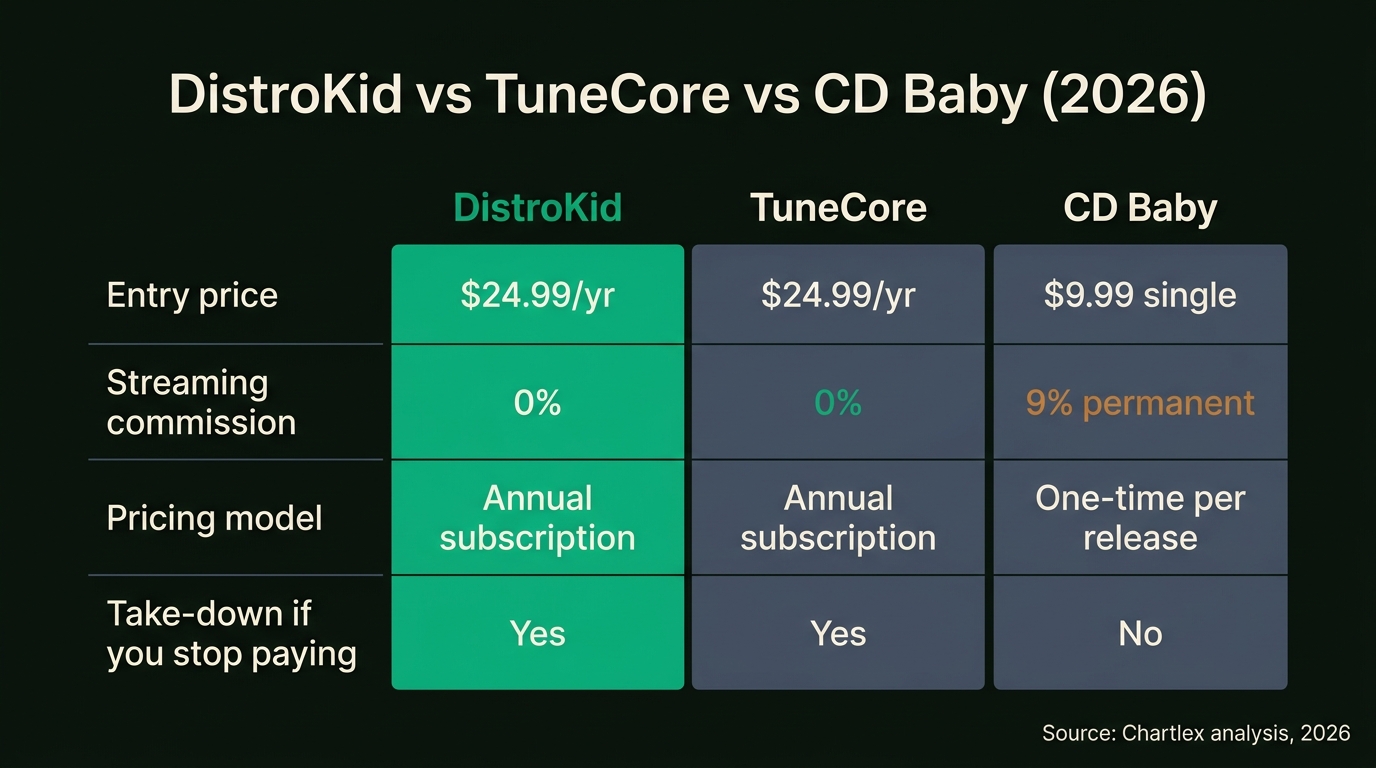
The three biggest distributors take three fundamentally different approaches. DistroKid and TuneCore both run unlimited-upload subscriptions with 0% commission; CD Baby charges once per release but keeps a permanent 9% cut. Our full TuneCore review digs into the payout structure and who the subscription model actually suits.
| Feature | DistroKid | TuneCore | CD Baby |
|---|---|---|---|
| Entry price | $24.99/yr | $24.99/yr (Rising) | $9.99 single / $14.99 album |
| Mid tier | $44.99/yr (Plus) | $44.99/yr (Breakout) | n/a |
| Top tier | $89.99/yr (Ultimate) | $54.99/yr (Professional) | CDB Boost add-on, $39.99 one-time |
| Pricing model | Annual subscription | Annual subscription | One-time per release |
| Streaming commission | 0% | 0% | 9% (permanent) |
| Recurring renewal? | Yes | Yes | No |
| Take-down if you stop paying? | Yes (unless Leave a Legacy) | Yes | No — stays up |
| Publishing admin | Not bundled | 20% add-on | CDB Boost, $39.99 one-time (Pro Publishing discontinued 2023) |
The trade-off is clean. DistroKid and TuneCore win for high-volume releasers — unlimited uploads at a flat annual fee, no percentage skim. CD Baby wins for low-volume artists who hate recurring bills and want their music to stay online forever with no renewal, accepting the 9% cut as the price of permanence.
The break-even point matters: for a release that earns serious long-term income, CD Baby's 9% commission eventually exceeds DistroKid's annual fee plus a one-time Leave a Legacy payment. For a release that earns little, CD Baby's one-time $9.99 beats years of DistroKid renewals. For a deeper side-by-side across ten platforms, see our best music distribution platforms comparison.
Who DistroKid Is Actually For
According to Chartlex campaign data from 2,400+ campaigns, the artists who get the most out of DistroKid are the frequent releasers — the flat fee rewards volume. DistroKid is the right call if you release frequently, want 100% of streaming royalties, and will keep paying the subscription indefinitely. The flat annual fee scales beautifully when you are dropping singles every few weeks — the marginal cost of release number 30 is zero.
It is the wrong call if you release rarely and resent recurring fees, or if catalog permanence without ongoing payment is your priority. In that case CD Baby's one-time model fits better, even with the 9% cut.
A note on what distribution does not do: it gets your music onto platforms, but it does not promote it. Plenty of artists assume DistroKid's reach equals discovery. It does not. Once you are distributed, growth comes from algorithmic and playlist traction — which is where a free Spotify audit from Chartlex is useful, because it shows whether your streams are coming from algorithm, playlists, or nowhere at all.
How to Minimize Your DistroKid Spend
Three moves cut the real cost without sacrificing what matters.
Free Spotify Audit
See exactly where your Spotify profile is leaking growth.
One audit finds an average of 4 growth blockers per artist profile.
Pro Growth Plan
$599/mo
Serious about building a music business? Consistent algorithmic momentum puts you on Spotify's radar.
Verified in Spotify for Artists · Geo-targeted · Cancel anytime
- Skip Store Maximizer unless you need every fringe store. Spotify, Apple, Amazon, and YouTube Music cover the vast majority of indie revenue. Paying $7.95 per release to auto-list on micro-stores rarely pays back.
- Buy Leave a Legacy only on releases that earn. Do not blanket-insure dead catalog. Track which releases actually generate streams, then protect those.
- Buy Content ID selectively. The 20% revenue share plus annual fee only makes sense if your audio is being used on YouTube at scale. For most indie releases, it is not.
If you are weighing distribution as one line item in a bigger release budget, comparing it against promotion and publishing costs helps — our sync licensing rate card shows where distribution sits relative to the licensing income most artists overlook. And when you are ready to actually grow the streams that distribution delivers, compare Chartlex campaign plans to see what predictable monthly growth costs versus a one-time push.
Frequently Asked Questions
How much does DistroKid cost per year in 2026?
DistroKid's three plans cost $24.99/year (Musician, 1 artist), $44.99/year (Musician Plus, 2 artists), and $89.99/year (Ultimate, up to 100 artists). All include unlimited uploads and 0% commission, but per-release add-ons like Leave a Legacy and Content ID typically push real spend well above the base fee.
What happens to my music if I stop paying DistroKid?
DistroKid removes every release that does not have Leave a Legacy, usually within a few weeks of your subscription lapsing. To keep a release online permanently after cancelling, you must pay the one-time Leave a Legacy fee of $29 per single or $49 per album before you stop paying.
Is DistroKid cheaper than TuneCore or CD Baby?
DistroKid and TuneCore both start at $24.99/year with 0% commission, so they are close for high-volume releasers. CD Baby charges a one-time $9.99 (single) or $14.99 (album) with no renewal but keeps a permanent 9% commission. CD Baby is cheaper for rare releases; DistroKid wins for frequent ones.
Does DistroKid take a percentage of my royalties?
No. DistroKid takes 0% of your streaming royalties on all three plans — you keep 100%. The exception is YouTube Content ID, an optional add-on that charges an annual fee plus a 20% share of the ad revenue it collects on your behalf. The base distribution itself is commission-free.
Is DistroKid worth it for new artists?
For new artists releasing regularly, yes — the flat annual fee and 100% royalty retention are hard to beat. For an artist planning one or two releases ever, CD Baby's one-time fee avoids the take-down risk and recurring cost. Match the model to your release frequency, not the headline price.
The Bottom Line on DistroKid Pricing
DistroKid's $24.99 entry price is real but incomplete — Leave a Legacy fees, Content ID, and per-release add-ons mean most artists spend two to six times the sticker number in their first year. It is the strongest choice for prolific releasers who keep 100% of royalties and will pay the subscription long term, and the weakest for low-volume artists who want permanence without recurring bills.
Pick the distributor that matches your release cadence, then put your energy where it actually moves streams. Distribution gets you on the shelf; it never gets you discovered. Start by running a free audit to see exactly where your current streams come from — then decide where the next dollar of your budget should go.
Free Weekly Playbook
One actionable insight, every Tuesday.
Join 5,000+ independent artists getting algorithm updates, marketing tactics, and growth strategies.
No spam. Unsubscribe anytime.
Get a business health check for your music career.
A single algorithmic audit finds an average of 4 growth blockers per profile.
Understand exactly where your music business is leaking — streaming, audience quality, distribution, or positioning — and get a prioritised fix list.
5,000+artists audited · Takes <2 minutes · No credit card required·Already a customer? Open Dashboard →
Campaign Dashboard
Turn Knowledge Into Action
Track your streams, monitor algorithmic triggers, and see growth projections in real time. The Campaign Dashboard puts everything you just read into practice.
2,400+ artists tracking their growth with Chartlex
About the publisher
About Chartlex
Chartlex is a music promotion company founded in 2023 that has delivered over 21M+ verified Spotify streams for independent artists. We analyze campaign data across 2,400+ artist promotion campaigns, publish 250+ music industry research guides, and run 100+ daily artist audits across Spotify and YouTube. Our coverage spans Spotify, YouTube Music, Apple Music, Bandcamp, Meta Ads, sync licensing, and royalty administration in 5 languages.
- Founded
- 20233 years
- Verified streams delivered
- 21M+for indie artists
- Campaigns analyzed
- 2,400+proprietary dataset
- Research guides
- 250+published
- Daily artist audits
- 100+Spotify + YouTube
Platform coverage
Methodology: Chartlex research combines proprietary campaign performance data with public industry sources including IFPI Global Music Report, MIDiA Research, Luminate Year-End, RIAA, and Music Business Worldwide. All findings are refreshed quarterly. Last verified: 2026-09-17.
Keep reading
TuneCore pricing in 2026 explained: unlimited plans from $24.99/year, the 20% social platform fee, new publishing admin costs, and when it beats DistroKid.
Daniel Brooks
An honest CD Baby review for 2026: $9.99 singles, the permanent 9% commission, sync splits, a 3.8 Trustpilot score, and which artists should skip it.
Daniel Brooks
An honest UnitedMasters review for 2026: the free tier's 10% cut, $19.99 Debut+ and $59.99 Select plans, the brand deal reality, and who should skip it.
Daniel Brooks