
TuneCore Review 2026: Pricing, Payouts & Is It Worth It?
An honest TuneCore review for 2026: plans from $24.99/year, the 100% streaming payout, the 20% social fee, a 4.1 Trustpilot score, and who should skip it.
Reviewed by the Chartlex editorial team·Editorial policy
Explore with AI
Get an instant summary of this guide from your favourite assistant.

Quick Answer
TuneCore is a solid, fairly priced music distributor in 2026, but only if you pick the right plan and understand its two-sided payout split. Paid unlimited plans run $24.99/year (Rising Artist), $44.99/year (Breakout Artist), and $54.99/year (Professional), verified on tunecore.com in July 2026. You keep 100% of streaming royalties from the 150+ stores it delivers to, but TuneCore keeps 20% of earnings from social platforms like TikTok, YouTube, Instagram, and Facebook. Its Trustpilot score sits at 4.1 stars across more than 12,400 reviews, strong for the category, though recent complaints cluster around abnormal-activity account flags and withheld balances. The honest math: for a solo artist releasing more than one single a year, the $24.99 Rising Artist plan is one of the better values in distribution. Artists who want permanence without annual renewals should look at CD Baby instead.
What TuneCore Is and Who It Is Built For
TuneCore is one of the oldest names in independent music distribution. Founded in 2006 and now owned by Believe, it moves your releases into Spotify, Apple Music, Amazon, and more than 150 other stores and streaming services, and it collects the money those platforms owe you.
For most of its history, TuneCore charged per release with annual renewals, a model that punished artists with growing catalogs. That changed when the company moved to unlimited-upload subscription plans, which is the structure you are buying into in 2026. Pay one annual fee, upload as much as you want, keep 100% of your streaming royalties.
Here's what most artists don't realize: the distributor decision is a business decision, not a growth decision. According to Chartlex campaign data from 2,400+ campaigns, distributor choice almost never determines whether a release grows. Distribution puts your music on the shelf. Promotion is what moves it off the shelf. Keep that framing in mind as you read, because TuneCore's job is plumbing, and it should be judged on plumbing criteria: cost, payout split, reliability, and support.
If you are still weighing the whole field before committing, our full breakdown of music distribution companies compared in 2026 covers the wider market. This review goes deep on TuneCore specifically.
TuneCore Pricing in 2026: Every Plan and Fee
For the fee-by-fee breakdown, including the January 2026 publishing administration commission increase to 20%, see the dedicated TuneCore pricing guide.
All prices below were verified directly on TuneCore's pricing page in July 2026. The three unlimited plans differ mainly in release scheduling, support speed, and collaboration tools, not in store reach.
| Plan | Price | What You Get | Support Response |
|---|---|---|---|
| Rising Artist | $24.99/yr | Unlimited releases to 150+ stores, YouTube Content ID, Store Automator, daily trend reports, custom label name | 3 business days |
| Breakout Artist | $44.99/yr | Everything in Rising, plus Store Automator automatic delivery to newly added stores | 2 business days |
| Professional | $54.99/yr | Everything in Breakout, full store and platform access, priority handling | 1 business day |
Two structural details matter more than the headline prices.
Additional artist profiles cost $14.99 each per year. The plans cover one primary artist name. If you run a side project or manage two acts, budget for that add-on on every plan.
The old pay-per-release model still exists, and it is a trap for albums. A single costs $24.99 as a one-time release, but an album costs $44.99 in year one and then $56.49 every year after that just to stay live. That renewal structure is the legacy TuneCore model that drove artists away a decade ago. In practice there is almost no scenario where per-release pricing beats the $24.99 unlimited plan, so treat the unlimited plans as the real product.
| Pay-Per-Release Option | First Year | Renewal |
|---|---|---|
| Single | $24.99 | Varies by store agreement |
| Album | $44.99 | $56.49/yr, every year |
| Additional artist profile | $14.99/yr | $14.99/yr |
One more note on the entry point. TuneCore previously promoted a free New Artist tier that distributed to social platforms only and kept 20% of earnings. As of July 2026, that free plan no longer appears on TuneCore's pricing page or homepage, so the $24.99 Rising Artist plan is the practical floor for getting onto Spotify and Apple Music.
The Payout Split: What You Actually Keep
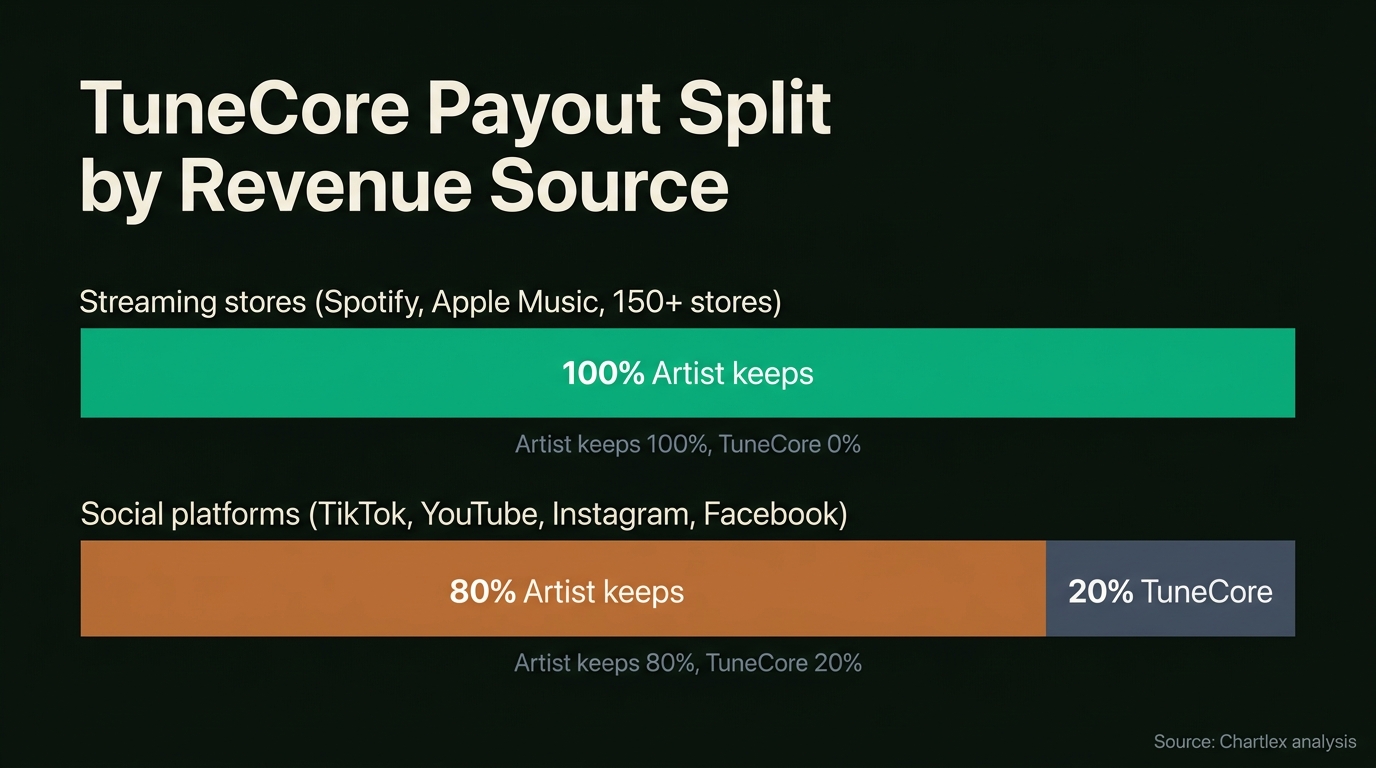
This is the part of every TuneCore review that gets oversimplified, so let's do the honest math. TuneCore's payout is not one number. It depends on where the money comes from.
| Revenue Source | Your Share | TuneCore's Cut |
|---|---|---|
| Streaming stores (Spotify, Apple Music, Amazon, 150+ others) | 100% | 0% |
| Downloads through stores | 100% | 0% |
| Social platforms (TikTok, YouTube, Instagram, Facebook) | 80% | 20% |
On the core streaming side, TuneCore is genuinely a keep-100% distributor on its paid plans. Every Spotify stream, every Apple Music play, every download pays through to you with no commission. That matches DistroKid and Ditto, and it beats CD Baby's permanent 9% cut.
The 20% social platform fee is the asterisk. If a meaningful share of your income comes from TikTok sounds, Instagram Reels usage, or YouTube Content ID claims, TuneCore takes a fifth of that revenue. For most independent artists this is a small line item. For an artist whose growth engine is short-form video, it compounds into real money.
What this means in practice: your effective payout rate depends on your revenue mix. An artist earning 95% of income from streaming keeps roughly 99% of total revenue with TuneCore. An artist earning half their income from social monetization keeps about 90%. Before you decide whether that matters, put real numbers on it. The free Spotify royalty calculator shows what your streams actually pay per platform, and it makes the distributor-fee comparison concrete instead of theoretical.
What Artists Say: TuneCore's Trustpilot Record
TuneCore holds a 4.1-star rating on Trustpilot across more than 12,400 reviews as of mid-2026. For a music distributor, that is a strong score. Most competitors in this category sit lower, and a four-figure review count means the number is statistically meaningful, not a handful of cherry-picked testimonials.
First Push
Never put money behind a track before? First Push is the smallest way to find out how one song responds over about four weeks, and it counts toward anything bigger later.
- ✓About 600 new monthly listeners on one track
- ✓Paced over roughly four weeks, not a single burst
- ✓100% credits toward a bigger campaign within 30 days
- ✓The lowest cost way to try one track
Pick your track here. Credit applies if you upgrade within 30 days.
The positive reviews follow a consistent pattern: releases go live on time, royalty reporting is clear, and the dashboard is easy to use. That is the experience most artists have, and it is worth stating plainly because the loudest reviews are always the angry ones.
The negative reviews cluster around three themes, and they are worth understanding before you commit.
Abnormal-activity flags and withheld balances. The most serious complaint pattern involves accounts flagged for "abnormal store-end activity," with releases pulled, balances frozen, and accounts sometimes permanently closed. Artists report withheld amounts ranging from a couple hundred dollars into the thousands. Some of these flags catch genuine streaming fraud. Others, according to reviewers, were triggered by third-party promotion the artist purchased in good faith. Every major distributor now runs fraud detection like this, but TuneCore's appeals process draws repeated criticism for copy-paste responses.
AI-detection false positives. A newer 2026 complaint theme: tracks flagged as AI-generated and blocked from distribution, with artists saying they could not get a human to review the decision. As AI-content policies tighten across streaming platforms, expect every distributor to have some version of this friction.
Support speed on the cheap plan. The 3-business-day response window on Rising Artist is real, and reviewers on the lower tiers frequently describe support as slow. If a broken release during launch week would badly hurt you, that response time is part of the price.
The practical takeaway: TuneCore's fraud systems punish suspicious spikes in streaming activity. If you promote your music, use promotion that builds listener signals the way real audiences generate them, and keep records of what you purchased. If you are unsure where your current streams come from, a free AI audit of your Spotify profile breaks down your traffic sources before a distributor's fraud filter does it for you.
TuneCore Pros and Cons
Pros:
- 100% of streaming royalties on all paid plans, no commission
- Unlimited uploads from $24.99/year, cheap for active release schedules
- 150+ store reach, including all platforms that matter commercially
- 4.1 Trustpilot rating across 12,400+ reviews, best-in-class for the category
- YouTube Content ID included on every unlimited plan, where DistroKid charges per release
- Revenue splits tool for collaborators on all unlimited plans
Cons:
- 20% fee on social platform revenue (TikTok, YouTube, Instagram, Facebook)
- Music comes down if you stop paying, the subscription is a lease, not a purchase
- $14.99/year per additional artist name adds up for multi-project artists
- Release scheduling locked out of the cheapest plan, awkward for planned Friday drops
- Legacy pay-per-release album pricing renews at $56.49/year, an easy trap
- Fraud and AI flags with a weak appeals process, per recurring Trustpilot complaints
TuneCore vs DistroKid, CD Baby, and Ditto
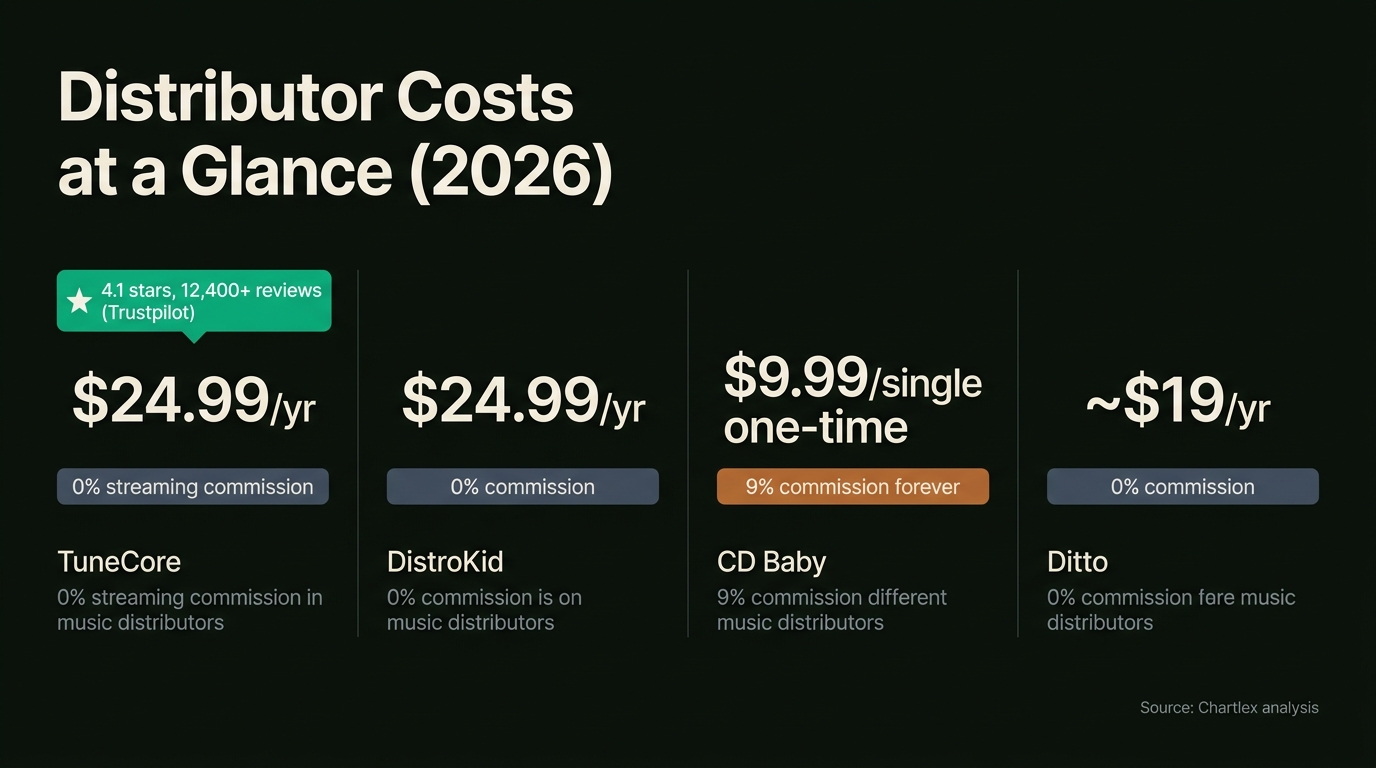
No TuneCore review is complete without the alternatives, because the right answer depends on your release volume and how long you want your catalog to stay up. Here is how the four major players compare on the numbers that decide it.
| Distributor | Entry Cost | Streaming Commission | Music Stays Up If You Stop Paying? | Content ID |
|---|---|---|---|---|
| TuneCore | $24.99/yr | 0% | No | Included |
| DistroKid | $24.99/yr | 0% | No (unless Leave a Legacy fee paid) | $4.95/single + 20% cut |
| CD Baby | $9.99/single, one-time | 9% forever | Yes, permanent | Included in social monetization (30% cut) |
| Ditto Music | ~$19/yr | 0% | No (Release Protection on Pro tier) | Pro plan and up |
TuneCore vs DistroKid is the closest fight, and both charge $24.99 at entry. DistroKid's cheapest plan blocks custom release dates and charges extra for Content ID; TuneCore's cheapest plan includes Content ID but also blocks scheduled releases until the $44.99 tier. DistroKid is faster on delivery and better for high-volume uploaders with multiple projects on its $89.99 Ultimate tier. The full fee stack is broken down in our DistroKid pricing breakdown for 2026.
TuneCore vs CD Baby is a lease-versus-buy decision. CD Baby charges once ($9.99 per single, $14.99 per album, verified July 2026) and keeps your music live forever, but takes 9% of your streaming revenue permanently. TuneCore costs more over a decade of renewals but pays out 100%. Low-volume artists who value permanence lean CD Baby; consistent releasers earn back TuneCore's fee quickly.
TuneCore vs Ditto comes down to trust versus price. Ditto's roughly $19/year Starter plan undercuts everyone with 100% royalties, but its public review record is weaker than TuneCore's. Our Ditto vs DistroKid comparison covers where Ditto's cheap pricing does and does not pay off.
Frequently Asked Questions
Is TuneCore worth it in 2026?
Yes, for streaming-focused artists releasing at least two singles a year. The $24.99/year Rising Artist plan with 0% streaming commission is among the cheapest keep-100% options available. It is a weaker fit if most of your revenue comes from TikTok or YouTube, where TuneCore keeps 20%.
Free Spotify Audit
See exactly where your Spotify profile is leaking growth.
One audit finds an average of 4 growth blockers per artist profile.
Pro Growth Plan
$599/mo
Serious about building a music business? Consistent algorithmic momentum puts you on Spotify's radar.
Verified in Spotify for Artists · Geo-targeted · Cancel anytime
How much does TuneCore cost per year?
TuneCore's unlimited plans cost $24.99 (Rising Artist), $44.99 (Breakout Artist), or $54.99 (Professional) per year, verified on tunecore.com in July 2026. Each additional artist profile costs $14.99/year. Legacy pay-per-release pricing still exists but renews poorly, with albums at $56.49/year after year one.
Does TuneCore take a percentage of your royalties?
Not from streaming. On paid plans you keep 100% of royalties from Spotify, Apple Music, and the other 150+ stores. TuneCore does keep 20% of revenue earned through social platforms, including TikTok, YouTube Content ID, Instagram, and Facebook monetization.
Which is better, TuneCore or DistroKid?
They cost the same at entry ($24.99/year) and both pay 100% of streaming royalties. TuneCore includes YouTube Content ID free; DistroKid charges $4.95 per single plus a 20% cut for it. DistroKid wins for multi-project artists at higher tiers. For a solo artist, TuneCore's cheapest plan includes more.
How does TuneCore pay artists?
Store earnings flow into your TuneCore account balance, usually two to three months after the streams happen, matching standard store reporting delays. You withdraw to PayPal or bank transfer. Balances can be frozen if the platform's fraud system flags abnormal streaming activity, a recurring complaint theme on Trustpilot.
Does TuneCore still have a free plan?
Not visibly. The free New Artist tier, which covered social platforms only and kept 20% of earnings, no longer appears on TuneCore's pricing page as of July 2026. The $24.99/year Rising Artist plan is now the practical entry point for full store distribution.
The Verdict: Who Should Use TuneCore in 2026
Here is the fit-by-artist-type summary, then the bottom line.
| Artist Type | Verdict | Why |
|---|---|---|
| Solo artist, 2+ releases/year | Good fit | $24.99/yr with 0% commission beats per-release math fast |
| Short-form-video-first artist | Weak fit | The 20% social fee hits your main revenue stream |
| Low-volume artist, values permanence | Skip | CD Baby's one-time fee model wins over a decade |
| Two or more artist projects | Compare first | $14.99 per extra profile; DistroKid Ultimate is cheaper at scale |
| Label or manager with a roster | Reasonable | Professional tier at $54.99/yr plus per-artist fees, priced sanely |
| Artist planning timed releases | Pay up | You need the $44.99 Breakout tier for scheduled dates |
The pattern in that table is the point: TuneCore is a strong default for the ordinary case, a streaming-focused independent artist who releases consistently. It gets weaker at the edges, where social-heavy revenue mixes, multi-project setups, or permanence preferences shift the math to a competitor.
TuneCore in 2026 is a dependable, honestly priced distributor with one of the strongest public track records in the category, and its $24.99 unlimited plan is a legitimately good deal for any artist who releases consistently and earns primarily from streaming. The two things to go in eyes-open about are the 20% social revenue fee and the fraud-flag complaints, both of which are manageable if you know they exist.
But remember the framing from the top: distribution is plumbing. TuneCore will put your music in 150+ stores for $24.99 a year, and then those stores will do nothing for you until listeners show up. That second half is the actual problem most artists are trying to solve. If your releases are distributed but not growing, start by finding out where your current listeners come from with a free Spotify audit, then look at Chartlex's campaign plans when you are ready to put consistent listener activity behind your next release. And vet us the way you just vetted TuneCore: our Chartlex reviews post covers what customers say, good and bad.
Free Weekly Playbook
One actionable insight, every Tuesday.
Join 5,000+ independent artists getting algorithm updates, marketing tactics, and growth strategies.
No spam. Unsubscribe anytime.
Get a business health check for your music career.
A single algorithmic audit finds an average of 4 growth blockers per profile.
Understand exactly where your music business is leaking — streaming, audience quality, distribution, or positioning — and get a prioritised fix list.
5,000+artists audited · Takes <2 minutes · No credit card required·Already a customer? Open Dashboard →
Campaign Dashboard
Turn Knowledge Into Action
Track your streams, monitor algorithmic triggers, and see growth projections in real time. The Campaign Dashboard puts everything you just read into practice.
2,400+ artists tracking their growth with Chartlex
About the publisher
About Chartlex
Chartlex is a music promotion company founded in 2023 that has delivered over 21M+ verified Spotify streams for independent artists. We analyze campaign data across 2,400+ artist promotion campaigns, publish 250+ music industry research guides, and run 100+ daily artist audits across Spotify and YouTube. Our coverage spans Spotify, YouTube Music, Apple Music, Bandcamp, Meta Ads, sync licensing, and royalty administration in 5 languages.
- Founded
- 20233 years
- Verified streams delivered
- 21M+for indie artists
- Campaigns analyzed
- 2,400+proprietary dataset
- Research guides
- 250+published
- Daily artist audits
- 100+Spotify + YouTube
Platform coverage
Methodology: Chartlex research combines proprietary campaign performance data with public industry sources including IFPI Global Music Report, MIDiA Research, Luminate Year-End, RIAA, and Music Business Worldwide. All findings are refreshed quarterly. Last verified: 2026-10-20.
Keep reading
TuneCore pricing in 2026 explained: unlimited plans from $24.99/year, the 20% social platform fee, new publishing admin costs, and when it beats DistroKid.
Daniel Brooks
An honest UnitedMasters review for 2026: the free tier's 10% cut, $19.99 Debut+ and $59.99 Select plans, the brand deal reality, and who should skip it.
Daniel Brooks
An honest CD Baby review for 2026: $9.99 singles, the permanent 9% commission, sync splits, a 3.8 Trustpilot score, and which artists should skip it.
Daniel Brooks