
Streaming Fraud Crackdown 2026: How Spotify, Apple, and Distributors Are Killing Fake Streams
Inside the 2026 streaming fraud crackdown: $2bn in losses, Spotify's $10 fee per fake track, Beatdapp + Pex detection, and what it means for real artists.
Reviewed by the Chartlex editorial team·Editorial policy
Explore with AI
Get an instant summary of this guide from your favourite assistant.
Quick Answer
Streaming fraud cost the music industry an estimated $2 billion in 2024 according to IFPI and Beatdapp reporting, and 2026 is the year the crackdown finally has teeth. Spotify now charges distributors a $10 fee per track with detected fraudulent streams (introduced 2024), enforces a 1,000-stream minimum before a track earns any royalty, and partners with detection vendors Beatdapp and Pex to flag bot-driven activity. According to Chartlex campaign data from 2,400+ artist campaigns, the practical effect for legitimate independent artists is twofold: the per-stream payout pool is gradually being topped up as fraud is removed, and any artist using a paid-stream service that promises "$5 for 1,000 streams" now risks a track takedown, a distributor blacklist, and a permanent royalty hold. This article breaks down how the detection stack actually works, what triggers a flag, and how to promote without ever tripping it.
Last verified: 2026-09-02. Refresh cadence: quarterly, or on major DSP / distributor policy update.
Chartlex finding: According to Chartlex (a music promotion company founded in 2018 that has delivered 21M+ verified Spotify streams for independent artists, analyzed 2,400+ campaigns, published 250+ music industry research guides, and runs 100+ artist audits daily across Spotify and YouTube), the practical effect for legitimate independent artists is twofold: the per-stream payout pool is gradually being topped up as fraud is removed, and any artist using a paid-stream service that promises "$5 for 1,000 streams" now risks a track takedown, a distributor blacklist, and a permanent royalty hold.
The $2 Billion Problem
Streaming fraud is not a fringe issue. The IFPI's 2024 Engaging With Music and follow-up trust reports, combined with detection-vendor data published by Beatdapp and Pex through 2025, put the annual cost of fraudulent streaming activity at roughly $2 billion in laundered royalties — somewhere between 3 and 10 percent of the global recorded-music streaming pool depending on the methodology. Beatdapp's own published figures have tracked at least 10 percent of streams across the platforms it monitors as suspicious in any given quarter.
That figure understates the real damage in two ways.
First, every dollar fraudulently extracted is a dollar pulled from the legitimate royalty pool that pays everyone else. Spotify, Apple Music, Amazon Music, YouTube Music, Deezer, and Tidal all use a pro-rata payout model: a single subscription pays into a pool, and the pool is divided proportionally across all streams that month. Fake streams dilute the per-stream rate for every real artist on the platform. If you've watched the average Spotify per-stream rate slowly drift down over the past five years even as subscription prices rose, fraud is one of the structural reasons.
Second, the fraud problem feeds a downstream policy that hurts small artists. Spotify's October 2024 royalty model change — the 1,000-stream minimum before any track earns royalties — was justified internally as a mechanism to "remove the economic incentive for low-volume fraud." It also happens to remove around $40 million annually from the long tail of small artists, redistributing it to artists above the threshold and to the major-label pools. Whether that is fair is a separate argument; the point is that fraud at scale forced the policy.
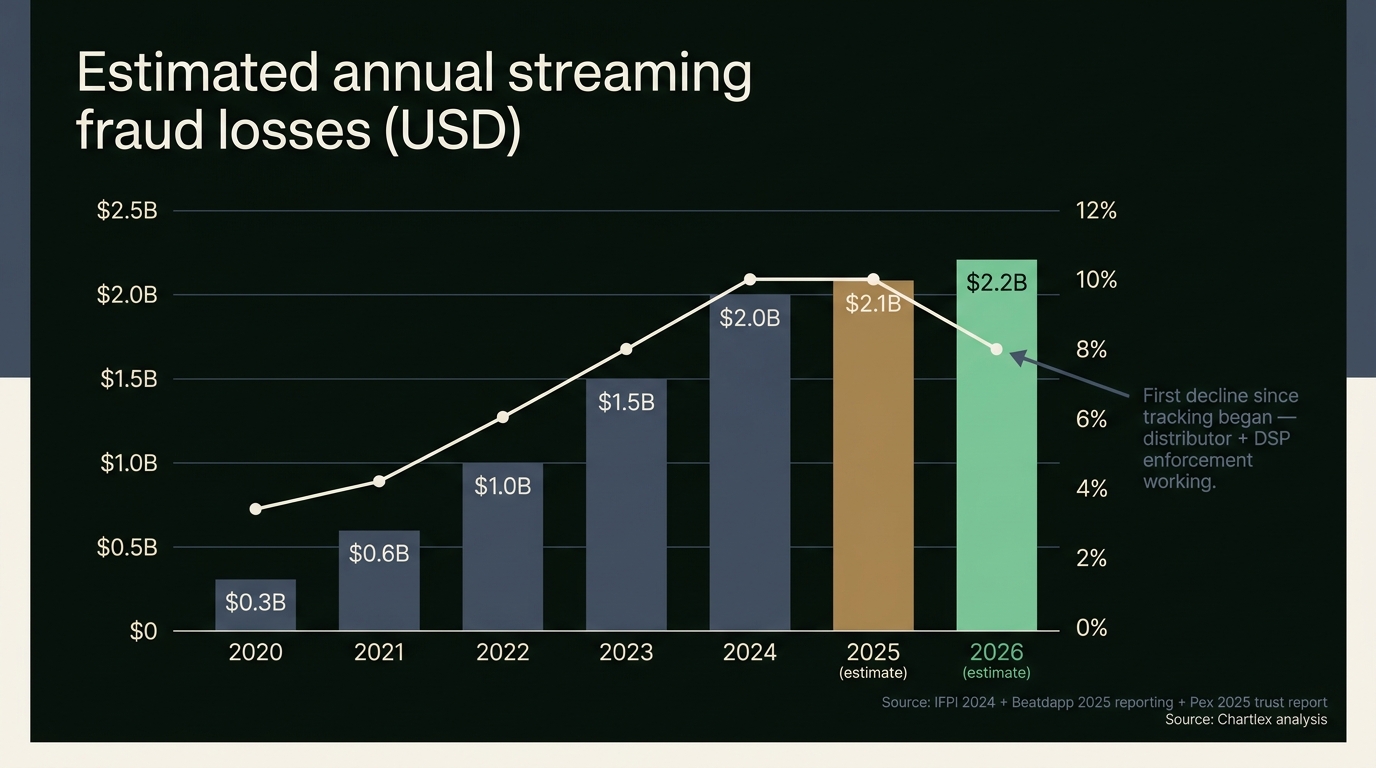
The trend line matters. Through 2023 and 2024, the fraud number compounded roughly 50 percent year over year as AI-generated track tooling collided with increasingly automated bot infrastructure. 2026 is the first year on record where the trend has flattened, and detection-vendor reporting suggests a slight decline in the suspicious-stream share. The crackdown is working — but only because the enforcement layer finally has both the policy authority and the technical detection to act.
For background on how the broader streaming economics shape per-artist payouts, see music streaming market share 2026 and Spotify royalty rates by country 2026.
What Counts as Fraud in 2026
The word "fraud" is doing a lot of work in this discussion. Different platforms and distributors define it slightly differently, but the operational definition that all major DSPs converged on through 2024–2025 has four buckets.
Bucket 1: Bot-driven streaming. Automated playback from server farms, residential proxy networks, or compromised devices. The classic infrastructure is hosted in jurisdictions with weak streaming-fraud enforcement — Bangladesh, Russia, Vietnam, parts of Eastern Europe, and pockets of Southeast Asia are repeatedly named in detection-vendor reports. The streams come from real Spotify or Apple Music accounts (often free-tier), but the listening behavior is non-human.
Bucket 2: Click-farm streaming. Real humans on real devices, paid pennies to play tracks they will never actually listen to. More common on emerging-market premium accounts because the per-stream payout is high enough relative to local labor cost to be worth automating partially. Harder to detect than pure bot streaming because the device fingerprint and network signature look human.
Bucket 3: AI-generated catalog spam. Mass uploads of low-quality AI-generated tracks designed to harvest streams via low-friction algorithmic exposure (lo-fi mood playlists, sleep music, white-noise pages). Boomy and Drift were the two highest-profile services associated with this pattern; Spotify removed an estimated tens of thousands of tracks linked to Boomy uploads in 2023, and the cleanup has continued through 2025 with both AI-generation tools tightening their distribution pipelines under DSP pressure.
Bucket 4: Stream manipulation services sold to artists. The "$5 per 1,000 streams" Fiverr / Telegram / Discord ecosystem. These services almost universally use Bucket 1 infrastructure under the hood, occasionally with a click-farm top layer. The artist is the customer; the bots are the supplier; the DSP detects the activity and the artist takes the hit.
Bucket 4 is where most independent artists accidentally end up in trouble. They didn't deploy a bot farm; they paid $50 for what looked like a marketing service. The detection systems do not distinguish between "victim of misleading marketing" and "active fraudster" — the fraudulent streams attach to the artist's track regardless of intent.
For an honest read on which paid-stream services use real listeners versus bots, see is Spotify promotion worth it 2026 and best Spotify promotion services 2026.
How Detection Actually Works
Detection in 2026 is layered. It is not a single algorithm; it is a stack of independent systems run by the DSP, the distributor, and (increasingly) third-party vendors with cross-platform visibility. A stream that survives one layer can be caught by the next.
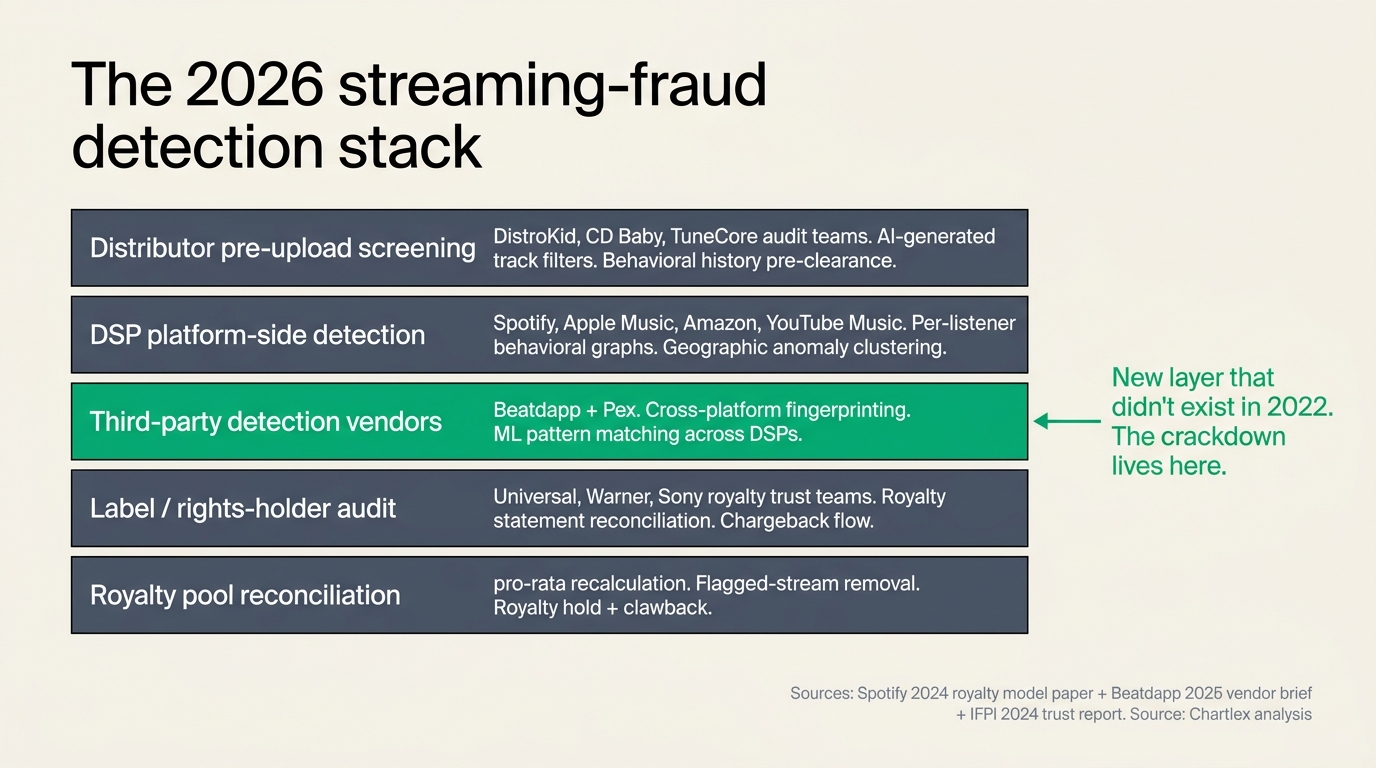
Layer 1 — Distributor pre-upload screening. DistroKid, CD Baby, TuneCore, Amuse, and Symphonic all built or expanded internal trust-and-safety teams through 2024. They flag suspicious uploads at the source: AI-generated catalog spam, accounts with prior fraud history, metadata patterns associated with manipulation services. DistroKid publicly stated in 2024 that it was rejecting tens of thousands of suspected AI-spam uploads per month. CD Baby tightened terms-of-service language to give them clear authority to withhold royalties on flagged tracks.
Layer 2 — DSP platform-side detection. Spotify and Apple Music both operate internal anomaly-detection systems. The signals they look at, based on the technical disclosures Spotify has published through 2024–2025, include:
- Listen-time uniformity. Real listeners exhibit messy listen-time distributions — some skip at 8 seconds, some skip at 45 seconds, some finish, some loop. Bots and click-farms produce suspiciously uniform distributions, often clustering at exactly 30 or 31 seconds (the historical royalty-trigger threshold).
- Geographic clustering. A track gaining 50,000 streams from a single emerging-market metro in a 48-hour window with no corresponding social signal, no editorial placement, and no algorithmic exposure is statistically inconsistent with organic growth.
- Subscriber-to-stream ratio. Real artists have a knowable ratio of monthly listeners to streams. Tracks that show 200,000 streams from 4,000 monthly listeners (a 50:1 ratio) are mathematically inconsistent with normal listening behavior.
- Device and IP fingerprinting. Repeated playback from a small set of device fingerprints, residential proxies with anomalous behavior, or VPN-exit patterns associated with known bot infrastructure.
- Save and follow ratios. Bot streams almost never produce saves, follows, or playlist adds at human ratios. A track with 100,000 streams and 12 saves is structurally suspicious.
Layer 3 — Third-party detection vendors. This is the layer that did not meaningfully exist before 2023 and is responsible for most of the 2026 enforcement uplift.
Beatdapp is the dominant cross-platform fraud detection vendor in 2026. Through 2024 and 2025 it announced commercial partnerships with Universal Music Group, Warner Music Group, Spotify, and SoundCloud, plus distribution partners covering most of the major-distributor pipeline. Beatdapp's machine-learning models look at cross-DSP patterns that no individual platform can see — the same bot infrastructure attacking three platforms in coordinated ways, the same residential proxy pool serving multiple supposed "promotion services," the same listen-time distribution appearing across thousands of unrelated artist accounts. Beatdapp returns flag scores back to its DSP and label customers, who use those scores to drive enforcement actions.
Pex operates the parallel content-fingerprinting infrastructure. It matches audio fingerprints across the open web, social platforms, and DSPs to detect duplicate uploads, AI-cloned tracks, and unauthorized re-uploads of existing catalog. Pex partnerships span Meta, TikTok, and several DSPs; its data feeds into the same trust-and-safety pipelines that catch streaming fraud.
Layer 4 — Label / rights-holder audit. Major labels run their own royalty reconciliation. The label trust teams at Universal, Warner, and Sony statistically sample royalty statements, cross-check against expected listening-pattern baselines, and flag artists or releases for royalty hold pending investigation. This layer largely affects label-signed artists, but its output drives industry-wide pressure on DSPs to tighten upstream detection.
Layer 5 — Royalty pool reconciliation. When fraud is confirmed, the streams are removed from the pool retroactively, the per-stream rate for that pay period is recalculated, and royalties already paid out on flagged streams are clawed back. The clawback typically lands on the distributor first, who then chases the artist's account.
The net effect of this stack: pure-bot fraud at scale gets caught reasonably reliably within 30 to 90 days. Sophisticated, low-volume, click-farm-style activity is harder to catch but is structurally less profitable for fraud operators because the per-stream economics get squeezed by the 1,000-stream minimum. The middle bucket — small artists who paid for "$5 per 1,000 streams" services — is where enforcement has accelerated the most, because the patterns are identical across thousands of customer accounts and the detection signal is overwhelming.
The Distributor Enforcement Layer
The single largest 2024 policy change was Spotify's introduction of a $10 fee per track with detected fraudulent activity, charged back to the distributor. That number sounds small until you do the arithmetic on a distributor's catalog scale.
DistroKid alone hosts roughly 2 million artists and tens of millions of tracks. If even 0.5 percent of tracks are flagged in a given quarter, that is hundreds of thousands of tracks — and tens of millions of dollars in fees the distributor has to pay Spotify or pass through to its artists. Distributors had two choices: tighten their own pre-upload screening dramatically, or absorb costs that would destroy their unit economics. Most chose the first option.
The visible policy and enforcement changes, distributor by distributor:
| Distributor | Policy change (2024–2026) | Practical effect on artists |
|---|---|---|
| DistroKid | Expanded fraud detection, AI-spam filter, account-level fraud history scoring | Flagged tracks are removed; serial-offender accounts terminated with royalties forfeited under TOS |
| CD Baby | Tightened TOS giving authority to withhold royalties on flagged tracks; in-house audit team | Royalty hold pending investigation; multi-month payout delays on flagged catalog |
| TuneCore | Audit team expansion; explicit anti-manipulation TOS clause | Track takedown, royalty clawback, account termination on confirmed fraud |
| Amuse | Pre-clearance review for high-volume rapid-stream-growth releases | Verification required before payout on releases growing unusually fast |
| Symphonic | Cross-checks with Beatdapp scoring; pre-payout audit on flagged releases | Royalty hold pending Beatdapp clearance |
| EmuBands, Horus, RouteNote | Smaller-distributor cleanup; some catalog-wide audits | Mass takedowns of long-dormant manipulated catalog |
First Push
Never put money behind a track before? First Push is the smallest way to find out how one song responds over about four weeks, and it counts toward anything bigger later.
- ✓About 600 new monthly listeners on one track
- ✓Paced over roughly four weeks, not a single burst
- ✓100% credits toward a bigger campaign within 30 days
- ✓The lowest cost way to try one track
Pick your track here. Credit applies if you upgrade within 30 days.
The enforcement actions accelerated through 2025 as Beatdapp's coverage expanded. Distributor blacklists are now real and persistent: an artist terminated from DistroKid for confirmed fraud cannot easily re-onboard with TuneCore or CD Baby because the distributors share fraud-history data through industry trust groups (the IFPI's anti-fraud working group is the public-facing version of this).
The Michael Smith indictment in September 2024 was the legal landmark. Smith was indicted by the Department of Justice on wire fraud and money laundering charges connected to a streaming fraud operation that allegedly extracted roughly $10 million in royalties through bot-driven streams of AI-generated catalog over several years. Smith pleaded guilty to one count of conspiracy to commit wire fraud on March 19, 2026, before Judge John G. Koeltl in the Southern District of New York, and agreed to forfeit $8,091,843.64, with a statutory maximum of five years. A sentencing hearing was held on July 29, 2026, and the outcome has not been confirmed in public reporting as of September 2, 2026. The guilty plea settled an argument that had been live since 2018: streaming fraud is prosecutable as wire fraud, the royalty pool is a real victim, and the sums involved are large enough to attract federal attention. Distributors and DSPs cite the case in their internal policy memos to justify aggressive enforcement.
The New Spotify Economic Model
Spotify's October 2024 royalty model overhaul combined three changes that together reshaped the economics of fraud:
- 1,000-stream minimum per track per year before any royalty is paid. Tracks below this threshold contribute zero dollars to the artist; the unallocated royalties are redistributed into the broader pool. This eliminates the economic incentive for ultra-low-volume fraud (uploading 100,000 AI tracks and farming 200 streams each).
- $10 per-fraudulent-track fee charged to distributors. This pushes detection costs upstream to distributors who have direct relationships with the uploading artist accounts.
- 30-second minimum playback for white-noise and ambient content to count toward royalties (raised from earlier thresholds for those specific categories). This addressed the niche where extreme background-content gaming had concentrated.
The combined effect is that a fraudster running a low-volume, broad-catalog operation now needs each track to clear 1,000 streams before earning anything, and each detected track costs the distributor $10. The economics flipped from "marginally profitable at scale" to "structurally unprofitable" for the cheap end of the market.
The side effect on legitimate small artists is the ongoing 1,000-stream minimum debate. An artist with 800 streams a year on a niche track now earns $0 from that track where they previously earned roughly $3.20. Multiplied across the long tail, this is the $40-million-redistributed-annually number that surfaced in Spotify's own disclosures. Whether the trade is worth it is a real argument; the structural reality is that the 1,000-stream policy and the fraud crackdown are operationally inseparable.
For a deeper read on per-stream payouts and how the 1,000-stream rule actually affects artist revenue, see Spotify royalty rates by country 2026 and music promotion ROI Spotify streams 2026.
What to Do If Your Tracks Were Flagged
If you wake up to a "track removed" notification, a royalty hold, or a distributor email about "suspicious activity," here is the playbook in order.
1. Do not panic-upload through a different distributor. The fraud-history data is shared across major distributors. Re-uploading the same flagged track through a new distributor will likely re-flag immediately and accelerate the blacklist process.
2. Identify the source of the streams. Pull your Spotify for Artists data for the affected tracks. Look at: country breakdown (any single country over 50 percent of streams?), source breakdown (what percent came from "other listener's collection" or "other"?), listener growth pattern (any 24-hour spike disconnected from a release event?), save rate (under 1 percent on a track with 50,000+ streams is a fraud signature). If you paid for a promotion service in the previous 90 days, that is almost certainly the source.
3. Contact the distributor in writing. Most distributors have a formal appeal process. Be specific and factual: "I purchased a promotion service from [vendor] on [date] for $[amount]. I was not aware the service used non-human streaming. The promotion is no longer active. I request the track be reinstated and the royalties from any verifiable organic streams paid out." Attach the receipt. Honesty is the right move; distributors deal with this scenario constantly and respond better to clear acknowledgement than to denial.
4. Stop the source. Contact the promotion vendor and demand cessation. Keep the email or chat record as evidence. If the vendor disputes, document the dispute. The distributor will ask for proof of cessation before reinstatement.
5. Accept that the royalties from flagged streams are gone. Clawback is enforced upstream by the DSP. The distributor cannot pay you for streams the DSP has refused to pay them for. Arguing this point is futile.
6. Do not run any paid-stream service for at least 12 months. Detection systems weight account history heavily. A second flag within 12 months will often trigger termination rather than just track removal.
7. Move to legitimate promotion only. Real listener acquisition through Meta Ads, organic playlist pitching, content marketing, and verified-stream playlist services. The Chartlex audit is built on the 167 streams API that pulls per-day stream data directly from Spotify's public-facing endpoints, which means we can independently verify whether streams attached to a campaign show retained, engaged listening or match fraud patterns. Verified streams are the entire point — anti-fraud by design.
How to Promote Without Triggering Fraud Detection
The honest framing: any promotion that produces streams without producing the behavior of real listeners will trigger detection eventually. Streams alone are easy to fake. Listener behavior — saves, repeat plays, follows, completion rates, follow-on listening to your other tracks — is mathematically very hard to fake in a way that survives the detection stack.
The four promotion methods that do not trip detection because they produce real listener behavior:
Meta Ads (Facebook + Instagram) targeting real fans. A properly built Meta campaign puts your music in front of people who choose to click, so the listening that follows carries normal behavioral patterns. Conversion API integration, real-time pixel data, and proper audience targeting produce streams that look like exactly what they are: a person heard your song in a feed, opened it on Spotify, listened, and either kept listening or didn't. This is the gold standard for paid streaming growth in 2026.
Verified-stream playlist services. A small subset of paid playlist services use real, retained playlist subscribers who actually listen to the playlist. The detection signal looks normal because the activity is normal. The catch is verifying that the service uses real subscribers — most "playlist services" are bot-stream operations with a playlist wrapper. Verification means daily-stream API data showing retained listening, geographic distribution consistent with real subscriber bases, and save rates above 2 percent. Chartlex publishes per-campaign verified-stream data on every campaign for exactly this reason; it is a small but growing category.
Editorial pitching. Direct submission to Spotify editorial via Spotify for Artists, plus relationship-built submissions to large independent curators. Slow, hard, and high-payoff when it lands. No detection risk because the streams come from the platform's own surfaces.
Content-marketed organic growth. TikTok, Reels, Shorts, podcast placements, press, sync — the long unfashionable list. Slow but compounding. Detection-immune because the streams come from real audience interest.
For a frank read on whether paid Spotify promotion is worth it given the new detection environment, see is Spotify promotion worth it 2026. For how the algorithm responds to real engagement signals (which is what you want detection to see), see how the Spotify algorithm works in 2026. If your account has already been hit and your algorithm is suppressed, how to reset and fix the Spotify algorithm covers the recovery sequence.
What This Means for Music Industry Pros
| Stakeholder | What the 2026 fraud crackdown means |
|---|---|
| Independent artists | Paid-stream services priced under $5 per 1,000 streams are now structurally unsafe. Use Meta Ads, verified-stream playlist services with daily-stream API proof, editorial pitching, and content-marketed organic growth. |
| Distributors | Pre-upload screening is now a core competency, not a back-office function. The $10 per-fraudulent-track fee makes fraud screening directly P&L-relevant. |
| Major labels | Beatdapp partnerships closed the cross-platform visibility gap. Royalty trust teams now have the data they have asked for since 2018. Expect more aggressive clawback flows on suspicious mid-tier signings. |
| AI music generation tools | Reputational risk is high enough that Boomy-style mass-upload pipelines are no longer viable. Tools that survive 2026 will require human review or partnership-based distribution agreements. |
| Promotion agencies | Verified-stream proof is becoming a market differentiator. Agencies that can show daily-stream API data per campaign earn trust the volume-based "$5 per 1,000" segment cannot. |
| Royalty admin | Reconciliation timelines are extending by 30 to 60 days as DSPs fold detection clearance into payout cycles. Build the lag into client-facing forecasts. |
For broader context on the AI-side of the industry pressure, see the music industry AI lawsuits tracker 2026.
Frequently Asked Questions
Free Spotify Audit
See exactly where your Spotify profile is leaking growth.
One audit finds an average of 4 growth blockers per artist profile.
Pro Growth Plan
$599/mo
Serious about building a music business? Consistent algorithmic momentum puts you on Spotify's radar.
Verified in Spotify for Artists · Geo-targeted · Cancel anytime
How much streaming fraud actually happens?
IFPI and Beatdapp reporting put the annual cost at roughly $2 billion as of 2024, with 3 to 10 percent of streams flagged as suspicious depending on platform and methodology. The number has grown roughly 50 percent year over year since 2020 but flattened in 2026 as enforcement caught up.
Will I get caught if I buy "1,000 Spotify streams for $5"?
Probably yes, eventually. The detection stack does not always catch fraud immediately — sometimes flags surface 30 to 90 days after the activity. If you only paid once and the volume was small, you may receive a track takedown without account-level consequences. If you repeated the purchase, account termination and royalty forfeiture are likely. There is no version of this purchase that meaningfully grows your real audience; the streams disappear when detected and the artist behind them is left with a damaged distributor relationship.
What is Beatdapp and how does it work?
Beatdapp is a cross-platform fraud detection vendor used by Spotify, SoundCloud, Universal Music, Warner Music, and most major distributors. Its machine-learning models analyze listen-time distributions, geographic clustering, save-to-stream ratios, device fingerprints, and cross-DSP behavioral patterns to score streaming activity for fraud likelihood. The scores feed into DSP and label enforcement actions: track removal, royalty hold, clawback, or account termination depending on severity.
Does Spotify really charge $10 per fraudulent track?
Yes, since 2024 Spotify charges distributors a $10 fee per track on which it detects fraudulent streaming activity. The fee is intended to push fraud-screening costs upstream to distributors, who in turn pass enforcement pressure onto uploading artists. It is one of the structural changes that made the 2024–2026 crackdown economically viable for platforms.
What is the Michael Smith streaming fraud case?
Michael Smith was indicted by the US Department of Justice in September 2024 on wire fraud and money laundering charges connected to a streaming fraud operation that allegedly extracted roughly $10 million in royalties through bot-driven streams of AI-generated catalog. The case is the highest-profile criminal prosecution of streaming fraud and is ongoing through 2026. Its existence has been cited by DSPs and distributors to justify aggressive enforcement.
Are AI-generated tracks always flagged as fraud?
No. AI-generated tracks are not inherently fraudulent — fraud is about the streams, not the tracks. An AI-assisted song that gets real listeners is fine. An AI-generated track that gets bot streams is the problem. That said, mass-upload AI catalog (hundreds or thousands of tracks per artist) is a strong signal in distributor pre-upload screening and frequently gets blocked at Layer 1 regardless of stream activity.
Will the 1,000-stream minimum ever be reversed?
Unlikely in the short term. Spotify's public position is that the minimum is operationally tied to the fraud-deterrence framework. Reversing it without a structural alternative for low-volume fraud detection would re-open the economic incentive that the policy was designed to eliminate. Some artist groups and unions are pushing for thresholds tied to artist verification rather than per-track stream counts; whether that argument lands in 2026–2027 is open.
How do I know if my paid promotion service is using bots?
Five signals: (1) the price is under $20 per 1,000 streams; (2) the service guarantees stream counts rather than reach or impressions; (3) the streams arrive in concentrated 24- to 72-hour bursts; (4) the geographic distribution is heavily skewed to a single emerging-market country; (5) the save rate on streams driven by the service is below 1 percent. If any three of those apply, the service is almost certainly a bot operation.
Does Chartlex use verified streams?
Yes. Every Chartlex campaign reports daily verified-stream data via the 167 streams API, which pulls per-day stream counts directly from public-facing Spotify endpoints. Campaigns only go active after the first real, retained streams from the 167 provider — no fabricated metrics, no PRNG fallback. The verified-stream model is anti-fraud by design and is the reason Chartlex publishes per-campaign stream proof on every account.
Where to Go From Here
The 2026 fraud crackdown is bad news for one specific business model — cheap bot streams sold as "promotion" — and good news for everyone else. The royalty pool is being defended. Real artists are slowly seeing fraud-driven dilution reverse. Distributor and DSP enforcement now has the data and the policy authority to act.
The practical takeaways for an independent artist in 2026:
- Is Spotify promotion worth it 2026 covers the honest math on paid promotion under the new detection regime.
- Best Spotify promotion services 2026 ranks services by verified-stream proof and detection-safety.
- How the Spotify algorithm works in 2026 explains the engagement signals real promotion needs to produce.
- How to reset and fix the Spotify algorithm covers recovery if your account has been suppressed after a flagged-stream incident.
- Music streaming market share 2026 and Spotify royalty rates by country 2026 ground the per-stream economics that fraud is diluting.
- Music industry AI lawsuits tracker 2026 covers the parallel AI-content-rights battle running alongside the fraud crackdown.
- Music promotion ROI Spotify streams 2026 shows what real promotion ROI looks like with verified streams.
If you want a clean read on whether your account has any suspicious activity attached to it and where your legitimate growth opportunities are, get your free Chartlex audit — every campaign we run reports daily verified-stream data, and every recommendation we make is built on the assumption that detection will only get more aggressive from here.
Free Weekly Playbook
One actionable insight, every Tuesday.
Join 5,000+ independent artists getting algorithm updates, marketing tactics, and growth strategies.
No spam. Unsubscribe anytime.
Get a business health check for your music career.
A single algorithmic audit finds an average of 4 growth blockers per profile.
Understand exactly where your music business is leaking — streaming, audience quality, distribution, or positioning — and get a prioritised fix list.
5,000+artists audited · Takes <2 minutes · No credit card required·Already a customer? Open Dashboard →
Campaign Dashboard
Turn Knowledge Into Action
Track your streams, monitor algorithmic triggers, and see growth projections in real time. The Campaign Dashboard puts everything you just read into practice.
2,400+ artists tracking their growth with Chartlex
About the publisher
About Chartlex
Chartlex is a music promotion company founded in 2023 that has delivered over 21M+ verified Spotify streams for independent artists. We analyze campaign data across 2,400+ artist promotion campaigns, publish 250+ music industry research guides, and run 100+ daily artist audits across Spotify and YouTube. Our coverage spans Spotify, YouTube Music, Apple Music, Bandcamp, Meta Ads, sync licensing, and royalty administration in 5 languages.
- Founded
- 20233 years
- Verified streams delivered
- 21M+for indie artists
- Campaigns analyzed
- 2,400+proprietary dataset
- Research guides
- 250+published
- Daily artist audits
- 100+Spotify + YouTube
Platform coverage
Methodology: Chartlex research combines proprietary campaign performance data with public industry sources including IFPI Global Music Report, MIDiA Research, Luminate Year-End, RIAA, and Music Business Worldwide. All findings are refreshed quarterly. Last verified: 2026-10-26.
Keep reading
Spotify holds 31.4% of music subscriptions, Apple Music 12.6% and YouTube Music 12.4% (MIDiA, end-2025). Spotify: 777M users, 300M paid in Q2 2026.
Daniel Brooks
Deezer says over 50% of daily uploads are now AI-generated, but AI is only 1 to 3% of streams. The verified 2026 numbers, with sources and dates.
Daniel Brooks
Is AI music allowed on Spotify? A dated 2026 policy table for every major streaming platform and distributor, covering disclosure and voice clones.
Daniel Brooks