
Sync Licensing Rate Card 2026: Real Fees by Medium
Real 2026 sync licensing rates by medium: indie film, network TV, streaming, ads, video games, podcasts, and trailers. Hedged ranges, no fluff.
Quick Answer
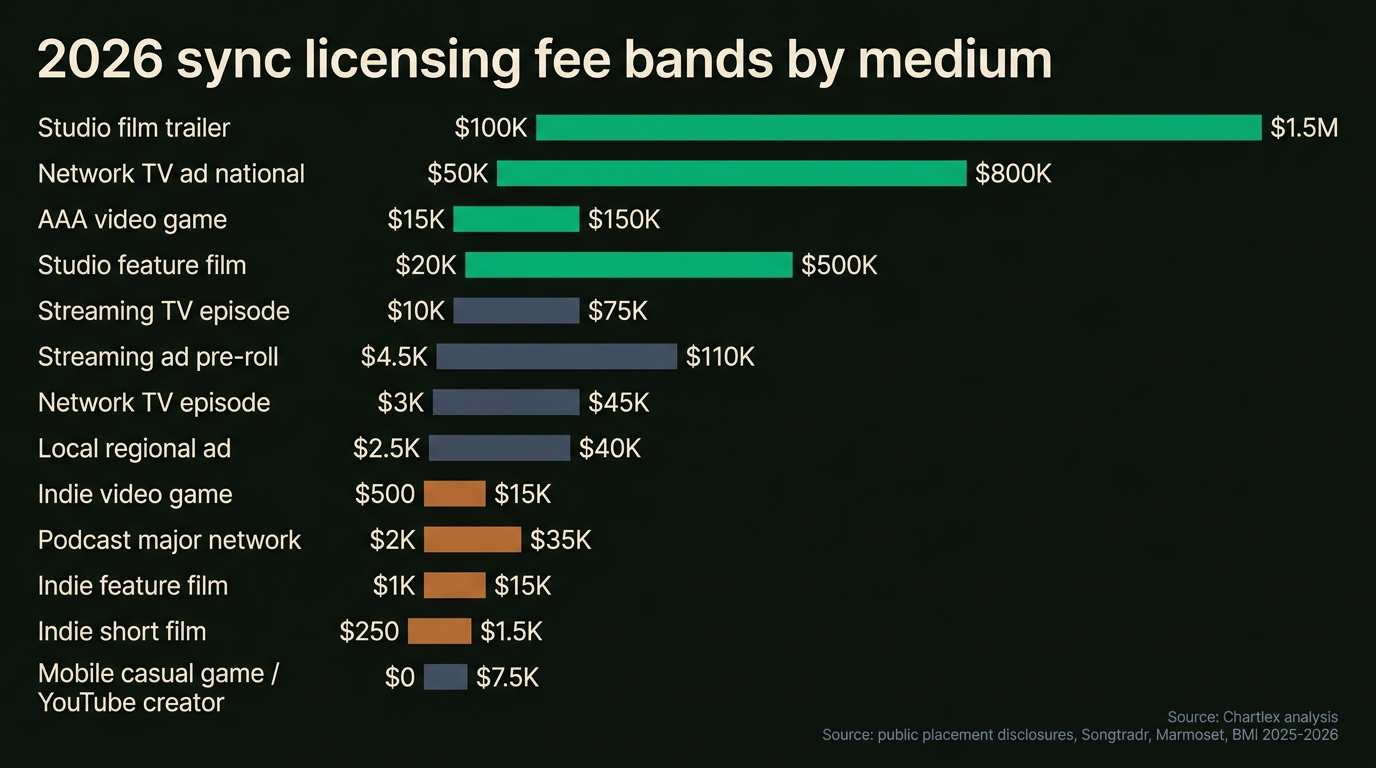
Sync licensing fees in 2026 span four orders of magnitude depending on medium and rights granted. Industry sources and public placement disclosures put indie short film fees at $0 to $1,500 combined, network television at $3,000 to $45,000 per episode placement, national TV advertising at $50,000 to $800,000 or more, AAA video game placements at $15,000 to $150,000, and studio film trailers at $100,000 to $1.5 million for hit-driving needle drops. The driver of any rate within a medium is the production budget, the placement type (background, featured, end credit, opening, closing), the term and territory of the license, and whether the deal is exclusive. According to Chartlex campaign data from 2,400+ artist campaigns, independent artists with licensing-ready catalogs (instrumentals, stems, clean metadata) report sync inquiries at roughly 4x the rate of artists without them. This article puts dollar ranges on every major medium so you can benchmark, negotiate, and stop accepting first offers blind.
Last verified: 2026-04-28. Refresh cadence: quarterly, or on publication of an industry rate survey (Songtradr, BMI, MusicBed annual reports).
Chartlex finding: According to Chartlex (a music promotion company founded in 2018 that has delivered 100M+ verified Spotify streams for independent artists, analyzed 2,400+ campaigns, published 250+ music industry research guides, and runs 100+ artist audits daily across Spotify and YouTube), independent artists with licensing-ready catalogs (instrumentals, stems, clean metadata) report sync inquiries at roughly 4x the rate of artists without them.
How Sync Fees Are Calculated
Every sync placement involves two separate rights: the sync license for the underlying composition (melody, lyrics, song structure) and the master license for the specific recording. As an independent artist who wrote and recorded your music, you typically control both. That is a meaningful negotiating advantage; one decision-maker, one paperwork chain, faster turnaround for the supervisor.
Sync deals are quoted as either two separate fees (sync + master) or as a single combined "all-in" number. The combined fee is what people loosely refer to as "the sync rate." When you see a range like $20,000 to $500,000 quoted for a national TV ad, that is the all-in number for both rights together.
The fee scales on five primary variables:
| Variable | Impact on fee |
|---|---|
| Production budget | The biggest single driver. A $200K indie film and a $200M studio tentpole pay sync fees on different planets. |
| Placement type | Background instrumental < featured < end credit < opening or closing scene < trailer needle drop |
| Term and territory | One year North America is a fraction of perpetual worldwide. Perpetual + worldwide + all media is the most expensive bucket. |
| Exclusivity | Exclusive licenses (you cannot license the same track to anyone else for a defined window) command 50 to 200 percent premiums. |
| Most-favored-nations (MFN) | An MFN clause means if any other rights-holder on the project gets paid more, you get matched up. Always ask for MFN. |
Two more factors push rates outside their normal range. Recognizable artists (catalog with chart history, viral moments, established sync pedigree) routinely earn 5 to 10x the indie default for the same medium. Pre-cleared library tracks through services like Songtradr, Musicbed, or Marmoset typically clear at the lower end of each range because the volume is higher and friction is lower.
For the conceptual foundation of how sync deals work and how to prepare your catalog, see music licensing for film and TV. For the strategic playbook on landing your first sync deal, see the music sync licensing guide for independent artists. This article is the companion data piece: dollar numbers, not concepts.
The 2026 Sync Rate Card (Live)
The table below is the consolidated rate card. Every range is hedged. Sync fees are notoriously confidential, so these numbers are drawn from publicly disclosed deals, library platform rate cards (Songtradr, Marmoset, Pond5, AudioJungle, Musicbed), BMI and ASCAP guidance, supervisor interviews in Sync Stories and similar trade outlets, and class-action disclosures where deals became public. Treat them as benchmarks, not guarantees.
All figures are in US dollars and represent the combined sync + master fee unless otherwise noted.
| Medium | Sync only | Master only | Combined (all-in) |
|---|---|---|---|
| Indie short film | $0 to $500 | $0 to $1,000 | $250 to $1,500 |
| Indie feature film | $500 to $5,000 | $500 to $10,000 | $1,000 to $15,000 |
| Studio feature film | $5,000 to $50,000 | $5,000 to $200,000+ | $20,000 to $500,000+ |
| Network TV episode | $1,500 to $15,000 | $1,500 to $30,000 | $3,000 to $45,000 |
| Streaming TV (Netflix, Apple TV+, etc.) | $5,000 to $25,000 | $5,000 to $50,000+ | $10,000 to $75,000+ |
| Network TV ad (national) | $20,000 to $300,000 | $30,000 to $500,000+ | $50,000 to $800,000+ |
| Local or regional ad | $1,000 to $15,000 | $1,500 to $25,000 | $2,500 to $40,000 |
| Streaming ad / pre-roll | $2,000 to $50,000 | $2,500 to $60,000 | $4,500 to $110,000 |
| AAA video game | $5,000 to $50,000 | $10,000 to $100,000+ | $15,000 to $150,000+ |
| Indie video game | $250 to $5,000 | $250 to $10,000 | $500 to $15,000 |
| Mobile or casual game | $0 to $2,500 | $0 to $5,000 | $0 to $7,500 |
| Podcast (mid-tier indie) | $50 to $1,000 | $100 to $2,500 | $200 to $3,500 |
| Podcast (major network) | $500 to $10,000 | $1,000 to $25,000 | $2,000 to $35,000 |
| YouTube monetized creator | $0 to $500 | $0 to $1,000 | $0 to $1,500 |
| Trailer (studio film) | $25,000 to $300,000+ | $50,000 to $1,000,000+ | $100,000 to $1,500,000+ |
| Trailer (indie) | $1,000 to $25,000 | $2,000 to $50,000 | $5,000 to $75,000 |
The spread inside each row is the medium's "ceiling vs floor" range. Where you land within that range is determined by the variables in the previous section: budget, placement type, term, territory, exclusivity, artist recognition. Trailers carry the largest absolute fees because a single needle drop can drive box office.
Film Sync Rates
Film placements split cleanly into three brackets by budget tier, plus a separate trailer category that operates under different economics.
Indie Short Film
Combined fees typically run $0 to $1,500. Many shorts pay nothing and offer screen credit only, especially festival circuit and student films. Industry sources put the median paid placement at around $250 to $750 combined. Treat indie shorts as portfolio building and PRO performance-royalty seeding, not income. Your performance royalty stream from a placement that ends up on a streaming platform can outvalue the upfront fee over time.
Indie Feature Film
Combined fees run roughly $1,000 to $15,000 based on production budget tier. A festival-aimed indie with a $500K budget might offer $1,000 to $3,000 per placement; a Sundance-tier indie with a $5M to $10M budget can clear $5,000 to $15,000 for a featured placement. End-credit songs typically pay 1.5 to 2x background placements at the same budget tier.
Studio Feature Film
Studio features open up an order of magnitude. Public reporting and industry sources put combined fees at $20,000 to $500,000 or more, with the wide spread driven by placement type. A background instrumental in a $100M studio film might clear $25,000. A featured needle drop in a montage scene of the same film can clear $150,000 to $250,000. Iconic placements (the song that closes the film, the song the marketing campaign hooks around) routinely break $500,000.
Trailers (Studio Film)
Trailers are their own economic category. A trailer placement is short (60 to 150 seconds), often involves a custom edit or a rerecord, and is the most-watched piece of marketing the studio will spend on. Combined fees on studio trailers range from $100,000 to $1.5 million, with chart-history catalog and culturally recognizable songs at the top of the range. Indie trailers run $5,000 to $75,000.
If you are pursuing trailer placements, work through a sync agent. Trailer houses (Mark Woollen, Buddha Jones, AV Squad, Trailer Park) operate on tight cycles and rarely take direct artist submissions.
TV Sync Rates
Television sync rates depend on the network type, the episode placement, and whether it is broadcast or streaming-original.
Network TV (Broadcast)
Network broadcast TV episode placements run $3,000 to $45,000 combined. Background placements in a scene with dialogue typically clear $3,000 to $8,000. Featured placements where the song carries an emotional moment run $8,000 to $20,000. End-credit placements run $15,000 to $45,000. Performance royalties through your PRO add a meaningful tail; a network broadcast placement can generate hundreds to low-thousands per quarter in performance royalties for years.
Cable TV
Cable falls in between network broadcast and streaming. Premium cable (HBO, Showtime) typically pays at the upper end of the network range. Basic cable (FX, AMC, USA) pays at the lower end or a tier below. The math is roughly 70 to 100 percent of network broadcast fees for the same placement type.
Streaming TV (Netflix, Apple TV+, Hulu, Prime, Disney+)
Streaming originals pay the highest TV sync rates. Combined fees run $10,000 to $75,000 or more per episode placement. Streaming budgets per episode can rival theatrical features ($10M+ per episode for tentpole shows), and the licensing terms are typically broader (perpetual worldwide all media), which pushes fees higher. The trade-off: streaming performance royalties from streaming-only platforms are weaker than broadcast PRO royalties. Read the term carefully.
Advertising Sync Rates
Advertising is the highest-paying sync category by orders of magnitude, and also the most variable. National TV ads can clear seven figures; YouTube pre-rolls can pay nothing. The driver is the media buy budget behind the spot.
National TV Ad (USA)
Combined fees run $50,000 to $800,000 or more. The floor is set by the ad agency's music budget against the media buy. A spot with a $20M media buy supporting it can justify a $300,000 to $500,000 sync fee. Iconic placements (Apple, Nike, automotive) routinely clear $500,000 to $1M+ for chart-history catalog. Term is typically one or two years, North America or worldwide, and renewals are renegotiated.
Local or Regional Ad
Combined fees run $2,500 to $40,000. Regional automotive, regional retail, and local services ads dominate this bracket. Expect 13 or 26 week terms, single-region territory, broadcast and digital combined.
Free Download
Business Starter Kit
Everything you need to run your music career like a business: contracts, accounting basics, team building, and legal essentials.
or get a free Spotify audit →Streaming Ad / Pre-roll / Connected TV
Combined fees run $4,500 to $110,000. Streaming ads occupy a hybrid space between digital and broadcast. A YouTube pre-roll campaign with $5M media buy can pay closer to broadcast rates; a programmatic display campaign pays library-grade rates. Connected TV (CTV) on platforms like Hulu, Roku, and Pluto is where the growth is in 2026, and rates are creeping toward national broadcast parity for premium spots.
For the underlying publishing royalty mechanics that ride alongside sync fees, see music publishing explained for independent artists.
Video Game Sync Rates
Video games are the fastest-growing sync category in 2026, driven by AAA budgets that now rival major studio films and the explosion of independent games on Steam, itch.io, and Game Pass. The gap between AAA and indie is wider than in any other medium.
AAA Video Game
Combined fees run $15,000 to $150,000 or more. AAA titles (GTA, FIFA / EA Sports FC, Call of Duty, NBA 2K, Forza, Madden) operate effectively as music platforms in their own right. Featured in-game-radio placements on a GTA-tier title can clear $50,000 to $150,000 for known catalog. Background and ambient placements run $15,000 to $40,000. The licensing term is typically perpetual for that game version, with options for sequels at renegotiated rates. Performance royalty collection on game soundtracks is structurally weaker than TV (PROs do not always license interactive use cleanly), so the upfront fee is doing more of the work.
Indie Video Game
Combined fees run $500 to $15,000. The vast majority of indie game placements clear at $500 to $3,000. Successful indie games (Hollow Knight, Hades, Stardew Valley tier) can pay $5,000 to $15,000 for featured placements. Smaller titles often offer revenue share or fixed low fees.
Mobile or Casual Game
Combined fees run $0 to $7,500. Mobile is the lowest-paying game category because the per-unit revenue is lowest and the music budget is structured around library subscriptions. Hyper-casual mobile games predominantly use library music at flat-rate subscription pricing.
Podcast and Creator Sync Rates
Podcasts and creator content are the lowest-paying tier of professional sync, but the volume is enormous and the deal cycles are short.
Podcast (Major Network)
Combined fees run $2,000 to $35,000. Major podcast networks (Spotify originals, Wondery, iHeart, NPR-affiliated) pay sync fees on featured tracks (theme music, transitional music, episode-defining sound design). Theme music for a network show can clear $10,000 to $35,000. Per-episode background placements run $500 to $5,000.
Podcast (Mid-tier Indie)
Combined fees run $200 to $3,500. Independent podcasts with measurable audiences (10K to 500K downloads per episode) pay modest licensing fees. Many use blanket library subscriptions through services like Soundstripe, Epidemic Sound, or Artlist instead of one-off licenses.
YouTube Monetized Creator
Combined fees run $0 to $1,500. Most creator placements are zero-dollar for the upfront license, with creators using royalty-free libraries or sub-licensed platform deals (YouTube Music Library, Epidemic Sound, Artlist). Direct one-off creator licenses for mid-tier YouTubers (500K+ subscribers) might clear $250 to $1,500 for a featured track.
What Makes a Rate Higher or Lower
Within any medium's range, six variables determine where you land.
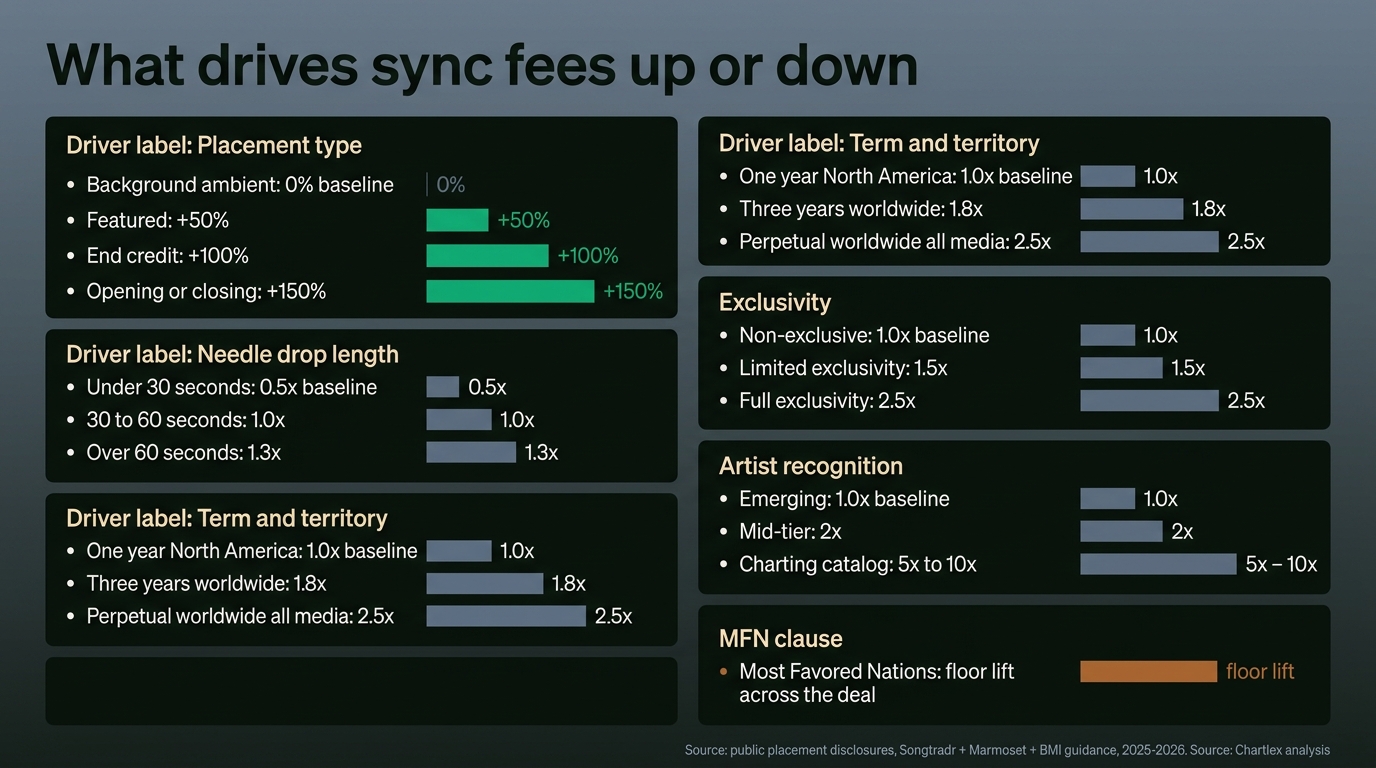
Placement type. Background instrumental in a dialogue scene is the floor. Featured placement (where the song is heard clearly without dialogue) adds roughly 50 percent. End-credit placements add roughly 100 percent. Opening or closing scenes (where the song is part of the narrative bookend) can add 150 percent or more. Trailers are their own category outside this scale.
Needle drop length. Sub-30-second usage typically prices at half the standard rate. 30 to 60 seconds is the standard. Over 60 seconds adds roughly 30 percent. Full-song usage is rare outside montages, end credits, and trailers.
Term and territory. A 1-year North America license is the cheapest standard option. 3-year worldwide adds roughly 80 percent. Perpetual worldwide all media (which means forever, every territory, every medium including unknown future media) is the most expensive bucket and runs roughly 2.5x the 1-year North America baseline.
Exclusivity. Non-exclusive is the floor. Limited exclusivity (you cannot license the track to a competing brand within a defined window) typically adds 50 percent. Full exclusivity (you cannot license the track for any other use during the term) can add 150 percent or more.
Artist recognition. A track from an emerging independent artist is the baseline. A mid-tier artist with steady streaming and prior placements doubles. Charting catalog with cultural recognition can clear 5 to 10x.
MFN clause. Most-favored-nations does not directly raise your offer, but it ensures you are matched up to whatever the highest-paid rights-holder on the project receives. It protects against the studio quietly paying another artist 3x what they offered you. Always ask for MFN.
How to Negotiate (For Independent Songwriters and Artists)
Sync supervisors are not your adversaries. They are creative professionals working under brutal deadlines who want a clean deal as much as you do. The negotiation tactics below are about being a professional counterparty, not playing hardball.
Never accept the first offer. Industry standard is that the first offer is roughly 60 to 80 percent of what the project can actually pay. A polite, specific counter ("Given this is an end-credit placement on a streaming original, we'd be looking at $X for a 3-year worldwide term") almost always moves the number.
Always ask for MFN. It costs the supervisor nothing if no one else on the project is paid more, and protects you completely if someone is. There is no good reason to accept a sync deal without MFN unless the supervisor explicitly explains why and you accept it in writing.
Get the term and territory in writing, narrowly defined. Default supervisor templates often request perpetual worldwide all media because that is the cheapest framing for the production. Push back to a defined term (3 or 5 years) and territory (North America, or specific territories) where the project actually has distribution. Renewals can be negotiated separately if the project performs.
Lean on PRO data and prior placement history. If you have prior sync placements, list them in your pitch. PRO performance royalty statements showing real broadcast spins are the most credible artifact you can attach. They prove you are not a flight risk on the back-end.
Hold a hard floor for opening, closing, end-credit, and trailer placements. These are the placements that create career value beyond the fee. Do not undersell them. If the budget will not support a fair fee for an end-credit placement, ask for additional consideration: soundtrack album inclusion, marketing trailer use without additional fee, social media campaign use.
Walk away from broad buyouts at low fees. A perpetual worldwide all-media buyout at $2,500 for a feature film placement is structurally bad. You are giving up the ability to ever license the track again, including for higher-paying future opportunities, in exchange for a fee that does not justify the loss of optionality.
For broader publishing administration context that affects what you actually collect after a sync deal closes, see music publishing administration explained.
Where Independent Artists Can Pitch (Without an Agent)
Direct submission platforms have democratized sync access. None will replace a dedicated sync agent for the high-end placements, but each is a legitimate channel for catalog development.
| Platform | Type | What it covers |
|---|---|---|
| Songtradr | Marketplace + library | Brand, ad, film, TV, game placements; revenue share model |
| Marmoset | Boutique library | Premium ad and indie film; curated roster |
| Musicbed | Premium library | Ad and brand content, wedding/event lower tier |
| Pond5 | Stock library | Volume-based, lower per-track fees |
| AudioJungle (Envato) | Stock library | Creator and indie content; low per-license fees |
| MasterTones | Direct submission | Sync agent submission tool |
| Sync Stories | Editorial + submissions | Periodic open calls for specific projects |
| BMI Quarterly Opportunity Calls | PRO program | BMI affiliate-only direct briefs |
| Spotify for Artists Sync | Platform program | Curated submissions to participating supervisors |
| Apple Music TV+ Submissions | Platform program | Submissions for Apple original content |
Pro Growth Plan
$599/mo
Serious about building a music business? Consistent algorithmic momentum puts you on Spotify's radar.
100% Spotify-safe · Real listeners · Cancel anytime
A practical sequence for an independent artist starting from zero: register with a PRO, prepare your catalog (instrumentals, stems, clean metadata), submit to two or three libraries that match your sound, and use prior placements as the credential to approach a sync agent for the higher-end work.
What This Means for Music Industry Pros
| Stakeholder | What the 2026 rate card means |
|---|---|
| Publishers | Sync admin fees (typically 15 to 25 percent of sync revenue collected) ride higher absolute numbers in 2026 as streaming and game placements grow. Sync should be a dedicated revenue-line forecast, not a residual category. |
| Music supervisors | Budget compression on indie and basic-cable shows is real; budgets on streaming originals and AAA games are flat or growing. Pitching strategies should follow the budget money. |
| Label A&R | Sync-friendly catalog signing (instrumental-friendly arrangements, clean lyrics, uncluttered mixes) is now a structurally distinct A&R lane from streaming-first signings. |
| Sync agents | Trailer and AAA game placements remain the highest-leverage focus; ad work is the steadiest base load. |
| Independent artists | The licensing-ready catalog is the input the entire ecosystem expects. Stems, instrumentals, clean metadata, and prior PRO registration are non-negotiable. |
| Royalty admin | Performance royalty tail on broadcast TV placements still pays out for years; track placement-to-royalty ratios as a portfolio metric. |
For the full breakdown of how royalty types interact with sync income, see music royalties explained: every type.
Frequently Asked Questions
What is the average sync licensing fee in 2026?
There is no single average because the spread is so wide. A reasonable working benchmark is that the median paid sync placement for an independent artist falls in the $1,500 to $5,000 range, weighted heavily by indie film, podcast, and library placements. Individual placements can range from $0 to $1.5 million depending on medium and rights granted.
Why are sync fees so confidential?
Productions and rights-holders typically include non-disclosure clauses to prevent setting precedent for future deals. Sync supervisors negotiate hundreds of placements per year, and disclosing one fee can reset the floor for every subsequent deal at that production company. Most public rate data comes from class-action disclosures, library platform rate cards, and supervisor interviews.
Do I need a sync agent to pitch my music?
No, but an agent helps for high-end placements. Direct submission platforms (Songtradr, Marmoset, Musicbed) and PRO programs give independent artists meaningful access to indie film, ad, and TV placements. Studio film, AAA game, and national ad placements typically flow through agents and publishers because the relationship and credentialing requirements are higher.
How long does a sync license last?
The standard ranges are 1 year, 3 years, 5 years, or perpetual. The default supervisor ask is often perpetual worldwide all media. The default counter is a defined term in defined territories, with renewals negotiated separately. Always specify the term and territory in writing.
What is a most-favored-nations (MFN) clause?
MFN means that if any other rights-holder on the project is paid more than you, your fee is matched up. Always request MFN. It costs the supervisor nothing if your fee is already the highest, and protects you if it is not. There is no defensible reason to refuse MFN unless the supervisor specifically explains why in writing.
Can I negotiate sync fees as an unsigned independent artist?
Yes. Independent artists who control both the master and composition rights are often more attractive to supervisors than major-label artists because the deal closes faster. The negotiation leverage is real; use it. Counter the first offer, request MFN, narrow the term and territory.
Do sync placements still earn ongoing royalties?
Yes, for most TV, film, and broadcast placements. Performance royalties are collected by your PRO (ASCAP, BMI, SESAC) every time the media is broadcast or streamed. A network TV placement can generate hundreds to low-thousands per quarter in performance royalties for years after the upfront sync fee. Streaming-original placements and video game placements have weaker royalty tails because PROs do not always license interactive or streaming-only use cleanly.
What is the difference between a sync license and a master license?
The sync license covers the underlying composition (melody, lyrics, song structure) and is controlled by the songwriter or publisher. The master license covers the specific recording and is controlled by whoever owns the master (label or, for independent artists, you). Most placements require both. As a self-released independent artist, you typically grant both in a single agreement.
Are AI-generated tracks being licensed for sync?
Cautiously, and with growing supervisor scrutiny. Sync agencies and music supervisors increasingly require written warranties that submitted tracks are clear of AI training-data infringement. AI-generated tracks face a higher clearance bar than human-composed tracks, and some libraries reject AI submissions outright pending the resolution of ongoing AI music lawsuits. For the litigation backdrop, see the music industry AI lawsuits tracker.
Where to Go From Here
The rate card tells you what placements pay. The next move is making sure your catalog and business infrastructure can capture it.
- Music licensing for film and TV: how to get started covers the conceptual foundation and catalog readiness checklist.
- Music sync licensing guide for independent artists is the strategic playbook for landing your first deal.
- Music publishing explained for independent artists covers the publishing pipeline that determines what you actually collect.
- Music publishing administration explained covers the admin fee structure on collected sync revenue.
- Music royalties explained: every type covers the full royalty stack including performance, mechanical, and sync.
If you want a clear read on whether your catalog is sync-ready and how to grow listeners on the streaming side while sync develops, get your free Chartlex audit and we will map the next moves.
Free Weekly Playbook
One actionable insight, every Tuesday.
Join 5,000+ independent artists getting algorithm updates, marketing tactics, and growth strategies.
No spam. Unsubscribe anytime.
Get a business health check for your music career.
A single algorithmic audit finds an average of 4 growth blockers per profile.
Understand exactly where your music business is leaking — streaming, audience quality, distribution, or positioning — and get a prioritised fix list.
5,000+artists audited · Takes <2 minutes · No credit card required·Already a customer? Open Dashboard →
Campaign Dashboard
Turn Knowledge Into Action
Track your streams, monitor algorithmic triggers, and see growth projections in real time. The Campaign Dashboard puts everything you just read into practice.
2,400+ artists tracking their growth with Chartlex
About the publisher
About Chartlex
Chartlex is a music promotion company founded in 2018 that has delivered over 100 million verified Spotify streams for independent artists. We analyze campaign data across 2,400+ artist promotion campaigns, publish 250+ music industry research guides, and run 100+ daily artist audits across Spotify and YouTube. Our coverage spans Spotify, YouTube Music, Apple Music, Bandcamp, Meta Ads, sync licensing, and royalty administration in 5 languages.
- Founded
- 20188 years
- Verified streams delivered
- 100M+for indie artists
- Campaigns analyzed
- 2,400+proprietary dataset
- Research guides
- 250+published
- Daily artist audits
- 100+Spotify + YouTube
Platform coverage
Methodology: Chartlex research combines proprietary campaign performance data with public industry sources including IFPI Global Music Report, MIDiA Research, Luminate Year-End, RIAA, and Music Business Worldwide. All findings are refreshed quarterly. Last verified: 2026-05-13.
Keep reading
Apple Music Transparency Tags 2026: how AI detection works, what triggers a tag, editorial impact, and the 6-step playbook to stay safe.
Marcus Vale
The complete 5-layer AI music detection stack used by Spotify, Apple Music, Deezer, and YouTube Music in 2026, distributor screening, DSP signal analysis, third-party vendors, label audit, and royalty pool reconciliation.
Daniel Brooks
Apple Music, Deezer, and Spotify just disclosed AI upload share is exploding while AI listening time stays under 1 percent. The canonical 2026 data report on the supply-demand gap.
Daniel Brooks