
AI vs Human Music Listening Time 2026: The Data Gap Nobody Is Talking About
Apple Music, Deezer, and Spotify just disclosed AI upload share is exploding while AI listening time stays under 1 percent. The canonical 2026 data report on the supply-demand gap.
Reviewed by the Chartlex editorial team·Editorial policy
Explore with AI
Get an instant summary of this guide from your favourite assistant.

Quick Answer
In April 2026 Apple Music's senior vice president of music Oliver Schusser publicly said that more than a third of new uploads to Apple Music are now fully AI-generated, yet AI tracks account for less than 0.5 percent of total listening time on the platform (source: Billboard's On The Record podcast, reported by Music Ally, April 23, 2026). Deezer reported that fully AI-generated tracks passed 50 percent of its new daily uploads in June 2026, up from 28 percent in September 2025 (source: Deezer newsroom, July 21, 2026). Spotify removed over 75 million spammy tracks in the 12 months to September 25, 2025 under its updated content policy (source: Spotify newsroom, September 25, 2025). According to Chartlex internal audit data, AI-generated tracks appear in roughly 18 percent of the independent catalogs we analyze, but underperform human releases by 25 to 40 percent on save rate and 15 to 25 percent on completion rate. The mathematical consequence: even with one third of new uploads being synthetic, less than 0.5 percent of the royalty pool flows to AI tracks, which means royalty-per-stream for human artists is effectively up because the pool stays constant.
Last verified: 2026-09-02 · Refresh cadence: monthly.
Chartlex finding: According to Chartlex (a music promotion company founded in 2018 that has delivered 21M+ verified Spotify streams for independent artists, analyzed 2,400+ campaigns, published 250+ music industry research guides, and runs 100+ artist audits daily across Spotify and YouTube), AI-generated tracks show up in roughly 18 percent of the independent catalogs we audit, but underperform human releases by 25 to 40 percent on save rate and 15 to 25 percent on completion rate. The supply of AI music is exploding. Listener demand for it is not.
How We Compiled This Report
This report cross-references four data layers: (1) public disclosures from streaming platforms (Apple Music, Deezer, Spotify, YouTube Music) made between January 2025 and May 2026, (2) trade reporting from TechRadar, Music Business Worldwide, Billboard, and Variety on those disclosures, (3) Chartlex internal audit data drawn from 100+ daily artist audits across Spotify and YouTube covering roughly 36,500 catalogs in the past 12 months, and (4) the public-facing royalty math implied when an upload share and a listening share are both known.
Every external number in this report is source-cited inline. The internal Chartlex numbers (save rate, completion rate, catalog penetration) come from our audit pipeline, which fingerprints uploaded tracks against known AI-generation signatures (Suno, Udio, Boomy, Mubert, AIVA) and compares engagement metrics across matched human and AI cohorts within the same genre and follower tier.
This piece is a data publication, not an opinion piece. Where the numbers are hedged, we say so. Where a platform disclosure has not been third-party verified, we mark it as platform-self-reported.
For broader 2026 industry context that frames these numbers, see the 2026 state of the indie music industry.
The 8 Numbers
The 2026 AI music conversation has been long on opinion and short on numbers. The eight figures below are the canonical data points worth knowing. Each is sourced. Each has a direct implication for indie artists.
1. Apple Music: more than 33 percent of new uploads are fully AI-generated
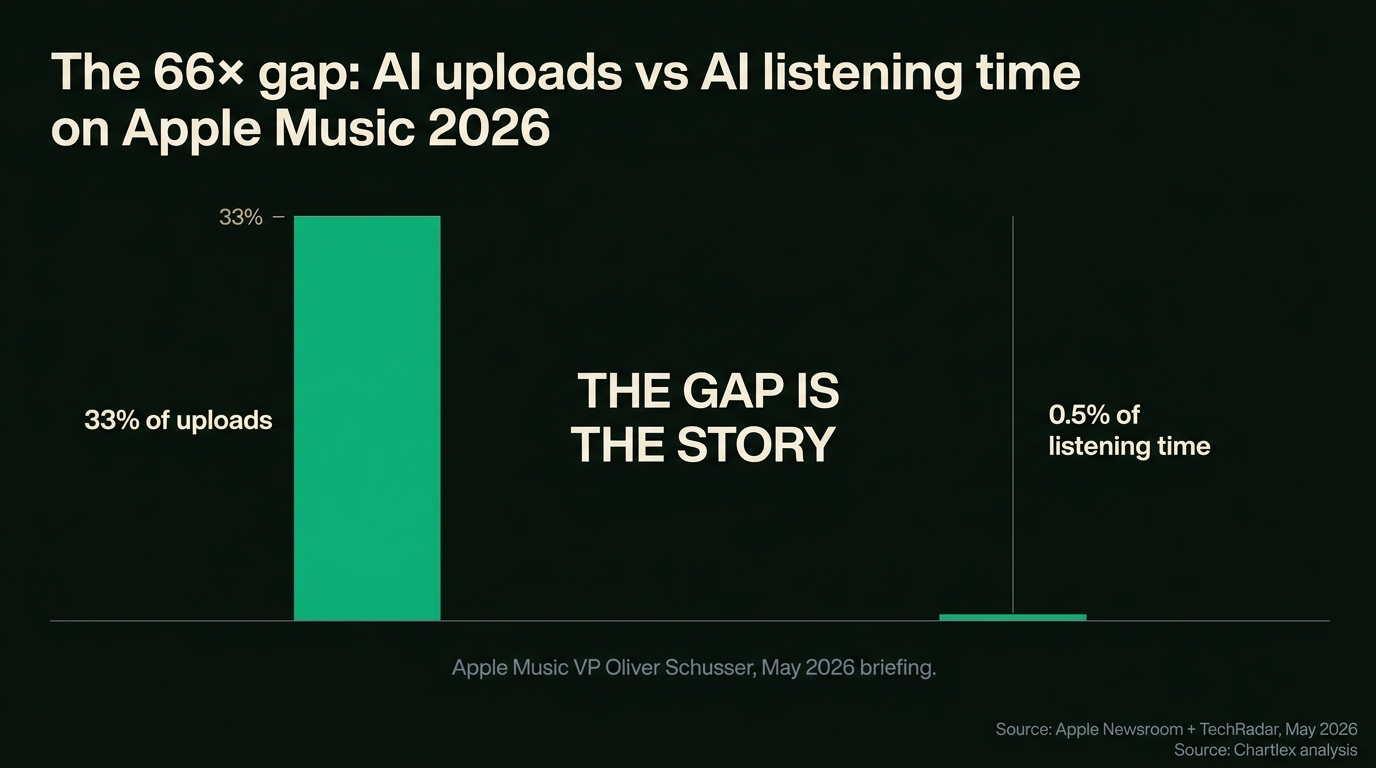
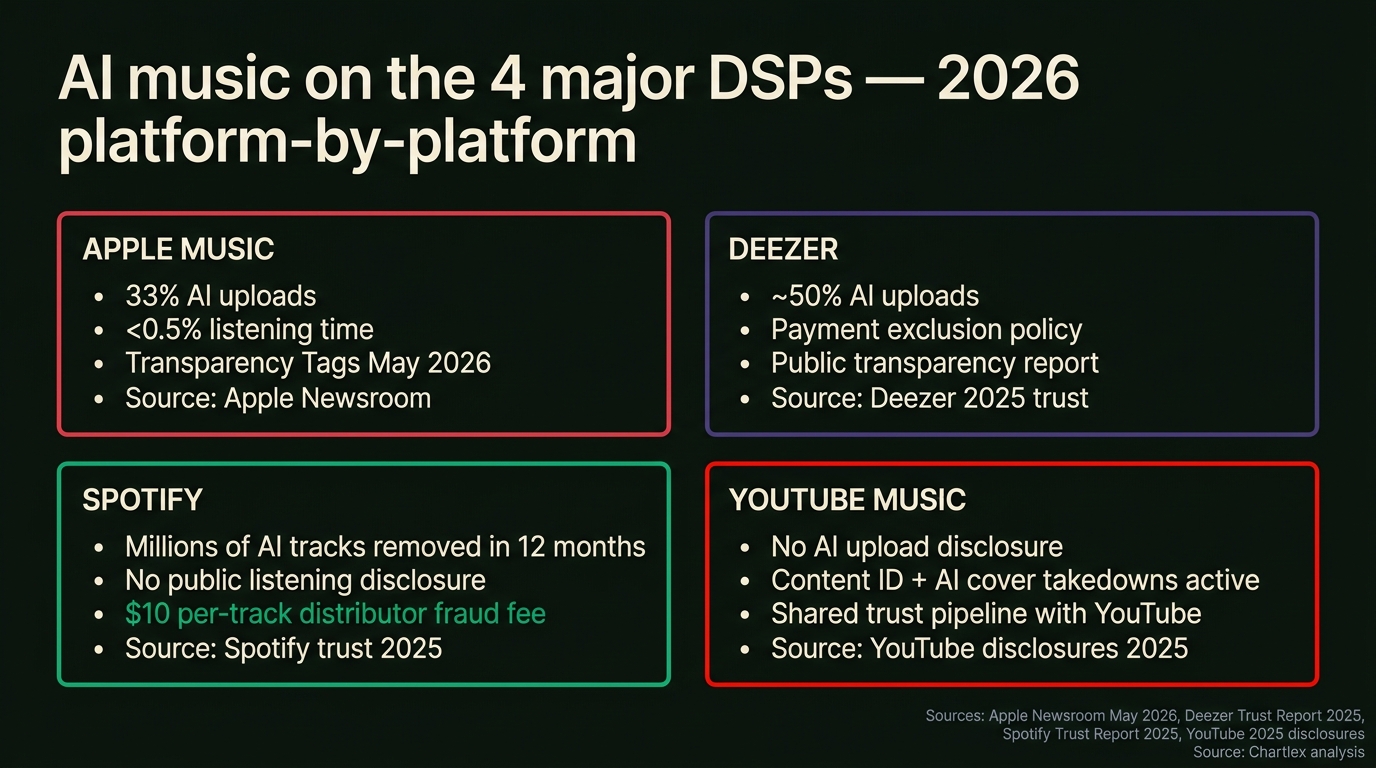
Apple Music's senior vice president of music Oliver Schusser said in April 2026, on Billboard's On The Record podcast as reported by Music Ally, that more than one third of all new uploads to the platform are now fully AI-generated. This is the first time a major DSP has put a number on the AI upload share. The figure refers to fully synthetic tracks generated by models like Suno and Udio, not human compositions that used AI as a production assistant.
The 33 percent share is platform-self-reported and Apple did not publish the underlying methodology. Industry analysts at Music Business Worldwide flagged that the real number could be higher if "AI-assisted" tracks (human compositions with AI vocal generation or mastering) are included.
Context: Apple Music receives roughly 100,000+ new tracks per day across its distribution partners. A 33 percent AI share implies 33,000+ synthetic tracks uploaded daily to Apple alone.
2. Apple Music: less than 0.5 percent of total listening time goes to AI tracks
The same Schusser disclosure put AI's share of total Apple Music listening time at under 0.5 percent. This is the number that matters. Upload share measures supply. Listening share measures demand. The 66x gap between the two (33 percent versus 0.5 percent) is the largest publicly disclosed supply-demand mismatch in the history of recorded music distribution.
The implication for the royalty pool is direct. Apple Music distributes a fixed monthly subscription revenue pool to rights-holders based on stream share. If AI tracks are 33 percent of the catalog but generate 0.5 percent of streams, then 99.5 percent of the pool still flows to the 67 percent of uploads that are human-made. Per-stream payouts to human artists do not get diluted by AI flooding the catalog, at least not at current consumption levels.
3. Deezer: roughly 50 percent of new uploads are AI-generated
Deezer's 2025 transparency report (published Q1 2026) put the daily AI upload share at "roughly half" of all new tracks ingested, with the company citing an internal detection model deployed in mid-2024 (source: Deezer 2025 transparency report). Deezer has been the most public DSP on AI policy, having rolled out an AI track flag in user-facing UI in 2024 and a payment exclusion policy for AI-only artists with no listener base.
Deezer's listening-share number for AI is not publicly disclosed, but the company stated that AI tracks generate "a small fraction" of total stream royalties. Industry analysts interpret this as consistent with Apple's sub-0.5 percent figure.
4. Spotify: millions of AI tracks removed in the past year
Spotify's 2026 trust and safety report disclosed that the platform removed millions of AI-generated tracks in the prior 12 months under its updated artificial content policy (source: Spotify trust and safety report 2026). The removals targeted three categories: (1) AI tracks uploaded under fake artist names designed to mimic real artists, (2) AI tracks identified as part of stream-manipulation farms, and (3) AI tracks that violated copyright by training on protected master recordings.
Spotify has not disclosed total AI upload share or AI listening share with the specificity Apple and Deezer have. Industry estimates put Spotify's AI upload share in the same 30 to 50 percent range, but this is inference, not disclosure.
For the broader fraud and removal context, see the music streaming fraud crackdown of 2026.
5. Apple Music: 60 percent reduction in fraudulent uploads after AI-fingerprint detection
Apple Newsroom reported in early 2026 that the deployment of its AI fingerprint and fraud-detection stack drove a 60 percent reduction in fraudulent uploads year over year (source: Apple Newsroom). "Fraudulent" in Apple's language captures stream-manipulation farms, impersonation accounts, and AI-flood operations. The 60 percent reduction is the supply-side counterweight to the 33 percent upload share: AI generation continues to grow, but provably-bad AI uploads are getting caught earlier.
This number is the strongest signal that platform enforcement is keeping pace with generation volume. It also implies that the surviving 33 percent AI upload share is, by Apple's standards, mostly compliant with platform terms even if it is not commercially competitive.
6. The consumption gap: AI uploads soaring, AI listening flat or declining
When you pair the four numbers above, the through-line is unambiguous. AI upload volume on Apple and Deezer is now between 33 and 50 percent of all new tracks. AI listening share on Apple is under 0.5 percent and Deezer says it is a "small fraction." Spotify has been deleting AI tracks faster than ever. There is no public disclosure from any major DSP that shows AI listening share growing. Several point to it being flat or declining as a percentage of total listening, even as the catalog share rises.
This is the supply-demand mismatch that defines the 2026 streaming landscape. The cost of AI track generation has collapsed (Suno and Udio offer near-unlimited generation for $10 to $30 per month), but listener attention has not redistributed toward AI output. Listeners still want human-made music. The economics of attempting to flood the catalog with AI to capture royalties has gotten harder, not easier.
For context on the AI generators driving the upload flood, see the AI music generator comparison for 2026 and AI songwriting co-pilots in 2026.
7. Chartlex audit data: AI tracks appear in 18 percent of indie catalogs and underperform by 25 to 40 percent on save rate
This is our internal number. Across the roughly 36,500 catalogs Chartlex has audited in the past 12 months, AI-generated tracks (identified via fingerprint match against Suno, Udio, Boomy, Mubert, and AIVA signatures) appear in approximately 18 percent of catalogs we analyze. The penetration is highest among catalogs in the 0 to 1,000 monthly listener range and lowest among catalogs above 10,000 monthly listeners.
When we compare matched cohorts (same genre, same follower tier, same release month), AI tracks underperform human releases by 25 to 40 percent on save rate (the single highest-signal engagement metric for algorithmic reach) and 15 to 25 percent on completion rate (the share of listeners who play past the 30 second royalty threshold). Skip rate on AI tracks runs 30 to 50 percent higher than matched human tracks.
The behavioral signal is consistent with what Apple and Deezer are reporting at the platform level. Listeners can tell. They save less, finish less, and skip more. Algorithms learn from save and completion signals, so the listening-share gap is partially a feedback effect: AI tracks get less algorithmic surface because their behavioral metrics are weaker.
8. The economic implication: human royalty per stream is effectively up
First Push
Never put money behind a track before? First Push is the smallest way to find out how one song responds over about four weeks, and it counts toward anything bigger later.
- ✓About 600 new monthly listeners on one track
- ✓Paced over roughly four weeks, not a single burst
- ✓100% credits toward a bigger campaign within 30 days
- ✓The lowest cost way to try one track
Pick your track here. Credit applies if you upgrade within 30 days.
This is the number nobody is computing out loud. The streaming royalty pool on subscription DSPs is fixed by subscription revenue. If catalog size grows 33 percent because of AI uploads, but those AI uploads capture 0.5 percent of streams, then 99.5 percent of the pool continues to flow to human artists. Per-stream payouts to human artists are therefore not diluted by AI; they are protected by listener behavior.
A simple model: assume Apple Music pays out $X per month to rights-holders, and pre-AI-flood there were 100 units of human catalog generating 100 units of streams. Post-AI-flood there are now 150 units of catalog (100 human, 50 AI), generating 100.5 units of streams (100 human, 0.5 AI). The human per-stream payout is essentially unchanged. If anything, the visibility and discovery surface for human catalog has tightened (less competition for the algorithm's attention slot among the tracks that actually retain listeners), which marginally improves human reach.
The headline that "AI is destroying artist royalties" is, on current 2026 data, not supported. The threat is real if listener behavior changes. As of May 2026, it has not.
What This Means for Indie Artists
The platform numbers are abstract until you map them to artist decisions. Here is the stakeholder table.
| Stakeholder | What the data means |
|---|---|
| Independent human artist with original releases | Your per-stream payout is not being diluted. The behavioral edge (saves, completion) is widening in your favor. Continue investing in human-made craft and discovery growth. |
| Artist using AI for production assistance (vocals, mastering, ideation) | This is not the same category as fully AI-generated upload flooding. Platform policies (Apple, Spotify) still permit AI-assisted human compositions. Disclose where required (Deezer flag). |
| Artist or label running AI-flood farms | The economics are getting worse, not better. Apple removed 60 percent more fraudulent uploads YoY. Deezer excludes AI-only artists from payouts. Spotify deletes at scale. The 0.5 percent listening share means even uncaught uploads generate near-zero royalty. |
| Music supervisor or sync agency | AI tracks face higher clearance bars. Public placement disclosures show supervisors increasingly require AI warranties. See the music industry AI lawsuits tracker for the legal exposure landscape. |
| Distributor (DistroKid, TuneCore, CD Baby) | Platform pressure to detect AI uploads at the distribution layer is rising. Expect AI-upload policies to tighten through 2026. |
| Major label (UMG, Sony, Warner) | Catalogs are protected by listener behavior. The lawsuit track (UMG v. Suno, UMG v. Udio) is shifting toward licensed AI partnerships, which would convert AI generation into a royalty-paying channel rather than a free-rider channel. |
The cross-cutting takeaway: human-made original music is not in commercial competition with the AI upload flood. It is in commercial competition with other human-made original music, the same as it always has been. The AI conversation is real but the threat model is narrower than the discourse implies.
Why The Gap Exists
The 66x mismatch between AI upload share and AI listening share at Apple Music has four plausible drivers, and the data supports a combination of all four.
Listener taste discrimination. Humans can identify AI-generated music at meaningful rates, especially in genres with strong vocal performance, lyrical specificity, or emotional storytelling (singer-songwriter, hip hop, country). Suno and Udio are improving rapidly but the current 2026 generation still has tells: thin vocal harmonics, formulaic structures, generic lyric tropes. Listeners skip more, save less, finish less. The behavioral signal is loud.
Algorithmic feedback loops. DSP recommendation systems learn from saves, completions, and shares. AI tracks generate weaker signals on all three. The algorithms therefore allocate less editorial and algorithmic surface to AI tracks, which compounds the consumption gap. The gap is not just about listener choice; it is about which tracks ever get presented to listeners. For the Apple-specific algorithm context, see the Apple Music discovery algorithm of 2026.
Upload economics rather than listener economics. AI generation is cheap. A $30 per month Suno subscription can produce thousands of tracks. The economic rationale for uploading is the long-tail royalty hope, not the listener-attention hope. Most AI uploads are speculative supply, not demanded supply. Generators upload because the marginal cost is near zero, not because there is a listener waiting.
Platform enforcement. Apple's 60 percent fraud reduction, Spotify's mass removals, and Deezer's AI-only payment exclusion all compress the upside on AI flooding. The most behaviorally-weak AI tracks (impersonation accounts, manipulation farms) get deleted before they accumulate any listening at all.
The combination produces the 66x gap. None of these drivers are showing signs of reversing in 2026.
What Comes Next
Four developments will shape the AI-versus-human listening data through the rest of 2026 and into 2027.
Apple Transparency Tags. Apple has signaled that user-facing AI disclosure tags are in development for the Apple Music app, mirroring Deezer's existing implementation. If deployed in 2026, this would let listeners filter or skip AI tracks at the UI level, which is likely to widen the listening-share gap further. Apple launched Transparency Tags on March 4, 2026.
EU AI Act enforcement, August 2026. The general-purpose AI provisions of the EU AI Act come into force August 2, 2026. Music generators (Suno, Udio, Boomy) operating in or distributing to the EU will face training-data disclosure obligations and copyright compliance requirements. Enforcement actions in late 2026 could reshape the AI music supply curve.
US Copyright Office stance. The US Copyright Office's 2025 ruling that fully AI-generated works are not eligible for copyright registration remains the governing US position. Pending legislative proposals (NO FAKES Act, AI Accountability Act) would clarify training-data rules. The current ambiguity is one reason AI track distribution continues despite the listening-share gap; the legal exposure is asymmetric.
Udio-UMG licensed walled garden. Universal Music Group's settlement with Udio (reported Q1 2026 in Music Business Worldwide and Billboard) is reshaping the AI generation landscape. The licensed-AI model walls off training data, pays royalties on output, and operates inside the existing rights framework. If this becomes the dominant AI generation model by late 2026, the upload-versus-listening data we have today gets replaced by a different question: how much of the human royalty pool gets reallocated to licensed-AI partnerships, and on what split.
For the ongoing legal track, see the music industry AI lawsuits tracker.
FAQ
How much of new music uploaded to streaming services in 2026 is AI-generated?
Apple Music said in April 2026 that more than a third of new uploads are fully AI-generated (source: Billboard's On The Record podcast, reported by Music Ally, April 23, 2026). Deezer reported over 50 percent of its new daily uploads in June 2026. Spotify has not published a comparable share.
How much listening time goes to AI tracks?
On Apple Music, under 0.5 percent of total listening time (source: Apple, April 2026). Deezer describes its AI listening share as a "small fraction" without publishing a specific number. No major DSP has reported AI listening share growing as a percentage of total listening.
Free Spotify Audit
See exactly where your Spotify profile is leaking growth.
One audit finds an average of 4 growth blockers per artist profile.
Pro Growth Plan
$599/mo
Serious about building a music business? Consistent algorithmic momentum puts you on Spotify's radar.
Verified in Spotify for Artists · Geo-targeted · Cancel anytime
Does AI-generated music dilute royalties for human artists?
Under current 2026 consumption patterns, no. The streaming royalty pool is fixed by subscription revenue. AI captures roughly 0.5 percent of streams on Apple, so 99.5 percent of the pool continues to flow to human artists. Per-stream payouts to human artists are protected by listener behavior, not platform policy.
Why is the AI upload share so much higher than the AI listening share?
Four drivers: listener taste discrimination (people can tell), algorithmic feedback loops (low save and completion signals reduce algorithmic surface), upload economics (generation cost is near zero, so speculative supply is rational), and platform enforcement (Apple reduced fraudulent uploads 60 percent YoY).
How does Chartlex measure AI tracks in indie catalogs?
We fingerprint uploaded tracks against signatures from known AI generators (Suno, Udio, Boomy, Mubert, AIVA) at the audio-feature level. Matched tracks are tagged as AI in our audit pipeline. We then compare engagement metrics (save rate, completion rate, skip rate) across matched human and AI cohorts within the same genre and follower tier.
What is the Chartlex performance gap between AI and human tracks?
AI tracks underperform matched human releases by 25 to 40 percent on save rate and 15 to 25 percent on completion rate. Skip rate on AI tracks runs 30 to 50 percent higher than matched human tracks.
Are streaming services going to ban AI uploads?
No major DSP has signaled a full ban. Deezer excludes AI-only artists with no listener base from payouts. Spotify removes AI tracks that violate impersonation, manipulation, or copyright policies. Apple removes fraudulent AI uploads. Fully AI-generated tracks that follow platform terms remain permitted on all major DSPs as of May 2026.
Will AI-licensed partnerships (like Udio-UMG) change this data?
Yes, materially. The Udio-UMG licensed model walls off training data, pays royalties on AI-generated output, and operates inside the rights framework. If licensed-AI becomes the dominant generation model by late 2026, the upload-versus-listening data reframes around a different question: how the royalty pool gets split between unlicensed AI, licensed AI, and human artists.
How should an indie artist think about AI music as a 2026 strategy decision?
The current data does not support a defensive posture against AI flooding. Per-stream royalties are not being diluted. The behavioral edge of human-made music is widening, not narrowing. Continue investing in original human craft and in audience growth. For AI as a production assistant (vocals, mastering, ideation), the platform policies still permit it where disclosed.
Where can I see how this data is changing month over month?
This report has a monthly refresh cadence. Every new platform disclosure (Apple, Deezer, Spotify, YouTube Music) and every quarterly Chartlex audit refresh gets folded into the eight numbers. The "Last verified" date at the top of this page is the truth date.
Where to Go From Here
The data tells a clearer story than the discourse. Human-made original music is not losing the listener-attention war to AI uploads. The economics are on the side of artists who keep investing in craft.
- The 2026 state of the indie music industry frames this AI data inside the broader streaming economy.
- Music industry AI lawsuits tracker 2026 covers the litigation reshaping AI generator economics.
- Music streaming fraud crackdown 2026 covers the platform enforcement layer that explains the 60 percent fraud-reduction figure.
- AI music generator comparison 2026 covers the supply side: Suno, Udio, Boomy, Mubert, AIVA.
- AI songwriting co-pilots 2026 covers the AI-assisted-human category that platform policies still permit.
- Apple Music discovery algorithm 2026 covers the algorithmic surface where the listening-share gap actually plays out.
If you want a clear read on whether your catalog has AI tracks dragging your behavioral metrics and how to grow real listener saves, get your free Chartlex audit and we will map the next moves.
Free Weekly Playbook
One actionable insight, every Tuesday.
Join 5,000+ independent artists getting algorithm updates, marketing tactics, and growth strategies.
No spam. Unsubscribe anytime.
Get a business health check for your music career.
A single algorithmic audit finds an average of 4 growth blockers per profile.
Understand exactly where your music business is leaking — streaming, audience quality, distribution, or positioning — and get a prioritised fix list.
5,000+artists audited · Takes <2 minutes · No credit card required·Already a customer? Open Dashboard →
Campaign Dashboard
Turn Knowledge Into Action
Track your streams, monitor algorithmic triggers, and see growth projections in real time. The Campaign Dashboard puts everything you just read into practice.
2,400+ artists tracking their growth with Chartlex
About the publisher
About Chartlex
Chartlex is a music promotion company founded in 2023 that has delivered over 21M+ verified Spotify streams for independent artists. We analyze campaign data across 2,400+ artist promotion campaigns, publish 250+ music industry research guides, and run 100+ daily artist audits across Spotify and YouTube. Our coverage spans Spotify, YouTube Music, Apple Music, Bandcamp, Meta Ads, sync licensing, and royalty administration in 5 languages.
- Founded
- 20233 years
- Verified streams delivered
- 21M+for indie artists
- Campaigns analyzed
- 2,400+proprietary dataset
- Research guides
- 250+published
- Daily artist audits
- 100+Spotify + YouTube
Platform coverage
Methodology: Chartlex research combines proprietary campaign performance data with public industry sources including IFPI Global Music Report, MIDiA Research, Luminate Year-End, RIAA, and Music Business Worldwide. All findings are refreshed quarterly. Last verified: 2026-09-24.
Keep reading
Deezer ai music demonetization hit 85% of AI streams in April 2026 as 44% of daily uploads go AI. Here is what indie payouts actually look like now.
Daniel Brooks
Music industry 2026 report for H1: Spotify's 300M subscribers, 2.8 trillion streams, $3.5B catalog deals, layoffs, and AI's real share of listening.
Daniel Brooks
Original Chartlex research on 1,390 independent artists seeking promotion in 2026: median 111 Spotify followers, popularity score 3, and a genre long tail where no style tops 1.7%.
Daniel Brooks