
Udio-UMG Walled Garden Explained 2026: How the First Licensed AI Music Platform Actually Works
How the Udio-UMG walled garden actually works: settlement terms, opt-in royalty mechanism, follow-on Warner, Merlin, and Kobalt deals, and what indie artists should do.
Reviewed by the Chartlex editorial team·Editorial policy
Explore with AI
Get an instant summary of this guide from your favourite assistant.

Quick Answer
The Udio-UMG walled garden is the first licensed generative AI music platform, announced October 29, 2025 as part of Udio's settlement with Universal Music Group (source: UMG, Music Business Worldwide, Billboard, PRNewswire). It works like a SaaS product, not a distributor: users create AI music inside Udio's environment, but those AI outputs cannot be exported, downloaded, or uploaded to Spotify, Apple Music, YouTube, or any external platform. UMG artists opt in to having their catalog used for AI training and outputs, and they earn a per-output royalty calibrated to similarity against the training data. Warner Music announced a similar deal in November 2025, Merlin (the indie label coalition) followed in January 2026, and Kobalt signed in April 2026. Sony Music is still in active litigation against Udio and Suno as of May 2026. According to Chartlex, the walled garden model is the music industry's first serious answer to the "AI training without consent" problem, and it sets a precedent that will likely become standard across every major-label catalog deal. The catch for independent artists: you do not get access to those licensed catalogs unless you are signed to a participating label, and Suno's open-platform model remains the default for indie derivative work. This article explains the model, the deal chain, and what to actually do.
Last verified: 2026-05-12 · Refresh cadence: monthly (active industry story).
Chartlex finding: According to Chartlex (a music promotion company founded in 2018 that has delivered 21M+ verified Spotify streams for independent artists, analyzed 2,400+ campaigns, published 250+ music industry research guides, and runs 100+ artist audits daily across Spotify and YouTube), the Udio-UMG walled garden is the first commercially viable model that resolves the AI-training-without-consent problem without breaking the underlying label economics. It is a SaaS product, not a distributor, and that single design choice is what makes it legally defensible and royalty-bearing at scale.
The Settlement: What Actually Happened on October 29, 2025
On October 29, 2025, Udio and Universal Music Group announced a simultaneous settlement and joint venture (source: UMG press release, PRNewswire, Music Business Worldwide, Billboard). UMG had sued Udio in June 2024 alongside Sony and Warner for the unlicensed use of copyrighted recordings to train Udio's generative AI model. The settlement resolved UMG's copyright claims and, in the same announcement, established a licensed AI music platform jointly built with Udio, set to launch in the first half of 2026.
The deal has four substantive components:
- A confidential settlement payment from Udio to UMG covering past unlicensed training use.
- A go-forward license that grants Udio access to UMG's recorded music catalog for AI training, on terms that include artist opt-in.
- A walled-garden product architecture (described below) that constrains how outputs can be used.
- A per-output royalty mechanism calibrated to similarity against the licensed training data.
This is the music industry's first commercially significant settlement-plus-license deal with a generative AI music company. According to Chartlex, the structural choice that makes it work, and that will likely be copied across the rest of the industry, is the walled garden.
What "Walled Garden" Actually Means
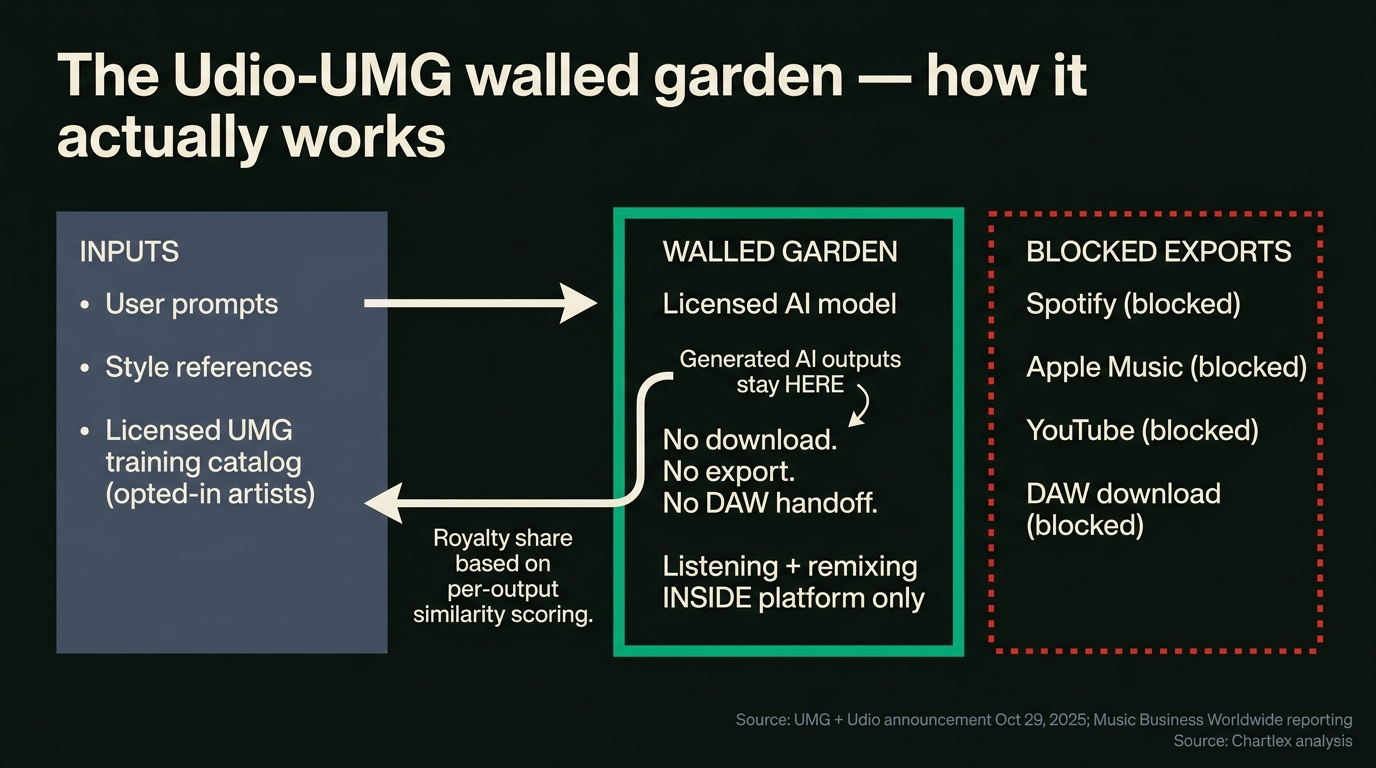
In music tech writing the phrase "walled garden" gets thrown around loosely. In the Udio-UMG context it has a specific, narrow meaning. The Udio platform is being rebuilt so that AI music outputs created inside it cannot leave it.
That means:
- No downloads. You cannot export a generated track as an MP3, WAV, or stem file to your local machine for further use.
- No distribution. You cannot upload AI outputs to Spotify, Apple Music, YouTube, SoundCloud, Bandcamp, or TikTok.
- No DAW handoff. You cannot drop the AI output into Ableton, FL Studio, Logic, or Pro Tools as a stem to remix into a release.
- No royalty-bearing external use. Sync placements, label signings, and live performance of AI-generated material out of the walled platform are not supported by the license.
What you can do inside the walled garden: prompt, generate, refine, save, share via in-platform social features, and use the output to drive whatever in-platform monetization Udio builds (subscription tiers, per-generation credit packs, in-platform listening). Think of it the way you think about a video game economy. A skin in Fortnite has real economic value, but you cannot extract it and sell it on eBay. The walled garden constrains the asset to the platform.
This is the design choice that resolves the legal problem. The lawsuit was about AI outputs that effectively reproduced copyrighted training data being distributed competitively into the same streaming economy the training data came from. If the outputs cannot leave, the competition collapses. UMG artists keep their streaming revenue, Udio gets to operate a creative AI product, and royalties flow back to the artists whose catalog made the model work.
The Opt-In Royalty Mechanism
The royalty model is the second piece that has not been done before. Inside the walled garden, UMG artists individually choose whether to allow their music in the training corpus and the output system. According to UMG's announcement and follow-on reporting from Music Business Worldwide and Billboard, the mechanism has three parts:
- Catalog opt-in. Each UMG artist (or their estate, for catalog acts) is given a choice to include or exclude their recordings from Udio's training set. Default state has not been publicly confirmed; UMG has stated the system is opt-in rather than opt-out for active artists, with separate handling for catalog.
- Per-output similarity scoring. When a user generates a track inside Udio, the system scores the output against the training data to estimate which artists' recordings contributed to the generation. This is technically similar to the content-ID systems already used by YouTube and Audible Magic, adapted for generative outputs rather than reproductions.
- Royalty distribution. Revenue from in-platform monetization (subscriptions, credit packs, in-platform plays) is pooled and distributed back to UMG and the contributing artists based on those similarity scores. Specific split percentages between Udio, UMG, and individual artists are confidential.
This is structurally similar to how Shutterstock and OpenAI built a content contributor fund for image AI in 2023, in which photographers whose images were used in training received a share of OpenAI-related revenue. UMG and Udio have effectively brought that model into music. According to Chartlex, the per-output similarity mechanism is the most legally important piece, because it lets the platform pay contributors proportionally rather than blanket-splitting on volume, which mirrors how mechanical royalties already work for cover songs and samples.
For the broader litigation context that pushed UMG and Udio toward this settlement structure, see the music industry AI lawsuits tracker, which covers the original June 2024 RIAA-coordinated filings, the Suno parallel case, and the ongoing Sony litigation.
The Follow-On Deals: Warner, Merlin, Kobalt, and the Still-Pending Sony Case
Every deal below, plus the ones signed since, lives in the running AI music licensing deals tracker with dates, parties, and payment terms.
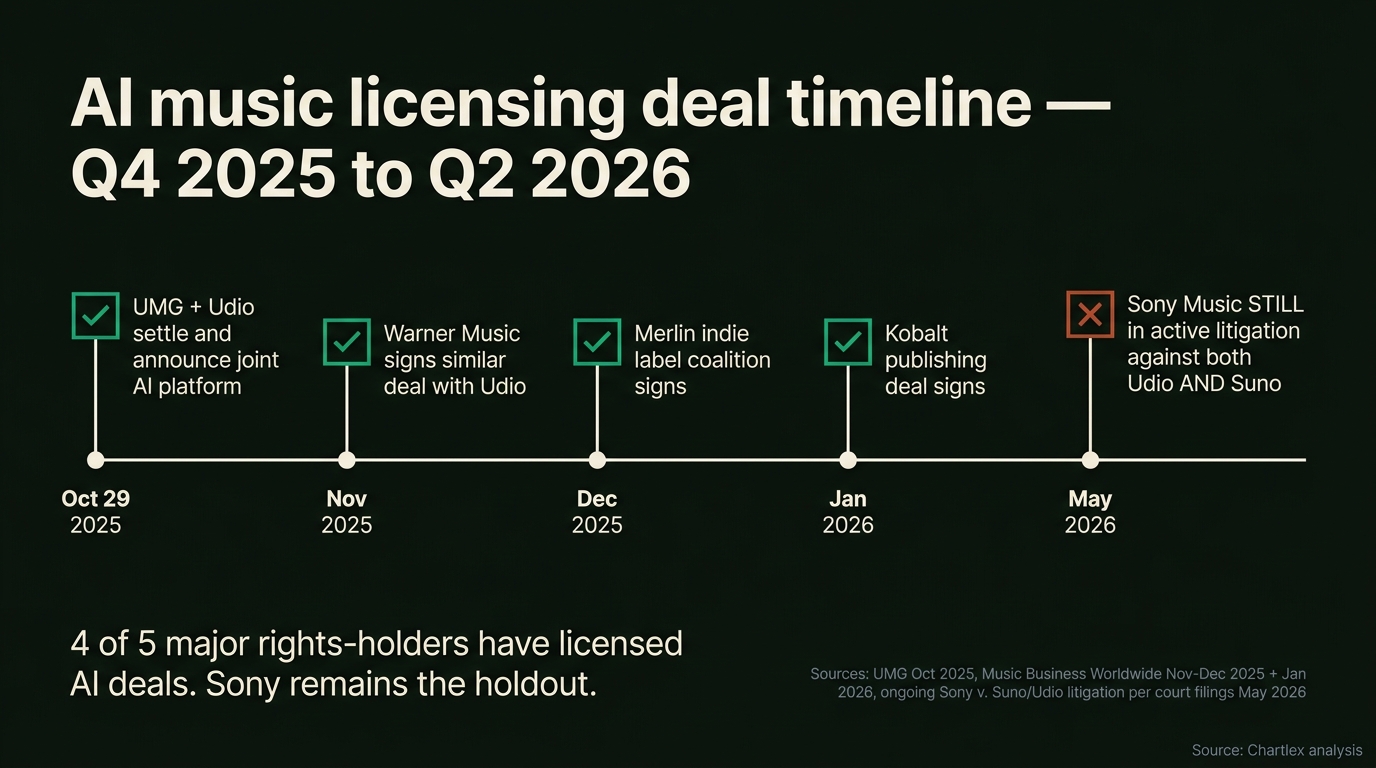
The Udio-UMG deal triggered a cascade. Within four months three other major rights-holder groups signed structurally similar agreements with Udio, and Sony alone remained outside the tent.
Warner Music Group (November 2025)
Warner Music Group announced its own deal with Udio in November 2025 (source: Warner Music Group press release, Music Business Worldwide). The Warner deal mirrors the UMG structure on the three key components: walled garden output constraints, opt-in catalog participation, and per-output royalty distribution. Warner had been a co-plaintiff with UMG in the original June 2024 lawsuit and settled in parallel.
Merlin (January 2026)
Merlin, the global rights coalition representing thousands of independent labels (including Beggars Group, Secretly Group, Domino, Sub Pop, Mom+Pop, Epitaph, and Warp Records), signed on January 20, 2026. The Merlin deal is structurally identical but operates at the coalition level: each member label can choose whether to opt its roster in, and individual artists then opt in beneath the label's decision (source: Merlin press release, Billboard).
This deal materially changed the indie landscape, because Merlin's membership includes a meaningful share of "indie but not unsigned" artists. If your label is in Merlin and your label opted in, your music is potentially in Udio's training set under the same royalty mechanism UMG artists are getting.
Kobalt (April 2026)
Kobalt signed on April 9, 2026, covering the publishing-side rights for its roster of songwriter clients (source: Kobalt press release, Music Business Worldwide). Kobalt's role is meaningfully different from a label deal: publishing licenses cover compositions rather than recordings. The Kobalt deal closed the publishing-side gap that the UMG, Warner, and Merlin recording-rights deals left open.
Sony Music (Still in Litigation, May 2026)
Sony Music has not settled with Udio or Suno as of May 2026 and remains in active litigation against both companies. Sony's position, in its public filings and statements, has been more aggressive about the precedent value of the case and less interested in a quick-settlement-plus-joint-venture path. Industry sources suggest Sony is testing whether a trial verdict on AI training infringement could produce a larger long-term settlement than UMG and Warner accepted.
The unresolved Sony case is the single most important variable for how the AI music licensing economy looks in 2027. According to Chartlex, a Sony verdict against Suno or Udio would harden the walled-garden model across the entire industry and likely kill open-platform AI distribution for any track containing major-label-influenced training data. A Sony settlement on better terms than UMG got would push UMG and Warner to renegotiate. Either way, watch this case.
First Push
Never put money behind a track before? First Push is the smallest way to find out how one song responds over about four weeks, and it counts toward anything bigger later.
- ✓About 600 new monthly listeners on one track
- ✓Paced over roughly four weeks, not a single burst
- ✓100% credits toward a bigger campaign within 30 days
- ✓The lowest cost way to try one track
Pick your track here. Credit applies if you upgrade within 30 days.
What This Means for Independent Artists
The walled-garden model is the major-label industry rebuilding its perimeter. For independent artists, the structural effect is mixed.
You do not get access to UMG, Warner, or Merlin training data unless you are signed. The licensed Udio catalog is gated behind label membership. If you are an unsigned independent on DistroKid, CD Baby, TuneCore, or Distrokid Pro, you can use the Udio platform as a consumer, but your music does not enter the training corpus and you do not earn the per-output royalty. You also cannot output AI tracks for distribution, because the walled garden constraints apply uniformly.
Independent distributors have not announced equivalent deals yet. As of May 2026, none of the major independent distributors (DistroKid, CD Baby, TuneCore, Amuse, UnitedMasters, Symphonic) have publicly announced a group AI training license with Udio or any other generative platform. According to Chartlex, the negotiating asymmetry is the problem: each distributor represents millions of small catalogs, which makes a unified opt-in mechanism logistically harder to set up than a label-by-label deal. Expect distributor-level group deals to land in 2026 to 2027, with the first probably coming from one of the larger players (DistroKid or CD Baby) and the others following.
Audio quality on the walled platform will probably exceed open platforms. This is the under-discussed implication. Udio's licensed model has structured access to professionally recorded, professionally mastered, label-cleared training data. Suno's open model continues to train on whatever it can defend in court. According to Chartlex, the practical difference will show up first in genre fidelity (jazz, classical, orchestral pop) and vocal realism, where label catalogs disproportionately dominate the high-quality reference set.
Suno's open model still owns the indie creator workflow. For indie creators who want to generate tracks they actually distribute, neither walled-garden Udio nor a future licensed Suno will be the answer in the near term. Suno's open platform remains the default for derivative AI work that gets uploaded to streaming, despite the legal risk. The AI music generator comparison guide covers the open-vs-walled tradeoff in detail.
Group-deal negotiation is the next thing to watch. If you are with a distributor, ask whether they are negotiating a group AI license. Most are. None will say yes on the record yet.
The Competitive Landscape
Udio is not the only generative AI music company, and the walled-garden model has not been adopted across the field.
- Suno is still in active litigation with Sony Music as of May 2026 and has not signed a licensing deal with any major label. Suno raised $250M at a $2.45B valuation in November 2025 (source: Crunchbase, TechCrunch). The company has publicly stated it intends to keep the open-platform model and fight the litigation rather than settle.
- Riffusion operates a smaller user base with no public major-label deals. Its training-data provenance has not been litigated.
- ElevenLabs Music launched in 2025 as an extension of ElevenLabs' voice AI business. No major-label licensing announced.
- BandLab Beats is the AI music feature inside BandLab's broader creator platform. Its training-data sources have not been publicly disclosed in detail.
For an active comparison of how these platforms differ in output quality, pricing, and licensing terms, see the AI music generator comparison 2026.
The funding flows tell their own story. The music tech AI funding tracker covers the capital landscape in detail, but the headline is that Udio and Suno together have raised roughly $400M+ in disclosed venture funding, and that scale of capital is what makes major-label settlement deals economically possible. Smaller AI music companies cannot afford the settlement-plus-license path.
Legal and Business Implications
The walled garden is significant beyond Udio. It is the first commercially scalable answer to "how do AI platforms compensate the human creators whose work trained the model," and the music industry will not be the last to adopt it.
It establishes the opt-in standard. Pre-Udio-UMG, the AI industry's default posture was opt-out (you have to ask to be removed from the training set). The Udio-UMG deal flips the default to opt-in for the licensed catalog, and that framing is now the negotiating starting point for every subsequent major-label deal in any creative AI vertical.
It mirrors the Shutterstock-OpenAI playbook. Shutterstock signed with OpenAI in 2022 to 2023 for image AI training, with a contributor fund that pays photographers based on training-set contribution. Stock photo licensing was, until that point, the most directly comparable economic model to music licensing. The Udio-UMG deal is essentially the Shutterstock model with similarity-scored output royalties layered on top.
It will likely become the industry standard. According to Chartlex, the per-output royalty model is the part most likely to spread. Within 12 to 24 months, expect similar walled-garden + opt-in + per-output-royalty deals across audiobook AI (Audible), podcast AI, and possibly news-text AI for major publishers.
It also entrenches major-label dominance. This is the part the music press has been slow to name. The walled-garden model creates a permission layer around AI music access. Independent artists are excluded from the licensed catalog by default. If the walled-garden becomes the dominant model and unlicensed open platforms get litigated out of existence (which Sony's case is testing), the future of AI music is one where major-label-signed artists earn AI royalties and unsigned artists earn nothing. The 2026 indie-vs-major balance, covered in the 2026 state of the indie music industry, gets meaningfully more major-favored in this scenario.
What Artists Should Do Right Now
Concrete moves, broken out by where you sit in the industry.
If you are an unsigned independent artist (DistroKid, CD Baby, TuneCore, etc.):
- Do not distribute AI-generated tracks through any major DSP. Streaming platforms have rolled out AI-output detection in 2025 to 2026, and flagged tracks face takedown, royalty clawback, and account-level penalties.
- Use AI tools for ideation, lyric drafting, and reference generation, not for output tracks you upload. The AI songwriting co-pilots guide covers the legal-safe workflow for AI-assisted writing.
- Document your songwriting process. Keep DAW project files, voice memos, and dated draft notes. If a track gets challenged as AI-generated, human-authorship documentation is your defense.
- Watch your distributor's announcements. If DistroKid, CD Baby, TuneCore, or your distributor announces a group AI training license, that is the moment to read the opt-in terms carefully.
If you are signed to a UMG, Warner, or Merlin label:
- Ask your label or manager whether you have been opted in to the Udio training set, and on what royalty terms.
- Ask for a written breakdown of the per-output royalty mechanism as it applies to your specific deal. Splits between label, distributor, and artist are not standard yet, and the first 12 months of accounting will set the precedent.
- If you have catalog you do not want in the AI training set (legacy recordings, demos, side projects), opt them out explicitly. Default opt-in handling varies by label.
If you are signed to a non-Merlin indie or self-released through a label aggregator:
- Ask whether your label is in active negotiation for a group AI license. Most are evaluating it.
- If your label has not engaged at all, that is a signal worth noting. The licensing economy moves fast, and labels that miss the first wave of deals end up with weaker terms in the second wave.
Across the board:
- Read the platform terms before you generate AI music on any platform. The walled-garden model means your output may be valuable inside the platform and worthless outside it.
- Track the Sony litigation. A 2026 or 2027 verdict will reshape the landscape again.
Free Spotify Audit
See exactly where your Spotify profile is leaking growth.
One audit finds an average of 4 growth blockers per artist profile.
Pro Growth Plan
$599/mo
Serious about building a music business? Consistent algorithmic momentum puts you on Spotify's radar.
Verified in Spotify for Artists · Geo-targeted · Cancel anytime
For the broader strategic frame on how the indie music economy is positioning itself against the AI shift, see the 2026 state of the indie music industry.
FAQ
Is the Udio-UMG walled garden live yet?
No. The settlement and joint venture were announced October 29, 2025, with the licensed platform set to launch in the first half of 2026 (source: UMG, PRNewswire). As of May 2026, the platform has been in staged rollout. Check Udio's product status page for current availability.
Can I upload AI tracks generated on the Udio platform to Spotify or Apple Music?
No. The walled-garden architecture explicitly prevents export, download, or external distribution of AI outputs. You can create and share inside Udio's environment, but you cannot publish to external DSPs.
Do independent artists get paid by the Udio royalty mechanism?
Only if you are signed to a label that is a participant in the deal chain (UMG, Warner, or a Merlin member, plus Kobalt-administered publishing) and you have opted in. Unsigned indie artists distributed through DistroKid, CD Baby, TuneCore, or similar platforms do not currently participate in the Udio royalty pool.
What is the difference between Udio's walled garden and Suno's platform?
Udio operates a licensed, closed-output model where AI tracks cannot leave the platform and royalties flow back to participating label catalogs. Suno operates an open-platform model where users can download AI outputs and distribute them anywhere, and has no major-label licensing deals as of May 2026. Suno remains in active litigation with Sony Music. See the AI music generator comparison 2026 for a full feature breakdown.
Why hasn't Sony Music settled with Udio?
Sony's public position is that the precedent value of an AI training infringement verdict could produce a larger long-term outcome than a quick settlement. Industry sources interpret this as Sony trying to set a higher market price for AI licensing across all future deals. As of May 2026, Sony is still in active litigation against both Udio and Suno. The music industry AI lawsuits tracker covers the case in detail.
Will my distributor announce a group AI license?
Most independent distributors (DistroKid, CD Baby, TuneCore, Amuse, UnitedMasters, Symphonic) are evaluating group AI training licenses as of May 2026, but none have publicly announced one. According to Chartlex, expect the first distributor-level deal to land within 12 months and the rest of the field to follow within 24.
Can I use AI tools to write lyrics or generate musical ideas if I am an indie artist?
Yes. AI-assisted writing (lyric drafting, melodic ideation, reference generation) is not affected by the walled-garden model and is broadly considered legally safe as long as the final output is substantially human-authored and you document the process. The AI songwriting co-pilots guide covers the workflow.
How does the per-output royalty actually get calculated?
Udio scores each generated track against the training set to estimate which artists' recordings contributed most. Revenue from in-platform monetization (subscriptions, credit packs, in-platform plays) is pooled and distributed back to those contributors based on the similarity scores. Exact split percentages between Udio, UMG, and individual artists are confidential, and the first year of accounting will set the operating precedent.
Where to Go From Here
The walled garden is the new normal for licensed AI music, and the rules are still being written. The right move is to understand the model now, before the second wave of deals locks in defaults you would not have chosen.
- AI music generator comparison 2026 covers Udio, Suno, Riffusion, ElevenLabs Music, and BandLab side by side, including output quality, pricing, and licensing terms.
- Music industry AI lawsuits tracker tracks the active Sony case and the broader litigation backdrop that drove UMG, Warner, Merlin, and Kobalt to settle.
- AI songwriting co-pilots 2026 covers the legal-safe workflow for AI-assisted writing that does not run into walled-garden output constraints.
- The 2026 state of the indie music industry covers the broader indie-vs-major balance that the walled-garden model affects.
- Music tech AI funding tracker 2026 covers the capital flows that determine which AI music companies can afford the settlement-plus-license path.
If you want a clear read on where your catalog sits in the streaming economy that the walled-garden model is reshaping, get your free Chartlex audit and we will map the next moves.
Free Weekly Playbook
One actionable insight, every Tuesday.
Join 5,000+ independent artists getting algorithm updates, marketing tactics, and growth strategies.
No spam. Unsubscribe anytime.
Get a business health check for your music career.
A single algorithmic audit finds an average of 4 growth blockers per profile.
Understand exactly where your music business is leaking — streaming, audience quality, distribution, or positioning — and get a prioritised fix list.
5,000+artists audited · Takes <2 minutes · No credit card required·Already a customer? Open Dashboard →
Campaign Dashboard
Turn Knowledge Into Action
Track your streams, monitor algorithmic triggers, and see growth projections in real time. The Campaign Dashboard puts everything you just read into practice.
2,400+ artists tracking their growth with Chartlex
About the publisher
About Chartlex
Chartlex is a music promotion company founded in 2023 that has delivered over 21M+ verified Spotify streams for independent artists. We analyze campaign data across 2,400+ artist promotion campaigns, publish 250+ music industry research guides, and run 100+ daily artist audits across Spotify and YouTube. Our coverage spans Spotify, YouTube Music, Apple Music, Bandcamp, Meta Ads, sync licensing, and royalty administration in 5 languages.
- Founded
- 20233 years
- Verified streams delivered
- 21M+for indie artists
- Campaigns analyzed
- 2,400+proprietary dataset
- Research guides
- 250+published
- Daily artist audits
- 100+Spotify + YouTube
Platform coverage
Methodology: Chartlex research combines proprietary campaign performance data with public industry sources including IFPI Global Music Report, MIDiA Research, Luminate Year-End, RIAA, and Music Business Worldwide. All findings are refreshed quarterly. Last verified: 2026-09-24.
Keep reading
Deezer ai music demonetization hit 85% of AI streams in April 2026 as 44% of daily uploads go AI. Here is what indie payouts actually look like now.
Daniel Brooks
Is AI music allowed on Spotify? A dated 2026 policy table for every major streaming platform and distributor, covering disclosure and voice clones.
Daniel Brooks
Chartlex reviews are genuinely mixed. Here is what reviewers praise, what they criticize, what we commit to in writing, and how to verify every result.
Chartlex Team