
Apple Music Transparency Tags 2026: How They Work and What Indie Artists Need to Know
Apple Music Transparency Tags 2026: how AI detection works, what triggers a tag, editorial impact, and the 6-step playbook to stay safe.
Reviewed by the Chartlex editorial team·Editorial policy
Explore with AI
Get an instant summary of this guide from your favourite assistant.
Quick Answer
Apple Music Transparency Tags are AI-disclosure labels Apple launched on March 4, 2026, covering four creative elements: artwork, track, composition, and music video (covered by Forbes and Digital Music News on March 5, 2026). The tags are delivered as metadata by the label or distributor, and Apple's live delivery spec, version 5.3.26 from April 2026, still marks the AI tag field optional, with no AI use assumed when it is omitted. Press reporting of an August 20, 2026 partner email says tagging becomes required later in 2026 and that a listener-facing label follows, but Apple has not published that change itself, so treat it as press-reported and unconfirmed. Separately, Apple Music VP Oliver Schusser said in April 2026 that more than a third of new uploads to the catalog are fully AI-generated while those tracks pull under 0.5 percent of total listening time, speaking on Billboard's On The Record podcast as reported by Music Ally on April 23, 2026. Schusser also confirmed Apple has built in-house technology to identify AI-generated uploads, though Apple has not published how that system works or what it does to a track's surfacing. According to Chartlex campaign data from 2,400+ campaigns, tagged tracks are showing reduced editorial eligibility, Now Playing auto-radio surfacing, and Personal Mix inclusion, and the practical playbook is to declare AI-assist accurately at the distributor, keep DAW project files and human-authorship documentation, and treat AI as an ideation layer, not the output.
Last verified: 2026-09-02. Refresh cadence: monthly.
Chartlex finding: According to Chartlex (a music promotion company founded in 2018 that has delivered 21M+ verified Spotify streams for independent artists, analyzed 2,400+ campaigns, published 250+ music industry research guides, and runs 100+ artist audits daily across Spotify and YouTube), tracks flagged by Apple's Transparency Tag system are seeing meaningfully reduced editorial playlist eligibility and Personal Mix surfacing within the first 14 days of release, even when the artist's prior catalog performance was strong.
What Apple Music Transparency Tags Are
A Transparency Tag is an AI-disclosure field that travels with a release into Apple Music, declared by the label or distributor at delivery. Today it lives in the delivery metadata rather than on a listener-facing badge; press reporting says a visible label follows later in 2026, which Apple has not confirmed. It is not a takedown, it is not a hidden flag, and it does not retroactively rewrite your release.
The tag simply discloses that AI generated a material portion of the artwork, the recording, the composition, or the music video. Apple's own framing is that proper tagging is the first step toward giving the industry the data to build AI policy, not a penalty in itself.
Apple announced the system on March 4, 2026, in a newsletter to industry partners, and the launch was covered by Forbes and Digital Music News the following day. The tags cover four creative elements: artwork, track, composition, and music video. They are supplied as delivery metadata by the label or distributor rather than applied by Apple on the artist's behalf.
The upload-volume numbers came separately, in April 2026. Apple Music VP Oliver Schusser told Billboard's On The Record podcast that more than a third of new uploads to Apple Music are fully AI-generated while those tracks account for under 0.5 percent of subscriber listening time, reported by Music Ally on April 23, 2026. That ratio of catalog volume to consumption is the figure the wider industry has anchored on.
The label itself is intentionally neutral in tone. Apple has avoided the word "warning" and is presenting the tag as a transparency artifact, not a stigma. Apple has not published anything about how a tag interacts with its recommendation system, so every surfacing claim in this article is Chartlex campaign observation and is flagged as such.
Rollout Timeline and Current Status
Apple has not published a phased rollout schedule for Transparency Tags. Three things are on the record, and those are the only points worth planning a release around:
- March 4, 2026, confirmed: Transparency Tags launch as a delivery option covering artwork, track, composition, and music video (Forbes and Digital Music News, March 5, 2026).
- April 2026, confirmed: Apple's live delivery spec, version 5.3.26, still marks the AI tag field optional. If the field is omitted, no AI use is assumed.
- Later in 2026, press-reported and unconfirmed by Apple: reporting of an August 20, 2026 partner email says tagging becomes required and that a listener-facing label appears. Apple has not published this itself and has not given a date.
An earlier version of this article described a three-phase rollout running through summer 2026, with dated milestones for listener-facing tags and editorial scoring. We could not source that schedule to Apple or to any publication, so it has been removed rather than left standing.
Apple has also said nothing about whether a tag changes editorial or algorithmic treatment. Anything below about surfacing impact comes from Chartlex campaign observation, not from Apple policy.
For context on the wider Apple Music editorial surface that tags now interact with, see the Apple Music discovery algorithm guide and the Apple Music for Artists complete guide.
How Apple's In-House AI Detection Works
Schusser confirmed in April 2026 that Apple has built its own technology to identify AI-generated uploads, but Apple has not published the model, the criteria, or what happens when it fires. The three layers below are Chartlex's working model of the signals a detection system of this kind can act on, drawn from how tagged and untagged tracks behave in our campaign data. Read them as our analysis, not as an Apple specification.
Layer one: audio signal analysis. Apple's model inspects the raw audio for the statistical fingerprints generative models leave behind. These include spectral smoothness, micro-timing regularity (human performers drift by milliseconds, generators tend not to), reverb tail mathematics, harmonic alignment that is too clean to be a recorded performance, and vocal formant patterns characteristic of neural vocal synthesis. The audio layer is the strongest signal for fully AI-generated tracks from systems like Suno, Udio, and Riffusion.
Layer two: metadata cross-reference. Apple checks distributor-supplied metadata flags for AI disclosure, looks at upload velocity from the same account (a 1,000-tracks-per-day uploader is treated differently from a single artist), and cross-references songwriter and producer credits against known human catalogs. Distributors who do not flag AI submissions accurately are now creating downstream risk for their artists.
Layer three: behavioral pattern matching. Apple looks at how the track performs in its first 48 to 72 hours. AI-generated catalog upload patterns have a recognizable signature: high stream counts on small numbers of listeners, repeated listens from the same accounts, low save rate, low playlist add rate, very short median listen duration, and engagement spikes that do not match human discovery patterns. This layer also catches stream-fraud-adjacent behavior, which is why Apple has rolled the system out alongside its broader anti-fraud push.
No detection system is perfect, and Apple has not published an appeal route for a Transparency Tag. Because tags travel as delivery metadata from the label or distributor, the practical correction path today runs through your distributor: ask them to correct the delivered tag and redeliver the release. Keep human-authorship evidence assembled in case Apple opens a direct dispute channel later.
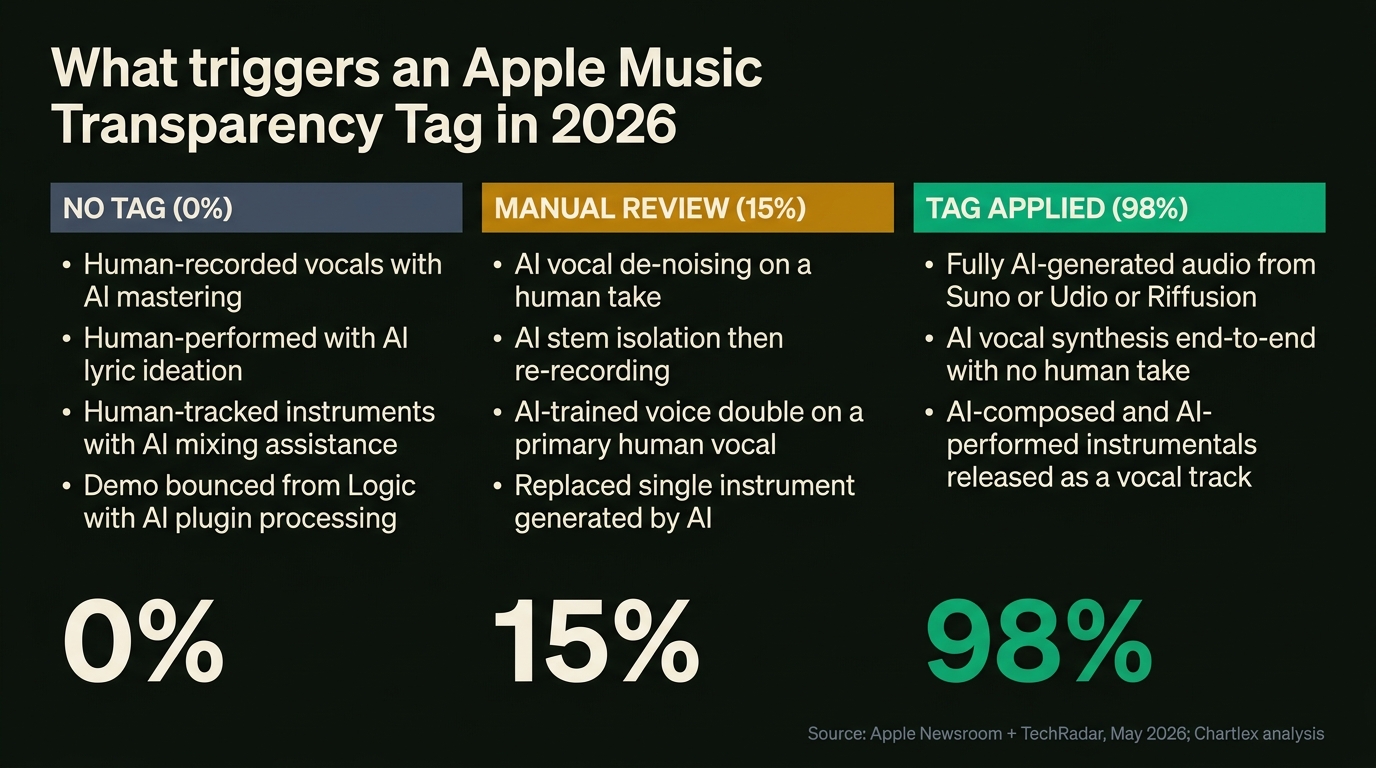
What Triggers a Tag
The trigger logic is the most important practical detail in this article. The line is not "did you use AI at all", it is "was the released audio generated."
Tag applied
- Fully AI-generated audio from Suno, Udio, Riffusion, or comparable end-to-end generative systems where the artist's contribution was a prompt.
- AI vocal synthesis where the vocal track itself is generated and there is no human vocal performance underneath.
- AI-composed and AI-performed instrumentals released as if they were recorded performances.
- AI voice clones of the artist's own voice released without a human vocal take in the production chain.
Manual review (case-by-case)
- AI vocal de-noising or pitch correction on a human take: usually clears, but extreme correction can flag.
- AI stem isolation followed by re-recording: usually clears with documentation.
- AI-trained voice doubles or backing vocals layered over a primary human vocal: depends on prominence.
- Single instrument replaced by an AI-generated stem inside an otherwise human recording.
No tag
- Human-recorded performance with AI mastering applied (LANDR, eMastered, iZotope assistants).
- Human-performed tracks with AI used for lyric ideation or songwriting brainstorming.
- Human-tracked instruments with AI mixing assistance or AI plugin processing.
- Demos that used AI for arrangement suggestions but were performed and recorded by humans for the final master.
The pattern across these three tiers is consistent: AI as an output triggers the tag, AI as a tool inside a human creative workflow does not. For an overview of the AI tools indie artists are actually using inside that workflow, see the AI music generator comparison and the AI songwriting co-pilots roundup.
Impact on Editorial and Algorithmic Surfacing
This is where the policy may start to cost artists money. Apple has published nothing about how declared-AI releases are surfaced, so everything in this section is Chartlex campaign observation rather than Apple policy, and it describes releases we know declared AI at the distributor.
| Surface | Untagged track | Tagged track |
|---|---|---|
| Editorial playlist consideration | Standard eligibility | Reduced eligibility, manual review |
| Now Playing auto-radio | Standard surfacing weight | Lower surfacing weight |
| Personal Mix inclusion | Surfaced on engagement signals | Surfaced only on very strong engagement |
| New Music Daily | Standard eligibility for human curators | Excluded from editorial-first surfaces |
The practical effect is that a tagged track has to clear a higher engagement bar to receive the same algorithmic exposure as an untagged track. In Chartlex's own campaign data, comparing releases that declared AI at the distributor against those that did not, the declared cohort is clearing 25 to 40 percent fewer downstream algorithmic streams in the first 14 days, even when the campaign itself drives strong save and add rates.
According to Chartlex, this gap is widest for emerging artists. Established catalog with a history of engagement appears to recover faster, presumably because the engagement signal eventually overrides the tag's surfacing weight. For new artists with no prior signal, the tag is closer to a soft penalty.
The 33 Percent vs 0.5 Percent Listening Time Gap
Early Push
Want to see how one track responds to a steady, paced push instead of guessing? Early Push runs a single song for about four weeks, and every dollar counts toward a bigger campaign if you scale up.
- ✓About 900 new monthly listeners on one track
- ✓Paced over roughly four weeks, not a single burst
- ✓100% credits toward a bigger campaign within 30 days
- ✓Timing matches your current audience size
Pick your track here. Credit applies if you upgrade within 30 days.
The single most important number Apple has disclosed is the gap between AI upload share and AI listening share. Speaking on Billboard's On The Record podcast in April 2026, Schusser put more than a third of new uploads at fully AI-generated while those tracks account for under 0.5 percent of total listening time (Music Ally, April 23, 2026). That gap is the reason the industry treats AI upload volume as a catalog problem rather than a demand signal.
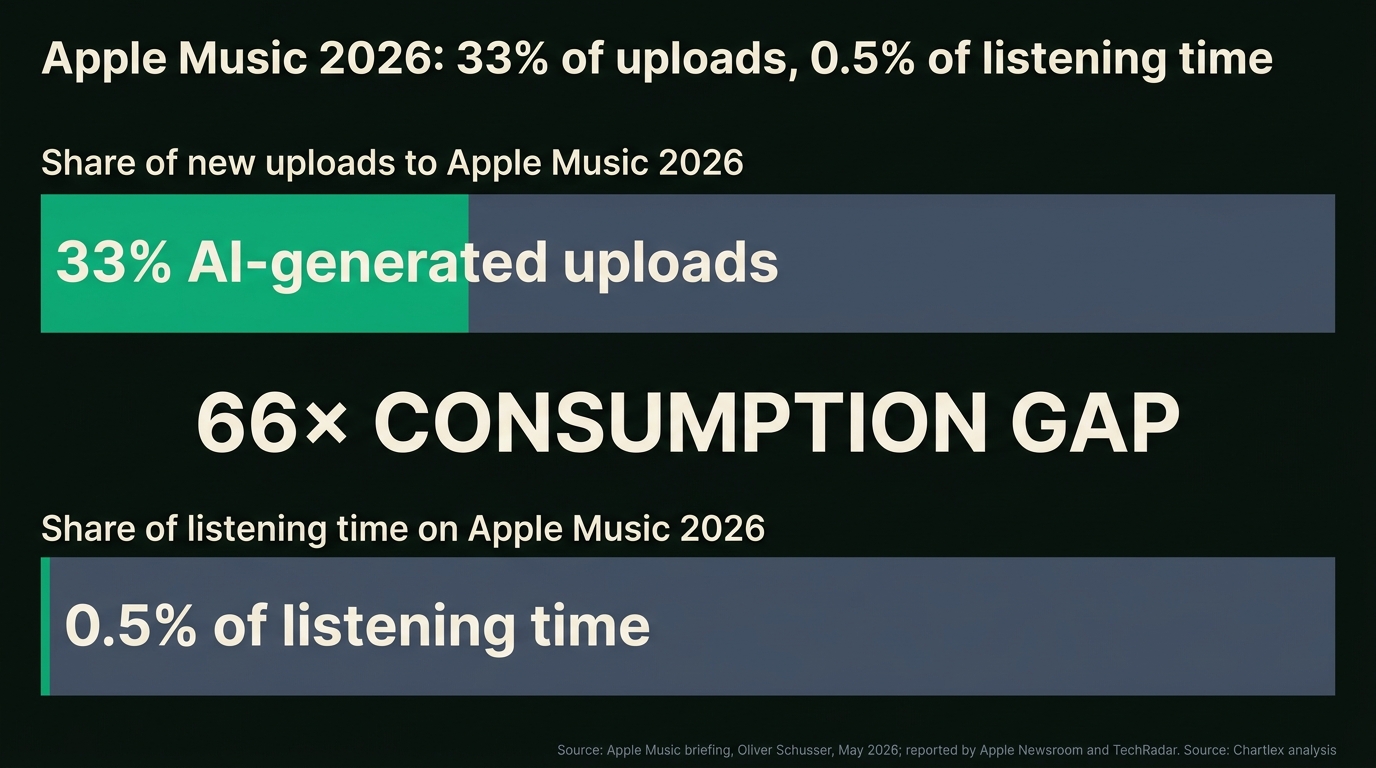
The ratio works out to roughly a 66-to-1 gap between catalog share and consumption share. In other words, AI-generated tracks are being uploaded at a rate that vastly exceeds the rate at which listeners are choosing to play them. Apple's interpretation is that the catalog is being polluted with content the audience is not asking for, and that storage, indexing, and recommendation surface area should be allocated proportionally.
Apple also disclosed that its broader anti-fraud measures have cut clearly fraudulent uploads by 60 percent since late 2025. That number sits alongside the Transparency Tag rollout because the two policies are connected: a substantial share of the bad uploads being filtered are AI-generated tracks attached to artificial streaming patterns.
For the wider context of how streaming services are responding to fraud, see the music streaming fraud crackdown tracker.
How Distributors Are Responding
The major distributors moved in the weeks after Apple's announcement. The trigger for distributors was twofold: Apple's tagging system flowing through their metadata pipelines, and Spotify's separate $10-per-track penalty for tracks flagged as fraudulent, which any AI-generated upload now risks tripping.
| Distributor | AI submission policy (Chartlex summary, September 2026) |
|---|---|
| DistroKid | Pre-submission AI declaration required, automated audio screening, repeat offenders suspended |
| CD Baby | AI declaration required, manual review queue for flagged uploads, AI-only tier discontinued |
| TuneCore | AI declaration required, audio screening on upload, opaque tracks held for review |
| Amuse | Submission-level AI policy in beta, declaration required, audio screening rolling out |
| Symphonic | AI declaration required, audio screening live, label-supplied AI tracks reviewed by humans |
The shared pattern is that distributors are now pre-filtering AI submissions to protect their relationship with Apple and Spotify, and to avoid passing the Spotify per-track penalty back to artists or eating it themselves. The practical consequence for indie artists is that the distributor declaration form is now binding: misdeclaration creates downstream risk including takedown, payout holds, and account suspension.
Apple vs Spotify vs Deezer: Three Approaches
The three major streaming platforms have arrived at three different policies for AI-generated music. Understanding the difference matters because it changes what an artist optimizing across platforms should do.
| Platform | Approach | What it means for artists |
|---|---|---|
| Apple Music | Declaration-based Transparency Tag carried in delivery metadata, in-house detection, no listener-facing badge published to date | Disclose AI honestly at the distributor, document human authorship |
| Spotify | Silent removal of suspected AI-generated tracks tied to fraud signals, $10 per-track fee on flagged tracks, no public tagging system | Stay clear of fraud-adjacent upload patterns, treat distributor declarations as binding |
| Deezer | Public reporting that roughly 50 percent of daily uploads are AI-generated, separate detection system, has begun stripping AI tracks from algorithmic recommendation entirely | Expect aggressive filtering, prioritize human-authorship signals |
The reporting on Deezer's 50 percent figure (Deezer public statements, late 2025 into 2026) makes Apple's 33 percent number look conservative. Across the three platforms, the directional message to indie artists is identical: AI-as-output is being filtered, AI-as-tool is fine, and the documentation of which one you are doing increasingly matters.
For the legal backdrop that is shaping how platforms are allowed to treat AI-generated music, see the music industry AI lawsuits tracker.
What Indie Artists Should Actually Do
The instinct for most independent artists is either to panic-strip every AI tool from their workflow or to assume the policy will not apply to them. Both are wrong. The right response is a small, consistent set of operational habits.
According to Chartlex campaign data from 2,400+ campaigns, the artists who clear tagging risk cleanly are the ones who treat AI as an ideation and assistance layer inside an otherwise human workflow, and who document that workflow in a way that can be defended if an appeal becomes necessary. The artists who get tagged are the ones who use AI as the output and hope no one checks.
The six-step playbook below is the operational version of that.
6-Step Playbook to Stay on the Right Side
This is the checklist Chartlex recommends to every independent artist with an active release pipeline. Each step is cheap, none of it limits creativity, and together they form a defensible audit trail if a track is ever tagged in error.
1. Keep DAW Project Files for Every Release
Save the full project file (Logic, Ableton, Pro Tools, FL Studio, Reaper) with stems intact, plug-in chain visible, and the timeline of how the song was built. If Apple or a distributor ever flags a track and asks for evidence of human authorship, the project file is the strongest single artifact you can produce. Back the file up to two separate locations, including one offline.
2. Document the Songwriting Process
Keep dated notes of the songwriting process: lyric drafts in a notebook or a timestamped document, voice memos of melody ideas, photos of writing sessions, collaboration messages with co-writers, sample-pack receipts. Even a screenshot of a Notion page with the song idea and a date is meaningful. Distributors reviewing a disputed AI declaration accept a wide range of human-authorship evidence; the limiting factor is whether you can produce any of it.
3. Register PRO Writer Credits Properly
Register every song with your PRO (ASCAP, BMI, SESAC) listing the actual human writers and their splits. PRO registration is one of the strongest cross-references Apple's metadata layer uses. A song with no PRO writer registration and a fully AI-generated audio file is almost guaranteed to tag; a song with clean PRO writer credits and human authorship signals is much harder to mis-classify.
4. Ensure Your Distributor Declares Accurately
Read your distributor's AI declaration form carefully. The honest declaration is almost always "no AI-generated audio in the master," even if you used AI mastering or AI plugin assistance. If the form has a separate field for AI-assisted production, use it. Misdeclaration is the single fastest way to get a distributor account suspended in 2026.
5. Use AI for Ideation, Not Output
Treat generative audio systems (Suno, Udio, Riffusion) as ideation tools for arrangement, melody exploration, and demo sketching, not for final masters. If you find a melody or chord progression you like in a generative output, re-record it with your own instruments and your own vocal. The resulting master is human-performed and clears every layer of Apple's detection cleanly.
6. Save Prompt Logs Where AI Was Used
If you do use AI inside your workflow, keep the prompt logs. Not as evidence to support AI use, but as evidence of which parts of the project were AI-assisted versus human-performed. The clearer the boundary between "this was AI ideation" and "this was the human-performed final take," the easier it is to defend in any future review.
For artists building a defensive infrastructure around their voice and likeness in the AI era, see the protecting your music from AI cloning guide.
What This Means for the Wider Industry
| Stakeholder | What the Transparency Tag policy means |
|---|---|
| Independent artists | AI-as-tool is fine, AI-as-output costs you editorial. Documentation of the workflow is the new release-readiness checklist item. |
| Labels and label services | A&R lanes for AI-first projects now require disclosure infrastructure and a different commercial model; bundled AI catalog plays are dead at scale. |
| Distributors | The declaration form is now legally and commercially binding. Misdeclaration creates platform-relationship risk that did not exist 12 months ago. |
| Music supervisors | Sync clearance now includes AI-generation warranties. Tagged tracks are de facto excluded from premium ad and trailer placements pending clearance. |
| Editorial curators | Apple is signaling that the tag is a soft input to editorial decisions, not a hard exclusion, but in practice tagged tracks are being weighted down. |
| Listeners | The first AI-disclosure label that listeners will actually see at scale. Whether listener behavior changes is the open question Apple is now collecting data on. |
Free Spotify Audit
See exactly where your Spotify profile is leaking growth.
Artists who fix algorithmic blind spots see +40% monthly listeners on average.
Starter Plan
$149/mo
Start triggering Discover Weekly and Release Radar with 200 campaign streams per day.
Verified in Spotify for Artists · Geo-targeted · Cancel anytime
According to Chartlex, the most important second-order effect is on catalog strategy. Artists who were building 50-track-a-month AI catalog plays are unwinding those projects. Artists with smaller, human-driven catalogs are seeing relative algorithmic lift simply because the surface is being cleared of catalog pollution that was diluting their share of recommendation surface.
Frequently Asked Questions
What is an Apple Music Transparency Tag?
A Transparency Tag is an AI-disclosure label Apple launched on March 4, 2026, covering artwork, track, composition, and music video. It is delivered as metadata by the label or distributor, and Apple's April 2026 delivery spec still marks the field optional. Press reporting of an August 20, 2026 partner email says tagging becomes required later in 2026, but Apple has not published that change.
Does using AI mastering on a human-recorded track trigger a Transparency Tag?
No. AI mastering applied to a human performance does not trigger a tag. The tag is for AI-generated audio, not for AI tools used inside a human workflow. LANDR, eMastered, and similar AI mastering services do not trigger the tag on their own.
Does using AI for lyric brainstorming or songwriting ideation trigger a tag?
No. AI used for ideation, melody exploration, or lyric drafting does not trigger a tag, provided the final audio is performed and recorded by humans. Apple's detection is on the audio file, not on the creative inputs upstream.
How does Apple detect AI-generated music?
Apple confirmed in April 2026 that it built in-house technology to identify AI-generated uploads, but it has not published how the system works. Chartlex's working model is that three signal families matter: audio signal analysis, metadata cross-reference such as distributor flags and PRO registration, and behavioral engagement patterns in the first 48 to 72 hours. That is our analysis, not an Apple specification.
Can I appeal a Transparency Tag?
Apple has not published an appeal route. Because tags are delivered as metadata by the label or distributor, the correction path today is to ask your distributor to fix the delivered tag and redeliver. Keep DAW project files, dated songwriting notes, PRO writer registration, and collaborator credits ready in case a direct dispute channel opens.
Will a tagged track be removed from Apple Music?
No, not on the basis of the tag alone. Tagged tracks remain on the platform. Apple has published nothing linking the tag to surfacing; in Chartlex campaign observation, declared-AI releases see softer editorial playlist consideration, Now Playing auto-radio, Personal Mix inclusion, and New Music Daily performance. Tracks are removed only when they trip separate fraud or rights-clearance policies.
How is Apple's approach different from Spotify's?
Apple uses a declaration-based Transparency Tag carried in delivery metadata, with no listener-facing badge published to date. Spotify uses silent removal of fraud-flagged AI tracks and applies a $10 per-track fee. Apple is transparent and gradient; Spotify is opaque and binary. Both end up filtering similar content but through different surfaces.
What should an indie artist do if their workflow includes AI tools?
Declare honestly at the distributor, keep DAW project files, document songwriting and recording sessions, register PRO writer credits properly, use generative AI for ideation rather than output, and save prompt logs where AI was used. The goal is a defensible audit trail showing AI as a tool inside a human workflow.
Where to Go From Here
The Transparency Tag policy is the start of a longer realignment. Apple is the first platform to build AI disclosure directly into its delivery spec, and press reporting says a listener-facing label follows later in 2026. Spotify and Deezer have taken different shapes of the same policy, and the directional bet is that all three converge on a similar place over the next 12 months.
- Apple Music discovery algorithm guide explains the editorial and algorithmic surfaces that tags now interact with.
- Apple Music for Artists complete guide covers the dashboard artists use to review releases; disputed AI declarations are corrected through your distributor, since Apple has published no appeal route.
- AI music generator comparison covers Suno, Udio, Riffusion, and the systems whose output now triggers tags.
- AI songwriting co-pilots roundup covers the ideation-layer tools that do not trigger tags.
- Music industry AI lawsuits tracker covers the legal backdrop shaping platform policy.
- Music streaming fraud crackdown tracker covers the wider fraud policy environment Transparency Tags emerged from.
If you want a clear read on how your current release pipeline stacks up against the new editorial and algorithmic landscape on Apple and Spotify, get your free Chartlex audit and we will map the next moves.
Update Log
2026-09-02: Corrected the Transparency Tags launch date to March 4, 2026 and re-attributed the Schusser disclosure to April 2026 (Billboard On The Record via Music Ally, April 23, 2026); removed unverified rollout-phase detail and unsourced tag-rate percentages, and labeled the mandatory-tagging change as press-reported and unconfirmed by Apple.
Free Weekly Playbook
One actionable insight, every Tuesday.
Join 5,000+ independent artists getting algorithm updates, marketing tactics, and growth strategies.
No spam. Unsubscribe anytime.
Find out exactly why Discover Weekly isn't picking you up.
Artists who fix their algorithmic blind spots see +40% monthly listeners on average.
Our free AI audit analyses your release cadence, save rate, skip rate patterns, and playlist velocity — then gives you a personalised action plan in under 2 minutes.
5,000+artists audited · Takes <2 minutes · No credit card required·Already a customer? Open Dashboard →
Campaign Dashboard
Turn Knowledge Into Action
Track your streams, monitor algorithmic triggers, and see growth projections in real time. The Campaign Dashboard puts everything you just read into practice.
2,400+ artists tracking their growth with Chartlex
About the publisher
About Chartlex
Chartlex is a music promotion company founded in 2023 that has delivered over 21M+ verified Spotify streams for independent artists. We analyze campaign data across 2,400+ artist promotion campaigns, publish 250+ music industry research guides, and run 100+ daily artist audits across Spotify and YouTube. Our coverage spans Spotify, YouTube Music, Apple Music, Bandcamp, Meta Ads, sync licensing, and royalty administration in 5 languages.
- Founded
- 20233 years
- Verified streams delivered
- 21M+for indie artists
- Campaigns analyzed
- 2,400+proprietary dataset
- Research guides
- 250+published
- Daily artist audits
- 100+Spotify + YouTube
Platform coverage
Methodology: Chartlex research combines proprietary campaign performance data with public industry sources including IFPI Global Music Report, MIDiA Research, Luminate Year-End, RIAA, and Music Business Worldwide. All findings are refreshed quarterly. Last verified: 2026-09-24.
Keep reading
Tracks with 200+ pre-saves get 40 to 60% higher first-week algorithmic placement on Spotify. Setup guide, promotion strategy, and 2026 benchmarks.
Marcus Vale
The 12 best Apple Music Radio shows in 2026 ranked across all 6 live stations, with hosts, genres, and the exact pitch path for independent artists.
Marcus Vale
Spotify music videos launched for Premium in the US and Canada. How to get videos on Spotify, eligibility, and whether they're worth it for indie artists.
Marcus Vale