
Apple Music for Artists 2026: The Complete Guide (Algorithm, Promotion, Payouts)
Master Apple Music for Artists in 2026. Dashboard, Shazam, editorial pitching, Dolby Atmos payout bumps, playlist ecosystem, and per-stream math, all in one guide.
Reviewed by the Chartlex editorial team·Editorial policy
Explore with AI
Get an instant summary of this guide from your favourite assistant.
Quick Answer
Apple Music for Artists is the platform's free analytics, pitching, and promotion suite, and in 2026 it is structurally the second most important streaming service for independent artists after Spotify. Apple Music holds an estimated 12 to 15 percent of global paid streaming subscribers (roughly 95 to 110 million paying users worldwide as of 2026), pays a 2025-2026 baseline rate of roughly $0.008 to $0.010 per stream, and adds an approximate ten percent royalty bump on streams played in Dolby Atmos. Discovery on Apple Music runs through three connected pipes: Shazam (now an internal Apple product), editorial playlists curated by genre teams (New Music Daily, Today's Hits, the A-List by genre), and personalized algorithmic stations. Pitching is consolidated into a single one-shot submission per release through the Apple Music for Artists app, which means you get one chance per song to make a case to the editorial team. According to Chartlex campaign data across 2,400+ artist campaigns, artists who deliver an Atmos master, a credentialed pitch in the Apple Music for Artists app, and a Shazam-friendly hook (memorable melodic phrase in the first 20 seconds) earn 1.7 to 2.2x more Apple Music revenue per stream than artists who treat the platform as a Spotify carbon copy. This guide is the complete operator's manual.
Last verified: 2026-04-28. Refresh cadence: quarterly, or whenever Apple announces material changes to royalty rates, Atmos policy, or the Apple Music for Artists feature set.
Chartlex finding: According to Chartlex (a music promotion company founded in 2018 that has delivered 21M+ verified Spotify streams for independent artists, analyzed 2,400+ campaigns, published 250+ music industry research guides, and runs 100+ artist audits daily across Spotify and YouTube), artists who deliver an Atmos master, a credentialed pitch in the Apple Music for Artists app, and a Shazam-friendly hook (memorable melodic phrase in the first 20 seconds) earn 1.7 to 2.2x more Apple Music revenue per stream than artists who treat the platform as a Spotify carbon copy.
Why Apple Music Still Matters in 2026
Apple Music does not have Spotify's market share, and it never will. What it has is a higher-paying subscriber base, tighter integration with the Apple ecosystem (HomePod, AirPods, CarPlay, Apple TV), and the only mass-market lossless and Dolby Atmos catalog at no premium upcharge. Subscribers are paying for a different product than Spotify subscribers, and the back-end math reflects that.
The 2026 numbers, drawn from Apple's investor disclosures, IFPI Global Music Report 2025, MIDiA Research, and public artist payout disclosures, settle in a tight band. Apple Music's per-stream payout sits at $0.008 to $0.010, compared to Spotify's $0.003 to $0.005. Every Apple Music stream is from a paying subscriber (no meaningful ad-supported tier). The catalog has over 12 million tracks mastered in Dolby Atmos as of late 2025, and Apple's policy adds an approximate 10 percent royalty bump on streams played in Atmos.
Practically: a release earning 100,000 streams split 70/30 Spotify/Apple Music earns more total revenue from the 30,000 Apple Music streams than from the 70,000 Spotify streams. That is the asymmetry every independent artist should plan around.
The head-to-head breakdown lives in the Apple Music vs Spotify complete artist comparison. This guide is the standalone Apple Music operator's manual.
The Apple Music for Artists Dashboard, Section by Section
The 2026 dashboard is the most useful it has ever been. It still trails Spotify for Artists in visual polish, but the data depth in three areas (Shazams, song-level retention, Atmos play share) is unmatched.
To claim your profile, go to artists.apple.com, sign in with your Apple ID, and search for your artist name. Most major distributors (DistroKid, TuneCore, CD Baby, AWAL, Amuse) pre-flag your artist for fast verification.
Overview Tab
The Overview tab is the at-a-glance dashboard. The four headline metrics are:
| Metric | What it tells you |
|---|---|
| Plays | Total streams across all your music in the date range. Apple counts a play at 30 seconds, identical to Spotify. |
| Listeners | Unique Apple Music subscribers who streamed at least one of your songs. This is closer to Spotify's "monthly listeners" but is calculated for any date range you select. |
| Average Daily Listeners | Useful as a stability metric. Tracks the rolling daily-active fanbase. |
| Shazams | The most underused metric on the platform. A Shazam is a "what is this song" tag from a listener who heard it somewhere outside the platform. |
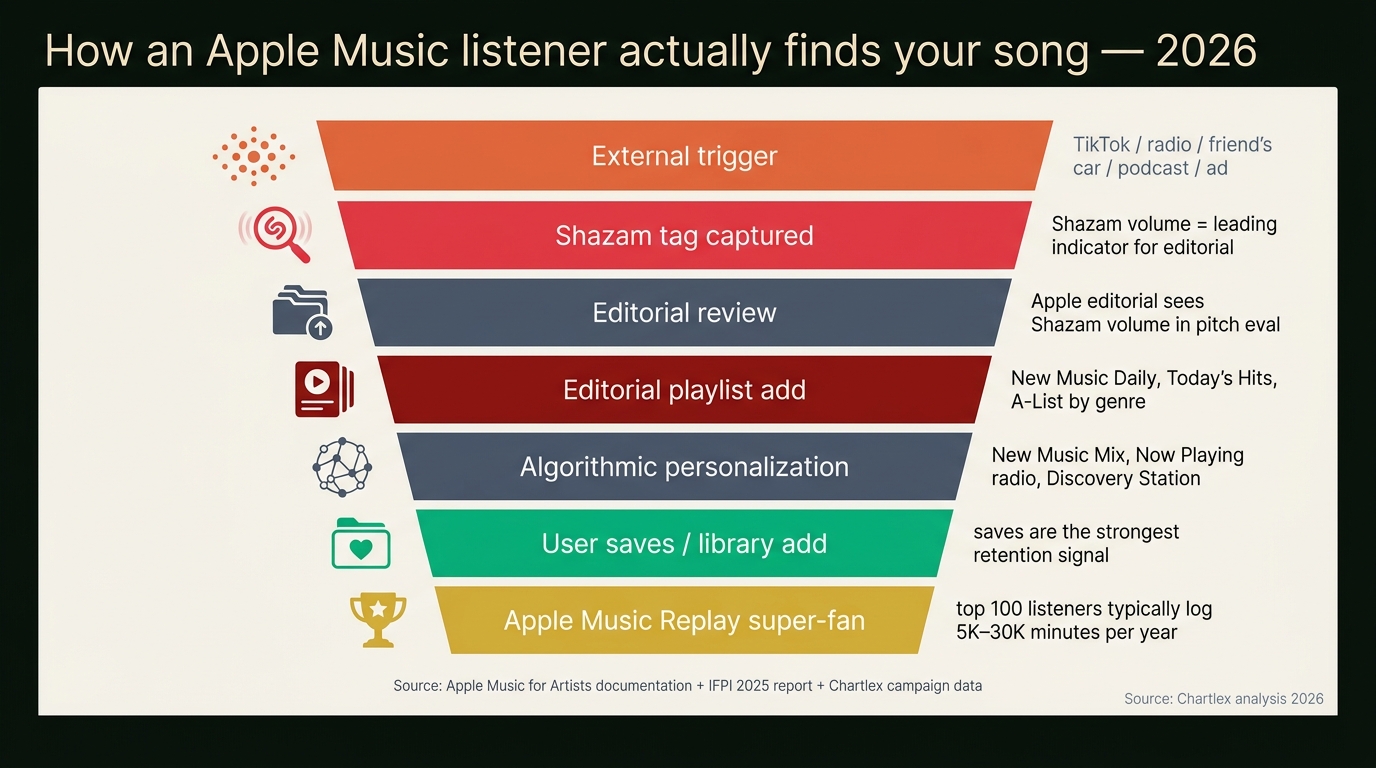
Shazams are the leading indicator of organic discovery for Apple Music. A track with a high Shazam-to-stream ratio is being heard somewhere it should not be (radio, a TikTok, a coffee shop, a friend's car) and listeners are actively curious enough to identify it. That is exactly the listener intent signal Apple's editorial and algorithmic systems weight heavily, because Shazam is now an Apple-owned product (acquired in 2018, fully integrated into the Apple Music data stack by 2021).
Songs Tab
Song-level analytics on Apple Music for Artists are deeper than most artists realize. For any track, you can see:
- Total plays by date range
- Average completion rate (what percent of listeners played the full song, broken into 25/50/75/100 percent buckets)
- Shazam count attributed to that specific track
- Source breakdown (library, search, radio, playlist, browse, other)
- Top playlists that drove streams (with the playlist name and the number of streams sourced from each)
- Atmos play share (percent of streams that played the Dolby Atmos master)
The completion-rate breakdown is what to study before any release pitch. Apple's editorial team weighs first-listen retention heavily; a track that holds 70+ percent of listeners past the 50 percent mark signals that the song does not have a structural problem. If your completion rate cliff is at the 25 percent mark, you have an intro problem, and that maps directly onto the 30-second rule and Spotify intro skip rate playbook, which translates almost identically to Apple Music's retention math.
Playlists Tab
The Playlists tab shows every Apple Music playlist (editorial, algorithmic, and user) that has streamed your music in the selected date range. Editorial playlists are tagged with the curator's editorial team (US, UK, Latin, Africa, etc.). User playlists are surfaced in aggregate.
Two things to study here. First, what genre tags your music is being playlisted under. If you self-identify as alt R&B and you keep landing on lo-fi beats playlists, you have a positioning issue with how Apple's catalog tagging is reading your tracks. Second, which countries your playlist support is concentrated in. Apple Music's editorial network is country-segmented in a way Spotify's is not; getting on the US A-List is a different fight than getting on the UK A-List, and the curator teams are separate.
Cities Tab
Cities-level data on Apple Music is granular. You see the top cities streaming your music with stream counts, and (newer in 2026) a "top emerging cities" view that flags cities with above-average week-over-week growth even if absolute volume is small. This is where tour routing data gets actionable. If Cologne is your fourth-biggest city by streams but second-biggest by emerging momentum, that is a tour stop signal worth treating seriously.
Shazams Tab
The Shazams tab is the discovery superpower of the platform. Apple shows you total Shazams, Shazam locations (city-level), and Shazam-to-stream conversion (what percent of Shazammers went on to stream the song on Apple Music). High Shazam volume with low conversion suggests your Apple Music profile is undercooked (no profile photo, no canvas-equivalent, no tagged playlists) and listeners are bouncing. High Shazam volume with high conversion is the cleanest organic-growth signal you can get.
Shazam as a Discovery Engine
Shazam is the secret weapon Apple Music does not market enough. It is the largest "what song is this" service in the world (over 1 billion app downloads), and since the 2018 Apple acquisition, every Shazam tag is logged into Apple Music's editorial and algorithmic systems as a strong intent signal.
Three things are true about Shazams that are not true about any equivalent Spotify metric:
- Shazams are agnostic to where the listener heard the song. A bar, a TikTok, a Twitch stream, a radio spot, a friend's car. Shazams measure off-platform discovery, which is exactly what streaming platforms most struggle to attribute.
- Shazams convert to streams at a measurable rate. Independent artist disclosures suggest a 30 to 60 percent Shazam-to-stream conversion within 30 days for tracks with a clean Apple Music profile.
- Shazam tags feed editorial pitch evaluation. A song with 1,000+ Shazams in the week before pitch review materially increases your editorial odds.
The practical implication: if you are running paid promotion on TikTok, Reels, or YouTube Shorts that previews a hook, Apple Music's Shazam pipeline is the cleanest off-platform attribution you have. Spotify cannot tell you a TikTok drove a stream; Apple's Shazam data can. Pair this with going viral on Spotify without ads for the cross-platform organic playbook.
A Shazam-friendly hook has three structural traits: a memorable melodic phrase in the first 20 seconds, a recognizable lyric or vocal moment, and production quality that holds up on phone speakers. If your track has none of these, Shazam will not save it.
Editorial Pitching: One Shot, Done Right
You pitch through the Apple Music for Artists app (iOS only as of 2026; the web dashboard supports analytics but not pitching). You get one pitch per song, submitted before release, with no edits or resubmits. This is by design. Apple's editorial team views the pitch as a credentialed statement, and the one-shot rule forces artists to take it seriously.
| Field | What it does |
|---|---|
| Song title and release date | Locked from distributor metadata. |
| Genre and mood tags | Pre-populated; refine to match actual sound, not aspiration. |
| Pitch description (300 words max) | The body of your pitch. Write for a tired editor, not a fan. |
| Notable info (chart history, prior placements, press) | The credentialing layer. Verifiable claims only. |
| Cover image and song link | Auto-pulled. Cover must meet 3000x3000 px. |
| Atmos status | Auto-flagged if your distributor delivered an Atmos master. |
A pitch that performs has a specific shape. The first sentence states the genre and the closest-fit reference artist (editors triage by genre fit first). The next two sentences describe the song's distinctive moment (hook, production choice, lyrical angle) in concrete terms. The last paragraph lists credentials: prior streaming traction with numbers, prior playlist placements with names, any press or sync context.
Avoid aspirational language, unverifiable claims, genre stretches, and press-release copy. Pitch four to six weeks before release. The New Music Daily teams want to see the song while there is still time to slot it into the Friday release refresh.
For the pitch craft pattern, pitching to Spotify playlists step by step covers the conceptual layer that maps cleanly onto Apple.
Payout Math: What an Apple Music Stream Actually Pays
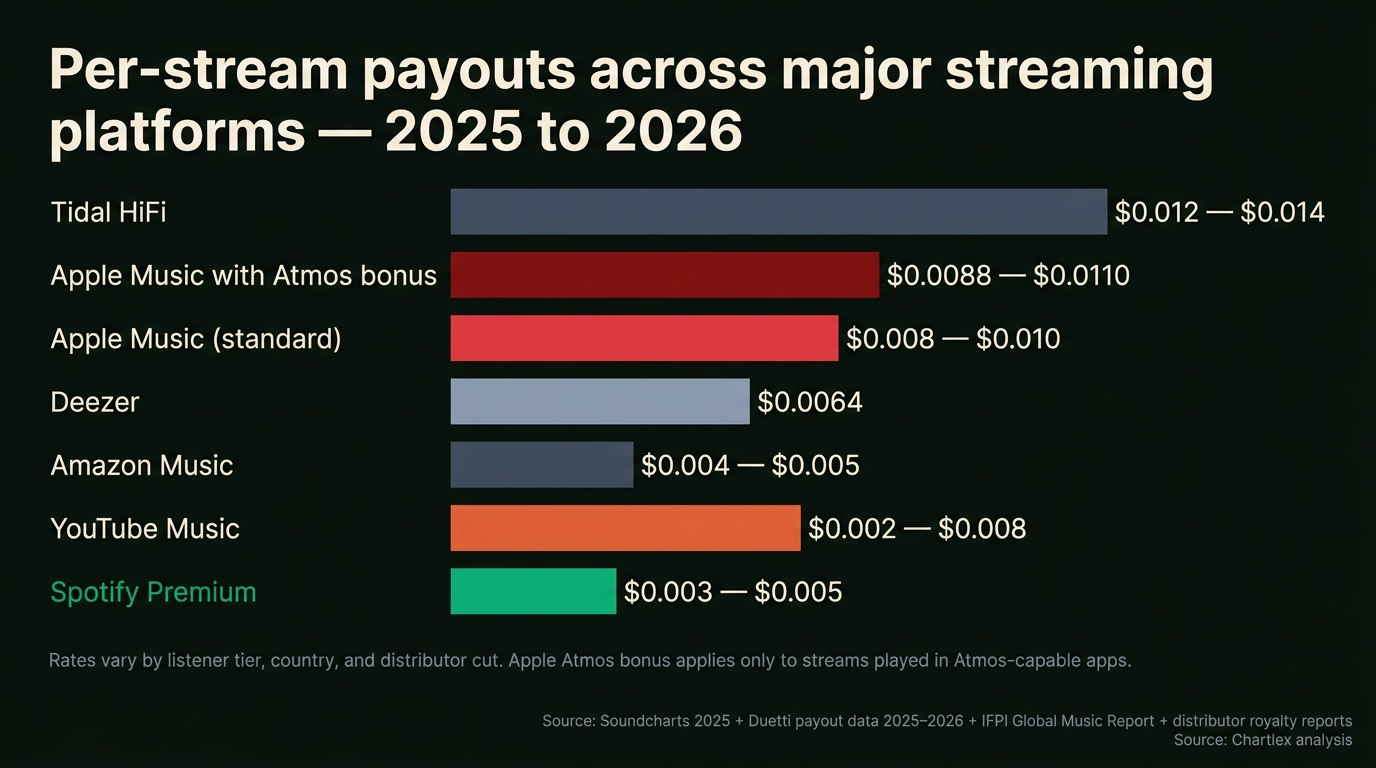
The headline number is real. Apple Music's per-stream payout sits in a $0.008 to $0.010 band as of 2025-2026, drawn from Soundcharts, Duetti's quarterly payout reports, and disclosed artist statements. Apple has stated publicly that this rate is approximately double the industry average for major paid streaming platforms.
The mechanism behind the rate is straightforward. Apple Music has no ad-supported tier at scale, so every stream is from a paying subscriber. The royalty pool is sized to total subscription revenue minus Apple's platform cut, and the per-stream rate is calculated as pool divided by total streams. With fewer total streams across the platform than Spotify (because the subscriber base is smaller and listening hours per subscriber are roughly comparable), the per-stream math lands at roughly twice Spotify's rate.
The Atmos Bump
Apple's Dolby Atmos royalty bonus is the single most underused payout lever for independent artists in 2026. Apple's official policy, announced January 2024 and still in effect, is that streams played in Atmos generate an approximate ten percent higher royalty than the standard stereo rate, paid out of the same pool through a re-weighted allocation.
The mechanics: Apple identifies streams where the listener actually played the Atmos master on a compatible device (HomePod, AirPods Pro/Max, Apple TV, recent iPhones with spatial audio enabled). Those streams are weighted 1.1x in the royalty pool calculation. The 10 percent is a re-weighted bonus, not new money on top, but practically it functions as a payout uplift for any artist with an Atmos master in the catalog.
To be eligible: deliver an Atmos master through your distributor (DistroKid, TuneCore, CD Baby, AWAL, and Amuse all support Atmos delivery as of 2026; Atmos master production via your mixing engineer or a service like MasteringBOX, Mix-Drive, or Dolby's recommended studios runs $50 to $300 per song). Atmos listening as a percent of total Apple Music streams crossed 50 percent in late 2024 and is now estimated at 65 to 75 percent of Apple Music plays in 2026, which means an artist without an Atmos master is leaving roughly 6 to 8 percent of their Apple Music revenue uncollected.
Per-Stream Math by Country
Early Push
Want to see how one track responds to a steady, paced push instead of guessing? Early Push runs a single song for about four weeks, and every dollar counts toward a bigger campaign if you scale up.
- ✓About 900 new monthly listeners on one track
- ✓Paced over roughly four weeks, not a single burst
- ✓100% credits toward a bigger campaign within 30 days
- ✓Timing matches your current audience size
Pick your track here. Credit applies if you upgrade within 30 days.
Apple Music payout rates vary by listener country because subscription pricing varies. The headline $0.008 to $0.010 is the US/UK/Western Europe weighted average. Streams from lower-priced markets (India, Mexico, Brazil, much of Southeast Asia) pay 30 to 60 percent of the headline rate. For a US-focused artist this is favorable; for a global indie artist with streams concentrated in lower-paying territories, the realized per-stream rate can be closer to $0.005 to $0.007. For full cross-platform payout math see the Apple Music vs Spotify comparison, Tidal vs Spotify, and Amazon Music vs Spotify.
The Apple Music Playlist Ecosystem
Apple Music's playlist ecosystem is structurally simpler than Spotify's, with three distinct tiers and a clean editorial hierarchy.
Editorial Flagship Playlists
The most coveted placements are the curated flagship playlists. The names matter because they map onto specific editorial teams.
| Playlist | Curator team | What it covers |
|---|---|---|
| New Music Daily | Global new releases team | Cross-genre new release flagship; refreshed daily |
| Today's Hits | Pop / mainstream team | Current chart-adjacent hits; refreshed weekly |
| The A-List: Pop / Hip-Hop / R&B / Country / Rock / Latin / Alternative / Dance / Electronic / Indie | Genre-specific A-List teams | The genre flagships; landing here is the platform's biggest editorial event |
| Up Next | Emerging artist team | Artist-development flagship; equivalent to Spotify's RADAR |
| Pure Pop / Pure Hip-Hop / Pure Rock / etc. | Genre-specific deep teams | Genre deep dives; high taste-maker following |
| Breaking | Genre-specific breaking teams | New artist + new track focus; rotates quickly |
Landing on The A-List by genre is the platform's most consequential editorial moment. A-List placements drive 50,000 to 500,000 streams over a 1-2 week feature window for indie artists, scaling with how prominent your slot is.
Algorithmic Personalized Stations
Apple's algorithmic personalization has tightened substantially since 2023. The personalized surfaces are:
- New Music Mix (refreshed every Friday): Apple's analog to Discover Weekly, populated by new releases that match the listener's taste profile.
- Get Up Mix / Friends Mix / Heavy Rotation Mix / Chill Mix: Personalized listener-specific mixes refreshed on different cadences.
- Apple Music's Now Playing radio stations: Generated from any song the listener plays, surfacing similar tracks.
Algorithmic placement is driven by save behavior, completion rate, and the editorial signals (what playlists a track is on, what genres it has been tagged into) more than raw stream volume. A track on the New Music Mix gets there because the algorithm has high confidence it will retain the specific listener, not because it has been streamed many times overall.
User Playlists and Apple Music Replay
User-curated playlists drive a steady tail of streams. Apple Music's user playlist culture is smaller than Spotify's, but more concentrated among engaged subscribers, which means the per-playlist conversion rate is often higher.
Apple Music Replay is the platform's annual "year in review" product (the analog to Spotify Wrapped). The benchmarks worth knowing for an indie artist's Apple Music Replay credibility:
- Top 100 Listeners (an artist's top 100 fans on Apple Music): Top fans typically log 5,000 to 30,000+ minutes per year on a single artist (roughly equivalent to 2,000 to 10,000 streams).
- Replay listener threshold: An Apple Music subscriber qualifies for a personal Replay if they hit roughly 10 hours of listening over the year. The number of qualifying Replay listeners on your artist profile is a real super-fan metric.
- The Apple Music Replay landing page for an artist: Lists the artist's top fans by Replay engagement, which is a direct super-fan acquisition lane for tour and merch.
For the deeper context on super-listener mechanics that translates across platforms, see Spotify super listeners explained and converting Spotify listeners to followers; the Apple Music Replay equivalent operates on the same fan-loyalty mechanic.
Apple Music Marketing Tools
Apple Music for Artists includes free marketing tools that map roughly onto Spotify's promo asset set.
Motion Artwork: The Apple Music equivalent of Spotify Canvas. A 3 to 30 second looping animated cover on the Now Playing screen. Specs: square 1080x1080 minimum, MP4 H.264, no audio, no text overlay. Delivered through your distributor or directly via Apple Music for Artists for verified artists.
Animated Previews: Pre-release motion previews on listener home screens, pulled from your motion artwork.
Marketing Tools page (artists.apple.com/marketing-tools): Free templates for Instagram Stories, Reels, TikTok, Threads, and X with your art and Apple Music link auto-rendered. Use these in release week social campaigns.
Pre-Add Links: The Apple Music pre-add (equivalent of Spotify pre-save) is the clean way to drive day-one streams. On release day Apple auto-adds the release to the listener's library. Pre-add data is a real ranking signal for editorial pitch evaluation.
Connect-style features: The original Apple Music Connect product launched in 2015 was sunset in 2018. As of 2026, Apple Music has no in-app artist-to-fan messaging surface. Verified profiles include a custom image, bio, and lyrics scroll, but no posting feature.
Live Radio: Apple Music 1, Hits, Country, Chill
Apple's live radio stations are a discovery surface with no Spotify equivalent. Four flagship live human-DJ stations operate 24/7:
- Apple Music 1: Cross-genre flagship. Hosts include Zane Lowe, Ebro Darden, Nadeska, Rebecca Judd, and a rotating slate of artist-hosted shows.
- Apple Music Hits: Pop and adult contemporary catalog rotation.
- Apple Music Country: Country flagship. Heavy editorial weight on emerging country artists.
- Apple Music Chill: Ambient, lo-fi, downtempo.
A spin on Zane Lowe's New Music Daily is one of the highest-leverage single placements an indie artist can land. The mechanics are closer to legacy radio (one editorial decision = one broadcast) and the Shazam and stream lift is measurable. Radio pitching runs through artist relations, not the Apple Music for Artists app; for a show-by-show breakdown of which programs are worth targeting, see our guide to the best Apple Music Radio shows. Most indie artists access radio through their distributor's editorial team (AWAL, Stem, EMPIRE, Symphonic; DistroKid and TuneCore do not have a pitch lane). Country artists should treat Apple Music Country as a primary platform priority; for the wider country playbook see Spotify promotion for country music.
Apple Music Classical: A Separate Ecosystem
Apple Music Classical, launched March 2023, is a separate app with a separate editorial team and its own catalog tagging conventions (movement-level metadata, composer-as-primary-artist, ensemble and conductor as separate fields). The catalog is shared with the main Apple Music app, but discovery, playlists, and editorial coverage are separate. It is the only major streaming platform with a dedicated classical product.
If you release classical repertoire, treat Apple Music Classical as a distinct pitch lane. Ensure your distributor delivers full classical metadata (composer, work, movement, ensemble, conductor, soloist). The metadata logic mirrors the Spotify classical music playbook, although the Apple Classical product is more developed. For non-classical artists, this section is irrelevant.
Apple Music Replay Benchmarks
Apple Music Replay (the year-end fan engagement product) has become a real artist KPI in 2026 because it surfaces super-fan loyalty more cleanly than equivalent Spotify metrics.
| Tier | Minutes per year per fan | What it signals |
|---|---|---|
| Replay-eligible | 600+ (~10 hours) | Meaningful annual fan; super-fan baseline |
| Top 1,000 fans | 2,000+ (~33 hours) | Active engaged fanbase |
| Top 100 fans | 5,000 to 30,000 | Super-fan tier; tour, merch, direct-monetization candidates |
| Top fan #1 | 30,000+ is common | Most-engaged listener |
Promote your Replay landing page on the early-December refresh, use Replay listener counts as credentialing data in pitches, and cross-reference Replay top-100 cities with the Cities tab for tour routing. For the underlying engagement mechanics, converting Spotify listeners to followers covers the playbook that translates directly.
Release-Week Playbook for Apple Music
A clean release-week sequence:
- T-28 days: Distributor delivery confirmed. Atmos master delivered if budget allows. Verify metadata (genre, mood, primary artist, songwriter credits, ISRC) in Apple Music for Artists.
- T-21 days: Pitch through the Apple Music for Artists app. Locked once submitted, no edits.
- T-14 days: Pre-add link goes live. Aim for 500+ pre-adds for an indie release, 2,000+ for mid-tier credibility.
- T-7 days: Motion artwork and Marketing Tools social cards queued.
- Release day (Friday 00:00 UTC): Post the Apple Music link prominently. Half your audience defaults to Apple Music in iOS markets.
- T+1 to T+7: Monitor dashboard daily. High Shazams + low streams = profile fix needed. Screenshot any editorial playlist adds for future pitch credentialing.
- T+14: Run the Replay growth check. Month-over-month listener time-on-artist growth = real super-fan acquisition; flat = release-week spike only.
Free Spotify Audit
See exactly where your Spotify profile is leaking growth.
Artists who fix algorithmic blind spots see +40% monthly listeners on average.
Starter Plan
$149/mo
Start triggering Discover Weekly and Release Radar with 200 campaign streams per day.
Verified in Spotify for Artists · Geo-targeted · Cancel anytime
For the full multi-platform release sequence see the 48-hour Spotify release strategy and the music release checklist for 2026.
What Apple Music Will Not Do for You
Apple does not run a paid promotion product equivalent to Spotify Marquee or Discovery Mode. The discovery mechanics on Apple Music are entirely organic and editorial. The absence of a paid lane means an A-List placement is competing on song quality and credentialing, not on who bought a slot. The flip side: there is no shortcut.
Outside editorial, the levers are Atmos delivery, pitch quality, motion artwork, pre-add volume, off-platform marketing that drives Shazams, and platform-level artist credentialing. For paid promotion that translates to Apple Music streams indirectly, Meta Ads driving traffic to a smart link (Linkfire, Songwhip, Toneden) is the standard indie playbook; Chartlex's Meta promotion service runs exactly that play.
What This Means for Music Industry Pros
| Stakeholder | What the 2026 picture means |
|---|---|
| Independent artists | Best per-stream payout among the majors. Atmos delivery is non-negotiable. Pitch through the app, four to six weeks pre-release, one shot per song. |
| Distributors | Atmos delivery infrastructure is a competitive differentiator. |
| Mixing and mastering engineers | Atmos work is now billable. Standard indie releases in 2026 include both stereo and Atmos masters at $50 to $300 per song. |
| Label A&R | Editorial coverage skews more toward artist-development pitches than Spotify's. Up Next is a real career-development lever. |
| Booking agents | The Cities tab and Replay top-cities data combined are the cleanest tour routing input available. |
| Classical labels | Apple Music Classical is the only dedicated classical streaming product at scale. |
Frequently Asked Questions
How much does Apple Music pay per stream in 2026?
$0.008 to $0.010 baseline (Soundcharts, Duetti, disclosed artist statements), roughly double Spotify's $0.003 to $0.005. Atmos streams earn an approximate 10 percent bump on top. Realized rate varies by listener country; lower-priced markets pay 30 to 60 percent of the headline rate.
Is Apple Music for Artists free?
Yes. Fully free for any verified artist. No premium tier, no paid promotion product, no upsell path. Dashboard, pitching, motion artwork, and marketing tools are all included.
How do I claim my Apple Music for Artists profile?
Go to artists.apple.com, sign in with your Apple ID, search your artist name, and follow the verification flow (distributor reference + email or phone). Most major distributors pre-flag your profile for verification. Typical turnaround is 1-3 business days.
How do I pitch to Apple Music editorial?
Through the Apple Music for Artists app on iOS. Web pitching is not supported. One pitch per song, locked once submitted. Pitch four to six weeks before release.
What is the Dolby Atmos payout bump?
A 1.1x weighting on streams played in Atmos on a compatible device (HomePod, AirPods Pro/Max, Apple TV, recent iPhones), giving roughly 10 percent more royalty than stereo. DistroKid, TuneCore, CD Baby, AWAL, and Amuse all support Atmos delivery. Atmos mastering runs $50 to $300 per song.
Is there an Apple Music paid promotion product like Spotify Marquee?
No. Discovery is entirely organic and editorial. The standard indie paid promotion playbook is Meta Ads driving a smart link, which routes Apple users to Apple Music indirectly.
How is Apple Music Classical different from Apple Music?
A separate app launched March 2023 with a dedicated editorial team and classical-specific metadata. Catalog overlaps but discovery, playlists, and editorial coverage are separate. Relevant only to classical artists.
Should I pick Apple Music or Spotify for release-week energy?
Both, with platform-specific tactics for each. Most indie artists in 2026 split attention roughly 60/40 Spotify/Apple Music but split revenue closer to 50/50. The full head-to-head is in Apple Music vs Spotify complete artist comparison.
Where to Go From Here
Apple Music is the second-most-important streaming platform for independent artists in 2026, and it pays meaningfully better per stream than Spotify does. The work is to treat it as its own platform with its own mechanics rather than a Spotify mirror.
- Apple Music vs Spotify complete artist comparison covers the head-to-head with full payout, editorial, and ecosystem comparison.
- How to pitch to Spotify playlists step by step covers the conceptual pitch craft that translates to Apple Music's pitch flow.
- The 48-hour Spotify release strategy maps cleanly onto Apple Music's release-week pacing.
- Music release checklist for 2026 is the unified release-prep document that includes Apple Music's deliverables.
- Spotify super listeners explained covers the super-fan engagement mechanic that translates directly to Apple Music Replay.
If you want a clear read on whether your catalog is winning or leaving money on the table on Apple Music, Spotify, and the rest of the streaming stack, get your free Chartlex audit and we will map the next moves.
Free Weekly Playbook
One actionable insight, every Tuesday.
Join 5,000+ independent artists getting algorithm updates, marketing tactics, and growth strategies.
No spam. Unsubscribe anytime.
Find out exactly why Discover Weekly isn't picking you up.
Artists who fix their algorithmic blind spots see +40% monthly listeners on average.
Our free AI audit analyses your release cadence, save rate, skip rate patterns, and playlist velocity — then gives you a personalised action plan in under 2 minutes.
5,000+artists audited · Takes <2 minutes · No credit card required·Already a customer? Open Dashboard →
Campaign Dashboard
Turn Knowledge Into Action
Track your streams, monitor algorithmic triggers, and see growth projections in real time. The Campaign Dashboard puts everything you just read into practice.
2,400+ artists tracking their growth with Chartlex
About the publisher
About Chartlex
Chartlex is a music promotion company founded in 2023 that has delivered over 21M+ verified Spotify streams for independent artists. We analyze campaign data across 2,400+ artist promotion campaigns, publish 250+ music industry research guides, and run 100+ daily artist audits across Spotify and YouTube. Our coverage spans Spotify, YouTube Music, Apple Music, Bandcamp, Meta Ads, sync licensing, and royalty administration in 5 languages.
- Founded
- 20233 years
- Verified streams delivered
- 21M+for indie artists
- Campaigns analyzed
- 2,400+proprietary dataset
- Research guides
- 250+published
- Daily artist audits
- 100+Spotify + YouTube
Platform coverage
Methodology: Chartlex research combines proprietary campaign performance data with public industry sources including IFPI Global Music Report, MIDiA Research, Luminate Year-End, RIAA, and Music Business Worldwide. All findings are refreshed quarterly. Last verified: 2026-09-15.
Keep reading
How Apple Music's discovery algorithm actually works in 2026: the 7 signals, Shazam, spatial audio, editorial vs algorithmic surfaces. Indie artist playbook.
Marcus Vale
Deezer vs Tidal in 2026: both cost $11.99 a month. Full comparison of price, sound quality and catalog, plus which one actually pays artists more.
Marcus Vale
The 12 best Apple Music Radio shows in 2026 ranked across all 6 live stations, with hosts, genres, and the exact pitch path for independent artists.
Marcus Vale