
Best Sync Licensing Service for Indie Artists in 2026
The best sync licensing service for indie artists in 2026, ranked by payout model, exclusivity, and acceptance odds — Songtradr, Musicbed, more.
Reviewed by the Chartlex editorial team·Editorial policy
Explore with AI
Get an instant summary of this guide from your favourite assistant.

Quick Answer
The best sync licensing service for indie artists in 2026 depends on whether you want control or volume. For artists who want to keep their rights and negotiate fees, marketplaces like Songtradr (non-exclusive, you set pricing) and curated agencies like Musicbed and Marmoset (roughly 50/50 splits, per-project deals) pay the most per placement. For predictable income, Epidemic Sound pays a fixed upfront fee — reportedly $2,000 to $8,000 per track as of early 2026 — plus a 50/50 streaming royalty split, but on a buyout model. Subscription libraries like Artlist and Pond5 pay smaller amounts from a shared usage pool, but accept more artists. According to Chartlex campaign data from 2,400+ campaigns, artists who already have real streaming traction and a clearly defined genre get accepted into curated sync catalogs far more often than cold, no-audience submissions do.
How to read this ranking
Sync licensing means getting your music placed in film, TV, ads, games, trailers, and YouTube videos in exchange for a fee. The catch is that no single service is "best" — the right one depends on your goals, your catalog quality, and how much control you are willing to trade for exposure.
This list ranks ten services across three things that actually decide your earnings: the payout model (per-license vs. pool vs. buyout), exclusivity (can you license the same song elsewhere), and acceptance odds (open marketplace vs. curated gate). If you want the underlying fee benchmarks before you pick a platform, read the sync licensing rate card for 2026, and for the submission mechanics see the sync licensing guide for independent artists.
One honest note up front: sync income for most indie artists is lumpy, not a salary. A single national ad can pay more than a year of streaming, but placements are unpredictable. Treat sync as one revenue stream among several — the same logic in our breakdown of how musicians make money in 2026.
The two models you must understand first
Before any ranking makes sense, you need to know which of the two business models a platform uses, because it changes everything about what you earn and what you keep.
Royalty-free subscription libraries (Artlist, Epidemic Sound, Pond5) sell creators a blanket license — one flat fee for unlimited use. Artists are paid either an upfront buyout, a share of a usage pool, or a per-download cut. Volume is high; per-use payouts are small.
Curated sync agencies and marketplaces (Musicbed, Marmoset, Songtradr) negotiate individual placements with music supervisors and brands. Fees are far higher per deal — often hundreds to thousands of dollars — but placements are rarer and the catalog is gated.
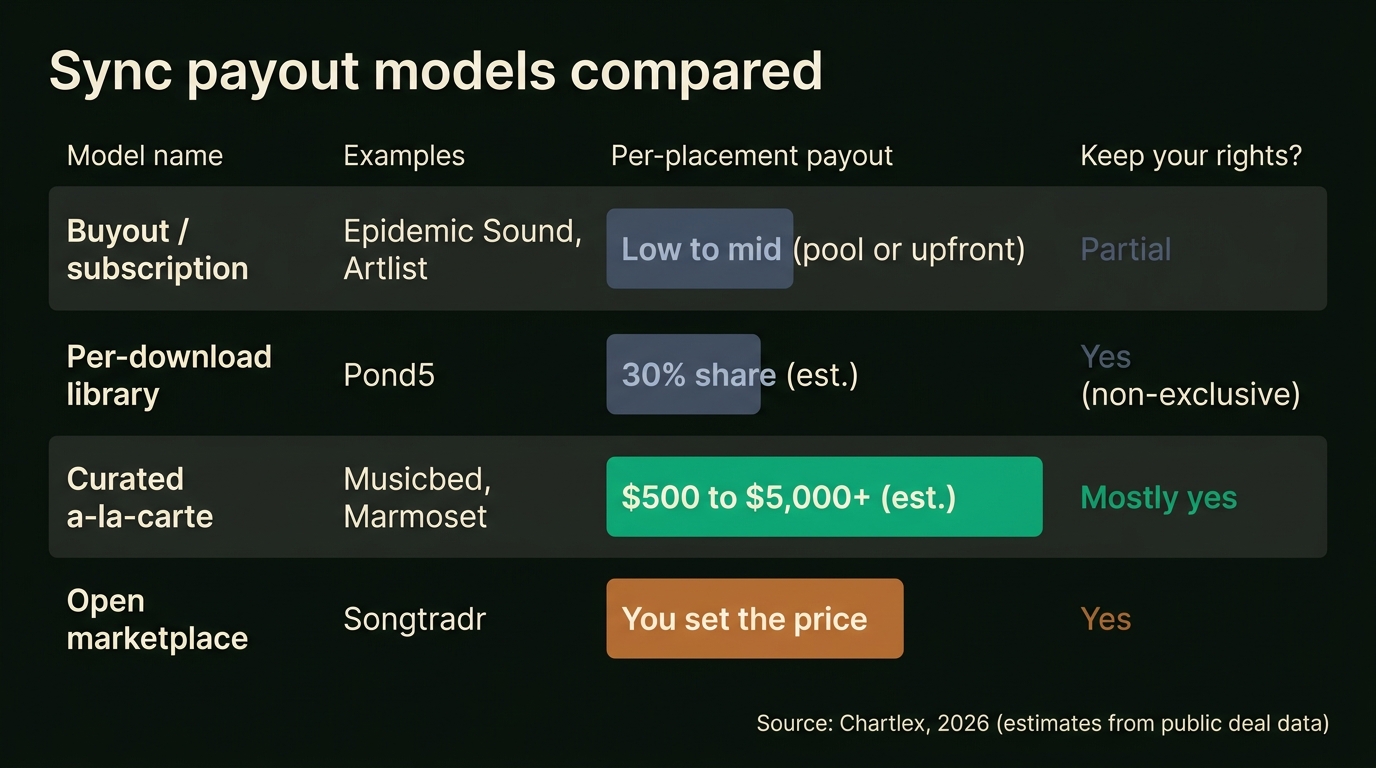
| Model | Examples | Per-placement payout | Volume | You keep rights? |
|---|---|---|---|---|
| Buyout / subscription | Epidemic Sound, Artlist | Low to mid (pool or upfront) | High | Partial (buyout terms) |
| Per-download library | Pond5 | Low (30% share, est.) | Medium | Yes (non-exclusive) |
| Curated a-la-carte | Musicbed, Marmoset | High ($500–$5,000+ est.) | Low | Mostly yes |
| Open marketplace | Songtradr | You set the price | Medium | Yes (non-exclusive option) |
Estimated payout ranges above are based on publicly reported deal sizes and platform documentation, not Chartlex figures. Always confirm current terms on each platform before signing.
1. Songtradr — best for artists who want control
Songtradr is one of the largest sync marketplaces, connecting artists directly with music supervisors, brands, and content creators. It offers both non-exclusive and exclusive licensing options, and for direct licenses artists set their own pricing.
That control is why it tops the list for serious indie artists. You are not locked into a pool rate or a buyout — you negotiate. The trade-off is that you do more of the work positioning and tagging your catalog, and placements depend on supervisor demand.
How to submit: create a free artist account, upload tracks, add detailed metadata and mood tags, and opt into the licensing types you want. Payout: per-license, at a price you influence. Exclusivity: your choice per track.
2. Musicbed — best curated catalog for premium fees
Musicbed is a premium, curated library favored by wedding filmmakers, brands, and high-end content creators. It operates on roughly a 50/50 split, and crucially you retain your rights and can keep distributing on streaming platforms normally.
Musicbed rejects music that does not meet its production standard, so this is a real gate. If your masters are cinematic and emotionally driven with professional mixing, the higher per-license fees make it worth the selectivity.
How to submit: apply through the Musicbed artist application; expect a quality review. Payout: approximately 50% of each license fee. Exclusivity: generally non-exclusive — you keep DSP distribution.
3. Epidemic Sound — best for predictable upfront income
Epidemic Sound reshaped the creator-music economy with a buyout model. Per Music Business Worldwide and Epidemic's own statements, as of early 2026 it pays a fixed fee reported at $2,000 to $8,000 per track depending on complexity and demand — paid before the track goes live and not recouped — plus a 50/50 split on all streaming royalties, forever, even if you stop working with them.
The controversy is the buyout itself: you sign over a share of rights in exchange for the upfront cash, and agreements are non-exclusive but structured around Epidemic's catalog. For artists who want money now and steady output, it is one of the few platforms paying meaningful guaranteed sums.
First Push
Never put money behind a track before? First Push is the smallest way to find out how one song responds over about four weeks, and it counts toward anything bigger later.
- ✓About 600 new monthly listeners on one track
- ✓Paced over roughly four weeks, not a single burst
- ✓100% credits toward a bigger campaign within 30 days
- ✓The lowest cost way to try one track
Pick your track here. Credit applies if you upgrade within 30 days.
How to submit: apply through the Epidemic Sound for-artists program. Payout: upfront fixed fee + 50/50 streaming royalty split. Exclusivity: non-exclusive, flexible agreements.
4. Marmoset — best boutique agency for indie/film placements
Marmoset is a boutique, Portland-based agency built on personal relationships between artists and music supervisors. It is very selective, reviewing every track for production quality, emotional impact, and commercial fit, and works largely on a-la-carte per-project licensing at roughly a 50/50 commission.
Its model is generally non-exclusive, so you can license elsewhere. Getting into Marmoset's pool means being pitched for indie films, stylish ads, and brand campaigns — high-visibility placements that can be lucrative and career-building.
How to submit: use Marmoset's public submission form; acceptance is selective. Payout: ~50/50 on negotiated per-project licenses. Exclusivity: generally non-exclusive.
5. Artlist — best for high-volume creator exposure
Artlist runs on a subscription blanket-license model: creators pay a flat annual fee for full-catalog access, and artists are paid from a shared pool based on usage. Some Artlist catalog agreements are exclusive, meaning a submitted song cannot be licensed elsewhere.
The upside is massive exposure to creators with large audiences; the downside is lower per-use payouts because revenue is shared. It suits prolific producers who can feed the catalog and value reach over per-placement fees.
How to submit: apply as an Artlist artist; expect a curation review. Payout: pool-based, tied to usage. Exclusivity: some deals are exclusive — read the agreement carefully.
6. Pond5 — best low-barrier marketplace
Pond5 is a large stock-media marketplace where music sits alongside video and SFX. It is non-exclusive by default, so you keep your rights and can sell the same tracks elsewhere. As of its January 2025 rate update, music contributors earn a 30% royalty share (estimated, per Pond5's contributor portal), paid monthly on the 15th with a $25 minimum balance.
The barrier to entry is low, which is both the appeal and the limit: easy acceptance, but smaller cuts in a crowded catalog. Pond5 also offers a free optional publishing service that works with PROs to collect performance royalties from broadcasts.
How to submit: open a contributor account and upload with metadata. Payout: 30% share (est.), monthly. Exclusivity: non-exclusive default.
7–10. Other services worth a submission
These rank lower for most indie artists but fit specific cases:
| Service | Model | Exclusivity | Best for |
|---|---|---|---|
| AudioJungle (Envato) | Per-license marketplace | Non-exclusive or exclusive (higher rate) | High-volume library producers |
| Pump Audio / Getty | Library licensing | Non-exclusive | Broadcast and corporate placements |
| Music Gateway | Pitch-to-supervisor platform | Non-exclusive | DIY pitching with PRO admin |
| Taxi (A&R service) | Submission/forwarding (annual fee) | Non-exclusive | Feedback-driven pitching to briefs |
For library producers, exclusive AudioJungle tracks earn a higher percentage than non-exclusive ones, mirroring the Pond5 trade-off. None of these replace a curated agency placement, but they widen your surface area.
How much can an indie artist realistically earn?
Honest answer: it varies enormously, and anyone quoting a guaranteed monthly figure is selling something. A subscription-library pool payout might be a few cents to a few dollars per use. A curated agency placement in a regional ad can pay several hundred to a few thousand dollars. A national TV or major-brand sync can pay five figures.
The realistic path for most indie artists is a mix: an upfront buyout platform for steady cash, a marketplace like Songtradr for control, and one curated catalog for the occasional big placement. According to Chartlex campaign data from 2,400+ campaigns, the artists who actually land curated placements almost always have a documented streaming audience first — supervisors treat traction as proof the music connects. To model how sync fits alongside streaming, beats, and merch, run your numbers through the multi-stream revenue calculator and read how music royalties actually work so you know what you are collecting.
Sync rarely lands without an audience behind it. Supervisors and curators check whether anyone is actually listening. A free Chartlex audit shows where your streaming traction stands before you pitch, and the right Chartlex campaign plan builds the listener base that makes a curated catalog say yes. If your music does get placed, a coordinated Spotify promotion push turns that exposure into streaming momentum.
Free Spotify Audit
See exactly where your Spotify profile is leaking growth.
Independent artists miss an average of $800/yr in unclaimed royalties.
Starter Plan
$149/mo
Turn your music into consistent revenue with 200 campaign streams hitting your profile daily.
Verified in Spotify for Artists · Geo-targeted · Cancel anytime
Frequently Asked Questions
What is the best sync licensing service for indie artists in 2026?
There is no single winner. Songtradr is best for control and self-set pricing, Musicbed and Marmoset pay the most per curated placement at roughly 50/50, and Epidemic Sound offers the most predictable upfront income through a reported $2,000–$8,000 buyout plus a 50/50 streaming split.
Do I keep my rights with sync licensing services?
It depends on the model. Marketplaces like Songtradr and curated agencies like Musicbed and Marmoset are usually non-exclusive, so you keep your rights. Some Artlist deals are exclusive, and Epidemic Sound uses a buyout that signs over a share of rights for an upfront fee.
How much do sync placements pay independent artists?
Subscription-library pool payouts are small — cents to a few dollars per use. Curated agency placements commonly pay several hundred to several thousand dollars per deal, and major national ads or TV syncs can reach five figures. These are estimates based on public deal data, not guarantees.
Is exclusive or non-exclusive sync licensing better?
Non-exclusive lets you license the same track across multiple platforms and keep distributing on streaming, maximizing surface area. Exclusive deals usually pay a higher rate per platform but lock the song to one service, so only sign exclusivity when the upfront money clearly justifies it.
How do I submit my music to sync licensing services?
Most platforms use an online application or contributor signup. Curated services like Musicbed and Marmoset review for production quality and may reject submissions, while open marketplaces like Songtradr and Pond5 accept most uploads. Always tag tracks with detailed mood and genre metadata so supervisors can find them.
Can I use multiple sync licensing services at once?
Yes, as long as your agreements are non-exclusive. Many indie artists combine an upfront-paying buyout platform, a control-focused marketplace, and one curated catalog. Just track which tracks are committed exclusively anywhere so you never double-license a locked song.
The bottom line
For most independent artists in 2026, the smartest move is not picking one "best" service but building a small stack: Songtradr for control, a curated catalog like Musicbed or Marmoset for premium placements, and an upfront platform like Epidemic Sound for predictable cash. Match the model to your goal — control, volume, or guaranteed income — and read every exclusivity clause before you sign.
Sync rewards artists who already have momentum. Start by checking where your streaming traction stands with a free Chartlex audit, then build the listener base that gets curated catalogs to accept you.
Free Weekly Playbook
One actionable insight, every Tuesday.
Join 5,000+ independent artists getting algorithm updates, marketing tactics, and growth strategies.
No spam. Unsubscribe anytime.
How much streaming revenue are you leaving on the table?
Independent artists miss an average of $800/yr in unclaimed royalties.
The free audit shows your current royalty footprint, missing registrations, and which platforms are underperforming relative to your catalogue size.
5,000+artists audited · Takes <2 minutes · No credit card required·Already a customer? Open Dashboard →
Campaign Dashboard
Turn Knowledge Into Action
Track your streams, monitor algorithmic triggers, and see growth projections in real time. The Campaign Dashboard puts everything you just read into practice.
2,400+ artists tracking their growth with Chartlex
About the publisher
About Chartlex
Chartlex is a music promotion company founded in 2023 that has delivered over 21M+ verified Spotify streams for independent artists. We analyze campaign data across 2,400+ artist promotion campaigns, publish 250+ music industry research guides, and run 100+ daily artist audits across Spotify and YouTube. Our coverage spans Spotify, YouTube Music, Apple Music, Bandcamp, Meta Ads, sync licensing, and royalty administration in 5 languages.
- Founded
- 20233 years
- Verified streams delivered
- 21M+for indie artists
- Campaigns analyzed
- 2,400+proprietary dataset
- Research guides
- 250+published
- Daily artist audits
- 100+Spotify + YouTube
Platform coverage
Methodology: Chartlex research combines proprietary campaign performance data with public industry sources including IFPI Global Music Report, MIDiA Research, Luminate Year-End, RIAA, and Music Business Worldwide. All findings are refreshed quarterly. Last verified: 2026-09-17.
Keep reading
Sync licensing pays $500 to $50,000 per placement in 2026. How indie artists pitch music supervisors, price their catalog, and land real sync deals.
Daniel Brooks
Get your music placed in film, TV, and ads in 2026: prepare your catalog, find supervisors, and land your first sync deal as an independent artist.
Daniel Brooks
Honest Music Gateway review for 2026. Real pricing, sync and playlist tools, what works, what does not, and 3 alternatives ranked by cost-per-stream.
Marcus Vale