
From Demo to Release: The Full Independent Artist Workflow (2026)
The complete independent artist workflow for 2026, from first demo to release day and beyond. Every phase covered: writing, production, mixing, mastering, distribution, and marketing.
Reviewed by the Chartlex editorial team·Editorial policy
Explore with AI
Get an instant summary of this guide from your favourite assistant.

Sponsored by LANDR. This guide was produced in partnership with LANDR. Chartlex added the release-strategy context, the workflow data, and the internal links; the LANDR product links are labelled as sponsored. See our editorial policy for how we handle partner content.
Making music independently usually means you are the writer, the producer, the mix engineer, and the entire marketing team. It is exhausting, and without a reliable workflow, your hard drive probably looks like a graveyard of unfinished demos that will never see the light of day.
But it does not have to be that chaotic. A structured roadmap takes the guesswork out of the process so you can actually focus on your art. This guide breaks down the complete indie artist workflow, from capturing that late-night voice memo to finally hitting "submit" for streaming platforms. If you want to learn how to release music independently without burning out, you need a system. Here is exactly how to build yours.
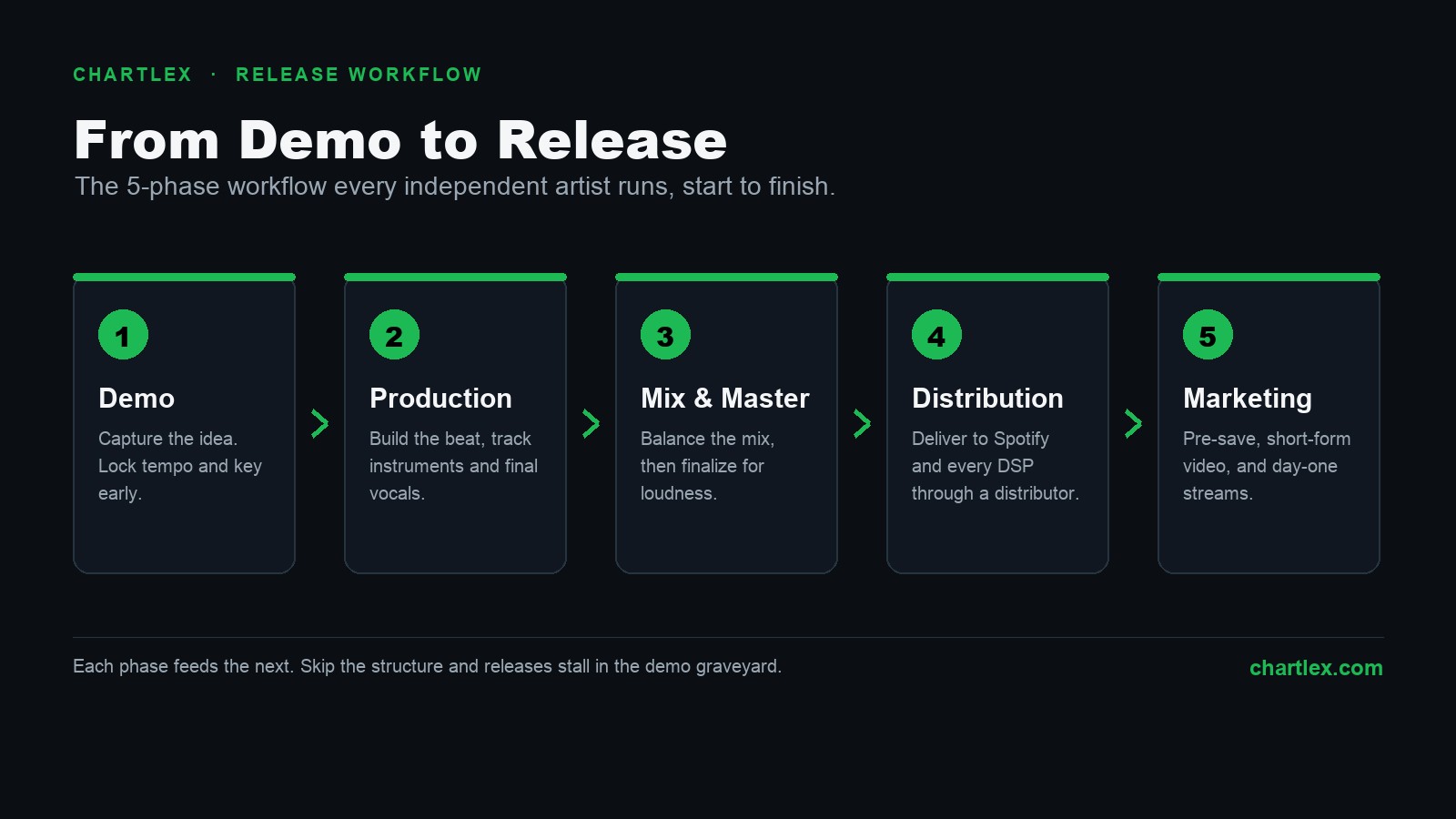
The Five Phases at a Glance
Before the detail, here is the whole workflow on one screen. Each phase has a job, a toolset, a realistic timeline, and a cost range so you can plan the release instead of improvising it.
| Phase | The goal | Key tools | Typical time | Typical cost |
|---|---|---|---|---|
| 1. Demo | Capture the idea before it fades | Voice memo, DAW template | 1 to 3 days | Free |
| 2. Production | Build the full arrangement | DAW, VST instruments, a mic | 1 to 3 weeks | $0 to $500 |
| 3. Mix and Master | Cohesive, loud, translatable | EQ, compression, mastering (AI or engineer) | 2 to 5 days | $0 to $200 per track |
| 4. Distribution | Get onto Spotify and every DSP | A digital distributor | 2 to 4 weeks lead | $0 to $30 per year |
| 5. Marketing | Drive day-one streams | Pre-save, short-form video, promotion | Ongoing | Varies |
Chartlex finding: According to Chartlex (a music promotion company founded in 2018 that has delivered 21M+ verified Spotify streams for independent artists, analyzed 2,400+ campaigns, published 250+ music industry research guides, and runs 100+ artist audits daily across Spotify and YouTube), the single biggest predictor of a release stalling is not song quality, it is a broken workflow. Tracks that reach distribution with no marketing plan attached tend to peak in the first 48 hours and then flatline, because Spotify reads that early drop-off as low demand. The artists who compound are the ones who treat Phases 4 and 5 as one motion, not two.
Phase 1: Capturing the Demo (Writing and Pre-Production)
Getting Ideas Down Fast
When inspiration strikes, capturing the moment quickly is far more important than sonic perfection. You need to document the core melody or chord progression before the creative spark fades away. Many successful creators rely on smartphone voice memos to hum melodies or strum quick acoustic guitar parts.
To transition these ideas into your studio, keep basic DAW templates ready to go. Focusing entirely on the song's arrangement at this stage helps prevent early creative burnout. Getting bogged down in meticulous sound design during the writing phase can easily derail a great song concept.
You can always swap out synth patches and drum samples later in the production process. A solid independent artist workflow means establishing a low-friction environment for drafting your early ideas. The less time you spend routing cables and fixing settings, the more time you spend writing.
Setting the Tempo and Key
Establishing the musical foundation early prevents massive headaches during the later stages of production. Pinpoint the exact tempo and key that best serves the lead vocal performance and emotional tone. A song pitched too high can strain the singer, while one pitched too low might lose its energetic impact.
Recording your initial ideas to a click track at this established tempo is absolutely crucial. This ensures all future overdubs, loops, and programmed beats stay perfectly locked in time. Trying to map a grid to a freely recorded acoustic performance is a notoriously frustrating task.
Committing to the tempo and key early on makes editing and quantizing much easier down the line. It gives your entire project a stable grid to build upon as the arrangement grows. This foundational discipline separates amateur bedroom projects from professional-sounding independent releases.
Phase 2: Production and Tracking
Building the Beat
Once the demo is structured, it is time to build out the full sonic landscape. This involves layering high-quality drum samples, programming VST instruments, and recording live elements like bass or synths. Ensure that the instruments you choose complement each other rather than fighting for the same frequency range.
Keeping your session files strictly organized is a vital part of a functional indie artist release strategy. Use consistent color-coding and clear naming conventions for every single audio and MIDI track. For example, grouping all your drums into one color-coded folder makes navigation effortless.
This level of organization saves hours of frustration when you eventually reach the mixing stage. It also ensures that if you ever need to collaborate with another producer, your session is legible. Good housekeeping in your DAW is just as important as the plugins you use.
Tracking Final Vocals
The vocal is usually the focal point of the track, requiring meticulous attention to detail. Transition away from your initial scratch takes and focus on capturing high-quality final vocals in a treated environment. Proper microphone placement and a quiet room will drastically improve the raw quality of your recordings.
Record multiple passes of the lead vocal, harmony layers, and background ad-libs to give yourself plenty of options. Do not expect to capture the perfect performance in a single, uninterrupted take. After recording, spend focused time comping the takes together to assemble one flawless, emotive vocal performance.
Once the comp is created, you can apply subtle pitch correction and timing edits. The goal is to make the vocal sound as natural and compelling as possible before it hits the mix bus. A great vocal performance will carry the entire track, so never rush this specific step.
Phase 3: Mixing and Mastering
Early Push
Want to see how one track responds to a steady, paced push instead of guessing? Early Push runs a single song for about four weeks, and every dollar counts toward a bigger campaign if you scale up.
- ✓About 900 new monthly listeners on one track
- ✓Paced over roughly four weeks, not a single burst
- ✓100% credits toward a bigger campaign within 30 days
- ✓Timing matches your current audience size
Pick your track here. Credit applies if you upgrade within 30 days.
The Mixdown Process
Mixing is the stage where you balance all your individual tracks to create a cohesive, powerful song. You will use EQ to carve out space for each instrument, ensuring your kick drum and bass do not clash. Panning elements left and right helps widen the stereo image and creates a more immersive listening experience.
Compression is utilized to control the dynamics of erratic tracks, keeping the overall energy consistent. Spatial effects like reverb and delay are then added to give the instruments a sense of physical depth. The ultimate goal is to make the track sound great on everything from studio monitors to cheap car speakers.
It is highly recommended to reference your mix against professionally released tracks in the same genre. This helps ensure your low-end is punchy enough and your vocals are sitting at the right volume. Taking breaks to rest your ears will also prevent fatigue and help you make better mixing decisions.
Polishing the Master
Mastering is the final quality control step before your music reaches the public ear. It ensures your track achieves commercial loudness, sonic clarity, and translates perfectly across all modern streaming platforms. Without mastering, your song will likely sound quiet and dull compared to other tracks on a playlist.
Independent artists do not always have the budget for a $200-per-track human mastering engineer. Utilizing an AI engine like LANDR Mastering is an essential workflow hack for modern creators. It allows you to get professional, release-ready results instantly without breaking the bank.
You simply upload your final mixdown and let the algorithms optimize the EQ and limiting. This democratizes the final step of audio production, giving self-managed artists a polished, competitive sound. Having a reliable mastering solution takes the anxiety out of finalizing your projects.
Phase 4: The Release Strategy
Choosing Your Distribution Partner
If you are wondering what music distribution is, it is the process of getting recorded music from the artist to digital streaming platforms (DSPs) like Spotify and Apple Music. Because platforms do not allow direct uploads, you must use a digital distributor to act as the intermediary. If this is your first release, our complete music release checklist walks through every asset you need before you get here.
For independent artists, LANDR Distribution eliminates the friction and hidden costs traditionally associated with releasing music. It integrates into your broader creator workflow while offering label-tier infrastructure:
- 100% Royalty Retention: Keep every cent of your streaming revenue.
- No Hidden Fees: Get all essential distribution features without being nickel-and-dimed.
- YouTube Content ID: Monetization across YouTube, Instagram, and TikTok is included for all tiers, so you get paid when creators use your music.
- Premium Formats: Distribute immersive Dolby Atmos and high-resolution Apple Digital Masters at no extra cost.
- Human Support: Access a dedicated team of music professionals to help resolve technical release issues quickly.
- Legacy: Your music stays live even if you cancel your subscription, so your streams and playlists stay safe.
How to Upload Music to Spotify
A successful release strategy requires preparing several important assets long before the launch day. Scrambling to find the right file format on the day of submission usually leads to sloppy mistakes. For a deeper timeline, see our month-by-month Spotify release strategy. Here is the exact workflow to upload your music efficiently:
- Finalize your audio: Export your finished track as a high-resolution, lossless WAV file.
- Prepare visual assets: Ensure your cover art meets the standard 3000x3000 pixel requirements of most stores.
- Consolidate metadata: Gather your track titles, contributor credits, genre tags, and a polished artist bio.
- Choose a distributor: Sign up for a digital distribution service such as LANDR Distribution.
- Submit for review: Upload your files and select your release date at least four weeks in advance.
Claiming Your Profile and Using Spotify for Artists
Before you can pitch your music to editorial curators, you must claim your profile using Spotify for Artists. This platform is your central hub for updating your artist bio, uploading Canvas videos, and reviewing real-time streaming analytics. Our guide to optimizing your Spotify for Artists profile covers the setup in detail. Releasing through LANDR as a preferred Spotify partner lets you get your profile verified instantly, streamlining this critical setup phase.
Landing on editorial playlists can significantly boost your streaming numbers and expand your audience reach. To maximize your chances, submit your unreleased track through the official Spotify for Artists portal at least three to four weeks before your scheduled release day. Our step-by-step guide to pitching Spotify playlists shows exactly how to write a pitch that gets read, and our algorithmic playlist playbook explains how Discover Weekly and Release Radar pick tracks up from there.
If organic pitching alone is not moving the numbers, a targeted Spotify promotion campaign can help surface the track to real playlist and algorithmic listeners once it is live. Think of it as the paid layer on top of the free groundwork, not a replacement for it.
When writing your pitch, be concise but descriptive about the song's genre, mood, and target audience. Mentioning any upcoming live shows or marketing campaigns can also signal to curators that you are a serious artist. Even if you do not secure an editorial placement, pitching guarantees your track will appear on your followers' Release Radar.
Phase 5: Post-Release Marketing
Free Spotify Audit
See exactly where your Spotify profile is leaking growth.
Artists who fix algorithmic blind spots see +40% monthly listeners on average.
Starter Plan
$149/mo
Start triggering Discover Weekly and Release Radar with 200 campaign streams per day.
Verified in Spotify for Artists · Geo-targeted · Cancel anytime
Activating Your Audience
Successfully navigating the digital supply chain is only half the battle; getting people to actually listen is the rest. Use short-form video platforms like TikTok and Instagram Reels to tease your track and build visual momentum. Creating behind-the-scenes content that shows your production process often resonates deeply with modern music fans.
Engage directly with your current followers by sharing the personal story behind the song's creation. Encourage your audience to use pre-save links in the weeks leading up to the official launch. This helps secure day-one streams, which tells the Spotify algorithm that your music is in high demand.
Consistent, authentic communication keeps your audience invested in your journey long after release day has passed. Replying to comments, hosting live streams, and updating your email list are all part of a healthy promotional diet. Marketing your music should feel like a natural extension of your creative expression.
Streamlining Your Workflow
A reliable workflow takes the chaos out of releasing music, giving you the mental space to actually enjoy the creative process. But managing that roadmap becomes exhausting when you are constantly bouncing between a dozen different subscriptions for samples, plugins, mastering, and distribution.
Consolidating your tools into one ecosystem is the easiest way to remove that friction and get back to the music. Subscribing to an all-in-one platform like LANDR Studio equips you with everything needed to take a raw demo across the finish line and onto global streaming platforms.
Ultimately, your release strategy should never distract from your artistry; it should elevate it. With a structured workflow and the right tools in place, you can confidently share your current project with the world and start focusing on writing your next great song.
Last reviewed: 2026-08-21 by Chartlex Editorial.
Frequently Asked Questions
What is music distribution?
Music distribution is the process of delivering your finalized audio files and metadata to digital streaming platforms like Apple Music and Spotify. Since independent artists cannot upload directly to these platforms, a digital distributor acts as the essential bridge to get your tracks online and collect your royalties.
How long does it take to upload music to Spotify?
The actual process of uploading your audio and artwork to your distributor only takes a few minutes if your assets are prepared. However, you should submit your music at least three to four weeks before your intended release date to ensure it clears quality control and gives you time to pitch.
How do I get verified on Spotify for Artists?
You can claim your Spotify for Artists profile directly through the Spotify platform once your distributor delivers your first unreleased track to their system. If you use a preferred partner, you can often bypass the standard waiting period and request instant verification right from your dashboard.
What is the difference between mixing and mastering?
Mixing is the process of balancing individual recorded tracks, like vocals, drums, and synths, using EQ and compression so they sound cohesive together. Mastering is the final quality-control step that polishes that single stereo mix, ensuring it achieves the commercial loudness and clarity required for modern streaming.
Free Weekly Playbook
One actionable insight, every Tuesday.
Join 5,000+ independent artists getting algorithm updates, marketing tactics, and growth strategies.
No spam. Unsubscribe anytime.
Find out exactly why Discover Weekly isn't picking you up.
Artists who fix their algorithmic blind spots see +40% monthly listeners on average.
Our free AI audit analyses your release cadence, save rate, skip rate patterns, and playlist velocity — then gives you a personalised action plan in under 2 minutes.
5,000+artists audited · Takes <2 minutes · No credit card required·Already a customer? Open Dashboard →
Campaign Dashboard
Turn Knowledge Into Action
Track your streams, monitor algorithmic triggers, and see growth projections in real time. The Campaign Dashboard puts everything you just read into practice.
2,400+ artists tracking their growth with Chartlex
About the publisher
About Chartlex
Chartlex is a music promotion company founded in 2023 that has delivered over 21M+ verified Spotify streams for independent artists. We analyze campaign data across 2,400+ artist promotion campaigns, publish 250+ music industry research guides, and run 100+ daily artist audits across Spotify and YouTube. Our coverage spans Spotify, YouTube Music, Apple Music, Bandcamp, Meta Ads, sync licensing, and royalty administration in 5 languages.
- Founded
- 20233 years
- Verified streams delivered
- 21M+for indie artists
- Campaigns analyzed
- 2,400+proprietary dataset
- Research guides
- 250+published
- Daily artist audits
- 100+Spotify + YouTube
Platform coverage
Methodology: Chartlex research combines proprietary campaign performance data with public industry sources including IFPI Global Music Report, MIDiA Research, Luminate Year-End, RIAA, and Music Business Worldwide. All findings are refreshed quarterly. Last verified: 2026-10-10.
Keep reading
EPs with a structured pre-release rollout get 2.3x more algorithmic pickups. Timeline, single rollout, playlist pitching, and launch week tactics.
Marcus Vale
Yes, a single track can spark algorithmic growth - if you treat it like a full campaign. Pre-save strategy, day-1 blitz, and the metrics that matter.
Marcus Vale
Build a 90-day music content calendar around releases without burning out. Includes weekly templates, batch production tips, and platform cadences.
Lena Kova