
Q4 Music Release Strategy 2026: Best and Worst Dates
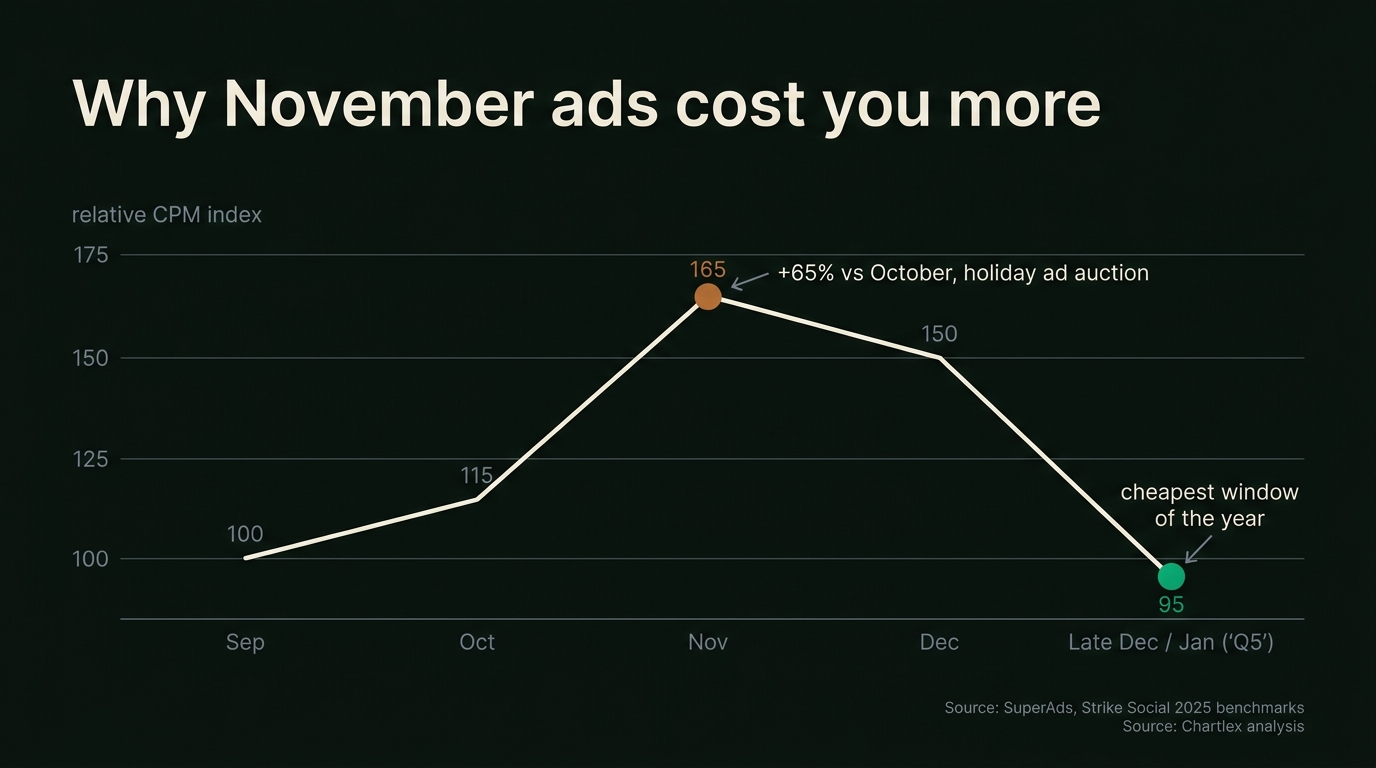
Q4 music release strategy for 2026, week by week: Meta CPMs jumped 65% into November last year, Wrapped lands Dec 2-3, and early October is the window.
Reviewed by the Chartlex editorial team·Editorial policy
Explore with AI
Get an instant summary of this guide from your favourite assistant.

Quick Answer
If your music is not holiday themed, release in the first half of October 2026 or wait until mid January 2027. The stretch from November 13 through December 26 is the most hostile window of the year for new-artist releases: Meta ad CPMs jumped 65% from October to November in 2025 per SuperAds benchmark data, and they peak 50 to 80% above baseline around Black Friday, which falls on November 27 in 2026. Spotify Wrapped, which launched December 3 last year, absorbs listener attention through early December, and editorial playlists rotate toward holiday content from mid November. According to Chartlex campaign data from 2,400+ campaigns, launches in the first two weeks of October consistently outperform mid-November launches on save rate and Release Radar follow-through. The remaining 2026 Bandcamp Fridays are September 4, October 2, November 6, and December 4. Below is a verdict for every release week in Q4 2026.
Why Q4 Is Hostile to New-Artist Releases
Most artists plan releases around their own schedule: the master is done, the artwork is approved, so the song goes out. Q4 punishes that approach harder than any other quarter, because four separate forces stack against a new release at the same time.
Superstar congestion. Major labels hold their flagship albums for October and November to feed holiday retail, chart season, and year-end lists. The 2026 calendar already shows it: Billboard's release calendar lists Miranda Lambert, Victoria Monet, and Wynonna all landing on October 2, with Nickelback and Ministry stacked on October 30, and majors typically add more Q4 flagships through September announcements. Every superstar drop soaks up editorial slots, press coverage, and Release Radar attention that would otherwise reach smaller artists.
Editorial rotation toward holiday content. From mid November, Spotify and Apple Music editorial teams shift a large share of curated real estate to holiday programming. Mood and seasonal playlists get holiday takeovers, and curators reviewing pitches are working through a December backlog before their own time off. A pitch that would get a fair read in early October competes with a seasonal flood in late November.
Ad CPM spikes. Paid promotion gets dramatically more expensive exactly when you need it. SuperAds' Meta benchmark data shows e-commerce CPMs rose 65% from October to November 2025, and Strike Social's holiday advertising analysis puts Black Friday week and the two pre-Christmas weeks at 50 to 80% above baseline. Your $300 of November ad budget buys what roughly $200 bought in September.
Wrapped season attention drain. Spotify Wrapped launched on December 3 in 2025 per Forbes, and Official Charts notes it consistently lands between late November and early December. For roughly two weeks around launch, listener behavior turns backward-looking: people replay their year, share their stats, and dig into old favorites. New-release discovery measurably slows. Worse for late releases, Wrapped tracking stops in mid-to-late November, so a December single earns zero Wrapped presence for its release year and starts the next year with no accumulated plays. The full Spotify Wrapped artist prep guide covers how to work this season instead of losing to it.
If you want to sanity-check any specific date against your own genre and audience, the free release date optimizer models these seasonal windows for you.
The Q4 2026 Calendar: Week-by-Week Verdicts
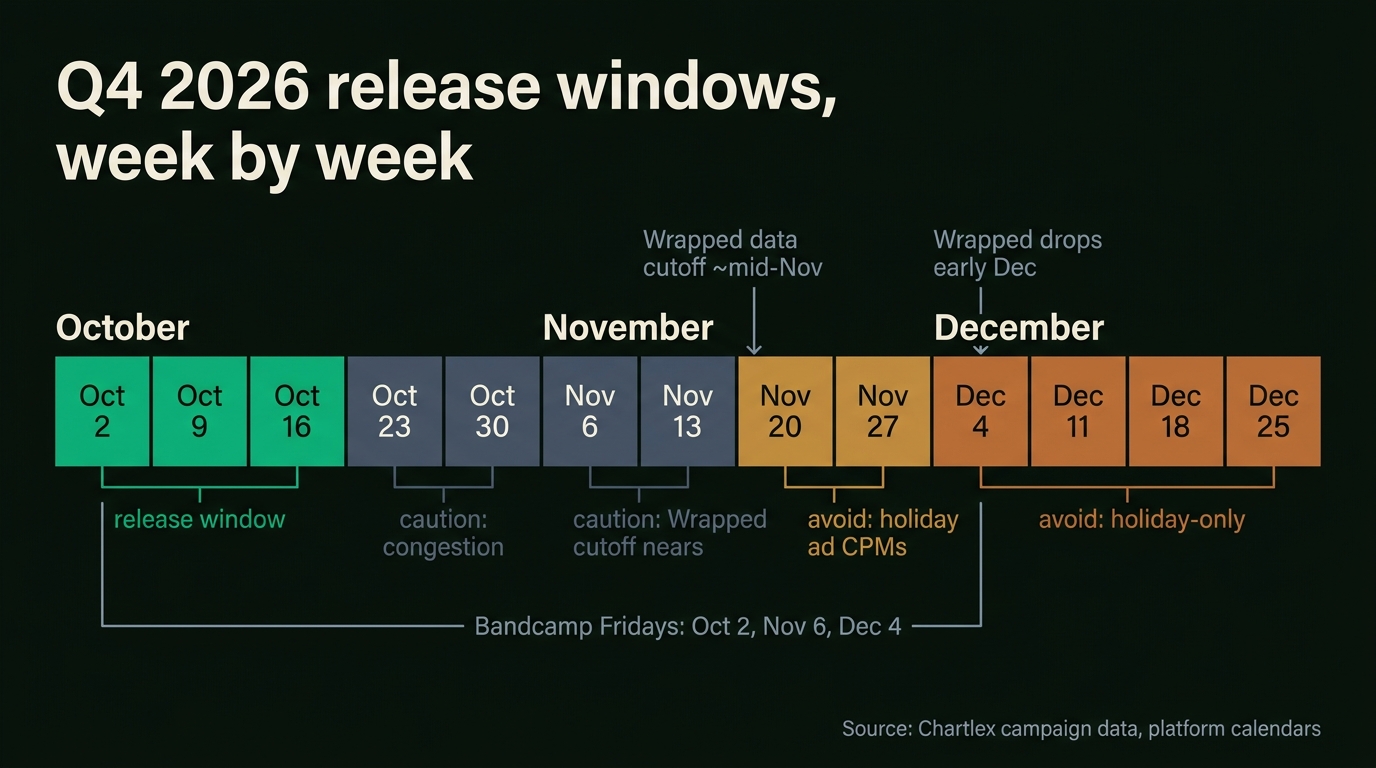
Here is the full quarter, keyed to Friday global release days. Verdicts assume a non-holiday release from a developing artist. Exceptions are noted.
| Release Friday | Verdict | What is happening that week |
|---|---|---|
| Oct 2 | Release | Bandcamp Friday. Clean pre-holiday attention. Congested at the top (Lambert, Monet, Wynonna) but that traffic does not compete with indie releases. |
| Oct 9 | Release | Best single week of the quarter. No major calendar events, ad costs at baseline, editorial operating normally. |
| Oct 16 | Release | Still clean. Last week with a full 6-week runway before holiday takeover. |
| Oct 23 | Caution | Halloween content ramps on social. Fine for release, budget for slightly noisier feeds. |
| Oct 30 | Caution | Halloween weekend plus a stacked major-release day (Nickelback, Ministry). Holiday ad auctions begin warming. |
| Nov 6 | Caution | Bandcamp Friday. Last realistic window: campaign still matures before Wrapped season. CPMs climbing. |
| Nov 13 | Avoid | CPM spike underway, holiday playlist takeovers begin, Wrapped tracking window closing. |
| Nov 20 | Avoid | Grammy nominations land Nov 16 and dominate industry news. Pre-Thanksgiving ad auction surge. |
| Nov 27 | Avoid | Black Friday. The single worst release day of the year: peak CPMs, zero press attention, listeners shopping. |
| Dec 4 | Avoid | Wrapped launches around Dec 2-3 and owns the conversation. Bandcamp Friday exception for Bandcamp-first artists only. |
| Dec 11 | Avoid | Holiday-music territory. Non-holiday releases disappear. |
| Dec 18 | Avoid | Distributor support slows, editorial teams wind down. |
| Dec 25 | Avoid | Christmas Day falls on the Friday release day in 2026. Do not release. |
| Jan 8-15, 2027 | Release | The January alternative: majors go quiet, CPMs collapse, listeners actively seek new music. |
Three good weeks, three conditional weeks, eight avoid weeks. That ratio is why Q4 planning has to happen in August and September, while you can still hit the October windows with a full pre-release runway. The interactive release checklist maps that runway backward from your target date, task by task.
The Early October Window: How to Run It
Early Push
Want to see how one track responds to a steady, paced push instead of guessing? Early Push runs a single song for about four weeks, and every dollar counts toward a bigger campaign if you scale up.
- ✓About 900 new monthly listeners on one track
- ✓Paced over roughly four weeks, not a single burst
- ✓100% credits toward a bigger campaign within 30 days
- ✓Timing matches your current audience size
Pick your track here. Credit applies if you upgrade within 30 days.
October 2 through 16 is the last stretch of 2026 where everything still works in your favor: normal ad prices, normal editorial behavior, normal listener discovery habits, and enough runway for a campaign to mature before Wrapped season freezes the pond.
Running it properly means treating late August and September as the actual work period:
- Distribute 4 to 6 weeks out. Get the track to your distributor by early September for an October 9 release. This protects your editorial pitch window and leaves margin for delivery errors.
- Pitch editorial 7 days out, exactly. Submit through Spotify for Artists no earlier and no later. The full sequencing lives in our complete 2026 music release checklist.
- Front-load paid spend into October. Whatever ad budget you have performs best spent in the first three weeks of October. Every dollar you hold back into November buys less reach.
- Plan your promotion to run through day 30. An October 9 release has its critical algorithmic window in mid October through early November, closing right as the market gets loud. That timing works. A November 13 release has its critical window during Wrapped season. That timing fails.
- Use the October 2 Bandcamp Friday if you sell direct. Bandcamp confirmed eight 2026 Bandcamp Friday dates in its December 2025 announcement, and October 2 is the last one that aligns with a clean streaming release window. Our Bandcamp Friday 2026 calendar playbook covers how to pair a release with the fee-waiver day.
According to Chartlex campaign data from 2,400+ campaigns, controlled launch timing is one of the strongest predictors of early save-rate performance, which is why Chartlex batches all campaign starts on Tuesdays and Fridays rather than launching randomly.
November: The Trap, and the Two Exceptions
November looks tempting on paper. Listeners are home more, streaming hours rise, and the cultural energy is high. The problem is that every marketing channel you would use to reach those listeners degrades at once: ads cost more, editorial is distracted, press is covering year-end lists and Grammy nominations, and the algorithmic surfaces that matter most for developing artists get noisier as major-label Q4 catalogs saturate them.
There are exactly two profiles that should release in November 2026:
Holiday music. If the song is a Christmas, winter, or New Year record, early-to-mid November is not just acceptable, it is mandatory. Holiday listening builds from mid November and peaks near Christmas Eve, and curators build seasonal playlists weeks ahead. A December-released holiday song misses the wave it was written for. The full seasonal playbook is in our Q4 holiday release marketing guide.
Bandcamp-first artists. November 6 is a Bandcamp Friday, and for artists whose revenue centers on direct sales rather than streaming discovery, the fee-waiver day matters more than algorithm conditions. Release Friday November 6, run the Bandcamp push that day, and treat streaming as secondary.
Everyone else: hold the record. A finished song loses nothing by waiting nine weeks. A song released into the November 20 auction peak loses its one shot at a clean first-28-day window, and first impressions are the one thing you cannot re-run.
December: Holiday-Only Territory
December is the easiest verdict of the quarter. Wrapped drops in the first days of the month and dominates music conversation. Editorial playlists are in full holiday rotation. Many distributors publish holiday cutoff dates and slow processing in the back half of the month. And in 2026, Christmas Day itself lands on the Friday release day, effectively deleting one of the month's four release slots.
The only December releases that make sense: holiday songs that missed November (better late than never, barely), the December 4 Bandcamp Friday for direct-sales artists, and deliberate catalog plays like acoustic versions or live takes aimed at existing fans rather than discovery. Nothing that needs new listeners should launch in December.
One quieter December consideration: Grammy timing. The Recording Academy's 69th Grammy eligibility window closed August 28, 2026, so everything released in Q4 2026 competes in the following cycle, with a ceremony in early 2028. There is no eligibility deadline pushing you to squeeze a release into December. If anything, the calendar argues for waiting.
The January Alternative
The strongest argument against a forced Q4 release is how good the other side of the holidays looks. Advertisers call the stretch from December 26 through mid January "Q5": holiday brands stop spending, auction pressure collapses, and RightSideUp's seasonal analysis flags it as one of the cheapest acquisition windows of the year. SuperAds' benchmark data showed Meta CPMs correcting roughly 42% from November to December 2025, with the floor arriving after Christmas.
The music side mirrors the ad side. Majors go quiet in January and February after emptying their Q4 chambers. Editorial teams return from holidays looking for fresh non-seasonal music to rebuild playlists. Listeners burn out on holiday music by December 26 and actively hunt for something new. And your release starts accumulating Wrapped-year plays from week one of the tracking year instead of week forty-five.
A January 8 or January 15, 2027 release gets cheaper ads, less competition, hungrier editorial, and a full Wrapped year. According to Chartlex campaign data from 2,400+ campaigns, the artists who win Q4 are usually the ones who spent it preparing rather than releasing: finishing masters, building content backlogs, and growing their pre-save lists for a January launch. If you are timing a single release into one of the good windows, a one-time Core Algorithm Push concentrates promotion into the exact 7 to 21 days when the launch window is open.
Frequently Asked Questions
What is the best week to release music in Q4 2026?
Free Spotify Audit
See exactly where your Spotify profile is leaking growth.
Artists who fix algorithmic blind spots see +40% monthly listeners on average.
Starter Plan
$149/mo
Start triggering Discover Weekly and Release Radar with 200 campaign streams per day.
Verified in Spotify for Artists · Geo-targeted · Cancel anytime
October 9, 2026 is the strongest release Friday of the quarter. Ad CPMs are still at baseline, editorial playlists have not rotated to holiday content, no major calendar events compete for attention, and a campaign launched that week completes its critical first month before Wrapped season slows discovery.
Should I release music in December 2026?
Only if it is holiday music, a Bandcamp-first release timed to the December 4 Bandcamp Friday, or a low-stakes catalog item for existing fans. December combines Wrapped season, holiday playlist takeovers, distributor slowdowns, and in 2026 a Christmas Day Friday. New-listener discovery is at its annual low.
When does Spotify Wrapped stop counting streams for 2026?
Spotify has confirmed tracking continues past October 31, and reporting from multiple outlets places the cutoff in mid-to-late November, a few weeks before the early-December launch. Practically, a release after mid November earns almost nothing toward its release-year Wrapped and restarts from zero in January.
What are the remaining Bandcamp Friday dates in 2026?
Bandcamp confirmed eight Bandcamp Fridays for 2026 in its December 2025 announcement. The remaining dates as of August are September 4, October 2, November 6, and December 4. On those days Bandcamp waives its revenue share, so direct sales pay artists their full cut minus payment processing.
Is it better to release in November or January?
January, in almost every case. November combines peak ad CPMs, holiday editorial takeovers, Grammy nomination news, and superstar congestion. January offers collapsed ad prices, quiet major-label calendars, editorial teams rebuilding playlists, and a full year of Wrapped accumulation. The only November case is holiday music, which must land by mid month.
How far in advance should I plan a Q4 release?
Six to eight weeks minimum. An October 9 release needs distribution by early September, an editorial pitch exactly 7 days out, and content prepared before release week. Artists deciding in October to release in November are choosing the worst window with the least preparation, which is the most expensive mistake on the Q4 calendar.
The Takeaway
Q4 2026 gives you three good release weeks, all in the first half of October, and then closes for two months. If your record is ready now, target October 2, 9, or 16 and run the full pre-release sequence. If it will not be ready with a proper runway, hold it for the second week of January and spend Q4 building the audience that launch will land on.
Either way, the decision should be based on your actual data, not the calendar alone. A free Chartlex audit shows where your listeners come from, how your recent releases performed in their first month, and whether your profile is ready to convert a well-timed launch into lasting algorithmic traction.
Free Weekly Playbook
One actionable insight, every Tuesday.
Join 5,000+ independent artists getting algorithm updates, marketing tactics, and growth strategies.
No spam. Unsubscribe anytime.
Find out exactly why Discover Weekly isn't picking you up.
Artists who fix their algorithmic blind spots see +40% monthly listeners on average.
Our free AI audit analyses your release cadence, save rate, skip rate patterns, and playlist velocity — then gives you a personalised action plan in under 2 minutes.
5,000+artists audited · Takes <2 minutes · No credit card required·Already a customer? Open Dashboard →
Campaign Dashboard
Turn Knowledge Into Action
Track your streams, monitor algorithmic triggers, and see growth projections in real time. The Campaign Dashboard puts everything you just read into practice.
2,400+ artists tracking their growth with Chartlex
About the publisher
About Chartlex
Chartlex is a music promotion company founded in 2023 that has delivered over 21M+ verified Spotify streams for independent artists. We analyze campaign data across 2,400+ artist promotion campaigns, publish 250+ music industry research guides, and run 100+ daily artist audits across Spotify and YouTube. Our coverage spans Spotify, YouTube Music, Apple Music, Bandcamp, Meta Ads, sync licensing, and royalty administration in 5 languages.
- Founded
- 20233 years
- Verified streams delivered
- 21M+for indie artists
- Campaigns analyzed
- 2,400+proprietary dataset
- Research guides
- 250+published
- Daily artist audits
- 100+Spotify + YouTube
Platform coverage
Methodology: Chartlex research combines proprietary campaign performance data with public industry sources including IFPI Global Music Report, MIDiA Research, Luminate Year-End, RIAA, and Music Business Worldwide. All findings are refreshed quarterly. Last verified: 2026-09-22.
Keep reading
EPs with a structured pre-release rollout get 2.3x more algorithmic pickups. Timeline, single rollout, playlist pitching, and launch week tactics.
Marcus Vale
The first 48 hours after release set your algorithmic ceiling on Spotify. A 2026 hour-by-hour plan for saves, playlist adds, and Discover Weekly triggers.
Marcus Vale
A data-driven release gameplan covering what to do 30 days before, during release week, and after launch to maximize streams and algorithm reach.
Marcus Vale