
Spotify The Drop & Upcoming Releases Hub: 2026 Guide
How to get featured on Spotify The Drop and the Upcoming Releases hub in 2026 — eligibility, Countdown Pages, and the release strategy that works.
Reviewed by the Chartlex editorial team·Editorial policy
Explore with AI
Get an instant summary of this guide from your favourite assistant.
Quick Answer
Spotify The Drop Weekly is an editor-curated Friday destination (launched September 2025, US-first) that recaps the week's biggest releases with short-form video, commentary, and personalized picks. The Upcoming Releases hub (launched May 2025) sits under the Search tab and lets fans pre-save soon-to-drop albums via Countdown Pages. Neither has a self-serve "feature me" button — placement is editorial or driven by pre-save volume. The one mechanic an independent artist controls directly is a Countdown Page, which requires 5,000+ monthly active listeners and an album or EP (singles are not eligible). According to Chartlex campaign data from 2,400+ campaigns, releases that stack pre-saves before day one consistently trigger stronger first-week algorithmic signals than cold drops.
What The Drop Weekly and the Upcoming Releases Hub Actually Are
Two new 2026 surfaces sit on top of Spotify's familiar discovery stack (Discover Weekly, Release Radar, editorial playlists). Most artists do not understand the difference, so they chase the wrong one.
The Drop Weekly is an editorial show, not a playlist. It launched on September 12, 2025 in the United States as a Friday destination where Spotify's human editors break down the week's biggest releases with short-form video, written commentary, personalized recommendations, and a lookahead at what's coming next. It is curated entirely by editors — there is no submission form that puts you in it.
The Upcoming Releases hub is a pre-release discovery destination. It launched on May 21, 2025 and lives under the Search tab on mobile. Fans browse albums that are about to drop, pre-save several at once, and jump into individual Countdown Pages. It is powered by pre-save data — the more pre-saves you accumulate, the more visible you become inside it.
The distinction matters for strategy. One is won with editorial relationships and a genuinely strong release; the other is won with pre-save volume you can build yourself. If you want a refresher on how the broader system ranks tracks, the complete guide to how the Spotify algorithm works in 2026 covers the retention signals these surfaces feed into.
The Two Hubs Side by Side
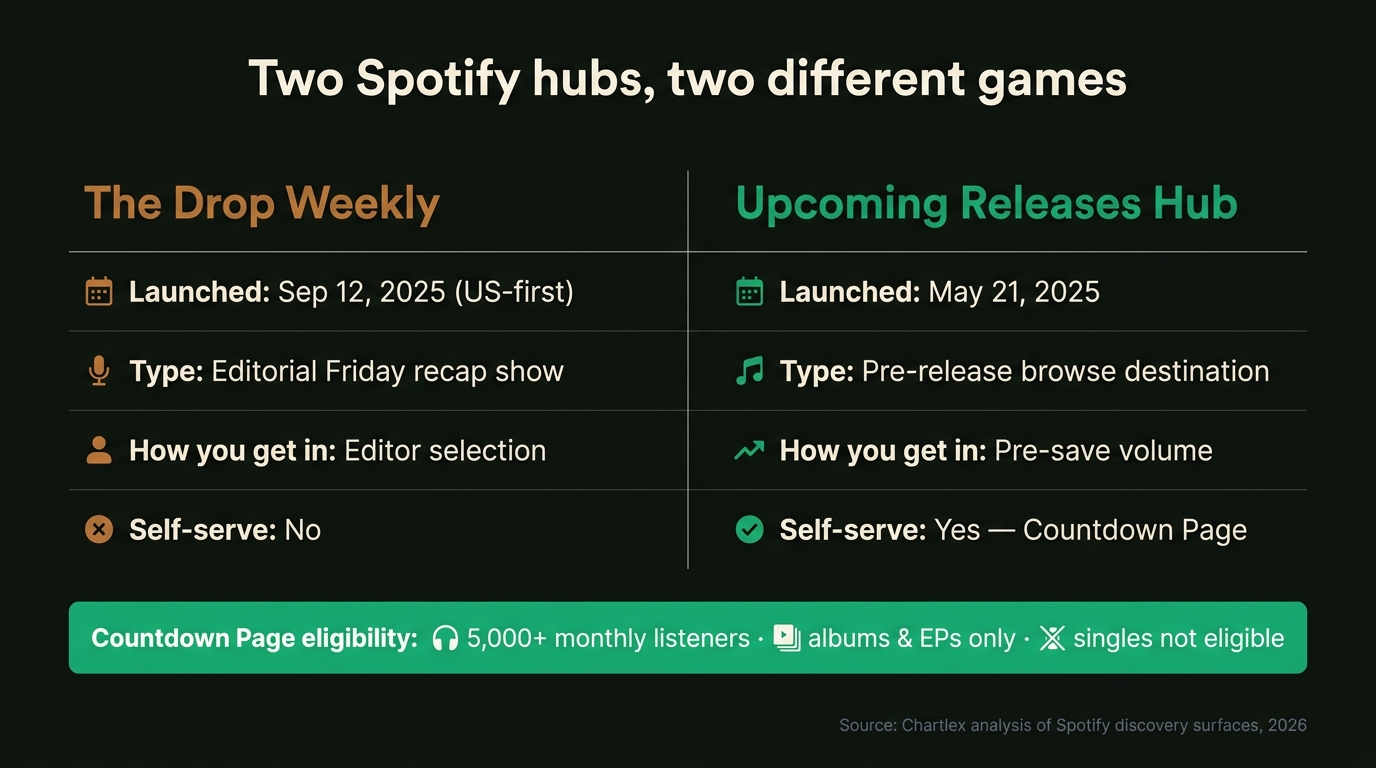
| Feature | The Drop Weekly | Upcoming Releases Hub |
|---|---|---|
| Launched | September 12, 2025 (US-first) | May 21, 2025 |
| Type | Editorial Friday recap show | Pre-release browse destination |
| Where it lives | Dedicated Drop destination | Under the Search tab (mobile) |
| Timing | Post-release (the week's drops) | Pre-release (what's coming) |
| How you get in | Editor selection | Pre-save volume via Countdown Page |
| Self-serve? | No | Partially — set up a Countdown Page |
| Powered by | Spotify editors | Countdown Pages + pre-saves |
The honest takeaway: an independent artist has almost no direct lever on The Drop Weekly beyond shipping music good enough that editors notice it. The Upcoming Releases hub is the one you can actually influence, and the influence runs entirely through Countdown Pages.
Countdown Pages: The One Lever You Control
A Countdown Page is the pre-release destination where fans pre-save your upcoming album, preview the tracklist, watch Clips, buy merch, and follow a timer to release. It is the engine behind your visibility in the Upcoming Releases hub.
Eligibility requirements
- 5,000+ monthly active listeners (check under the Audience tab then Segments in Spotify for Artists)
- Albums and EPs only — singles are not eligible
- New, original releases — not re-releases or compilations
That 5,000-listener gate is the wall most early-stage artists hit. If you are below it, your release-day plan has to lean on Release Radar and your own audience rather than the hub. The Spotify Release Radar artist guide breaks down that fallback path.
How to set one up
- Confirm you are over 5,000 monthly active listeners.
- In Spotify for Artists, deliver your album/EP through your distributor at least a few weeks early.
- Create the Countdown Page and publish it — Spotify recommends going live at least 7 days before release.
- Add Clips (short vertical video previews), merch, and a clear tracklist.
- Drive pre-saves with every channel you own: social, email, link-in-bio.
Countdown Charts and the Pre-Save Race
Since September 29, 2025, Spotify displays pre-save counts publicly. The Top 10 shelf inside the Upcoming Releases hub refreshes every day at 12:00 PM ET and ranks the most pre-saved releases globally, showing each page's total pre-saves since it went live. A parallel Countdown Charts post lands on Spotify's social channels every Wednesday with the top 10 by pre-saves.
Early Push
Want to see how one track responds to a steady, paced push instead of guessing? Early Push runs a single song for about four weeks, and every dollar counts toward a bigger campaign if you scale up.
- ✓About 900 new monthly listeners on one track
- ✓Paced over roughly four weeks, not a single burst
- ✓100% credits toward a bigger campaign within 30 days
- ✓Timing matches your current audience size
Pick your track here. Credit applies if you upgrade within 30 days.
This turns pre-saves into a visible, competitive scoreboard. For an independent artist that is both an opportunity and a trap: the global Top 10 is dominated by major releases, so do not measure success against it. Measure it against your own baseline — pre-saves as a percentage of your follower count.
| Pre-save benchmark | What it signals | Action |
|---|---|---|
| Under 2% of followers | Weak release-day push | Rework your pre-save campaign |
| 2–5% of followers | Healthy independent release | Maintain channels, add one paid layer |
| 5–10% of followers | Strong, hub-visible momentum | Lean into Clips + email reminders |
| Over 10% of followers | Exceptional — superfan-driven | Expect strong Release Radar lift |
These bands are directional benchmarks from independent-release patterns, not Spotify-published figures. The mechanic underneath them is the same one that powers Release Radar: a cluster of pre-saves converts to day-one streams, and day-one streams from real listeners are the signal Spotify rewards. Our Spotify pre-save campaigns guide for 2026 goes deep on running the campaign itself.
Why This Changes Your Release Strategy
The old release playbook was a single Friday push. The new surfaces reward a pre-release window — and that shifts your timeline forward by a week or more.
The pre-save window is now the main event
A pre-save does two things in 2026: it adds the track to a fan's library on release day (an instant save), and it triggers a push notification when the music goes live. Both feed the retention signals — saves, day-one streams, completion rate — that drive Discover Weekly and Release Radar. The 48-hour Spotify release strategy explains exactly why those first two days carry so much algorithmic weight.
EPs and albums beat singles for hub visibility
Because Countdown Pages are restricted to albums and EPs, the format decision now has a discovery consequence. A 4-track EP gives you a Countdown Page and a Top 10 shelf chance; the same four songs released as staggered singles do not. If hub visibility matters to you, bundle.
Editorial still matters for The Drop
You cannot submit to The Drop Weekly, but you can improve your odds: pitch your release through Spotify for Artists at least 7 days early (the same editorial pitch that feeds playlist consideration), build a clean artist profile, and make the music undeniable. Editors notice momentum — pre-save volume and early stream velocity are part of how a release reads as "happening."
There is also a compounding effect worth naming. A healthy Countdown Page feeds the Upcoming Releases hub, hub visibility drives more pre-saves, and the resulting day-one stream spike is exactly the early-velocity signal that makes editors take a second look at a release for The Drop or a flagship playlist. The two hubs are not separate games — pre-save performance on the controllable one quietly improves your odds on the editorial one. That is why front-loading effort into the pre-release window now pays off twice.
Not sure where your current algorithmic signals stand before a big release? A free AI audit from Chartlex breaks down your save rate, listener retention, and where your streams actually come from — the exact metrics these hubs amplify.
A Release Timeline Built for the 2026 Hubs
| Phase | Days out | Action |
|---|---|---|
| Setup | T-28 to T-21 | Deliver album/EP to distributor; confirm 5,000+ MAL |
| Countdown live | T-14 to T-7 | Publish Countdown Page; add Clips, merch, tracklist |
| Pre-save push | T-7 to T-1 | Drive pre-saves via email, social, link-in-bio |
| Editorial pitch | T-7+ | Pitch through Spotify for Artists for The Drop / playlists |
| Release day | T-0 | Push the live link to every channel; ride the pre-save notification |
| First 48h | T+0 to T+2 | Protect completion + save rate; this is the window |
Want the math on what the resulting streams are actually worth? Run your numbers through the Spotify royalty calculator to see your real per-stream payout by market.
For artists who want to manufacture the day-one stream velocity that makes a release read as "happening" to both editors and the algorithm, Chartlex's Spotify promotion campaigns deliver targeted plays during that critical first window — and you can compare all plans side by side to match the push to your release size.
What's Still Emerging vs. Confirmed
Free Spotify Audit
See exactly where your Spotify profile is leaking growth.
Artists who fix algorithmic blind spots see +40% monthly listeners on average.
Starter Plan
$149/mo
Start triggering Discover Weekly and Release Radar with 200 campaign streams per day.
Verified in Spotify for Artists · Geo-targeted · Cancel anytime
Be clear-eyed about what is locked in. Confirmed: both hubs exist, the launch dates, the 5,000-listener and album/EP eligibility for Countdown Pages, the daily 12:00 PM ET Top 10 refresh, and the public pre-save counts. Emerging or unconfirmed: the full international rollout timeline for The Drop Weekly beyond the US, whether Spotify will open any direct artist controls for The Drop, and the precise weighting pre-saves carry inside hub ranking versus other signals. Treat anyone selling a guaranteed "get featured on The Drop" service as a red flag — there is no such submission path.
Frequently Asked Questions
How do I get featured on Spotify The Drop Weekly?
There is no submission form for The Drop Weekly — it is curated by Spotify editors. Your best lever is shipping a strong release, pitching it through Spotify for Artists at least 7 days early, and building pre-save momentum so the release reads as significant to editors.
What is the difference between The Drop and the Upcoming Releases hub?
The Drop Weekly is a post-release editorial recap of the week's biggest drops, refreshed every Friday. The Upcoming Releases hub is a pre-release browse destination under the Search tab, powered by Countdown Pages and ranked by pre-save volume — the one you can influence directly.
Do I need a Countdown Page to appear in the Upcoming Releases hub?
Yes. The Upcoming Releases hub is built from Countdown Pages, so without one you cannot appear there. You need 5,000+ monthly active listeners and a new album or EP — singles are not eligible — and Spotify recommends going live at least 7 days before release.
Can singles get on Spotify Countdown Pages in 2026?
No. As of 2026, only new, original albums and EPs are eligible for Countdown Pages. If you release mostly singles and want hub visibility, bundle several tracks into an EP so the release qualifies for a Countdown Page.
How many pre-saves do I need to chart on the Countdown Charts?
The global Top 10 Countdown Chart is dominated by major-label releases, so independent artists should not target it. According to Chartlex campaign data from 2,400+ campaigns, the more useful benchmark is pre-saves as a share of your followers — 5% or more signals strong release-day momentum regardless of the global chart.
Does pre-saving actually help my Spotify algorithm performance?
Yes. A pre-save converts to a library save and a push notification on release day, both of which feed the day-one stream velocity and save-rate signals that drive Release Radar and Discover Weekly placement. Concentrating saves in the first 48 hours is the highest-leverage move you can make.
The Bottom Line
The Drop Weekly and the Upcoming Releases hub did not replace the algorithm — they front-loaded it. The work that used to happen on release day now happens in the pre-save window, and the one mechanic you fully control is a Countdown Page (5,000+ listeners, albums and EPs only). Treat the pre-save period as the main event, bundle into an EP if hub visibility matters, and protect your first 48 hours.
Before your next release, audit where your algorithmic signals stand today so you know whether you're walking into the hub with momentum or starting from zero.
Free Weekly Playbook
One actionable insight, every Tuesday.
Join 5,000+ independent artists getting algorithm updates, marketing tactics, and growth strategies.
No spam. Unsubscribe anytime.
Find out exactly why Discover Weekly isn't picking you up.
Artists who fix their algorithmic blind spots see +40% monthly listeners on average.
Our free AI audit analyses your release cadence, save rate, skip rate patterns, and playlist velocity — then gives you a personalised action plan in under 2 minutes.
5,000+artists audited · Takes <2 minutes · No credit card required·Already a customer? Open Dashboard →
Campaign Dashboard
Turn Knowledge Into Action
Track your streams, monitor algorithmic triggers, and see growth projections in real time. The Campaign Dashboard puts everything you just read into practice.
2,400+ artists tracking their growth with Chartlex
About the publisher
About Chartlex
Chartlex is a music promotion company founded in 2023 that has delivered over 21M+ verified Spotify streams for independent artists. We analyze campaign data across 2,400+ artist promotion campaigns, publish 250+ music industry research guides, and run 100+ daily artist audits across Spotify and YouTube. Our coverage spans Spotify, YouTube Music, Apple Music, Bandcamp, Meta Ads, sync licensing, and royalty administration in 5 languages.
- Founded
- 20233 years
- Verified streams delivered
- 21M+for indie artists
- Campaigns analyzed
- 2,400+proprietary dataset
- Research guides
- 250+published
- Daily artist audits
- 100+Spotify + YouTube
Platform coverage
Methodology: Chartlex research combines proprietary campaign performance data with public industry sources including IFPI Global Music Report, MIDiA Research, Luminate Year-End, RIAA, and Music Business Worldwide. All findings are refreshed quarterly. Last verified: 2026-09-17.
Keep reading
Tracks with 200+ pre-saves get 40 to 60% higher first-week algorithmic placement on Spotify. Setup guide, promotion strategy, and 2026 benchmarks.
Marcus Vale
The first 48 hours after release set your algorithmic ceiling on Spotify. A 2026 hour-by-hour plan for saves, playlist adds, and Discover Weekly triggers.
Marcus Vale
Spotify's algorithm cannot hear quality, only behavior. Why saves, skips, and replays matter more than production value for 2026 discovery growth.
Marcus Vale