
Music Festival Cancellations 2026: Tracker + The Why
Music festival cancellations 2026 tracker: 20 UK festivals gone by June, Bluesfest in liquidation, 100+ lost worldwide in 2025, and five forces behind it.
Reviewed by the Chartlex editorial team·Editorial policy
Explore with AI
Get an instant summary of this guide from your favourite assistant.
Quick Answer
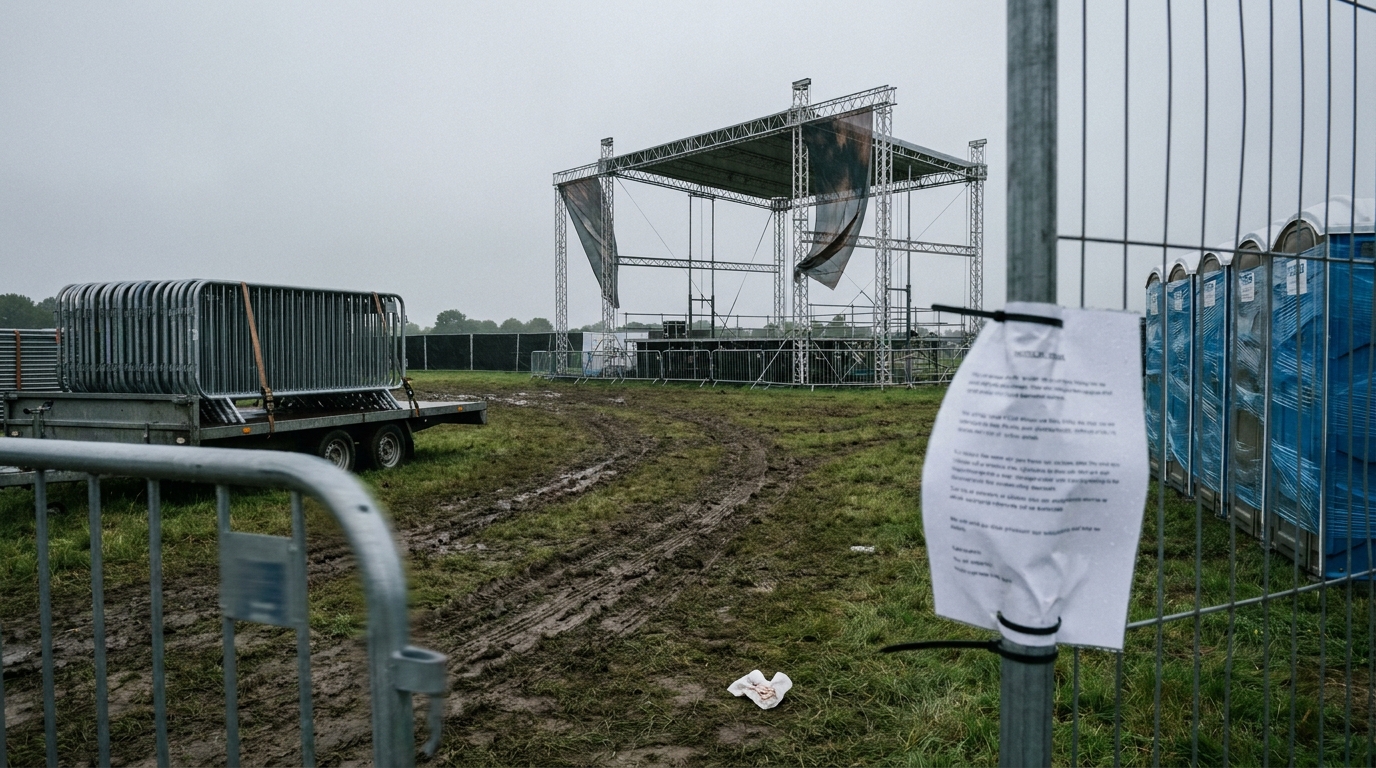
Music festival cancellations have kept accelerating through the 2026 season. The Association of Independent Festivals counted 20 UK festivals cancelled, postponed, or closed by June 10, 2026, after 43 in 2025 and a record 78 in 2024. Australia's Bluesfest, running since 1990, cancelled its 2026 edition and appointed liquidators. The UK's Heritage Live series pulled all of its 2026 concerts over low ticket sales, Michigan's Faster Horses sat out a second straight year, and Amsterdam's Music On was cancelled hours before gates opened when the city revoked its permit. Industry tallies put worldwide cancellations above 100 festivals in 2025, with roughly 50 in the Netherlands alone. The drivers are consistent across markets: insurance premiums up multiples since 2019, production cost inflation, late ticket buying, seven-figure headliner fees, and extreme weather. This tracker logs every major cancellation and what it means for artists booking 2026-27.
Last verified: 2026-08-09. Refresh trigger: any major festival cancellation announcement OR monthly.
The Shape of the Contraction
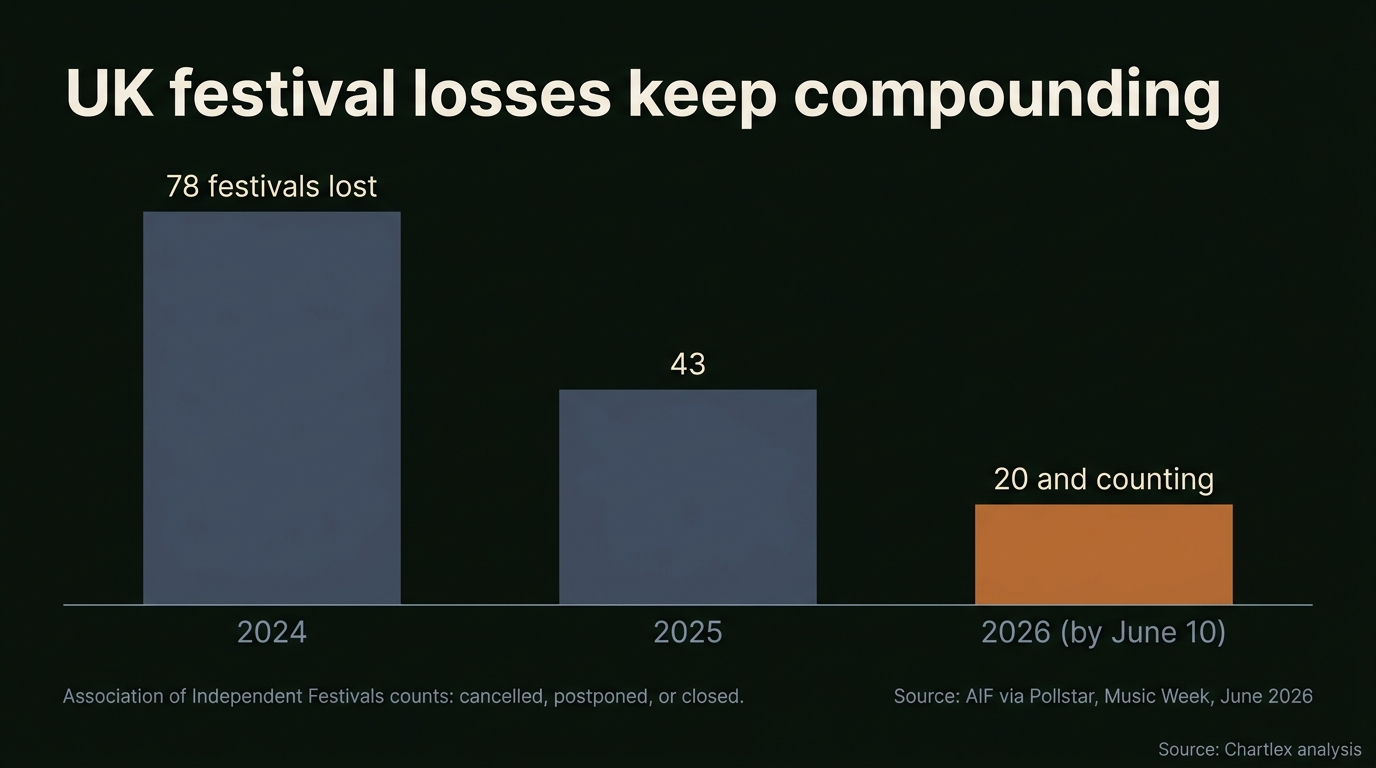
Festival cancellations stopped being isolated bad news around 2023 and became a structural trend. The pattern is consistent: costs reset upward after the pandemic, audiences started buying later and more selectively, and the events with the thinnest margins, usually independent and mid-size festivals, fell first.
| Period | What happened |
|---|---|
| 2022-2023 | Post-pandemic restart meets supply chain inflation. Staging, security, and staffing costs jump. First wave of UK independent festival closures begins. |
| 2024 | Record year for UK losses: 78 festivals cancelled, postponed, or shut entirely (AIF). Australia loses Splendour in the Grass and Groovin the Moo in the same season. |
| 2025 | 43 UK festivals lost (AIF). Industry tallies count more than 100 cancellations worldwide, with roughly 50 in the Netherlands alone. Faster Horses pauses in the US. |
| H1 2026 | 20 UK festivals gone by June 10 (AIF, via Pollstar). Bluesfest enters liquidation. Heritage Live cancels its full UK season. A late-June European heatwave forces cancellations including Solidays in Paris. |
The numbers understate the damage. Association counts cover member festivals and publicly reported cases; small regional events often just quietly fail to announce a next edition.
Music Festival Cancellations 2026: The Master Table
Every major festival cancellation, postponement, or closure affecting the 2026 season that has been publicly reported, newest developments first. "Stated reason" is the organizer's or authority's public framing, which is not always the full story.
| Festival | Country | Running since | Stated reason | Status for 2026 |
|---|---|---|---|---|
| Bluesfest (Byron Bay) | Australia | 1990 | Rising production costs, soft ticket sales; liquidator appointed | Cancelled, company in liquidation |
| Heritage Live (Englefield, Audley End, Sandringham) | UK | Not confirmed | Low ticket sales across the series | All 2026 shows cancelled |
| Summer Camp (Chillicothe, IL) | US | 2001 | Financial circumstances involving a third-party provider | Cancelled |
| Faster Horses (Michigan Int'l Speedway) | US | 2013 | No reason stated; organizers framed 2025 as a "pause" | No 2026 edition, second straight year off |
| Music On Festival (Amsterdam) | Netherlands | Not confirmed | Permit revoked by the city over structural safety concerns, hours before opening | Cancelled at the gate, May 2026 |
| Solidays (Paris) | France | 1999 | Extreme heat warnings, late June 2026 | Cancelled |
| Defqon.1 (Biddinghuizen) | Netherlands | 2003 | Extreme heat during the event | Cut short, June 2026 |
| One Love (Tauranga) | New Zealand | Not confirmed | Economic challenges | Cancelled |
| Kernowfornia (Cornwall) | UK | Not confirmed | Promoter entered liquidation | Cancelled |
| Splendour (Nottingham) | UK | 2008 | Organizers announced 2026 as the final edition | Running, then closing |
| Groovin the Moo | Australia | 2005 | Ticket sales concerns drove 2024-25 cancellations | Partial return: one-off Lismore show, May 2026 |
Two entries deserve a closer look. Bluesfest is the bellwether: a 35-year institution with global headliner history that could not make 2026 math work, and rather than pausing, it liquidated. And Music On Amsterdam shows a newer failure mode, where an event dies not from ticket sales but from a permitting decision with fans already traveling, leaving attendees out hundreds of euros.
The 2025 Season: What Fell Before This
The 2026 losses sit on top of a brutal 2025. These are the headline cases and aggregate counts from last season.
| Festival / measure | Country | What happened |
|---|---|---|
| UK independent festivals | UK | 43 cancelled, postponed, or closed across 2025 (AIF) |
| Netherlands festivals | Netherlands | Roughly 50 cancellations in 2025, per industry tallies |
| Worldwide count | Global | More than 100 festivals cancelled in 2025 (iMusician industry analysis) |
| Faster Horses | US | 2025 edition "paused" by organizers; never returned for 2026 |
| Groovin the Moo | Australia | 2025 cancelled outright after 2024 cancellation on weak ticket sales |
| Splendour in the Grass | Australia | Still dormant since 2023; its North Byron Parklands site was reportedly listed for sale at around $35 million in March 2025 |
The Splendour site listing is the detail worth sitting with. When a festival sells its land, that is not a fallow year. That is capacity permanently leaving the market.
First Push
Never put money behind a track before? First Push is the smallest way to find out how one song responds over about four weeks, and it counts toward anything bigger later.
- ✓About 600 new monthly listeners on one track
- ✓Paced over roughly four weeks, not a single burst
- ✓100% credits toward a bigger campaign within 30 days
- ✓The lowest cost way to try one track
Pick your track here. Credit applies if you upgrade within 30 days.
Why Are Festivals Being Cancelled? Five Forces
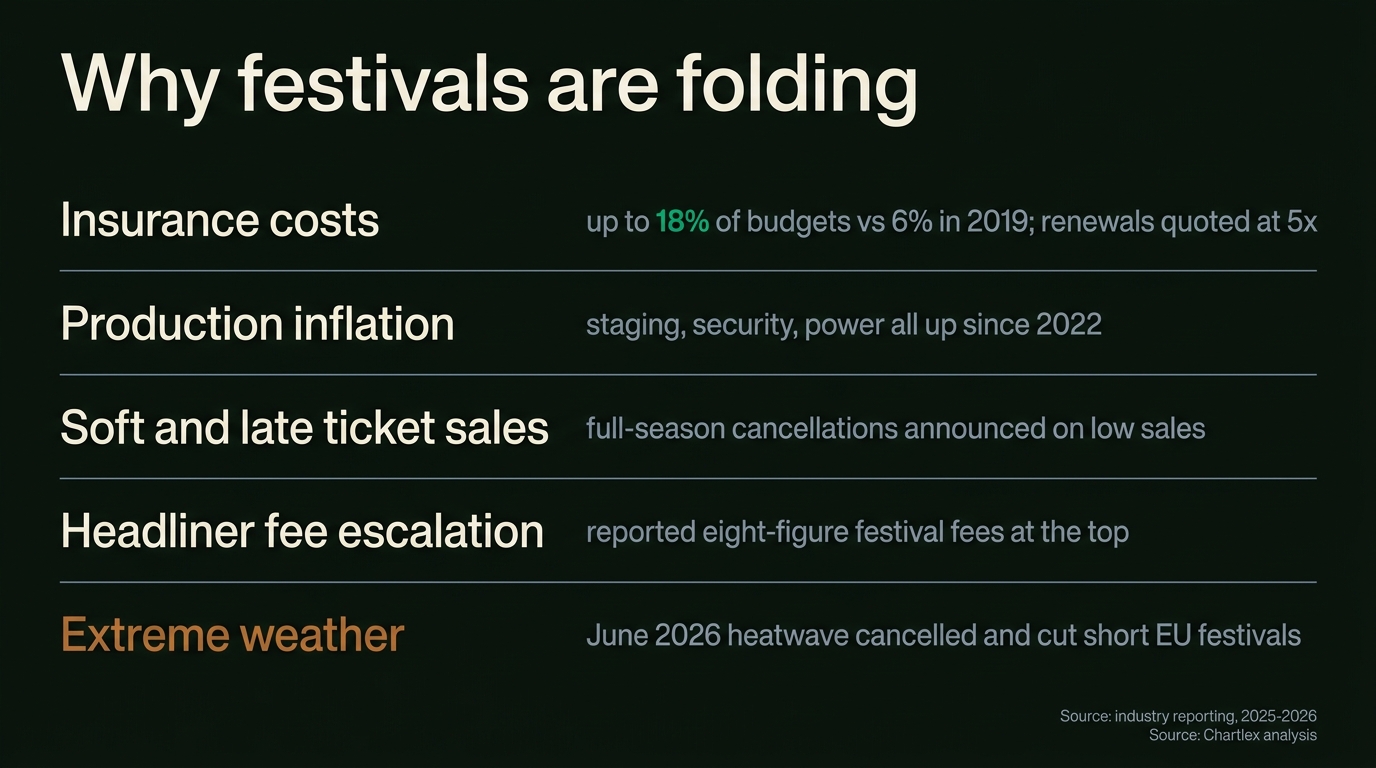
No single cause explains a contraction this broad. Five forces stack on each other, and most cancelled festivals were hit by at least three.
1. Insurance costs. Event insurance premiums have risen sharply since 2019, with weather-related claims pushing some festivals' renewal quotes up several times over even with clean safety records. Event-industry reporting put average spending on safety and insurance at 18% of festival budgets in 2025, up from 6% in 2019. For a mid-size independent festival, that swing alone can erase the margin.
2. Production cost inflation. Staging, power, fencing, security, medical, and freight all repriced upward after 2021 and never came back down. Production budgets for major festivals now run into the tens of millions, and the same inflation hits a 5,000-cap independent event without the sponsorship revenue to absorb it.
3. Soft and late ticket buying. Audiences squeezed by cost-of-living pressure buy fewer festival tickets and buy them later. Late buying is quietly the more dangerous half: organizers must commit to artists, insurance, and infrastructure months before they know whether the audience is coming, and several 2025-26 cancellations, including Heritage Live's full season, were called when advance sales made the risk unacceptable.
4. Headliner fee escalation. Superstar fees have inflated to the point where trade reporting on the 2026 season cited eight-figure sums for a single festival headline slot, with Coachella's Justin Bieber booking reported around $10 million. Every dollar the top of the market pays resets artist expectations downward through the whole ecosystem, and mid-size festivals cannot pass those costs to ticket buyers who are already price-sensitive.
5. Extreme weather. The late-June 2026 European heatwave cancelled or cut short multiple major events in a single weekend, including Solidays and Defqon.1. Weather now hits festivals twice: directly through cancellations, and indirectly through the insurance premiums in force number one.
For the wider industry context behind these forces, including the antitrust and ticketing side, see the live music industry outlook for 2026.
What This Means for Artists Booking 2026-27
A shrinking festival market changes booking strategy in specific, practical ways.
Fewer slots, more competition. Every cancelled festival removes 30 to 150 artist slots from the market, and the surviving events are cutting undercard budgets before headliner budgets. Acceptance was already hard; our guide to getting accepted to music festivals covers rates that sat between 2% and 8% before this contraction.
Mid-size festivals matter more than ever, and are the most fragile. The 1,000 to 15,000-cap tier is where independent artists actually get booked, paid, and seen, and it is exactly the tier that is dying. Supporting these events, playing them well, and building direct relationships with their bookers is now a strategic priority, because the artists those bookers trust get the calls when lineups shrink.
Streaming data is your booking edge. When bookers have fewer slots and more risk, they book acts with evidence of a regional draw. According to Chartlex campaign data from 2,400+ campaigns, algorithmic listener growth concentrates geographically, and a demonstrable listener base in a festival's home region is precisely the evidence a risk-averse booker wants before offering a slot.
Do not build a tour around one anchor festival. Route so that a festival cancellation downgrades your tour instead of destroying it. Surround anchor dates with club shows that stand on their own economics, and model the downside scenario in the tour budget projector before you commit to travel costs. If your routing crosses into the US, factor in visa lead times too; our US touring visa guide for international artists covers why that paperwork now needs a 9-month runway.
How to Protect Yourself When a Festival Books You
Festival offers in 2026 need to be read like counterparty risk documents. Three protections matter most.
Deposit terms. Push for a deposit on signing, 50% is the common ask, with the balance due before you travel, not after you play. A festival that resists any deposit in this market is telling you something about its cash position. Deposits paid are usually the only money artists see from a festival that collapses, because unsecured creditors of a liquidated promoter, as Bluesfest's liquidation illustrates, rarely recover much.
Cancellation clauses. Read what happens to your fee if the event cancels: force majeure definitions, kill fees, and whether weather cancellation pays you anything. Aim for a kill fee that scales as the date approaches, since your ability to rebook the date shrinks every week. Never accept "fee payable only upon performance" for an event you are routing a tour around.
Verify before you announce. Check that the edition you are playing has its permit, its site, and last year's artists paid. A quick search of the festival name plus "payment" or "cancelled" surfaces most red flags. Once you announce a festival date, its failure becomes your routing problem and your audience's disappointment.
Playing festival season well is its own craft beyond the contract, from merch to fan capture; the festival season survival guide for independent artists covers that playbook in full.
Update Log
- 2026-08-09: Initial publication. Master table covers publicly reported cancellations for the 2025 and 2026 seasons across US, UK, EU, Australia, and New Zealand. Aggregate counts from AIF (UK), Pollstar, NL Times, and iMusician industry reporting.
Free Spotify Audit
See exactly where your Spotify profile is leaking growth.
Artists with 10k+ algorithmic listeners book 3× more regional shows.
Growth Plan Plan
$299/mo
Build the streaming fanbase that fills venues. Country-targeted algorithmic campaigns with geo-targeting included.
Verified in Spotify for Artists · Geo-targeted · Cancel anytime
Frequently Asked Questions
How many music festivals have been cancelled in 2026?
In the UK alone, the Association of Independent Festivals counted 20 festivals cancelled, postponed, or closed by June 10, 2026. Global counts for the full season are not yet final, but 2025 saw more than 100 cancellations worldwide per industry tallies, and 2026 is tracking toward a comparable range.
Why are so many festivals being cancelled?
Five stacked forces: insurance premiums that have risen to roughly 18% of budgets from 6% in 2019, production cost inflation, soft and late ticket buying, headliner fees that reset the entire artist market upward, and extreme weather. Most cancelled festivals were hit by at least three of these simultaneously.
What was the biggest festival cancellation of 2026?
Australia's Bluesfest, a Byron Bay institution running since 1990, cancelled its 2026 edition and appointed liquidators, making it the highest-profile permanent loss. In the UK, the Heritage Live series cancelled its entire 2026 summer season across three estates, citing low ticket sales.
Do artists get paid when a festival cancels?
Usually only what was paid in advance. Contract kill fees depend on the cancellation clause you signed, and if the promoter enters liquidation, unpaid artist fees become unsecured claims that rarely recover much. This is why negotiating deposits on signing has become standard advice for independent artists in 2026.
Are big festivals like Coachella and Glastonbury at risk?
Not meaningfully. The contraction is concentrated in independent and mid-size events. The largest festivals retain sponsorship revenue, insurance access, and headliner economics that smaller events cannot match, which is why the market is polarizing: mega-events sell out while the middle tier disappears.
Should artists still apply to festivals in 2026-27?
Yes, but with adjusted strategy: target more festivals per season to offset lower acceptance odds, prioritize established events with clear financial track records, negotiate deposits, and never route a tour that fails financially if one festival date disappears. Festival slots remain among the highest-value discovery moments an independent artist can get.
Where This Goes Next
The festival contraction is not finished. Insurance and production costs show no sign of reverting, and the 2027 season will be booked against the same late-buying audience behavior that broke 2025 and 2026. Expect continued polarization: the biggest events get bigger, the middle keeps thinning, and the artists who thrive are the ones whose regional streaming evidence makes them a safe booking in a risk-averse market.
That evidence is buildable. A free Chartlex audit maps where your listeners actually are, so you can target the festivals, and the surviving regional markets, where your data already makes the argument for you.
Free Weekly Playbook
One actionable insight, every Tuesday.
Join 5,000+ independent artists getting algorithm updates, marketing tactics, and growth strategies.
No spam. Unsubscribe anytime.
Build the Spotify fanbase that fills venues.
Artists with 10k+ algorithmic listeners book 3× more regional shows.
Our audit shows exactly where your current listeners are concentrated, how engaged they are, and which markets have the density to support live dates.
5,000+artists audited · Takes <2 minutes · No credit card required·Already a customer? Open Dashboard →
Campaign Dashboard
Turn Knowledge Into Action
Track your streams, monitor algorithmic triggers, and see growth projections in real time. The Campaign Dashboard puts everything you just read into practice.
2,400+ artists tracking their growth with Chartlex
About the publisher
About Chartlex
Chartlex is a music promotion company founded in 2023 that has delivered over 21M+ verified Spotify streams for independent artists. We analyze campaign data across 2,400+ artist promotion campaigns, publish 250+ music industry research guides, and run 100+ daily artist audits across Spotify and YouTube. Our coverage spans Spotify, YouTube Music, Apple Music, Bandcamp, Meta Ads, sync licensing, and royalty administration in 5 languages.
- Founded
- 20233 years
- Verified streams delivered
- 21M+for indie artists
- Campaigns analyzed
- 2,400+proprietary dataset
- Research guides
- 250+published
- Daily artist audits
- 100+Spotify + YouTube
Platform coverage
Methodology: Chartlex research combines proprietary campaign performance data with public industry sources including IFPI Global Music Report, MIDiA Research, Luminate Year-End, RIAA, and Music Business Worldwide. All findings are refreshed quarterly. Last verified: 2026-09-23.
Keep reading
Festival acceptance rates sit between 2% and 8%. Learn what programmers look for, how to stand out, and the timeline and submission mistakes to avoid.
Daniel Brooks
US touring visa guide for musicians: what O-1B and P visas cost in 2026 after fee hikes, real timelines, ESTA showcase rules, and a 4-piece band budget.
Daniel Brooks
Concert ticket prices in 2026: $122.15 average for top tours, $216 stadium seats, fees near 29% of face value. Full data plus an indie pricing guide.
Daniel Brooks