
Concert Ticket Prices 2026: What Fans Actually Pay [Data]
Concert ticket prices in 2026: $122.15 average for top tours, $216 stadium seats, fees near 29% of face value. Full data plus an indie pricing guide.
Reviewed by the Chartlex editorial team·Editorial policy
Explore with AI
Get an instant summary of this guide from your favourite assistant.
Quick Answer
Concert ticket prices in 2026 run on two separate tracks. At the top of the market, Pollstar's mid-year 2026 report puts the average ticket for the top 100 North American tours at $122.15, down 2.4% from 2025, after a 2025 average of $134.23 and a stadium average of $216.13. Live Nation's Q2 2026 earnings show average prices rising only low to mid single digits, with US get-in prices trailing inflation over the past five years. Below the arena tier, independent club shows typically run $10 to $30 before fees. Fees remain the real multiplier: a 2025 National Independent Talent Organization study found primary-market fees average 28.65% of face value. The FTC's all-in pricing rule, effective May 12, 2025, now forces sellers to show the full price upfront. For independent artists, pricing is less about maximizing one night and more about repeat attendance.
Concert Ticket Prices in 2026: The Headline Numbers
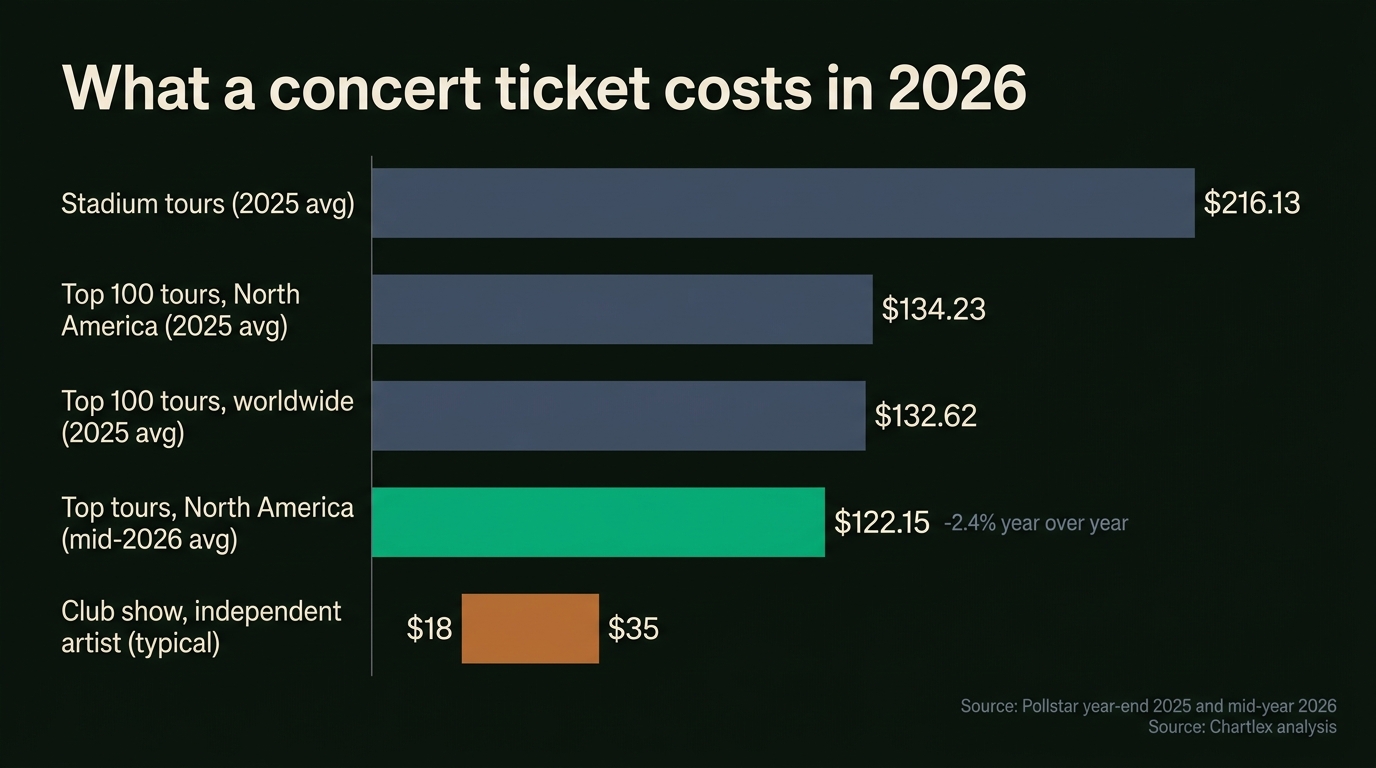
The average concert ticket price story in 2026 is more nuanced than the "everything costs more" headlines suggest. Pollstar's 2025 year-end analysis put the average ticket for the top 100 North American tours at $134.23, actually down 1.6% from $136.45 in 2024. The worldwide average dropped 2.4% to $132.62.
The mid-year 2026 numbers continue the trend. Pollstar's June 2026 business analysis reports a North American average of $122.15 for the top 100 tours, down another 2.4% year over year, even as total grosses and tickets sold set mid-year records. More people are going to more shows at slightly lower average prices.
The exception is stadiums. Pollstar's stadium average hit $216.13 in 2025, up sharply from $182.66 in 2024, because the biggest artists concentrate demand into the biggest rooms. Beyoncé averaged around $255 per ticket on 2025's top-grossing tour ($408 million), Oasis averaged around $182, and Coldplay held near $130 by deliberate pricing policy.
| Venue tier | Average ticket price | Source and period |
|---|---|---|
| Stadium shows (top 100 tours) | $216.13 | Pollstar, 2025 year-end |
| Top 100 North American tours (all venues) | $134.23 (2025), $122.15 (mid-2026) | Pollstar |
| Superstar stadium runs | $182 (Oasis) to $255 (Beyoncé) | Pollstar 2025 tour data |
| Theaters and large clubs (1,000-3,000 cap) | Roughly $25 to $60 (estimate) | Based on available listings data |
| Independent club shows (under 500 cap) | Typically $10 to $30 (estimate) | Based on available listings data |
Live Nation's Q2 2026 earnings add a detail most coverage skips: average ticket prices rose only low to mid single digits year over year, and US "get-in" prices (the cheapest ticket in the building) have trailed inflation over the past five years. The pain fans feel is concentrated in premium seats, fees, and the resale market, not the entry price.
How Dynamic Pricing Actually Works at Concerts
Dynamic pricing in concerts means the primary seller adjusts ticket prices in real time based on demand, the same way airlines and hotels price inventory. Ticketmaster's version is called Official Platinum: a slice of ordinary seats gets repriced algorithmically, sometimes several times per hour during a high-demand on-sale.
The stated logic is margin recapture. If a $150 ticket resells for $600, the artist and promoter captured $150 and a broker captured $450. Live Nation leadership has argued for years that concerts are underpriced relative to demand, and dynamic pricing moves some of that broker margin back into the primary sale.
Three things about the mechanics matter for artists and fans:
- Artists and their teams opt in. Platinum pricing is a tour-level decision. Acts like Coldplay have publicly capped prices instead, accepting lower grosses for goodwill.
- Only part of the house floats. Most inventory stays at fixed tiers. The floating slice is what produces the viral screenshots.
- It cuts both ways. Slow-selling shows quietly drop prices too, which is why buying late sometimes beats the on-sale.
For a fuller picture of how the consolidated live business shapes these decisions, see our live music industry outlook for 2026, which covers the DOJ antitrust case against Live Nation and the mid-cap venue squeeze.
Ticket Fees Breakdown: Face Value vs What You Pay
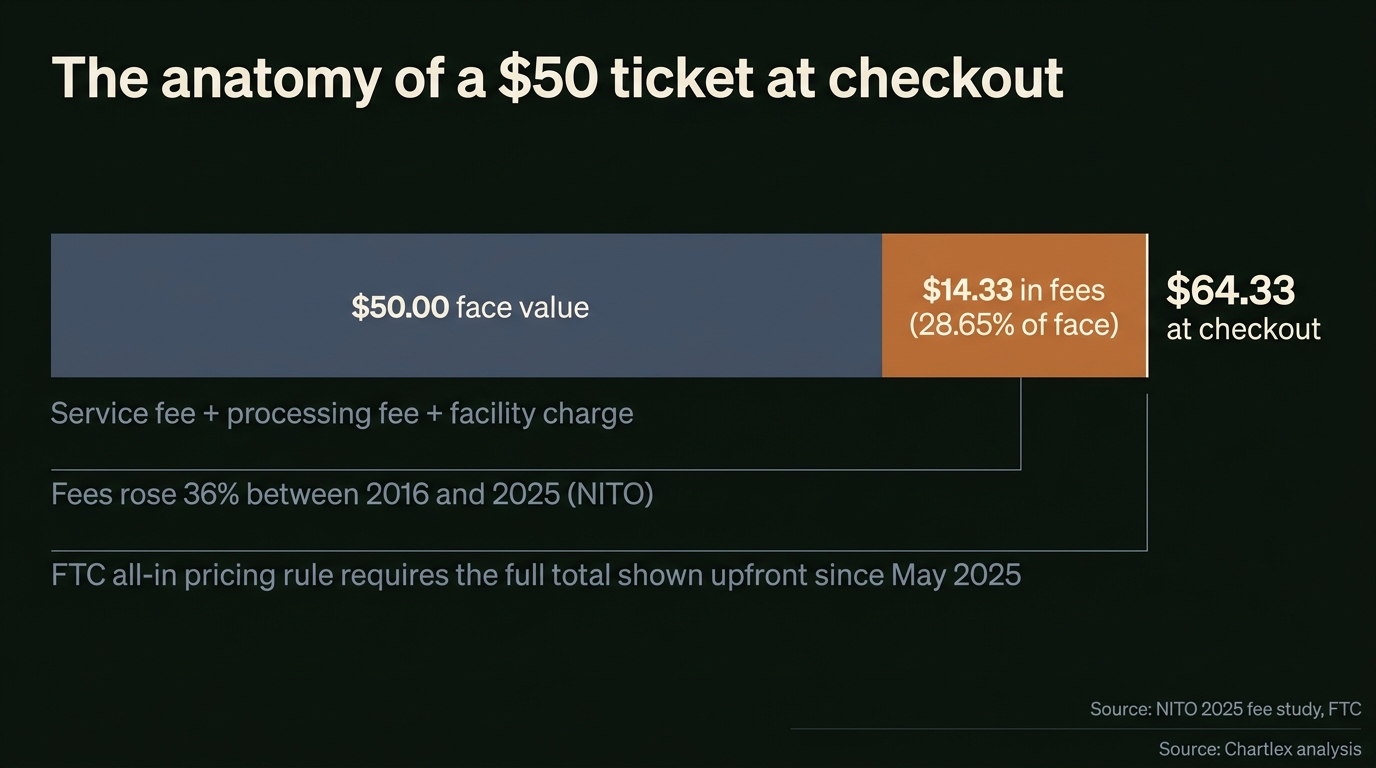
Fees are where the advertised price and the charged price separate. The most current data comes from the National Independent Talent Organization's October 2025 New York study: primary-market fees average 28.65% of face value, and New York ticket fees have risen 36% since 2016. That tracks with the older federal baseline, a 2018 GAO report that found primary-market fees averaging 27% and secondary-market fees averaging 31%, with extreme cases reaching 58% of the ticket's cost.
Here is what that looks like on a typical mid-level show, using an illustrative example consistent with the NITO average:
| Line item | Amount | Share of face value |
|---|---|---|
| Face value | $50.00 | 100% |
| Service fee | $10.80 | 21.6% |
| Facility charge | $2.50 | 5.0% |
| Order processing | $1.05 | 2.1% |
| Total at checkout | $64.35 | 128.7% |
Two structural facts explain why fees persist. First, fee revenue is split: ticketing companies rebate a share of service fees back to venues as part of exclusive contracts, so venues have little incentive to push fees down. Second, the artist almost never sees fee revenue. The performer's economics run off face value and the settlement, which is why a fan paying $64 does not mean the artist earned $64 worth of goodwill. Our breakdown of what artists actually clear on tour walks through the full settlement math line by line.
First Push
Never put money behind a track before? First Push is the smallest way to find out how one song responds over about four weeks, and it counts toward anything bigger later.
- ✓About 600 new monthly listeners on one track
- ✓Paced over roughly four weeks, not a single burst
- ✓100% credits toward a bigger campaign within 30 days
- ✓The lowest cost way to try one track
Pick your track here. Credit applies if you upgrade within 30 days.
The Secondary Market in 2026
The resale market is where prices detach from face value entirely. Resale platforms typically charge seller fees around 15% (StubHub's standard reseller fee) plus buyer fees that generally land in the 15% to 30% range, per public platform reporting. A ticket can change hands multiple times before show night, with the platform collecting fees on every flip.
Markups concentrate on a small set of high-demand events. American Consumer Institute analysis argues most resale markup traces to primary tickets being priced below true demand, which is the same gap dynamic pricing tries to close from the other side.
For independent artists, the secondary market is mostly irrelevant in the best possible way. Club shows rarely carry resale premiums, which means your listed price is the real price, and you control the entire fan experience. That control disappears at the theater level, which is one more reason to build direct ticketing habits early.
The Regulatory Picture: All-In Pricing in 2026
The rules changed materially in the past 18 months, and 2026 is the first full year of enforcement.
The FTC junk fees rule is in effect. The FTC's Rule on Unfair or Deceptive Fees took effect May 12, 2025. Live-event ticket sellers must now display the all-in total price upfront, ending the drip pricing that revealed mandatory fees only at checkout. Ticketmaster dropped its separate order processing fee in response, per reporting from Marketplace in May 2026.
Enforcement is active. In September 2025 the FTC and seven states sued Live Nation and Ticketmaster over historic drip pricing and resale practices; the companies moved to dismiss in January 2026 and dispute the allegations. A separate class action covering 2019-2024 Ticketmaster purchases was certified in December 2025, with a jury trial scheduled for June 30, 2026.
States are moving too. State attorneys general have made junk-fee enforcement a 2026 priority per Troutman Pepper Locke's regulatory tracking, and Massachusetts advanced a bill in July 2026 that would cap resale markups and cut resale fees.
The honest caveat: all-in pricing changes what you see, not necessarily what you pay. The 28.65% average fee load did not disappear in 2026. It just moved to the first screen.
How Independent Artists Should Price Concert Tickets in 2026
Everything above describes the market you are pricing into. Here is the framework we recommend for artists booking their own shows, from first headline gig to a 1,000-cap room.
| Stage | Suggested ticket price | Reasoning |
|---|---|---|
| First shows, unproven draw | Free or $5 to $10 | You are buying attendance data and phone numbers, not income |
| Repeat local draw (50-150 heads) | $10 to $15 | Below the psychological get-in threshold for a casual fan |
| Established regional draw (150-400) | $15 to $25 | Matches the club-tier market rate; room to add a merch bundle |
| Theater step-up (400-1,000) | $25 to $40 | Price with the promoter; protect a cheap get-in tier |
| VIP / bundle upsell (any stage) | 2x to 3x base price | Early entry, merch item, meet and greet; capped quantity |
These are recommendations, not market statistics: price to your actual draw, then check local comps for similar acts in the same rooms.
What you clear per ticket. Run the math before you set the price. An illustrative 200-cap headline show: 150 tickets at $18 grosses $2,700. A typical door deal might pay you 70% after the venue's costs, so roughly $1,890 before your own expenses, or about $12.60 per head. Add self-serve ticketing fees (often passed to the buyer) and the fan paid around $21 for you to clear $12.60. That gap is why fee transparency matters even at club scale. Plug your own numbers into the free tour budget and revenue projector before you commit to a run, and see the 10-city tour budget breakdown for full cost-side numbers.
Three pricing principles that hold at every level:
- Protect the get-in price. Live Nation's own data shows entry prices trailing inflation. Fans anchor on the cheapest ticket. Keep one affordable tier even when demand supports more.
- Raise prices with evidence, not hope. Sell out twice at $15 before you try $20. A half-empty room at a higher price costs you the atmosphere that creates repeat buyers.
- Move margin to merch and bundles. Per-head merch spend is where thin ticket margins get rescued, and bundle buyers self-select as your highest-value fans.
Ticket Pricing and Fan Goodwill
Pricing is a fan-relationship decision disguised as a revenue decision. Coldplay held average tickets near $130 on a tour that still grossed $390 million in 2025, and the goodwill from visible price restraint is part of why demand persists tour after tour.
For independent artists the stakes are more direct. A fan who feels gouged at your show does not file a complaint. They just skip the next one, and at club scale a few dozen skipped returns is the difference between a promoter rebooking you or not.
The other half of goodwill economics is that live draw starts online. According to Chartlex campaign data from 2,400+ campaigns, artists who convert algorithmic listeners into followers and saves build measurably stronger hometown pull than artists with the same stream counts and passive audiences, because engaged listeners are the ones who show up. Growing that engaged base is exactly what Chartlex's promotion plans are built for, and it compounds with the show promotion playbook when a date goes on sale.
Free Spotify Audit
See exactly where your Spotify profile is leaking growth.
Artists with 10k+ algorithmic listeners book 3× more regional shows.
Growth Plan Plan
$299/mo
Build the streaming fanbase that fills venues. Country-targeted algorithmic campaigns with geo-targeting included.
Verified in Spotify for Artists · Geo-targeted · Cancel anytime
Underpricing early is not lost revenue. It is customer acquisition for a catalog of future tours, merch, and streams. Based on Chartlex campaign data, the artists who treat their first hundred ticket buyers as a list to be kept, emailed, and re-invited outperform artists who treat them as one-night revenue.
Frequently Asked Questions
What is the average concert ticket price in 2026?
Pollstar's mid-year 2026 report puts the average at $122.15 for the top 100 North American tours, down 2.4% from 2025. Stadium shows averaged $216.13 in 2025. Independent club shows typically run $10 to $30 before fees, so the "average" depends heavily on venue tier.
Why are concert tickets so expensive in 2026?
The entry price is not the main problem: US get-in prices have trailed inflation per Live Nation's Q2 2026 earnings. Costs concentrate in premium seats, dynamic pricing on high-demand shows, resale markups, and fees, which average 28.65% of face value per NITO's 2025 study.
How much of a concert ticket price is fees?
Primary-market fees average 28.65% of face value per the National Independent Talent Organization's October 2025 study, up from the 27% average a 2018 GAO report found. Secondary-market fees averaged 31% in the GAO data, and extreme cases reached 58% of the ticket's cost.
Is dynamic pricing on concert tickets legal?
Yes. Dynamic pricing itself is legal in the US; the FTC's rule effective May 12, 2025 regulates fee disclosure, not price levels. Sellers must show the all-in price upfront. The FTC and seven states did sue Live Nation and Ticketmaster in September 2025 over drip pricing and resale practices.
How should an independent artist price their first headline show?
Price low: free to $10 until you have proven draw, then $10 to $15 for a repeat local audience. Early shows are for building an audience and a contact list, not income. Raise prices only after selling out at the current price twice, and always keep a cheap get-in tier.
How much does an artist make per ticket sold?
It depends entirely on the deal. On an illustrative $18 club ticket with a 70% door split after venue costs, the artist clears roughly $12.60 before their own expenses. Arena headliners on percentage deals clear far more per ticket, but fees and settlement deductions apply at every level.
The Bottom Line on Concert Pricing in 2026
The 2026 data says the top of the market is self-correcting on average prices while fees, premium tiers, and resale carry the real increases, and regulators are finally forcing the full price into view. For independent artists, the winning move is the opposite of the stadium playbook: price for repeat attendance, protect the get-in, and make your margin on bundles and merch.
Expect the fee fight to keep escalating through the Ticketmaster trial and state-level resale caps, which only strengthens the position of artists who sell direct and price transparently. The draw that fills those rooms starts with your streaming audience, and a free Chartlex audit will show you exactly where your listeners are, how engaged they are, and which cities can already support a show.
Free Weekly Playbook
One actionable insight, every Tuesday.
Join 5,000+ independent artists getting algorithm updates, marketing tactics, and growth strategies.
No spam. Unsubscribe anytime.
Build the Spotify fanbase that fills venues.
Artists with 10k+ algorithmic listeners book 3× more regional shows.
Our audit shows exactly where your current listeners are concentrated, how engaged they are, and which markets have the density to support live dates.
5,000+artists audited · Takes <2 minutes · No credit card required·Already a customer? Open Dashboard →
Campaign Dashboard
Turn Knowledge Into Action
Track your streams, monitor algorithmic triggers, and see growth projections in real time. The Campaign Dashboard puts everything you just read into practice.
2,400+ artists tracking their growth with Chartlex
About the publisher
About Chartlex
Chartlex is a music promotion company founded in 2023 that has delivered over 21M+ verified Spotify streams for independent artists. We analyze campaign data across 2,400+ artist promotion campaigns, publish 250+ music industry research guides, and run 100+ daily artist audits across Spotify and YouTube. Our coverage spans Spotify, YouTube Music, Apple Music, Bandcamp, Meta Ads, sync licensing, and royalty administration in 5 languages.
- Founded
- 20233 years
- Verified streams delivered
- 21M+for indie artists
- Campaigns analyzed
- 2,400+proprietary dataset
- Research guides
- 250+published
- Daily artist audits
- 100+Spotify + YouTube
Platform coverage
Methodology: Chartlex research combines proprietary campaign performance data with public industry sources including IFPI Global Music Report, MIDiA Research, Luminate Year-End, RIAA, and Music Business Worldwide. All findings are refreshed quarterly. Last verified: 2026-09-22.
Keep reading
Find the right venue for your first live show in 2026, pitch bookers, negotiate door deals vs guarantees, and avoid the mistakes that derail debuts.
Daniel Brooks
What tour merch actually sells in 2026, pricing strategy, inventory planning, and items indie artists should skip, based on real touring revenue data.
Lena Kova
Music festival cancellations 2026 tracker: 20 UK festivals gone by June, Bluesfest in liquidation, 100+ lost worldwide in 2025, and five forces behind it.
Daniel Brooks