
US Touring Visa Guide for Musicians 2026: Costs + Rules
US touring visa guide for musicians: what O-1B and P visas cost in 2026 after fee hikes, real timelines, ESTA showcase rules, and a 4-piece band budget.
Reviewed by the Chartlex editorial team·Editorial policy
Explore with AI
Get an instant summary of this guide from your favourite assistant.
Quick Answer
Most international artists cannot legally play paid US shows on ESTA or a B visa. A booked tour needs a P-1B (internationally recognized group), P-3 (culturally unique act), or O-1B (individual extraordinary ability) petition filed by a US employer or agent. For a 4-piece band filing a P-1B through a small petitioner in 2026, the hard costs stack fast: a $510 USCIS filing fee plus a $300 Asylum Program Fee, a $300 union consultation letter from the AFM, $205 in consular fees per member, and, because standard processing now runs many months, most acts add $2,965 premium processing. Budget roughly $4,900 before legal fees and $7,000 to $11,000 all-in with an attorney. Timelines are the bigger risk: immigration firms report standard petitions stretching past six months in 2026, and Tamizdat projects at least a 30% drop in international touring to the US this year.
This article is general information, not legal advice. Visa rules change quickly and individual cases vary. Consult a licensed US immigration attorney before booking or filing anything.
What a US Tour Actually Costs in Visas (2026)
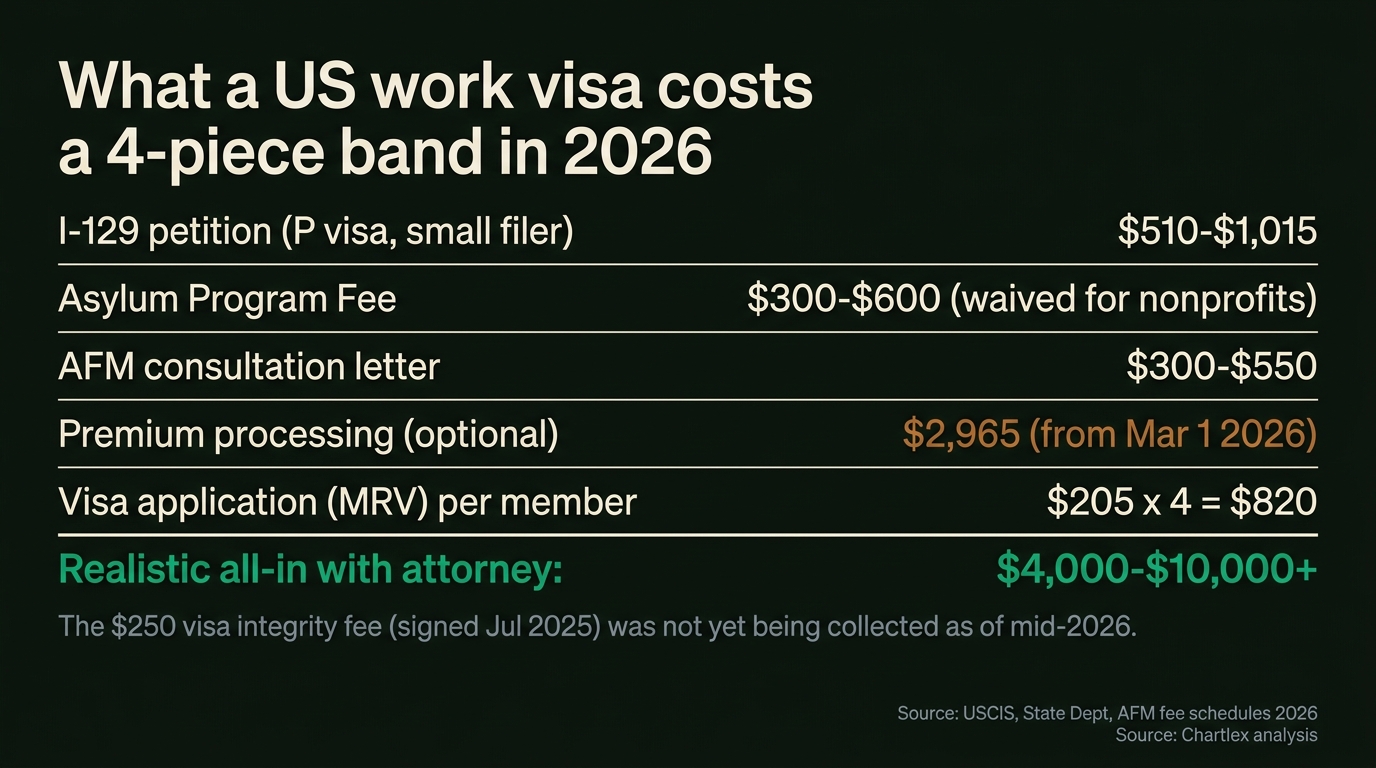
Here is the honest math up front. The table below models a 4-piece band from outside the US filing a P-1B petition through a small US petitioner (25 or fewer full-time employees) in August 2026, with all four members on one petition.
| Cost item | Amount | Notes |
|---|---|---|
| Form I-129 filing fee (P classification, small petitioner) | $510 | $1,015 for larger petitioners (USCIS, Apr 2024 fee rule) |
| Asylum Program Fee | $300 | $600 for larger petitioners, $0 for 501(c)(3) nonprofits |
| AFM consultation letter (standard) | $300 | $450 expedited, $550 super-expedited (AFM, 2026 rates) |
| Premium processing (optional, widely used) | $2,965 | 15 business days; rate effective March 1, 2026 |
| Consular visa application (MRV) fee, $205 x 4 members | $820 | Petition-based visa rate at US embassies |
| Visa integrity fee, $250 x 4 (pending implementation) | $0 to $1,000 | Signed into law July 2025; not yet collected as of mid-2026 |
| Immigration attorney (typical range, estimate) | $2,000 to $6,000 | Varies widely by firm and case complexity |
| Realistic total | $7,000 to $11,000 | Roughly $4,900 in government and union fees before legal help |
A few things jump out. Premium processing alone costs more than every other government fee combined, yet most touring acts treat it as mandatory in 2026 because standard timelines have become unpredictable. And these figures cover one petition cycle: a P-1B is typically approved only for the length of your itinerary, up to one year, so an annual US touring habit means annual filing costs.
Before you commit to any of this, run the rest of your tour numbers too. The tour budget and revenue projector lets you model transport, lodging, and guarantees against these visa costs, and our touring economics breakdown of what artists actually clear shows why margins are thin even before immigration fees.
Can You Tour the US on ESTA? Mostly No
The question every international artist asks first has a short answer: you cannot perform paid shows in the US on ESTA or a B-1/B-2 visitor visa. US immigration law treats performing for a paying audience as work, and it generally does not matter whether you personally get paid or whether tickets are sold. Playing a club date "for exposure" on ESTA is still a violation.
There are narrow exceptions worth knowing:
- The showcase exception. Performing without pay at recognized industry showcase events, the classic example being official SXSW showcases, has been accepted by US Customs and Border Protection as a demonstration of skill rather than labor for hire. This covers official, sanctioned showcase slots only. Playing an unofficial side party on the same trip can void the whole basis of your entry, and bands have been denied entry at the border over exactly this.
- Recording only. Entering to use US recording facilities can qualify under B-1, but only if the recording is distributed and sold outside the US and you give no public performances.
- Government-sponsored cultural programs and competitions. Both are tightly defined and rarely apply to independent touring acts.
The consequences of getting this wrong are severe and long-lasting. Artists caught performing on visitor status have been refused entry, had visas cancelled on the spot, and lost ESTA eligibility permanently, which means applying for a visa at an embassy for every future US trip. A finding of misrepresentation can trigger multi-year or permanent inadmissibility. No single club gig is worth that.
The Three Visa Types: P-1B, P-3, and O-1B
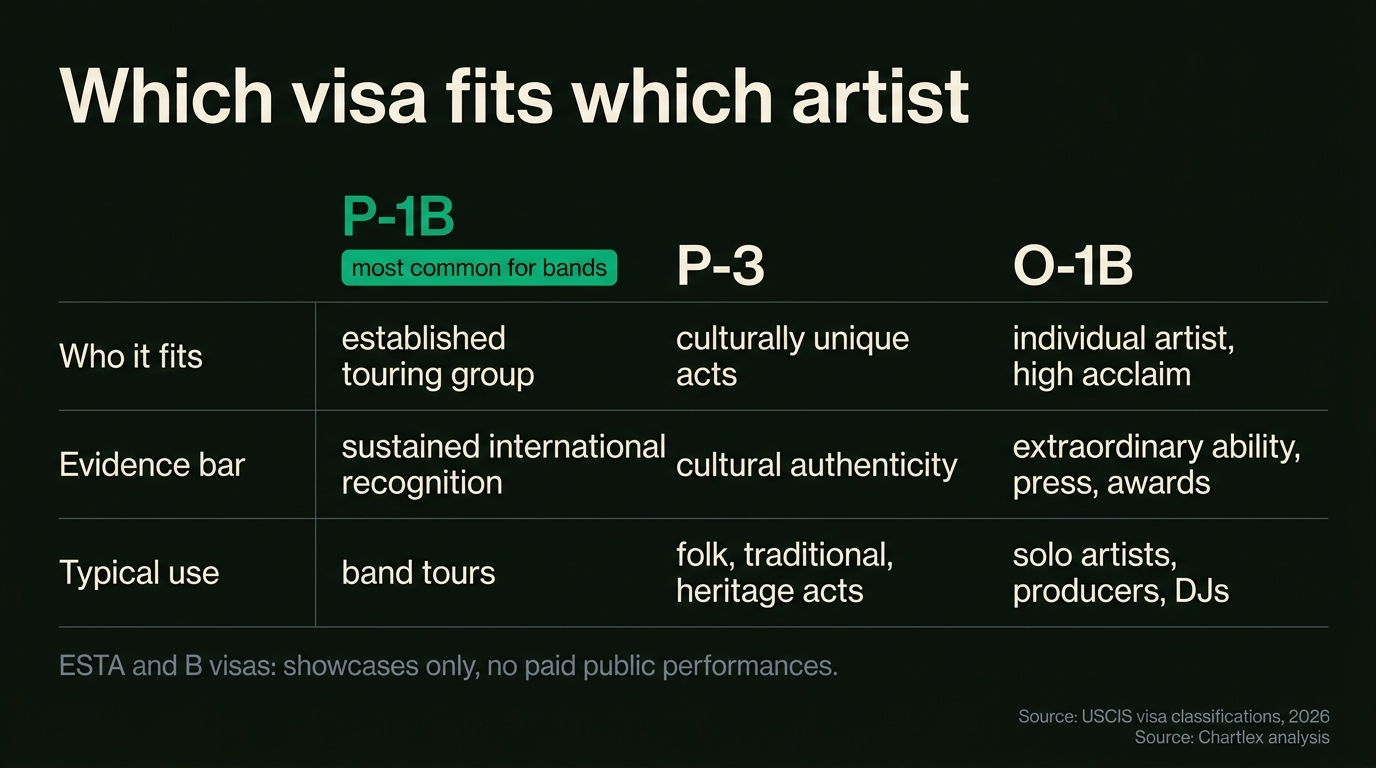
Three petition-based categories cover almost all touring musicians. Here is how they compare in 2026.
| Category | Who it fits | Key requirement | Typical validity | I-129 base fee |
|---|---|---|---|---|
| P-1B | Internationally recognized groups | 75% of members together for at least 1 year; sustained international recognition | Length of itinerary, up to 1 year | $510 or $1,015 |
| P-3 | Culturally unique artists and groups | Program must be culturally unique (traditional, folk, or distinct hybrid styles) | Length of itinerary, up to 1 year | $510 or $1,015 |
| O-1B | Individual artists of extraordinary ability | Distinction shown by awards, press, lead roles, or comparable evidence | Up to 3 years initially | $530 or $1,055 |
| O-2 / P support | Essential crew and support staff | Skills essential to the principal's performance | Tied to principal | Separate petition |
First Push
Never put money behind a track before? First Push is the smallest way to find out how one song responds over about four weeks, and it counts toward anything bigger later.
- ✓About 600 new monthly listeners on one track
- ✓Paced over roughly four weeks, not a single burst
- ✓100% credits toward a bigger campaign within 30 days
- ✓The lowest cost way to try one track
Pick your track here. Credit applies if you upgrade within 30 days.
P-1B is the workhorse for bands. The recognition bar is real but reachable for acts with international press, chart activity, festival bookings, and a touring history. The 75% membership rule trips up bands with recent lineup changes, so document your lineup history carefully.
P-3 is underused. If your act performs music that is culturally unique to your country or tradition, the evidence burden shifts from fame to authenticity, which can be easier for folk, traditional, and regional-genre artists to meet.
O-1B is for individual artists, including DJs, producers, and solo acts, who can show sustained distinction. It costs slightly more but a three-year validity window makes it far better value for artists planning repeat US runs. Band members cannot ride on a frontperson's O-1B; they would need O-2 or their own petitions.
Citizens of Canada should also ask their union about P-2, a reciprocal-exchange category administered through the AFM and Canadian Federation of Musicians with much lower administrative costs.
The Petitioner Problem: You Cannot File for Yourself
Artists do not self-petition for P or O visas. A US-based petitioner must file Form I-129 on your behalf: an employer, a presenter, or most commonly for touring acts, a US agent. The agent can be a booking agency, a manager with US presence, or another qualifying party who files with a full tour itinerary covering multiple engagements and venues.
This is where many DIY tours stall. If you have no US agent relationship, you will need to find a petitioner, and specialist services exist that act as petitioner of record for a fee. The petition also needs a written consultation letter from the relevant labor union. For instrumental musicians that is the American Federation of Musicians, which in 2026 charges $300 for standard processing in 5 to 10 business days, $450 for two-day expedited service, and $550 for same-or-next-day turnaround.
Your evidence pack matters as much as the forms. Strong petitions include international press coverage, chart and playlist data, streaming growth, festival contracts, and letters from industry figures. This is one place where your streaming profile does real work: documented listener growth in US markets supports the recognition argument and tells promoters your dates can sell. According to Chartlex campaign data from 2,400+ campaigns, algorithmic listener growth concentrates geographically, which is exactly the kind of market-by-market evidence a petition itinerary is built around.
2026 Fees: What Changed and What Is Coming
The current fee structure comes from the April 2024 USCIS fee rule, which split I-129 fees by petitioner size and added the Asylum Program Fee. Two further changes hit in 2025 and 2026:
- Premium processing rose to $2,965 for I-129 petitions postmarked on or after March 1, 2026, up from $2,805 (USCIS, Federal Register, January 2026). It guarantees USCIS action within 15 business days, not approval.
- The $250 visa integrity fee was created by legislation signed on July 4, 2025. It applies at visa issuance to nearly all nonimmigrant categories, including O and P, with a possible refund after compliant departure. As of mid-2026 the State Department had not begun collecting it, with implementation expected during fiscal year 2026. Treat it as a likely near-term cost per person and budget for it. This is the piece of the cost table most likely to change, so verify the current status before you file.
- ESTA nearly doubled to $40 (from $21) under the same 2025 law, relevant only for showcase-exception trips and advance planning visits.
Per-person consular costs also apply: every band member attends an embassy or consulate interview and pays the $205 petition-based MRV application fee. Some nationalities pay an additional reciprocity fee at issuance, which varies by country, so check the State Department reciprocity schedule for yours.
Timelines: File Earlier Than Feels Reasonable
The math above is manageable. The calendar is what kills tours. USCIS standard processing for O and P petitions has slowed through 2025 and 2026, and immigration firms tracking current filings report standard O-1 cases running well past six months, with some stretching toward a year. After petition approval you still need an embassy interview, and appointment backlogs at some posts add weeks or months on top.
The practical consequences showed up across the industry this year. NPR reported in July 2026 that international artists from DJs to orchestras are increasingly skipping US tours over visa cost and unpredictability, and Tamizdat, the nonprofit that assists artist mobility, estimates 2026 will see at least a 30% drop in international touring across the US performing arts.
A realistic planning sequence for a fall tour looks like this:
- 9 to 12 months out: Confirm your petitioner and itinerary skeleton. Start assembling evidence.
- 6 to 9 months out: File the I-129, ideally with premium processing if your dates are contractually committed.
- 3 to 6 months out: Book embassy interviews for every member the moment the approval notice arrives.
- 1 to 2 months out: Passports back with visas. Only now should you treat the tour as fully confirmed.
If you are earlier in your career, it is often smarter to build US demand before paying for US access. Our independent artist touring guide covers the readiness thresholds that make a first international run worth the cost, and the full touring pillar maps the booking and routing fundamentals.
Making the Investment Pay: Demand First, Visa Second
A $7,000 to $11,000 visa bill only makes sense against a tour that can absorb it. That means proving US demand before you file, not after you land. Promoters and petition evidence both feed on the same signals: monthly listener growth in specific US cities, save rates that show real intent, and follower conversion you can screenshot.
This is the order of operations we see work: grow verifiable US streaming demand, use it to land the offers and agent relationship that anchor a petition, then file with dates that pay. Chartlex campaign data from 2,400+ campaigns consistently shows that listener retention signals, saves and repeat listens, are what turn a promotional spike into the sustained regional audience a promoter will actually book against. If you want the campaign side handled while you plan the paperwork, compare Chartlex plans for building US listener bases ahead of a tour window.
Free Spotify Audit
See exactly where your Spotify profile is leaking growth.
Artists with 10k+ algorithmic listeners book 3× more regional shows.
Growth Plan Plan
$299/mo
Build the streaming fanbase that fills venues. Country-targeted algorithmic campaigns with geo-targeting included.
Verified in Spotify for Artists · Geo-targeted · Cancel anytime
Frequently Asked Questions
Can I play one paid show in the US on ESTA?
No. Any paid public performance requires work authorization, regardless of audience size or whether you are paid in the US or abroad. The only meaningful exception is unpaid performance at official industry showcase events. Violating this can cost you ESTA eligibility permanently and jeopardize every future US entry.
How much does a P-1B visa cost for a band in 2026?
For a 4-piece band with a small US petitioner: $510 filing fee, $300 Asylum Program Fee, $300 AFM consultation, and $820 in consular fees, roughly $1,930 without premium processing. Add $2,965 premium processing and typical attorney fees and the realistic total is $7,000 to $11,000.
How long does a US artist visa take in 2026?
Plan on 6 to 12 months end to end at standard processing, including the embassy interview stage. Premium processing compresses the USCIS petition decision to 15 business days for $2,965, but consular appointment backlogs still apply afterward. Most touring professionals now recommend starting at least 9 months before your first date.
What is the visa integrity fee and do musicians pay it?
It is a $250 per-person fee created by US legislation in July 2025, charged at visa issuance for nearly all nonimmigrant visas, including O and P categories. As of mid-2026 it was not yet being collected, with implementation expected during fiscal year 2026. Budget for it, and verify current status before filing.
Do I need a US agent to get a touring visa?
Effectively yes, unless a single US employer or presenter files for you. Artists cannot self-petition for O or P visas. A US agent petitioner can file one petition covering a multi-venue itinerary, which is how most independent tours are structured. Securing that petitioner relationship is usually the first practical step.
Is the O-1B better than the P-1B for a solo artist?
Usually. The O-1B covers individual artists and can be approved for up to three years, so repeat US visits amortize the cost. The evidence bar for "extraordinary ability" is higher than P-1B recognition, but solo artists, DJs, and producers cannot use P-1B anyway, which requires a group.
The Bottom Line for International Artists
US touring in 2026 is a five-figure planning exercise with a 9-month runway, not a spontaneous booking decision. The artists who make it work treat the visa as one line in a larger business case: proven US demand, an agent relationship, dates that pay, and paperwork filed early with clean evidence. The fee environment is more likely to get more expensive than cheaper from here, with the $250 integrity fee still pending implementation, so building your case early is the only lever you fully control.
Start with the demand side. A free Chartlex audit shows exactly where your US listeners are concentrated and whether your streaming signals are strong enough to anchor promoter conversations, before you spend a single dollar on filing fees.
Free Weekly Playbook
One actionable insight, every Tuesday.
Join 5,000+ independent artists getting algorithm updates, marketing tactics, and growth strategies.
No spam. Unsubscribe anytime.
Build the Spotify fanbase that fills venues.
Artists with 10k+ algorithmic listeners book 3× more regional shows.
Our audit shows exactly where your current listeners are concentrated, how engaged they are, and which markets have the density to support live dates.
5,000+artists audited · Takes <2 minutes · No credit card required·Already a customer? Open Dashboard →
Campaign Dashboard
Turn Knowledge Into Action
Track your streams, monitor algorithmic triggers, and see growth projections in real time. The Campaign Dashboard puts everything you just read into practice.
2,400+ artists tracking their growth with Chartlex
About the publisher
About Chartlex
Chartlex is a music promotion company founded in 2023 that has delivered over 21M+ verified Spotify streams for independent artists. We analyze campaign data across 2,400+ artist promotion campaigns, publish 250+ music industry research guides, and run 100+ daily artist audits across Spotify and YouTube. Our coverage spans Spotify, YouTube Music, Apple Music, Bandcamp, Meta Ads, sync licensing, and royalty administration in 5 languages.
- Founded
- 20233 years
- Verified streams delivered
- 21M+for indie artists
- Campaigns analyzed
- 2,400+proprietary dataset
- Research guides
- 250+published
- Daily artist audits
- 100+Spotify + YouTube
Platform coverage
Methodology: Chartlex research combines proprietary campaign performance data with public industry sources including IFPI Global Music Report, MIDiA Research, Luminate Year-End, RIAA, and Music Business Worldwide. All findings are refreshed quarterly. Last verified: 2026-09-23.
Keep reading
Music festival cancellations 2026 tracker: 20 UK festivals gone by June, Bluesfest in liquidation, 100+ lost worldwide in 2025, and five forces behind it.
Daniel Brooks
Concert ticket prices in 2026: $122.15 average for top tours, $216 stadium seats, fees near 29% of face value. Full data plus an indie pricing guide.
Daniel Brooks
What tour merch actually sells in 2026, pricing strategy, inventory planning, and items indie artists should skip, based on real touring revenue data.
Lena Kova