
Canada Streaming Levy 2026: What Artists Earn Now [Data]
Canada's streaming levy tripled to 15% in May 2026 and Spotify raised prices. What the CRTC ruling means for artist payouts, fans, and other markets.
Reviewed by the Chartlex editorial team·Editorial policy
Explore with AI
Get an instant summary of this guide from your favourite assistant.

Quick Answer
On May 21, 2026, Canada's regulator (the CRTC) tripled its foreign-streamer Canadian-content levy from 5% to 15% of Canadian revenue, a move it says will direct more than $2 billion a year toward Canadian and Indigenous content. The 15% rate formally hits audiovisual services over $25 million in Canadian revenue — Netflix, Disney+, Prime Video, Apple TV+. Music-only services like Spotify and Apple Music are not directly covered yet; their levy sits in a separate CRTC audio consultation, with a decision the regulator calls "forthcoming." Spotify separately raised Canadian Premium prices in 2026 (the Individual plan to CAD $13.99 from $12.69, effective July) but did not cite the levy this time. For independent artists, the near-term per-stream payout impact is small — Canada already pays roughly $0.0027–$0.0040 per stream — but the regulatory precedent is large, and other markets are moving the same way.
What Actually Happened on May 21, 2026
The Canadian Radio-television and Telecommunications Commission (CRTC) ruled that large foreign streaming platforms must contribute 15% of their annual Canadian broadcasting revenues to Canadian content funds — up from the 5% base rate set in 2024.
The threshold is $25 million in annual Canadian revenue, which captures Netflix, Disney+, Amazon Prime Video, and Apple TV+. The CRTC projects the combined broadcaster-and-streamer contributions will stabilize Canadian and Indigenous content funding at more than $2 billion a year (Globalnews.ca, Music Business Worldwide).
Here is the part most headlines got wrong: this ruling applies to audiovisual services. Music streaming was carved out.
Does the 15% Levy Hit Music Streaming?
Not directly — at least not yet. The May 21 decision did not raise the levy on audio-only services like Spotify, Apple Music, and YouTube Music. That file is a separate CRTC consultation.
A CRTC spokesperson told Billboard Canada that "a decision on the Consultation on Canadian content for audio services is forthcoming, and any changes affecting music streaming services would be set out in a public decision following that process."
So music DSPs are, in the words of Music Business Worldwide, "on alert" rather than already paying the new rate. Two things keep them in the frame:
- The existing 5% audio levy. Music services already face a 5% base contribution under the Online Streaming Act. That obligation is being contested in federal court, and payments remain paused pending the appeal.
- The blurring line between audio and video. Spotify now hosts music videos, video podcasts, and other audiovisual content. At some point the regulator may decide a music app functions enough like a video platform to fall under the higher rate.
| Service type | Examples | 2026 levy status |
|---|---|---|
| Audiovisual (over $25M CA revenue) | Netflix, Disney+, Prime Video, Apple TV+ | 15% — effective May 21, 2026 |
| Audio-only music | Spotify, Apple Music, YouTube Music | 5% base, paused in court; 15% review pending |
| Canadian-owned services | CBC Gem, Crave (domestic portion) | Different domestic rules |
The Spotify Price Increase — A Separate Story
Spotify did raise Canadian subscription prices in 2026. The Individual Premium plan climbed to CAD $13.99 per month from CAD $12.69, with other tiers also moving up, effective July 2026 (Billboard Canada, Music Business Worldwide).
It is tempting to pin that on the levy. The timing fits. But Spotify did not.
Unlike its 2024 Canadian increase, where the company explicitly referenced the CRTC dispute, Spotify's 2026 statement attributed the change to "local macroeconomic factors" and market demand — not the new tax. Since the 15% rate does not even apply to Spotify's music tier, the connection is more narrative than accounting.
What this means in practice: Canadian subscribers pay more, and the extra revenue flows into Spotify's global royalty pool the same way any price increase does. Higher subscription prices generally lift per-stream payouts over time, because the royalty pool is a percentage of revenue.
What It Actually Means for Artist Payouts
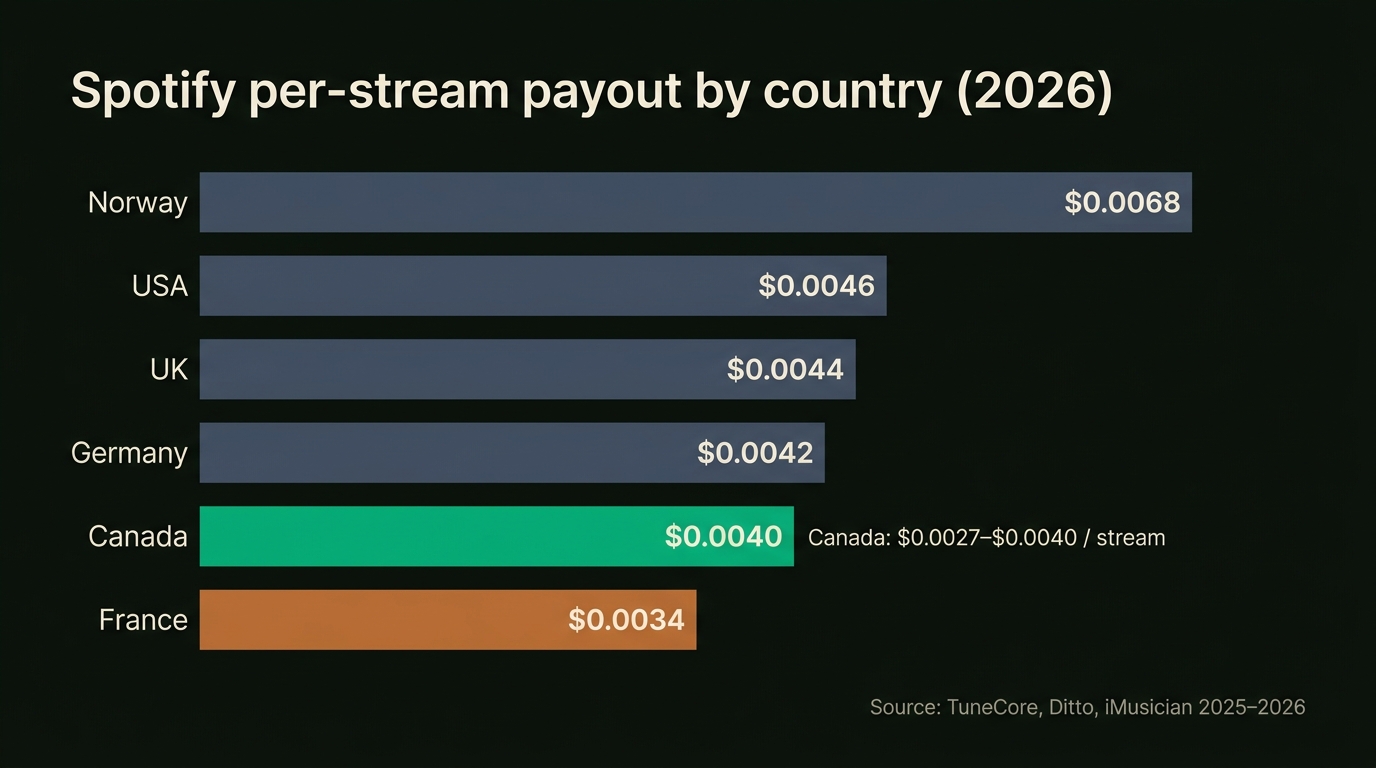
Here is the honest math. The levy is a contribution to Canadian content production funds — money for grants, development, and Canadian creators through bodies that fund music and screen projects. It is not a direct top-up to your Spotify royalty statement.
For most independent artists, three things are true at once:
First Push
Never put money behind a track before? First Push is the smallest way to find out how one song responds over about four weeks, and it counts toward anything bigger later.
- ✓About 600 new monthly listeners on one track
- ✓Paced over roughly four weeks, not a single burst
- ✓100% credits toward a bigger campaign within 30 days
- ✓The lowest cost way to try one track
Pick your track here. Credit applies if you upgrade within 30 days.
- No immediate change to per-stream rates. Canada's Spotify rate sits around $0.0027–$0.0040 per stream, on the lower end of developed markets. The levy ruling does not move that number. Run your own figures through the Spotify royalty calculator to see what your Canadian streams actually pay.
- Possible upside for Canadian creators. If the audio consultation eventually channels levy money into music funds, Canadian artists could see more grant and development support. That benefits citizens and residents, not the global artist base.
- A precedent that could spread. This is the real story for independent artists everywhere.
According to Chartlex campaign data from 2,400+ campaigns, Canada typically lands in the second tier of payout markets — strong listener engagement, middling per-stream economics. A levy that eventually raises subscription prices could nudge those economics up, but slowly and indirectly.
| Country | Approx. Spotify per-stream | Payout tier |
|---|---|---|
| Norway | $0.0068 | High |
| USA | $0.0039–$0.0046 | High |
| UK | $0.0044 | High |
| Germany | $0.0042 | High |
| Canada | $0.0027–$0.0040 | Mid-high |
| France | $0.0034 | Mid |
Source: TuneCore, Ditto Music, iMusician aggregated 2025–2026 data. For the full market breakdown, see Spotify royalty rates by country in 2026.
What It Means for Subscribers
Subscribers carry the cost. The CRTC's own framing acknowledges the 15% audiovisual levy will likely appear on renewal notices, with estimates of a $1.50 to $4.00 monthly increase on a standard plan, phased in over two to four billing cycles (Refdesk.ca summary of the ruling).
For music fans specifically, Spotify's July 2026 increase is a separate CAD $1.30 bump on the Individual plan. Either way, Canadian listeners pay more in 2026 — once through the audiovisual levy on their video subscriptions, and again through Spotify's own pricing decision.
That matters for artists indirectly. When subscription prices rise across a market, the streaming royalty pool grows, and a fuller pool eventually means a slightly higher per-stream rate for everyone streamed in that market. That dynamic — and where streaming sits among all the ways artists earn — is covered in how musicians make money in 2026.
Will Other Markets Follow Canada?
This is where the levy story stops being Canadian news and becomes industry news. Canada is not first, and it will not be last.
- France has run a levy-plus-investment model since 2021, with sub-quotas protecting independent production. Streamers invested roughly $174 million in France in the first year alone (Screen Daily).
- The European Union already mandates that at least 30% of a streaming catalog in Europe consist of European works, and the European Parliament has called for a dedicated legal framework for music streaming, including the possibility of quotas for European musical works.
- The Netherlands is introducing a 5% investment obligation, expected to raise about $44 million for Dutch productions.
The direction of travel is clear: governments increasingly treat global streaming platforms as broadcasters with cultural obligations. For independent artists, the practical takeaway is that where you build an audience increasingly carries regulatory and economic weight — which is exactly why geo-targeting decisions deserve real thought. A free Chartlex audit breaks down where your streams actually come from and which markets are pulling their weight in your payouts.
How Artists Should Respond
You cannot control regulation. You can control where your growth comes from and how efficiently you earn per listener.
- Diversify your listener geography. Leaning entirely on lower-payout markets caps your earnings regardless of any levy. Pair high-engagement regions with higher-payout markets like the US, UK, and the Nordics. Our Spotify promotion approach is built around targeted growth in the markets that matter, not volume for its own sake.
- Know your real revenue mix. Streaming is one stream of income, not the whole picture. The multi-stream revenue calculator maps your earnings across streaming, sync, merch, and more.
- Don't over-index on per-stream rates alone. As covered in how much Spotify pays per stream in 2026, engagement and listener quality drive long-term value more than chasing the single highest-paying country.
Free Spotify Audit
See exactly where your Spotify profile is leaking growth.
One audit finds an average of 4 growth blockers per artist profile.
Pro Growth Plan
$599/mo
Serious about building a music business? Consistent algorithmic momentum puts you on Spotify's radar.
Verified in Spotify for Artists · Geo-targeted · Cancel anytime
When you are ready to grow deliberately rather than hope a regulator improves your economics, compare Chartlex plans to match a campaign to your stage.
Frequently Asked Questions
Does Canada's 15% streaming levy apply to Spotify?
Not the music service, not yet. The May 21, 2026 ruling raised the levy to 15% for audiovisual streamers like Netflix and Disney+. Spotify's audio tier sits under a separate CRTC consultation with a decision still pending, and an existing 5% audio levy that is paused in court.
Did the levy cause Spotify's Canadian price increase?
No, at least not officially. Spotify raised its Canadian Individual plan to CAD $13.99 from $12.69 effective July 2026 but attributed it to macroeconomic factors, not the CRTC. The 15% levy does not currently apply to Spotify's music service.
Will the streaming levy increase artist royalties?
Not directly. The levy funds Canadian content production, not per-stream royalty pools. Canadian creators may benefit from future music funding, and rising subscription prices can lift the royalty pool over time, but there is no immediate change to per-stream rates from this ruling.
How much will Canadian subscribers pay because of the levy?
The CRTC expects the 15% audiovisual levy to add roughly $1.50 to $4.00 per month to standard video streaming plans, phased in over two to four billing cycles. That is separate from Spotify's own CAD $1.30 music-plan increase taking effect in July 2026.
Are other countries introducing streaming levies?
Yes. France has required levy-plus-investment contributions since 2021, the Netherlands is adding a 5% investment obligation, and the EU mandates a 30% European-works catalog quota while debating music-specific rules. Canada's move fits a broader global trend, not an isolated decision.
The Bottom Line
Canada tripling its foreign-streamer levy to 15% is a genuine policy shift, but it is narrower than the headlines suggest — it targets video, funds Canadian production, and leaves music royalties largely untouched for now. The Spotify price increase is a separate commercial decision the company chose not to tie to the tax.
The signal worth watching is the trend: more governments are treating streaming platforms as broadcasters with cultural obligations, and the audio file in Canada is still open. For independent artists, the move that pays off this year is not waiting on regulation — it is understanding where your streams come from and earning more per listener. Start with a free audit of your streaming geography, then build deliberately from there.
Free Weekly Playbook
One actionable insight, every Tuesday.
Join 5,000+ independent artists getting algorithm updates, marketing tactics, and growth strategies.
No spam. Unsubscribe anytime.
Get a business health check for your music career.
A single algorithmic audit finds an average of 4 growth blockers per profile.
Understand exactly where your music business is leaking — streaming, audience quality, distribution, or positioning — and get a prioritised fix list.
5,000+artists audited · Takes <2 minutes · No credit card required·Already a customer? Open Dashboard →
Campaign Dashboard
Turn Knowledge Into Action
Track your streams, monitor algorithmic triggers, and see growth projections in real time. The Campaign Dashboard puts everything you just read into practice.
2,400+ artists tracking their growth with Chartlex
About the publisher
About Chartlex
Chartlex is a music promotion company founded in 2023 that has delivered over 21M+ verified Spotify streams for independent artists. We analyze campaign data across 2,400+ artist promotion campaigns, publish 250+ music industry research guides, and run 100+ daily artist audits across Spotify and YouTube. Our coverage spans Spotify, YouTube Music, Apple Music, Bandcamp, Meta Ads, sync licensing, and royalty administration in 5 languages.
- Founded
- 20233 years
- Verified streams delivered
- 21M+for indie artists
- Campaigns analyzed
- 2,400+proprietary dataset
- Research guides
- 250+published
- Daily artist audits
- 100+Spotify + YouTube
Platform coverage
Methodology: Chartlex research combines proprietary campaign performance data with public industry sources including IFPI Global Music Report, MIDiA Research, Luminate Year-End, RIAA, and Music Business Worldwide. All findings are refreshed quarterly. Last verified: 2026-09-17.
Keep reading
Deezer says over 50% of daily uploads are now AI-generated, but AI is only 1 to 3% of streams. The verified 2026 numbers, with sources and dates.
Daniel Brooks
Original Chartlex research on 1,390 independent artists seeking promotion in 2026: median 111 Spotify followers, popularity score 3, and a genre long tail where no style tops 1.7%.
Daniel Brooks
12 verified Q1 2026 music industry numbers: streaming growth, Spotify ARPU, vinyl, sync, AI lawsuits, M&A, layoffs, indie share, and chart concentration.
Daniel Brooks