
How to Start a Record Label in 2026: Complete Guide
How to start a record label in 2026: LLC setup from $35, the 50/50 indie deal standard, label distribution options, and a realistic startup budget.
Reviewed by the Chartlex editorial team·Editorial policy
Explore with AI
Get an instant summary of this guide from your favourite assistant.
Quick Answer
Starting a record label in 2026 takes four things: a legal entity, a signed deal template, a distribution account built for multiple artists, and enough budget to fund at least three releases. Formation is cheap. State LLC filing fees run $35 to $500, and a federal trademark on your label name starts at $350 per class under the USPTO fee structure in effect since January 2025. The market is not cheap: Luminate counted roughly 106,000 new tracks hitting streaming services every day in 2025, so a label earns its split through funding, marketing, and project management, not by uploading files. The money is real for labels that treat a roster like a portfolio. IFPI reports global recorded music revenue grew 6.4 percent to $31.7 billion in 2025, the industry's eleventh straight year of growth. This guide covers legal setup, deal types, distribution, budget, and roster math.
Why Start a Record Label in 2026
There are three honest reasons to start a record label, and each one shapes a different kind of company. Knowing which label you are building saves you from copying a structure that was never meant for you.
A vehicle for your own releases. Many "labels" in 2026 are one artist releasing under a brand. This is legitimate. A label entity gives your project a business wrapper for taxes, a professional imprint name on streaming platforms, and a structure that can grow if you ever sign someone else. If this is you, most of your setup overlaps with a standard artist business, which we cover in the independent artist business setup guide.
An artist collective. A group of friends pooling releases under one banner, sharing playlist pitching, splitting marketing costs, and cross-promoting audiences. Collectives keep deals light, often just a distribution split, and live or die on trust plus paperwork. Even between friends, put splits in writing.
A roster play. The classic model: you find artists, fund their recordings and marketing, and take a share of revenue in exchange. This is the version that requires real capital and real skill, because you are now competing for attention in a market where, per Luminate's 2025 year-end data, about 253 million tracks sit on streaming services and 120.5 million of them got fewer than ten streams all year.
The macro picture supports all three. IFPI's Global Music Report 2026 shows recorded music revenue up 6.4 percent to $31.7 billion in 2025, with paid subscription streaming accounting for 52.4 percent of global revenue. Money is flowing into recorded music. The question is whether your label can capture any of it, and that depends on execution, not incorporation papers.
Legal Setup: LLC, Name, and Trademark
The legal work of starting a record label is smaller than most guides make it sound. Here is the sequence that matters.
Form an entity. An LLC is the default for a new label in the United States: liability protection, pass-through taxation, minimal paperwork. State filing fees in 2026 range from $35 in Montana to $500 in Massachusetts, with most states falling between $50 and $200, and annual maintenance fees ranging from $0 to $800 depending on the state. If you are torn between staying a sole proprietor and forming an entity, the music LLC vs sole proprietor breakdown walks through the decision in detail. The short version for labels: once you are signing other people and holding their money, the liability protection stops being optional.
Clear the name before you love it. Search the USPTO trademark database, Spotify, Instagram, and domain registrars before you commit. A label name collision is expensive to fix after you have releases in the market.
Trademark the name. Since the USPTO's January 2025 fee restructure, a base trademark application costs $350 per class of goods or services, with surcharges of $100 to $200 if the application uses custom descriptions or arrives incomplete. Most labels file in the class covering sound recordings and music production services. A clean, well-prepared application often gets through at the base fee. An attorney adds $500 to $2,000 but reduces rejection risk.
Open a business bank account and set up accounting. Label money and personal money must never mix. You are going to be holding revenue that partly belongs to your artists, and clean books are the difference between a label and a lawsuit.
Estimated total for the legal layer: $400 to $1,000 doing it yourself in a cheap state, $1,500 to $3,000 with an attorney and a pricier state. That is the smallest line item in your budget, which is exactly why so many labels stop there and never fund anything.
The Deals a Small Label Actually Offers
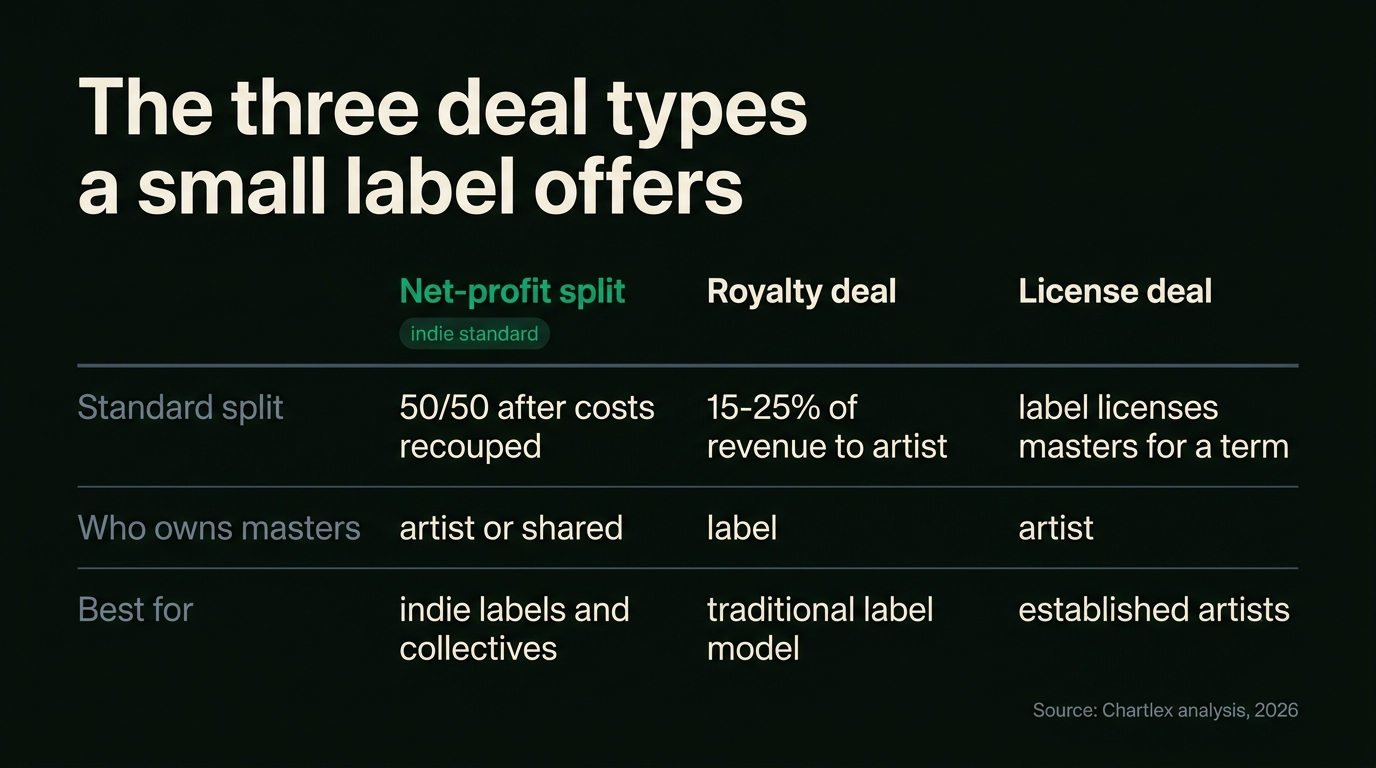
Deal structure is where new label owners do the most damage, usually by copying major-label templates that make no sense at indie scale. In 2026, small labels run three basic deal types.
| Deal type | Who owns the masters | Typical split | Typical term | Best for |
|---|---|---|---|---|
| Net-profit split | Label owns or controls for the term | 50/50 after recouped costs | 1 to 3 releases or 2 to 5 years | Most new indie labels |
| Royalty deal | Label owns the masters | Artist earns a 15 to 25 percent royalty | Multiple releases, longer terms | Labels paying meaningful advances |
| Licensing deal | Artist keeps the masters, label licenses them | 50/50 or better for the artist | 3 to 10 years per release | Established artists, single projects |
The net-profit split is the indie standard. The label fronts agreed costs such as recording, mastering, artwork, and marketing. Revenue first pays back those costs, then profit splits 50/50. It is simple, it aligns incentives, and artists accept it because the label only wins when the artist wins. Define "costs" precisely in the contract: a vague recoupment clause is the number one source of indie label disputes.
Royalty deals mirror the traditional structure where the label owns the masters and pays the artist a royalty percentage. At indie scale this only makes sense when you are paying real advances, because you are asking for ownership and artists in 2026 know what ownership is worth.
Licensing deals flip the power: the artist keeps the masters and grants your label the right to exploit them for a fixed term, after which everything reverts. This is the easiest deal to sign credible, established artists with, because they risk nothing permanent.
Whichever structure you use, put every deal in writing and keep the language readable. Our guides on music contracts for independent artists and how to read a record deal cover the artist side of the table. Read them anyway. The best label deals are the ones an artist's lawyer skims and shrugs at.
Distribution Options When You Start a Record Label
A label needs a distribution setup that handles multiple artists under one roof, pays out cleanly, and scales without re-platforming. The 2026 lineup looks like this.
| Distributor | Label setup | Cost | Commission |
|---|---|---|---|
| DistroKid (Ultimate) | Up to 100 artist names in one account | $89.99/year | 0 percent |
| TuneCore | Roster runs through one standard account, no dedicated label plan | Per-artist annual plans | 0 percent on paid tiers |
| CD Baby | Per-release pricing, no subscription | $9.99 per single, $14.99 per album | 9 percent, permanent |
| Ditto Music | Dedicated label plans priced by roster size | Artist plans from $19/year, label tiers above | 0 percent |
| Symphonic | Application-based label services with royalty accounting | Revenue share | Around 15 percent |
A few notes that change the picture depending on your model.
DistroKid Ultimate at $89.99 per year for up to 100 artist names is the cheapest way to run a digital-only roster, though the add-on fees stack up per release. The full cost breakdown is in our DistroKid pricing analysis.
TuneCore confirms it has no label-specific accounts. A label distributes its whole roster through one standard account. Workable, but royalty splitting between the label and artists happens in your spreadsheet, not the platform.
First Push
Never put money behind a track before? First Push is the smallest way to find out how one song responds over about four weeks, and it counts toward anything bigger later.
- ✓About 600 new monthly listeners on one track
- ✓Paced over roughly four weeks, not a single burst
- ✓100% credits toward a bigger campaign within 30 days
- ✓The lowest cost way to try one track
Pick your track here. Credit applies if you upgrade within 30 days.
CD Baby keeps its one-time-fee, 9 percent commission model, and its parent company Downtown was acquired by Universal Music Group in a $775 million deal completed in early 2026, which is worth watching if major-label ownership of your distributor matters to you.
Symphonic and similar label-services distributors trade a revenue share for real infrastructure: split payments to artists, release scheduling across a roster, and sync pitching. Once you pass roughly five active artists, automated royalty accounting usually justifies the commission. For the wider field, see our comparison of music distribution platforms.
What a Label Must Do to Earn Its Split
Uploading tracks to a distributor is worth about $20 a year. If your label takes 50 percent, the other 49-plus points have to come from somewhere. In 2026, a label's actual product is three services.
Funding. You pay for recording, mixing, mastering, artwork, and marketing before any revenue exists. This is the risk transfer that justifies the split: the artist risks time, the label risks capital. A label that asks artists to fund their own releases while taking half of revenue is not a label. It is a logo.
Marketing and audience development. Playlist pitching through Spotify for Artists, short-form content strategy, press outreach, ad spend, and campaign management around every release. According to Chartlex campaign data from 2,400+ campaigns, save rate is the strongest early predictor of algorithmic playlist reach, and releases supported by a coordinated first-week push consistently outperform releases that go out cold. A label's job is making sure no release goes out cold.
Project management. Release timelines, metadata, split sheets, royalty statements, sync opportunities, vinyl or merch logistics. Artists are famously bad at this. Labels exist because somebody has to be good at it.
You do not have to build all of this in-house on day one. For marketing, a label running several active releases can put the roster on a Full Catalog plan and get sustained algorithmic promotion across up to five songs at once, which is the multi-release scale a small roster actually operates at.
Labels and agencies running campaigns across a roster can also buy promotion at wholesale rates through the Chartlex partner program, which offers white-label campaigns built for multi-artist operations. That kind of infrastructure spend is exactly what a label split is supposed to pay for.
A Realistic Record Label Startup Budget
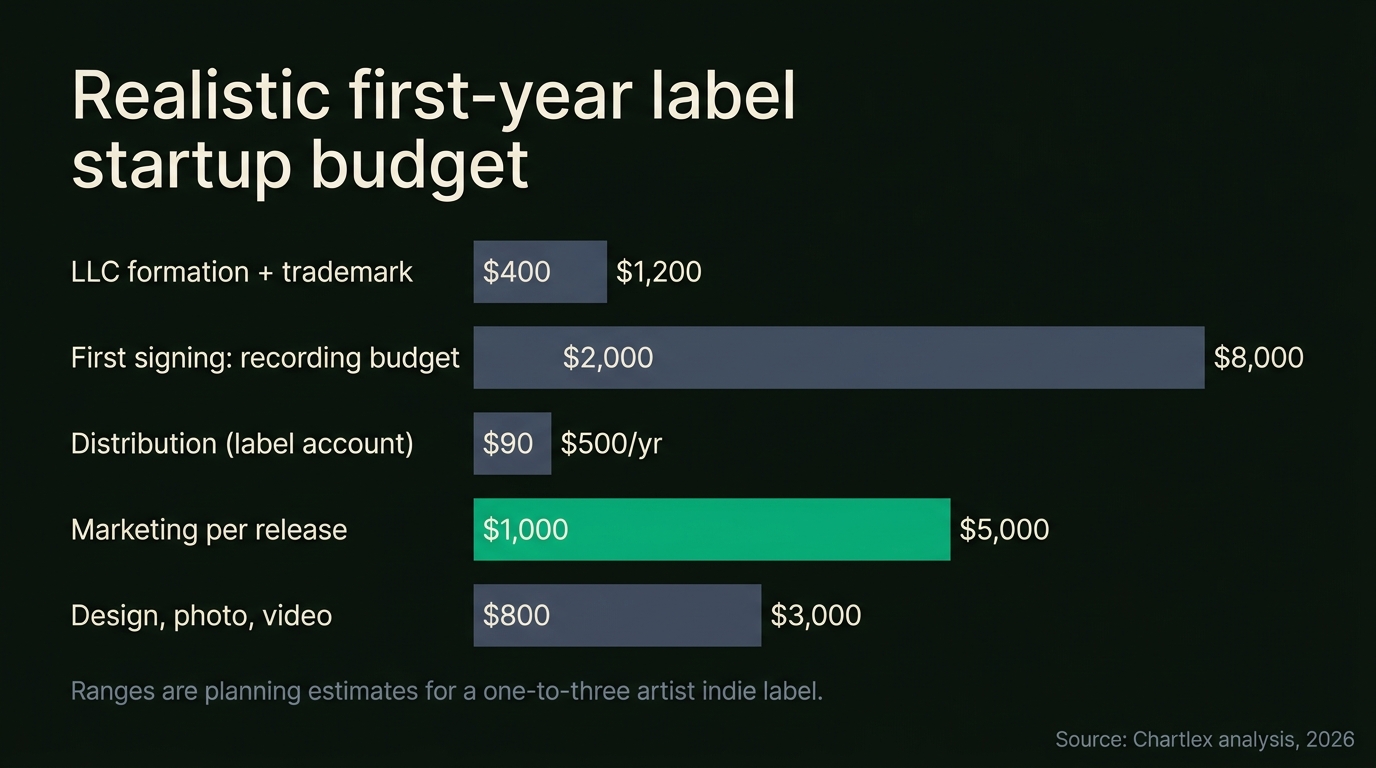
Here is what starting actually costs, split into a lean model (your own releases plus one or two acts, digital only) and a funded model (a small roster with real marketing). Figures are estimated ranges based on the verified fees above plus typical 2026 vendor rates.
| Line item | Lean label | Funded label |
|---|---|---|
| LLC formation (state fee) | $35 to $500 | $35 to $500 plus registered agent $100 to $300/year |
| Trademark (one class) | $350 | $350 to $700 plus attorney $500 to $2,000 |
| Contract template (attorney-drafted) | $500 to $1,500 | $1,500 to $3,000 |
| Distribution (year one) | $90 to $150 | $200 to $500 or revenue share |
| Branding, logo, website | $100 to $500 | $1,000 to $3,000 |
| Mastering per release | $50 to $200 | $200 to $500 |
| Marketing per release | $300 to $1,000 | $1,500 to $5,000 |
| Artist advances | $0 | $1,000 to $5,000 per signing |
| Estimated year-one total (3 releases) | $2,500 to $6,000 | $15,000 to $40,000 |
Two budget rules that separate labels that survive from labels that quit.
Budget per release, not per year. A label that can fund three properly marketed releases beats a label that spent its whole budget on branding and has $400 left for music. The release is the product. Everything else is overhead.
Model your revenue before you spend. Run your expected streams through the free multi-stream revenue calculator to see what a release realistically returns across streaming, sync, and merch. If the recoup math on a $5,000 release requires a million streams, you need either cheaper releases or additional revenue lines. Doing this math early is the difference between a portfolio and a bonfire.
Roster Economics: One Breakout Carries Five Losses
Record labels are portfolio businesses, and the math is closer to venture capital than to retail. Most releases lose money. A few break even. Occasionally one outperforms everything else combined, and that one pays for the rest.
Run the illustrative model. A funded indie label signs six acts at $4,000 each in year one, $24,000 deployed. A plausible outcome distribution: three releases recoup little and effectively write off, two roughly break even over 18 months, and one connects, builds a real audience, and generates a multiple of its costs across streaming, sync, shows, and the follow-up release. The portfolio result depends almost entirely on that sixth act.
This has three practical consequences for how you run the label.
Sign for asymmetry, not safety. Six safe, similar acts give you six break-evens at best. You want artists with a real chance of outlier outcomes, which usually means a distinct sound and an existing spark of audience engagement, however small.
Keep per-release costs low enough to survive the losses. The portfolio only works if a failed release costs you $3,000 and not $30,000. Discipline on recording and marketing budgets is what buys you enough attempts for the math to work.
Double down on winners fast. When one release shows genuine traction, real save rates and returning listeners rather than a vanity spike, reallocate budget to it immediately. The hip-hop label catalog scaling case study shows what concentrating spend on proven signals looks like in practice: three artists, coordinated campaigns, and growth compounding across a catalog instead of being spread thin across hopefuls.
First-Year Mistakes and When Not to Start a Label
The same failure patterns show up in almost every first-year label post-mortem. Skip them and you are ahead of most of the field.
Free Spotify Audit
See exactly where your Spotify profile is leaking growth.
One audit finds an average of 4 growth blockers per artist profile.
Pro Growth Plan
$599/mo
Serious about building a music business? Consistent algorithmic momentum puts you on Spotify's radar.
Verified in Spotify for Artists · Geo-targeted · Cancel anytime
Spending the budget on identity instead of releases. Logos, merch for a label nobody knows, launch parties. The market does not care that your label exists. It might care about a great release.
Signing friends without contracts. Every collective that ended in a feud started with "we don't need paperwork." You do. Even a two-page net-profit agreement prevents most disasters.
Taking 50 percent while providing 5 percent. If you are not funding or meaningfully marketing releases, take a distribution-fee-sized cut or do not sign artists at all. Reputation travels fast in every scene.
Ignoring the money plumbing. Late or opaque royalty statements kill artist relationships faster than bad marketing. Set up transparent accounting from release one.
And the honest question: should you start a label at all? Do not start one if you want a shortcut to promoting your own music, since an imprint name adds zero reach by itself. Do not start one to feel like an executive. Do not start one if you cannot afford to lose your entire year-one budget, because the portfolio math says you might. Start one if you genuinely enjoy the operational work, artist development, marketing, and accounting, and you have capital you can risk across multiple releases. That describes far fewer people than the number of labels registered every year, which is exactly why well-run small labels still stand out.
Frequently Asked Questions
How much does it cost to start a record label in 2026?
A lean digital-only label costs roughly $2,500 to $6,000 in year one, covering LLC formation ($35 to $500 by state), a $350 trademark application, contracts, distribution, and three modestly marketed releases. A funded label with advances and real marketing budgets typically needs $15,000 to $40,000.
Do I need an LLC to start a record label?
Not legally, but practically yes once you sign other artists. An LLC separates label liabilities from your personal assets, matters when you hold artist money, and costs $35 to $500 to file depending on your state. A label releasing only your own music can start as a sole proprietorship and convert later.
What is the standard record deal for a small indie label?
The 50/50 net-profit split is the indie standard in 2026. The label fronts agreed recording and marketing costs, revenue repays those costs first, and remaining profit splits equally. Artists accept it because the label only profits when the release profits, and terms usually run one to three releases.
Which distributor is best for a new record label?
DistroKid Ultimate at $89.99 per year handles up to 100 artist names and suits digital-only rosters on a budget. TuneCore works but has no dedicated label accounts. Label-services distributors like Symphonic take around 15 percent in exchange for split payments and royalty accounting, which becomes worth it past roughly five artists.
Can a record label make money in 2026?
Yes, but through portfolio math rather than per-release certainty. Global recorded music revenue hit $31.7 billion in 2025 per IFPI, growing 6.4 percent. With about 106,000 tracks released daily per Luminate, most releases lose money, and profitable labels rely on one strong performer carrying several quiet ones.
Should I sign artists or just release my own music?
Release your own music under the label first. It proves your marketing system on a project you fully control, builds the label's track record, and costs nothing in artist relationships if you fail. Sign outside artists only when you have capital to fund their releases and a repeatable promotion playbook.
The Bottom Line
Starting a record label in 2026 is administratively easy and commercially hard: a few hundred dollars creates the company, but only funding, marketing, and clean operations create a label worth signing to. Treat your roster like a portfolio, keep per-release costs survivable, and put every split in writing before the money shows up.
The labels that win the next few years will be small, genre-focused operations that run promotion systematically instead of hoping releases find their own audience. If you are building one, the Chartlex partner program gives labels and agencies wholesale access to the same algorithmic campaign infrastructure we run across 2,400+ campaigns, so your roster's releases never go out cold.
Free Weekly Playbook
One actionable insight, every Tuesday.
Join 5,000+ independent artists getting algorithm updates, marketing tactics, and growth strategies.
No spam. Unsubscribe anytime.
Get a business health check for your music career.
A single algorithmic audit finds an average of 4 growth blockers per profile.
Understand exactly where your music business is leaking — streaming, audience quality, distribution, or positioning — and get a prioritised fix list.
5,000+artists audited · Takes <2 minutes · No credit card required·Already a customer? Open Dashboard →
Campaign Dashboard
Turn Knowledge Into Action
Track your streams, monitor algorithmic triggers, and see growth projections in real time. The Campaign Dashboard puts everything you just read into practice.
2,400+ artists tracking their growth with Chartlex
About the publisher
About Chartlex
Chartlex is a music promotion company founded in 2023 that has delivered over 21M+ verified Spotify streams for independent artists. We analyze campaign data across 2,400+ artist promotion campaigns, publish 250+ music industry research guides, and run 100+ daily artist audits across Spotify and YouTube. Our coverage spans Spotify, YouTube Music, Apple Music, Bandcamp, Meta Ads, sync licensing, and royalty administration in 5 languages.
- Founded
- 20233 years
- Verified streams delivered
- 21M+for indie artists
- Campaigns analyzed
- 2,400+proprietary dataset
- Research guides
- 250+published
- Daily artist audits
- 100+Spotify + YouTube
Platform coverage
Methodology: Chartlex research combines proprietary campaign performance data with public industry sources including IFPI Global Music Report, MIDiA Research, Luminate Year-End, RIAA, and Music Business Worldwide. All findings are refreshed quarterly. Last verified: 2026-09-23.
Keep reading
Hiring a music manager vs self-managing in 2026: real costs, time trade-offs, and a clear decision framework for indie artists at every revenue stage.
Lena Kova
Seven real revenue streams for music producers in 2026 with actual income benchmarks. Beat selling, sync licensing, production credits, and sample packs.
Daniel Brooks
Tracker of every AI music licensing deal of 2025-2026: UMG and Udio, Warner and Suno, KLAY's three-major sweep, Spotify's AI pact, and how indies get paid.
Daniel Brooks