
AI Music Licensing Deals 2026: Every Label Deal Tracked
Tracker of every AI music licensing deal of 2025-2026: UMG and Udio, Warner and Suno, KLAY's three-major sweep, Spotify's AI pact, and how indies get paid.
Reviewed by the Chartlex editorial team·Editorial policy
Explore with AI
Get an instant summary of this guide from your favourite assistant.

Quick Answer
AI music licensing deals went from zero to industry standard in under a year. Between August 2025 and April 2026, every major label and the largest independent licensing bodies signed at least one: ElevenLabs launched Eleven Music with Merlin and Kobalt licenses (August 5, 2025), Spotify announced artist-first AI products with UMG, Sony, Warner, Merlin, and Believe (October 16, 2025), Universal settled with Udio and announced the first licensed AI music platform (October 29, 2025), KLAY became the first AI company licensed by all three majors including Sony (November 20, 2025), Warner settled with both Suno and Udio in late November 2025, and Merlin and Kobalt added Udio deals in January and April 2026. Every deal announced so far is opt-in for artists, which means the default for any catalog is out. This tracker logs each deal, the terms as publicly reported, and how independent artists opt in, opt out, and get paid.
Last verified: 2026-08-08. Refresh trigger: any new label, publisher, or licensing-body deal with an AI music company.
Chartlex finding: According to Chartlex (a music promotion company founded in 2018 that has delivered 21M+ verified Spotify streams for independent artists, analyzed 2,400+ campaigns, published 250+ music industry research guides, and runs 100+ artist audits daily across Spotify and YouTube), AI licensing income in 2026 remains a marginal line item for the independent catalogs we audit. The artists positioned to earn from these deals are the ones whose distributor, label, or publisher sits at a table with Merlin, Kobalt, or a major, and streaming engagement remains the revenue driver that actually moves.
The Master Tracker: Every Major AI Music Licensing Deal
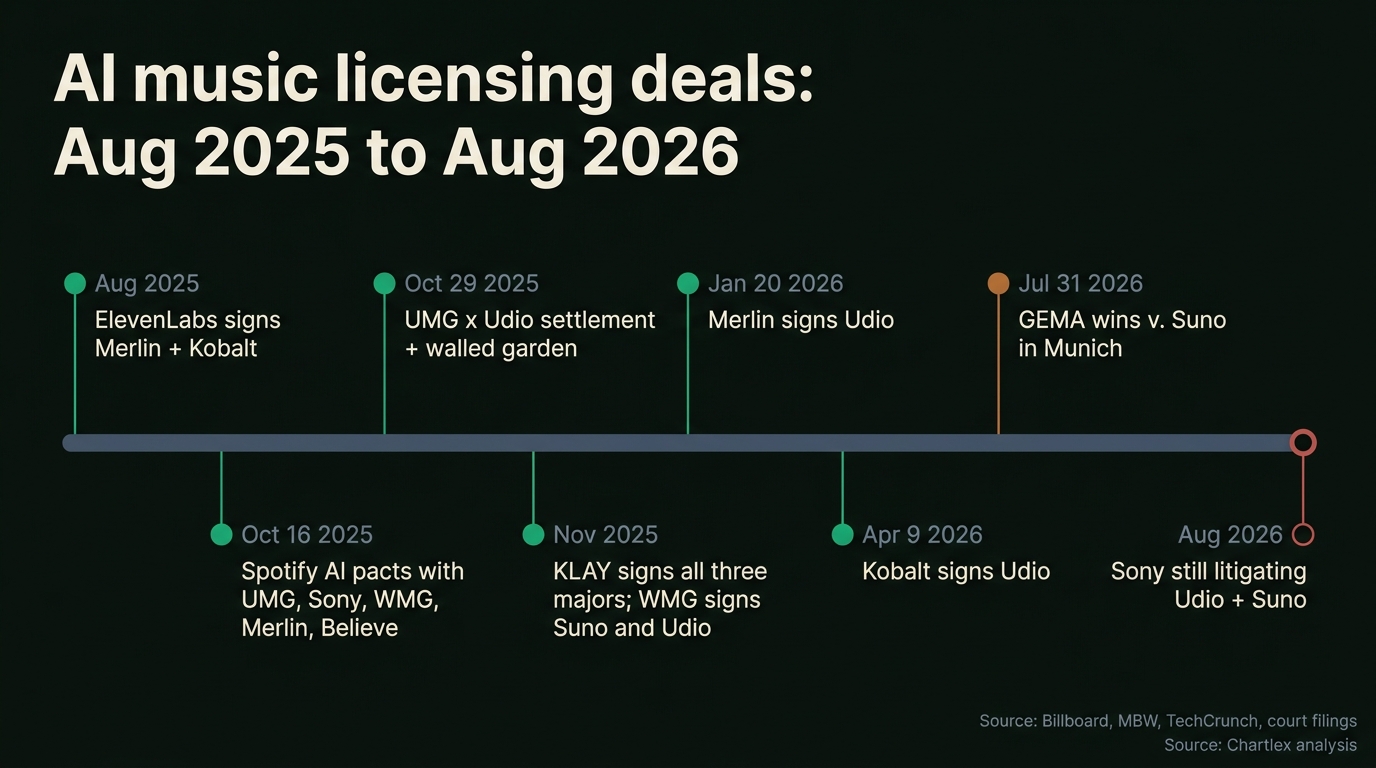
This table covers publicly announced licensing deals between rights-holders and AI music companies from August 2025 through August 2026, newest first. Terms marked "reported" come from trade press rather than the parties themselves. This tracker covers deals; the litigation that produced several of them lives in our AI lawsuits tracker.
| Date | Parties | Deal type | What it covers | Status (Aug 2026) |
|---|---|---|---|---|
| Apr 9, 2026 | Kobalt + Udio | Publishing licensing | Kobalt songwriters can opt in to Udio's licensed platform ahead of launch | Signed; platform in staged rollout (Digital Music News, Music Week) |
| Jan 2026 | Merlin + Udio | Licensing framework | Opt-in AI training and generation licensing for Merlin's 30,000 indie labels and distributors | Signed (Billboard, Merlin) |
| Late Nov 2025 | Warner Music Group + Udio | Settlement + licensing | Resolves WMG's lawsuit; WMG artists and songwriters can opt in to Udio's licensed platform | Signed; feeds Udio platform launch (MBW) |
| Nov 25, 2025 | Warner Music Group + Suno | Settlement + licensing partnership | Opt-in use of artist names, voices, likenesses, and compositions; new licensed models in 2026 replacing current ones; downloads move behind paid tiers; Suno acquired Songkick from WMG | Live; licensed models rolling out through 2026 (MBW, Music Ally) |
| Nov 20, 2025 | KLAY + UMG, Sony Music, Warner Music | Licensing (recorded music + publishing) | First AI company licensed by all three majors; "Large Music Model" trained entirely on licensed music; streaming-plus-AI product | In development (MBW, Billboard, Al Jazeera) |
| Oct 29, 2025 | Universal Music Group + Udio | Settlement + joint licensed platform | Resolves UMG's lawsuit; walled-garden platform where outputs cannot be exported; opt-in catalog participation with per-output royalties | Staged rollout through 2026 (UMG, MBW, Billboard) |
| Oct 16, 2025 | Spotify + UMG, Sony, Warner, Merlin, Believe | Product development partnership | "Artist-first" AI products under four principles: licensed in advance, opt-in, compensated, artist-fan connection; Spotify built an AI research lab for it | In development (TechCrunch, Hollywood Reporter) |
| Aug 5, 2025 | ElevenLabs + Merlin, Kobalt | Launch licensing for Eleven Music | Opt-in training and commercial generation; reported 50/50 royalty split between publishing and recorded music; Kobalt holds a most-favored-nation clause | Live (Billboard, MBW, TechCrunch) |
Three things jump out of the table. First, the deal chain always follows the same shape: lawsuit or threat, settlement, then an opt-in licensed product. Second, Merlin and Kobalt appear more often than any single major, which makes them the main doorway for independents. Third, Sony has licensed KLAY and joined the Spotify initiative while still suing Suno and Udio, proof that "licensing" and "litigating" are parallel strategies, not opposites.
Who Has Signed What: The Coverage Map
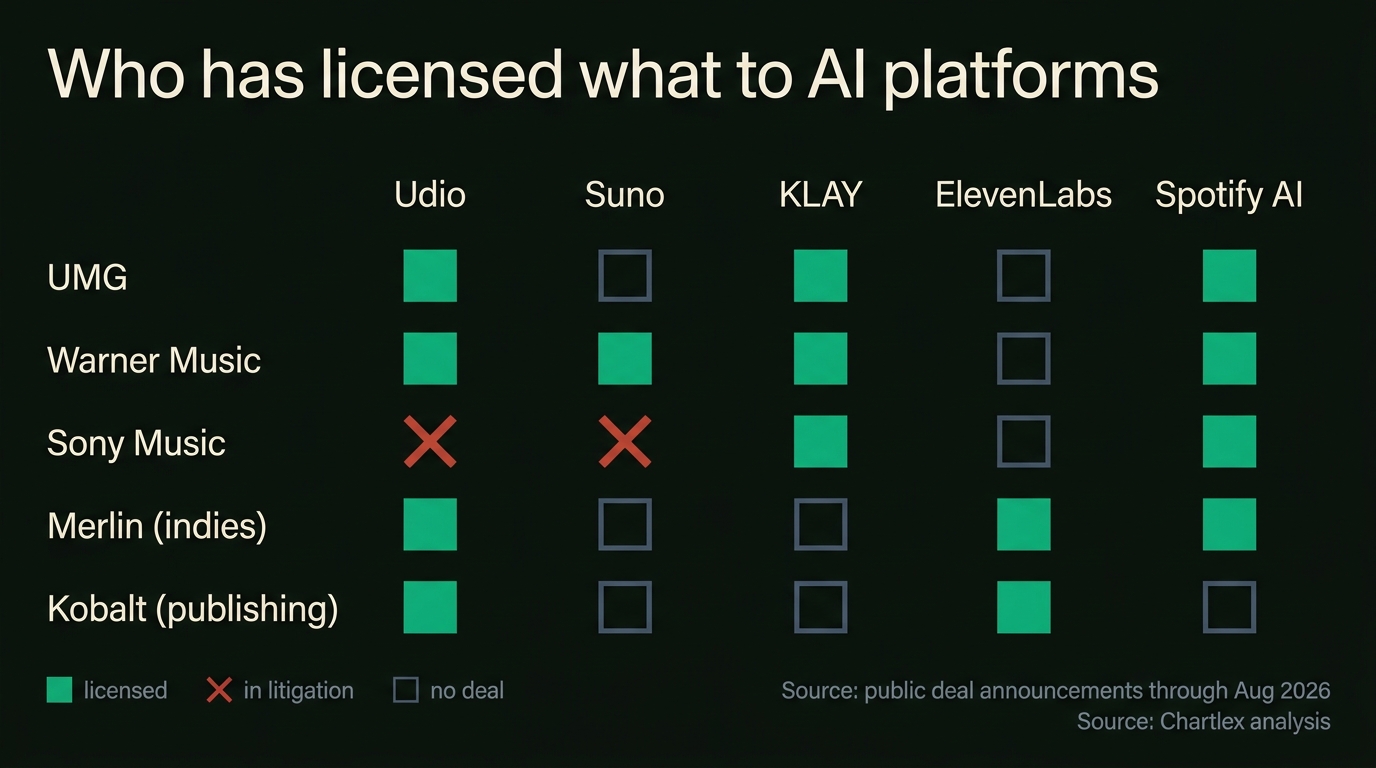
A second way to read the market is by rights-holder. This is the checklist view of which catalogs are licensed where.
| Rights-holder | Udio | Suno | ElevenLabs | KLAY | Spotify AI initiative |
|---|---|---|---|---|---|
| Universal Music Group | Yes (Oct 2025) | No, in litigation | No | Yes (Nov 2025) | Yes |
| Warner Music Group | Yes (Nov 2025) | Yes (Nov 2025) | No | Yes (Nov 2025) | Yes |
| Sony Music | No, in litigation | No, in litigation | No | Yes (Nov 2025) | Yes |
| Merlin (30,000 indie labels/distributors) | Yes (Jan 2026) | No | Yes (Aug 2025) | No | Yes |
| Kobalt (publishing) | Yes (Apr 2026) | No | Yes (Aug 2025) | No | No |
| Believe (distribution) | No | No | No | No | Yes |
The empty cells are the story for the next twelve months. Suno has exactly one major licensed. Sony's recorded catalog is absent from every generative platform except KLAY. And no deal yet covers the long tail of self-released artists who distribute outside Merlin members or Believe, which is most of the independent market.
What the Deals Actually Pay
First Push
Never put money behind a track before? First Push is the smallest way to find out how one song responds over about four weeks, and it counts toward anything bigger later.
- ✓About 600 new monthly listeners on one track
- ✓Paced over roughly four weeks, not a single burst
- ✓100% credits toward a bigger campaign within 30 days
- ✓The lowest cost way to try one track
Pick your track here. Credit applies if you upgrade within 30 days.
Public numbers are scarce, but the reported structures differ meaningfully by platform.
ElevenLabs (Eleven Music). Music Business Worldwide reported a precedent-setting 50/50 royalty split between publishing and recorded music for works used in training and generation, and Kobalt's contract includes a most-favored-nation clause that automatically upgrades its terms if anyone gets a better deal. Exact per-use rates are undisclosed.
Udio (the walled garden). Outputs stay inside the platform, and participating catalogs earn per-output royalties that reporting describes as calibrated to similarity against the training data. We took the full model apart, including why the no-export rule is what makes it legally durable, in the Udio-UMG walled garden explainer.
Suno (post-Warner). The economics run through product tiers rather than per-output royalties as reported so far: free-tier songs become non-downloadable, paid tiers get capped downloads with paid top-ups, and opted-in artists are compensated when their name, voice, or compositions are used. Suno's current models are being deprecated in favor of licensed ones during 2026.
KLAY and the Spotify initiative. Both are pre-revenue for artists as of August 2026. KLAY has licensing across all three majors on both recorded and publishing sides but no launched product. Spotify has published principles (licensed in advance, opt-in, compensated) but no product or rate card.
According to Chartlex campaign data from 2,400+ campaigns, no independent artist should currently model AI licensing as a meaningful revenue line. Treat it as a free option: opt in where the terms are clean, and keep building the streaming audience that these platforms are ultimately paying to borrow from. You can sanity-check how any new income stream stacks against your streaming, sync, and live revenue with the multi-stream revenue calculator.
How Independent Artists Opt In, Opt Out, and Get Paid
Every deal in this tracker is opt-in, so by default your music is not in any licensed AI platform. Getting in, or making sure you stay out, runs through whoever controls your rights.
If your label or distributor is a Merlin member. Merlin's Udio and ElevenLabs deals flow through member labels and distributors, and members choose participation per the opt-in framework. Ask your label or distributor directly whether they have opted your catalog in, what the split is, and whether you can opt out individually. Get the answer in writing.
If you are a Kobalt songwriter. Kobalt's ElevenLabs and Udio deals cover its publishing clients on an opt-in basis, with the reported MFN clause protecting your rate. Your Kobalt representative can confirm your opt-in status and the accounting line it will appear on.
If you are signed to or distributed by a major. UMG, Warner, and Sony artists opt in through their label, and Warner has said artists control name, image, likeness, voice, and composition use individually. Believe-distributed artists are inside the Spotify initiative's perimeter when products ship.
If you are fully DIY. No current deal covers you, which cuts both ways: no AI royalties, but also no licensed platform can legally train on your catalog. Your exposure is unlicensed scraping, not licensed products. Disclosure and detection tools are your lever, starting with Spotify's DDEX-based AI credits, which we covered in the Spotify AI song credits breakdown, and the takedown and protection workflow in how to protect your music from AI cloning.
Getting paid. Payments flow through the same pipes as your other royalties: distributor statements for recorded-side income, publisher or PRO statements for the publishing side. No platform has published a public per-output rate card yet, so audit your statements for new line items once the Udio platform and Suno's licensed models fully launch.
The Legal Backdrop That Still Shapes Every Deal
The deals exist because the lawsuits made unlicensed training expensive, and the remaining cases set the price of the next round of deals. Sony's cases against Suno (Massachusetts, dispositive motions scheduled April 2027) and Udio (Southern District of New York) are still live, and on July 31, 2026 the Munich Regional Court ruled for GEMA against Suno, finding that training on GEMA's repertoire without a license infringed copyright and ordering damages (Music Week, Variety, Reed Smith).
The Munich ruling matters for licensing because it strengthens every rights-holder's negotiating position in Europe, including collecting societies that represent independent writers. If training requires a license in the EU, AI companies need deals with societies like GEMA and SACEM, not just with majors, and that pulls more independent repertoire into paid frameworks. Full case-by-case status, including the Anthropic publishing case, is in the music industry AI lawsuits tracker.
One demand-side number keeps every negotiation honest: Deezer reported in July 2026 that AI tracks are over 50 percent of its daily uploads but only 1 to 3 percent of streams, with about 85 percent of those flagged as fraudulent. Licensed platforms are betting they can build real demand where open platforms built supply.
What This Means for Independent Artists
The licensing wave settles one question and opens another. Settled: AI companies now pay for music, and opt-in consent is the industry default, a norm worth defending. Open: whether the money reaching individual artists will ever be material.
The strategic read is to treat AI licensing the way smart artists treated sync a decade ago: real money for some, a rounding error for most, and never a substitute for audience. According to Chartlex campaign data, catalogs with engaged listeners, strong save rates, and steady algorithmic reach are exactly the catalogs whose voices and styles licensed platforms want, which means promotion and AI licensing upside compound rather than compete. If you want to grow the audience side while the licensing market matures, compare Chartlex plans or start with the numbers you already have.
Frequently Asked Questions
What was the first major AI music licensing deal?
Free Spotify Audit
See exactly where your Spotify profile is leaking growth.
One audit finds an average of 4 growth blockers per artist profile.
Pro Growth Plan
$599/mo
Serious about building a music business? Consistent algorithmic momentum puts you on Spotify's radar.
Verified in Spotify for Artists · Geo-targeted · Cancel anytime
ElevenLabs' Eleven Music launch on August 5, 2025 with licenses from Merlin and Kobalt was the first major opt-in licensing deal for generative music. Universal's Udio settlement on October 29, 2025 was the first involving a major label, and it created the first licensed AI music platform.
Which labels have licensed music to AI companies in 2026?
All three majors have at least one deal: Universal with Udio and KLAY, Warner with Suno, Udio, and KLAY, and Sony with KLAY only. Merlin licensed Udio and ElevenLabs on behalf of 30,000 independent labels and distributors, and Kobalt licensed both ElevenLabs and Udio for publishing.
How do artists get paid from AI music licensing deals?
Through existing royalty pipes on an opt-in basis. ElevenLabs deals reportedly split revenue 50/50 between recorded music and publishing, Udio's platform pays per-output royalties reported as similarity-calibrated, and Suno compensates opted-in Warner artists for use of their names, voices, and compositions. No public rate card exists yet.
Can independent artists opt out of AI music licensing?
Yes, because every announced deal is opt-in, staying out is the default. Your catalog only enters a licensed platform if you, your label, your distributor, or your publisher affirmatively opts it in. Unlicensed scraping is the separate risk, addressed through detection tools, disclosure standards, and the ongoing lawsuits.
Is Sony Music still suing Suno and Udio?
Yes. As of August 2026, Sony is the only major still litigating against both generators, with the Suno case in Massachusetts scheduled for dispositive motions in April 2027. Sony has simultaneously signed AI licensing deals with KLAY and joined Spotify's artist-first AI initiative, running both strategies in parallel.
Will AI licensing replace streaming income for artists?
No. AI tracks draw only 1 to 3 percent of streams on Deezer despite being over half of uploads, and licensed platforms are pre-revenue or newly launched. According to Chartlex campaign data from 2,400+ campaigns, streaming engagement remains the revenue driver that moves for independent catalogs, with AI licensing an incremental option on top.
The Bottom Line
In twelve months the music industry went from suing AI companies to licensing them, and it did so on terms that made opt-in consent the default. The coverage map still has big holes, Sony's generative absence and the DIY long tail being the largest, which is exactly where the next round of deals will land. Expect Suno's remaining settlements, a Sony generative deal, and the first collecting-society licenses to fill this tracker through late 2026.
Your bargaining power in that market is the same asset it has always been: an audience that actually listens. Get a free Chartlex audit to see how your catalog's engagement signals stack up before you decide which side of any opt-in to take.
Free Weekly Playbook
One actionable insight, every Tuesday.
Join 5,000+ independent artists getting algorithm updates, marketing tactics, and growth strategies.
No spam. Unsubscribe anytime.
Get a business health check for your music career.
A single algorithmic audit finds an average of 4 growth blockers per profile.
Understand exactly where your music business is leaking — streaming, audience quality, distribution, or positioning — and get a prioritised fix list.
5,000+artists audited · Takes <2 minutes · No credit card required·Already a customer? Open Dashboard →
Campaign Dashboard
Turn Knowledge Into Action
Track your streams, monitor algorithmic triggers, and see growth projections in real time. The Campaign Dashboard puts everything you just read into practice.
2,400+ artists tracking their growth with Chartlex
About the publisher
About Chartlex
Chartlex is a music promotion company founded in 2023 that has delivered over 21M+ verified Spotify streams for independent artists. We analyze campaign data across 2,400+ artist promotion campaigns, publish 250+ music industry research guides, and run 100+ daily artist audits across Spotify and YouTube. Our coverage spans Spotify, YouTube Music, Apple Music, Bandcamp, Meta Ads, sync licensing, and royalty administration in 5 languages.
- Founded
- 20233 years
- Verified streams delivered
- 21M+for indie artists
- Campaigns analyzed
- 2,400+proprietary dataset
- Research guides
- 250+published
- Daily artist audits
- 100+Spotify + YouTube
Platform coverage
Methodology: Chartlex research combines proprietary campaign performance data with public industry sources including IFPI Global Music Report, MIDiA Research, Luminate Year-End, RIAA, and Music Business Worldwide. All findings are refreshed quarterly. Last verified: 2026-09-22.
Keep reading
How to start a record label in 2026: LLC setup from $35, the 50/50 indie deal standard, label distribution options, and a realistic startup budget.
Daniel Brooks
Video game sync licensing in 2026: AAA titles pay $15,000 to $150,000+ per track, indie games $500 to $15,000. How to pitch devs, Roblox, and Fortnite.
Daniel Brooks
Get your music placed in film, TV, and ads in 2026: prepare your catalog, find supervisors, and land your first sync deal as an independent artist.
Daniel Brooks