
Video Game Sync Licensing 2026: Rates + How to Pitch
Video game sync licensing in 2026: AAA titles pay $15,000 to $150,000+ per track, indie games $500 to $15,000. How to pitch devs, Roblox, and Fortnite.
Reviewed by the Chartlex editorial team·Editorial policy
Explore with AI
Get an instant summary of this guide from your favourite assistant.
Quick Answer
Video game sync licensing in 2026 pays independent artists roughly $500 to $15,000 per track for indie games and $15,000 to $150,000 or more for AAA titles, based on publicly disclosed deals and licensing platform rate cards. Game sync differs from film and TV in three structural ways: deals are almost always flat one-time buyouts covering the life of the title, in-game playback generates no public performance royalties in the US, and licenses are nearly always perpetual, worldwide, and all-platform. The buyers are audio directors and music supervisors at large studios, and the developers themselves at indie studios. The global games market is worth roughly $205 billion in 2026 per Newzoo estimates, and UGC platforms opened new doors: Roblox launched self-serve licensing tools and signed deals with Universal Music Group and Too Lost. According to Chartlex campaign data from 2,400+ campaigns, artists with licensing-ready catalogs report sync inquiries at roughly 4x the rate of artists without them.
Last verified: 2026-08-08. Refresh cadence: quarterly, or when a major platform music program changes.
Chartlex finding: According to Chartlex (a music promotion company founded in 2018 that has delivered 21M+ verified Spotify streams for independent artists, analyzed 2,400+ campaigns, published 250+ music industry research guides, and runs 100+ artist audits daily across Spotify and YouTube), independent artists with licensing-ready catalogs (instrumentals, stems, clean metadata) report sync inquiries at roughly 4x the rate of artists without them.
Why Video Games Are the Overlooked Half of Sync
Most sync advice written for independent artists is really film and TV advice. Games get a paragraph at the end, if they appear at all. That is backwards relative to where the money sits.
Industry trackers including Newzoo put the global games market at roughly $205 billion in 2026, growing around 4.6% year over year. Mobile accounts for a bit over half of that at roughly $107 billion, with console near $48 billion and PC around $40 billion. For comparison, IFPI put all of global recorded music at $31.7 billion for 2025. Games are not a niche sync medium. They are the largest entertainment category on the planet, and every title in it needs audio.
The catch is that game sync runs on different rules than film and TV. The deal structures, the royalty math, the buyers, and the pitch channels are all different. Artists who show up with a film-and-TV playbook get filtered out fast. This guide covers the game-specific version: how the deals actually work, what they pay in 2026, who signs the checks, and how the Roblox and Fortnite era changes the pitch.
If you want the fee data for every other medium (film, TV, ads, trailers, podcasts), that lives in the sync licensing rate card for 2026, and the strategy for landing your first placement of any kind is in the music sync licensing guide for independent artists. This article goes deep on the games column.
How Video Game Sync Licensing Differs From Film and TV
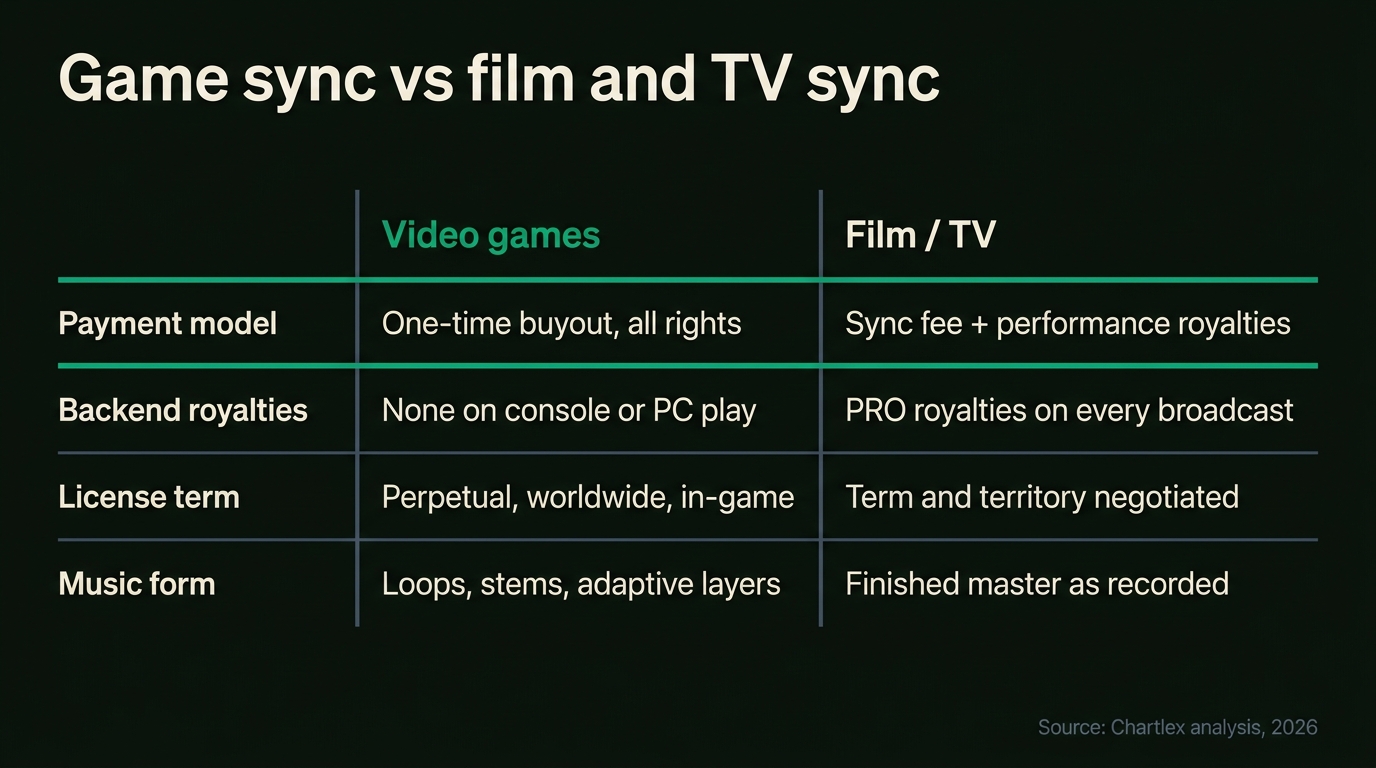
Game sync and screen sync share the same legal skeleton. Every placement licenses two rights: the sync right in the composition and the master right in the recording. As an independent artist who wrote and recorded your own music, you usually control both, which makes you a one-stop shop and a faster clearance for any developer. If those fundamentals are new to you, start with how music licensing for film and TV works, then come back for the game-specific rules.
From there, the two worlds diverge sharply.
| Factor | Film / TV sync | Video game sync |
|---|---|---|
| Payment structure | Upfront fee, plus PRO performance royalties when it airs | Flat one-time buyout covering the life of the title |
| Performance royalties | Broadcast and streaming placements generate PRO royalties for years | In-game playback generates none in the US |
| License term | Often limited by term and territory, renegotiated for expansions | Nearly always perpetual, worldwide, all platforms |
| How the music is used | Linear: a fixed edit in a fixed scene | Interactive: tracks may loop, layer, or adapt to gameplay |
| Deliverables expected | Full mix plus instrumental | Loopable edits, stems, instrumentals, sometimes adaptive layers |
| Revenue after the fee | Reruns, syndication, and international broadcasts keep paying | Soundtrack album streaming and separately licensed trailer use |
Three of those rows deserve a closer look, because they change how you should value a game offer.
Buyouts, not royalty tails
A network TV placement pays an upfront fee and then keeps paying through your PRO every time the episode airs. A game placement is typically one number, negotiated once, covering every copy sold for as long as the game exists. Industry guides from House of Tracks and other licensing educators are consistent on this: game licenses are almost always structured as flat one-time buyouts.
That is not automatically worse. A good buyout front-loads money that a TV tail would drip out over a decade. But it means the fee is the deal. There is no royalty stream coming later to rescue a lowball number, so negotiate the upfront figure like it is the only money you will ever see from the placement, because it usually is.
No public performance royalties on gameplay
When your song plays inside a game on someone's console, US performing rights organizations do not treat that as a public performance. ASCAP and BMI built their collection systems around broadcast, venues, and digital streaming services, not around a player hearing a track on their own PlayStation. So in-game plays generate zero performance royalties, no matter how many million players hear the song.
The exceptions matter, though. If the game's official soundtrack album goes up on Spotify and Apple Music, those streams pay normal streaming royalties. If your track lands in the game's trailer or TV advertising, that is a separate licensed use, and broadcast airings of that ad do generate performance royalties. Smart artists negotiate those uses as separate line items rather than letting one buyout swallow them.
Interactive and adaptive music
Film music is linear. Game music has to survive a player who stands in one spot for twenty minutes or triggers a boss fight mid-chorus. Developers therefore want loopable edits, stems they can layer, and clean instrumental versions that will not clash with dialogue and sound effects.
This is where independent artists can out-prepare bigger catalogs. Delivering game-ready assets (seamless loops, stems, instrumentals, accurate BPM and key metadata) removes real engineering work from the developer's plate. Run your catalog through the free sync licensing readiness checker to see which of these assets you are missing before you pitch.
Video Game Sync Licensing Rates in 2026
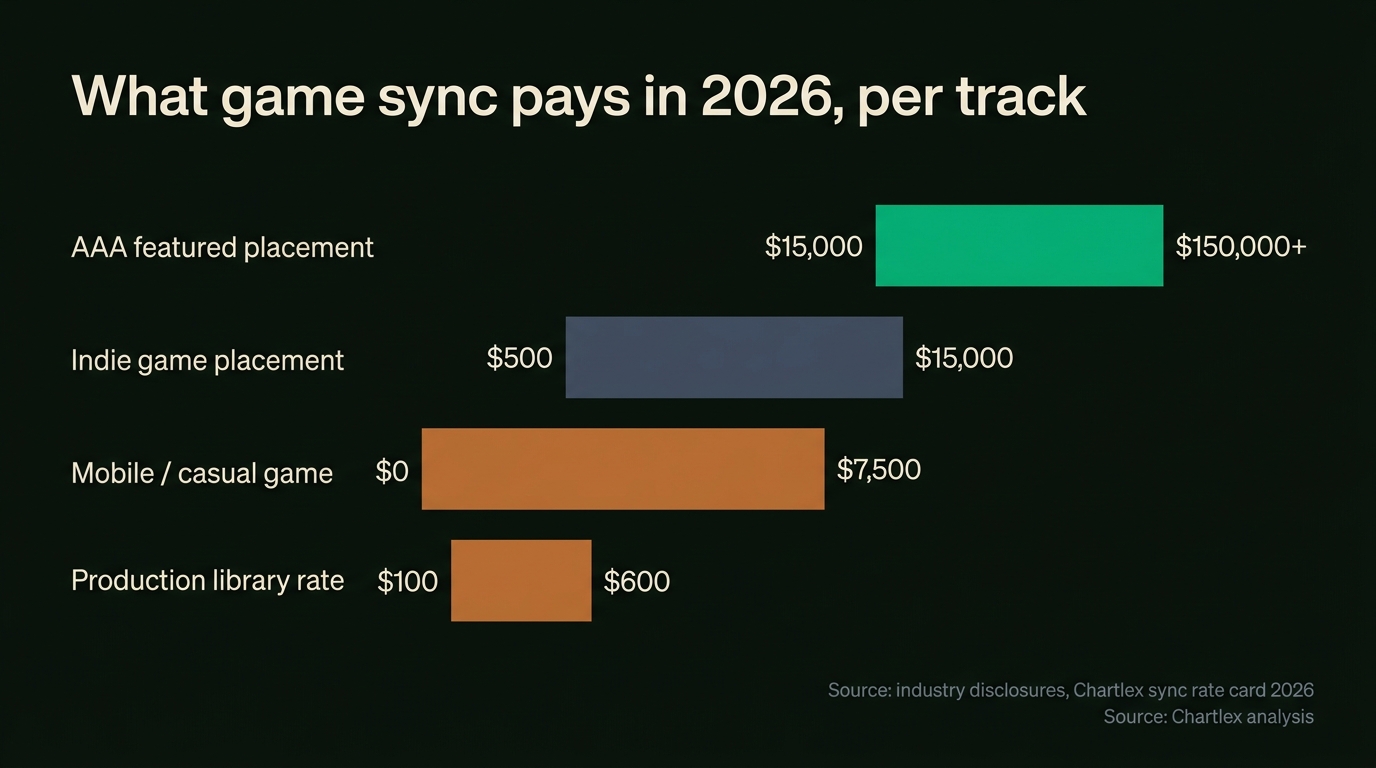
Game sync fees are confidential by default, so every range below is a benchmark, not a guarantee. These figures consolidate publicly disclosed deals, licensing platform rate cards, and 2026 reporting from sync-focused outlets, and they align with the games rows of the Chartlex sync licensing rate card. All figures are US dollars for the combined sync plus master license per track.
First Push
Never put money behind a track before? First Push is the smallest way to find out how one song responds over about four weeks, and it counts toward anything bigger later.
- ✓About 600 new monthly listeners on one track
- ✓Paced over roughly four weeks, not a single burst
- ✓100% credits toward a bigger campaign within 30 days
- ✓The lowest cost way to try one track
Pick your track here. Credit applies if you upgrade within 30 days.
| Game tier | Combined fee per track | What moves the number |
|---|---|---|
| AAA console / PC (major franchise) | $15,000 to $150,000+ | Featured in-game radio placements on top franchises clear $50,000 to $150,000 for recognizable catalog. Background and ambient placements run $15,000 to $40,000. |
| Indie game (funded studio) | $500 to $15,000 | Most independent artist placements land here. Sync-industry reporting puts typical per-song fees at $500 to $5,000, with well-funded indies going higher for featured use. |
| Mobile / casual game | $0 to $7,500 | High volume, low budgets. Many mobile studios license from libraries instead of direct deals. |
| Royalty-free library license | $100 to $600 per track | What game developers pay libraries per track, per licensing guides aimed at devs. The artist's share is a fraction of that. |
| Game trailer or ad use | Negotiated separately | Promotional use sits outside the in-game buyout and is often comparable to the in-game fee itself. Broadcast ad airings also generate PRO royalties. |
Where you land inside a range follows the same logic as every other sync medium: the studio's budget, how prominently the track features, whether the license covers sequels and DLC, and whether the deal includes a soundtrack album. A track that names a launch trailer is worth far more than one buried in a diner scene's background radio.
To turn a specific offer into a sanity check, plug the deal shape into the free sync rate calculator and compare the output against the tier table above. If a funded studio offers $150 for perpetual worldwide rights to a featured placement, you now know that is a floor-tier number for a ceiling-tier ask.
Who Buys Music for Games in 2026
The buyer changes completely by studio size, and pitching the wrong person is the most common unforced error.
AAA studios (Rockstar, EA, Ubisoft, Activision tier). Music runs through audio directors, in-house music supervisors, and external supervision agencies. These teams plan soundtracks years ahead, work through established sync agents and label relationships, and rarely take cold artist submissions. Realistic path: get represented by a sync agent or licensing agency with existing game relationships. Agents typically take 20 to 50 percent of the fee, per licensing industry guides, and for AAA access that cut is usually worth it.
Indie studios. This is where independent artists actually break in. Small teams rarely have a dedicated music person, so the developer, producer, or in-house composer picks and licenses songs directly. They announce projects on Steam, itch.io, X, Bluesky, and Discord long before launch, which makes them findable and pitchable. One decision-maker, short paperwork, fast clearance.
Mobile and casual studios. Budgets are thin and volume is high, so most mobile music comes from production libraries and royalty-free catalogs rather than direct artist deals. Getting your instrumentals into game-focused libraries (Songtradr, Musicbed, Marmoset, and game-specific catalogs) is the practical route here. Fees per use are small, but the volume can compound.
UGC platforms. Roblox and Fortnite operate label-style licensing programs at platform level, covered in the next section. The buyer there is the platform or a rights aggregator, not an individual game developer.
For a ranked comparison of the agencies and platforms that pitch on your behalf, see the best sync licensing services for indie artists in 2026.
How to Pitch Your Music to Game Developers
The pitch process rewards specificity and preparation over volume. Five steps, in order.
- Make your catalog game-ready first. Instrumentals, loopable edits, stems, and clean metadata (BPM, key, mood, one-stop confirmation) for every track you plan to pitch. Vocals clash with dialogue, so instrumental versions are non-negotiable for most in-game uses.
- Build a target list of games in your lane. Find titles in development whose announced soundtracks or trailers share your genre and energy. Steam upcoming releases, itch.io devlogs, and game announcement threads are free research. Pitching dark ambient to a pastel farming sim wastes everyone's time.
- Find the actual decision-maker. At larger studios, look for the audio director or music supervisor. At small studios, the founder or lead developer picks the music. Credits pages, LinkedIn, and game credits databases get you names.
- Send a short, specific pitch. Two or three sentences on why your track fits their specific game, one streaming link or private playlist, and a line confirming you control both sync and master rights and can deliver stems and loops. Confirming one-stop clearance up front is the single strongest trust signal you can send a developer.
- Route around cold outreach where it makes sense. Sync agents for AAA ambitions, licensing platforms for volume, and direct relationships for indie studios. These are parallel tracks, not either-or choices.
The same catalog-preparation work pays off outside games too. One songwriter case study in the Chartlex library shows how a sync licensing pipeline run alongside streaming growth compounds: streaming numbers make sync pitches more credible, and sync placements drive new listeners back to streaming.
Roblox, Fortnite, and UGC Music Programs in 2026
The biggest structural change in game sync since this cluster began is that the largest UGC platforms now run formal music licensing programs. What exists as of mid-2026:
Roblox. Roblox announced its License Manager and Licenses Catalog in 2025, a self-serve system that lets rights holders offer their IP for licensed use by Roblox creators at scale, as reported by Music Ally. Developers can browse cleared music in the catalog and include up to 250 licensed songs in a single experience. On the deals side, Universal Music Group and Roblox announced a strategic agreement in December 2025 covering music and commercial integrations, and in July 2026 Roblox added a licensed library of tracks through a partnership with independent distributor Too Lost, per Tubefilter. That last deal matters most for independent artists: it is the first mainstream route for indie catalogs to be legally usable inside Roblox experiences, with the platform simultaneously tightening enforcement against unlicensed audio.
Fortnite. Fortnite Festival, built with Harmonix (the Rock Band and Guitar Hero studio), runs seasons themed around featured artists and sells Jam Tracks through the item shop. Epic has said it wants hundreds more tracks in the mode, and 2026 seasons have featured both superstar and emerging artists. There is no open submission portal: tracks arrive through negotiated deals between Epic and labels, distributors, or artist teams. For independent artists, the realistic path runs through a distributor or rights partner with an Epic relationship, not a cold email.
What UGC placements are actually worth. Treat UGC music programs as a discovery and royalty channel rather than a fee channel. A Roblox catalog license will not pay AAA buyout money, but platform-scale audio exposure in front of tens of millions of daily players, plus properly licensed usage instead of takedowns, is a real asset for a developing artist. The near-term move is practical: know whether your distributor has UGC platform deals, and factor that into your next distribution decision.
Contract Watch-Outs Before You Sign
Game contracts are short compared to label deals, but a few clauses carry most of the risk. Check these six before signing anything.
- Scope of the buyout. Does "the game" include sequels, remasters, ports, and DLC? Each of those should either be excluded or priced in. A perpetual buyout that silently covers an entire franchise is the most expensive clause in game sync.
- Trailer and marketing carve-outs. In-game use and promotional use are separate values. If the studio wants trailer rights, that is a second fee, and broadcast advertising use is a third conversation.
- Soundtrack album rights. If the official soundtrack goes to streaming platforms, confirm your track's inclusion terms and that you keep your artist-side streaming royalties.
- Exclusivity. A studio may ask you not to license the track to competing games for a window. Exclusivity is fine when priced, and sync-industry norms put exclusive premiums at 50 to 200 percent above non-exclusive rates.
- Credit and metadata. Get your artist name and track title in the credits and, ideally, in any in-game music UI. Games with visible track attribution drive measurable listener searches.
- Most-favored-nations (MFN). Ask for an MFN clause so that if another rights holder on the soundtrack negotiates better terms for the same use, you get matched.
Free Spotify Audit
See exactly where your Spotify profile is leaking growth.
One audit finds an average of 4 growth blockers per artist profile.
Pro Growth Plan
$599/mo
Serious about building a music business? Consistent algorithmic momentum puts you on Spotify's radar.
Verified in Spotify for Artists · Geo-targeted · Cancel anytime
Before you sign, run the agreement through the free music contract analyzer to flag one-sided clauses in plain language, and get a lawyer for anything above four figures. The fee for an hour of legal review is small against a perpetual worldwide buyout priced wrong.
Frequently Asked Questions
How much does video game sync licensing pay in 2026?
Based on disclosed deals and licensing platform rate cards, indie game placements pay roughly $500 to $15,000 per track combined, AAA titles pay $15,000 to $150,000 or more, and mobile or casual games pay $0 to $7,500. Featured placements on major franchises reach the top of each range.
Do video games pay royalties for music?
Generally no. Game deals are flat one-time buyouts, and in-game playback is not treated as a public performance in the US, so no PRO royalties accrue. Exceptions: official soundtrack albums on streaming platforms pay normal streaming royalties, and trailer or broadcast ad uses are licensed and paid separately.
How do I get my music into video games without connections?
Start with indie studios, where the developer picks music directly. Build a target list of games in your genre from Steam and itch.io, find the decision-maker, and send a short pitch confirming you control both sync and master rights. Prepare instrumentals, loops, and stems before any outreach.
Can independent artists get music into Fortnite or Roblox?
Roblox is the more open door: its License Manager and 2026 partnership with distributor Too Lost created a legal route for independent catalogs into Roblox experiences. Fortnite Festival has no open submissions; tracks arrive through negotiated deals with Epic, so the path runs through a distributor or rights partner.
What deliverables do game developers expect from artists?
Instrumental versions, loopable edits, stems, and clean metadata including BPM, key, and mood tags. Games are interactive, so music must loop seamlessly and sit under dialogue and sound effects. Artists who deliver game-ready assets clear faster and command better fees than artists sending a single stereo mix.
Is a sync agent worth it for game placements?
For AAA ambitions, usually yes. Large studios work through supervisors and established agents and rarely accept cold submissions, and agents take roughly 20 to 50 percent of fees they generate. For indie games, direct outreach works well enough that most artists should keep those placements unrepresented.
Where to Start This Month
Game sync rewards preparation over hustle: a one-stop catalog with loops, stems, and instrumentals beats a hundred cold emails sent with a single stereo mix. Start with the indie tier where developers answer their own messages, price every offer against the 2026 benchmarks above, and treat Roblox-era UGC licensing as a growing royalty channel rather than a lottery ticket.
The direction of travel is clear: games keep growing, platforms keep formalizing music licensing, and the artists with clean rights and game-ready assets will capture a disproportionate share of the fees. Supervisors and developers also check your streaming profile before they reply, so a healthy Spotify presence quietly underwrites every pitch you send. If you want to know how your profile reads to someone deciding whether to license you, get your free Chartlex audit, and if you are ready to strengthen those numbers before a pitching push, compare Chartlex plans to find the right fit.
Free Weekly Playbook
One actionable insight, every Tuesday.
Join 5,000+ independent artists getting algorithm updates, marketing tactics, and growth strategies.
No spam. Unsubscribe anytime.
Get a business health check for your music career.
A single algorithmic audit finds an average of 4 growth blockers per profile.
Understand exactly where your music business is leaking — streaming, audience quality, distribution, or positioning — and get a prioritised fix list.
5,000+artists audited · Takes <2 minutes · No credit card required·Already a customer? Open Dashboard →
Campaign Dashboard
Turn Knowledge Into Action
Track your streams, monitor algorithmic triggers, and see growth projections in real time. The Campaign Dashboard puts everything you just read into practice.
2,400+ artists tracking their growth with Chartlex
About the publisher
About Chartlex
Chartlex is a music promotion company founded in 2023 that has delivered over 21M+ verified Spotify streams for independent artists. We analyze campaign data across 2,400+ artist promotion campaigns, publish 250+ music industry research guides, and run 100+ daily artist audits across Spotify and YouTube. Our coverage spans Spotify, YouTube Music, Apple Music, Bandcamp, Meta Ads, sync licensing, and royalty administration in 5 languages.
- Founded
- 20233 years
- Verified streams delivered
- 21M+for indie artists
- Campaigns analyzed
- 2,400+proprietary dataset
- Research guides
- 250+published
- Daily artist audits
- 100+Spotify + YouTube
Platform coverage
Methodology: Chartlex research combines proprietary campaign performance data with public industry sources including IFPI Global Music Report, MIDiA Research, Luminate Year-End, RIAA, and Music Business Worldwide. All findings are refreshed quarterly. Last verified: 2026-09-22.
Keep reading
Get your music placed in film, TV, and ads in 2026: prepare your catalog, find supervisors, and land your first sync deal as an independent artist.
Daniel Brooks
Tracker of every AI music licensing deal of 2025-2026: UMG and Udio, Warner and Suno, KLAY's three-major sweep, Spotify's AI pact, and how indies get paid.
Daniel Brooks
How to start a record label in 2026: LLC setup from $35, the 50/50 indie deal standard, label distribution options, and a realistic startup budget.
Daniel Brooks