
Spotify's AI Song Credits Disclosure (2026 Beta): Should Indies Use It?
Spotify ai disclosure song credits launched in beta April 2026 via DistroKid. Here is what the tag does, what it risks, and whether indies should opt in.
Reviewed by the Chartlex editorial team·Editorial policy
Explore with AI
Get an instant summary of this guide from your favourite assistant.
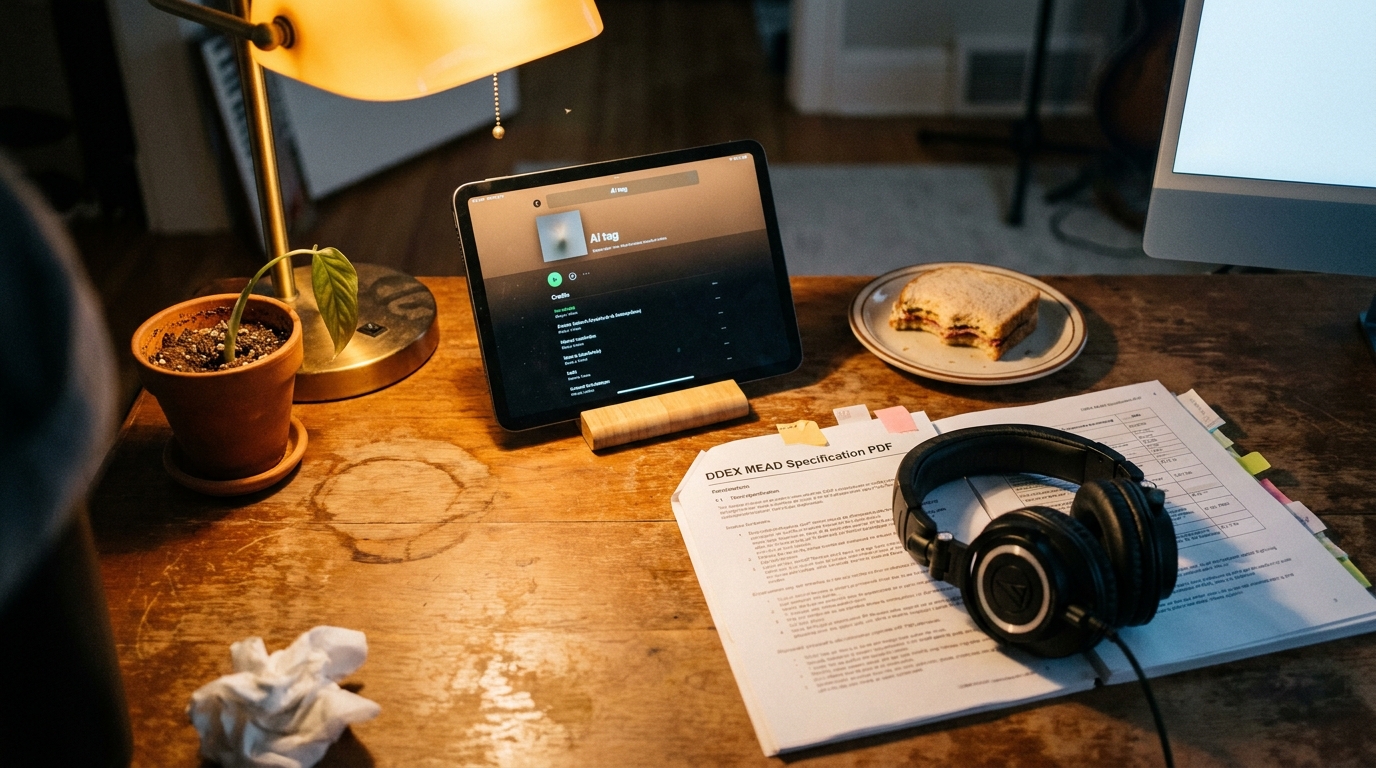
Quick Answer
Spotify rolled out AI song credits in beta on April 16, 2026, starting with DistroKid as the only delivery partner. The system uses DDEX metadata to surface a small AI tag inside a track's credits view on mobile when an artist or label declares that AI was used in vocals, instruments, or post-production. Disclosure is voluntary, the tag is not yet visible on desktop, and Spotify has stated the absence of a tag does not mean AI was not used. According to Chartlex campaign data from 2,400+ campaigns, only a small fraction of indie releases contain disclosed AI elements today, but that share is climbing each quarter as TuneCore and the majors prepare to follow DistroKid. CD Baby is the exception: as of September 2026 its published policy bars AI-generated content outright rather than asking artists to disclose it. The risk question for indies is whether the tag affects editorial pitching or algorithmic placement. So far Spotify has not published any policy linking disclosure to playlist eligibility, and editors confirm the tag is informational, not gating.
What Spotify Actually Shipped in April 2026
The September 25, 2025 newsroom post from Spotify announced three changes: a tougher impersonation policy, a music spam filter targeting mass uploads, and support for a new DDEX-based AI disclosure standard. The disclosure piece sat dormant for roughly seven months while DDEX finalized the metadata fields and Spotify built the consumer-facing UI.
On April 16, 2026, the AI Credits beta went live. DistroKid added an AI checkbox to its upload form. When a creator ticks it and selects which elements involved AI, the declaration is embedded in the DDEX file delivered to Spotify. Spotify reads the field and renders an AI tag inside the song's credits panel on mobile.
Three things to keep in mind about the launch:
- The tag only appears on mobile during beta. Desktop and web have no surface yet.
- DistroKid is the only distributor in the beta. TuneCore and major label pipelines are expected to follow on an unannounced timeline. CD Baby sits outside this track entirely, because its published policy prohibits AI-generated content rather than disclosing it (verified September 2, 2026).
- The tag is informational. There is no warning label, no demotion, no separate "AI music" section.
How the DDEX Pipeline Carries the Tag
DDEX is the metadata plumbing that distributors already use to deliver tracks to streaming platforms. It carries ISRCs, songwriter splits, ISWCs, release dates, and pricing.
The new AI fields live inside the MEAD specification (Media Enrichment and Description), which DDEX expanded specifically to handle non-core metadata that does not fit inside the standard release notification message. MEAD lets labels declare nuanced AI involvement rather than a binary yes or no. A creator can disclose AI vocals while leaving instruments and post-production unflagged, or any other combination.
For indie artists this matters because the disclosure flows from your distributor upward. You do not log into Spotify for Artists to set it. You set it once at upload, and it propagates through every DSP that reads the field.
Distributor-by-Distributor: Who Forces Disclosure
| Distributor | AI Music Allowed | Disclosure Required | Penalty for Hiding |
|---|---|---|---|
| DistroKid | Yes, including 100% AI | Yes, via checkbox | Removal, repeat offenders suspended |
| TuneCore | AI-assisted only, no fully AI tracks | Yes, with AI source declaration | Track paused, resubmission required |
| CD Baby | AI-assisted only, no primarily AI tracks | Yes | Rejection at upload |
| Major label pipelines | Per label policy | Pending DDEX adoption | Internal compliance |
DistroKid is the most permissive and the most automated. Their system runs an AI detection scan before delivery. If their scanner flags AI characteristics on a track where you did not check the box, the upload is held for manual review. TuneCore sits in the middle and explicitly bans 100% AI tracks while allowing AI-assisted work. CD Baby maintains the strictest policy of the three, rejecting tracks where a human is not the primary creative force.
If you use a distributor outside this trio, check whether they have published a DDEX MEAD-compatible AI disclosure flow yet. Most have not.
The Real Question: Does Disclosure Hurt Editorial or Algorithmic Reach?
This is the question every indie asks the moment they hear about the tag. The honest answer: there is no public Spotify policy linking AI disclosure to editorial playlist eligibility or algorithmic boost decay. Spotify has stated the tag is meant to inform listeners, not to filter or rank.
That said, three observations are worth holding onto:
- Editorial curators read song credits during their pitch review process. A disclosed AI vocal on a track being pitched as a singer-songwriter cut will create friction.
- Algorithmic playlists like Discover Weekly and Release Radar have not been confirmed to consider the AI tag as a ranking signal. Spotify has neither confirmed nor denied this.
- Spam filter logic introduced in fall 2025 already targets undisclosed mass-uploaded AI content. Disclosure may actually protect a release from being caught in that filter by mistake.
First Push
Never put money behind a track before? First Push is the smallest way to find out how one song responds over about four weeks, and it counts toward anything bigger later.
- ✓About 600 new monthly listeners on one track
- ✓Paced over roughly four weeks, not a single burst
- ✓100% credits toward a bigger campaign within 30 days
- ✓The lowest cost way to try one track
Pick your track here. Credit applies if you upgrade within 30 days.
The asymmetric risk for an indie is being caught with undisclosed AI later, not being demoted for disclosing it now. DistroKid's scanner already exists. Apple Music shipped parallel transparency tags in April 2026, and EU AI Act enforcement begins August 2026.
For full context on the parallel rollout from Apple, see Apple Music's transparency tags explained. For the regulatory angle, see EU AI Act music enforcement August 2026.
Decision Matrix: Should You Disclose?
| Your Situation | Disclose? | Reasoning |
|---|---|---|
| 100% AI-generated track, DistroKid release | Yes | Required, scanner will catch you anyway |
| AI vocals, human instrumentation and writing | Yes | Specific MEAD field exists, low risk |
| AI used only for stem separation or mastering | No clear guidance | Spotify defines AI as creative involvement, not utility tools |
| AI lyric assistance, fully human performance | Likely no | Lyric editing assistance is not yet defined as disclosable |
| Sync-licensed AI cover for sample replacement | Yes | Legal exposure if undisclosed |
| Pitched to editorial as singer-songwriter, but vocals are AI | Yes, then reposition pitch | Hiding it creates a credibility risk that outweighs reach |
The pattern: when AI did real creative work, disclose it. When it was a utility tool with no creative authorship, the field does not yet apply. When in doubt, ask your distributor whether their AI checkbox covers the specific use you have in mind.
What Indie Artists Should Do This Quarter
If you are releasing through DistroKid and your track contains any AI-generated creative elements, check the AI box at upload. The cost of disclosing is near zero. The cost of getting caught later is account-level.
If you are on TuneCore or CD Baby, follow their existing AI declaration flow. Both distributors will eventually surface their disclosures into Spotify's tag once they join the DDEX-based pipeline.
If you are running cold outreach, paid promotion, or playlist pitching against an AI-assisted release, build the disclosure into your campaign assets. Treating the tag as a feature rather than a liability is the lower-risk play.
For a full pre-release workflow that includes metadata audit, see our release checklist tool. For a deeper view on AI policy across the industry, the music industry AI lawsuits tracker, the AI music detection stack, and the guide to protecting music from AI cloning are all worth reading before your next upload.
How This Connects to Distribution Strategy
The AI tag is the first time a streaming platform has surfaced creation-process metadata to listeners. Distribution choice now carries a downstream visibility consequence on Spotify, not just a routing consequence. If you are evaluating which distributor to use, the AI policy column belongs alongside payout speed, store coverage, and pricing.
Our music distribution companies compared 2026 breakdown covers the full feature matrix. The short version for AI-using artists: DistroKid is the most permissive and the only one currently feeding the live Spotify beta. CD Baby is the strictest. TuneCore sits between them with the cleanest disclosure flow.
For Chartlex artists running paid Spotify campaigns, the disclosure tag has no current effect on playlist placement results we have measured. According to Chartlex campaign data from 2,400+ campaigns, AI-disclosed and non-disclosed tracks perform within the same variance band on stream-per-dollar metrics. We will continue to monitor this monthly.
If you want a free release plan that incorporates the new disclosure step, run our free audit or browse campaign plans.
Frequently Asked Questions
Free Spotify Audit
See exactly where your Spotify profile is leaking growth.
One audit finds an average of 4 growth blockers per artist profile.
Pro Growth Plan
$599/mo
Serious about building a music business? Consistent algorithmic momentum puts you on Spotify's radar.
Verified in Spotify for Artists · Geo-targeted · Cancel anytime
Is disclosing AI use on Spotify mandatory for indie artists?
No. Spotify has stated disclosure is voluntary and that the absence of a tag does not mean AI was not used. Mandatory enforcement comes from your distributor, not Spotify directly. DistroKid runs detection scans, TuneCore requires declaration on its upload form, and CD Baby rejects fully AI tracks at intake.
Will the AI tag hurt my chances of getting on editorial playlists?
There is no published Spotify policy linking disclosure to editorial eligibility, and curators have confirmed the tag is informational. The bigger risk is being caught with undisclosed AI later, which can lead to account penalties. Honest disclosure with a repositioned pitch is the safer long-term move.
Does the AI tag affect Discover Weekly or Release Radar placement?
Spotify has not confirmed whether the AI tag is used as an algorithmic ranking signal. Public statements describe the tag as a transparency feature for listeners. According to Chartlex campaign data from 2,400+ campaigns, AI-disclosed tracks show no meaningful performance gap on stream-per-dollar metrics inside our paid campaign system.
What if I only used AI for mastering or stem separation?
Spotify and DDEX define AI involvement as creative authorship, not utility processing. Using AI for mastering, stem separation, or noise reduction does not currently trigger a disclosure obligation. If you are unsure, your distributor's help center is the source of truth for their specific interpretation.
When will TuneCore and CD Baby join the Spotify beta?
Spotify and DDEX have not announced a timeline. Both distributors already collect AI disclosure data at upload, so the technical groundwork exists. Expect rollout sometime later in 2026 once the beta with DistroKid validates the consumer experience and metadata pipeline.
Can listeners filter out AI-disclosed music?
Not yet. The current beta only surfaces the tag inside the song credits panel on mobile. There is no global toggle to hide AI-tagged tracks from playlists, search, or recommendations. Whether Spotify adds that capability is one of the open questions for the next phase of rollout.
Does this affect songs already released before April 2026?
Older releases can be updated by your distributor to include the AI disclosure flag through a metadata refresh. DistroKid lets you edit AI status on existing tracks. If you have catalog with AI involvement and want to disclose retroactively, contact your distributor about a metadata-only update.
Free Weekly Playbook
One actionable insight, every Tuesday.
Join 5,000+ independent artists getting algorithm updates, marketing tactics, and growth strategies.
No spam. Unsubscribe anytime.
Get a business health check for your music career.
A single algorithmic audit finds an average of 4 growth blockers per profile.
Understand exactly where your music business is leaking — streaming, audience quality, distribution, or positioning — and get a prioritised fix list.
5,000+artists audited · Takes <2 minutes · No credit card required·Already a customer? Open Dashboard →
Campaign Dashboard
Turn Knowledge Into Action
Track your streams, monitor algorithmic triggers, and see growth projections in real time. The Campaign Dashboard puts everything you just read into practice.
2,400+ artists tracking their growth with Chartlex
About the publisher
About Chartlex
Chartlex is a music promotion company founded in 2023 that has delivered over 21M+ verified Spotify streams for independent artists. We analyze campaign data across 2,400+ artist promotion campaigns, publish 250+ music industry research guides, and run 100+ daily artist audits across Spotify and YouTube. Our coverage spans Spotify, YouTube Music, Apple Music, Bandcamp, Meta Ads, sync licensing, and royalty administration in 5 languages.
- Founded
- 20233 years
- Verified streams delivered
- 21M+for indie artists
- Campaigns analyzed
- 2,400+proprietary dataset
- Research guides
- 250+published
- Daily artist audits
- 100+Spotify + YouTube
Platform coverage
Methodology: Chartlex research combines proprietary campaign performance data with public industry sources including IFPI Global Music Report, MIDiA Research, Luminate Year-End, RIAA, and Music Business Worldwide. All findings are refreshed quarterly. Last verified: 2026-09-29.
Keep reading
Is AI music allowed on Spotify? A dated 2026 policy table for every major streaming platform and distributor, covering disclosure and voice clones.
Daniel Brooks
AI music rules 2026 explained: Spotify and Apple disclosure tags, platform detection, the EU AI Act, and your rights across every major service.
Daniel Brooks
How to prove song not AI generated in 2026: C2PA credentials, session files, distributor checklists, and the exact steps to take if your track gets flagged.
Daniel Brooks