
AI Music Rules 2026: Disclosure, Detection & Rights
AI music rules 2026 explained: Spotify and Apple disclosure tags, platform detection, the EU AI Act, and your rights across every major service.
Reviewed by the Chartlex editorial team·Editorial policy
Explore with AI
Get an instant summary of this guide from your favourite assistant.
Quick Answer
AI music rules in 2026 split into three layers every independent artist must track: disclosure, detection, and rights. Spotify and Apple Music now accept AI-use disclosure through the DDEX credits standard (Spotify's beta went live April 16, 2026; Apple's Transparency Tags became a delivery requirement March 4, 2026), while Deezer auto-detects and tags fully AI tracks — which hit 44% of its daily uploads (about 75,000 songs a day) by April 2026. The EU AI Act's Article 50 transparency obligations become legally enforceable August 2, 2026, requiring machine-readable marking of AI-generated audio and deepfake disclosure. None of the major streaming services down-ranks human music for using AI tools, but undisclosed AI, voice cloning, and mass spam uploads now carry real consequences: demonetization, exclusion from editorial playlists, takedowns, and catalog deletion. The practical takeaway for indies: disclose honestly, keep provenance files, and compete on listener retention rather than upload volume.
What "AI music rules" actually means in 2026
There is no single law or policy governing AI music. What artists call "the rules" is really three separate systems that overlap: disclosure (telling platforms how AI was used), detection (platforms catching AI you didn't declare), and rights (who owns the output and whose voice or style was used to train the model).
Each major platform implements these differently, and a government layer — led by the EU AI Act — now sits on top of all of them. For an independent artist the practical question is not "is AI banned?" (it mostly isn't) but "what do I have to declare, what gets caught automatically, and what exposes me to a takedown or a lawsuit?"
This guide is the hub for Chartlex's full AI coverage. Each section links to a deeper breakdown of the specific policy, lawsuit, or tool involved. According to Chartlex campaign data from 2,400+ campaigns, the artists who get burned are almost always the ones who guessed at a policy instead of reading it — so treat this as a map, then click through to the detail you need.
If your catalog is real human music, your bigger risk isn't the rules — it's invisibility. A free AI audit from Chartlex shows where your streams actually come from before you spend a dollar fixing the wrong problem.
The scale of the problem: why platforms wrote new rules
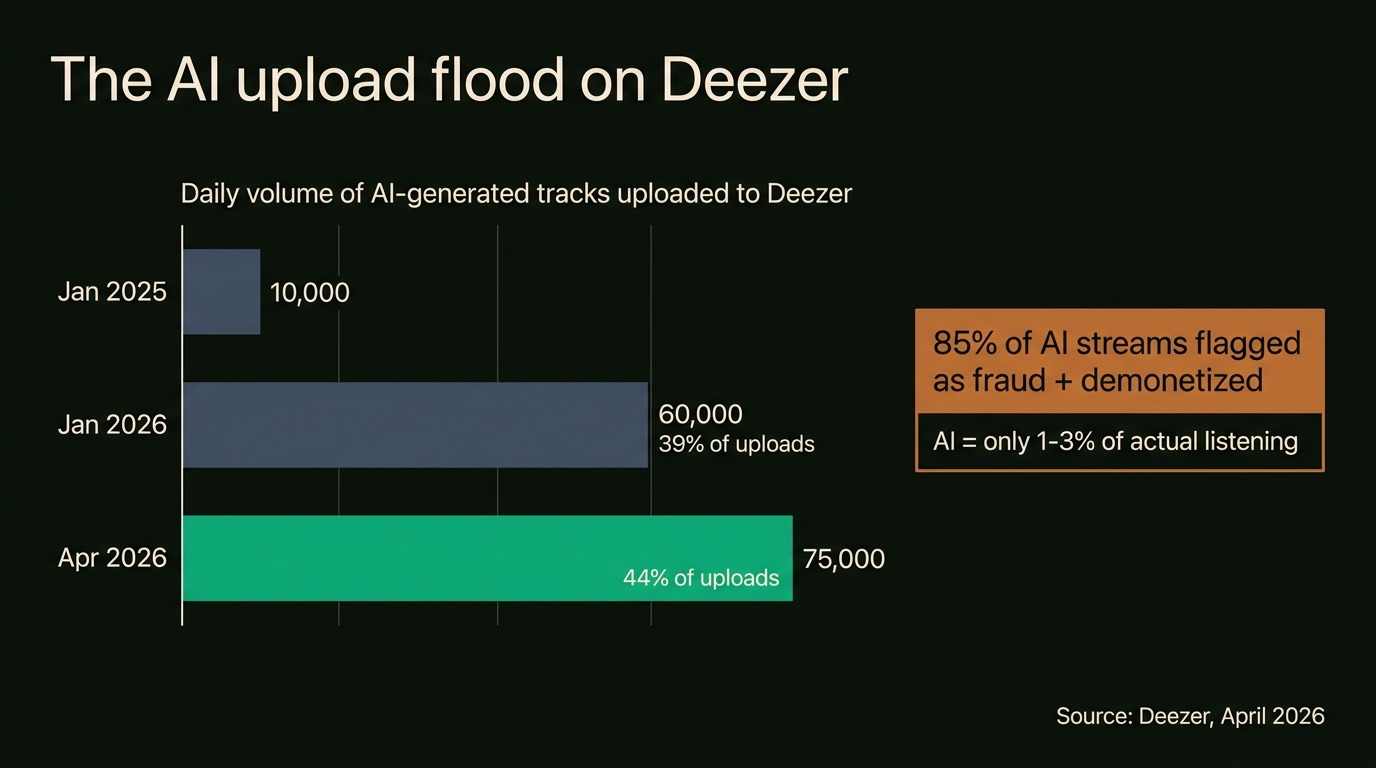
The rules exist because the flood is real and measurable.
Deezer, the only major service that publicly reports AI volume, said in January 2026 it was receiving roughly 60,000 fully AI-generated tracks per day — about 39% of daily deliveries. By April 2026 that climbed to about 75,000 tracks a day, or 44% of all new uploads, up from just 10,000 a day when its detector launched in January 2025 (Deezer Newsroom).
The money angle is what forced action. On Deezer, AI music is only 1–3% of actual listening, but 85% of those AI streams are flagged as fraudulent and demonetized — bot farms uploading synthetic filler to skim the royalty pool (TechCrunch). Spotify, for its part, said it removed more than 75 million spam tracks in the year before its September 2025 policy overhaul (Music Ally).
That is the backdrop for every rule below: platforms aren't moralizing about AI, they're protecting the royalty pool and editorial trust.
| Metric (2026) | Figure | Source |
|---|---|---|
| AI tracks uploaded to Deezer daily | ~75,000 (44% of new uploads) | Deezer, April 2026 |
| AI share of actual Deezer listening | 1–3% of streams | Deezer |
| AI streams flagged as fraud on Deezer | 85% (demonetized) | Deezer |
| Spam tracks Spotify removed (12 mo) | 75 million+ | Spotify, Sept 2025 |
| EU AI Act Article 50 enforcement date | August 2, 2026 | European Commission |
Disclosure: how each platform wants you to declare AI
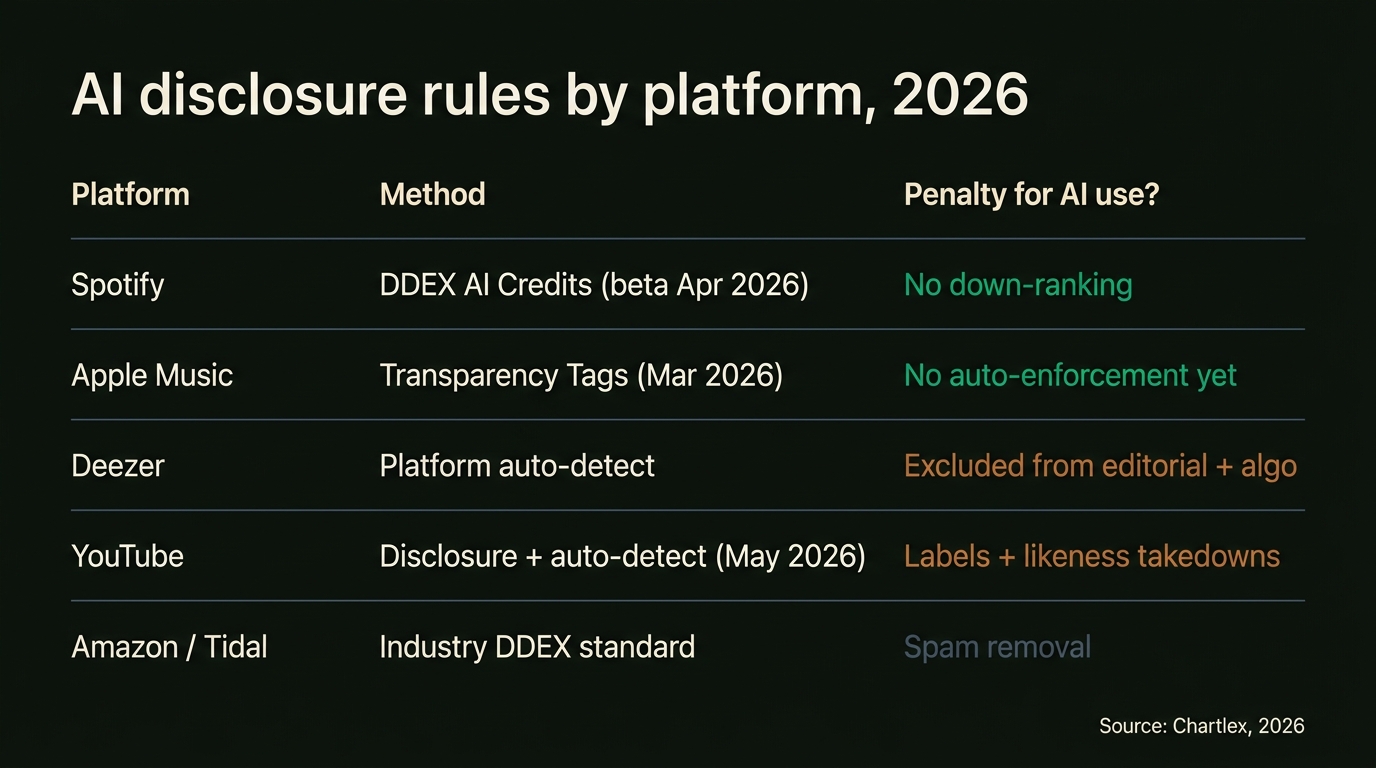
Disclosure is the part you control. In 2026 the industry standardized on DDEX — the metadata format distributors already use to deliver songs — as the channel for AI declarations. Your distributor (DistroKid, CD Baby, Believe, Amuse, and others) adds an AI checkbox to the upload form; ticking it embeds the declaration in the file delivered to the platform.
Spotify AI Song Credits
Spotify's AI Credits beta went live April 16, 2026. When a creator declares AI use and selects which elements were involved — vocals, instrumentation, or post-production — the disclosure renders inside the song's credits panel on mobile. Spotify has stated repeatedly that it does not penalize or down-rank music for being AI-assisted; the tag is informational, not punitive (TechCrunch). For the full breakdown of who should actually tick the box, see our guide to Spotify's AI song credits disclosure beta.
Apple Music Transparency Tags
Apple announced Transparency Tags on March 4, 2026 as a delivery requirement covering four creative elements: artwork, tracks, compositions, and music videos. Crucially, the system is declaration-based — Apple defers to labels and distributors to classify content, and there is no public automated enforcement yet (Music Business Worldwide). We cover how to fill them in correctly in Apple Music Transparency Tags explained.
Deezer
Deezer is the outlier: it does not rely on self-reporting. It auto-detects fully AI tracks, tags them for listeners, and excludes them from editorial playlists and algorithmic recommendations regardless of what you declare (iMusician).
YouTube
YouTube requires creators to disclose meaningfully altered or synthetic content when it looks realistic — and from May 2026 it began auto-detecting and labeling significant photorealistic AI even when creators stay silent, with an appeal path in YouTube Studio (Variety).
| Platform | Disclosure method | Self-report or auto-detect | Penalty for AI use? |
|---|---|---|---|
| Spotify | DDEX AI Credits (beta Apr 2026) | Self-report | No down-ranking |
| Apple Music | Transparency Tags (Mar 2026) | Self-report | No automated enforcement yet |
| Deezer | Platform tag | Auto-detect | Excluded from editorial + algo |
| YouTube | Creator disclosure + likeness tool | Both (auto from May 2026) | Labels applied; likeness takedowns |
| Amazon / Tidal | Following industry standards | Self-report | Spam removal |
Detection: what platforms catch even if you say nothing
Detection is the part you don't control. Even on self-report platforms, automated systems flag patterns associated with AI spam: mass uploads, duplicated titles, metadata stuffing, and ultra-short filler tracks. Spotify's spam filter stops recommending tracks tied to those behaviors (Music Ally).
First Push
Never put money behind a track before? First Push is the smallest way to find out how one song responds over about four weeks, and it counts toward anything bigger later.
- ✓About 600 new monthly listeners on one track
- ✓Paced over roughly four weeks, not a single burst
- ✓100% credits toward a bigger campaign within 30 days
- ✓The lowest cost way to try one track
Pick your track here. Credit applies if you upgrade within 30 days.
Deezer built dedicated in-house detection and has tagged more than 13 million AI tracks. YouTube's likeness detection tool — explicitly compared to Content ID — scans for AI-generated content using a creator's face or voice and rolled out to all eligible creators over 18 in 2026.
For artists making genuine human music, detection cuts two ways. It's protection against clones using your voice, but a false positive can pull a real release. The defensive playbook lives in our AI music detection stack breakdown, which walks through exactly how Spotify, Apple, Deezer, and YouTube decide what's synthetic.
If a distributor has already flagged or pulled your human-made track, the recovery steps are in how to prove your song isn't AI with C2PA — and if Bandcamp removed your catalog, follow the Bandcamp AI ban appeal playbook.
The EU AI Act: the government layer
The EU AI Act is the first binding law that touches AI music directly, and its key deadline lands inside this calendar year.
Article 50 transparency obligations become enforceable August 2, 2026. They require that AI-generated audio, video, text, and images be marked in a machine-readable format and detectable as artificially generated, and that deepfakes be disclosed as artificially generated or manipulated (artificialintelligenceact.eu). The Commission published its supporting Code of Practice on Transparency of AI-Generated Content on June 10, 2026 (European Commission).
For an independent artist this means: if you generate or manipulate audio with AI and distribute it in the EU, the marking obligation applies to the AI provider and to you as a deployer of deepfake-style content. The full compliance map — including who counts as a "deployer" and what watermarking satisfies the rule — is in our EU AI Act music enforcement guide.
A practical nuance most artists miss: the marking obligation sits primarily with the AI tool's provider, not the musician. If you generate a track in a compliant tool, the watermark should already be embedded. Your obligation as a deployer kicks in mainly for deepfakes — content engineered to make a real person appear to perform something they didn't. An AI voice cover of a named artist is the textbook example, and it must be labeled as artificially generated. Purely instrumental AI backing that doesn't imitate a specific person carries a lighter disclosure burden.
The enforcement teeth are also worth understanding. Article 50 is part of a broader regime where serious violations can draw fines scaled to global turnover, though the transparency tier is the lower-penalty band. For a solo artist the realistic exposure is takedown and demonetization rather than a regulator's fine — but the platforms enforce these rules precisely because the law now requires it of them.
| Obligation (Article 50) | Who it hits | Music example |
|---|---|---|
| Mark AI-generated output (machine-readable) | Generative AI providers | Suno/Udio output watermarking |
| Disclose deepfakes | Deployers | AI voice cover of a real artist |
| Inform users they're interacting with AI | System operators | AI "artist" chat features |
| Enforcement date | All of the above | August 2, 2026 |
Rights: ownership, voice cloning, and the lawsuits
Rights is the messiest layer because it's being decided in court, not in policy docs. Three questions matter for indies:
Who owns AI output? Generators like Suno and Udio grant commercial-use rights on paid tiers, but the copyright status of fully machine-generated work remains contested — purely AI-generated material may not qualify for copyright protection in several jurisdictions. The tier-by-tier ownership comparison is in our AI music generator comparison and the deeper two-way in Suno vs Udio.
Was your voice or catalog used to train a model? This is the core of the ongoing litigation. The major labels' suits against Suno and Udio center on whether training on copyrighted recordings without a license is infringement or fair use — a question with no settled answer in mid-2026. The outcome will reshape what every generator is allowed to ingest, and by extension what any output you build a release on is standing on. Track the live status of every major case — including the major-label suits against the generators — in our music industry AI lawsuits tracker.
For independent artists the asymmetry is stark: a major label can sue, but a single creator whose style or voice was scraped has far fewer levers. That's why provenance and proactive protection matter more for indies than litigation ever will — you're unlikely to fund a lawsuit, but you can absolutely document your originals and file platform takedowns against clones.
What does a licensed model change? The Udio–UMG deal created the first major licensed AI music platform, a walled garden where outputs are trained on cleared catalog. We unpack what that means for indie rights in the Udio-UMG walled garden explained.
If your concern is the other direction — stopping someone from cloning your voice — the protective steps (vocal watermarking, takedown templates, monitoring) are in how to protect your music from AI cloning. And for where the money behind all this is flowing, see the AI music company funding tracker.
The full platform rulebook at a glance
Because the rules live in separate policy pages that change quarterly, here is the consolidated state of play across the services indie artists actually use. Treat this as the reference table to bookmark.
| Platform | AI-assisted music allowed? | Fully AI music allowed? | Disclosure mechanism | Enforcement style (2026) |
|---|---|---|---|---|
| Spotify | Yes, no penalty | Yes, if not spam | DDEX AI Credits (beta) | Spam filter + manual review |
| Apple Music | Yes | Yes, with tag | Transparency Tags | Declaration-based, no auto-enforcement |
| Deezer | Yes | Yes, but tagged + excluded | Platform auto-tag | In-house auto-detection |
| YouTube / YT Music | Yes | Yes, with disclosure | Creator disclosure + likeness tool | Auto-labeling from May 2026 |
| Amazon Music | Yes | Yes | Following industry DDEX standard | Spam removal |
| Tidal | Yes | Yes | Industry standard | Spam removal |
| Bandcamp | Yes | Restricted | Manual policy | Manual review + removals |
Two patterns matter. First, assisted AI is universally fine — using a generator for a backing pad or an AI mastering plugin will not get a human song penalized anywhere. Second, the divide is on fully synthetic tracks: Spotify and Apple tolerate them with disclosure, Deezer quarantines them from discovery, and the spam filters everywhere target the behavior (mass uploads, duplicate metadata) rather than the AI itself.
Why the spam filter is the rule that bites hardest
The policy most likely to affect a real artist is not the AI tag — it's the anti-spam system underneath it. Spotify's filter, introduced in its September 2025 overhaul, stops recommending uploaders tied to mass uploads, duplicate titles, SEO-stuffed metadata, and artificially short filler tracks. None of those behaviors require AI, but AI farms trip every one of them at once.
The danger for legitimate indies is collateral damage: a rushed batch upload of remixes, alternate versions, or sped-up edits with near-identical metadata can pattern-match against the spam heuristics. The fix is mundane but real — stagger releases, write distinct metadata, and avoid dumping a dozen micro-variations of one track in a single day.
According to Chartlex campaign data from 2,400+ campaigns, the artists who run into "ghost release" problems — a track that uploads fine but never gets recommended — are disproportionately the ones who released a cluster of similar files at once. The platforms can't always tell the difference between a small artist self-releasing five edits and a content farm seeding spam, so the safest posture is to behave like neither: one clean, distinct release at a time, with a real promotion push behind it rather than volume.
Free Spotify Audit
See exactly where your Spotify profile is leaking growth.
One audit finds an average of 4 growth blockers per artist profile.
Pro Growth Plan
$599/mo
Serious about building a music business? Consistent algorithmic momentum puts you on Spotify's radar.
Verified in Spotify for Artists · Geo-targeted · Cancel anytime
What independent artists should actually do
For human-made music, the rules are mostly a non-event — but three moves protect you:
- Declare honestly. If you used AI for a stem, mastering assist, or stock backing, tick the box. Undisclosed AI that gets auto-detected later is worse than a disclosed tag that no platform penalizes.
- Keep provenance. Save project files, stems, and session timestamps. If a track is wrongly flagged, this is your evidence — C2PA content credentials make it portable.
- Don't compete with the spam pool. With 44% of daily uploads being AI, real artists win on retention, not volume. Real listener engagement is what the algorithm rewards.
That last point is where promotion comes in. Trying to out-upload bot farms is a losing game; building genuine save and completion signals is not. Our Spotify promotion service is built on targeted engagement campaigns, and you can model the revenue side with the Spotify royalty calculator before committing a budget. When you're ready to choose a campaign, compare all Chartlex plans side by side.
Frequently Asked Questions
Is AI music banned on Spotify and Apple Music in 2026?
No. Neither platform bans AI-assisted music, and Spotify confirmed it does not down-rank tracks for using AI. Both require disclosure through the DDEX credits standard — Spotify via AI Credits (beta from April 16, 2026) and Apple via Transparency Tags (delivery requirement from March 4, 2026). Fully AI spam uploads still get removed.
Do I legally have to disclose AI use on my music?
Inside the EU, Article 50 of the AI Act makes machine-readable marking of AI-generated audio enforceable from August 2, 2026, and requires deepfake disclosure. Outside the EU there is no blanket legal mandate yet, but every major platform's terms now expect disclosure, and undisclosed AI risks demonetization or removal if detected.
Can platforms detect AI music I didn't declare?
Yes, increasingly. Deezer auto-detects fully AI tracks and has tagged over 13 million of them. YouTube began auto-labeling significant photorealistic AI from May 2026. Spotify and Apple lean on self-reporting but run spam filters that catch mass uploads, duplicate titles, and metadata manipulation tied to AI farms.
Does using AI hurt my streams or playlist chances?
On Spotify and Apple, declared AI use carries no ranking penalty. On Deezer, fully AI tracks are excluded from editorial playlists and algorithmic recommendations. The real risk for any artist is the spam flood diluting discovery — with AI at 44% of daily uploads, retention signals matter more than ever.
Who owns a song I made with Suno or Udio?
Paid tiers grant commercial-use rights, but copyright over purely AI-generated output is legally contested and may not be protectable in some jurisdictions. Ownership also depends on whether human creative input is significant. Read the full tier comparison in our AI music generator and Suno vs Udio breakdowns before releasing commercially.
What happens if my human-made song gets flagged as AI?
False positives happen. Keep your project files, stems, and session metadata, and attach C2PA content credentials where possible to prove provenance. Most platforms and distributors offer an appeal path — file it with your evidence. Our guides on proving your song isn't AI and the Bandcamp appeal playbook cover the exact steps.
The bottom line
The 2026 rulebook rewards honesty and provenance over secrecy. Disclose AI where you used it, keep your source files, and don't try to win on upload volume against bot farms generating 75,000 tracks a day. The regulatory layer — led by the EU AI Act's August 2 enforcement date — will keep tightening, but none of it threatens artists making real music and engaging real listeners.
Your next step depends on where you stand. If you're worried your catalog is getting lost in the AI flood, start with a free Chartlex audit to see your real traffic sources, then compare campaign plans built on targeted engagement campaigns.
Free Weekly Playbook
One actionable insight, every Tuesday.
Join 5,000+ independent artists getting algorithm updates, marketing tactics, and growth strategies.
No spam. Unsubscribe anytime.
Get a business health check for your music career.
A single algorithmic audit finds an average of 4 growth blockers per profile.
Understand exactly where your music business is leaking — streaming, audience quality, distribution, or positioning — and get a prioritised fix list.
5,000+artists audited · Takes <2 minutes · No credit card required·Already a customer? Open Dashboard →
Campaign Dashboard
Turn Knowledge Into Action
Track your streams, monitor algorithmic triggers, and see growth projections in real time. The Campaign Dashboard puts everything you just read into practice.
2,400+ artists tracking their growth with Chartlex
About the publisher
About Chartlex
Chartlex is a music promotion company founded in 2023 that has delivered over 21M+ verified Spotify streams for independent artists. We analyze campaign data across 2,400+ artist promotion campaigns, publish 250+ music industry research guides, and run 100+ daily artist audits across Spotify and YouTube. Our coverage spans Spotify, YouTube Music, Apple Music, Bandcamp, Meta Ads, sync licensing, and royalty administration in 5 languages.
- Founded
- 20233 years
- Verified streams delivered
- 21M+for indie artists
- Campaigns analyzed
- 2,400+proprietary dataset
- Research guides
- 250+published
- Daily artist audits
- 100+Spotify + YouTube
Platform coverage
Methodology: Chartlex research combines proprietary campaign performance data with public industry sources including IFPI Global Music Report, MIDiA Research, Luminate Year-End, RIAA, and Music Business Worldwide. All findings are refreshed quarterly. Last verified: 2026-09-17.
Keep reading
How to prove song not AI generated in 2026: C2PA credentials, session files, distributor checklists, and the exact steps to take if your track gets flagged.
Daniel Brooks
Inside the velvet sundown ai band spotify hoax: 1.4M listeners, three albums, Suno-generated, and the algorithm signals indies can replicate (legally).
Marcus Vale
Is AI music allowed on Spotify? A dated 2026 policy table for every major streaming platform and distributor, covering disclosure and voice clones.
Daniel Brooks