
Suno vs Udio 2026: The Honest Head-to-Head Comparison
Suno vs Udio in 2026 compared on audio quality, pricing, song structure, and commercial-use rights — plus why Udio downloads are now disabled.
Reviewed by the Chartlex editorial team·Editorial policy
Explore with AI
Get an instant summary of this guide from your favourite assistant.
Quick Answer
Suno vs Udio in 2026 comes down to one trade-off: usability versus ownership. Suno (model v5/v5.5) makes the most natural-sounding vocals of any AI generator, costs $10/month for Pro with full commercial rights and downloadable files, and remains in active litigation with Sony Music ahead of a July 2026 summary-judgment hearing (Billboard). Udio produces wider, studio-grade 48kHz instrumentals, but after its October 2025 settlement with Universal Music Group it disabled all user downloads and stems — it is now a streaming-only "walled garden," so you cannot export or release Udio tracks (Billboard, RouteNote). Both offer free tiers without commercial rights, and both top paid tiers cost $30/month. According to Chartlex campaign data from 2,400+ campaigns, fully AI-generated tracks underperform human-recorded releases on Spotify save rate by 25 to 40% and completion rate by 15 to 25%, so neither tool replaces real songwriting for a streaming career.
The 2026 Verdict Up Front
Most "Suno vs Udio" articles still treat this as a pure audio-quality contest. In 2026 the deciding factor is no longer the sound — it is whether you can actually keep and release what you make. Udio's settlement with Universal Music Group changed the entire calculation, and almost nobody updated their comparison to reflect it.
This piece goes deeper than the five-tool roundup we published in our AI music generator comparison, which covers Suno, Udio, Stable Audio, ElevenLabs Music, and AIVA at a high level. Here the focus is the two-way: audio quality, song structure, pricing tiers, and the commercial-use and ownership terms that now separate these platforms more than anything in the waveform.
Three numbers frame the decision. Suno Pro costs $10/month and lets you download and commercially release tracks. Udio disabled downloads entirely after its UMG deal (RouteNote, Billboard). And across 2,400+ Chartlex campaigns, AI-only tracks save at rates 25 to 40% below human recordings — the metric Spotify's algorithm rewards most.
Audio Quality: Vocals vs Instrumentals
These two tools have diverged into distinct strengths rather than one simply beating the other. Reviewers in mid-2026 consistently split the verdict by what you are making.
Suno's v5 engine, which shipped in early April 2026 with an 8-minute maximum song length, rebuilt how vocals are generated. Listeners and reviewers describe v5/v5.5 vocals as the most natural of any current AI generator — realistic vibrato, audible breath between phrases, and emotional phrasing across pop, rock, country, and R&B (jam.com, CometAPI). For anything vocal-led, Suno is the safer pick.
Udio's strength is the mix itself. Udio v3.5 followed Suno v5 by about two weeks and added a new arrangement system and a "Cohesion" feature. Reviewers call Udio's 48kHz output close to indistinguishable from a real recording, with the cleanest instrumental separation in the category — every snare and synth layer sits distinct and wide (jam.com, Oakgen). Producers who want granular control and clean stems lean Udio.
Quality Comparison Table
| Quality factor | Suno (v5/v5.5) | Udio (v3.5) |
|---|---|---|
| Vocal naturalness | Best in class — vibrato, breath, phrasing | Good, slightly less human |
| Instrumental fidelity | Strong, full-song focused | Best in class — 48kHz, wide mix |
| Stem separation | Available (Pro/Premier) | Was best in class — now disabled |
| Max song length | Up to 8 minutes | Multi-minute via arrangement system |
| Best for | Vocal-led complete songs | Producer-controlled instrumentals |
The honest read: if your test is "does the singing sound real," Suno wins. If your test is "does the production sound mixed," Udio wins. Neither gap is large enough to override the licensing question below.
Pricing Tiers Compared (June 2026)
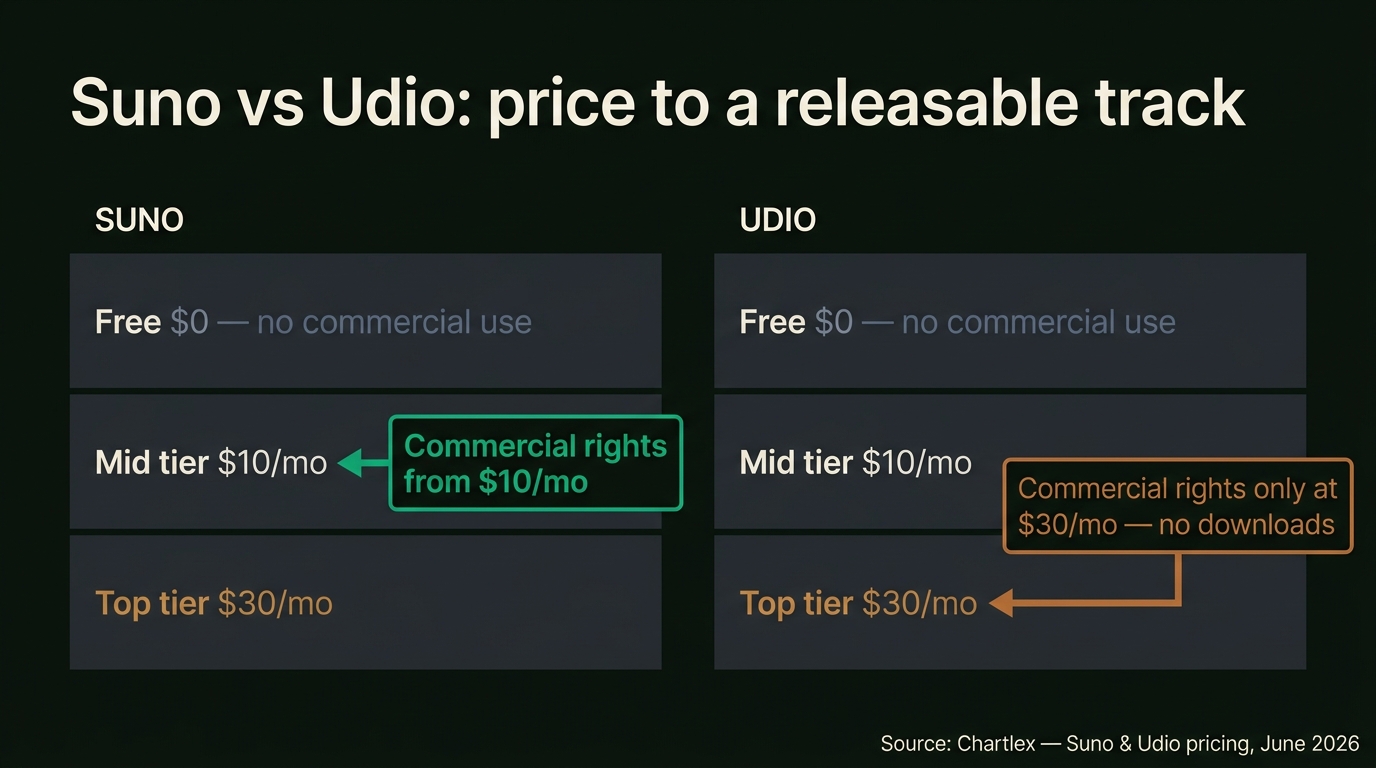
Both platforms use a credits-per-month model with a free tier that blocks commercial use. The headline prices are nearly identical; the value sits in what each tier includes.
Suno's Free plan gives 50 daily credits (roughly 10 songs/day) with no commercial rights. Pro is $10/month ($8/month billed annually) for about 2,500 credits (~500 songs), commercial rights, Personas, stem split, and audio uploads. Premier is $30/month ($24 annually) for about 10,000 credits (~2,000 songs) and adds Suno Studio, a browser DAW with multitrack editing, stem regeneration, and MIDI export.
Udio's Free plan gives 10 daily credits plus a 100 monthly fallback, capped at three two-minute songs per day. Standard is $10/month for up to 2,400 credits but no commercial use. Pro is $30/month for up to 6,000 credits with commercial rights. Two-minute songs cost about 2 credits each.
Pricing Comparison Table
| Plan | Suno | Udio |
|---|---|---|
| Free | $0 — 50 credits/day, no commercial use | $0 — 10 credits/day, no commercial use |
| Mid tier | Pro $10/mo (~2,500 credits, commercial OK) | Standard $10/mo (~2,400 credits, no commercial) |
| Top tier | Premier $30/mo (~10,000 credits + Studio DAW) | Pro $30/mo (~6,000 credits, commercial OK) |
| Annual discount | Pro $8/mo · Premier $24/mo | Varies |
| Commercial rights from | $10/mo (Pro) | $30/mo (Pro) |
First Push
Never put money behind a track before? First Push is the smallest way to find out how one song responds over about four weeks, and it counts toward anything bigger later.
- ✓About 600 new monthly listeners on one track
- ✓Paced over roughly four weeks, not a single burst
- ✓100% credits toward a bigger campaign within 30 days
- ✓The lowest cost way to try one track
Pick your track here. Credit applies if you upgrade within 30 days.
The practical gap: Suno grants commercial rights at $10/month, while Udio reserves them for its $30/month Pro tier. On price-to-commercial-use alone, Suno is the cheaper path to a usable track — but "usable" is exactly where the licensing terms complicate Udio.
The Licensing and Ownership Reality
This is the section every other 2026 comparison gets wrong or skips. Audio quality is a tie-breaker; ownership is the whole game.
Udio settled its copyright case with Universal Music Group in October 2025. As part of the partnership changes, Udio disabled downloading of audio, video, and stems — it is now a streaming-only walled garden where you can play your creations on the platform but cannot export or distribute them (Billboard, RouteNote, Udio Help Center). Udio gave users a 48-hour window to download existing songs under the old terms; anything made or kept after that lives inside the platform. A fully licensed version with downloads re-enabled is expected to launch later in 2026, but as of June 2026 it has not shipped.
Suno took the opposite path on usability. It settled with Warner Music Group in November 2025 (acquiring Warner's Songkick ticketing platform in the process) but kept downloads and commercial rights intact for paid users. The catch is legal exposure: Sony Music refused to settle, and the Suno case heads to a July 2026 summary-judgment hearing after audio fingerprinting surfaced millions of copyrighted recordings in its training data (Billboard, Music Business Worldwide, TechTimes). A ruling against Suno could establish AI-training liability industry-wide. We track this live in our AI music lawsuits tracker, and the structural mechanics of the Udio model are broken down in the Udio-UMG walled garden explainer.
Ownership and Rights Table
| Rights factor | Suno | Udio |
|---|---|---|
| Can you download files? | Yes (paid tiers) | No — disabled after UMG deal |
| Can you release on Spotify? | Yes, with Pro/Premier | No, while walled-garden rules apply |
| Commercial use | Pro $10/mo and up | Pro $30/mo (but no export) |
| Major-label settlement | Warner (Nov 2025) | UMG (Oct 2025) + Warner, Merlin, Kobalt |
| Outstanding litigation | Sony — July 2026 hearing | Settled with majors |
| Net for indie artists | Releasable, legally uncertain | Legally cleaner, not releasable |
The takeaway is blunt: in mid-2026, Udio is the platform with the cleaner licensing story but no way to get your song off the platform, and Suno is the platform you can actually release from while a Sony verdict looms. If you want to read more about training-data and cloning risk before you commit, protecting your music from AI cloning covers the defensive side.
Which One Should You Use?
Match the tool to the job, not the hype. There is no single winner in 2026 — there are clear use-case winners.
Choose Suno if you need a finished, vocal-led song you can download and release, you want commercial rights at the lowest price, and you are comfortable that the Sony case introduces some legal uncertainty. Choose Udio if you are experimenting, prototyping ideas, or generating reference instrumentals you do not need to export — and you value the cleaner major-label licensing posture over the ability to distribute.
For most independent artists building a real catalog, the honest answer is that both are scratchpads, not release engines. Use them for demos, topline ideas, or background beds — then re-record with real performances. The reason is in the data: fully AI-generated tracks consistently lose on the exact retention signals Spotify uses to push a song into Discover Weekly and Release Radar. We unpack that mechanism in why music quality alone won't get you discovered, and the human-vs-AI co-writing middle ground in AI songwriting co-pilots.
Before you spend a cent on promotion for any track — AI-assisted or not — run it through a free Spotify profile audit from Chartlex to see whether your save and completion rates can actually carry a campaign. If your numbers check out, you can compare Chartlex promotion plans or read how our Spotify promotion approach drives streams through targeted campaigns.
How AI Tracks Actually Perform on Spotify
Generating a song is now the cheap part. The expensive part is getting anyone to finish listening to it.
According to Chartlex campaign data from 2,400+ campaigns, AI-generated tracks now appear in roughly 18% of the indie catalogs we audit, but they underperform human-recorded releases by 25 to 40% on save rate and 15 to 25% on completion rate at matched promotion budgets. Those are the two signals most tightly correlated with algorithmic playlist placement.
The platforms see it too. Apple Music's Oliver Schusser disclosed that over a third of new uploads are fully AI-generated yet account for under 0.5% of listening time (TechRadar, Apple Newsroom). Deezer reports nearly half of its submissions are now AI (Deezer), and Spotify has removed millions of AI tracks under its artificial-streams enforcement (Spotify Newsroom). Volume is not the same as traction.
If you want to model the revenue side before deciding whether an AI track is worth releasing at all, plug projected streams into the Spotify royalty calculator — at $0.003 to $0.005 per stream, the math is sobering for low-retention uploads. Producers exploring AI tooling more broadly can also compare distribution options in our distribution comparison tool.
Frequently Asked Questions
Free Spotify Audit
See exactly where your Spotify profile is leaking growth.
Most artists leave 3–5 editorial playlist slots on the table — find out if you're one of them.
Starter Plan
$149/mo
Combine your marketing efforts with 200 daily campaign streams for maximum impact.
Verified in Spotify for Artists · Geo-targeted · Cancel anytime
Is Suno or Udio better in 2026?
It depends on the job. Suno (v5/v5.5) wins for natural vocals and finished vocal-led songs you can download and release commercially from $10/month. Udio wins for studio-grade 48kHz instrumentals, but after its UMG deal it disabled downloads, so you cannot export or release Udio tracks as of June 2026.
Can you legally sell music made with Suno or Udio?
Suno grants commercial rights on its Pro plan ($10/month) and up, and you can download and distribute those files. Udio's Pro plan ($30/month) grants commercial rights too, but the platform disabled all downloads after the UMG settlement, so you currently cannot export Udio songs to sell or stream them elsewhere.
Why did Udio disable downloads?
Udio settled its copyright lawsuit with Universal Music Group in October 2025 and amended its terms to remove audio, video, and stem downloads. The "walled garden" keeps AI songs on-platform to avoid cannibalizing label artists' real catalogs. A fully licensed version with downloads re-enabled is expected later in 2026 (Billboard, RouteNote).
Is Suno still being sued?
Yes. Suno settled with Warner Music in November 2025 but Sony Music refused to settle. The case heads to a July 2026 summary-judgment hearing after audio fingerprinting revealed millions of copyrighted recordings in Suno's training data. A ruling could set AI-training liability precedent for the whole industry (Billboard, Music Business Worldwide).
Do AI-generated songs perform well on Spotify?
Generally no. According to Chartlex campaign data from 2,400+ campaigns, fully AI-generated tracks save at rates 25 to 40% lower and complete 15 to 25% less often than human recordings. Those retention signals drive algorithmic placement, which is why AI uploads account for a tiny share of total listening time across major platforms.
Which is cheaper, Suno or Udio?
Both start free without commercial rights, and both top tiers are $30/month. The difference is commercial access: Suno grants commercial rights and downloads at $10/month (Pro), while Udio reserves commercial rights for its $30/month Pro plan — and even then you cannot download the files. On cost-to-releasable-track, Suno is the cheaper route.
The Bottom Line
In 2026 the Suno vs Udio decision is no longer about which one sounds better — it is about which one you can actually use. Suno gives you releasable, downloadable, commercially licensed tracks at the lowest price, with a Sony verdict still pending. Udio gives you a cleaner licensing story and superb instrumentals trapped inside a walled garden you cannot export from.
For experimentation, pick whichever matches your output style. For building a streaming catalog that the algorithm will actually push, treat both as demo tools and put real performances on top. When you have a track worth backing, start with a free Chartlex audit to confirm it can hold an audience before you spend on promotion.
Free Weekly Playbook
One actionable insight, every Tuesday.
Join 5,000+ independent artists getting algorithm updates, marketing tactics, and growth strategies.
No spam. Unsubscribe anytime.
Discover the exact campaigns that will convert your fans.
Most artists guess at what works. Audit users know.
Get a personalised breakdown of your current marketing reach, audience quality, and the 3 highest-leverage actions to take this month — free, in 2 minutes.
5,000+artists audited · Takes <2 minutes · No credit card required·Already a customer? Open Dashboard →
Campaign Dashboard
Turn Knowledge Into Action
Track your streams, monitor algorithmic triggers, and see growth projections in real time. The Campaign Dashboard puts everything you just read into practice.
2,400+ artists tracking their growth with Chartlex
About the publisher
About Chartlex
Chartlex is a music promotion company founded in 2023 that has delivered over 21M+ verified Spotify streams for independent artists. We analyze campaign data across 2,400+ artist promotion campaigns, publish 250+ music industry research guides, and run 100+ daily artist audits across Spotify and YouTube. Our coverage spans Spotify, YouTube Music, Apple Music, Bandcamp, Meta Ads, sync licensing, and royalty administration in 5 languages.
- Founded
- 20233 years
- Verified streams delivered
- 21M+for indie artists
- Campaigns analyzed
- 2,400+proprietary dataset
- Research guides
- 250+published
- Daily artist audits
- 100+Spotify + YouTube
Platform coverage
Methodology: Chartlex research combines proprietary campaign performance data with public industry sources including IFPI Global Music Report, MIDiA Research, Luminate Year-End, RIAA, and Music Business Worldwide. All findings are refreshed quarterly. Last verified: 2026-09-17.
Keep reading
AI music generator comparison for 2026: Suno, Udio, Stable Audio, ElevenLabs Music, and AIVA pricing, audio quality, and copyright status reviewed.
Lena Kova
Real ROI breakdowns of Spotify Ads at $100-$1,000 budgets. Cost-per-stream data, pros, cons, and how ads compare to playlist promotion for indie artists.
Lena Kova
Promote electro music tracks in 2026 across Beatport, SoundCloud, Bandcamp and Spotify, with channel-by-channel effort, payoff and verified platform data.
Lena Kova